
Life, 1907-04-04 · page 44 of 48
Life — April 4, 1907 — page 44: what you’re looking at
What you’re looking at
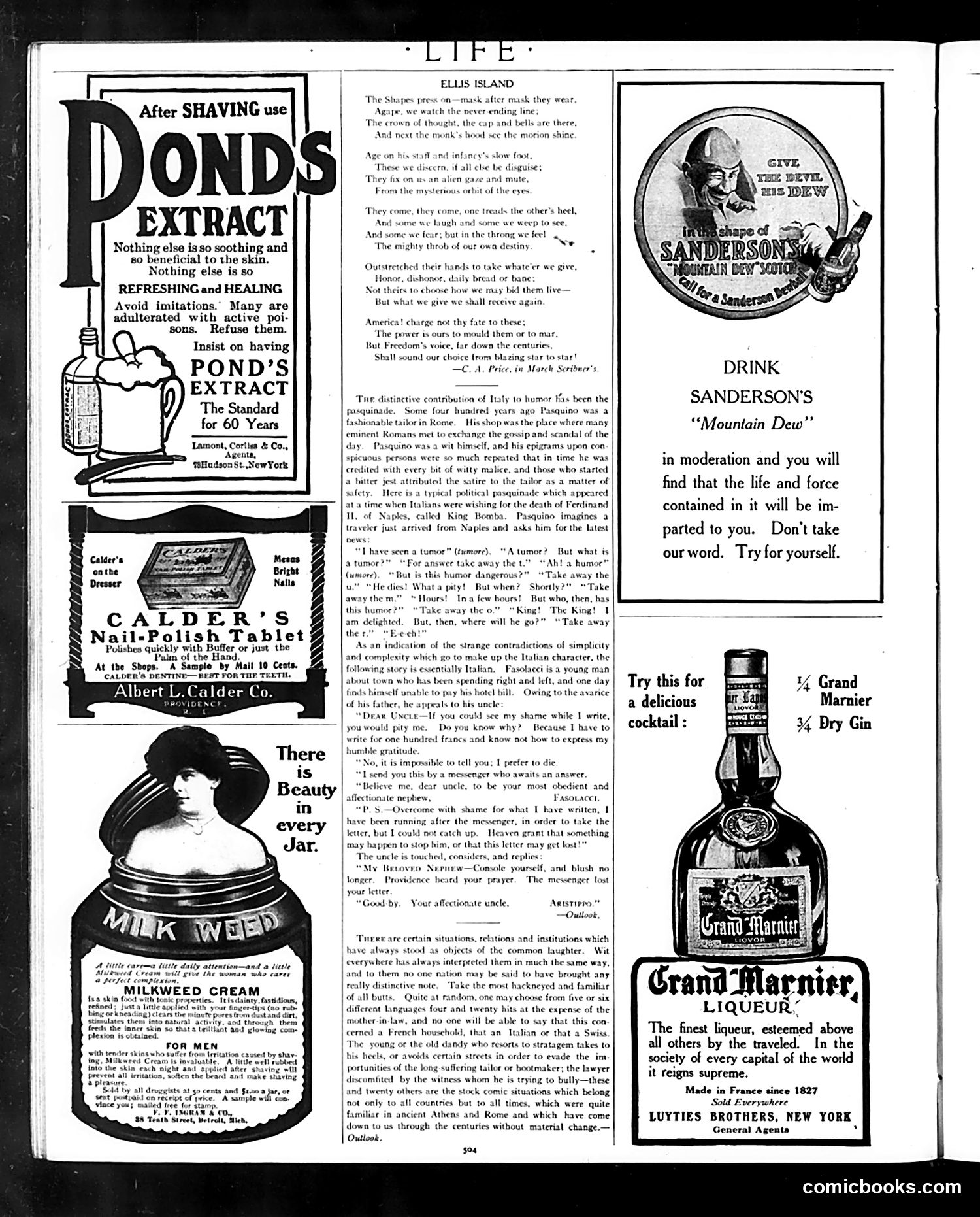
This page is primarily **advertising** with two notable editorial pieces: **"Ellis Island" Poem:** A patriotic verse addressing Italian immigration to America. The poem warns against judging immigrants by appearance ("mask after mask") and frames their arrival as a test of American values and freedom. It references the responsibility to treat newcomers fairly, ending with an appeal to national conscience. **Italian Humor Section:** Explains the "pasquinade"—Italian satirical tradition originating with a witty Roman tailor. The example mocks King Ferdinand II of Naples (called "King Bomba"), using wordplay where removing letters from "tumore" (tumor) reveals it's actually the king himself—a coded political critique suggesting the monarch is a disease on the state. **Context:** Both pieces reflect early 20th-century American concerns: immigrant assimilation and European political satire. The advertisements (Pond's Extract, Milkweed Cream) occupy the remaining space, typical of *Life* magazine's mixed editorial-commercial format.
📄 Transcribed text from this page (OCR, searchable)
Machine-transcribed from the original scan — historical spelling and the odd misread are preserved.
EXTRACT Nothing else isso soothing and so beneficial to the skin. Nothing else is so "RESHING and HEALING Avoid imitations. Many are adulterated with active poi- sons. Refuse them. Insist on having POND’S EXTRACT The Standard for 60 Years Lamont, Corltea & Co. ‘Agents, teHadsonSt..NewYork Done Mesos Bright Nails Nail-Polish Tablet Polishes quickly with Buffer or just t! anes aval of the Hand At the Shops. A Sample by it 10 Cents. CALDER'S DENTINE— BEST FOR THY. TEETH. Albert L.Calder Co. A little carema little daily attention—and a tittle Aistweed Cream will give the woman wd Care 8 perfect Complexion MILKWEED CREAM {sa shia food wi r Flexion is otealaed. FOR MEN suifer from fevitation ‘aight and applied afer shaving will ritation, soften the beard and make shaving sists at 59 ceots and $1.20 a Jar, of eigt of fee. A saijie wil con. Mlace yous tailed tree for seam. ¥.¥-1SGRAN © CO, 35 Tenth Street, Beirelt, Hed, ELLIS ISLAND The press on mask after mask they wear Agape, we watch the never-ending line; The crown of thought, the cap and bells And next th They fix on us an alien save and mute From the my < orbit of the eyes They come, they came, one tre c other's heel, And some we laugh and some we weep to see, And some we fear; but in the throng we feel The mighty the out own destiny ve Outstretched their hands to take w Honor, disho y bread of Not theis to choose how we may bid them live— But what we give we shall receive again. America! charge not thy fate to these; The power is ours to mould them of to mar. But Freedom's voice, far down the centuries, Shall sound our choice from blazing star to star! <C. A, Price, in March Scribner's Tur. distinctive contribution of Italy to humor ifas been the pasquinade. Some four hundred ycars ago Pasquino was a fashionable tailor in Rome. His shop was the place where many eminent Romans met to exchange the gossip and scandal of the day. Pasquino was a wit himself, and his epigrams upon con: | spicuous persons were so much repeated that in time he was | credited with every bit of witty malice, and those who started 2 hitter jest attributed the satire to the tailor asa matter of safety. Here is a typical political pasquinade which appeared | ata time when Italians were wishing for the death of Ferdinand Il, of Naples, called King Bomba. Pasquino imagines a traveler just arrived from Naples and asks him for the latest news have seen a tumor” (temore). “A tumor? But what is atumor?" “For answer take away the “Ab! a humor” | | (umore). “But humor dangerous?" “Take awa u.” “He dies! What a pity! But when? Shortly?" away them." “Hours! Ina few hours! But who, then, has this humor?" ke away the 0." “King! The King! 1 am delighted. But, then, where will he go?” “Take away the & peeh!” As an indication of the strange contradictions of simplicity and complexity which go to make up the Italian character, the following story is ewentially Italian. Fasolacci is a young man about town who has been spending right and left, and one day finds himself unable to pay his hotel bill. Owing to the avarice of his father, he appeals to his uncle “Dear Uncie—If you could sce my shame while I write, you would pity me. Do you know why? Because I have to write for one hundred francs and know not how to express my humble gratitude. “No, it is impmssible to tell yous I prefer to die send you this by a mesenger who awaits an answer, “Believe me, dear uncle, to be your most obedient and affectionate nephew, Fasotacet. “P.S.—Overcome with shame for what I have written, I have been running after the mesenger, in order to take the etter, but T could not Heaven grant that something may happen to stop hat this letter may get lost!" ‘The uncle i considers, and replies “My Betoven Nuriew—Console yourself, and blush no longer. Providence heard your prayer. The mesenger lost your letter “Goul:by. Your affectionate uncle, Aeistiero."* ‘Outlook, ‘Tuer are certain situations, relations and institutions which have always stood as objects of the common laughter. Wit everywhere has always interpreted them in much the same way, and to them no one nation may be said to have brought any ally distinctive note, “Take the most hackneyed and familiar of all butts, Quite at random, one may choose from five or six different languages four and twenty hits at the expense of the mother-in-law, and no one will be able to say that this con: ceed a French household, that an Italian of that a Swiss. The young dandy who reworts to stratagem takes to his heels, or avoids certain streets in order to evade the im. portunities of the long-suffering tailor or bootmaker; the lawyer discomfited by the witness whom he is trying to bully—these and twenty others are the stock comic situations which belong not only to all countries but to all times, which were quite familiar in ancient Athens and Rome and which have come down to us through the centuries without material change— Outlook. soa DRINK SANDERSON'S “Mountain Dew” in moderation and you will find that the life and force contained in it will be im- parted to you. Don't take our word. Try for yourself. Try this for a delicious cocktail : + Marnier, LIQUEUR, The finest liqueur, esteemed above all others by the traveled. In the society of every capital of the world it reigns supreme. Made in France since 1827 Sold Everywhere LUYTIES BROTHERS, NEW YORE General Agents comicbooks.com