
Life, 1907-04-04 · page 35 of 48
Life — April 4, 1907 — page 35: what you’re looking at
What you’re looking at
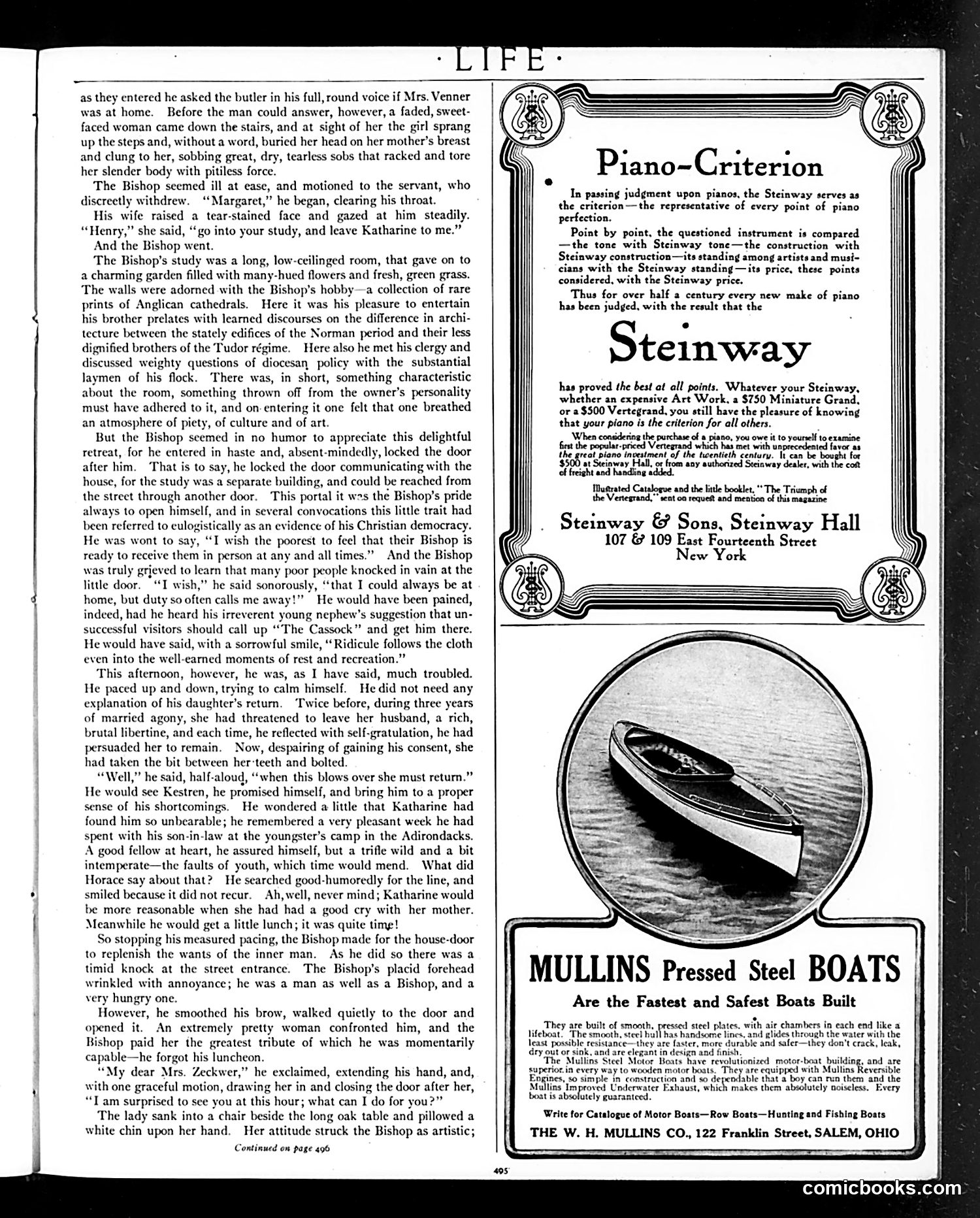
This page is primarily **literary fiction**, not political satire or cartoon content. It presents a serialized story (continued from page 496) depicting a domestic drama within an Anglican bishop's family. The narrative describes a bishop's distressed response to his daughter Katharine's return home after leaving her abusive, philandering husband. The story critiques the bishop's hypocrisy: he publicly preaches Christian virtue and claims accessibility to the poor through his study's open door, yet privately prioritizes "duty" and social propriety over his daughter's suffering. The satire targets **institutional religion**—particularly the gap between clergy's public piety and private priorities. The bishop's focus on his cathedral print collection and theological discussions contrasts sharply with his indifference to his own family's crisis. The page also contains **period advertisements** for Steinway pianos and Mullins steel boats, unrelated to the story.
📄 Transcribed text from this page (OCR, searchable)
Machine-transcribed from the original scan — historical spelling and the odd misread are preserved.
4 as they entered he asked the butler in his full, round voice if Mrs. Venner was at home. Before the man could answer, however, a faded, sweet- faced woman came down the stairs, and at sight of her the girl sprang up the steps and, without a word, buried her head on her mother’s breast and clung to her, sobbing great, dry, tearless sobs that racked and tore her slender body with pitiless force. The Bishop seemed ill at ease, and motioned to the servant, who discreetly withdrew. ‘‘Margaret,” he began, clearing his throat. His wife raised a tear-stained face and gazed at him steadily. “Henry,” she said, “go into your study, and leave Katharine to me.” And the Bishop went. The Bishop's study was a long, low-ceilinged room, that gave on to a charming garden filled with many-hued flowers and fresh, green grass. The walls were adorned with the Bishop's hobby—a collection of rare prints of Anglican cathedrals. Here it was his pleasure to entertain his brother prelates with learned discourses on the difference in archi- tecture between the stately edifices of the Norman period and their less dignified brothers of the Tudor régime. Here also he met his clergy and discussed weighty questions of diocesan, policy with the substantial laymen of his flock. There was, in short, something characteristic about the room, something thrown off from the owner’s personality must have adhered to it, and on-entering it one felt that one breathed an atmosphere of piety, of culture and of art. But the Bishop seemed in no humor to appreciate this delightful retreat, for he entered in haste and, absent-mindedly, locked the door after him. ‘That is to say, he locked the door communicating with the house, for the study was a separate building, and could be reached from the street through another door. This portal it wes the Bishop’s pride always to open himself, and in several convocations this little trait had been referred to eulogistically as an evidence of his Christian democracy. He was wont to say, “I wish the poorest to feel that their Bishop is ready to receive them in person at any and all times.” And the Bishop was truly grjeved to learn that many poor people knocked in vain at the little door. “I wish,” he said sonorously, “that I could always be at home, but duty so often calls me away!” He would have been pained, indeed, had he heard his irreverent young nephew's suggestion that un- successful visitors should call up “The Cassock” and get him there. He would have said, with a sorrowful smile, “Ridicule follows the cloth even into the well-earned moments of rest and recreation.” This afternoon, however, he was, as I have said, much troubled. He paced up and down, trying to calm himself. He did not need any explanation of his daughter’s retum. ‘Twice before, during three years of married agony, she had threatened to leave her husband, a rich, brutal libertine, and each time, he reflected with self-gratulation, he had persuaded her to remain. Now, despairing of gaining his consent, she had taken the bit between her-teeth and bolted. “Well,” he said, half-aloud, “when this blows over she must return.” He would see Kestren, he promised himself, and bring him to a proper sense of shortcomings. He wondered a little that Katharine had found him so unbearable; he remembered a very pleasant week he had spent with his son-in-law at the youngster’s camp in the Adirondacks. A good fellow at heart, he assured himself, but a trifle wild and a bit intemperate—the faults of youth, which time would mend. What did Horace say about that? He searched good-humoredly for the line, and smiled because it did not recur. Ah, well, never mind; Katharine would be more reasonable when she had had a good cry with her mother. Meanwhile he would get a little lunch; it was quite timg! So stopping his measured pacing, the Bishop made for the house-door to replenish the wants of the inner man. As he did so there was a timid knock at the street entrance. The Bishop's placid forehead wrinkled with annoyance; he was a man as well as a Bishop, and a very hungry one. However, he smoothed his brow, walked quietly to the door and opened it. An extremely pretty woman confronted him, and the Bishop paid her the greatest tribute of which he was momentarily capable—he forgot his luncheon. “My dear Mrs. Zeckwer,” he exclaimed, extending his hand, and, with one graceful motion, drawing her in and closing the door after her, “Tam surprised to see you at this hour; what can I do for you?” ‘The lady sank into a chair beside the long oak table and pillowed a white chin upon her hand. Her attitude struck the Bishop as artistic; Continued on page 496 Piano~Criterion In passing judgment upon pianos, the Steinway serves as the criterion—the representative of every point of piano perfection. Point by point, the questioned instrument is compared —the tone with Steinway tone—the construction with Steinway construction—its standing among artists and musi- cians with the Steinway standing—its price, these points considered, with the Steinway price. Thus for over half a century every new make of piano has been judged, with the result that the Steinway has proved the best at all points. Whatever your Steinway, i whether an expensive Art Work, a $750 Miniature Grand. or a $500 Vertegrand, you still have the pleasure of knowing that your piano is the criterion for all others. ‘When considering the purchase of « piano, gl aictanins fa the coouer satel Votreaed SAE hes oa woh eee ee the great lone intent af the teenth entry. lan be bout et 200 st Seiaway Ela. om aay 0 red Steinway dealer, with t Rogrted tied Catslonve and the little booklet, "The Triumph of ‘sent oo requett and mention of this magazine Steinway & Sons, Steinway Hall 107 & 109 East Fourteenth Street New MULLINS Pressed Steel BOATS Are the Fastest and Safest Boats Built ced) steel plates, with air chambers in each end like a handsome lines, and glides through the water with the y are faster, more durable and safer—they don’t crack, leak, They are built of smooth, lifeboat. The smooth, steel b least possible resistance: Steel Motor Boats have rev every way to wooden motor boats. simple in construction and so depend ized motor-boat building, and are e equipped with Mullins Reversible Je that a boy can run them and the Mullins Improved Underwater Exhaust, which makes them absolutely noiseless. Every boat is absolutely guaranteed. ‘Write for Catalogue of Motor Boats—Row Boats—Hunting and Fishing Boats THE W. H. MULLINS CO., 122 Franklin Street, SALEM, OHIO comicbooks.com