
Life, 1907-04-04 · page 16 of 48
Life — April 4, 1907 — page 16: what you’re looking at
What you’re looking at
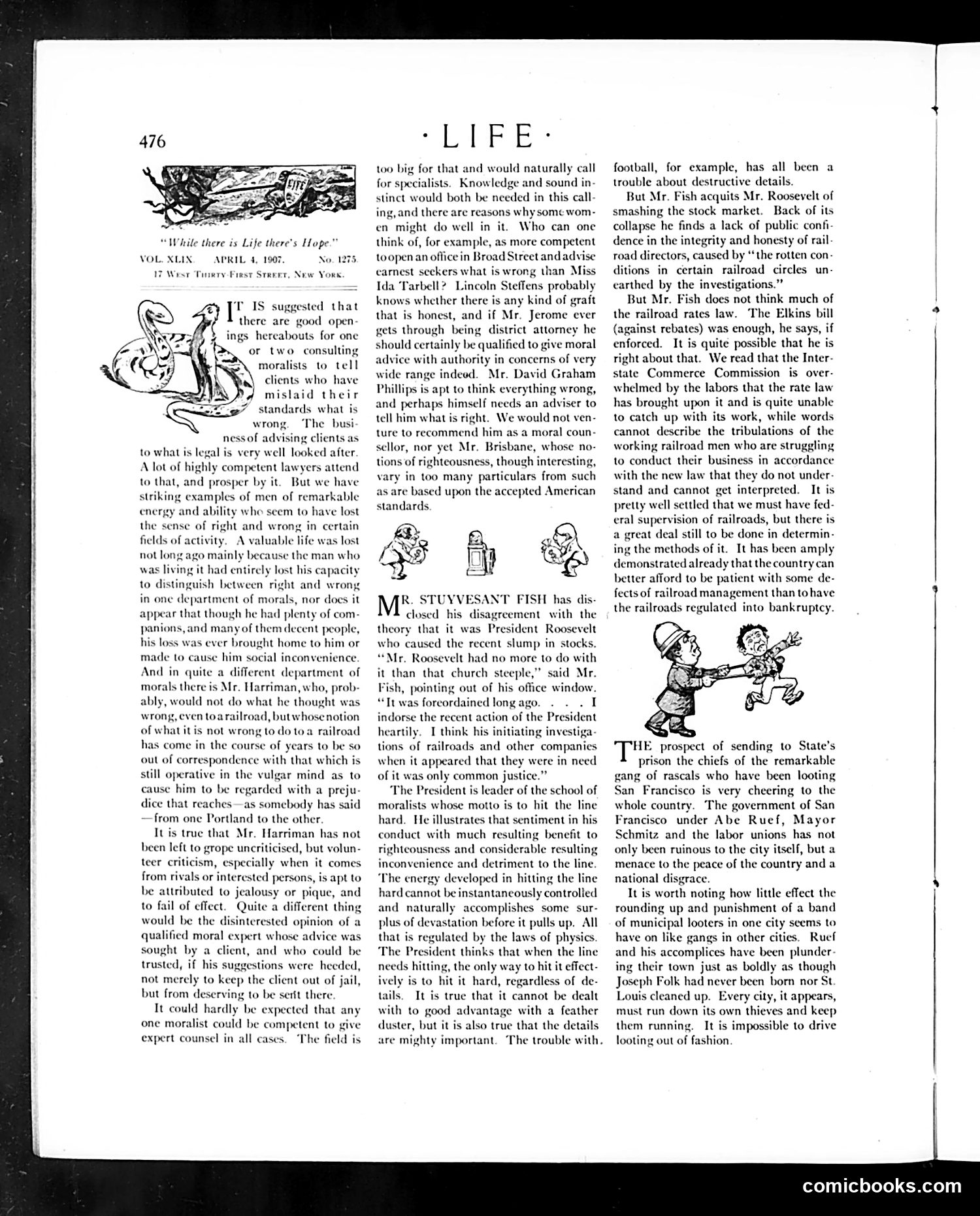
This page satirizes the moral failings of wealthy businessmen, particularly railroad magnates like **E.H. Harriman** (referenced in the text). The article proposes tongue-in-cheek that America needs specialized "moral consultants"—experts who could advise clients on ethical conduct. The satire names figures like **Ida Tarbell** (muckraking journalist who exposed Standard Oil), **Lincoln Steffens** (corruption investigator), and **David Graham Phillips** as hypothetically qualified moral advisors, contrasting them with amoral railroad executives. **Stuyvesant Fish** (railroad executive) is quoted defending President **Theodore Roosevelt's** stock-market criticism and recent railroad investigations as justified moral action. The cartoon ridicules how wealthy industrialists have lost moral compass while remaining legally untouched—they need not just lawyers, but moral guidance. It reflects Progressive Era outrage at corporate malfeasance and corruption among the Gilded Age elite.
📄 Transcribed text from this page (OCR, searchable)
Machine-transcribed from the original scan — historical spelling and the odd misread are preserved.
“While there is Life there's Hope VOL, XLIN. APRIL 4, 19 No.1 17 West Tinery Frest Steerer, New Yors € I IS suggested that there are good open or two consulting moralists to tell clients who have aid their standards what is wrong. The busi nessof advising clients as to what is legal is very well looked after A lot of highly competent lawyers attend to that, and prosper by it. But we have striking examples of men of remarkable energy and ability whe seem to have lost the sense of right and wrong in certain fields of activity. A valuable life w notlong 1s lost ro mainly because the man who was living it had entirely lost his capacity to distinguish between right and wrong in one department of morals, nor does it appear that though he had plenty of com- panions, and many of them decent people, his loss was ever brought home to him or made to cause him social inconvenience. And in quite a different department of morals there is Mr. Harriman, who, prob- ably, would not do what he thought was wrong, even toarailroad, butwhose notion of what itis not wrong to do toa railroad has come in the course of years to be so out of correspondence with that which is still operative in the vulgar mind as to cause him to be regarded with a preju- dice that reaches —as somebody has said —from one Portland to the other. It is true that Mr. Harriman has not been left to grope uncriticised, but volun- teer criticism, especially when it comes from rivals or interested persons, is apt to be attributed to jealousy or pique, and to fail of effect. Quite a different thing would be the disinterested opinion of a qualified moral expert whos sought by a client, and who could be trusted, if his suggestions were heeded, not merely to keep the client out of jail, but from deserving to be serit there. It could hardly be expected that any one moralist could be competent to give expert counsel in all cases. The field is ‘LIFE « too big for that and would naturally call for specialists. Knowledge and sound in- stinct would both be needed in this call ing, and there are reasons why some wom- en might do well in it. Who can one think of, for example, as more competent toopen an office in Broad Street and advise carnest seekers what is wrong than Miss Ida Tarbell? Lincoln Steffens probably knows whether there is any kind of graft that is honest, and if Mr. Jerome ever gets through being district attorney he should certainly be qualified to give moral advice with authority in concerns of very wide range indeed. Mr. David Graham Phillips is apt to think everything wrong, and perhaps himself needs an adviser to tell him what is right. We would not ven- ture to recommend him as a moral coun- sellor, nor yet Mr. Brisbane, whose no- tions of righteousness, though interesting, vary in too many particulars from such ed upon the accepted American By &\ IS a at Qe fy &e R. STUYVESANT FISH has dis- closed his disagreement with the theory that it was President Roosevelt who caused the recent slump in stot “Mr. Roosevelt had no more to do with it than that church steeple,” said Mr. Fish, pointing out of his office window. “Tt was foreordained longago. . . . I indorse the recent action of the President heartily, I think his initiating investig: tions of railroads and other companies when it appeared that they were in need of it was only common justice.” ‘The President is leader of the school of moralists whose motto is to hit the line hard. He illustrates that sentiment in his conduct with much resulting benefit to rightcousness and considerable resulting inconvenience and detriment to the line. ‘The cnergy developed in hitting the line hard cannot be instantaneously controlled and naturally accomplishes some sur- plus of devastation before it pulls up. All that is regulated by the laws of physics. The President thinks that when the line needs hitting, the only way to hit it effect- ively is to hit it hard, regardless of de- tails, It is true that it cannot be dealt with to good advantage with a feather duster, but it is also true that the details are mighty important. The trouble with. as are bas standards. football, for example, has all been a trouble about destructive details. But Mr. Fish acquits Mr. Roosevelt of smashing the stock market. Back of its collapse he finds a lack of public confi dence in the integrity and honesty of rail- road directors, caused by “the rotten con ditions in certain railroad circles un- carthed by the investigations.” But Mr. Fish does not think much of the railroad rates law. The Elkins bill (against rebates) was enough, he says, if enforced. It is quite possible that he right about that. We read that the Inter. state Commerce Commission is over- whelmed by the labors that the rate law has brought upon it and is quite unable to catch up with its work, while words cannot describe the tribulations of the working railroad men who are struggling to conduct their business in accordance with the new law that they do not under- stand and cannot get interpreted. It is pretty well settled that we must have fed- eral supervision of railroads, but there is a great deal still to be done in determin- ing the methods of it. It has been amply demonstrated already that the country can better afford to be patient with some de- fects of railroad management than to have the railroads regulated into bankruptcy. HE, prospect of sending to State's prison the chiefs of the remarkable gang of rascals who have been looting San Francisco is very cheering to the whole country. The government of San Francisco under Abe Ruef, Mayor Schmitz and the labor unions has not only been ruinous to the city itself, but a menace to the peace of the country and a national disgrace. It is worth noting how little effect the rounding up and punishment of a band of municipal looters in one city seems to have on like gangs in other cities. Ruef and his accomplices have been plunder ing their town just as boldly as though Joseph Folk had never been born nor St Louis cleaned up. Every city, it appears, must run down its own thieves and keep them running. It is impossible to drive looting out of fashion comicbooks.com | | | |