
Life, 1907-04-04 · page 34 of 48
Life — April 4, 1907 — page 34: what you’re looking at
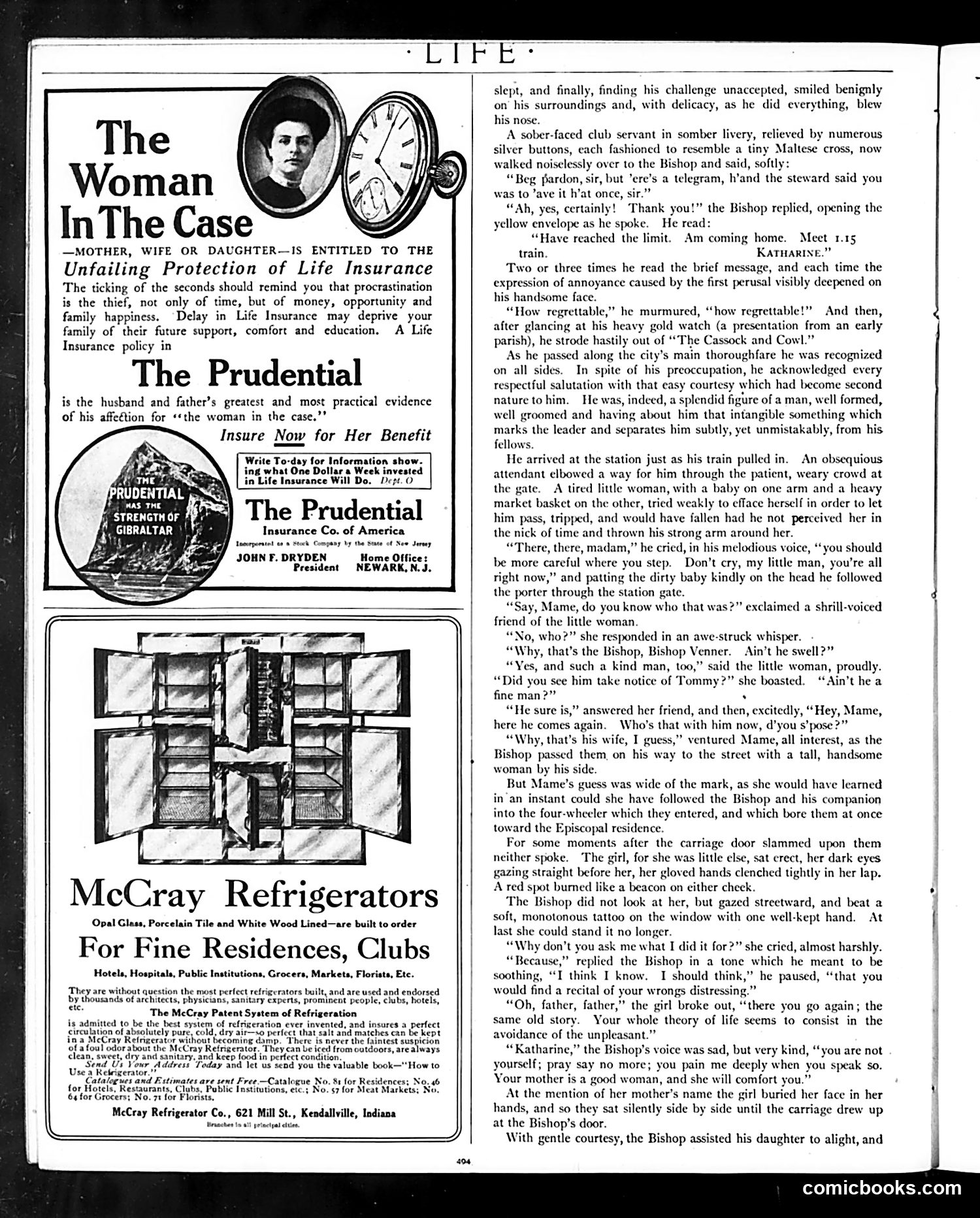
What you’re looking at
This page combines fiction with advertising. The main story (right column) depicts a Bishop receiving a telegram from "Katharine" announcing her arrival home, creating domestic tension. The narrative suggests scandal or impropriety—the Bishop's visible annoyance and the suggestive title ("The Woman in the Case") imply Katharine is either a daughter or someone whose return troubles him. The advertisements are the page's primary content: **The Prudential Insurance** (top) targets male breadwinners, framing life insurance as proof of affection for wives and daughters—a paternalistic appeal to masculine duty. **McCray Refrigerators** (bottom) advertises premium domestic appliances for wealthy households, hotels, and institutions. Together, these elements reflect early 20th-century concerns: economic insecurity (hence insurance), domestic respectability, and the aspirational lifestyle of the affluent middle and upper classes Life's readership inhabited.
📄 Transcribed text from this page (OCR, searchable)
Machine-transcribed from the original scan — historical spelling and the odd misread are preserved.
“LIFE. The Woman In The Case —MOTHER, WIFE OR DAUGHTER—IS ENTITLED TO THE Unfailing Protection of Life Insurance ‘The ticking of the seconds should remind you that procrastination is the thief, not only of time, but of money, opportunity and family happiness, “Delay in Life Insurance may deprive your family of their future support, comfort and education, A Life Insurance policy in The Prudential is the husband and father’s greatest and most practical evidence of his affeétion for «the woman in the case.’” Insure Now for Her Benefit PRUDENTIAL p <<A\ bi a THE mc) STRENGTH OF AP. | , GIBRALTAR i ais i af Incerperstel 09 ea J SOHN F. DRYDEN é President The Prudential Insurance Co. of America A Company Vy the Sate of New Jermey Home Office: NEWARK, McCray Refrigerators Opal Glass, Porcelain Tile and Whi For Fine Residences, Clubs Hotels, Hospitals, Public Institutions, Grocers, Markets, Florists, Ete. They are without question the most perfect refrigerators built, and are used and endorsed by thousands of architects, physicians, sanitary experts, prominent people, clubs, hotels, al The McCray Patent System of Refrigeration is admitted to be the best system of refrigeration ever invented, and insures a perfect circulation of absolutely pure, cold, dry air—so perfect that salt and matches can be kept in a McCray Refrigerator without becoming damp. There is never the faintest suspicion of afoul odor about the McCray Refngerator. They can Le iced from outdoors, are always: clean, sweet, dry and sanitary, and keep food in perfect condition. , Send Us Your Address Today and let us send you the valuable book—"*How to Use a Reteigerator.’? Catalogues and Estimates are sent Fi No. 81 for Residences; No. 46 for Hotels, Restaurants, Clubs, Public Instit . $7 for Meat Markets; No, 64 for Grocers; No. 71 for Florists, McCray Refrigerator Co., 621 Mill St., Kendallville, Indiana raackes tsa priectgal tes, precip J Wood Lined—are built to order 404 slept, and finally, finding his challenge unaccepted, smiled benignly on his surroundings and, with delicacy, as he did everything, blew his nose. A sober-faced club servant in somber livery, relieved by numerous silver buttons, each fashioned to resemble a tiny Maltese cross, now walked noiselessly over to the Bishop and said, softly: “Beg pardon, sir, but ere’s a telegram, h’and the steward said you was to ‘ave it h’at once, sir.” “Ah, yes, certainly! Thank you!” the Bishop replied, opening the yellow envelope as he spoke. He read: “Have reached the limit. Am coming home. Meet 1.15 train. KATHARINE.” Two or three times he read the brief message, and each time the expression of annoyance caused by the first perusal visibly deepened on his handsome face. “How regrettable,” he murmured, “how regrettable!” And then, after glancing at his heavy gold watch (a presentation from an early parish), he strode hastily out of “The Cassock and Cowl.” As he passed along the city’s main thoroughfare he was recognized on all sides. In spite of his preoccupation, he acknowledged every respectful salutation with that easy courtesy which had become second nature tohim. He was, indeed, a splendid figure of a man, well formed, well groomed and having about him that intangible something which marks the leader and separates him subtly, yet unmistakably, from his fellows. He arrived at the station just as his train pulled in. An obsequious attendant elbowed a way for him through the patient, weary crowd at the gate. A tired little woman, with a baby on one arm and a heavy market basket on the other, tried weakly to efface herself in order to let him pass, tripped, and would have fallen had he not perceived her in the nick of time and thrown his strong arm around her. “There, there, madam,” he cried, in his melodious voice, “you should be more careful where you step. Don’t cry, my little man, you're all right now,” and patting the dirty baby kindly on the head he followed the porter through the station gate. “Say, Mame, do you know who that wi friend of the little woman. “No, who?” she responded in an awe-struck whisper. “Why, that’s the Bishop, Bishop Venner. Ain’t he swell?” “Yes, and such a kind man, too,” said the little woman, proudly. “Did you see him take notice of Tommy?” she boasted.“ Ain’t he a fine man?” . “He sure is,” answered her friend, and then, excitedly, “Hey, Mame, here he comes again. Who's that with him now, d’you s'pose ?” “Why, that’s his wife, I guess,” ventured Mame, all interest, as the Bishop passed them, on his way to the street with a tall, handsome woman by his side. But Mame’s guess was wide of the mark, as she would have learned in an instant could she have followed the Bishop and his companion into the four-wheeler which they entered, and which bore them at once toward the Episcopal residence. For some moments after the carriage door slammed upon them neither spoke. The girl, for she was little else, sat crect, her dark eyes. gazing straight before her, her gloved hands clenched tightly in her lap. A red spot burned like a beacon on either check. The Bishop did not look at her, but gazed streetward, and beat a soft, monotonous tattoo on the window with one well-kept hand. At last she could stand it no longer. “Why don’t you ask me what I did it for?” she cried, almost harshly. “Because,” replied the Bishop in a tone which he meant to be soothing, “I think I know. I should think,” he paused, “that you would find a recital of your wrongs distressing.” “Oh, father, father,” the girl broke out, ‘there you go again; the same old story. Your whole theory of life seems to consist in the avoidance of the unpleasant.” “Katharine,” the Bishop's voice was sad, but very kind, ‘you are not yourself; pray say no more; you pain me deeply when you speak so. Your mother is a good woman, and she will comfort you.” At the mention of her mother’s name the girl buried her face in her hands, and so they sat silently side by side until the carriage drew up at the Bishop's door. With gentle courtesy, the Bishop assisted his daughter to alight, and ?” exclaimed a shrill-voiced comicbooks.com ] ] ]