
A complete issue · 52 pages · 1907
Life — February 7, 1907
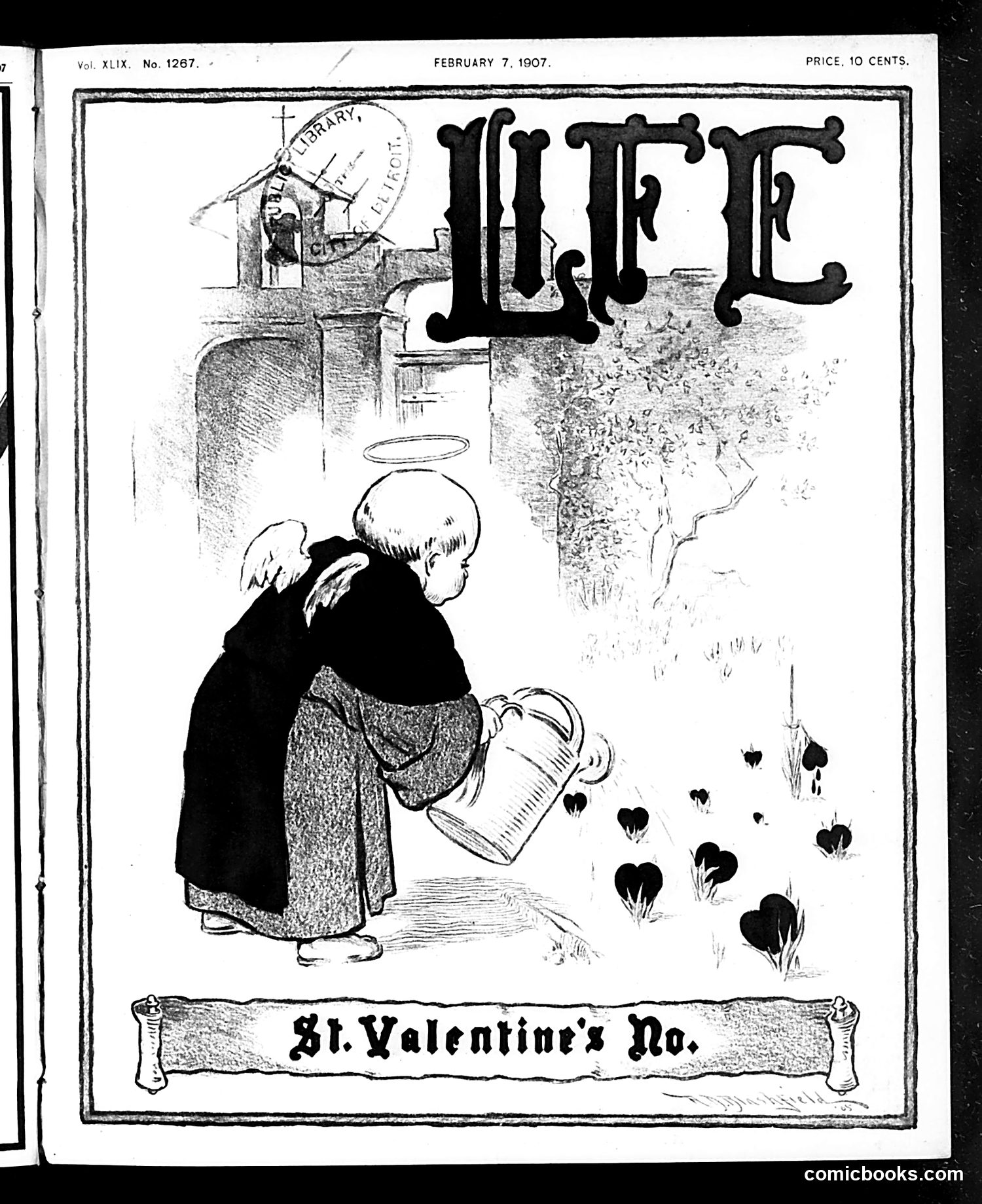
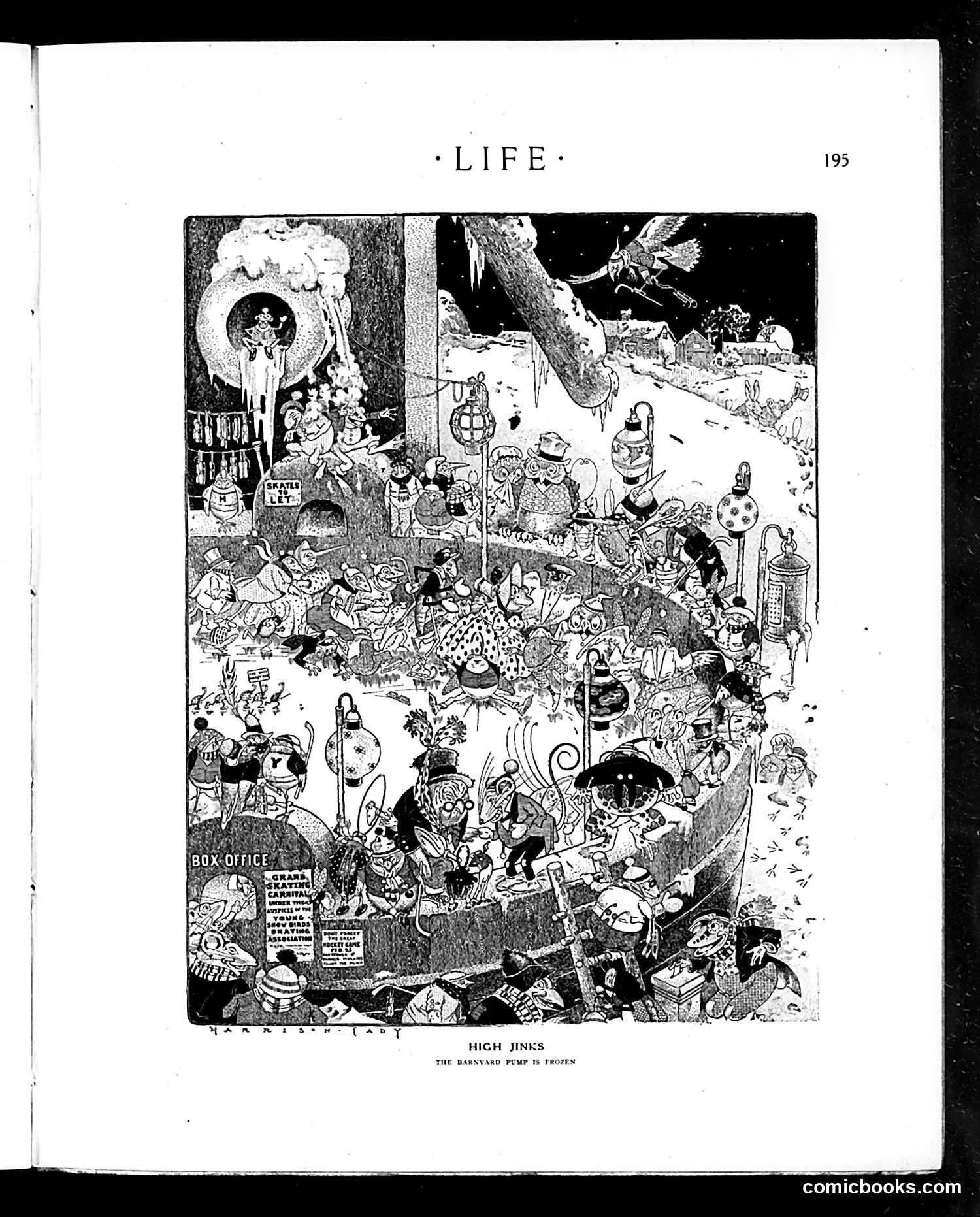
This is a Valentine's Day-themed illustration. An elderly woman (likely representing an older or aging female figure) waters heart-shaped flowers or plants, suggesting the cultivation of romantic love. The halo above her head appears to invoke Saint Valentine himself, the patron saint of love. The tower or structure in the background may reference a church or sacred location. The cartoon plays on the tradition of Valentine's Day gift-giving and romance—here depicted as requiring care and nurturing, like gardening. The "St. Valentine's No." caption indicates this was a special Valentine's-themed issue of the magazine. The satire likely comments on commercialized romance or the artificiality of manufactured sentiment around the holiday.
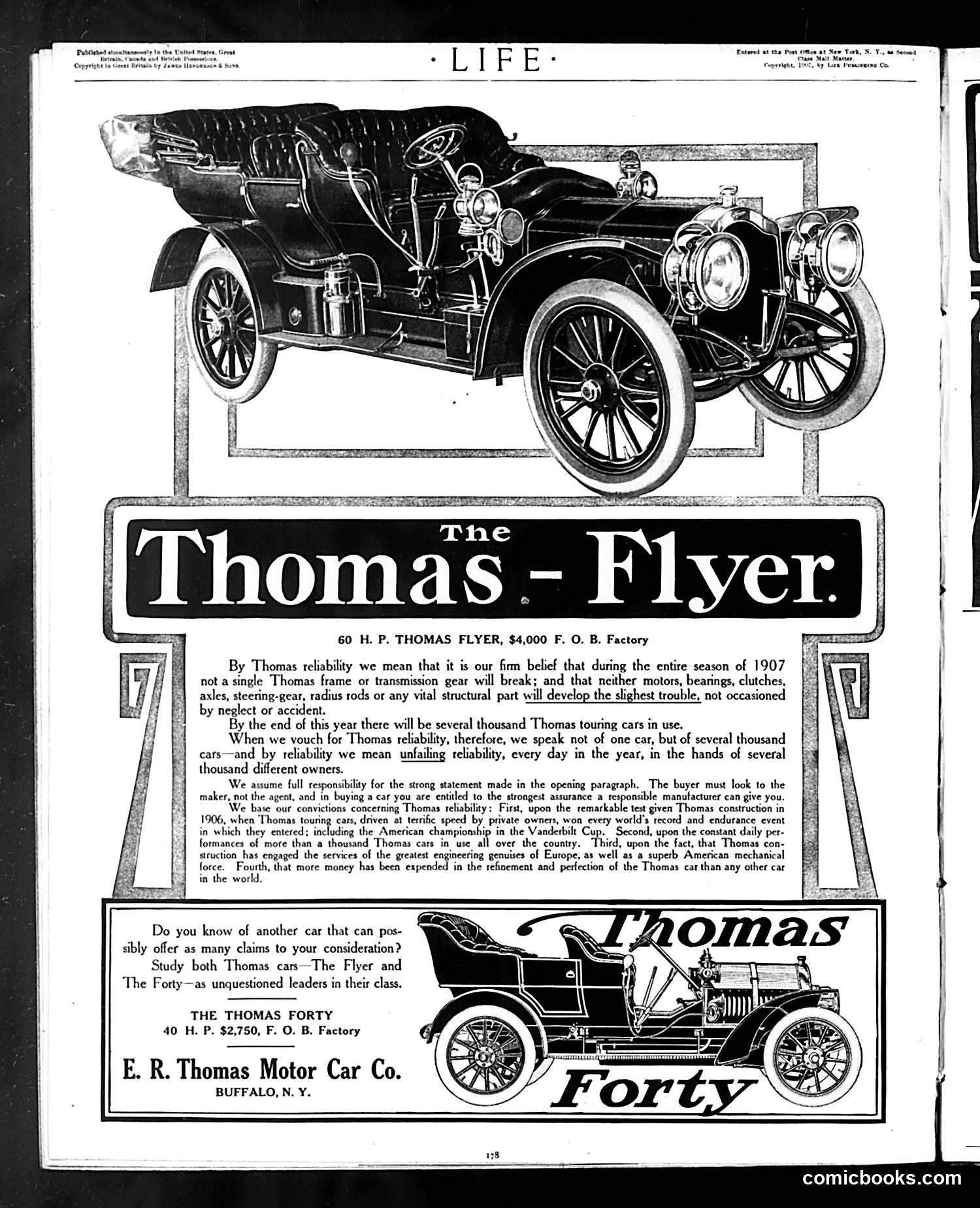
This is primarily **advertising content**, not political satire. The page features two car advertisements from the E.R. Thomas Motor Car Co. of Buffalo, NY, promoting the Thomas-Flyer and Thomas Forty models. The text makes claims about "Thomas reliability," asserting that during 1907, no Thomas component would break. It references the company's racing success, including winning the "Vanderbilt Cup" and an "American championship," plus the "daily performances of more than a thousand Thomas cars in use all over the country." The advertisements position Thomas cars as reliable competitors against the Ford, claiming both vehicles are "unquestioned leaders in their class." This represents early automotive marketing emphasizing durability and proven performance—standard advertising rhetoric rather than editorial commentary or satire.
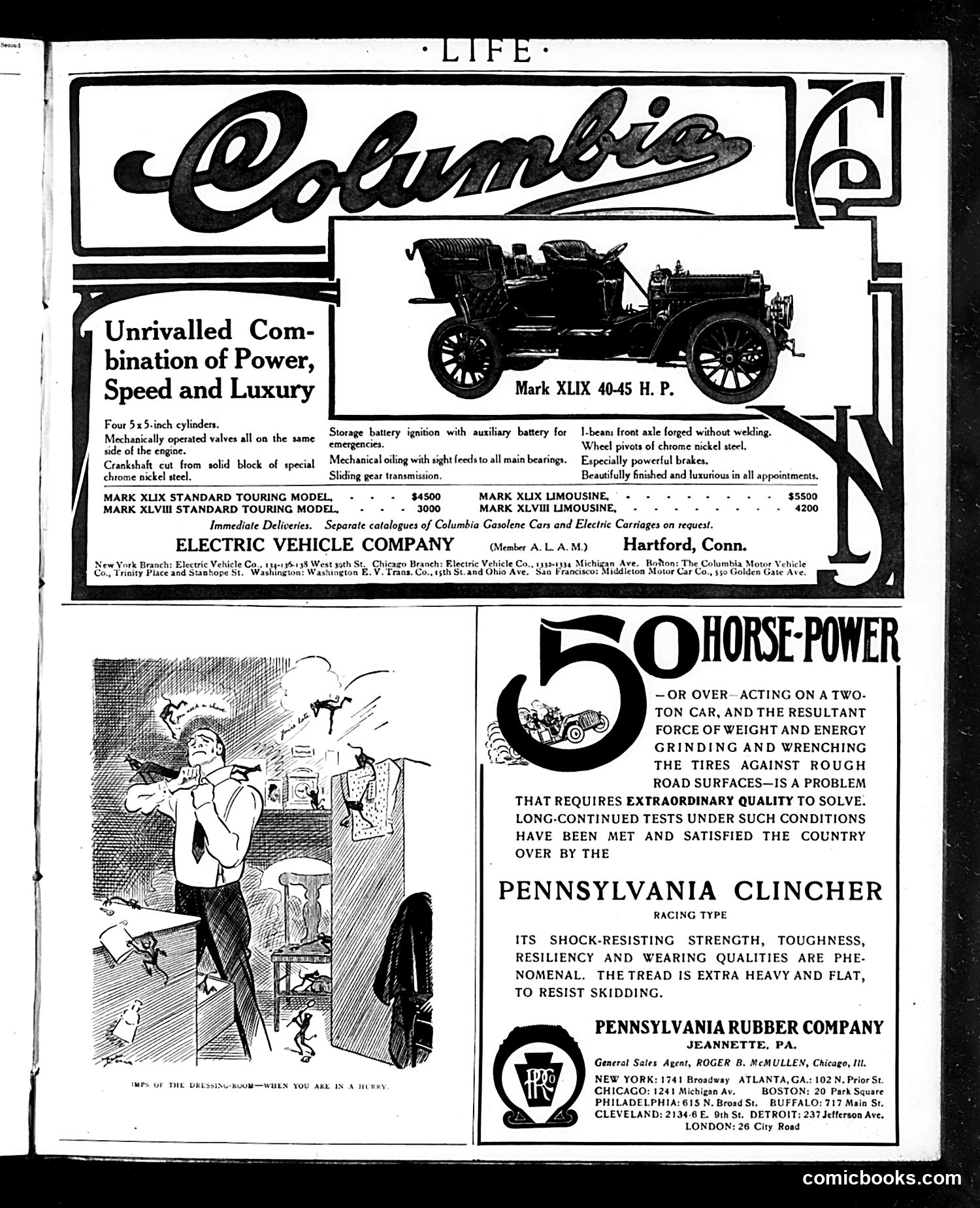
This page is primarily **advertising**, not political satire. The top half features a Columbia automobile advertisement highlighting the "Mark XLIX" touring model, emphasizing luxury features like a solid chrome-nickel steel crankshaft and mechanical oiling system. The Electric Vehicle Company of Hartford, Connecticut sold both gasoline and electric cars. The bottom half contains an unrelated cartoon showing a man in formal dress in what appears to be a dressing room with the caption "MEN OF THE DRESSING-ROOM—WHEN YOU ARE IN A HURRY," likely a humorous vignette about getting ready quickly. Below that is an advertisement for Pennsylvania Clincher tires, emphasizing their durability for heavy vehicles and rough road conditions. There is **no significant political or social satire** on this page—it's a straightforward collection of early 1900s automobile and tire advertisements with one light-hearted domestic humor cartoon.
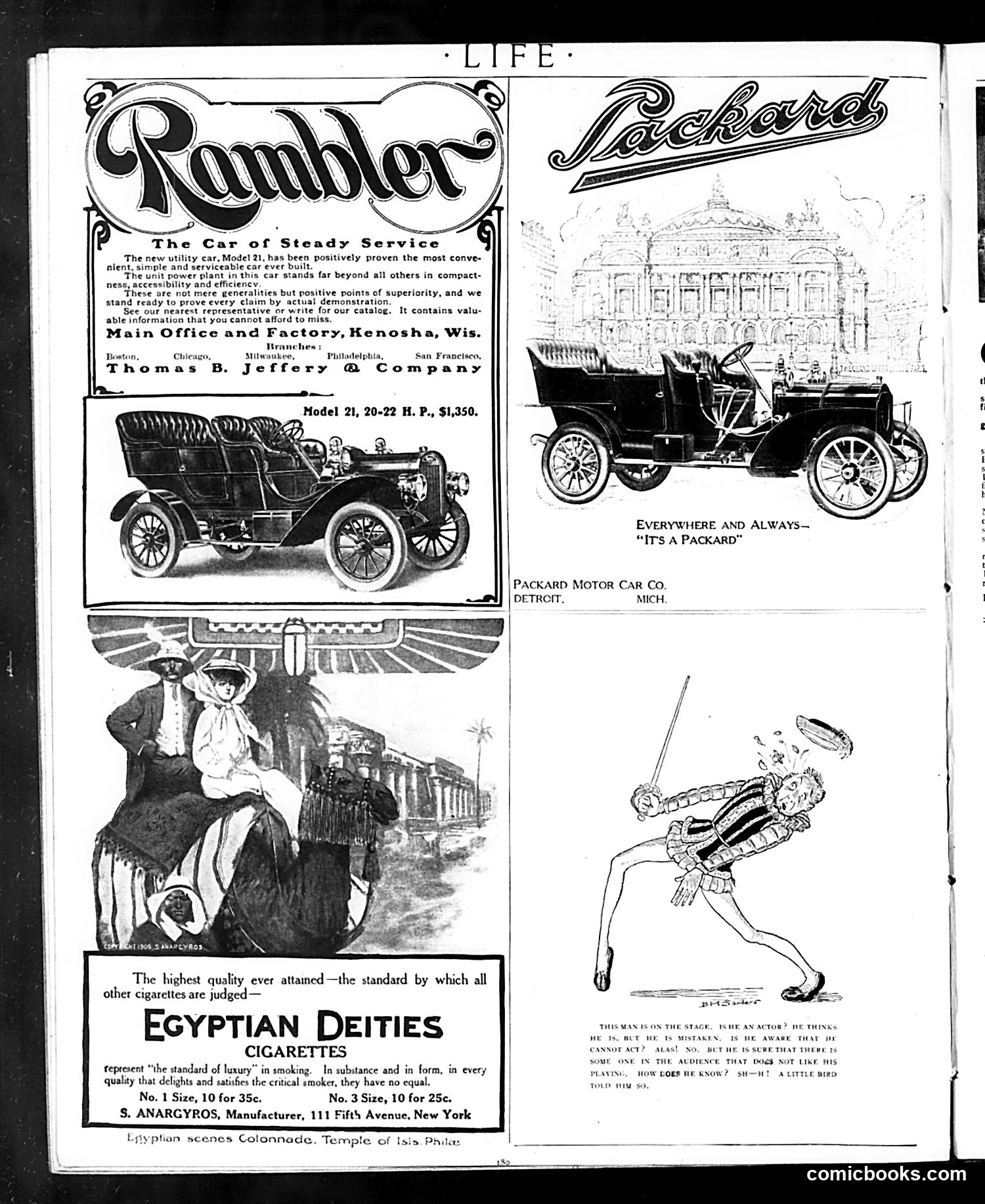
This page is **primarily advertisements** for automobiles and cigarettes, with minimal satirical content. **Left side:** Rambler and Egyptian Deities Cigarettes ads featuring early 1900s automobiles and luxury product messaging. **Right side:** Packard Motor Car advertisement with an illustration of an elegant automobile. **The cartoon element** (bottom right) appears to be a theatrical or entertainment-related illustration with accompanying text beginning "THIS MAN IS ON THE STAGE..." The sketch shows a figure in an exaggerated pose, likely satirizing theatrical acting or performance conventions of the era. However, without clearer text visibility, the specific satire target—whether mocking bad acting, particular performers, or theatrical pretension—cannot be determined with certainty. The page reflects Life magazine's mixed content of advertising and entertainment commentary typical of early 20th-century publications.
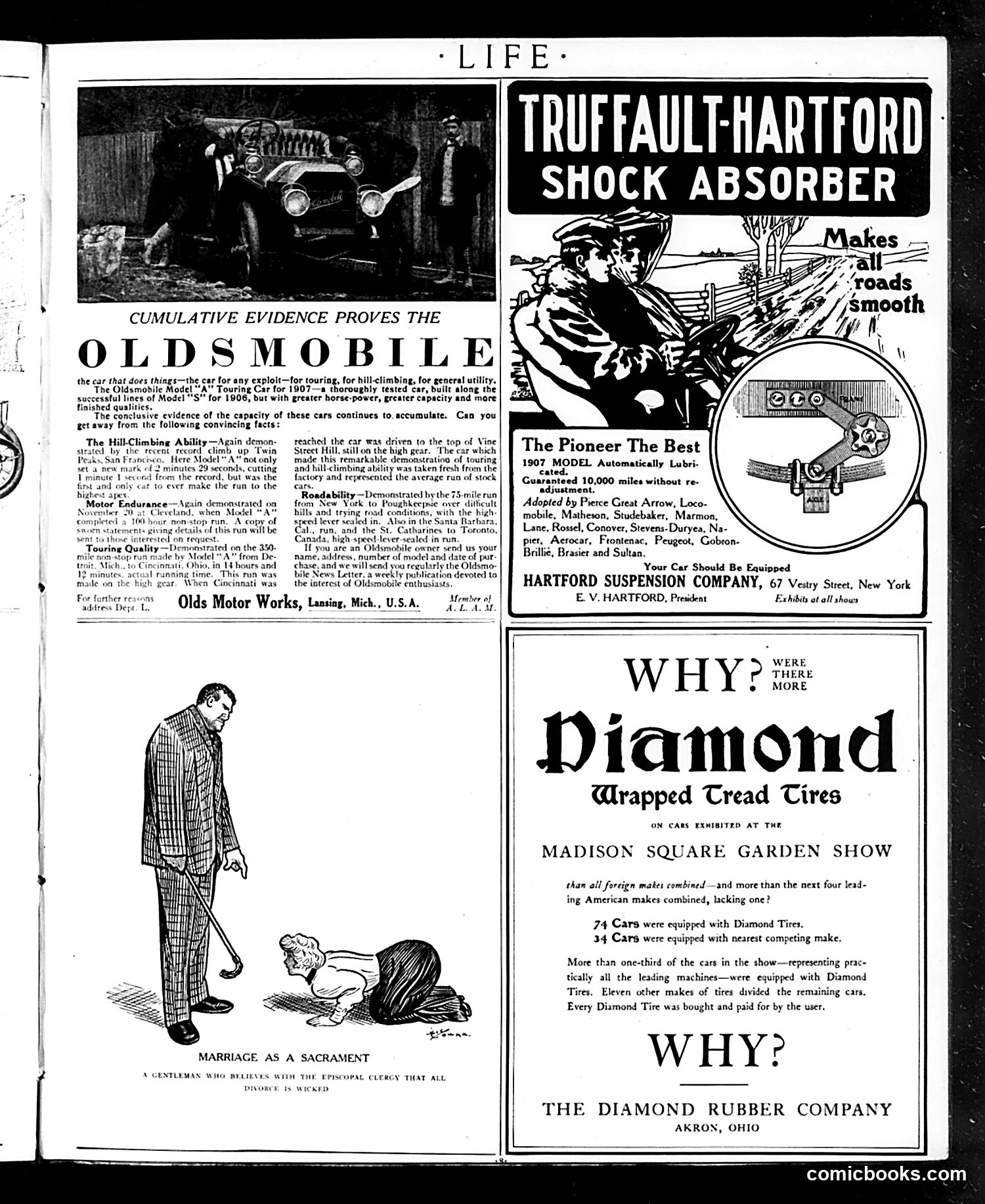
This page is primarily **advertisements for automobiles and automotive products** from what appears to be the early 1900s, not political satire. The single cartoon titled "Marriage as a Sacrament" shows a standing man looking down at a woman on the ground, with a caption indicating he's an Episcopal clergyman who believes all divorce is wicked. This is social satire about religious hypocrisy regarding marriage and divorce—the implied joke being that despite clergy's stated beliefs in the sanctity of marriage, divorces nonetheless occurred. The ads feature the Oldsmobile, Truffault-Hartford shock absorbers, Diamond wrapped tread tires, and the Pioneer automobile. These represent early automotive industry competition and marketing claims about reliability and innovation.
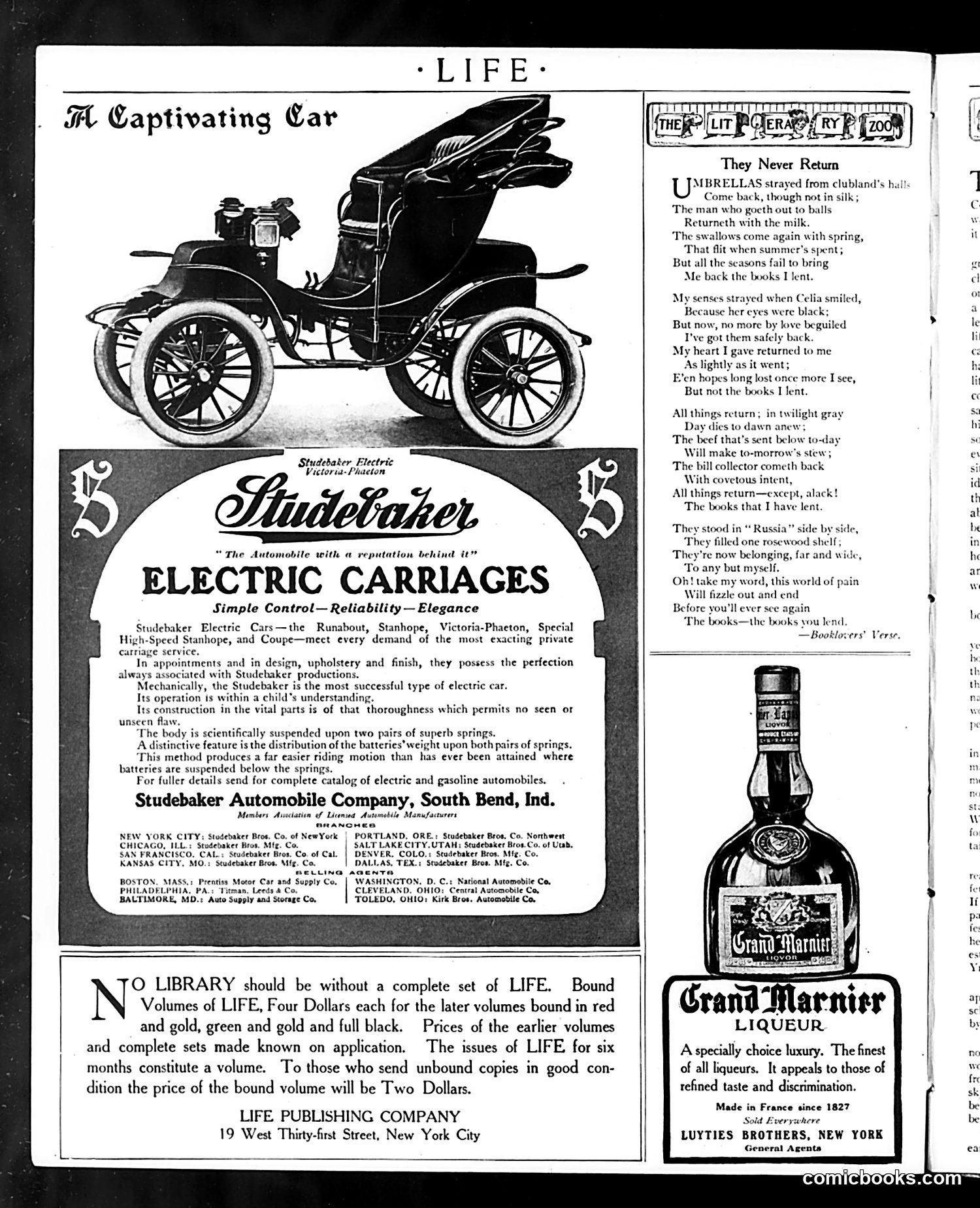
This page is primarily **advertising and literary content** rather than political satire. The dominant feature is a **Studebaker Electric Carriage advertisement** showcasing an early 1900s electric vehicle. The ad emphasizes luxury features ("Simple Control—Reliability—Elegance") and lists numerous dealerships, indicating widespread distribution. To the right is a **poem titled "They Never Return"** about lost library books—a humorous commentary on patrons who borrow and don't return items, written by "Booksellers' Verse." Below appears a **Grand Marnier liqueur advertisement** marketed as "a specially choice luxury" for refined tastes. The page reflects **early 20th-century consumer culture**: promoting new automotive technology, lamenting lost books, and advertising premium imported spirits to affluent readers.
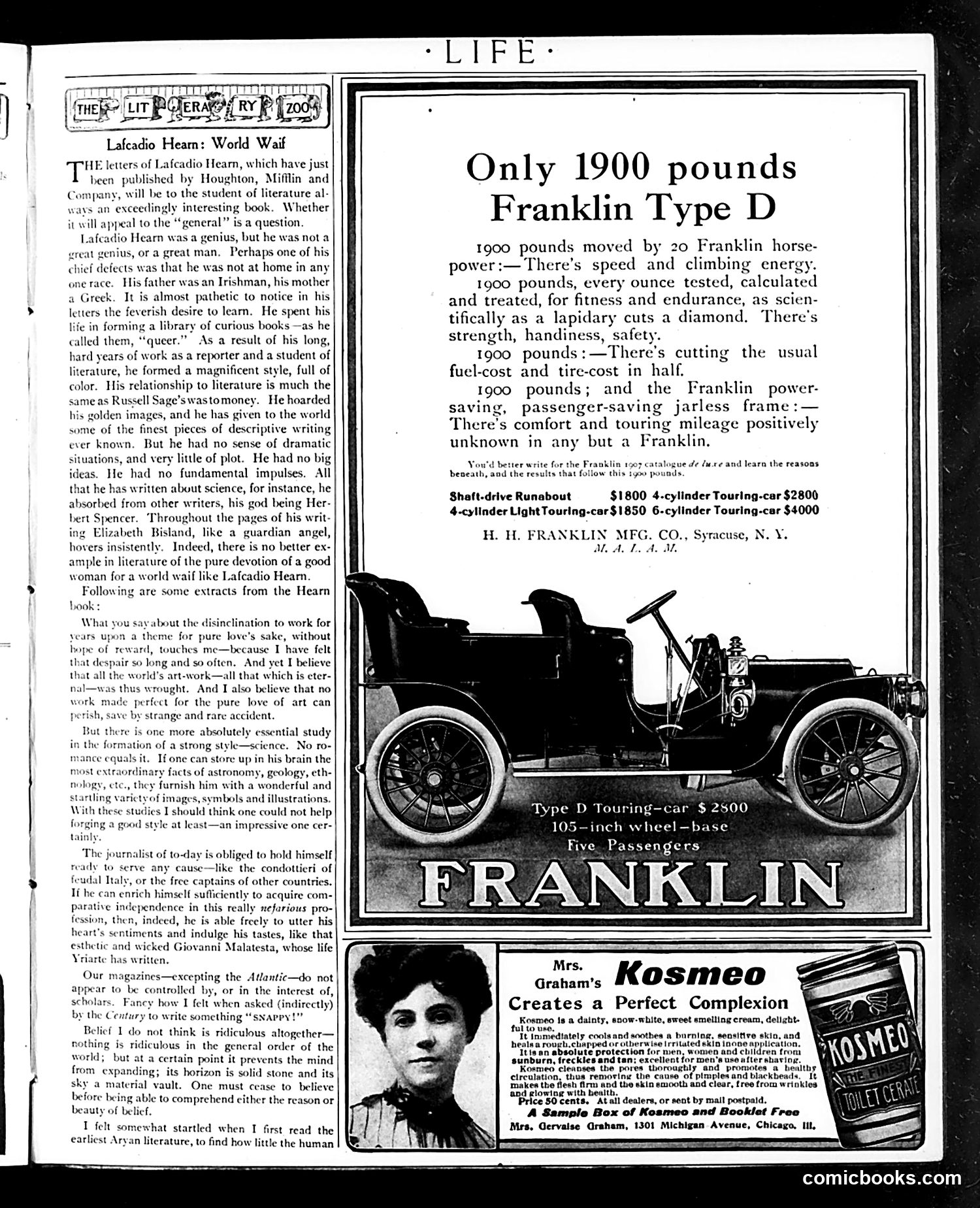
This page is primarily **advertising and editorial content** rather than political satire. The left column contains a literary essay on **Lafcadio Hearn**, a writer, discussing his journalism, literary style, and philosophy. The essay emphasizes his dedication to art and learning. The right side features **automobile advertisements**: a Franklin Type D touring car priced at $2,800 (with various configurations listed) and below it, Mrs. Graham's **Kosmeo beauty cream** advertisement. The Franklin ad emphasizes the car's efficiency—1,900 pounds moved by 20 horsepower—highlighting speed, climbing ability, and reduced fuel/tire costs. The Kosmeo ad touts a "Perfect Complexion" product. This represents typical early 20th-century Life magazine content: literary discussion mixed with consumer product marketing, reflecting the era's advertising-driven publishing model.
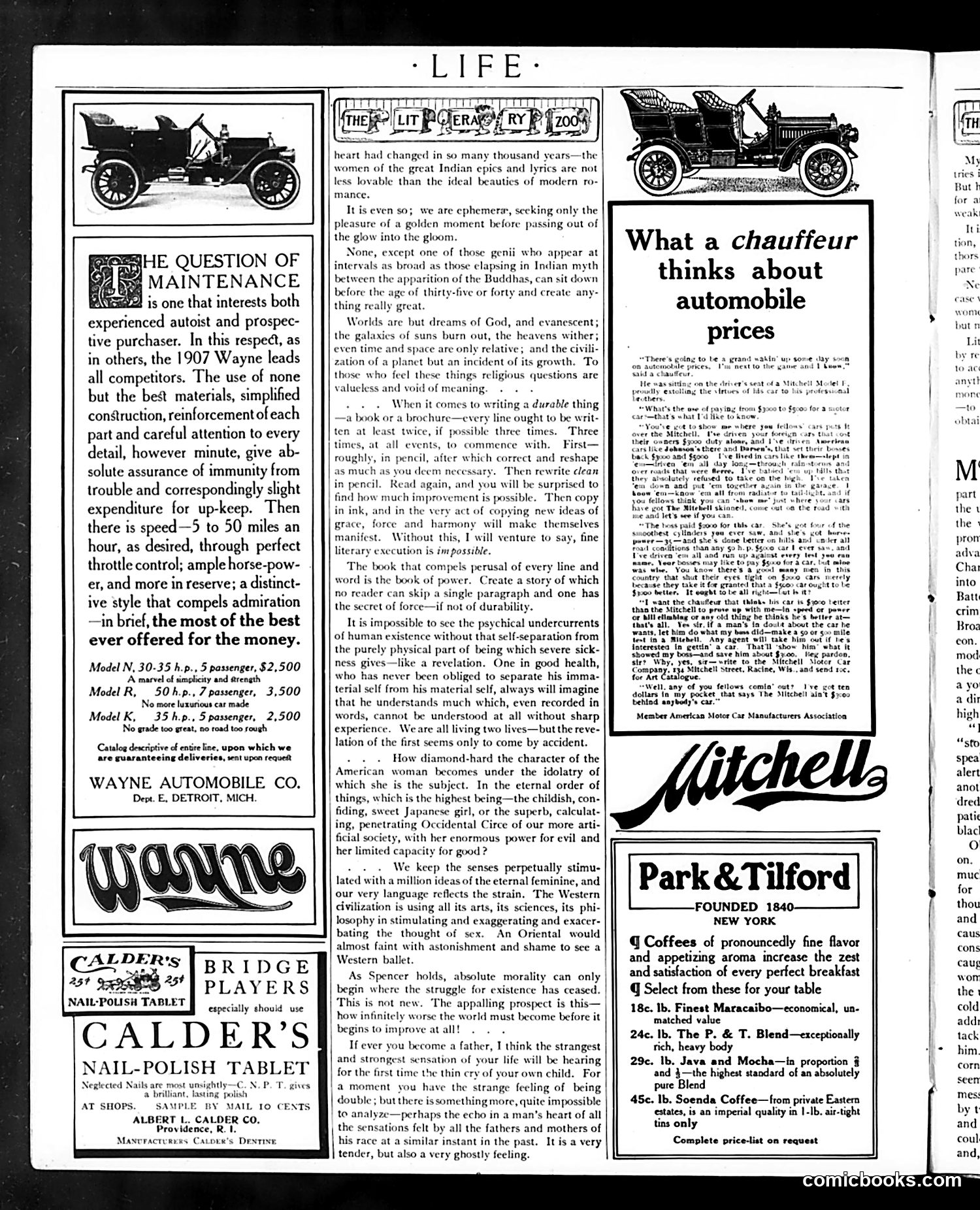
This page is primarily **advertisements and articles** rather than political cartoons. The main content includes: 1. **Wayne Automobile Co. advertisement** (left): Promotes the Model 30 and Model 20 Wayne cars, emphasizing durability and low maintenance costs—selling points for early automotive buyers skeptical of reliability. 2. **"What a Chauffeur Thinks About Automobile Prices"** (center): A humorous article where a chauffeur discusses pricing and value of automobiles, likely satirizing both inflated car prices and working-class perspectives on luxury goods. 3. **Mitchell, Park & Tilford, and Calder's advertisements** (bottom): Standard product ads for automobiles, coffee, and nail polish. The page reflects **early 1900s consumer culture** and automobile industry growth, with gentle satire about emerging automotive anxieties rather than sharp political commentary.
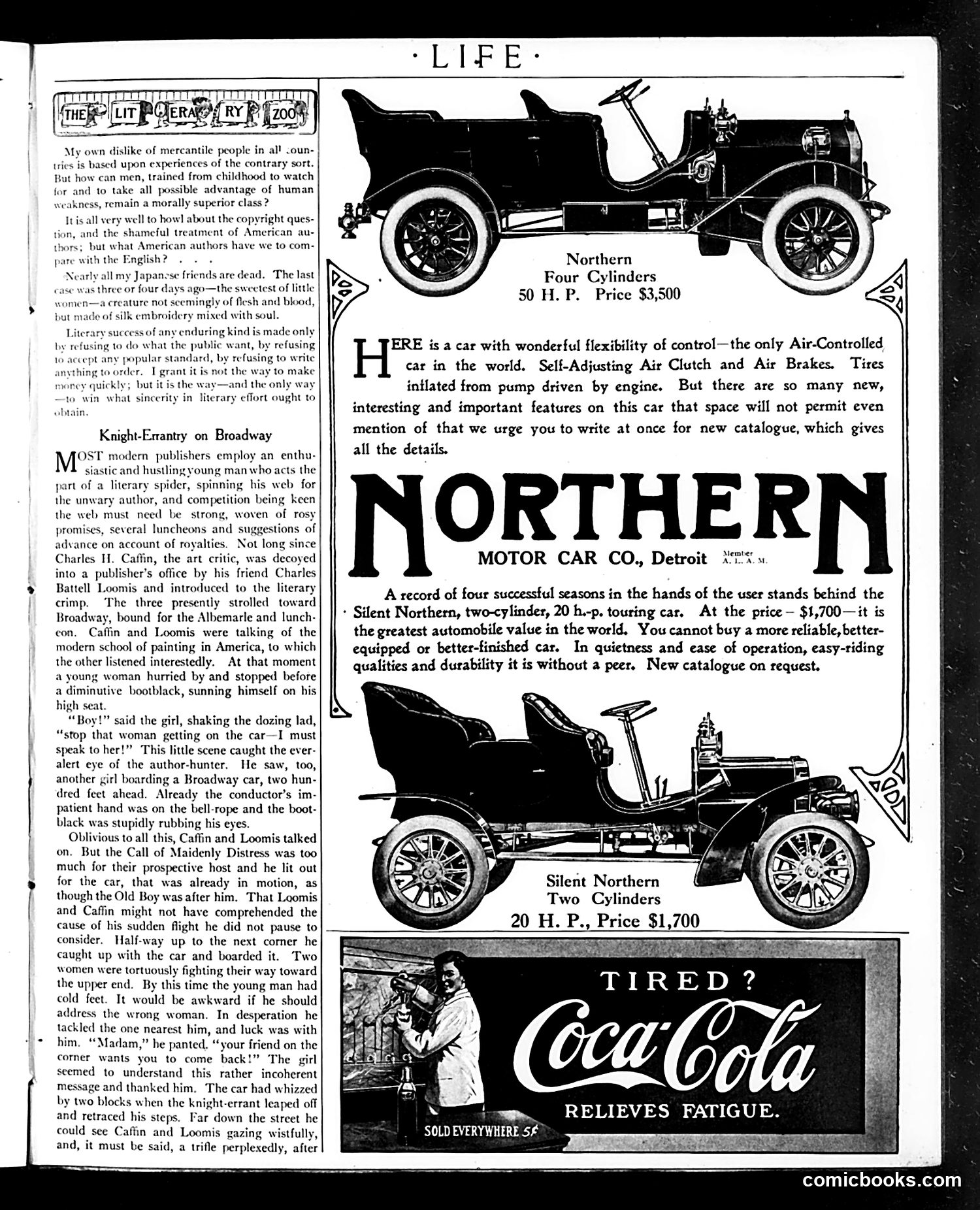
This page is primarily **advertising**, not satire or political commentary. The main content consists of two automobile advertisements for Northern Motor Car Company (Detroit), showcasing their "Four Cylinders" and "Silent Northern" models with prices ($3,500 and $1,700 respectively). The left column contains a literary piece titled "Knight-Errantry on Broadway," which appears to be humorous fiction about publisher dealings and a street encounter involving an author named Callin and Loomis. It's social commentary on literary pretension rather than political satire. The bottom features a **Coca-Cola advertisement** claiming the beverage "relieves fatigue," typical early-20th-century marketing language. There are **no political cartoons** on this page. The content reflects early 1900s consumer culture and advertising practices.
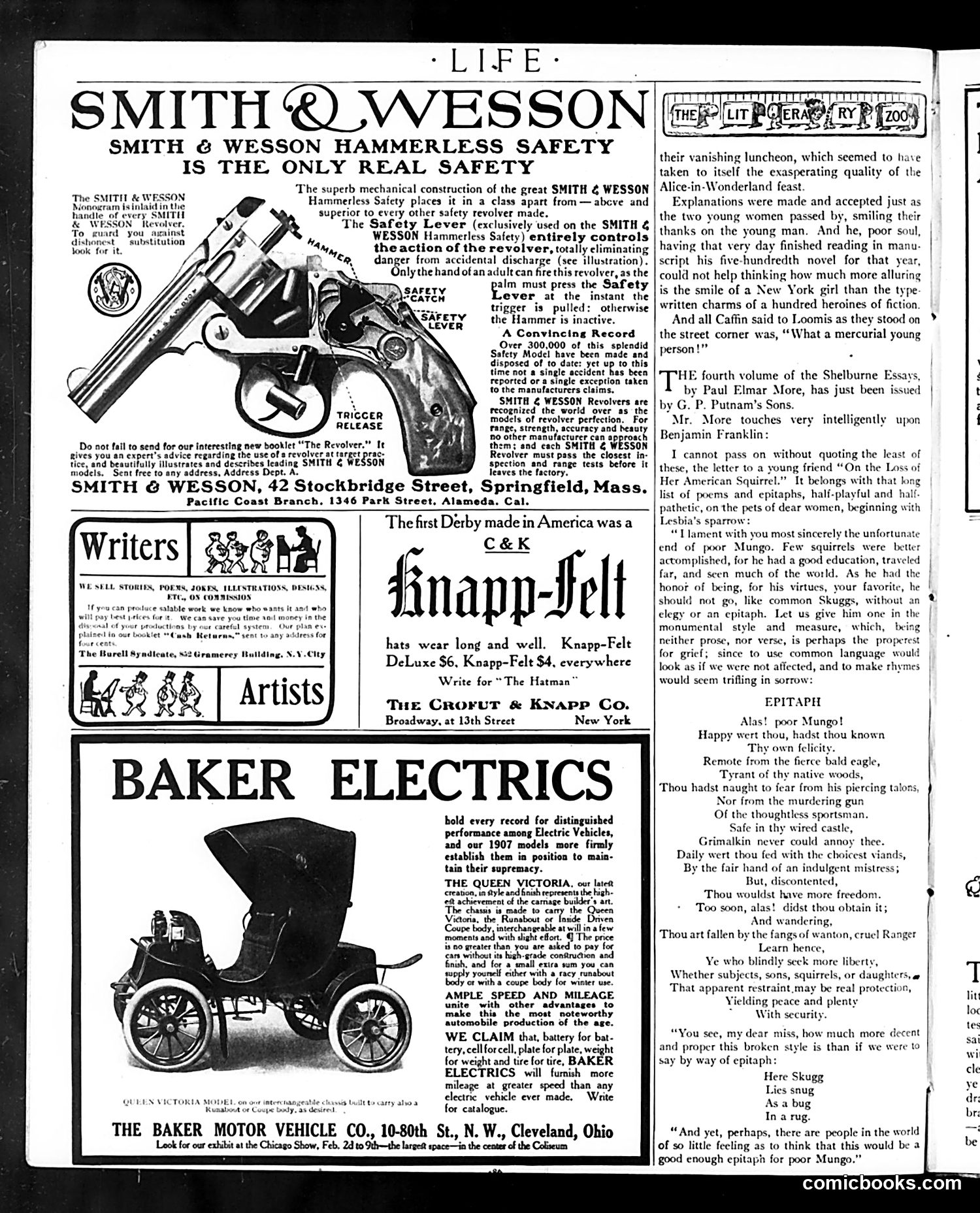
This page is primarily **advertising**, not satire or political commentary. It contains: 1. **Smith & Wesson ad**: Promotes their "Hammerless Safety" revolver, emphasizing the safety lever mechanism that prevents accidental discharge. The diagram shows the internal mechanism. Claims over 300,000 sold with no reported accidents. 2. **Baker Electrics ad**: Advertises electric vehicles, specifically the "Queen Victoria Model." Highlights battery performance, speed, and mileage—positioning electric cars as superior to gasoline vehicles. 3. **Supporting ads**: For writing services, artists, and Knapp-Felt products. The right column contains literary content (essays and poetry), unrelated to these advertisements. The satirical *Life* magazine context is present only in the masthead; the actual page content serves commercial purposes typical of early 1900s publications.
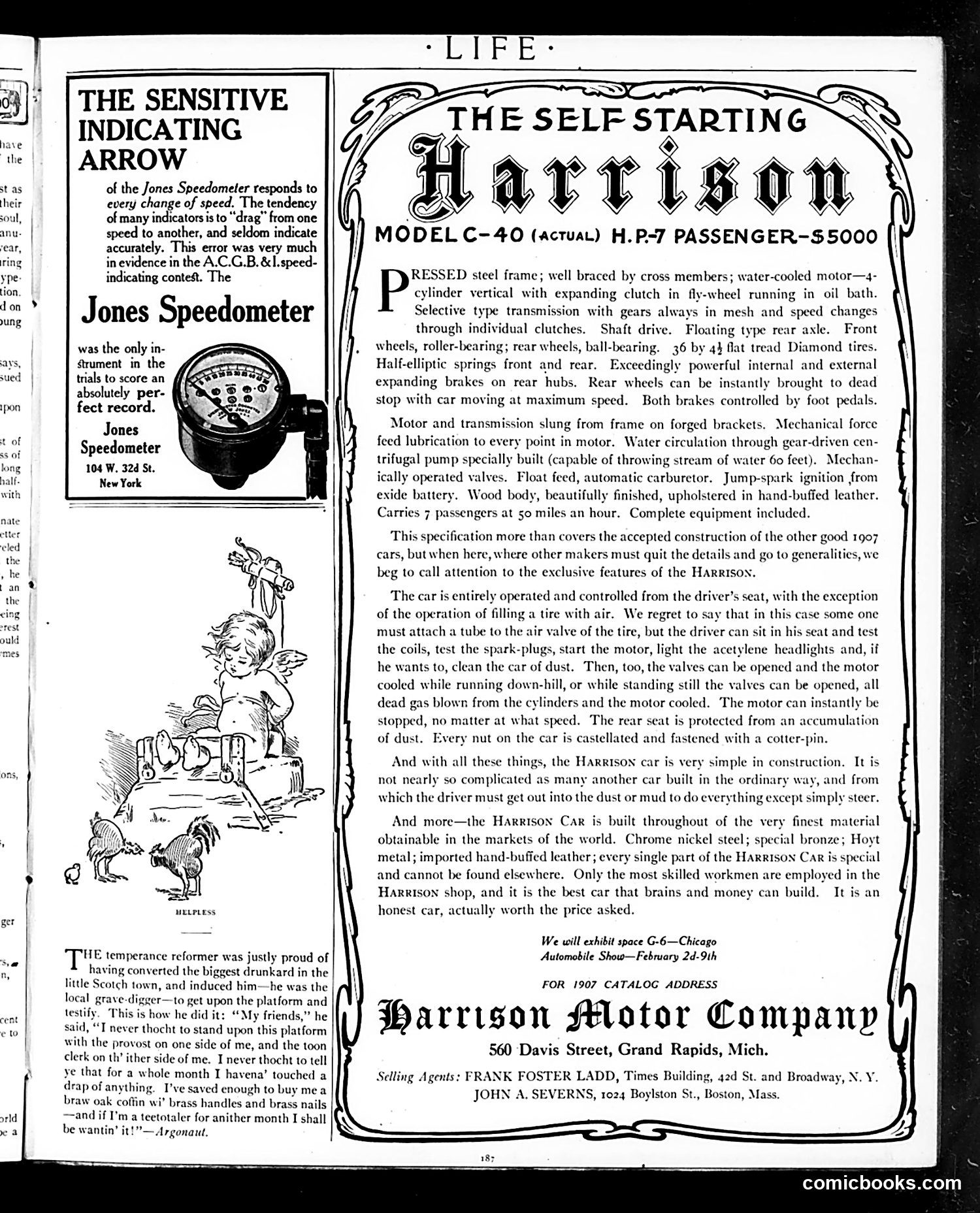
This page is primarily **advertising**, not satire. The dominant right-side content advertises the Harrison Motor Company's "Self Starting" Model C-40 automobile, emphasizing its innovative features like water-cooled motors and automatic ignition—technological marvels for 1907. The left sidebar advertises the Jones Speedometer, an instrument for measuring vehicle speed accurately. Below these ads is a humorous illustrated anecdote about a "temperance reformer" who converted a drunk in a Scottish town by preaching abstinence, then ironically became so thirsty himself that he later asked for a drink. The joke plays on hypocrisy and the difficulty of maintaining moral principles. The cartoonish illustrations are decorative period humor rather than political satire. This is essentially a commercial page dressed up with entertaining content.
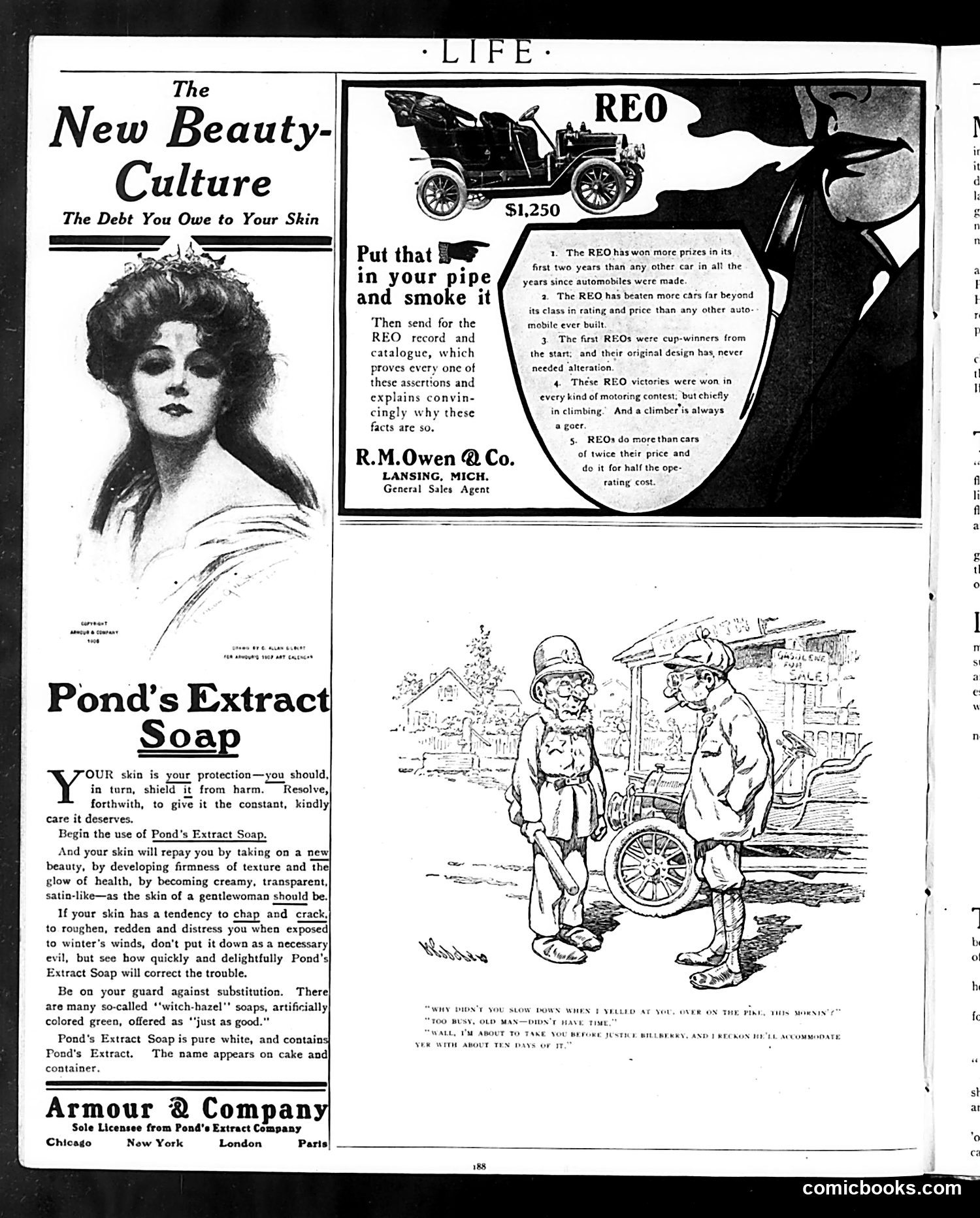
This page is primarily **advertising**, not satire or political commentary. It contains three advertisements: 1. **Pond's Extract Soap** (left): A beauty product ad emphasizing skincare protection, featuring a portrait of an attractive woman. The copy promotes the soap's purity and warns against substitutes. 2. **REO automobile** (top right): Promotes the REO car with five numbered claims about its racing record and value, targeting consumers interested in performance vehicles. 3. **Illustration** (bottom right): A cartoon showing two workmen discussing a car repair, with dialogue about saving money. This appears to be humorous filler or a supplementary advertisement rather than political satire. The page reflects early 20th-century consumer advertising aimed at middle-class readers, emphasizing product quality and value.
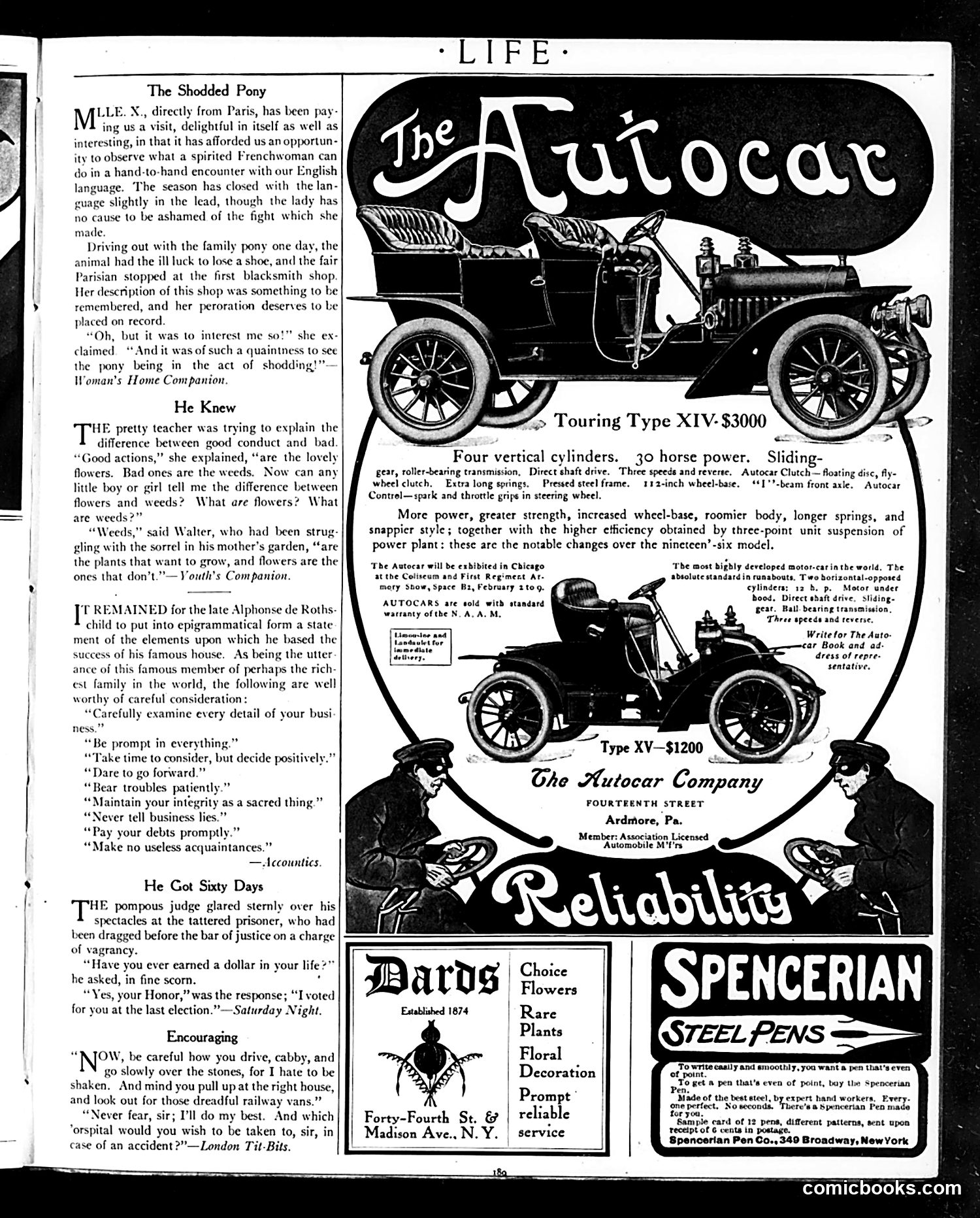
This LIFE magazine page is primarily **advertising**, not satire or political cartooning. The dominant feature is a large advertisement for the **Autocar**, an early automobile (two models shown: the Touring Type XIV at $3000 and Type XV at $1200, made by the Ohio Autocar Company in Ardmore, Pennsylvania). The page also contains several brief humorous anecdotes and aphorisms in the left column—"The Shodded Pony," "He Knew," "He Got Sixty Days," and "Encouraging"—which are character sketches or witty observations about everyday life, not political commentary. Additional small advertisements appear for Dards Flowers and Spencerian Steel Pens. The content reflects early 1900s consumer culture and product marketing rather than political satire.
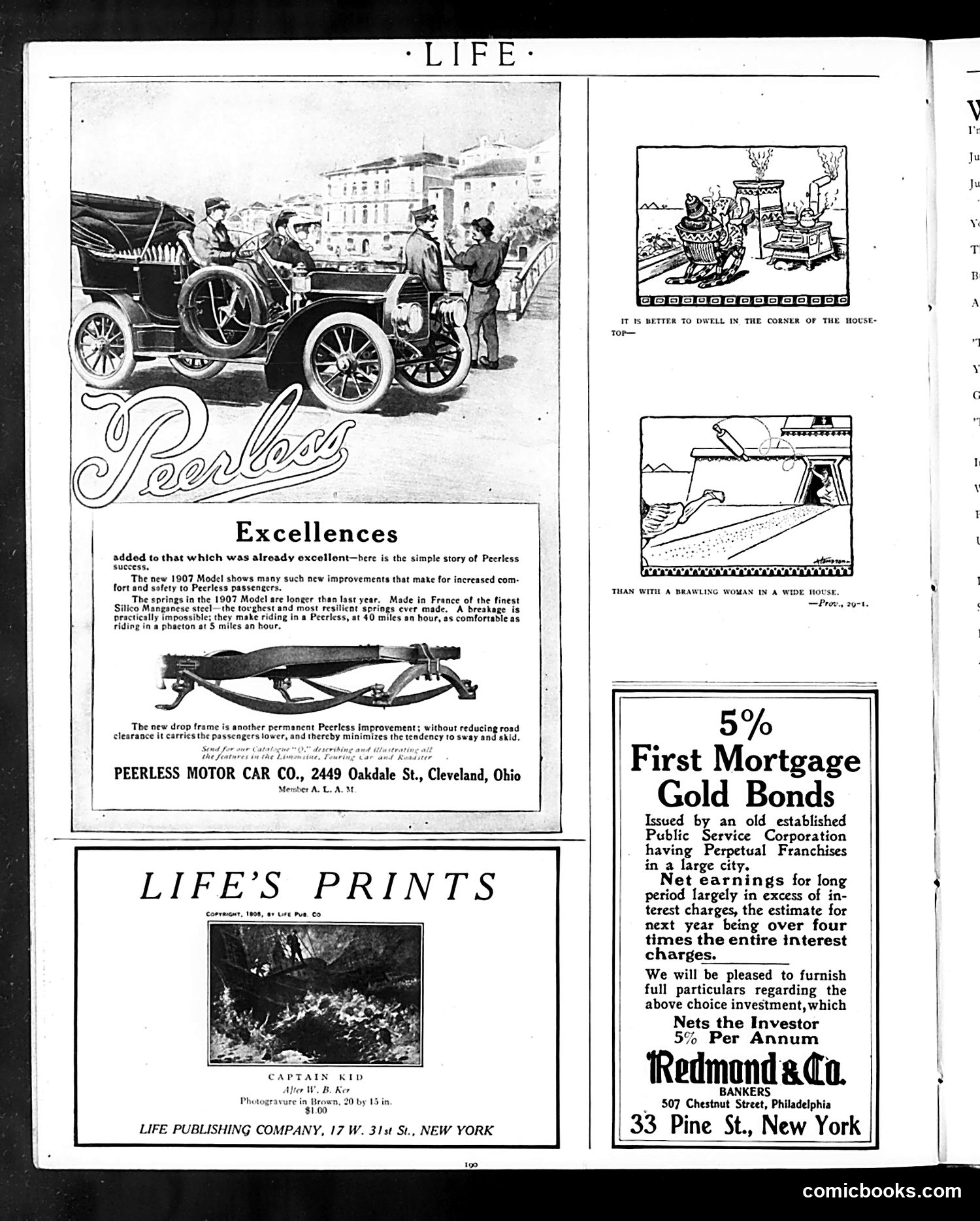
This is primarily an **advertising page** from Life magazine (circa 1907-1908). The main content is a **Peerless Motor Car advertisement** highlighting the 1907 model's engineering improvements—longer French steel springs and a drop frame design meant to provide smoother riding at higher speeds (40 mph). The page also includes: - **"Life's Prints"** section advertising a photogravure titled "Captain Kid" by W.B. Ker ($1.00) - Two small satirical cartoons with biblical references ("It is better to dwell in the corner of the housetop..." - Proverbs 29:1), likely commenting on domestic life or marital discord, though the specific joke is unclear from the image - A **bond investment advertisement** from Redmond & Co. offering 5% First Mortgage Gold Bonds The page reflects early 1900s consumer culture: automobile enthusiasm, art print collecting, and investment opportunities in public utilities—typical Life magazine content mixing satire with commercial interests.
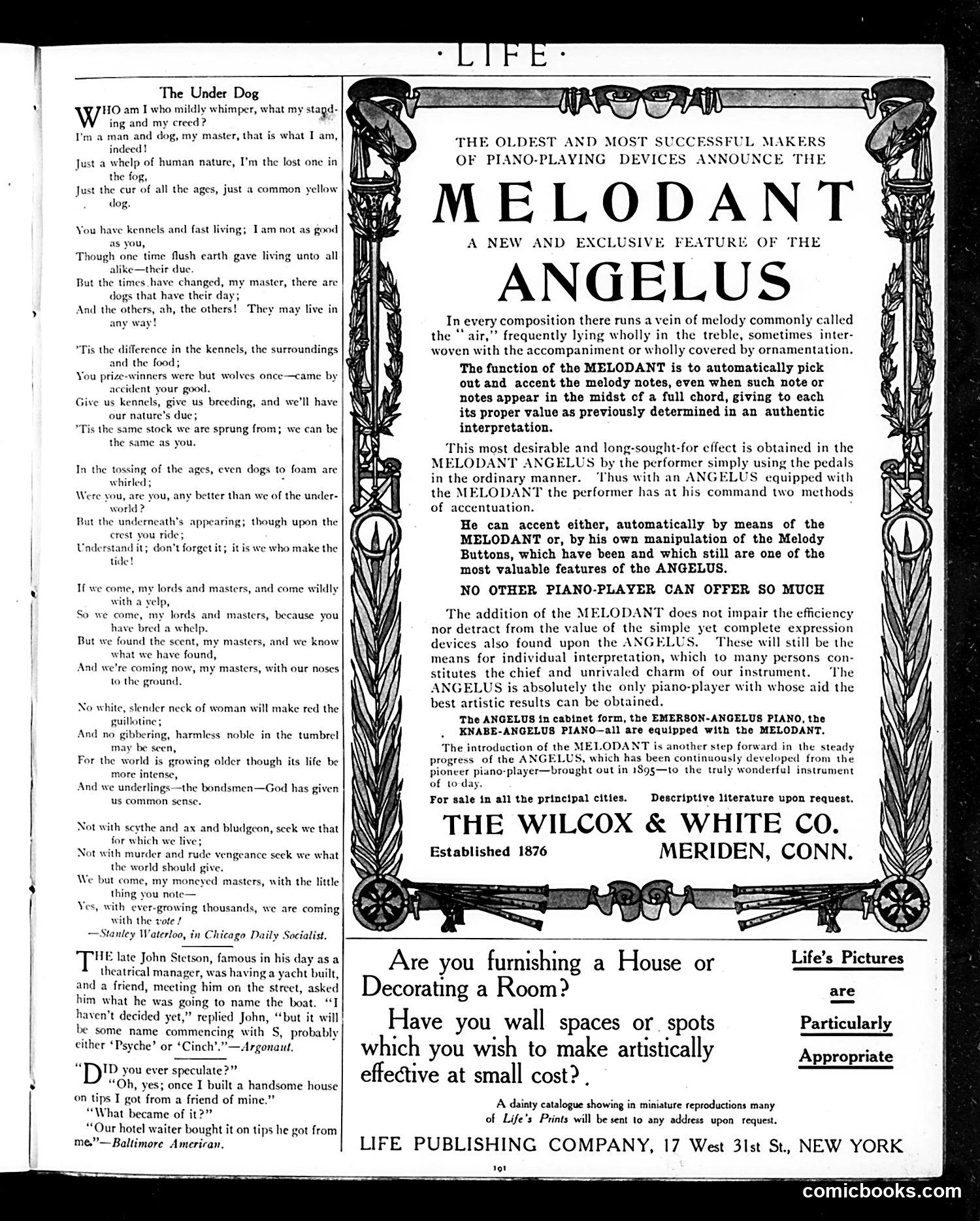
This page features a lengthy satirical poem titled "The Under Dog," attributed to Stanley Waterloo from the *Chicago Daily Socialist*. The poem uses a dog as metaphor for the working class or underclass, arguing for social equality through democratic means rather than violent revolution. The central conceit: a "common yellow dog" addresses the wealthy ("moneyed masters"), asserting that all classes share common origins ("same stock we are sprung from"). The satire critiques class privilege while making a radical argument—that the underclass possesses "common sense" and will achieve power "with the vote," not violence. The poem's final lines directly reference socialist concerns of the era: dismissing the French Revolution's guillotine and tumbrel, it advocates for democratic participation as the tool of social change. This represents early 20th-century American socialist rhetoric emphasizing ballot-box reform over violent upheaval. The surrounding advertisements (piano devices, house decorating) provide striking contrast to this revolutionary messaging—typical of *Life* magazine's dual commercial and editorial purposes.
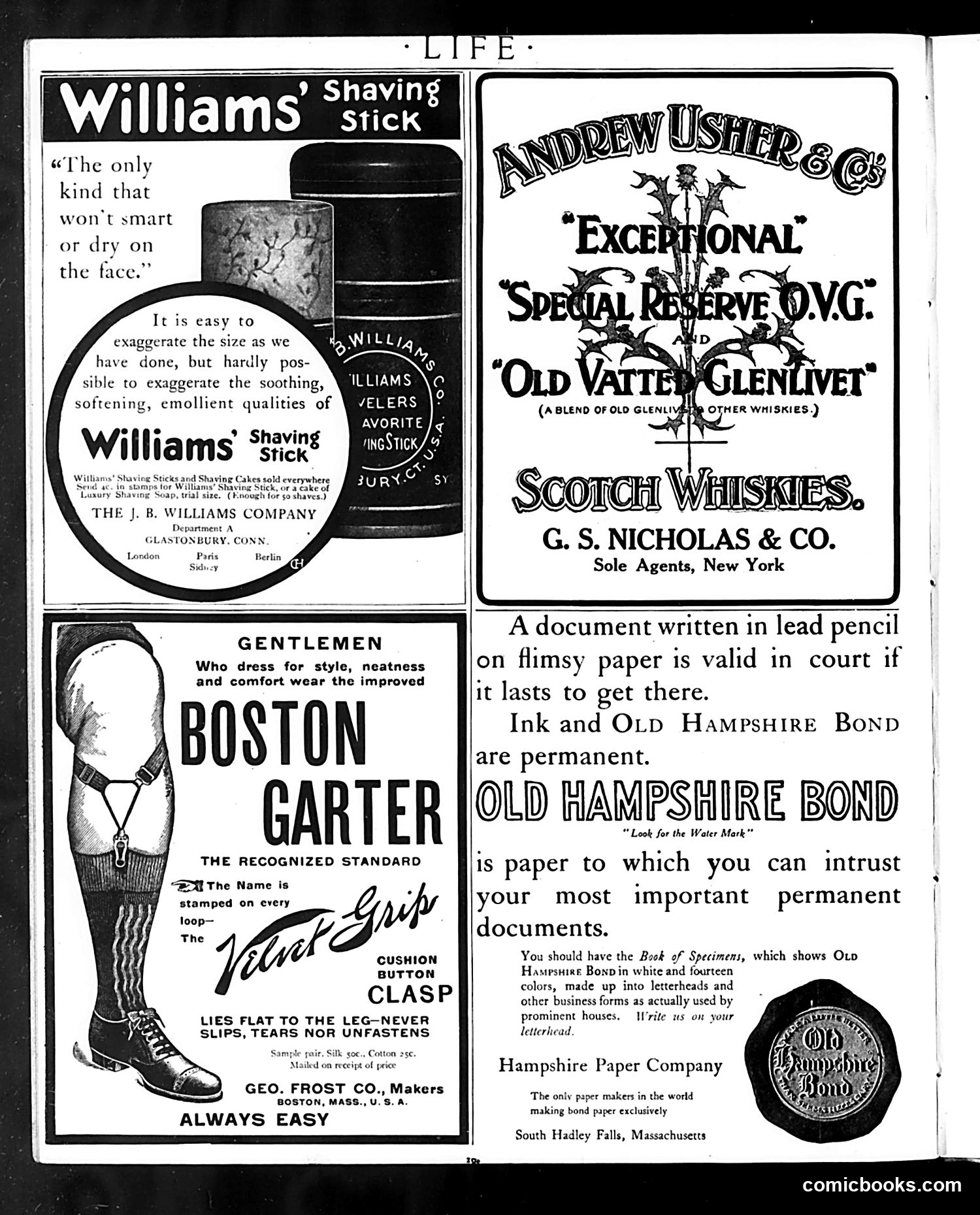
This page is primarily **advertising**, not satire or political commentary. It contains four product advertisements from the early 20th century: 1. **Williams' Shaving Stick** — emphasizes smoothness and comfort for wet or dry shaving 2. **Andrew Usher & Co. Scotch Whiskies** — promoting two brands to American consumers via New York distributors 3. **Boston Garter** — men's hosiery with a "cushion button clasp" designed to stay secure 4. **Old Hampshire Bond Paper** — specialty bond paper marketed for important legal documents, emphasizing permanence The only non-advertising content is a brief note about document validity, which serves as a transition to promote Hampshire Paper's durability for legal purposes. There is **no political satire or social commentary** on this page. It reflects early 1900s consumer culture and marketing practices targeting gentlemen.
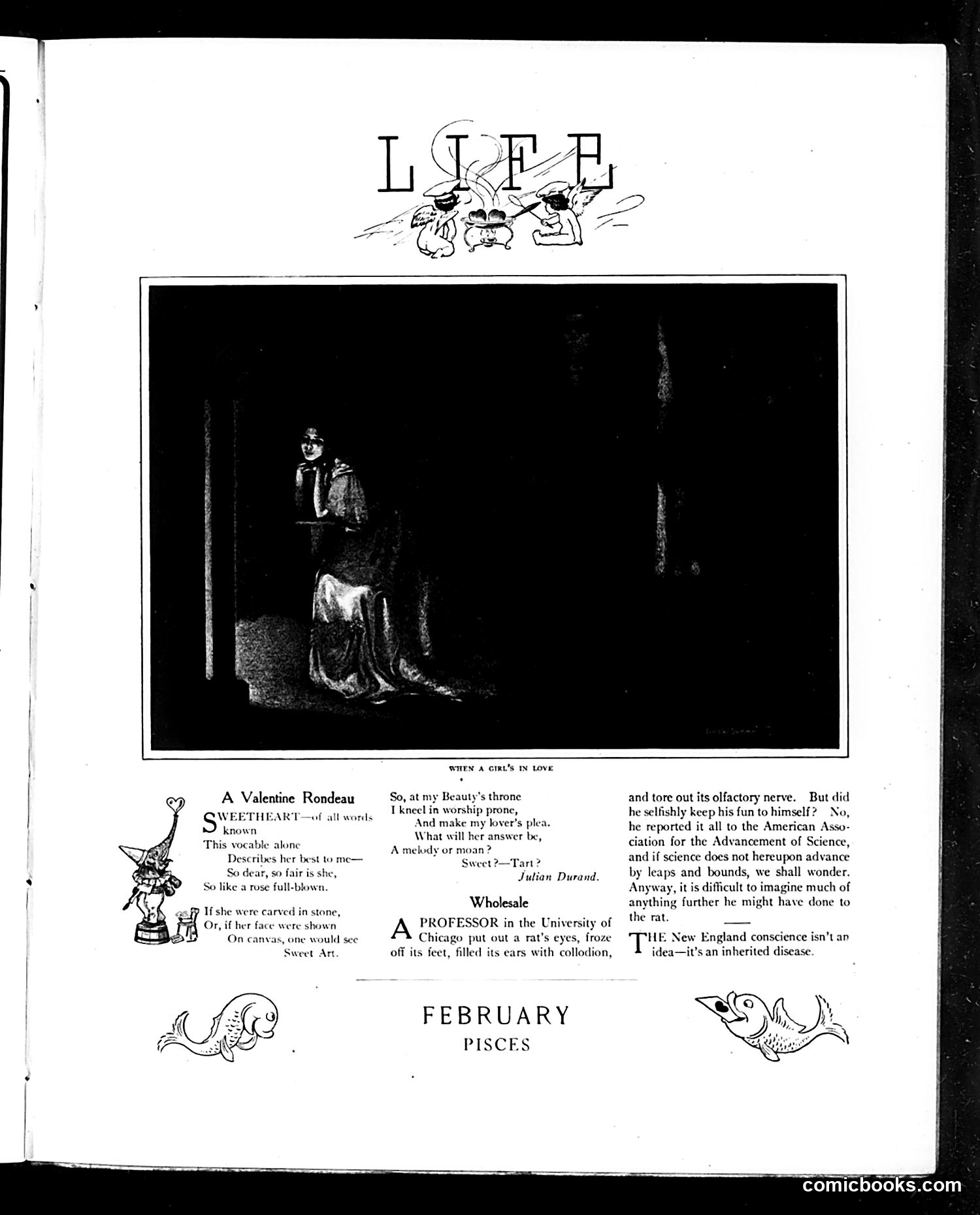
This page contains Valentine's Day humor and satirical commentary typical of early 20th-century Life magazine. The main cartoon, "When a Girl's in Love," features a romantic poem ("A Valentine Rondeau") mocking sentimentality with exaggerated praise of a sweetheart. The "Wholesale" section mocks scientific pretension through anecdotes: a University of Chicago professor performs bizarre experiments on a rat (freezing it, filling its ears with collodion—a chemical compound), then publicly reports these findings to the American Association for the Advancement of Science. The satire suggests scientists conduct pointless cruelty under the guise of research advancement. The final quip about "New England conscience" as "an inherited disease" stereotypes New Englanders as inherently moralistic and guilt-ridden—a common early American regional joke. The page is organized around February and the zodiac sign Pisces, with decorative fish illustrations. The humor targets romantic excess, scientific pomposity, and regional stereotypes.
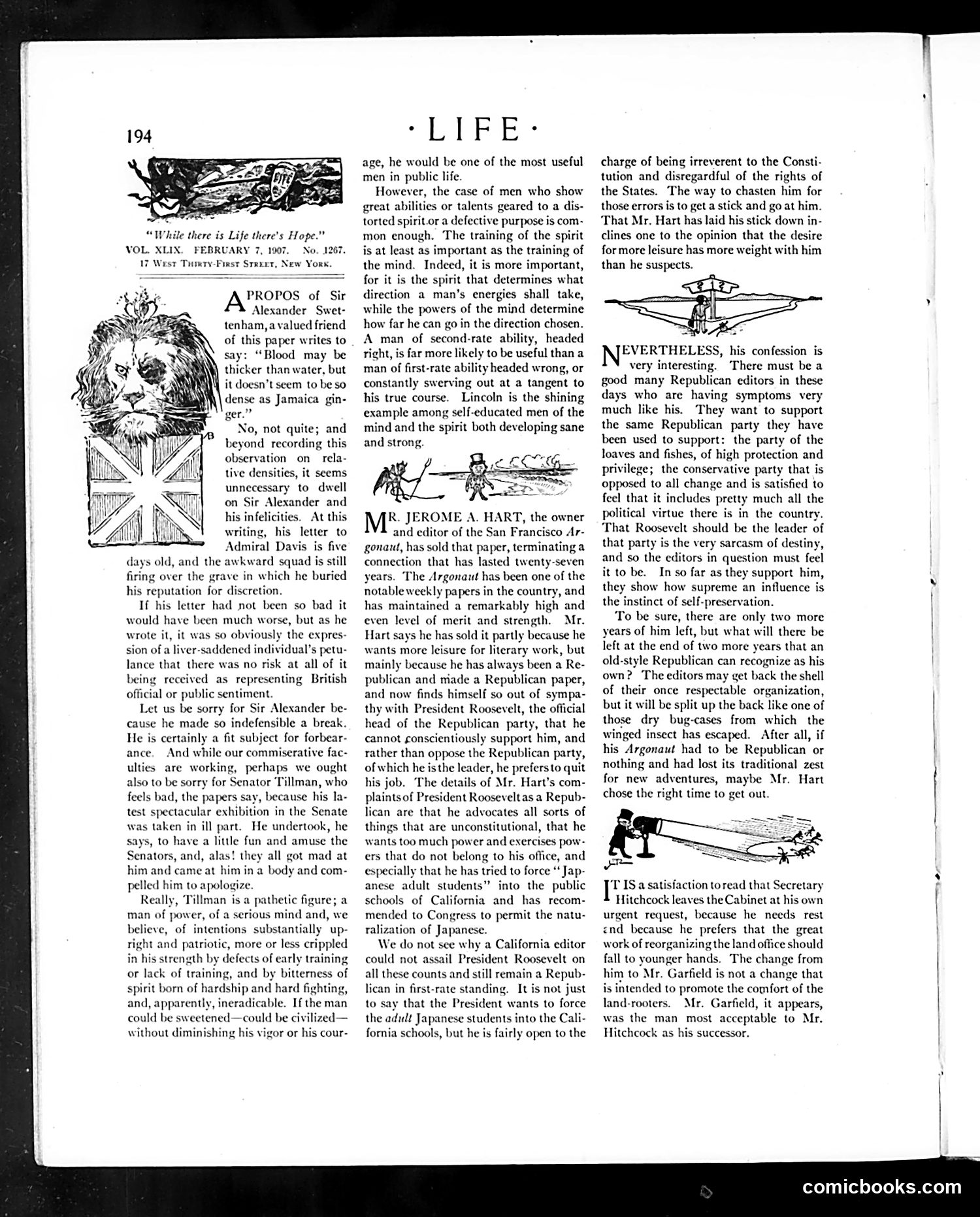
This page critiques three political figures for character flaws undermining their abilities. **Sir Alexander Swettenham** (opening anecdote): A British colonial official who damaged his reputation through an indiscreet letter to Admiral Davis—his poor judgment exposed him to public ridicule. **Senator Benjamin Tillman** (South Carolina): Portrayed as a powerful but bitter man whose "liver-saddened" temperament and lack of refinement sabotaged his effectiveness. The text suggests his early hardship created lasting bitterness that crippled his usefulness despite genuine ability. **Jerome A. Hart** (San Francisco *Argonaut* editor): Recently sold his newspaper because he could no longer support President Theodore Roosevelt, despite being Republican. Hart's principled resignation over Roosevelt's allegedly unconstitutional overreach of executive power illustrates the magazine's broader point: that personal integrity matters more than party loyalty. The editorial's thesis: spiritual/moral training matters more than raw ability. Lincoln exemplifies balanced development; these men show talent corrupted by defective character or principle.
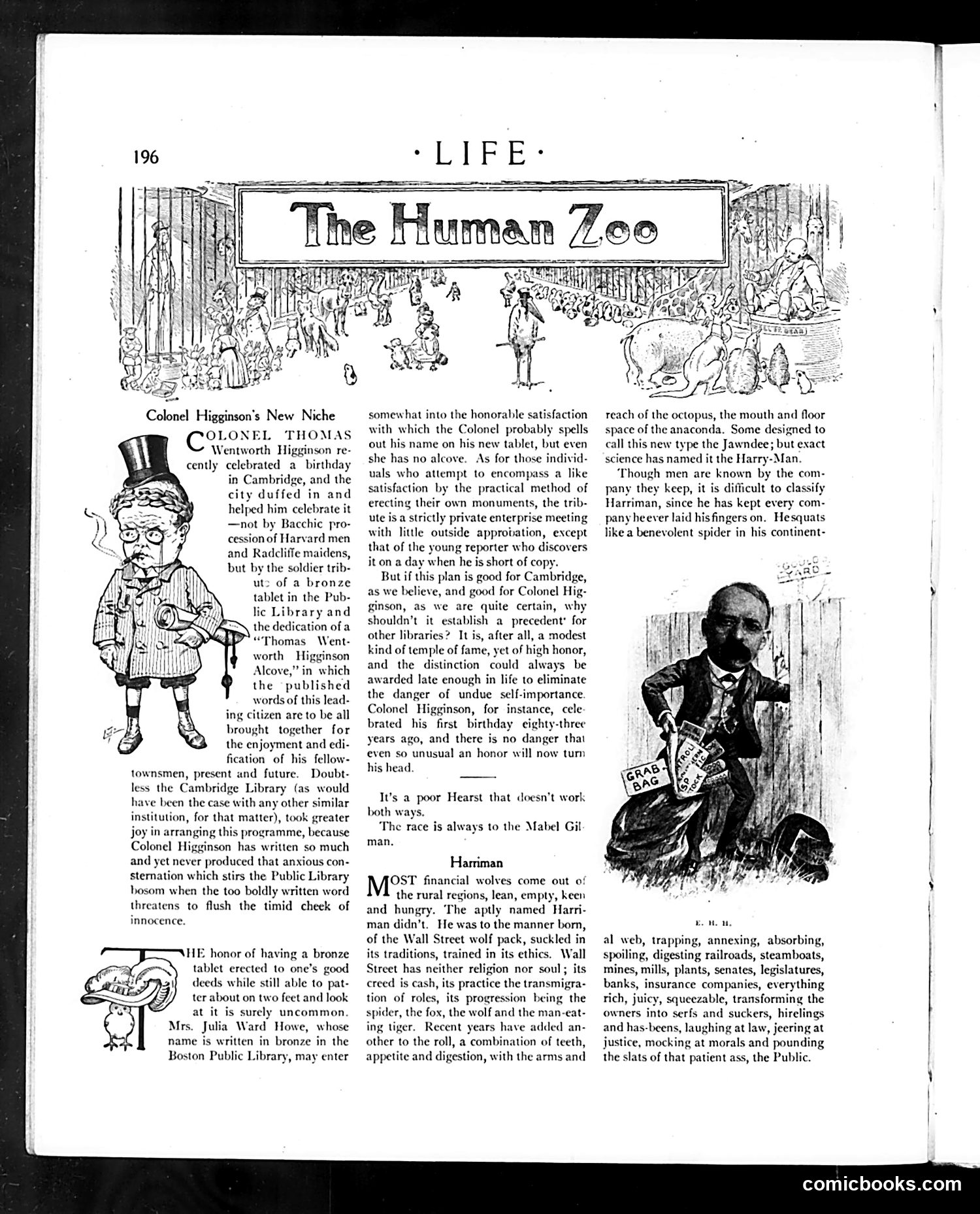
This page contains two satirical pieces about prominent figures: **Colonel Higginson's Tribute**: Life mocks the honor Cambridge bestowed on Colonel Thomas Wentworth Higginson—a bronze tablet and library alcove—during his birthday celebration. The satire is gentle: Life supports the gesture as appropriate for an elderly, respected literary figure (83 years old), unlikely to become vain from late-life honors. The joke is that such tributes are rare and amusing when someone still lives to see them. **Harriman Critique**: The sharper satire targets railroad magnate E.H. Harriman (shown in the caricature). Life sarcastically compares him to predatory animals—spider, fox, wolf, man-eating tiger—inventing a new species: the "Harry-Man." The satire attacks his ruthless business practices: absorbing railroads, steamboats, mines, and banks while transforming owners into "serfs and suckers," and his contempt for law, justice, and morals. This reflects Progressive Era criticism of unregulated industrial monopolies.
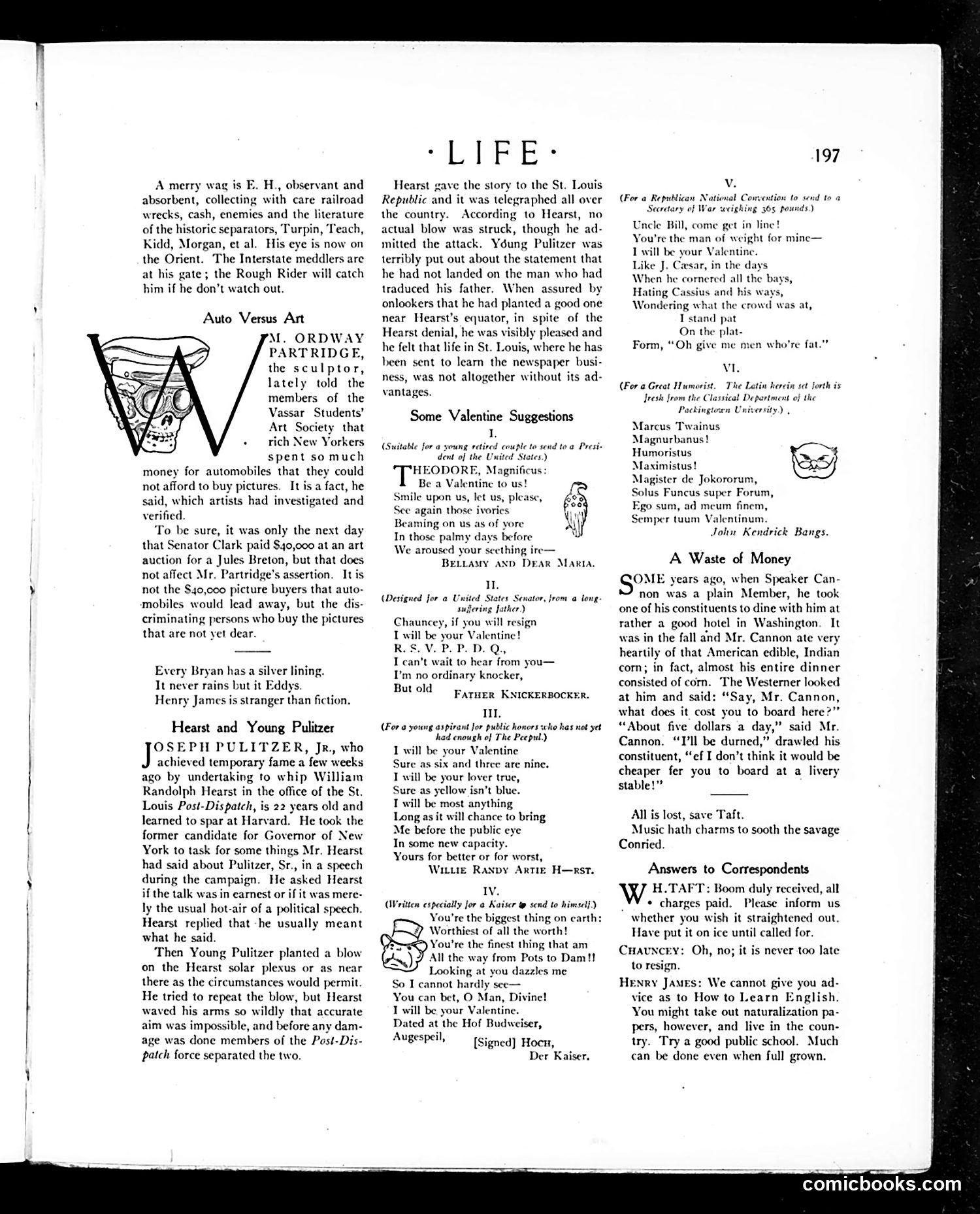
This page contains two main satirical pieces: **"Auto Versus Art"**: Sculptor M. Ordway Partridge claims wealthy New Yorkers spend so much on automobiles they can't afford art. The joke mocks this assertion—Senator Clark's $40,000 painting purchase the very next day proves Partridge wrong, yet Life notes the real problem is automobiles diverting *discriminating* (refined) buyers, not the wealthy. **"Hearst and Young Pulitzer"**: Joseph Pulitzer Jr., age 22, physically confronted newspaper magnate William Randolph Hearst over campaign insults to Pulitzer Sr. Hearst denied being struck; Young Pulitzer disputed this publicly. Life satirizes the incident's absurdity—a privileged young man seeking validation from witnesses that he'd landed a punch, finding "life in St. Louis" suddenly worthwhile because of the brawl's aftermath. The **Valentine suggestions** mock political figures (appears to include a President and Senator) with satirical romantic verses highlighting their vanity and self-interest.
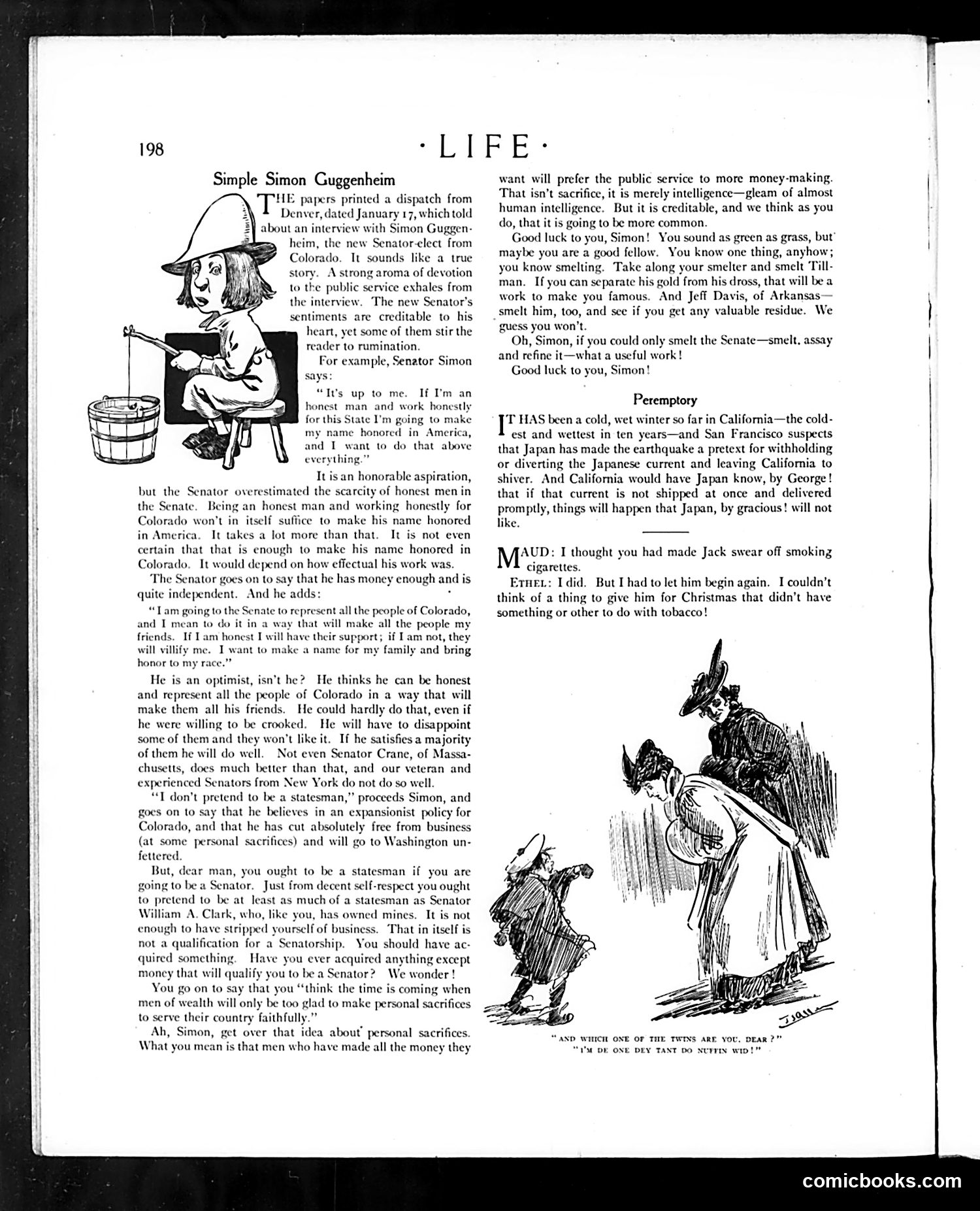
This 1913 *Life* magazine piece satirizes Simon Guggenheim, the newly elected U.S. Senator from Colorado, a wealthy mining magnate. The cartoon mocks his naive idealism about public service. Guggenheim claims he'll make his name "honored in America" through honest work and represent all Colorado citizens equally—sentiments *Life* finds laughably optimistic. The magazine ridicules his assertion that wealth naturally leads to self-sacrifice, arguing this is merely "intelligence" not noble sacrifice. The satire's sharpest jabs target his lack of political experience ("you sound as green as grass") and inexperience with Senate realities. Comparing him unfavorably to experienced senators, the writer sardonically suggests Guggenheim apply his smelting expertise to "refining" corrupt senators like Tillman and Davis—implying the Senate itself needs purification. The satirical tone is affectionate but cutting: Guggenheim means well, but dramatically underestimates what being a Senator requires beyond wealth and good intentions.
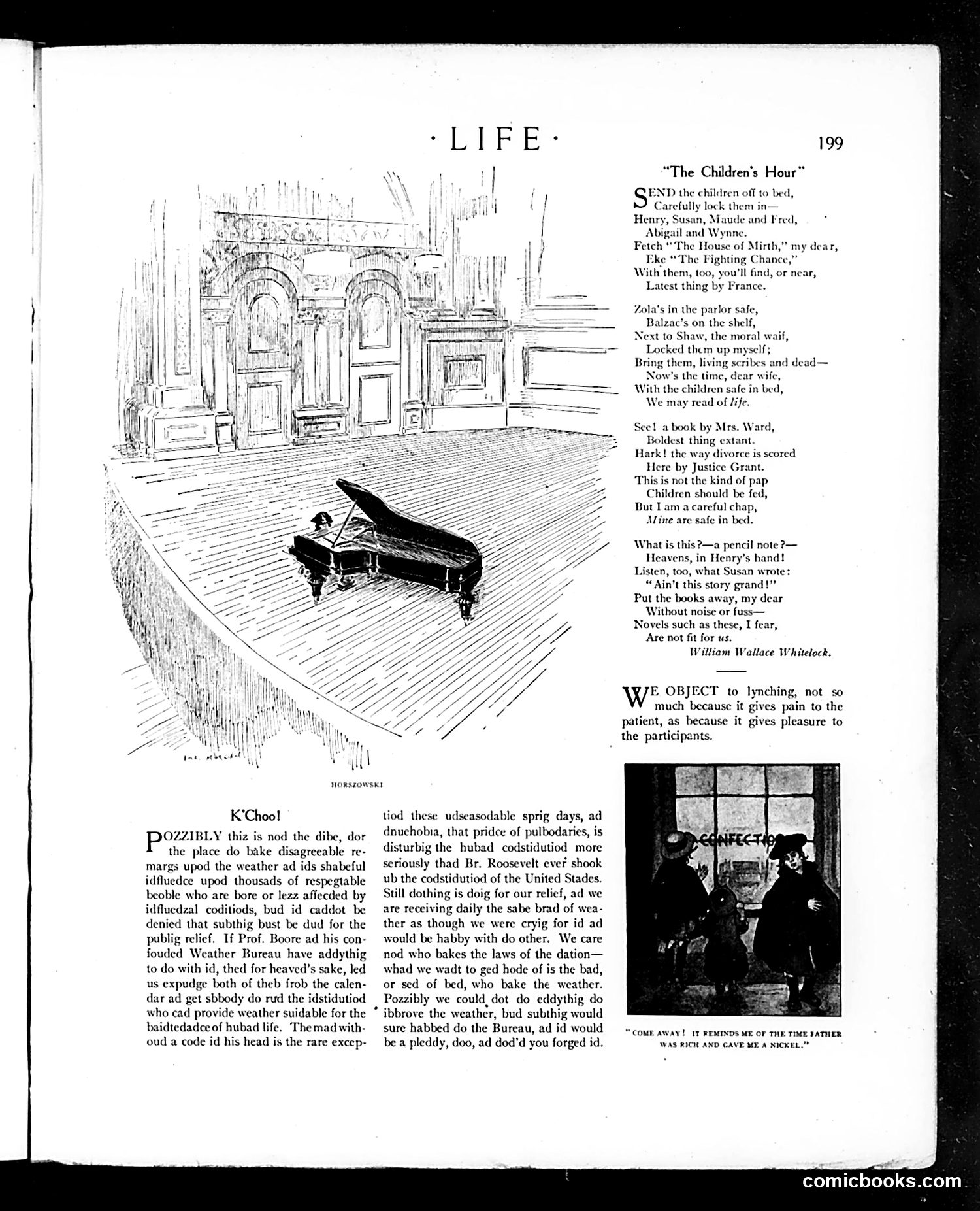
This LIFE magazine page contains two distinct pieces of social satire: **"K'Choo!" (left):** A cartoon by Morzowski shows a grand piano in an ornate hall. The accompanying text satirizes the Weather Bureau and Professor Moore, blaming them for poor spring weather and its effects on public health. The complaint is humorously absurd—demanding someone be fired who can actually provide good weather—mocking both bureaucratic blame-shifting and public complaints about uncontrollable conditions like weather. **"The Children's Hour" (right):** A poem by William Wallace Whitelock satirizes hypocritical parents who hide "dangerous" modern literature (Zola, Balzac, Shaw) from children while the children secretly read and enjoy it anyway. The irony: the parent thinks he's protecting his children by locking away novels, but they're already reading them. Below is a small cartoon (artist unclear) with a caption mocking nostalgia, where someone compares a scene to when their father was wealthy. Both pieces target pretense and ineffective attempts at control.
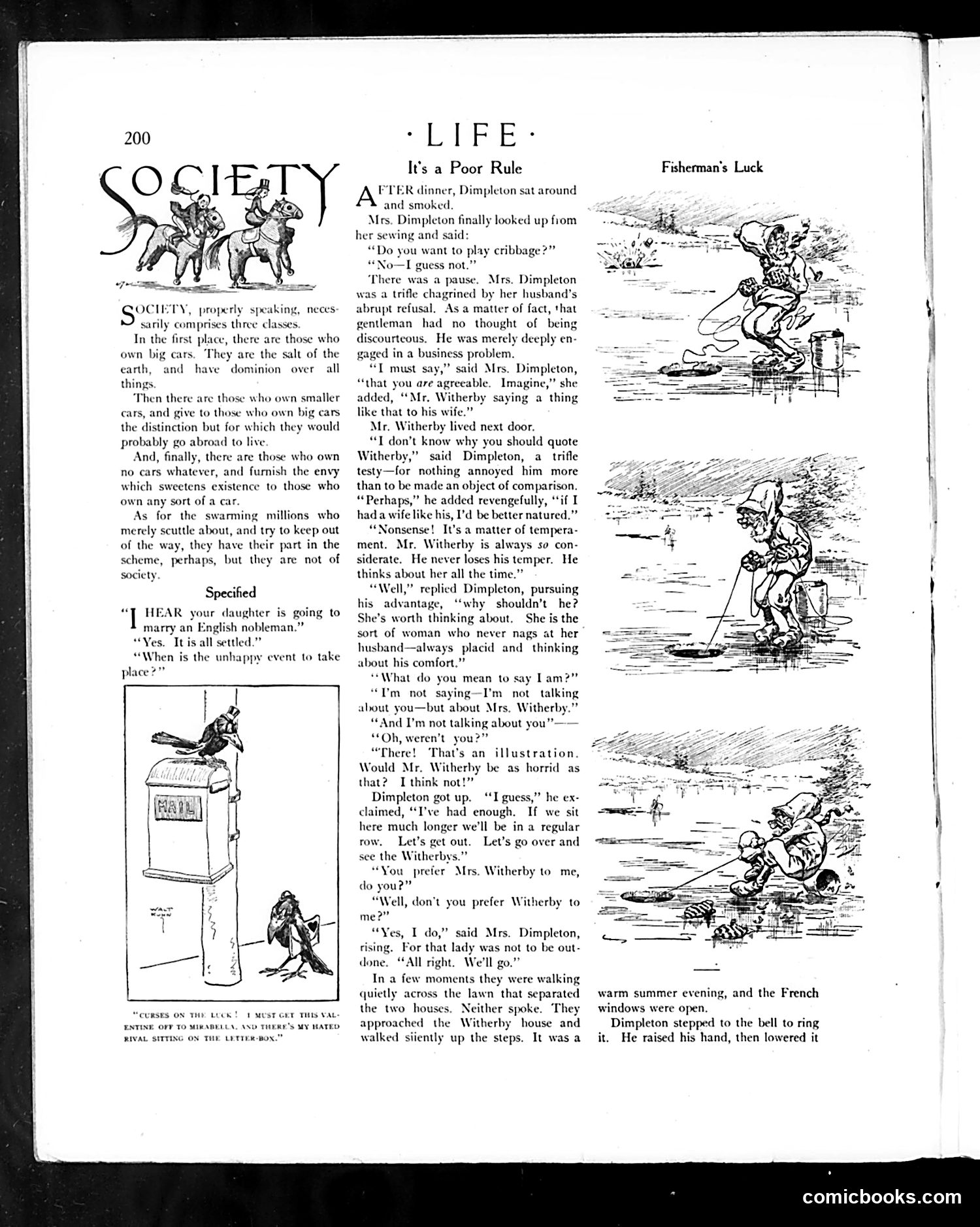
This Life magazine page contains two distinct pieces of satire: **"It's a Poor Rule"** (main story): A marital comedy where Mr. and Mrs. Dimpleton argue about their neighbor Mr. Witherby. When Mrs. Dimpleton criticizes her husband's lack of attentiveness by comparing him favorably to the always-considerate Witherby, Dimpleton retorts that Witherby only behaves well because his wife never nags. The couple becomes so irritated they decide to visit the Witherbys to prove their point—but the story ends ambiguously as Dimpleton hesitates at the doorbell, suggesting their confrontation will backfire. **The opening "Society" section** satirizes American class hierarchy of the era, mockingly defining "society" as those who own cars (big cars = the elite; smaller cars = middle class; no cars = invisible masses). It's commentary on automobile-driven status anxiety in early 20th-century America. **"Fisherman's Luck"** (right illustrations): Appears to be a brief humorous fishing narrative, though details are minimal. The cartoons employ the period's characteristic gentle domestic and social satire.
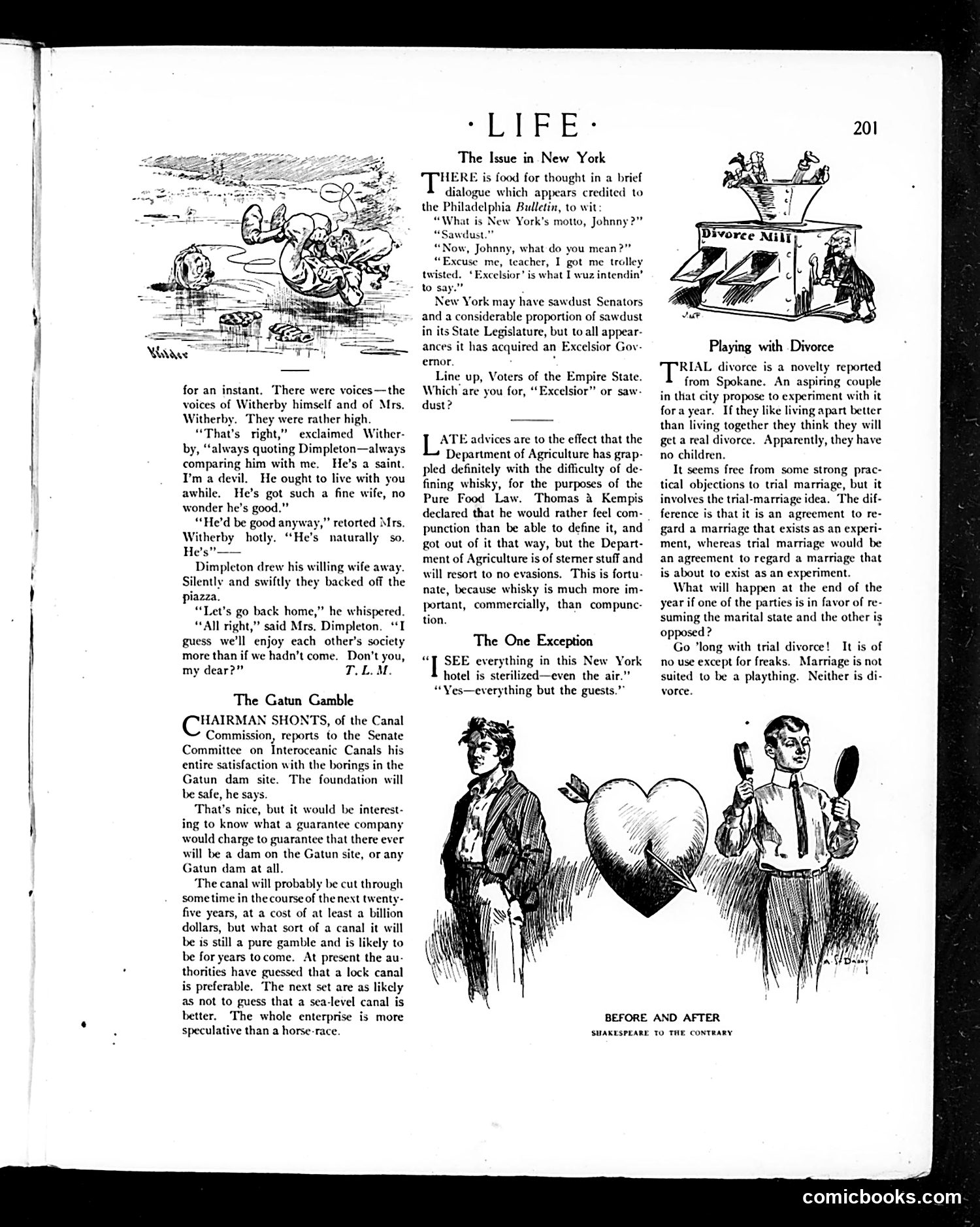
This page contains three distinct satirical pieces: **"The Issue in New York"** mocks New York politics through a child's dialogue. A boy defines New York's motto as "Sawdust" instead of "Excelsior," suggesting the state legislature is full of mediocre ("sawdust") politicians—though the new governor appears to represent genuine excellence. **"The Gatun Gamble"** criticizes the Panama Canal project's uncertainty. Despite Chairman Shonts's confidence about the Gatun dam foundation, the author sarcastically notes the entire enterprise is speculative—the canal may take 25 years and cost billions, with no guarantee it will even be built, let alone function as planned. **"Playing with Divorce"** ridicules a Spokane couple proposing a one-year trial divorce. The writer argues trial divorce is absurd because marriage shouldn't be "a plaything"—it's a commitment, not an experiment to be tested and abandoned if inconvenient. The cartoons ("Before and After") appear to illustrate romantic disillusionment, contrasting idealized love with harsh reality.
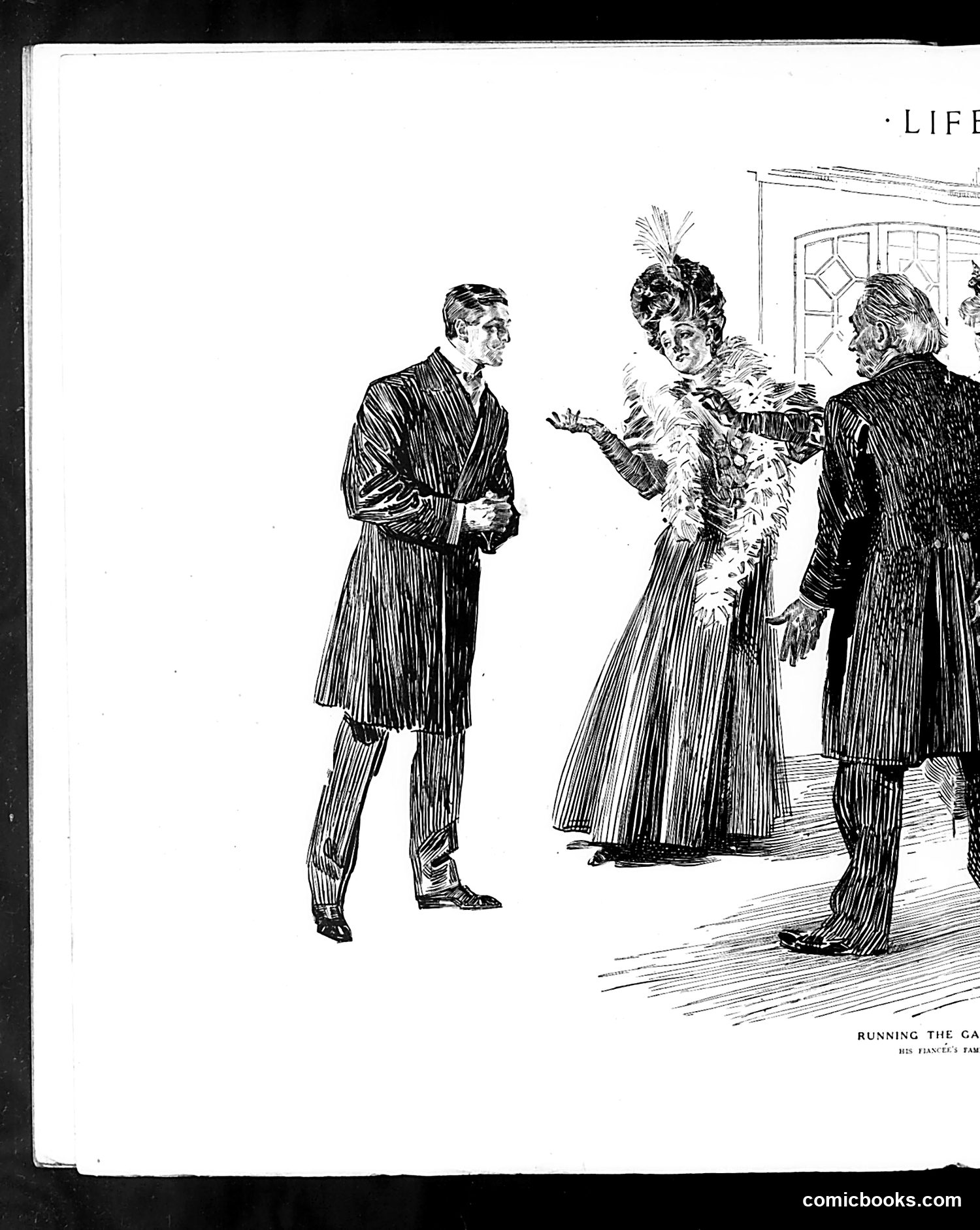
This Life magazine illustration depicts a social scene with three figures in formal early-20th-century dress. A man on the left observes while a fashionably dressed woman in the center—wearing an elaborate feathered hat and fur stole—appears to be the focus of attention from another man on the right. The incomplete caption "RUNNING THE GA[...] HIS FIANCEE'S FAM[...]" suggests this satirizes social dynamics around courtship or family management, likely mocking how a man must navigate or "run the gauntlet" of his fiancée's family social expectations and approval. The woman's conspicuous finery emphasizes material concerns, suggesting satire of upper-class matrimonial customs or the financial/social pressures involved in romantic pursuits of that era.
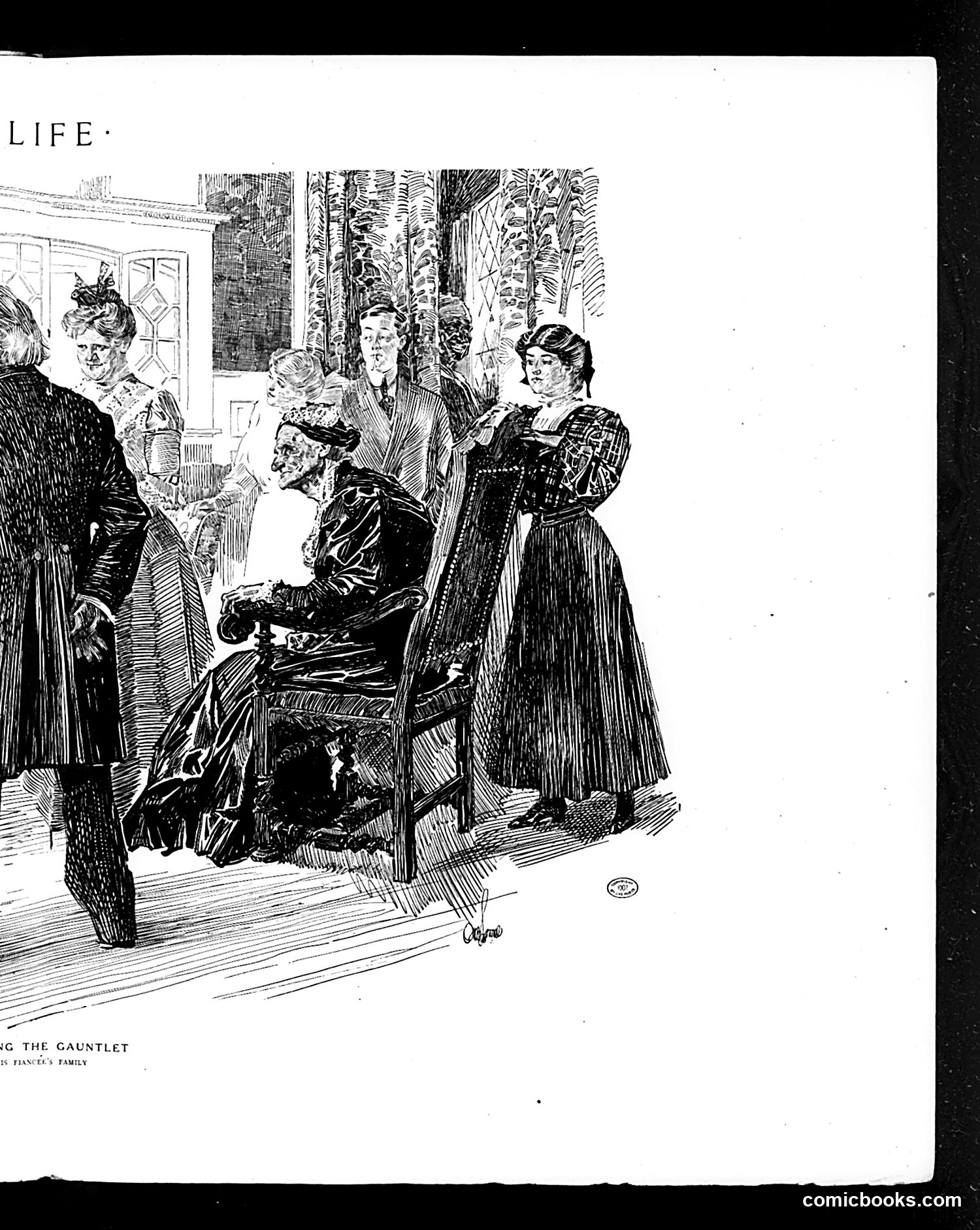
This appears to be a satirical illustration from Life magazine titled "Running the Gauntlet" (partial text visible: "...G THE GAUNTLET" and "...S FIANCEE'S FAMILY"). The scene depicts a seated woman in dark clothing being scrutinized by several standing figures in an interior setting with decorative wallpaper. The composition suggests a social trial or inspection—likely depicting a fiancée meeting her betrothed's family for the first time, a scenario treated as an ordeal ("running the gauntlet"). The satire mocks the anxiety of courtship rituals and family judgment in early 20th-century social customs. The woman's formal black dress and the family members' evaluative stares emphasize how marriage prospects involved intense social and familial scrutiny, particularly regarding a woman's suitability as a spouse. The work satirizes period gender dynamics and social pretension.
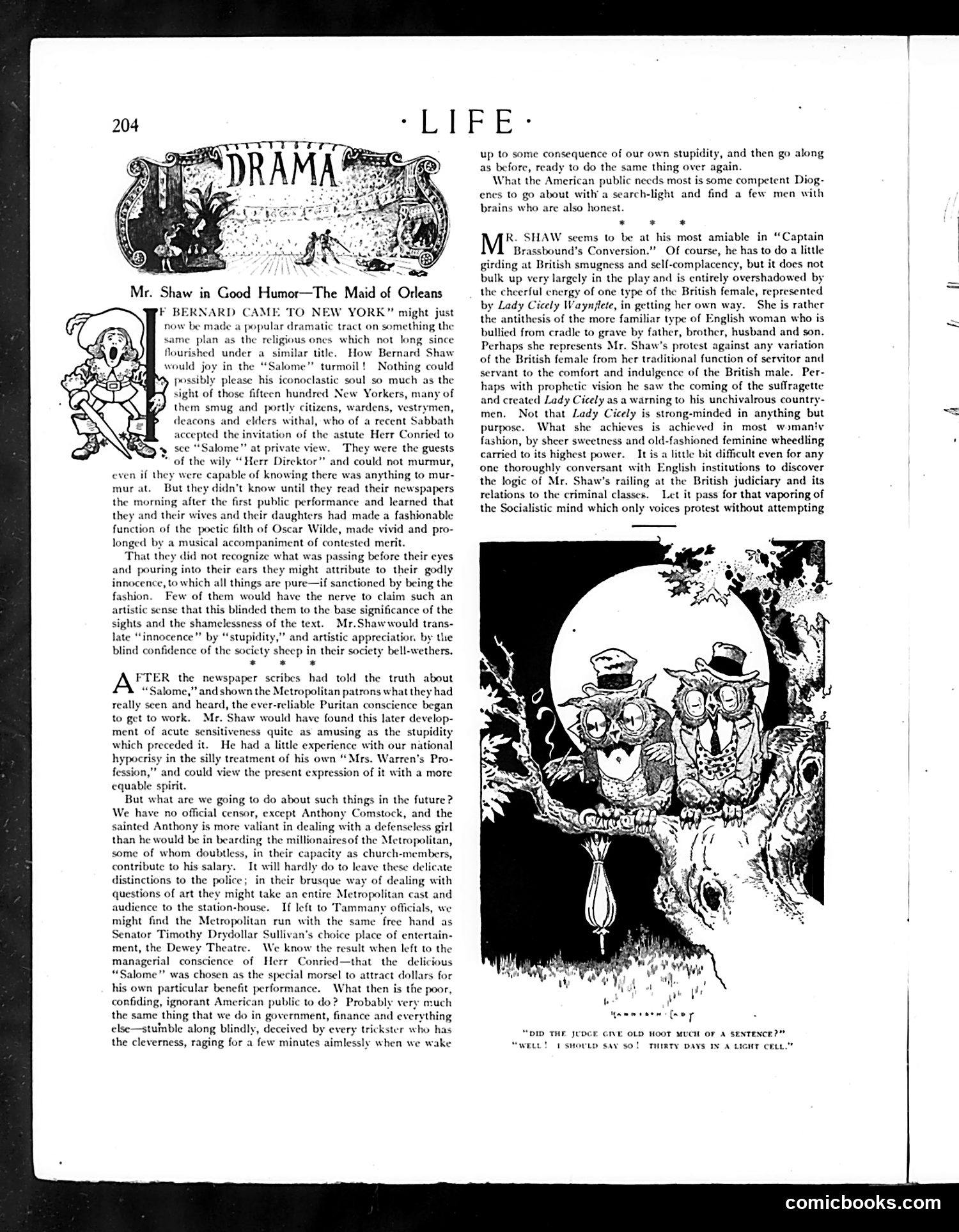
This article satirizes the hypocrisy of New York's elite regarding Oscar Wilde's scandalous play *Salome*. **The Setup:** Society's wealthy and respectable citizens (described as "smug and portly") attended a private viewing, unaware of the play's explicit sexual content. Only when newspapers revealed what they'd seen did their "Puritan conscience" kick in—they became outraged at what they'd unknowingly witnessed. **The Satire:** The author mocks this willful blindness, comparing it to the stupidity that playwright Bernard Shaw would find amusing. The piece criticizes how the fashionable and powerful can ignore moral concerns when presented as "art," yet claim innocence afterward. **Political Context:** The article references Anthony Comstock (a real censor), Tammany Hall corruption, and theater manager Herr Conried's profit motive—suggesting that American society lacks honest moral guardians and instead stumbles along "deceived by every trickster," blindly raging then forgetting. The accompanying illustration (right) appears to be a related satirical drawing, though details are unclear.
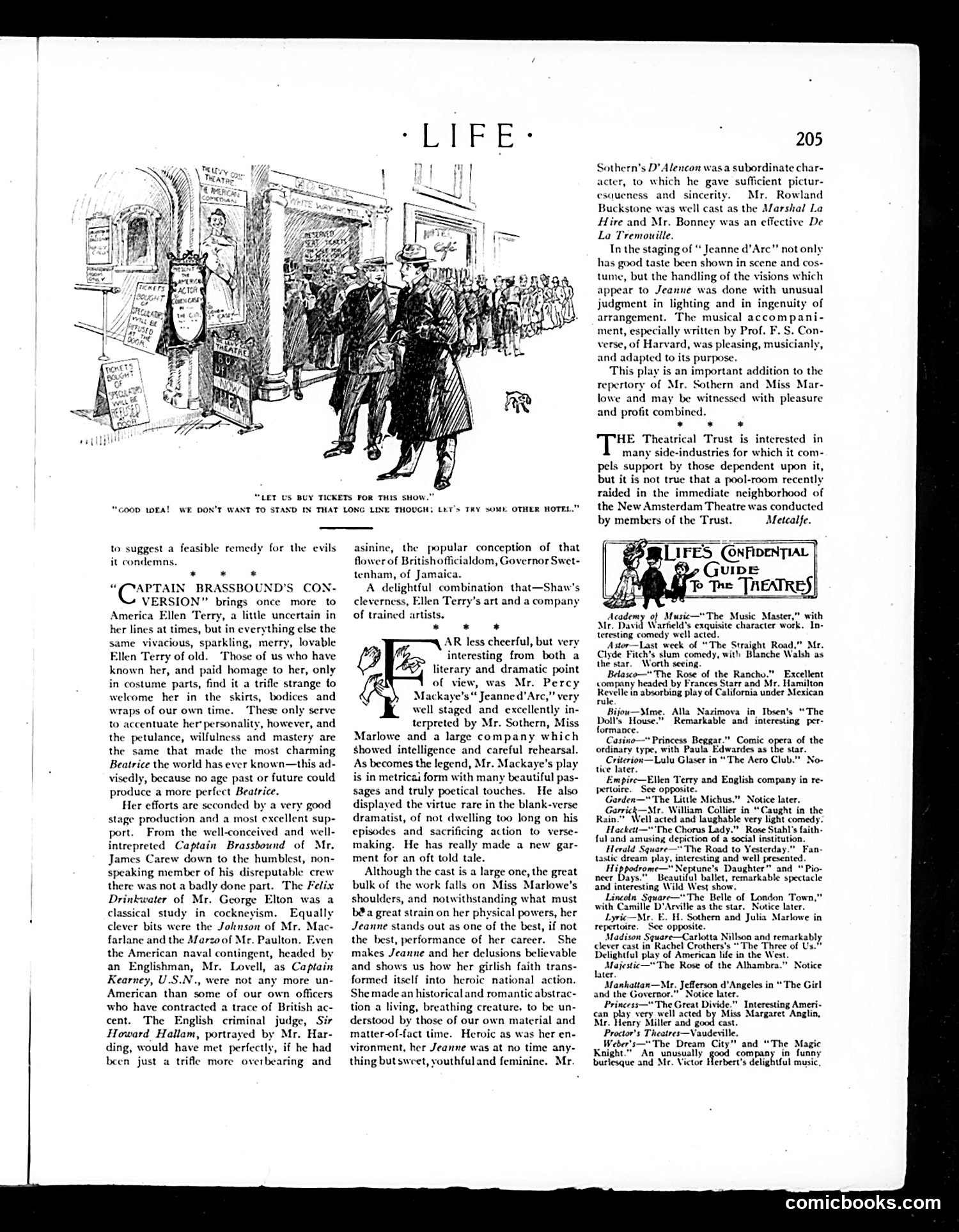
## The Cartoon The illustration depicts two well-dressed men outside a theater discussing ticket purchases. One suggests buying tickets for "this show," but his companion protests against standing in a long line, proposing they "try some other hotel" instead—implying they'll see a different theatrical production elsewhere. ## Meaning for Modern Readers This is **social satire about theatrical competition and consumer choice** in early 20th-century New York. The joke targets the inconvenience of popular shows: audiences faced long queues to purchase tickets, so patrons simply chose competing productions at rival theaters rather than wait. The cartoon humorously illustrates a real problem—**theater-going logistics**—while subtly mocking the disposable nature of theatrical entertainment. Rather than invest time in a desired show, audiences treated theaters as interchangeable commodities. The "hotel" reference likely alludes to theater lobbies or nearby hotel box offices where tickets were sold. This reflects the era's theatrical abundance and competitive marketplace, where entertainment options were plentiful enough that patience was unnecessary.
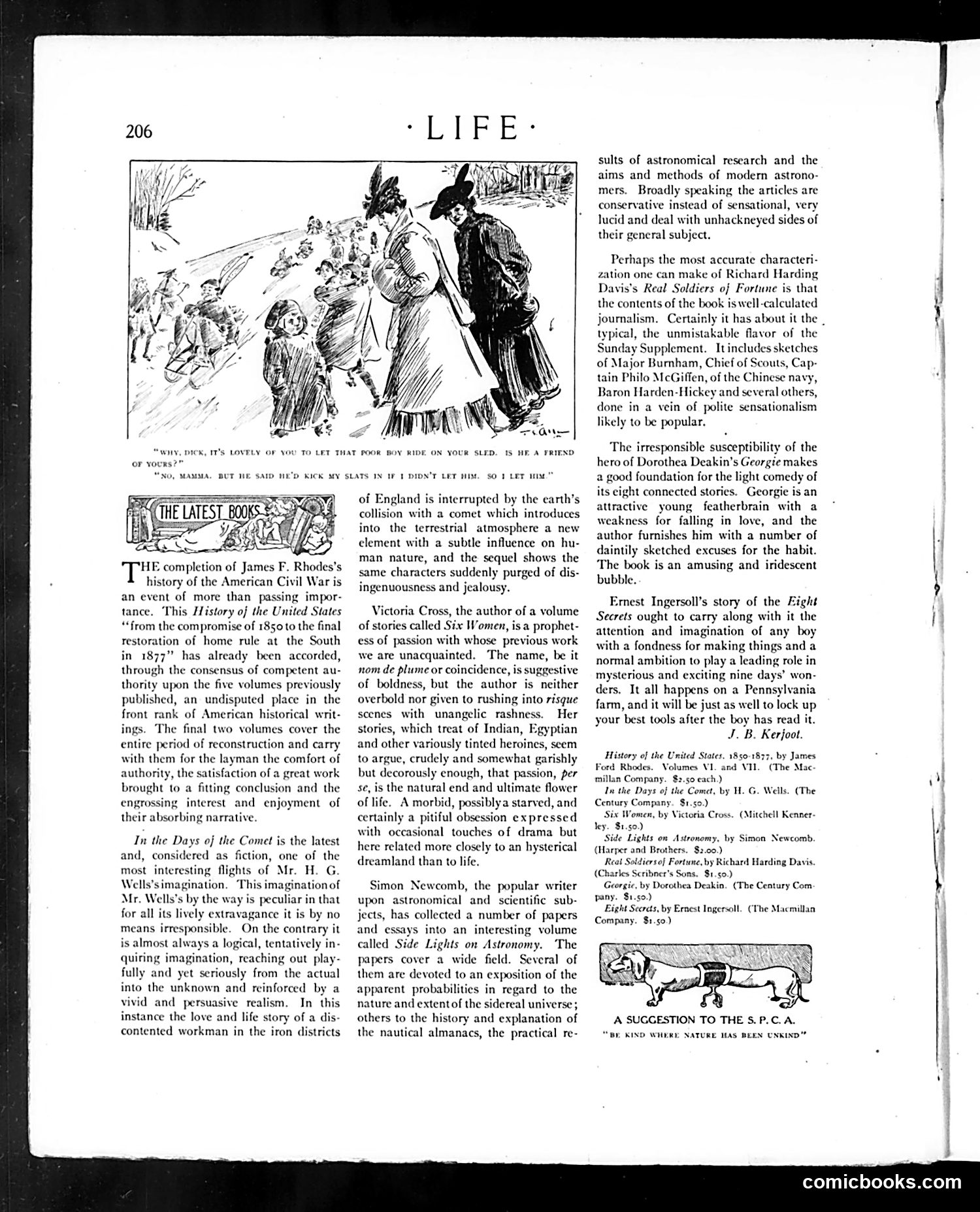
This page is primarily a **book review section** with one satirical cartoon at the top. ## The Cartoon The single illustration depicts a child telling his mother he's letting another boy ride on his sled—not out of kindness, but under coercion. The boy threatened to "kick my slats in" (beat him up) if refused. **The satire**: This is social commentary on bullying and extortion dressed in polite Victorian language. The cartoon mocks the genteel pretense of the era—the mother assumes charitable motives, but the child's brutal honesty reveals the coercive reality beneath civilized appearances. It's likely a commentary on power dynamics in society, possibly referencing labor disputes or political intimidation of the Reconstruction era. ## The Text The page reviews several books, including H.G. Wells's *In the Days of the Comet* (which involves a celestial event altering human nature) and Richard Harding Davis's *Real Soldiers of Fortune* (dismissed as mere "Sunday Supplement" journalism). The reviews are straightforward literary criticism with no apparent political agenda beyond professional assessment.
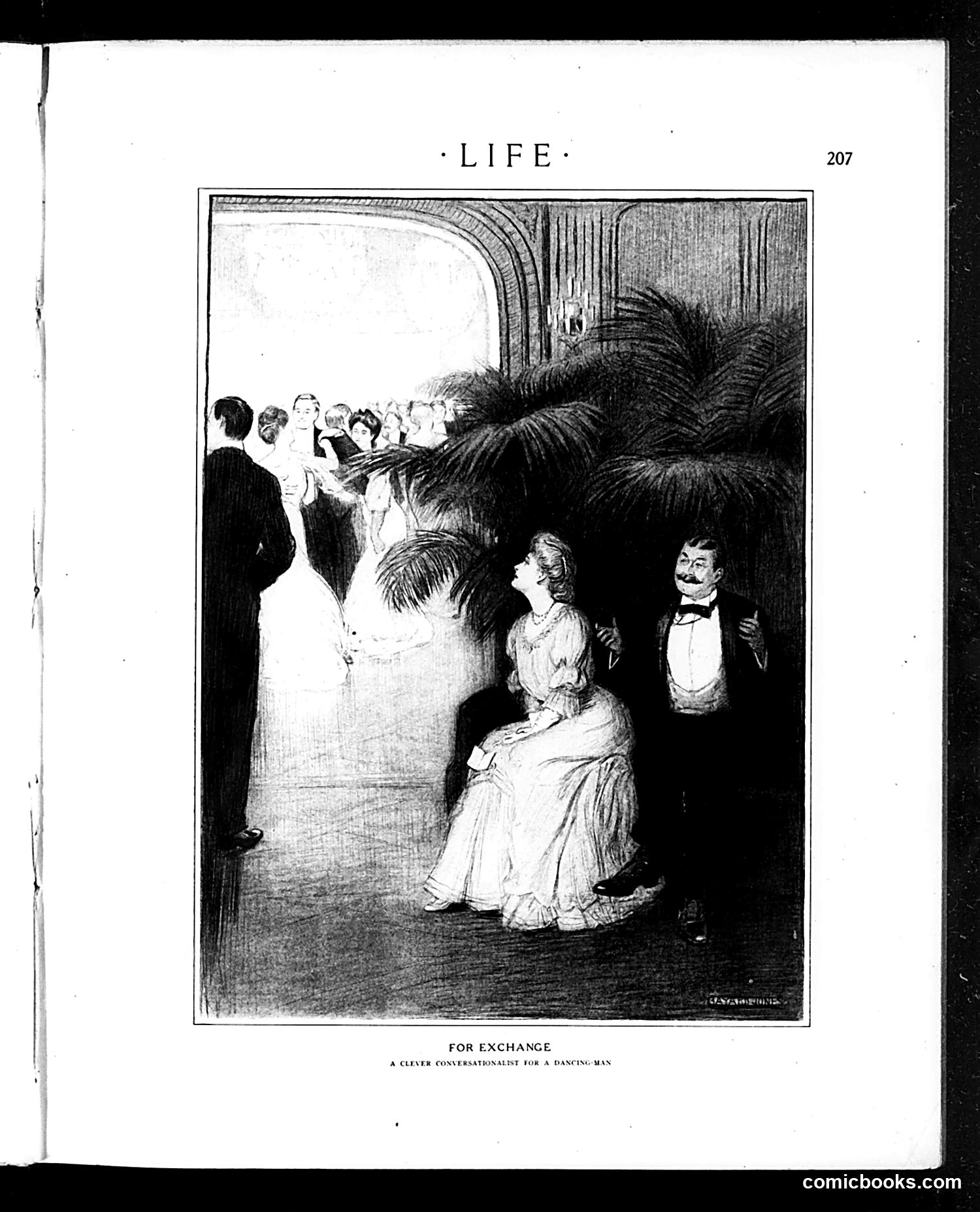
This satirical cartoon depicts a social exchange at what appears to be a formal evening event or party. In the foreground, a woman in a white dress sits prominently, while a man in formal attire stands nearby. Behind them, other guests mingle near a doorway, and large palm plants decorate the setting. The caption "FOR EXCHANGE: A CLEVER CONVERSATIONALIST FOR A DANCING MAN" suggests the cartoon's satirical point: it mocks the gender dynamics of high society courtship and entertainment. The joke implies women were valued primarily for either dancing ability or conversational skills—commodities to be traded or exchanged among men. It satirizes the superficiality of social interactions and the reduction of women to particular performative qualities within upper-class social gatherings.
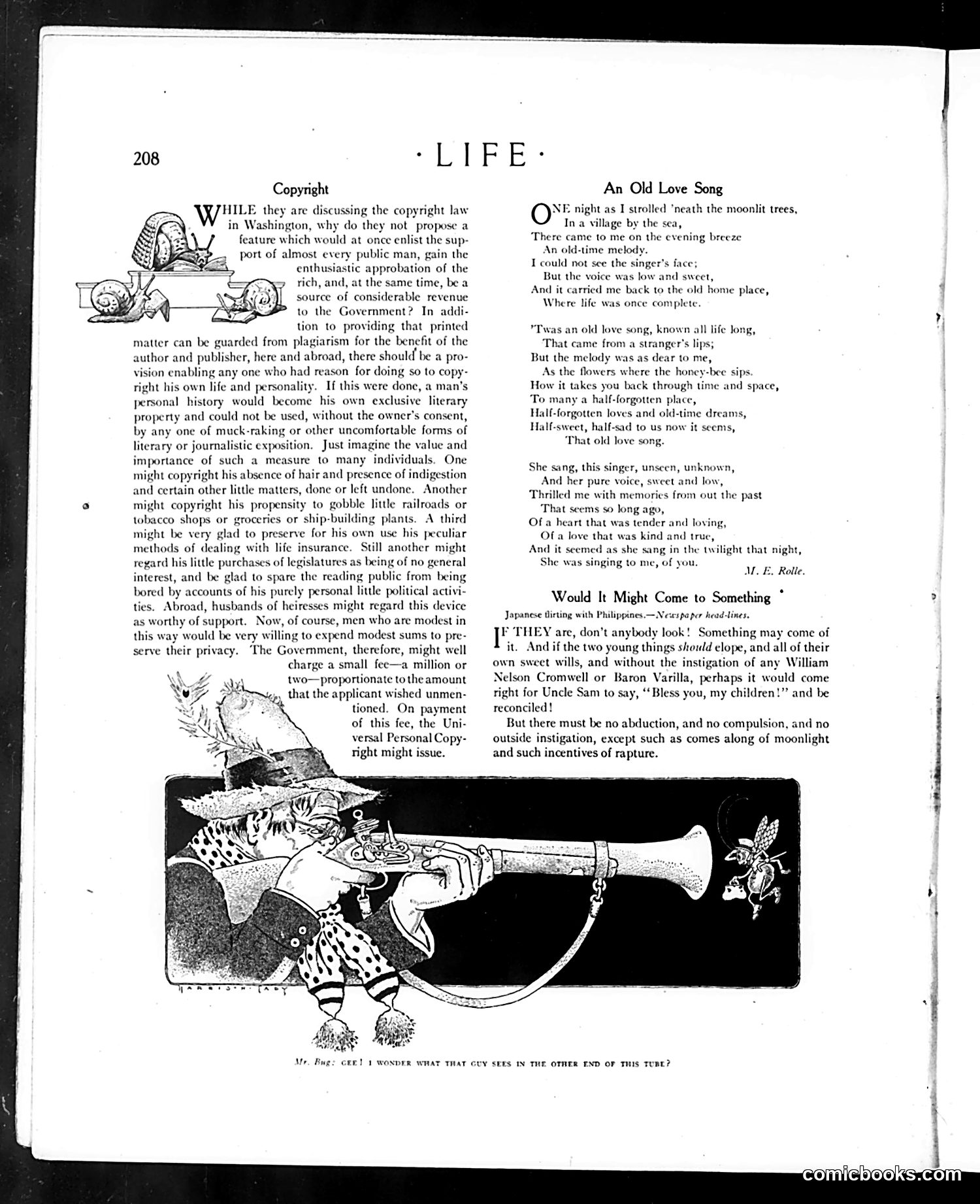
**The Copyright Proposal (Left Column):** This satirical essay proposes a "Universal Personal Copyright" allowing wealthy and powerful individuals to legally hide embarrassing facts about themselves—their business practices, political corruption, or personal scandals—from public exposure. The satire mocks robber barons, corrupt politicians, and monopolists (those "gobbling little railroads" and buying legislatures) who would eagerly pay the government a fee to suppress unflattering truths. It's a biting commentary on how the rich use money and power to control their public image and escape journalistic accountability. **The Cartoon (Bottom):** Shows a figure (likely a wealthy industrialist or politician, though not specifically identified) peering through a telescope, amusingly suggesting self-delusion or myopia about one's own character flaws. **"Would It Might Come to Something" (Right):** References recent diplomatic tensions with the Philippines and jokingly hopes for peaceful romantic reconciliation rather than military conflict, with veiled allusions to questionable American interventions.
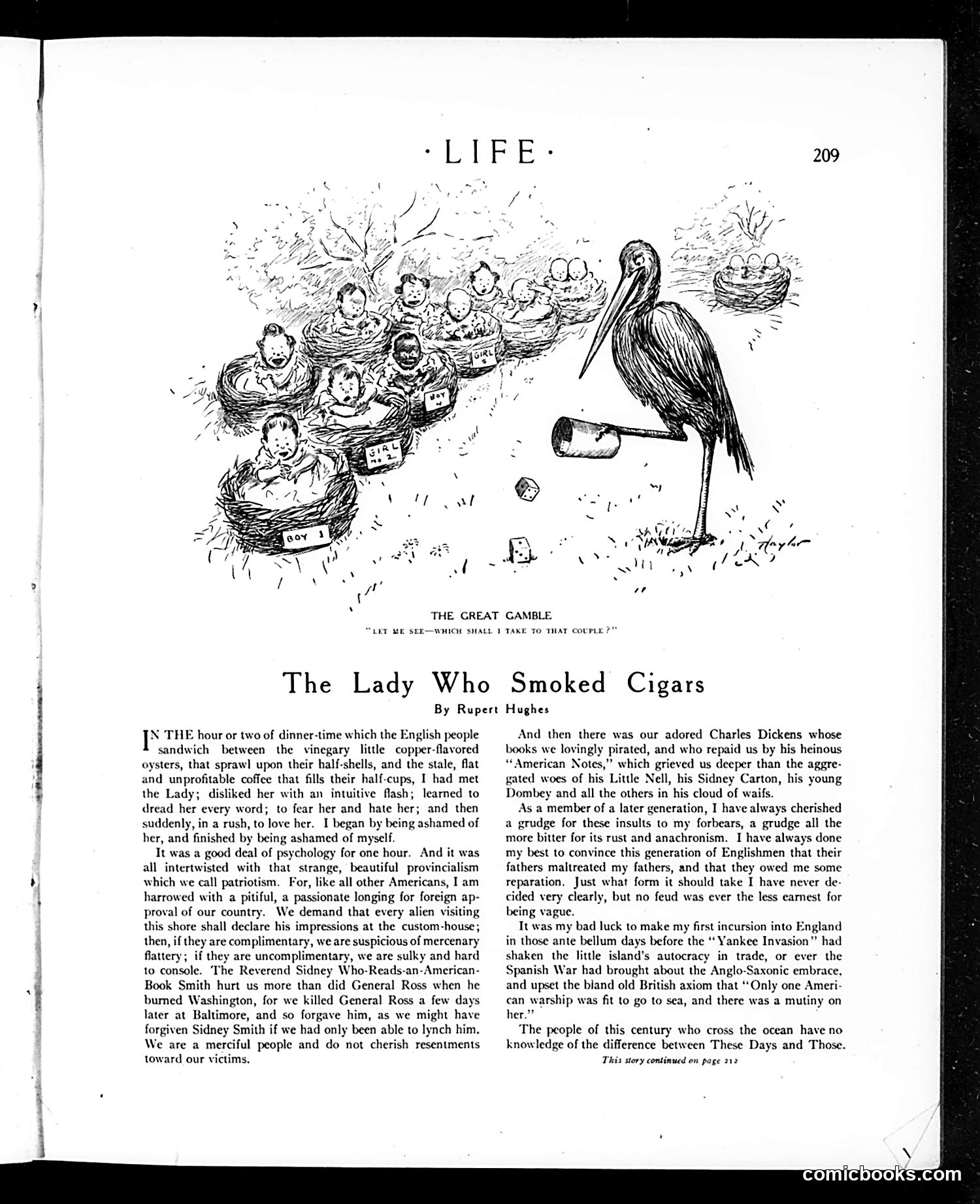
The cartoon depicts a stork carrying babies in baskets, appearing to decide which nest of infants to deliver to—a visual pun on "The Great Gamble" about choosing futures. The accompanying story by Rupert Hughes is a satirical essay on American-British relations and national pride. Hughes discusses how Americans simultaneously crave foreign approval yet resent foreign criticism. He cites specific historical grievances: British author Sidney Smith's unflattering travel writings hurt Americans more than actual military enemy General Ross did; Charles Dickens's "American Notes" deeply offended earlier generations through piracy and his critical portrayal of America. Hughes argues pre-WWI Americans harbored decades-old resentments toward Britain, though the "Yankee Invasion" and Spanish-American War had begun reconciling Anglo-Saxon relations. The essay sets up a story exploring these tensions through a mysterious "Lady" he encounters in England—establishing the cultural friction that animated transatlantic relations before modern alliance.
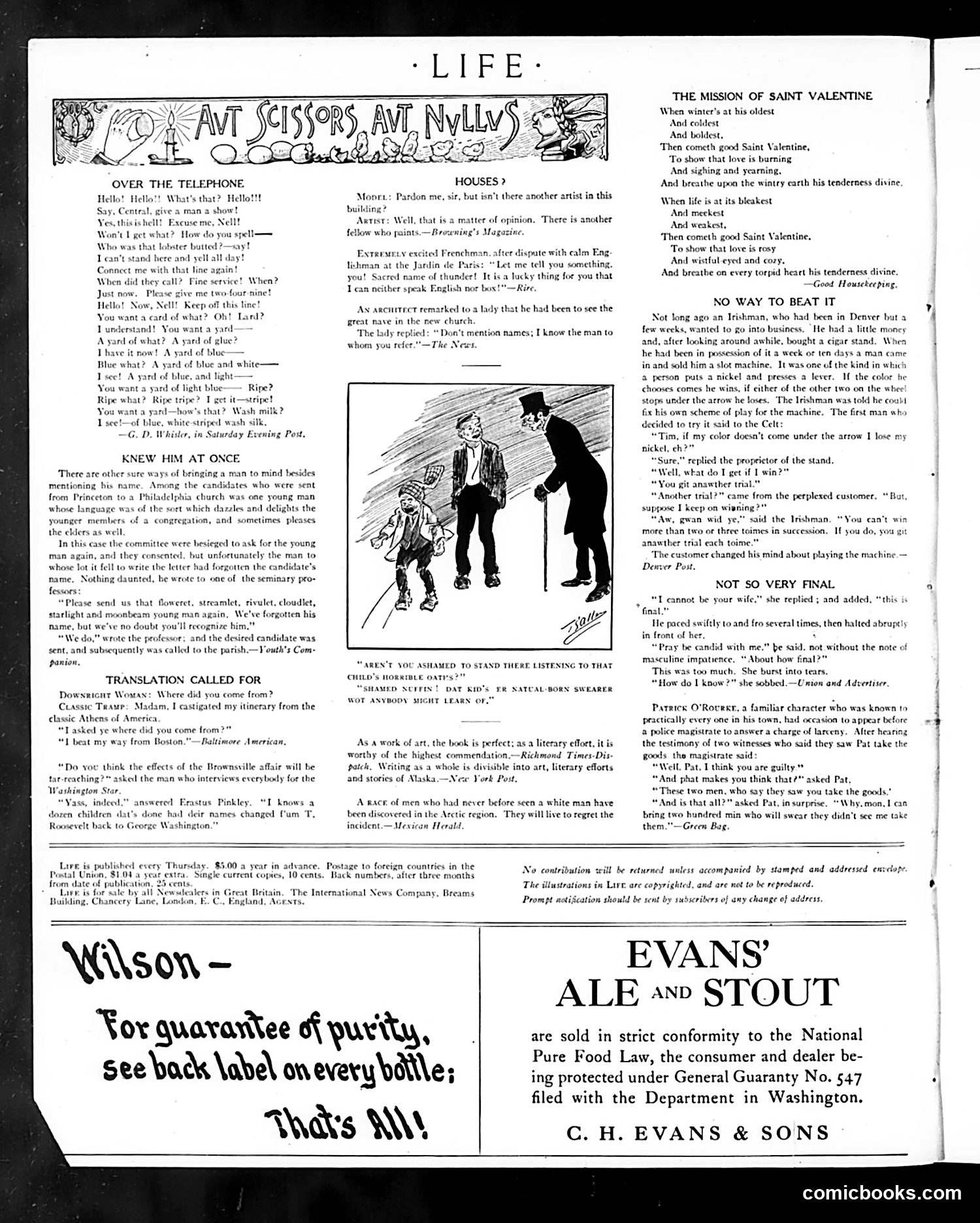
This page contains several satirical pieces typical of early 20th-century American humor: **"Over the Telephone"** is a comedy sketch mocking the confusion of early telephone communication—a caller and operator repeatedly mishear each other, confusing simple words ("lard" for "yard," "tripe" for "type"). The humor derives from the novelty and difficulty of voice-only communication without visual context. **"Knew Him at Once"** satirizes verbose, flowery speech. A seminary committee hires a candidate famous for poetic language ("starlight and moonbeam young man"), then forgets his actual name—showing that ornate rhetoric obscures rather than clarifies identity. **"Translation Called For"** contrasts a pretentious immigrant ("castigated my itinerary from classic Athens of America") with a blunt American ("I beat my way from Boston"), mocking affectation versus plain speech. The remaining pieces humorously address miscommunication, class differences, and period social dynamics. Advertisements for Wilson whiskey and Evans' Ale occupy the lower portion.
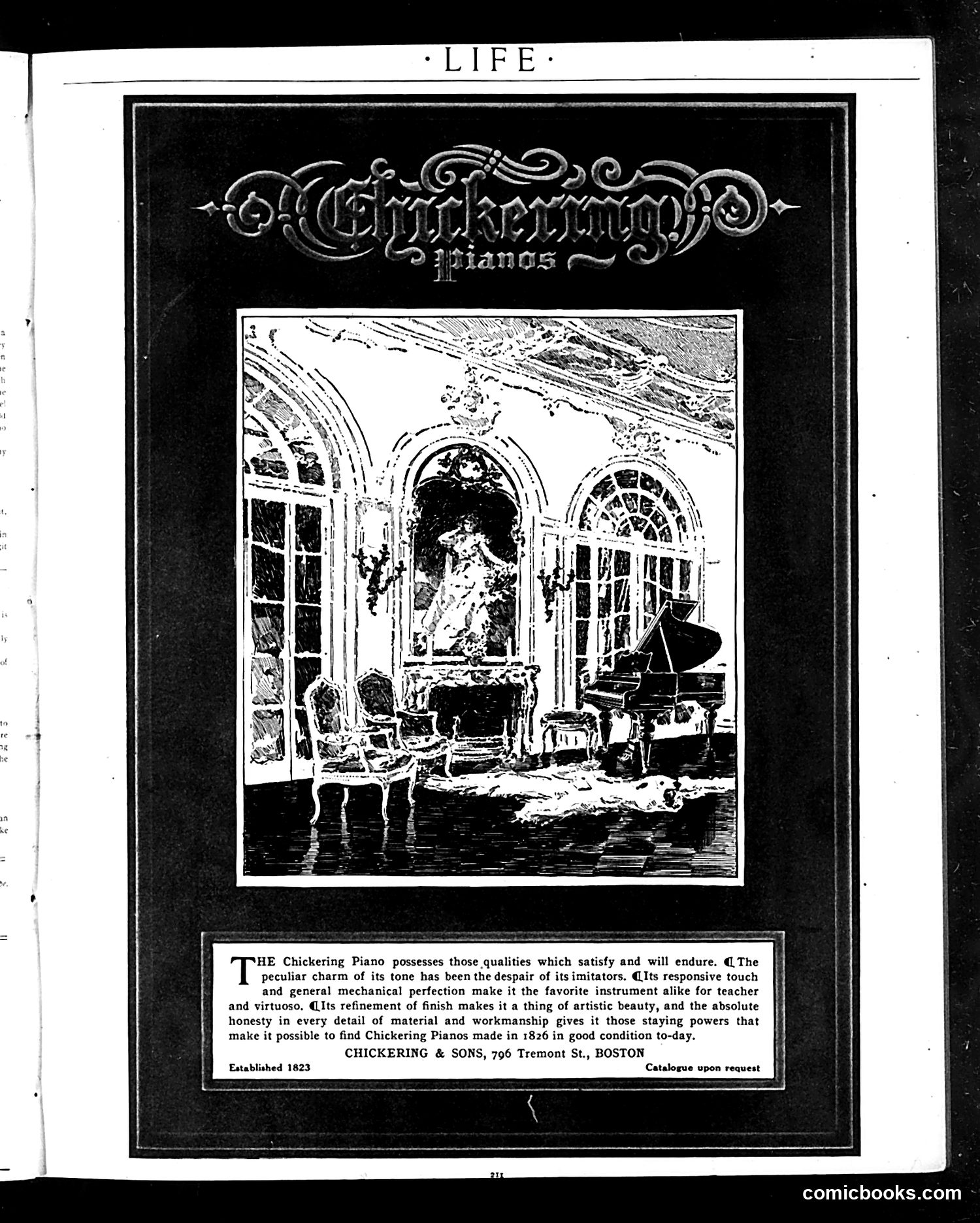
This page is a **Chickering Piano company advertisement**, not political commentary or satire. The illustration depicts an elegant parlor with a grand piano, fireplace, and tall windows—a aspirational scene of refined domestic life. The text emphasizes the piano's quality, durability, and prestige. Key selling points include: superior tone that competitors cannot imitate, mechanical perfection, artistic beauty, and exceptional longevity (claiming pianos from 1826 still exist in good condition). The Boston-based Chickering & Sons company, established 1823, positioned their pianos as instruments for both professional musicians ("virtuosos") and teachers. The luxurious interior setting appeals to middle/upper-class consumers who valued music as a marker of cultural refinement and domestic sophistication during this era. This represents standard early 20th-century advertising in *Life* magazine.
This is a satirical short story about Anglo-American cultural tensions, not primarily a political cartoon. The unnamed narrator, an American, attempts to convince a snobbish English novelist (Mrs. Nesmith) that Americans possess refinement and sophistication. Mrs. Nesmith stereotypes Americans using crude dialect ("I guess," "I calculate," "Pa used to operate considerable in pork"), which the narrator finds offensive. The narrator arranges an introduction to wealthy Americans—the "Asphalt King" and his wife—as living proof of American respectability. The joke: the Asphalt King proves the stereotype partially correct—he's described as physically "puny" and intellectually empty, appearing as a self-made industrialist lacking substance. His wife is presented more favorably. The satire targets both British condescension toward Americans and American nouveaux riches who gained fortunes through resource extraction (asphalt) rather than inherited gentility. It reflects early 20th-century anxiety about American social status in Anglo-American relations.
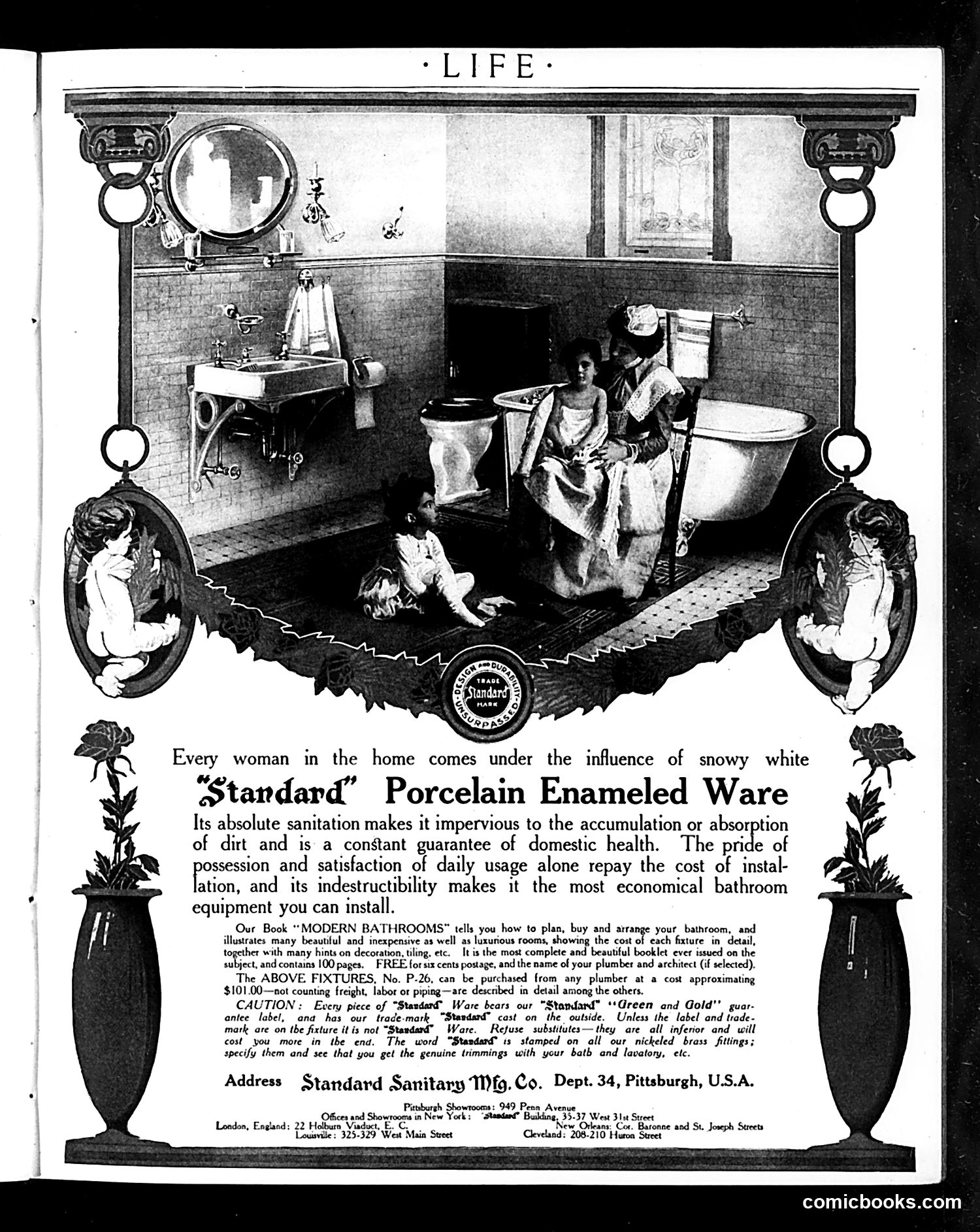
This is a **full-page advertisement**, not satire or political commentary. Standard Sanitary Manufacturing Company is marketing porcelain-enameled bathroom fixtures to homeowners. The image shows a cutaway bathroom scene with women and children using the fixtures, framed by decorative classical elements (urns, cherubs). The ad emphasizes **sanitation and hygiene** as selling points—key concerns of the early 20th century when indoor plumbing was becoming standard in middle-class homes. The text appeals to women as household managers, associating the product with "domestic health" and "pride of possession." It also warns against counterfeits, instructing buyers to check for the "Standard" trademark and label. The ad offers a free 100-page booklet on bathroom planning and design, suggesting this was a period when bathroom renovation was becoming a significant home improvement decision. **This reflects the era's marketing strategy of linking consumer goods to modern sanitation and respectability.**
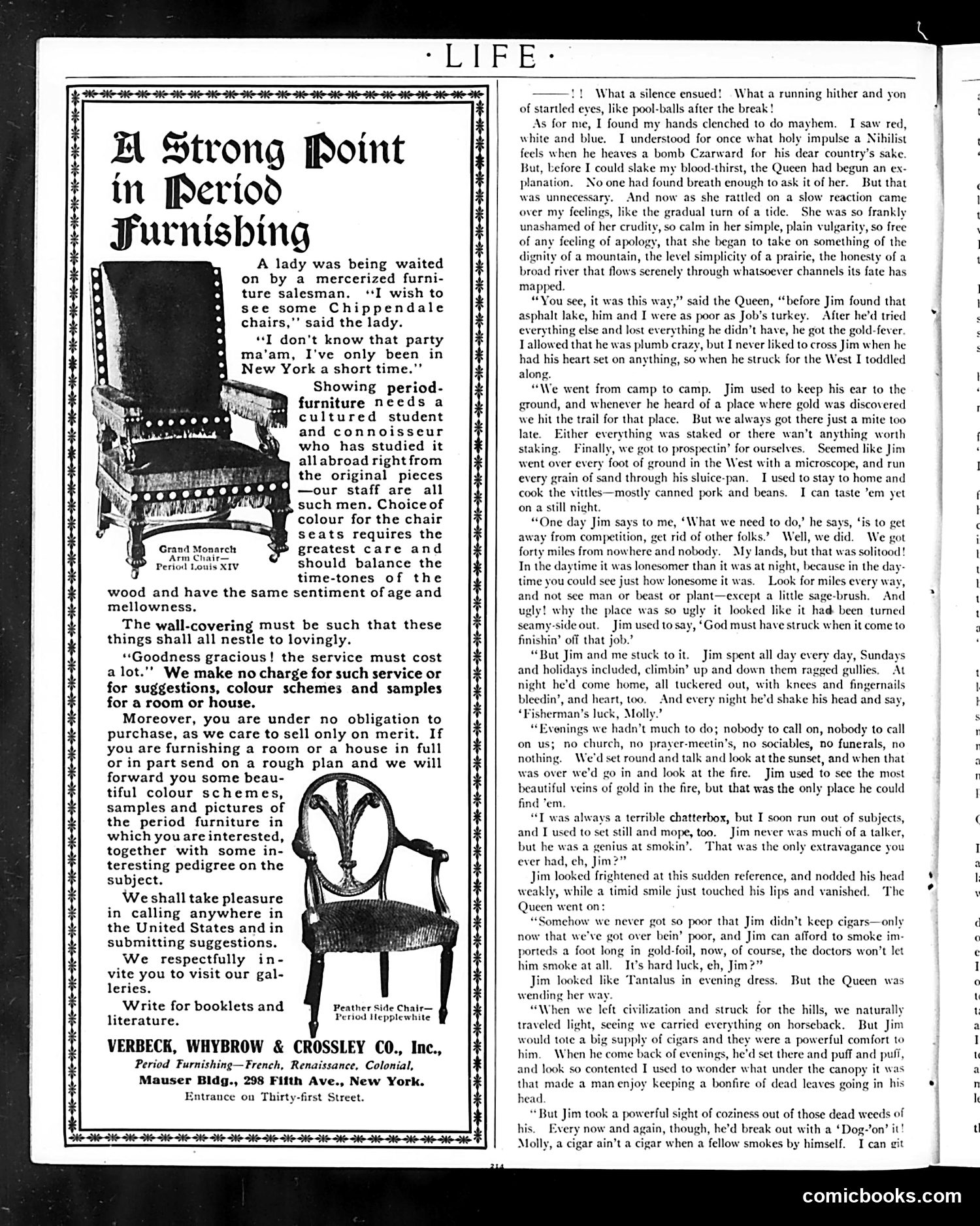
This page combines advertising with serialized fiction. The left side features an ornate advertisement for **Verbeck, Whybrow & Crossley Co., Inc.**, a period furniture dealer specializing in historically accurate reproductions (French, Renaissance, Colonial styles). The ad uses snobbish language about "cultured" taste and "pedigree" to market expensive furniture. The right side continues a story about a Queen narrating her past. She describes how she and "Jim" were poor prospectors seeking gold in the American West. The narrative appears satirical—mocking both frontier mythology and the Queen's crude, vulgar manner of speech (dialect like "ma'am," "vittles"). The juxtaposition creates irony: the pretentious furniture advertisement sits beside a story where a Queen speaks in working-class frontier vernacular, suggesting social pretension is ridiculous. The satire likely mocks both excessive materialism and false class distinctions—targets typical of *Life* magazine's humor in this era.
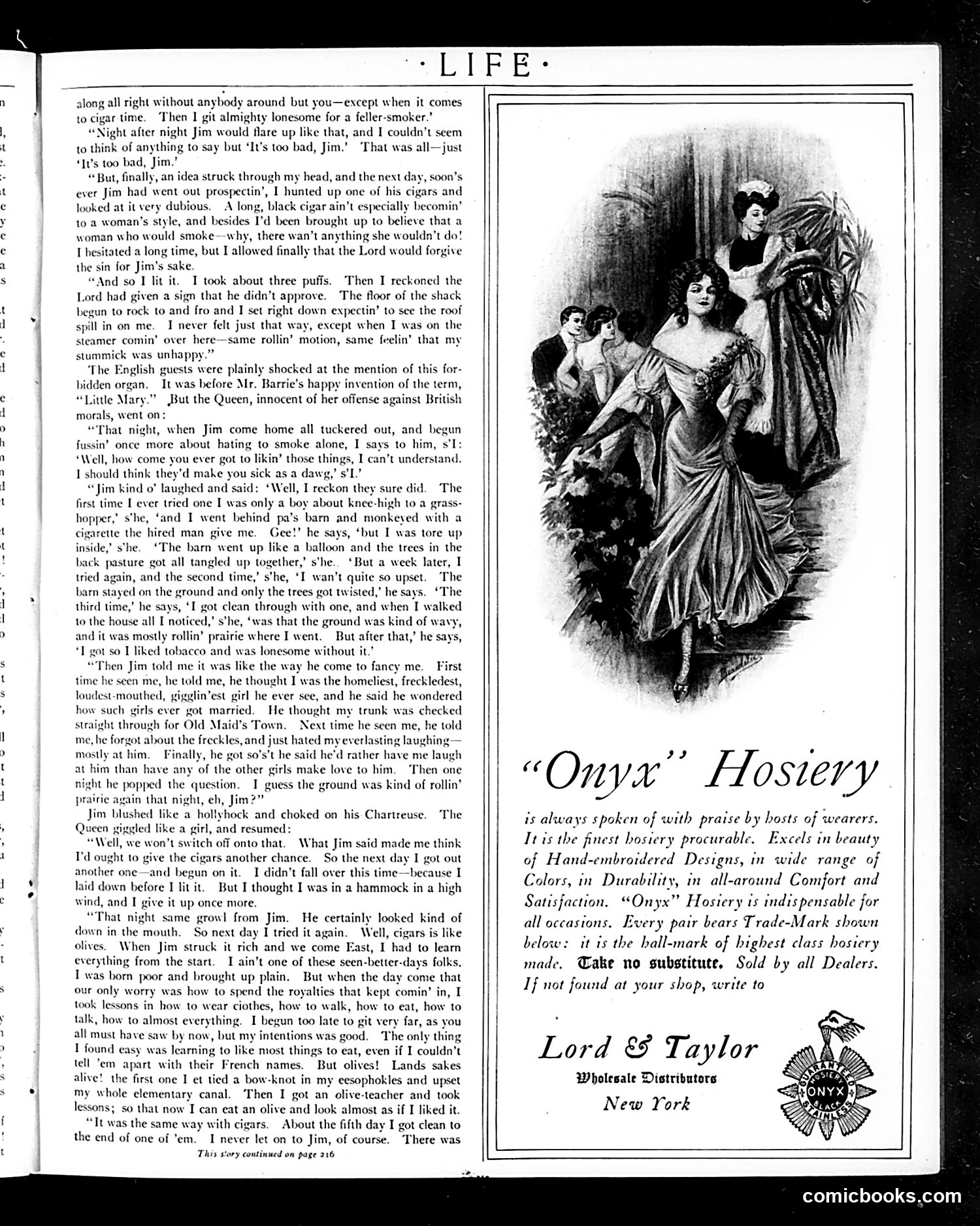
This page contains a lengthy anecdote—not a political cartoon—told by a female character (likely a queen, based on context clues) to English guests. The narrative describes her attempt to bond with her husband "Jim" by smoking one of his cigars, despite her upbringing forbidding women from smoking. The humor turns on several period-specific taboos: women smoking was considered deeply immoral ("there wan't anything she wouldn't do!"), and the Queen's candid discussion of this transgression shocks her proper English audience. The advertisement for "Onyx Hosiery" on the right represents typical Life magazine commercialization. **For modern readers:** The joke relies on early 20th-century gender norms where women smoking was scandalous. The Queen's casual vulgarity and rule-breaking behavior—smoking, discussing bodily reactions frankly—was shocking entertainment for the era's readers. The page contains no political satire, just social comedy about gender conventions now largely obsolete.
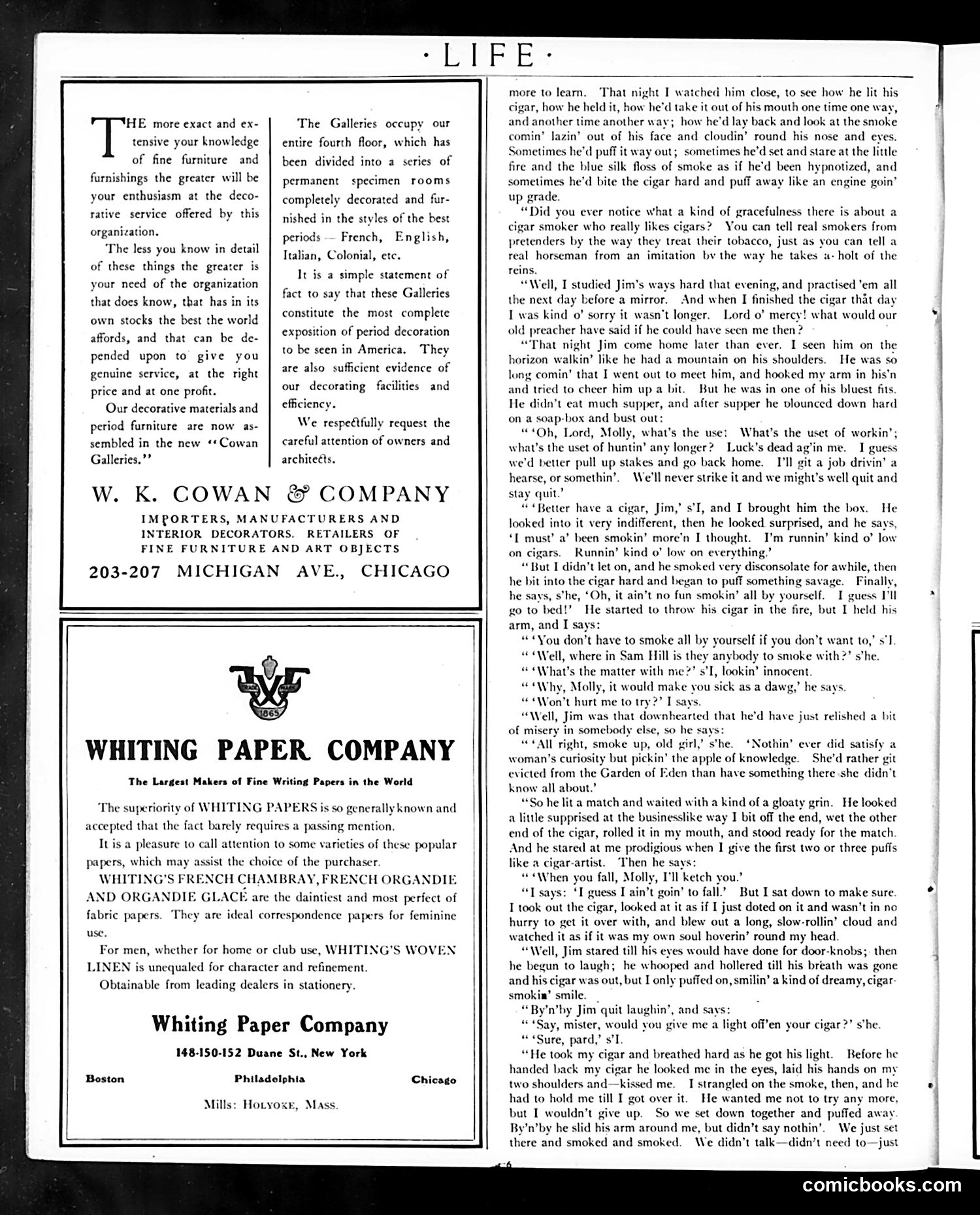
This page is primarily **advertising**, not satirical content. It contains three full-page ads for furniture (W.K. Cowan & Company), writing paper (Whiting Paper Company), and stationery. The right column contains what appears to be serialized **fiction or a personal essay** about a narrator learning to smoke cigars by observing someone named Jim. The narrative describes studying Jim's casual, graceful technique with cigars and practicing it in a mirror—suggesting the piece satirizes either masculine affectation or the desire to imitate "worldly" behavior. A reference to an "old preacher" implies social/religious disapproval of smoking, adding a morality-tale dimension. There are **no political cartoons visible**. The page reflects early 20th-century magazine format mixing advertising with light entertainment fiction.
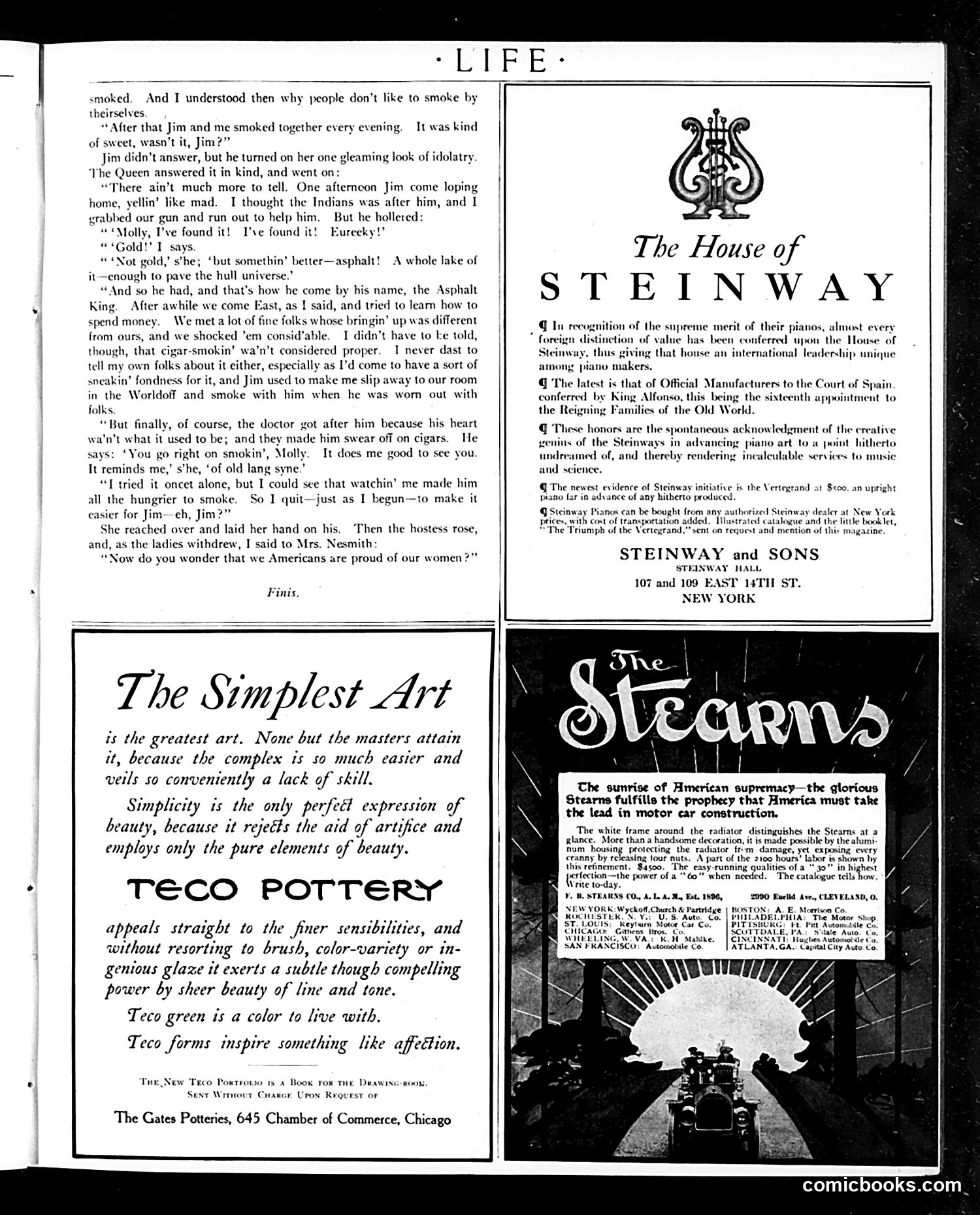
This page contains a short satirical story followed by advertisements, not a political cartoon. **The Story ("Finis"):** A wealthy woman ("The Queen") tells how she and her husband Jim—newly rich from discovering asphalt ("The Asphalt King")—scandalized high society by smoking together in their room. The satire targets the nouveau riche: their ignorance of social propriety, their eventual conformity to upper-class rules, and their touching devotion to each other despite social pressure. The final line celebrates American women's independence and loyalty. **The Advertisements:** The page includes ads for Steinway pianos (emphasizing royal patronage and prestige), Teco pottery (appealing to artistic refinement), and The Stearns automobile (featuring a dramatic locomotive image, promoting American manufacturing superiority). The advertisements reinforce the story's themes about aspiration, taste, and American achievement—wealthy Americans buying markers of culture and sophistication.
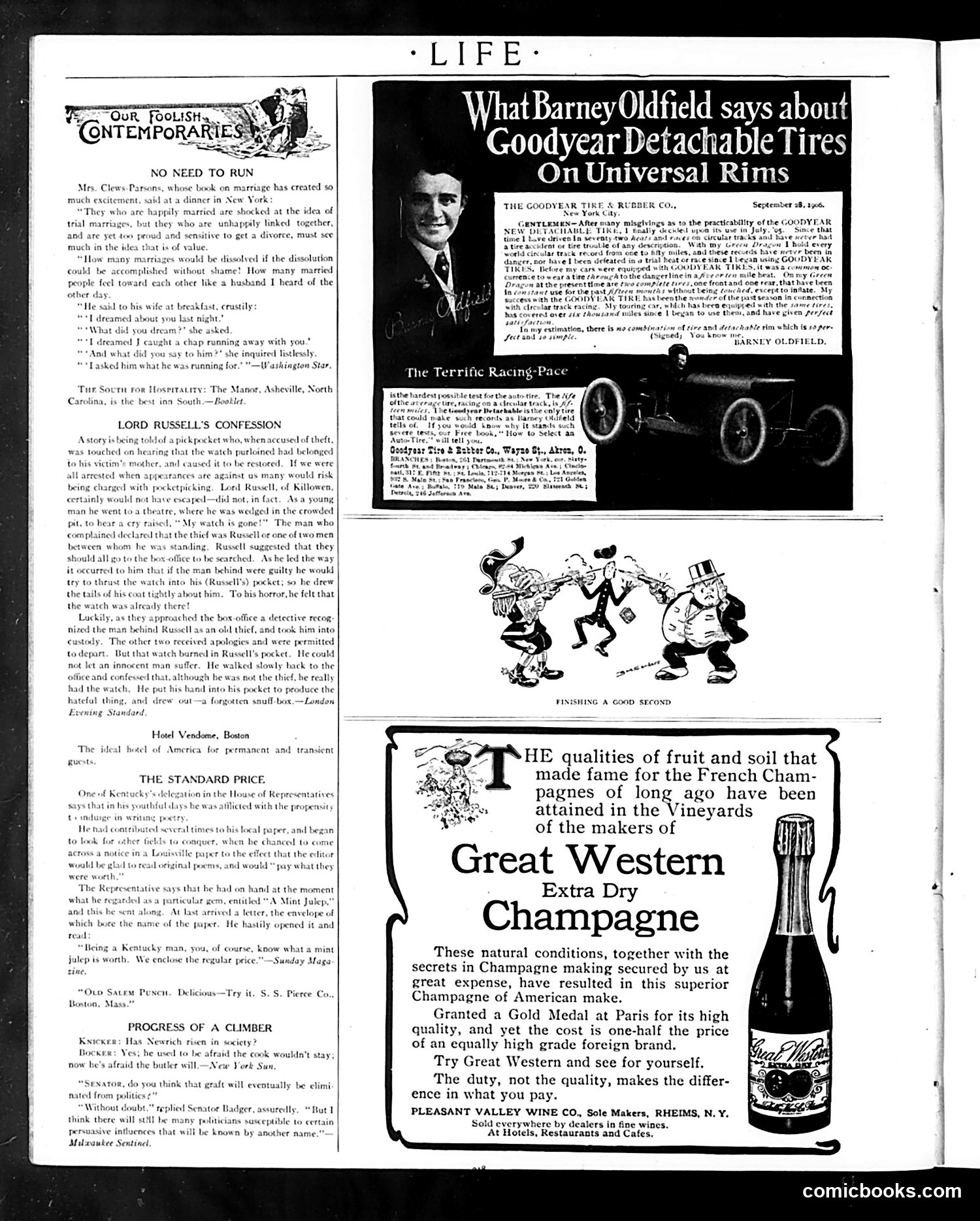
This page from *Life* magazine (September 28, 1905) mixes satirical commentary with period advertisements. **The Cartoons:** The upper left contains "Our Foolish Contemporaries," satirizing a Mrs. Clews Parsons who advocated "trial marriages"—a radical idea for 1905. The satire mocks how couples who practice this arrangement feel no lasting commitment ("like a husband I heard of the other day"). Below that, "Lord Russell's Confession" jokes about a pickpocket's logic: a nobleman suggests searching suspects to catch a thief, but one man refuses—revealing his guilt. The irony: the thief was Russell himself, who'd already hidden the watch in Russell's pocket beforehand. The cartoon labeled "Finishing a Good Second" appears to satirize financial/social climbing, though details are unclear. **Advertisements:** The page features endorsements from racecar driver Barney Oldfield promoting Goodyear tires, and champagne advertisements—typical early-1900s product placements using celebrity endorsement, a marketing strategy already established by this era.
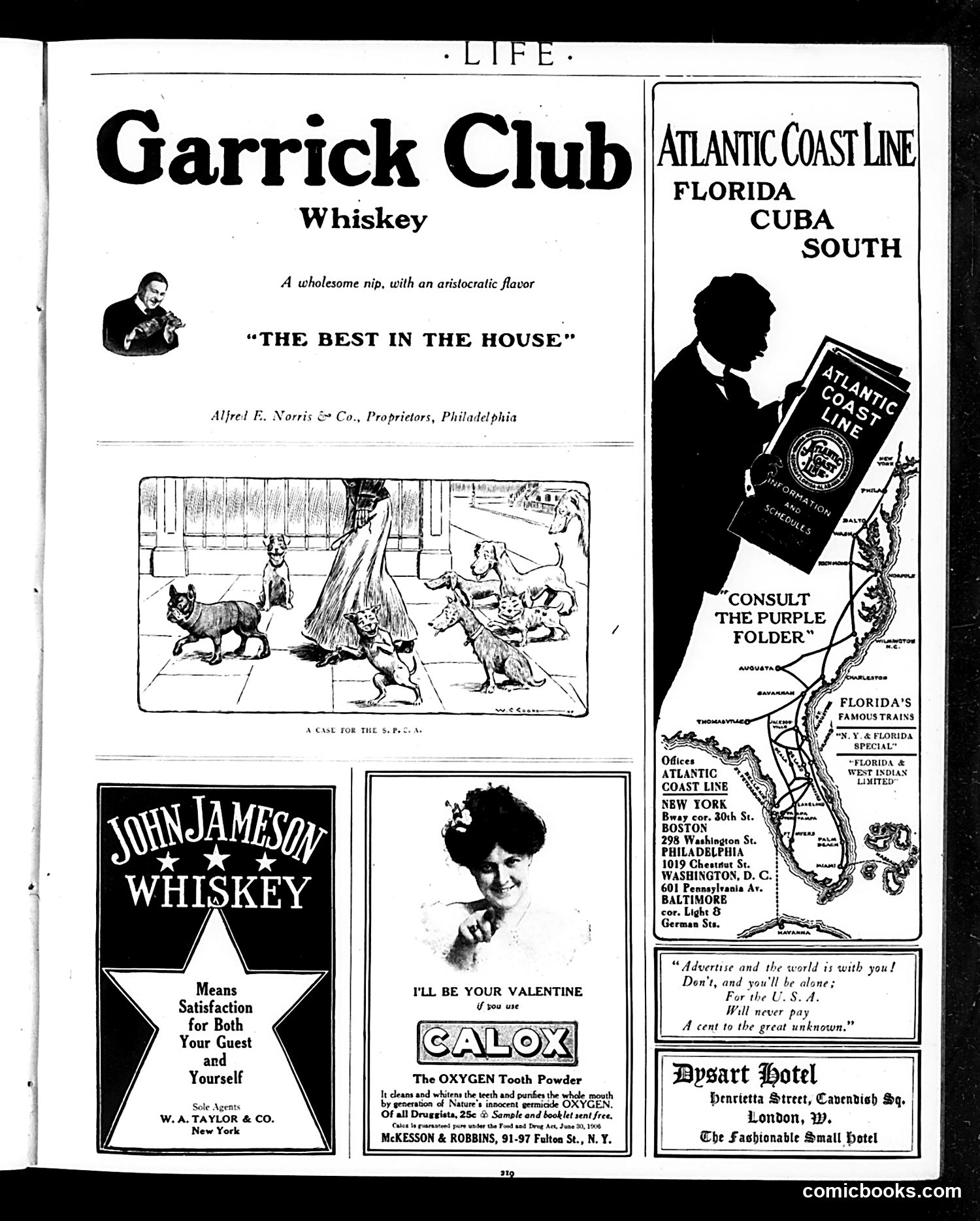
This is primarily an **advertisement page**, not a political cartoon. It contains multiple product ads from the early 20th century: **Main content:** - **Garrick Club Whiskey**: Features an illustration of dogs on a city street ("A cue for the S.P.C.A."), marketing itself as refined ("aristocratic flavor") - **John Jamson Whiskey**: Star-shaped ad emphasizing customer satisfaction - **Calox Tooth Powder**: Features a woman's face, using Valentine's Day messaging to promote the "Oxygen" cleaning formula - **Atlantic Coast Line**: Railroad advertisement with map promoting Florida, Cuba, and southern routes - **Dysart Hotel**: London lodging advertisement **The satire appears minimal**—the dog illustration on the whiskey ad may be a gentle joke about animal welfare (SPCA reference), but this is primarily a commercial page showcasing period advertising conventions: celebrity endorsements, pseudo-scientific health claims (the "Oxygen" tooth powder), and aspirational messaging about taste and refinement for a wealthy readership.
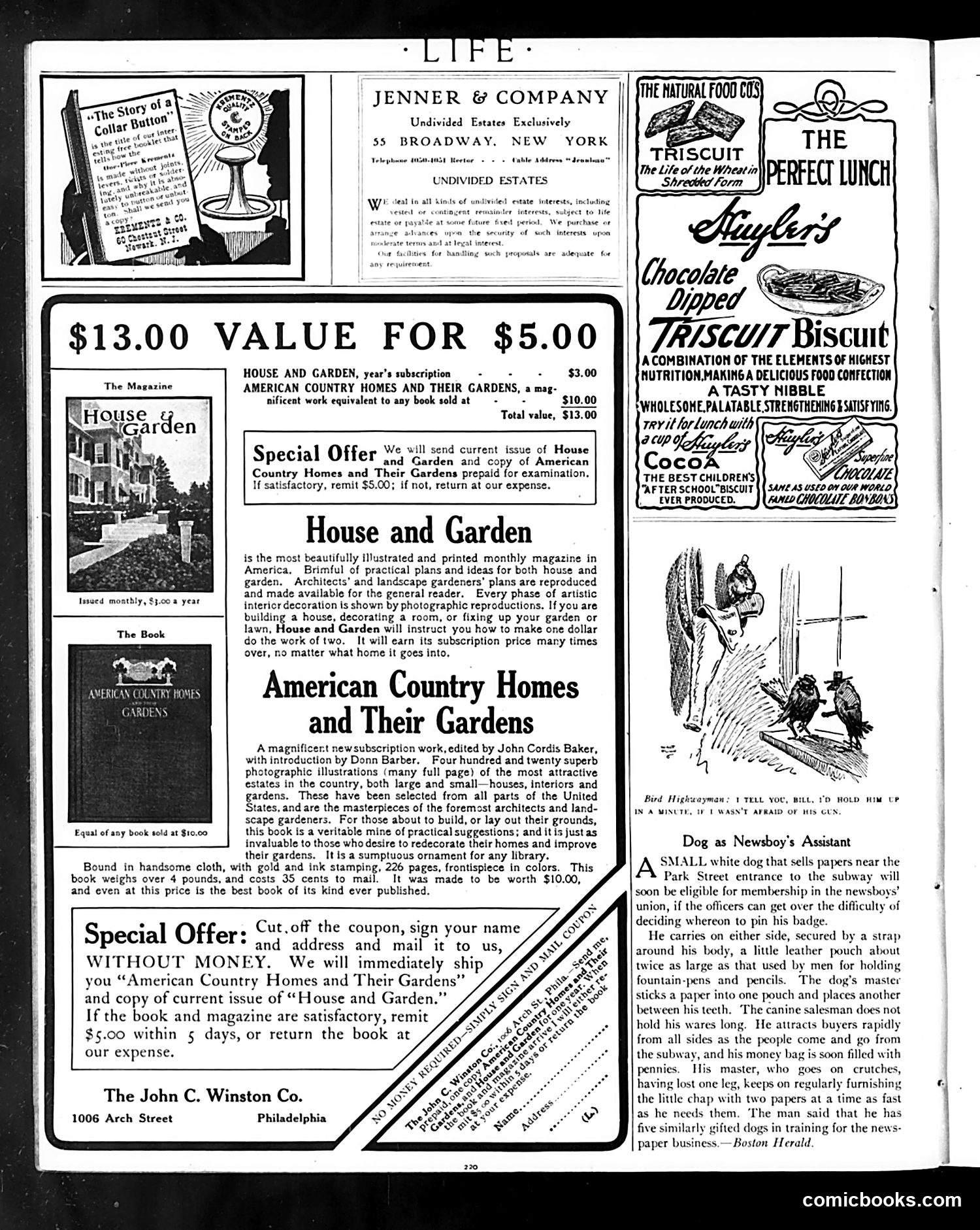
This is primarily an **advertisement page** rather than political satire. The main content consists of subscription offers for *House and Garden* magazine ($3.00) and *American Country Homes and Their Gardens* book ($10.00), bundled for a promotional price of $5.00. The upper right features **consumer product ads**: Stayler's Chocolate-Dipped Triscuit Biscuits (marketed as "the perfect lunch" with nutritional claims) and Jenner & Company's undivided estate real estate services. The lower right contains a brief **humor piece** about a dog assisting a newspaper vendor near Park Street subway entrance, carrying papers in leather pouches—a lighthearted feature about an unusual urban scene. There is **one small cartoon** depicting a bird as a "highwayman" stopping another bird, making a joke about robbery. Overall, this reflects early 20th-century concerns with genteel domesticity, landscape design, and urban novelty stories.
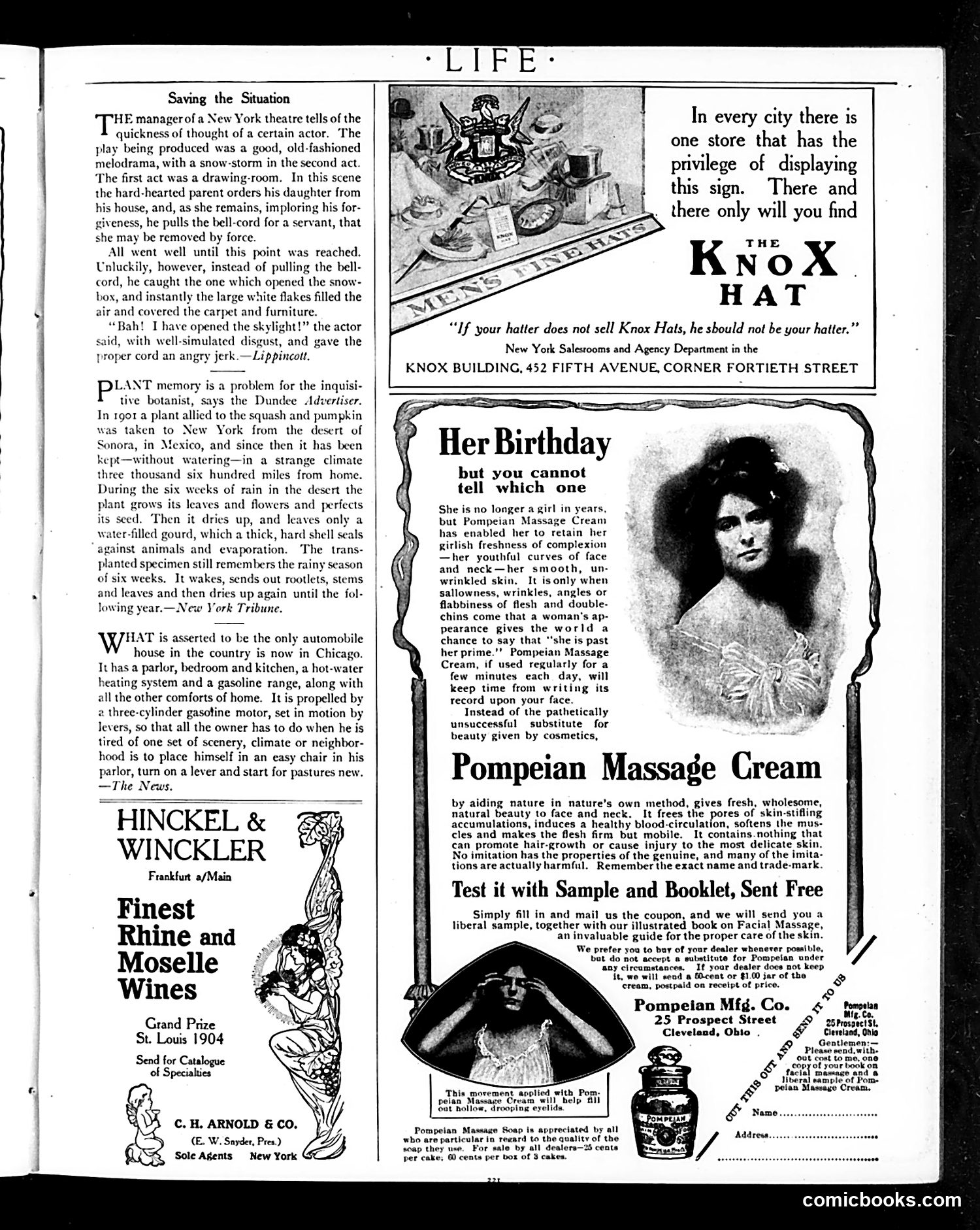
This page contains **three humorous anecdotes** and **period advertisements**, not political cartoons. The main story, "Saving the Situation," describes a theater actor who accidentally pulls the wrong bell-cord during a melodrama, triggering a snow-effect meant for act two. Rather than breaking character, he improvises brilliantly, claiming he "opened the skylight"—turning the mishap into a comedic moment that saves the scene. Two shorter pieces follow: one about a desert plant that retains its dormant cycle even when transplanted to New York, and another about an unusual automobile-house in Chicago with motorized living quarters. The **advertisements** promote Knox Hats (exclusive retailer claim), Rhine wines, and Pompeian Massage Cream (a skin product marketed to aging women concerned with appearing youthful—reflecting early 1900s beauty anxieties about wrinkles and age visibility). The page reflects early 20th-century concerns: theatrical entertainment, botanical curiosity, automotive novelty, and female beauty standards emphasizing youth.
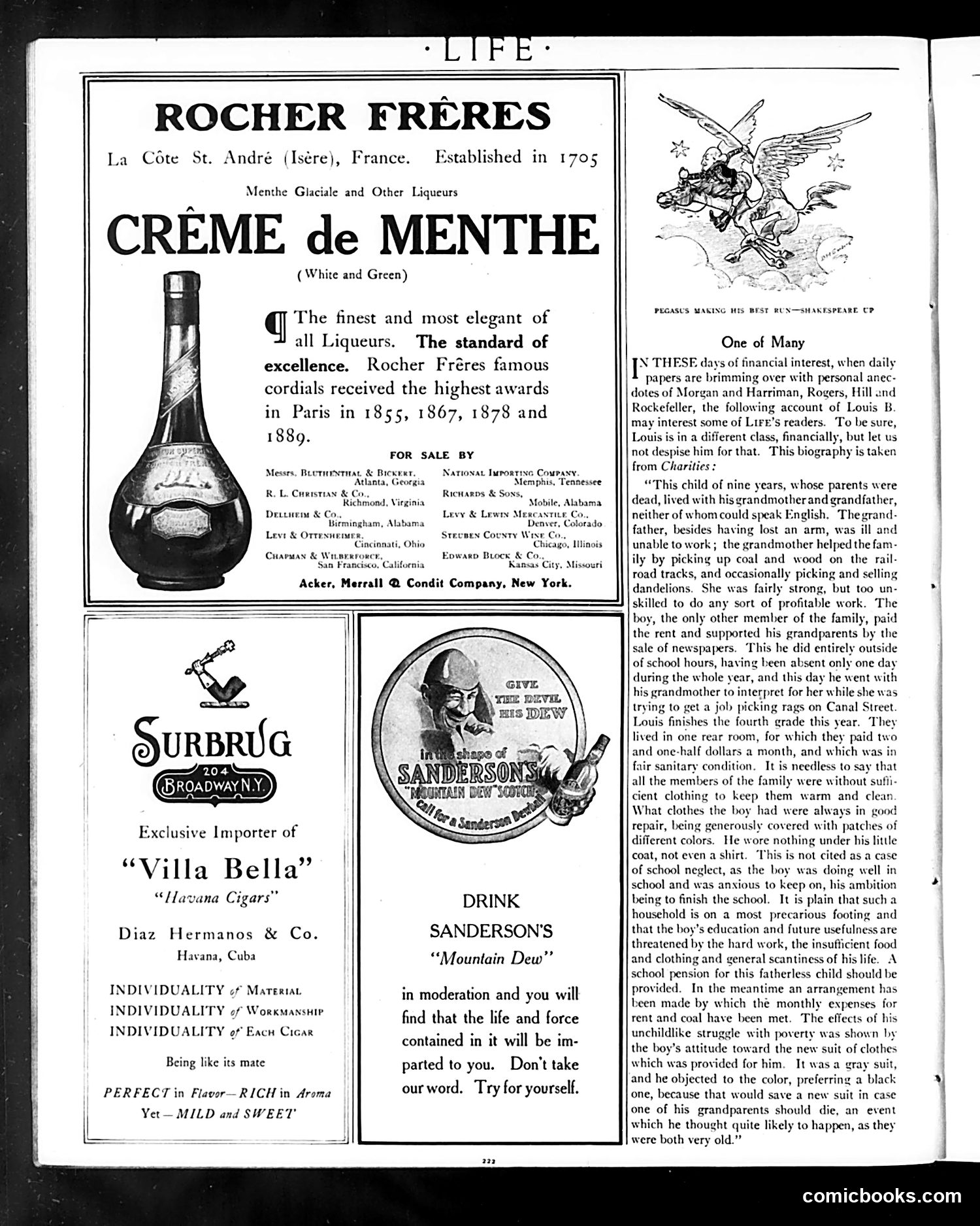
This page is primarily **advertising**, not satirical content. It features luxury product advertisements (French liqueur, Cuban cigars, whiskey) alongside a serious social commentary piece. The illustrated element—**Pegasus Making His First Run**—appears to be a classical allegorical image (winged horse from Greek mythology), likely used decoratively by the magazine rather than as political satire. The substantial text block titled "One of Many" is a **biographical case study** from the charity publication *Charities*, documenting a nine-year-old boy named Louis B. living in poverty with immigrant grandparents. The piece advocates for school pensions to support fatherless children, contrasting this genuine hardship with the luxury goods advertised elsewhere on the page—an implicit social critique about inequality, though not presented as cartoon satire. The page reflects Progressive Era concerns about child labor, poverty, and education rather than political cartooning.
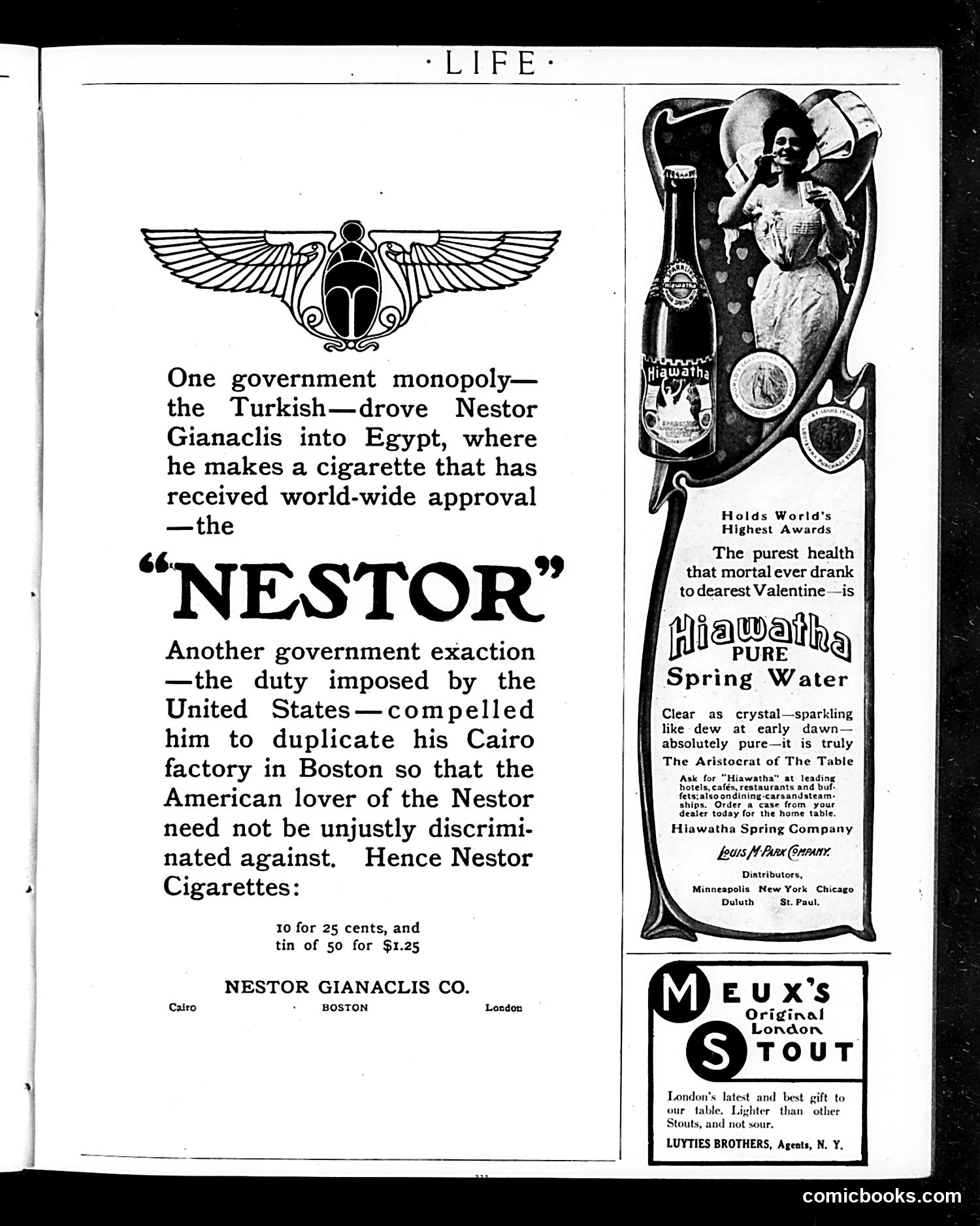
This page is primarily **advertising**, not political satire. The main feature promotes **Nestor Cigarettes** through a quasi-narrative explaining the product's origin. The advertisement claims that Turkish government monopolies drove entrepreneur Nestor Gianaclis to Egypt, where he created his cigarette. When U.S. tariff duties made imported cigarettes expensive for American consumers, he established a Boston factory to avoid "discrimination" against American smokers preferring his brand. The winged emblem at top suggests prestige and quality. The page includes two additional product advertisements: **Hiawatha Pure Spring Water** (positioned as a luxury table beverage with international awards) and **Meux's Original London Stout** (a beer marketed as lighter than competitors). All three ads reflect early 20th-century marketing strategies emphasizing international prestige, government approval, and class aspiration—typical of *Life* magazine's commercial content during this era.
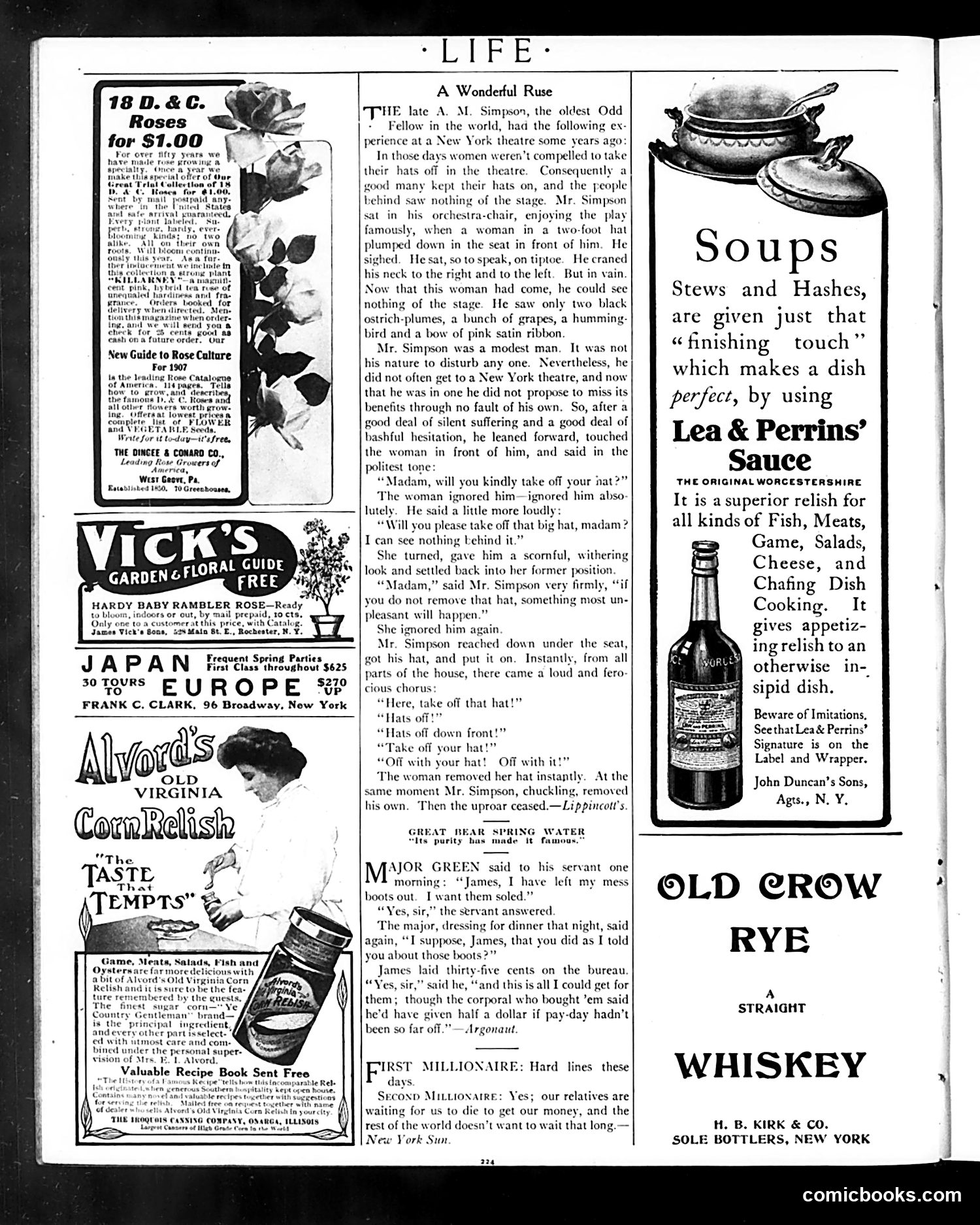
This anecdote satirizes the theater etiquette problem of the early 1900s: women wore enormous hats decorated with ostrich plumes, grapes, and ribbons that completely blocked other patrons' views of the stage. The joke centers on **A.M. Simpson**, identified as "the oldest Odd Fellow in the world," who politely requests a woman remove her hat. She ignores his increasingly firm requests. Simpson then retrieves his own hat and puts it on—instantly triggering angry shouts from the entire audience ("Hats off down front!"), forcing the woman to remove hers immediately. The satire exposes the hypocrisy of theater etiquette: one person's polite complaint goes ignored, but collective social pressure works instantly. It also mocks how absurdly large these hats were—they required explicit audience enforcement to manage. This reflects genuine historical frustration: oversized women's hats were a documented theater nuisance until the practice was eventually discouraged through social convention.
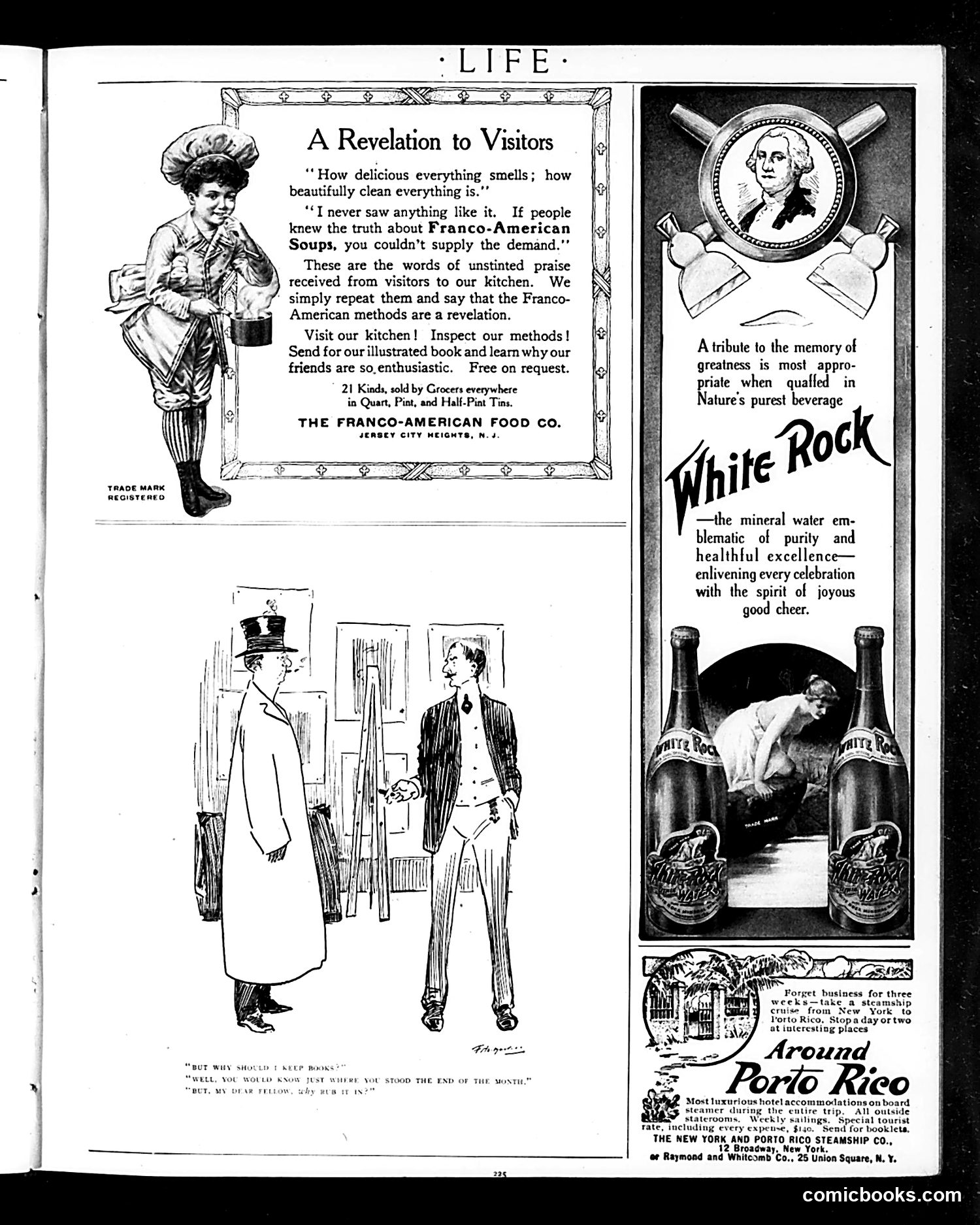
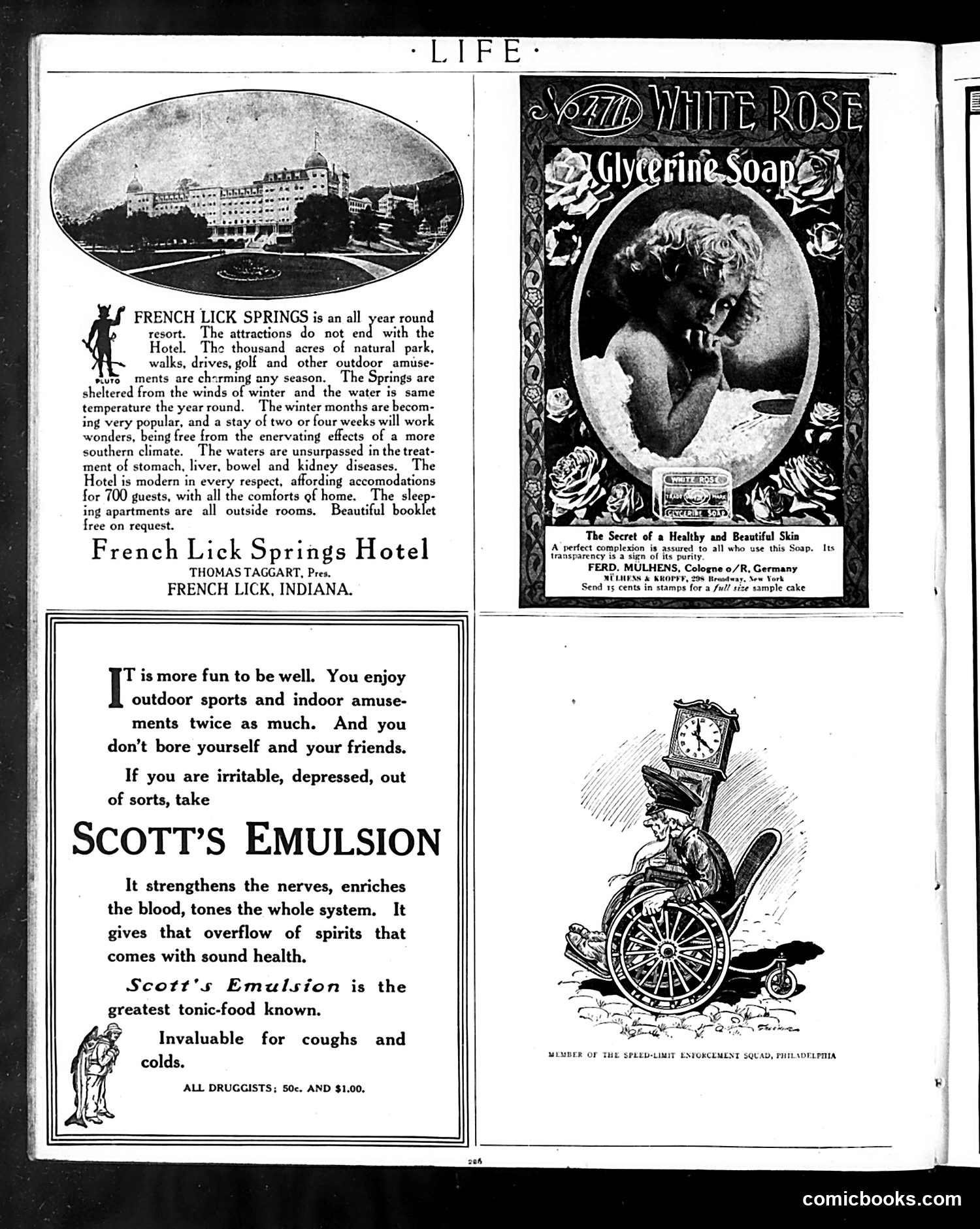
This page is primarily **advertising**, not satire or political commentary. It contains three distinct ads: 1. **French Lick Springs Hotel** (Indiana)—promoting a spa resort claiming to treat digestive and kidney ailments through mineral waters, typical of early-20th-century "wellness" tourism. 2. **Scott's Emulsion**—a tonic-food supplement marketed as a nerve strengthener and cure for irritability and coughs, reflecting patent medicine advertising common in this era. 3. **White Rose Glycerine Soap**—claiming to ensure perfect complexion through purity. The single cartoon shows a figure on a velocipede (early bicycle) with a clock on their back, labeled "Member of the Speed-Limit Enforcement Squad, Philadelphia"—likely satirizing early automobile speed enforcement, a relatively new phenomenon. This appears to be the page's only humor element, mocking earnest civic enforcement efforts.
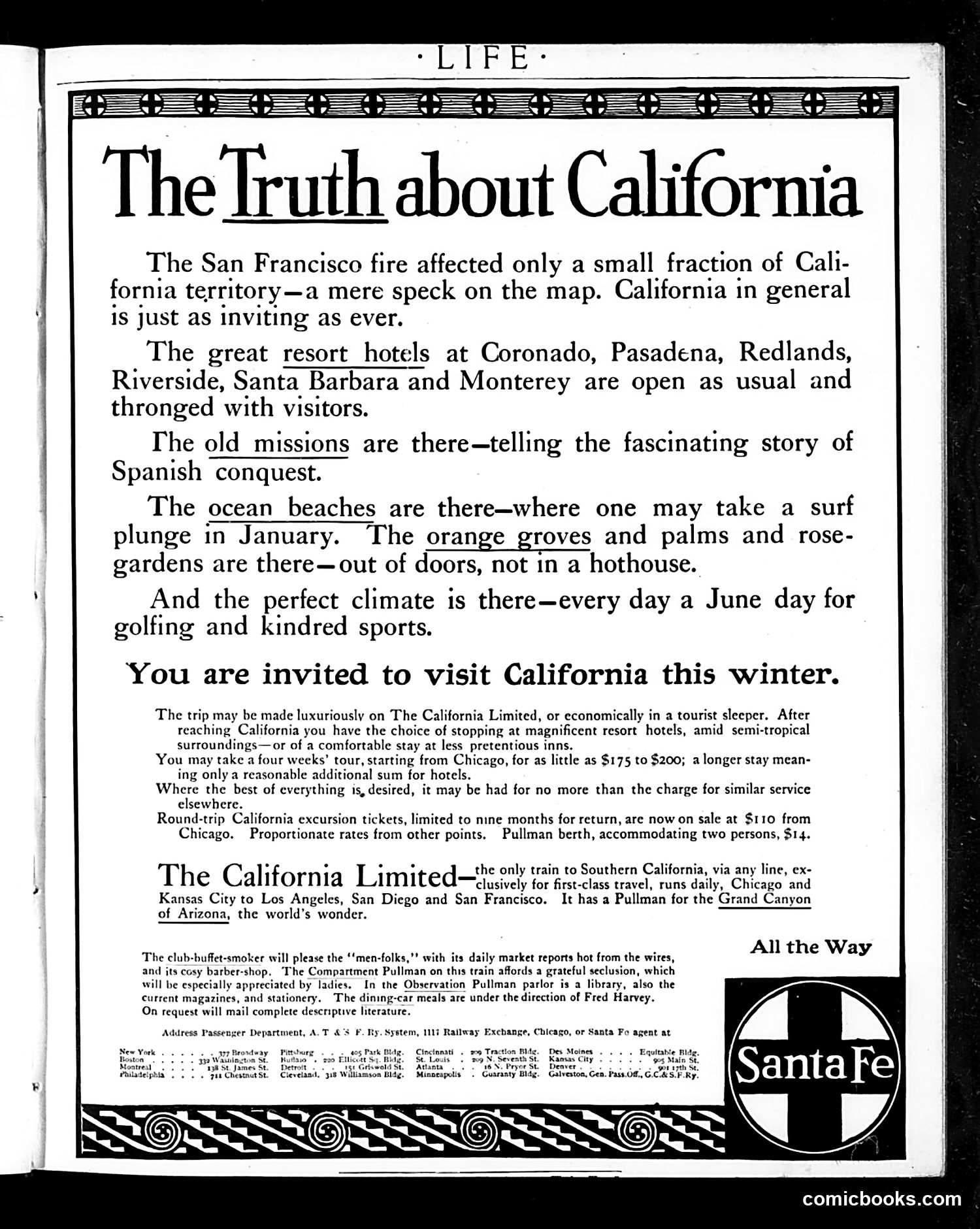
This is a **Santa Fe Railroad advertisement**, not a cartoon. It appears in *Life* magazine following the 1906 San Francisco earthquake and fire. The ad's purpose is **damage control and tourism promotion**. While the San Francisco fire devastated that city, the railroad reassures potential travelers that California remains desirable: resort hotels, missions, beaches, orange groves, and perfect weather are unaffected—merely "a speck on the map." The ad aggressively markets luxury train travel ("The California Limited") at various price points ($110–$200+ from Chicago), emphasizing comfort amenities (Pullman cars, fine dining under Fred Harvey's direction, observation parlors with libraries) to attract wealthy travelers while also offering economical tourist options. The subtext: don't let one disaster deter you from visiting California's attractions. It's a straightforward commercial message capitalizing on disaster recovery.
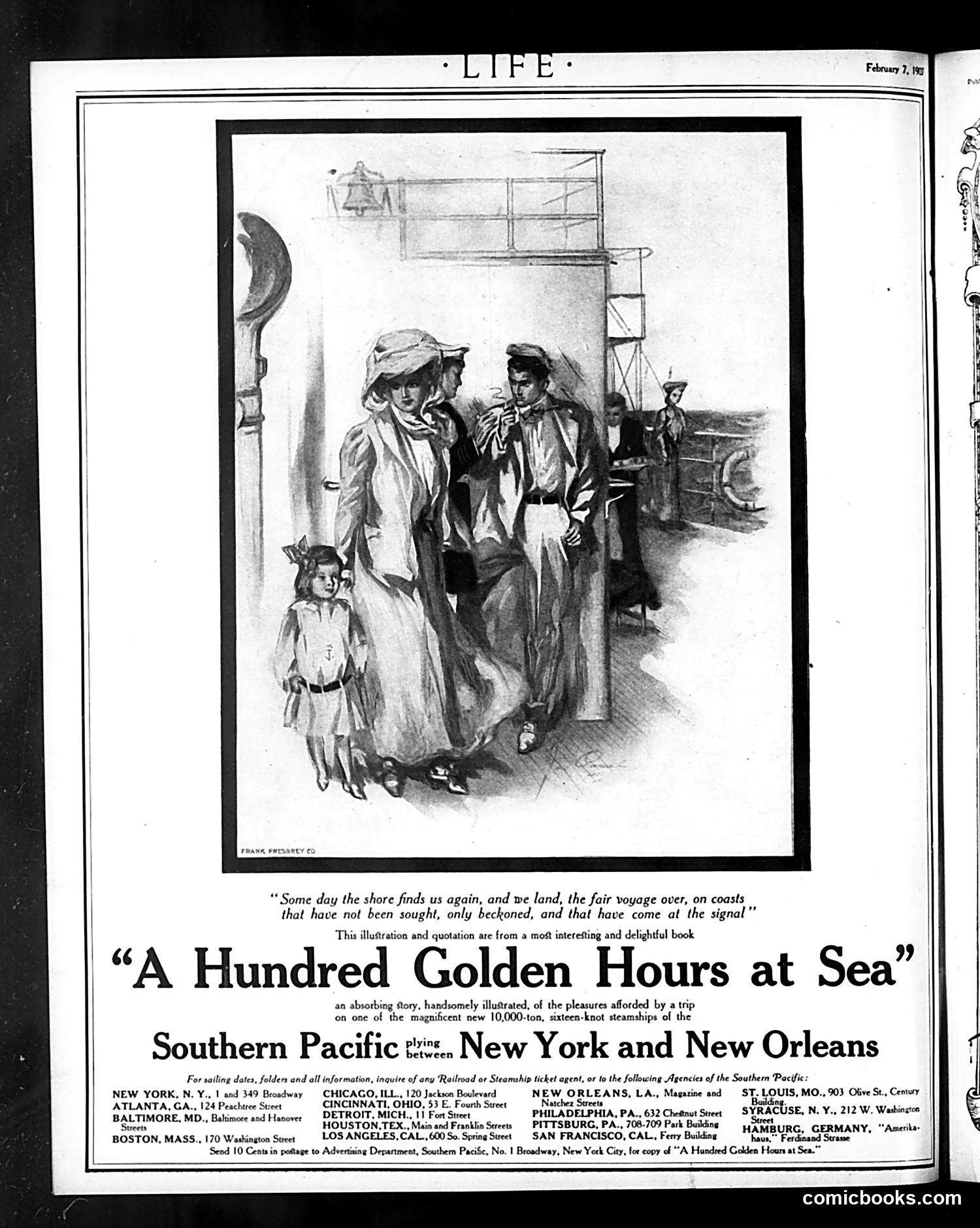
This is primarily a **steamship advertisement**, not political satire. The illustration depicts passengers—two women and a child—boarding or disembarking from a Southern Pacific steamship, with maritime infrastructure visible in the background. The ad promotes "A Hundred Golden Hours at Sea," a book describing luxury travel on new 10,000-ton steamships running between New York and New Orleans. The quoted passage romanticizes ocean voyages as leisurely adventures to exotic, "beckoned" coasts. This reflects early 20th-century leisure marketing: steamship travel was a luxury experience for affluent Americans. The illustration's sentimental tone and the book's "interesting and delightful" framing suggest travel as an escape and status symbol. The extensive list of ticket agents across major U.S. cities indicates Southern Pacific's broad commercial reach during the era before commercial air travel dominated long-distance passenger transport.