
Life, 1907-02-07 · page 30 of 52
Life — February 7, 1907 — page 30: what you’re looking at
What you’re looking at
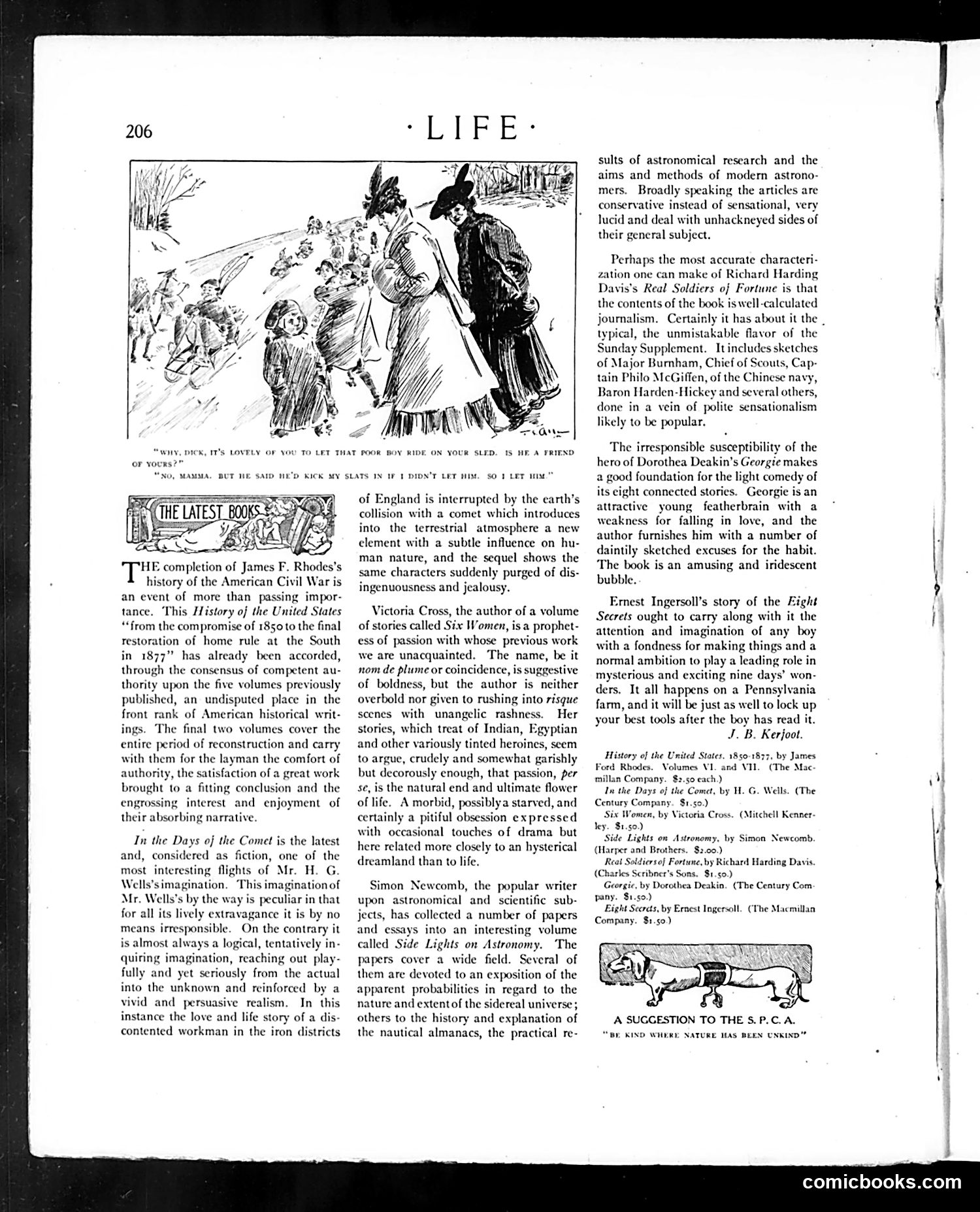
This page is primarily a **book review section** with one satirical cartoon at the top. ## The Cartoon The single illustration depicts a child telling his mother he's letting another boy ride on his sled—not out of kindness, but under coercion. The boy threatened to "kick my slats in" (beat him up) if refused. **The satire**: This is social commentary on bullying and extortion dressed in polite Victorian language. The cartoon mocks the genteel pretense of the era—the mother assumes charitable motives, but the child's brutal honesty reveals the coercive reality beneath civilized appearances. It's likely a commentary on power dynamics in society, possibly referencing labor disputes or political intimidation of the Reconstruction era. ## The Text The page reviews several books, including H.G. Wells's *In the Days of the Comet* (which involves a celestial event altering human nature) and Richard Harding Davis's *Real Soldiers of Fortune* (dismissed as mere "Sunday Supplement" journalism). The reviews are straightforward literary criticism with no apparent political agenda beyond professional assessment.
📄 Transcribed text from this page (OCR, searchable)
Machine-transcribed from the original scan — historical spelling and the odd misread are preserved.
or yours?” THE completion of James F. Rhode: history of the American Civil War is an event of more than passing impor- tance. This History of the United States “from the compromise of 1850 to the final restoration of home rule at the South in 1877” has already been accorded, through the consensus of competent au- thority upon the five volumes previously published, an undisputed place in the front rank of American historical writ- ings. The final two volumes cover the entire period of reconstruction and carry with them for the layman the comfort of authority, the satisfaction of a great work brought to a fitting conclusion and the engrossing interest and enjoyment of their absorbing narrative. In the Days oj the Comet is the latest and, considered as fiction, one of the most interesting flights of Mr. H. G. Wells’simagination. This imagination of Mr. Wells’s by the way is peculiar in that for all its lively extravagance it is by no means irresponsible. On the contrary it is almost always a logical, tentatively in- quiring imagination, reaching out play- fully and yet seriously from the actual into the unknown and reinforced by a vivid and persuasive realism. In this instance the love and life story of a di: contented workman in the iron districts ON “WHY, DICK, IT'S LOVFLY OF YOU TO LET THAT POOR BOY RIDE ON YOUR SLED. 18 HE A FRIEND “No, MAMMA. BUT IE SAID HE'D KICK MY SLATS IN IFT DIDN'T LET HI. S01 LET anna.” of England is interrupted by the carth’s collision with a comet which introduces into the terrestrial atmosphere a new element with a subtle influence on hu- man nature, and the sequel shows the same characters suddenly purged of dis- ingenuousness and jealousy. Victoria Cross, the author of a volume of stories called Six Women, isa prophet- ess of passion with whose previous work we are unacquainted. The name, be it nom de plume or coincidence, is suggestive of boldness, but the author is neither overbold nor given to rushing into risque scenes with unangelic rashne: Her stories, which treat of Indian, Egyptian and other variously tinted heroines, seem to argue, crudely and somewhat garishly but decorously enough, that passion, per se, is the natural end and ultimate flower of life morbid, possiblya starved, and certainly a pitiful obsession expressed with occasional touches of drama but here related more closely to an hysterical dreamland than to life. Simon Newcomb, the popular writer upon astronomical and scientific sub- jects, has collected a number of papers and essays into an interesting volume called Side Lights on Astronomy. The papers cover a wide field. Several of them are devoted to an exposition of the apparent probabilities in regard to the nature and extent of the sidereal universe ; others to the history and explanation of the nautical almanacs, the practical re- sults of astronomical research and the aims and methods of modern astrono- mers. Broadly speaking the articles are conservative instead of sensational, very lucid and deal with unhackneyed sides of their general subject. Perhaps the most accurate characteri- zation one can make of Richard Harding Davis's Real Soldiers of Fortune is that the contents of the book is well-calculated journalism. Certainly it has about it the | typical, the unmistakable flavor of the Sunday Supplement. It includes sketches of Major Burnham, Chief of Scouts, Cap- tain Philo McGiffen, of the Chinese navy, Baron Harden-Hickey and several others, done in a vein of polite sensationalism likely to be popular, The irresponsible susceptibility of the hero of Dorothea Deakin’s Georgie makes a good foundation for the light comedy of its eight connected stories. Georgie is an attractive young featherbrain with a weakness for falling in love, and the author furnishes him with a number of daintily sketched excuses for the habit. ‘The book is an amusing and iridescent bubble. Ernest Ingersoll’s story of the Eight Secrets ought to carry along with it the attention and imagination of any boy with a fondness for making things and a normal ambition to play a leading role in mysterious and exciting nine days’ won- ders. It all happens on a Pennsylvania farm, and it will be just as well to lock up your best tools after the boy has read it. J. B. Kerjoot. History of the United States. 1850-1877, by James Ford Rhodes. Volumes VI. and VII. (The Mac millan Company. $2.50 each.) In the Days oj the Comet, by H. G. Wells. (The Century Company. $1.50.) Six Women, by Victoria Cross. (Mitchell Kenner- ley. $1.50.) Side Lights on Astronomy, by Simon Newcomb. (Harper and Brothers. $2.00.) Reat Sotdierso} Fortune, by Richard Harding Davis (Charles Scribner's Sons. $1.50.) Georgic, by Dorothea Deakin. (The Century Com pany. $1.50.) Eight Scerds, by Ernest Ingersoll. (The Macmillan Company. $1.50) A SUGGESTION TO THE S. P.C. A. “Br KIND WHERE NATURE MAS BEEN UNKIND” comicbooks.com y