
Life, 1907-02-07 · page 18 of 52
Life — February 7, 1907 — page 18: what you’re looking at
What you’re looking at
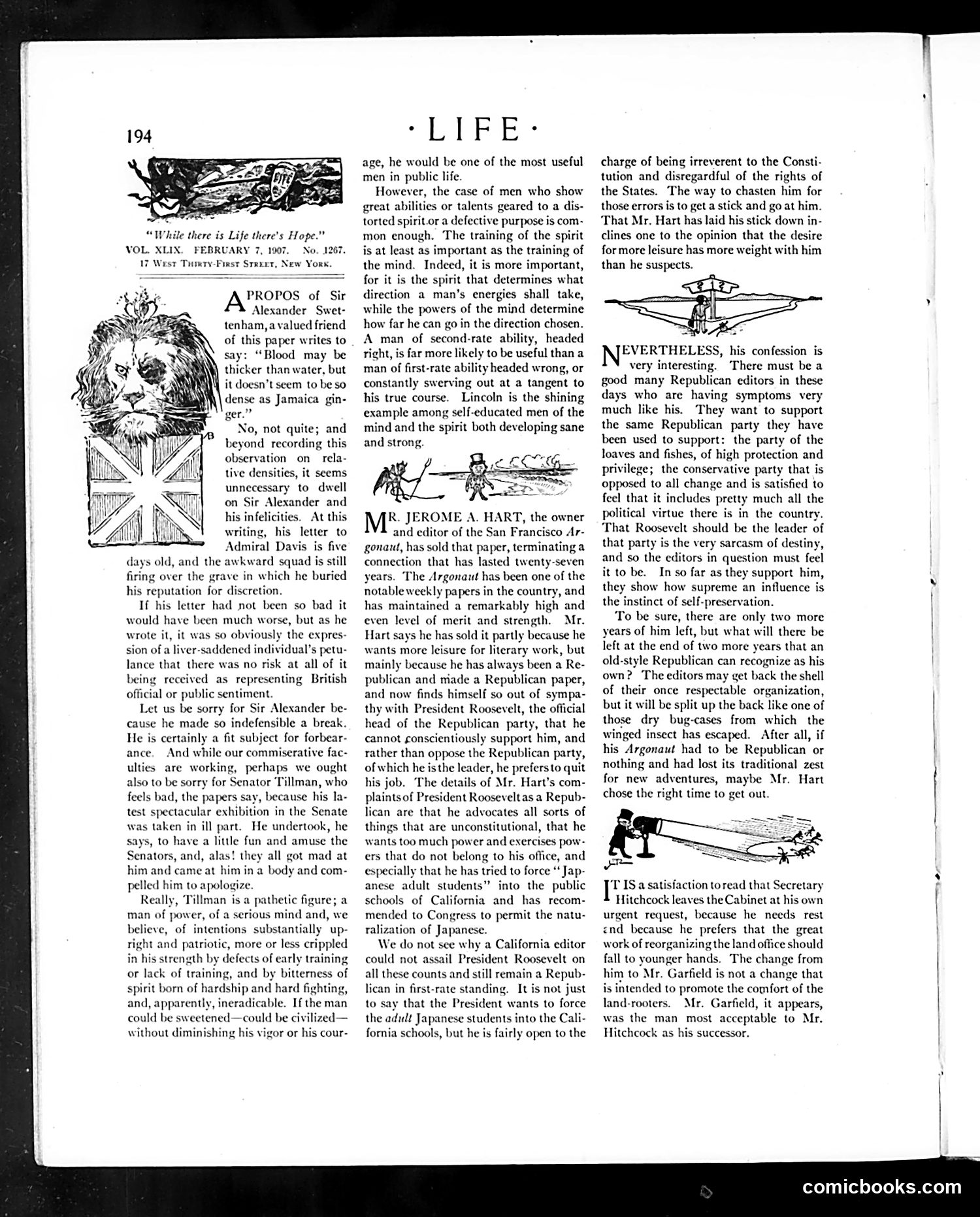
This page critiques three political figures for character flaws undermining their abilities. **Sir Alexander Swettenham** (opening anecdote): A British colonial official who damaged his reputation through an indiscreet letter to Admiral Davis—his poor judgment exposed him to public ridicule. **Senator Benjamin Tillman** (South Carolina): Portrayed as a powerful but bitter man whose "liver-saddened" temperament and lack of refinement sabotaged his effectiveness. The text suggests his early hardship created lasting bitterness that crippled his usefulness despite genuine ability. **Jerome A. Hart** (San Francisco *Argonaut* editor): Recently sold his newspaper because he could no longer support President Theodore Roosevelt, despite being Republican. Hart's principled resignation over Roosevelt's allegedly unconstitutional overreach of executive power illustrates the magazine's broader point: that personal integrity matters more than party loyalty. The editorial's thesis: spiritual/moral training matters more than raw ability. Lincoln exemplifies balanced development; these men show talent corrupted by defective character or principle.
📄 Transcribed text from this page (OCR, searchable)
Machine-transcribed from the original scan — historical spelling and the odd misread are preserved.
“While there is Life there's Hope.” VOL. XLIX. FEBRUARY No, 1267. West THiery-First Srrerr, PROPOS of Sir Alexander Swet- tenham,a valued friend of this paper writes to say: “Blood may be ) thicker than water, but it doesn’t seem to be so dense as Jamaica gin- ger.” No, not quite; and beyond recording this observation on rela- tive densities, it seems unnecessary to dwell on Sir Alexander and his infelicities. At this writing, his letter to Admiral Davis is five days old, and the awkward squad is still firing over the grave in which he buried his reputation for discretion. If his letter had not been so bad it would have been much worse, but as he wrote it, it was so obviously the expres- sion of a liver-saddened individual's petu- lance that there was no risk at all of it being received as representing British official or public sentiment. Let us be sorry for Sir Alexander be- cause he made so indefensible a break. He is certainly a fit subject for forbear- ance. And while our commiserative fac- ulties are working, perhaps we ought also to be sorry for Senator Tillman, who feels bad, the papers say, because his la- test spectacular exhibition in the Senate was taken in ill part. He undertook, he says, to have a little fun and amuse the nators, and, alas! they all got mad at him and came at him in a body and com- pelled him to apologize. Really, Tillman is a pathetic figure; man of power, of a serious mind and, we believe, of intentions substantially up- right and patriotic, more or less crippled in his strength by defects of early training or lack of training, and by bitterness of spirit born of hardship and hard fighting, and, apparently, ineradicable. If the man could be sweetened—could be civilized— without diminishing his vigor or his cour- ae oa age, he would be one of the most useful men in public life. However, the case of men who show great abilities or talents geared to a dis- torted spirit.or a defective purpose is com- mon enough. The training of the spirit is at least as important as the training of the mind. Indeed, it is more important, for it is the spirit that determines what direction a man’s energies shall take, while the powers of the mind determine how far he can go in the direction chosen. A man of second-rate ability, headed right, is far more likely to be useful than a man of first-rate ability headed wrong, or constantly swerving out at a tangent to his true course. Lincoln is the shining example among self-educated men of the mind and the spirit both developing sane and strong. Mé& JEROME A. HART, the owner and editor of the San Francisco Ar- gonaut, has sold that paper, terminating a connection that has lasted twenty-seven years. The Argonaut has been one of the notableweekly papers in the country, and has maintained a remarkably high and even level of merit and strength. Mr. Hart says he has sold it partly because he wants more leisure for literary work, but mainly because he has always been a Re- publican and niade a Republican paper, and now finds himself so out of sympa- thy with President Roosevelt, the official head of the Republican party, that he cannot gonscientiously support him, and rather than oppose the Republican party, of which he is the leader, he prefers to quit his job. The details of Mr. Hart’s com- plaintsof President Rooseveltas a Repub- lican are that he advocates all sorts of things that are unconstitutional, that he wants too much power and exercises pow- ers that do not belong to his office, and especially that he has tried to force “ Jap- anese adult students” into the public schools of California and has recom- mended to Congress to permit the natu- ralization of Japanese. We do not see why a California editor could not assail President Roosevelt on all these counts and still remain a Repub- lican in first-rate standing. It is not just to say that the President wants to force the adult Japanese students into the Cali- fornia schools, but he is fairly open to the charge of being irreverent to the Consti- tution and disregardful of the rights of the States. The way to chasten him for those errors is to get a stick and go at him. That Mr. Hart has laid his stick down in- clines one to the opinion that the desire for more leisure has more weight with him than he suspects. EVERTHELESS, his confession is very interesting. There must be a good many Republican editors in these days who are having symptoms very much like his. They want to support the same Republican party they have been used to support: the party of the loaves and fishes, of high protection and privilege; the conservative party that is opposed to all change and is satisfied to feel that it includes pretty much all the political virtue there is in the country. That Roosevelt should be the leader of that party is the very sarcasm of destiny, and so the editors in question must feel it to be. In so far as they support him, they show how supreme an influence is the instinct of self-preservation. To be sure, there are only two more years of him left, but what will there be left at the end of two more years that an old-style Republican can recognize as his own? The editors may get back the shell of their once respectable organization, but it will be split up the back like one of those dry bug-cases from which the winged insect has escaped. After all, if his Argonaut had to be Republican or nothing and had lost its traditional zest for new adventures, maybe Mr. Hart chose the right time to get out. T IS a satisfaction toread that Secretary Hitchcock leaves the Cabinet at his own urgent request, because he needs rest znd because he prefers that the great work of reorganizing the land office should fall to younger hands. The change from him to Mr. Garfield is not a change that is intended to promote the comfort of the land-rooters. Mr. Garfield, it appears, s the man most acceptable to Mr. Hitchcock as his successor. comicbooks.com