
Life, 1907-02-07 · page 28 of 52
Life — February 7, 1907 — page 28: what you’re looking at
What you’re looking at
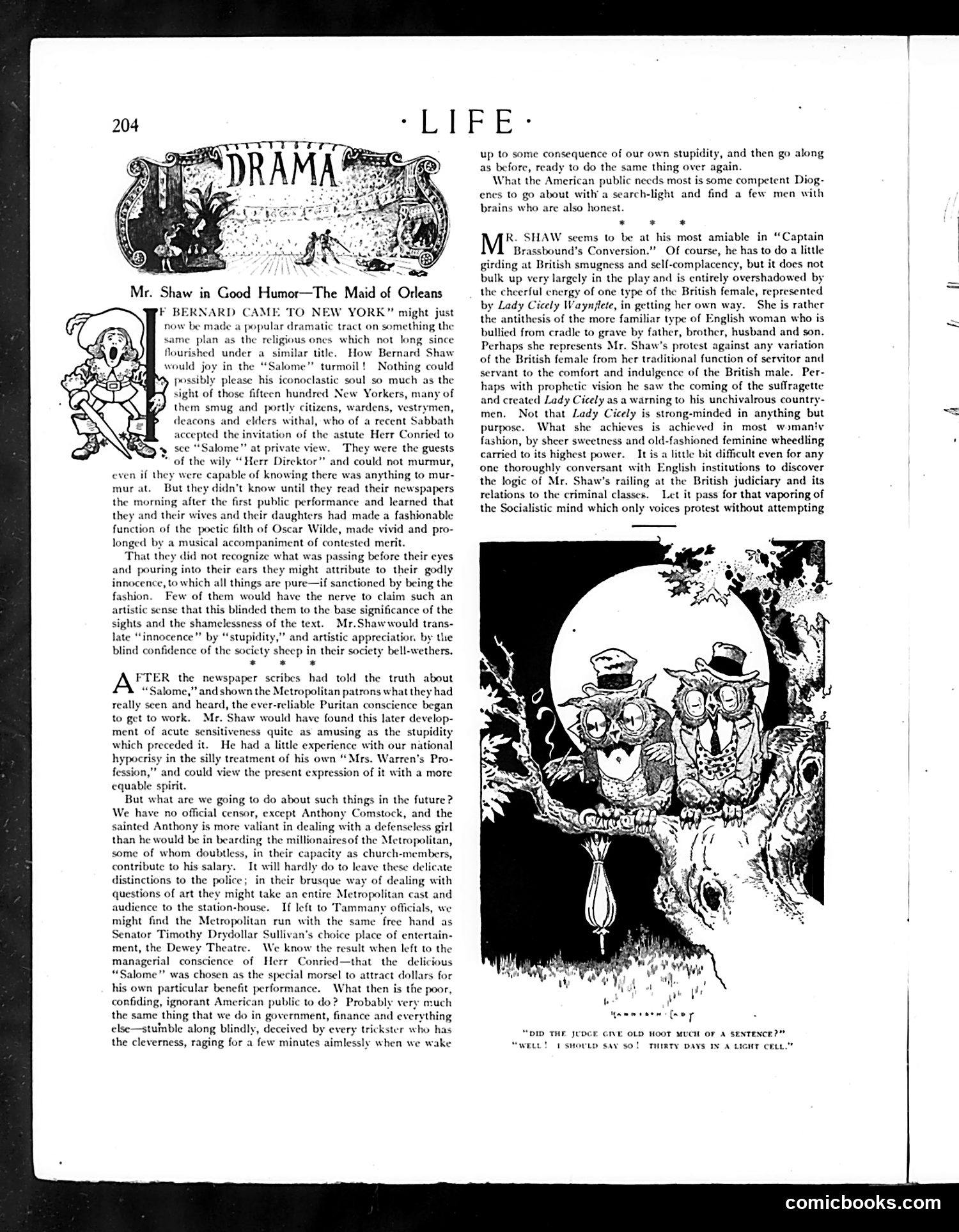
This article satirizes the hypocrisy of New York's elite regarding Oscar Wilde's scandalous play *Salome*. **The Setup:** Society's wealthy and respectable citizens (described as "smug and portly") attended a private viewing, unaware of the play's explicit sexual content. Only when newspapers revealed what they'd seen did their "Puritan conscience" kick in—they became outraged at what they'd unknowingly witnessed. **The Satire:** The author mocks this willful blindness, comparing it to the stupidity that playwright Bernard Shaw would find amusing. The piece criticizes how the fashionable and powerful can ignore moral concerns when presented as "art," yet claim innocence afterward. **Political Context:** The article references Anthony Comstock (a real censor), Tammany Hall corruption, and theater manager Herr Conried's profit motive—suggesting that American society lacks honest moral guardians and instead stumbles along "deceived by every trickster," blindly raging then forgetting. The accompanying illustration (right) appears to be a related satirical drawing, though details are unclear.
📄 Transcribed text from this page (OCR, searchable)
Machine-transcribed from the original scan — historical spelling and the odd misread are preserved.
Mr. Shaw in Good Humor—The Maid of Orleans F BERNARD CAME TO NEW YORK” might just now be made a popular dramatic tract on something the same plan as the religio Nourished under a similar title. How Bernard Shaw would joy in the “ ome" turmoil! Nothing could possibly please his iconoclastic soul so much as the sight of those fifteen hundred New Yorkers, many of them smug and portly citizens, wardens, vestrymen, deacons and elders withal, who of a recent Sabbath accepted the invitation of the astute Herr Conried to Salome” at private view. They were the guests * of the wily “Herr Direktor” and could not murmur, even if they were capable of knowing there was anything to mur- mur at. But they didn’t know until they read their newspapers the morning after the first public performance and learned that they and their wives and their daughters had made a fashionable function of the poetic filth of Oscar Wilde, made vivid and pro- longed by a musical accompaniment of contested merit. That they did not recognize what was passing before their eyes and pouring into their cars they might attribute to their godly innocence, to which all things are pure—if sanctioned by being the fashion. Few of them would have the nerve to claim such an artistic sense that this blinded them to the base significance of the sights and the shamelessness of the text. Mr.Shawwould trans- late “innocence” by “stupidity,” and artistic appreciation. by the blind confidence of the society sheep in their society bell-wethers. nr nr ones which not long since FTER the newspaper scribes had told the truth about lome,” and shown the Metropolitan patrons what they had really scen and heard, the ever-reliable Puritan conscience began to get to work. Mr. w would have found this later develop- ment of acute sensitiveness quite as amusing as the stupidity which preceded it. He had a little experience with our national hypocrisy in the silly treatment of his own “Mrs. Warren’s Pro- fession,” and could view the present expression of it with a more equable spirit. But what are we going to do about such things in the future? We have no official censor, except Anthony Comstock, and the sainted Anthony is more valiant in dealing with a defenseless girl than he would be in bearding the millionairesof the Metropolitan, some of whom doubtless, in their capacity as church-members, contribute to his salai It will hardly do to leave these delicate distinctions to the poli in their brusque way of dealing with questions of art they might take an entire Metropolitan cast and audience to the station-house. If left to Tammany officials, we might find the Metropolitan run with the same free hand as Senator Timothy Drydollar Sullivan's choice place of entertain- ment, the Dewey Theatre. We know the result when left to the managerial conscience of Herr Conried—that the delicious “Salome” was chosen as the special morsel to attract dollars for his own particular benefit performance. What then is the poor, confiding, ignorant American public to do? Probab! y much the same thing that we do in government, finance and everything else—stuinble along blindly, deceived by every trickster who has the cleverness, raging for a few minutes aimlessly when we wake >LIFE: up to some consequence of our own stupidity, and then go along as before, ready to do the same thing over again. What the American public needs most is some competent Diog- encs to go about with'a search-light and find a few men with brains who are also honest. * 8 6 R. SHAW seems to be at his most amiable in “Captain Brassbound’s Conversion.” Of course, he has to do a little girding at British smugness and self-complacency, but it does not bulk up very largely in the play and is entirely overshadowed by the cheerful energy of one type of the British female, represented by Lady Cicely Waynflete, in getting her own way. She is rather the antithesis of the more familiar type of English woman who is bullied from cradle to grave by father, brother, husband and son. Perhaps she represents Mr. Shaw’s protest against any variation of the British female from her traditional function of servitor and servant to the comfort and indulgence of the British male. Per- haps with prophetic vision he saw the coming of the suffragette and created Lady Cicely as a warning to his unchivalrous country- men. Not that Lady Cicely is strong-minded in anything but purpose. What she achieves is achieved in most womanty fashion, by sheer sweetness and old-fashioned feminine wheedling carried to its highest power. It is a litte bit difficult even for any one thoroughly conversant with English institutions to discover the logic of Mr. Shaw’s railing at the British judiciary and its relations to the criminal classes. Let it pass for that vaporing of the Socialistic mind which only voices protest without attempting Newimescut (omy, “DID THE JUDGE GIVE OLD HOOT MUCH OF A SENTENCE?" I sWovLo SAY so! THIRTY Days IN a Liter cet.” “wee comicbooks.com