
Life, 1907-02-07 · page 33 of 52
Life — February 7, 1907 — page 33: what you’re looking at
What you’re looking at
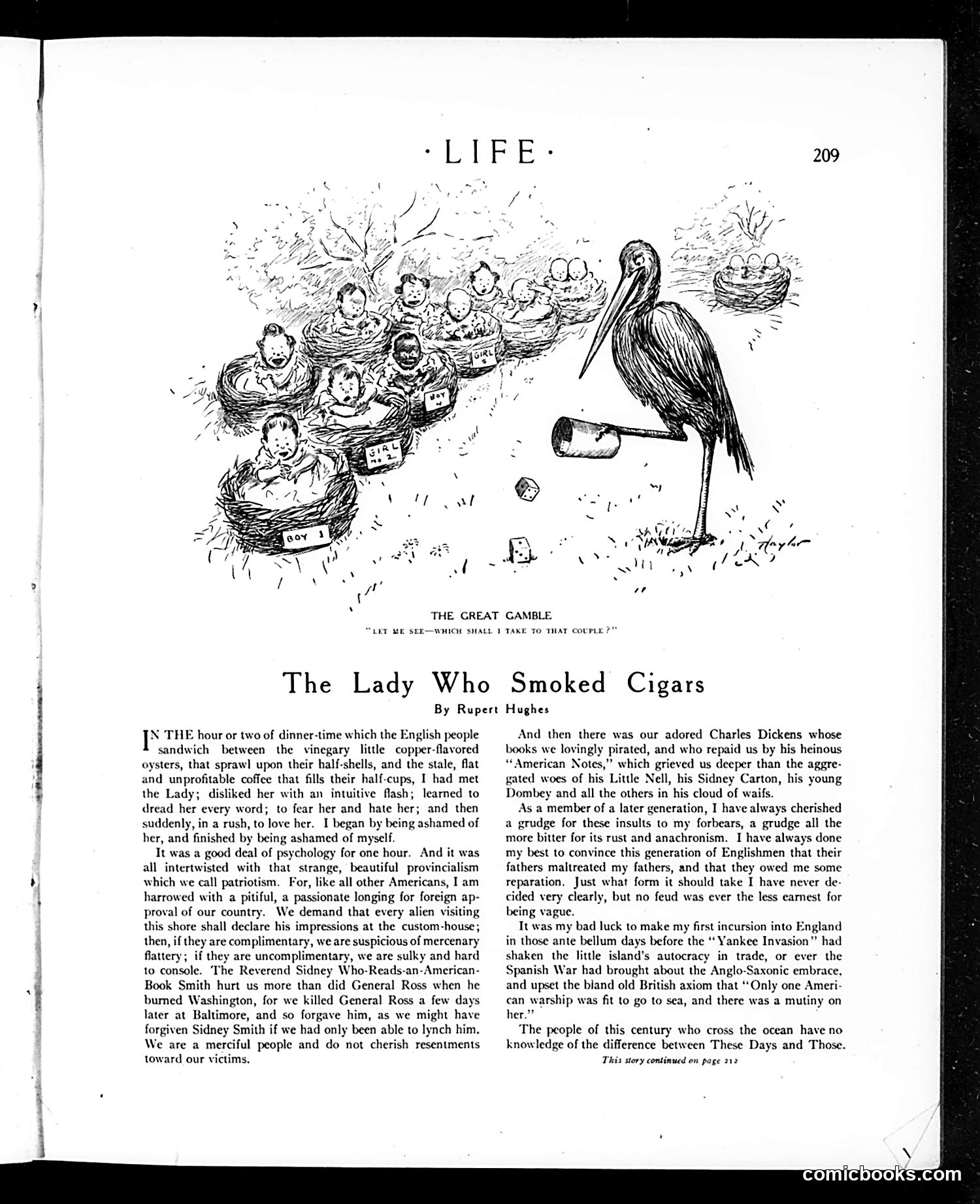
The cartoon depicts a stork carrying babies in baskets, appearing to decide which nest of infants to deliver to—a visual pun on "The Great Gamble" about choosing futures. The accompanying story by Rupert Hughes is a satirical essay on American-British relations and national pride. Hughes discusses how Americans simultaneously crave foreign approval yet resent foreign criticism. He cites specific historical grievances: British author Sidney Smith's unflattering travel writings hurt Americans more than actual military enemy General Ross did; Charles Dickens's "American Notes" deeply offended earlier generations through piracy and his critical portrayal of America. Hughes argues pre-WWI Americans harbored decades-old resentments toward Britain, though the "Yankee Invasion" and Spanish-American War had begun reconciling Anglo-Saxon relations. The essay sets up a story exploring these tensions through a mysterious "Lady" he encounters in England—establishing the cultural friction that animated transatlantic relations before modern alliance.
📄 Transcribed text from this page (OCR, searchable)
Machine-transcribed from the original scan — historical spelling and the odd misread are preserved.
0 tases nan ad THE GREAT “LET ME SEE—WHICH SHALL 1 The Lady Who By Rupert N THE hour or two of dinner-time which the English people sandwich between the vinegary little copper-flavored oysters, that sprawl upon their half-shells, and the stale, flat and unprofitable coffee that fills their half-cups, I had met the Lady; disliked her with an intuitive flash; learned to dread her every word; to fear her and hate her; and then suddenly, in a rush, to love her. I began by being ashamed of her, and finished by being ashamed of myself. It was a good deal of psychology for one hour. And it was all intertwisted with that strange, beautiful provincialism which we call patriotism. For, like all other Americans, I am harrowed with a pitiful, a passionate longing for foreign ap- proval of our country. We demand that every alien visiting this shore shall declare his impressions at the custom-house; then, if they are complimentary, we are suspicious of mercenary flattery; if they are uncomplimentary, we are sulky and hard to console. ‘The Reverend Sidney Who-Reads-an-American- Book Smith hurt us more than did General Ross when he bummed Washington, for we killed General Ross a few days later at Baltimore, and so forgave him, as we might have forgiven Sidney Smith if we had only been able to lynch him. We are a merciful people and do not cherish resentments toward our victims. CAMBLE TARE To THAT COUPLE?” Smoked Cigars Hughes And then there was our adored Charles Dickens whose books we lovingly pirated, and who repaid us by his heinous “American Notes,” which grieved us deeper than the aggre- gated woes of his Little Nell, his Sidney Carton, his young Dombey and all the others in his cloud of waifs. As a member of a later generation, I have always cherished a grudge for these insults to my forbears, a grudge all the more bitter for its rust and anachronism. I have always done my best to convince this generation of Englishmen that their fathers maltreated my fathers, and that they owed me some reparation, Just what form it should take I have never de- cided very clearly, but no feud was ever the less earnest for being vague. It was my bad luck to make my first incursion into England in those ante bellum days before the ‘‘ Yankee Invasion” had shaken the little island’s autocracy in trade, or ever the Spanish War had brought about the Anglo-Saxonic embrace, and upset the biand old British axiom that “Only one Ameri- can warship was fit to go to sea, and there was a mutiny on her.” The people of this century who cross the ocean have no knowledge of the difference between These Days and Those. This story continued on page 212