
Life, 1907-02-07 · page 23 of 52
Life — February 7, 1907 — page 23: what you’re looking at
What you’re looking at
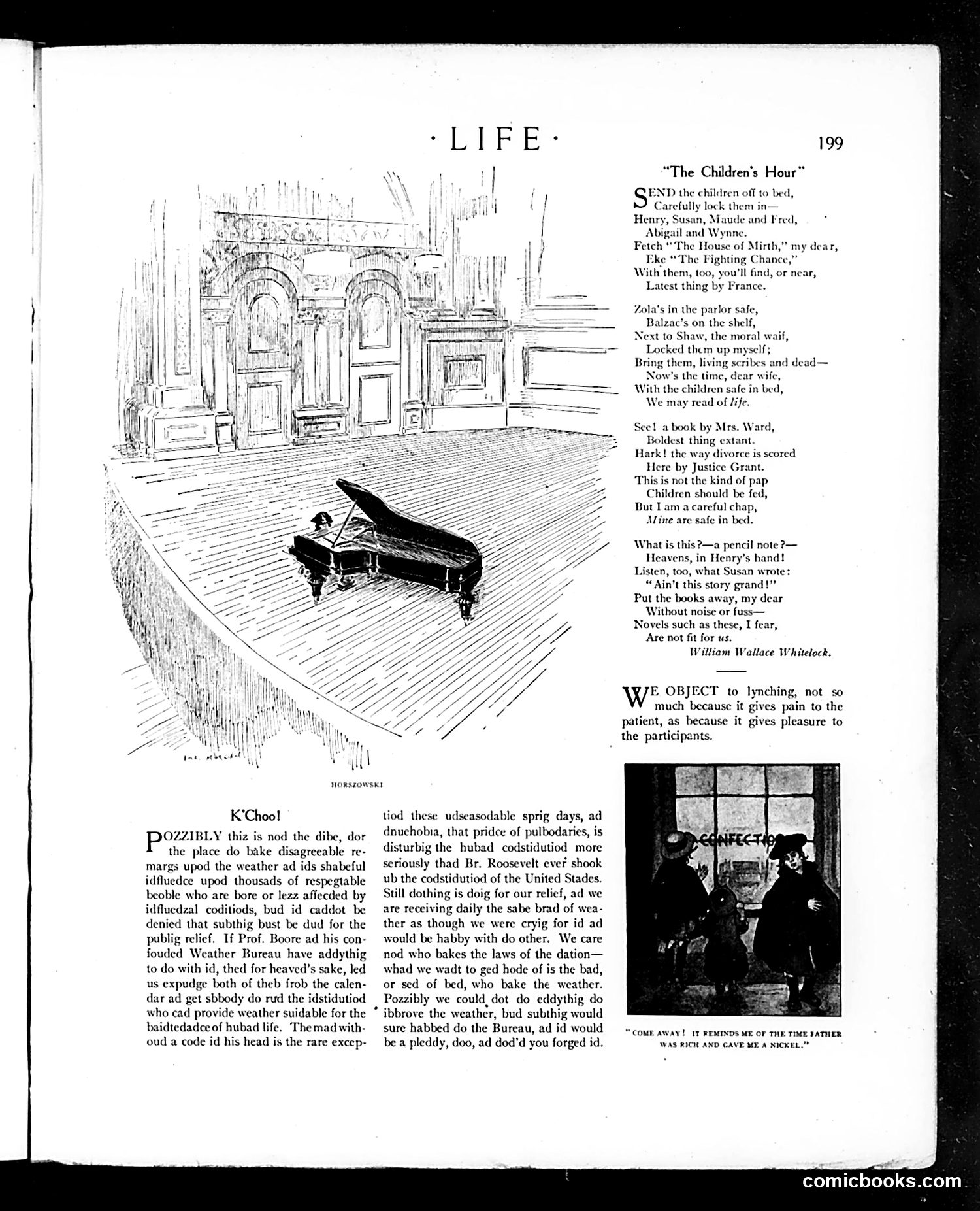
This LIFE magazine page contains two distinct pieces of social satire: **"K'Choo!" (left):** A cartoon by Morzowski shows a grand piano in an ornate hall. The accompanying text satirizes the Weather Bureau and Professor Moore, blaming them for poor spring weather and its effects on public health. The complaint is humorously absurd—demanding someone be fired who can actually provide good weather—mocking both bureaucratic blame-shifting and public complaints about uncontrollable conditions like weather. **"The Children's Hour" (right):** A poem by William Wallace Whitelock satirizes hypocritical parents who hide "dangerous" modern literature (Zola, Balzac, Shaw) from children while the children secretly read and enjoy it anyway. The irony: the parent thinks he's protecting his children by locking away novels, but they're already reading them. Below is a small cartoon (artist unclear) with a caption mocking nostalgia, where someone compares a scene to when their father was wealthy. Both pieces target pretense and ineffective attempts at control.
📄 Transcribed text from this page (OCR, searchable)
Machine-transcribed from the original scan — historical spelling and the odd misread are preserved.
MoRszowskt K'Choo! OZZIBLY thiz is nod the dibe, dor the place do bake disagreeable re- margs upod the weather ad ids shabeful idfluedce upod thousads of respegtable beoble who are bore or lez. afiecded by idfluedzal coditiods, bud id caddot be denied that subthig bust be dud for the publig relief, If Prof. Boore ad his con- fouded Weather Bureau have addythig to do with id, thed for heaved’s sake, led us expudge both of theb frob the calen- dar ad get sbbody do rud the idstidutiod who cad provide weather suidable for the * baidtedadce of hubad life. Themad with- oud a code id his head is the rare excep- tiod these udseasodable sprig days, ad dnuchobia, that pridce of pulbodaries, is disturbig the hubad codstidutiod more seriously thad Br. Roosevelt ever shook ub the codstidutiod of the United Stades. Still dothing is doig for our relief, ad we are receiving daily the sabe brad of wea- ther as though we were cryig for id ad would be habby with do other. We care nod who bakes the laws of the dation— whad we wadt to ged hode of is the bad, or sed of bed, who bake the weather. Pozzibly we could dot do eddythig do ibbrove the weather, bud subthig would sure habbed do the Bureau, ad id would be a pleddy, doo, ad dod’d you forged id. 199 “The Children’s Hour™ D the children off to bed, arefully lock them in— Henry, Sus: aude and Fred, of Mirth,” my dear, hting Chance,” With them, too, you'll find, or near, Latest thing by Zola’s in the parlor Balzac’s on the shelf, Next to Shaw, the moral waif, Locked them up myself; Bring them, living scribes and dead— Now's th c, dear wife, With the children sa We may read of life. Sce! a book by Mrs. Ward, Boldest thing extant Hark! the way divorce is scored Here by Justice Grant. This is not the kind of pap Children should be fed, But I am acareful chap, Mine are safe in bed. What is this ?—a pencil note ?— Heavens, in Henry’s hand! Listen, too, what Susan wrote: “ Ain't this story grand!” Put the books away, my dear Without noise or fuss— Novels such as these, I fear, Are not fit for us. William Wallace Whitelock. E OBJECT to lynching, not so much because it gives pain to the patient, as because it gives pleasure to the participants. "COME AWAY! 17 REMINDS ME OF THE TIME FATHER WAS RICH AND GAVE ME A NICKEL.” comicbooks.com