
Life, 1907-02-07 · page 24 of 52
Life — February 7, 1907 — page 24: what you’re looking at
What you’re looking at
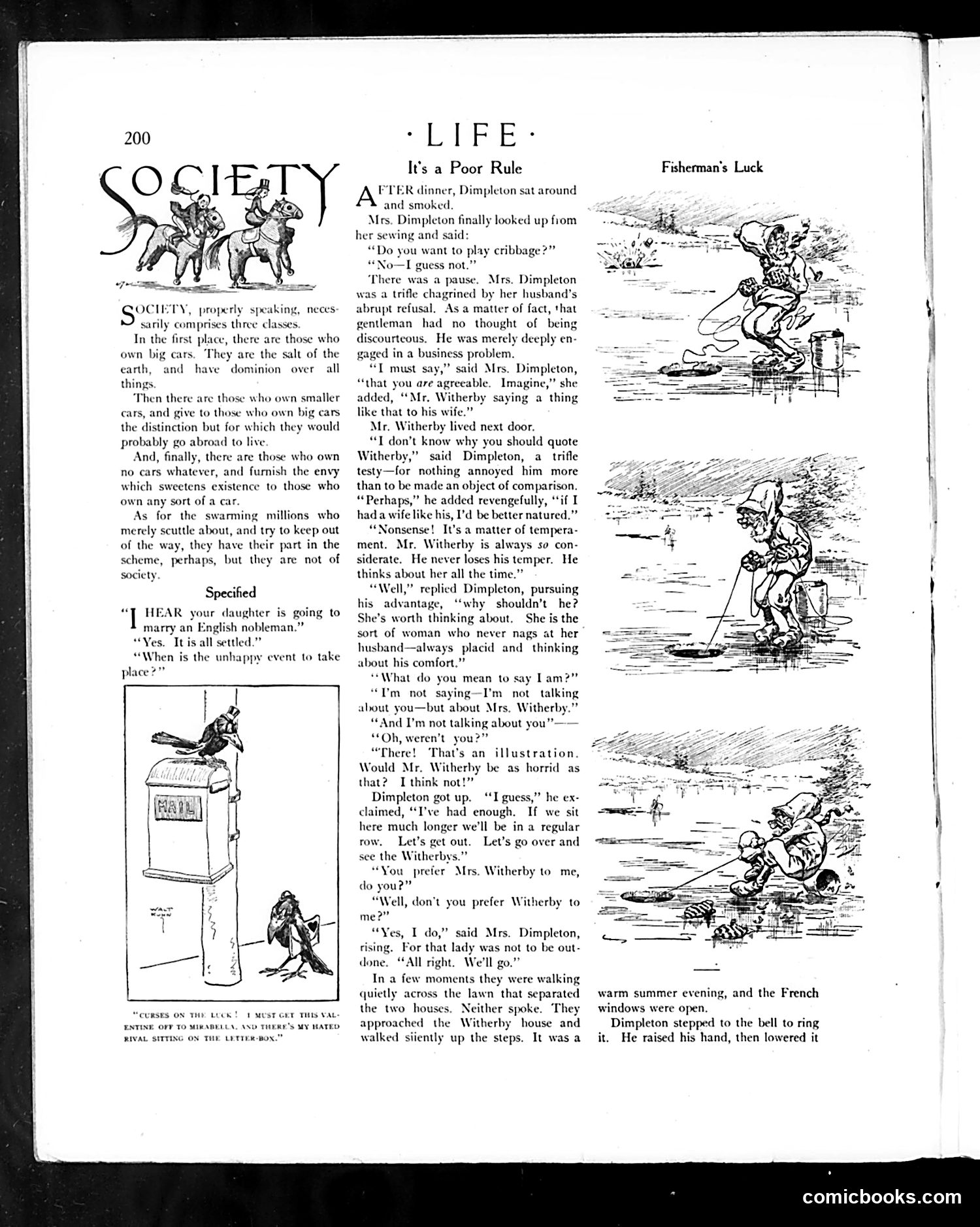
This Life magazine page contains two distinct pieces of satire: **"It's a Poor Rule"** (main story): A marital comedy where Mr. and Mrs. Dimpleton argue about their neighbor Mr. Witherby. When Mrs. Dimpleton criticizes her husband's lack of attentiveness by comparing him favorably to the always-considerate Witherby, Dimpleton retorts that Witherby only behaves well because his wife never nags. The couple becomes so irritated they decide to visit the Witherbys to prove their point—but the story ends ambiguously as Dimpleton hesitates at the doorbell, suggesting their confrontation will backfire. **The opening "Society" section** satirizes American class hierarchy of the era, mockingly defining "society" as those who own cars (big cars = the elite; smaller cars = middle class; no cars = invisible masses). It's commentary on automobile-driven status anxiety in early 20th-century America. **"Fisherman's Luck"** (right illustrations): Appears to be a brief humorous fishing narrative, though details are minimal. The cartoons employ the period's characteristic gentle domestic and social satire.
📄 Transcribed text from this page (OCR, searchable)
Machine-transcribed from the original scan — historical spelling and the odd misread are preserved.
gociery, properly speaking, neces: sarily comprises three classes. In the first place, there are those who own big cars. They are the salt of the earth, and have dominion over all things. Then there are those who own smaller cars, and give to those who own big cars the distinction but for which they would probably go abroad to live And, finally, there are those who own no cars whatever, and furnish the envy which sweetens existence to those who own any sort of a car. As for the swarming millions who merely scuttle about, and try to keep out of the way, they have their part in the scheme, perhaps, but they are not of society, Specified HEAR your daughter is going to marry an English nobleman.” “Yes. It is all settled.” “When is the unhappy event to ta place?” “CURSES ON TID, LUCK! 1 MUST GET THIS VAL ENTINE OFY TO MIRADELLA. AND T RIVAL SITTING ON THE LETTER-BOX. Ry’s MY HATED, *LIPE> It’s a Poor Rule FTER dinner, Dimpleton sat around and smoked. Mrs. Dimpleton finally looked up from her sewing and said: “Do you want to play cribbage?” “No—I guess not.” ‘There was a pause. Mrs. Dimpleton was a trifle chagrined by her husband’s abrupt refusal, As a matter of fact, that gentleman had no thought of being discourteous. He was merely deeply en- gaged in a business problem. “T must say,” said Mrs. Dimpleton, “that you are agreeable. Imagine,” she added, “Mr, Witherby saying a thing like that to his wife.” Mr. Witherby lived next door. “TI don’t know why you should quote Witherby,” said Dimpleton, a trifle testy—for nothing annoyed him more than to be made an object of comparison. “Perhaps,” he added revengefully, “if I had a wife like his, I’d be better natured.” “Nonsense! It’s a matter of tempera- ment. Mr. Witherby is always so con- siderate. He never loses his temper. He thinks about her all the time.” “Well,” replied Dimpleton, pursuing his advantage, ‘‘why shouldn’t he? She’s worth thinking about, She is the sort of woman who never nags at her husband—always placid and thinking about his comfort.” “What do you mean to say Lam?” “Pm not saying—I'm not talking about you—but about Mrs. Witherby.”” “And I’m not talking about you””—— “Oh, weren't you?” “There! That's an illustration. Would Mr. Witherby be as horrid as. that?) [think not!” Dimpleton got up. “I guess,” he € claimed, “I've had enough. If we s here much longer we'll be in a regular row. Let’s get out. Let’s go over and see the Witherbys.”” “You prefer Mrs, Witherby to. me, do you?” “Well, don't you prefer Witherby to me?” “Yes, I do,” said Mrs. Dimpleton, i For that lady was not to be out- done. “All right. We'll go.” In a few moments they were walking quietly across the lawn that separated the two houses. Neither spoke. They approached the Witherby house and walked siiently up the steps. It was a Fisherman's Luck warm summer evening, and the French windows were open. it. Dimpleton stepped to the bell to ring He raised his hand, then lowered it comicbooks.com