
Life, 1907-02-07 · page 36 of 52
Life — February 7, 1907 — page 36: what you’re looking at
What you’re looking at
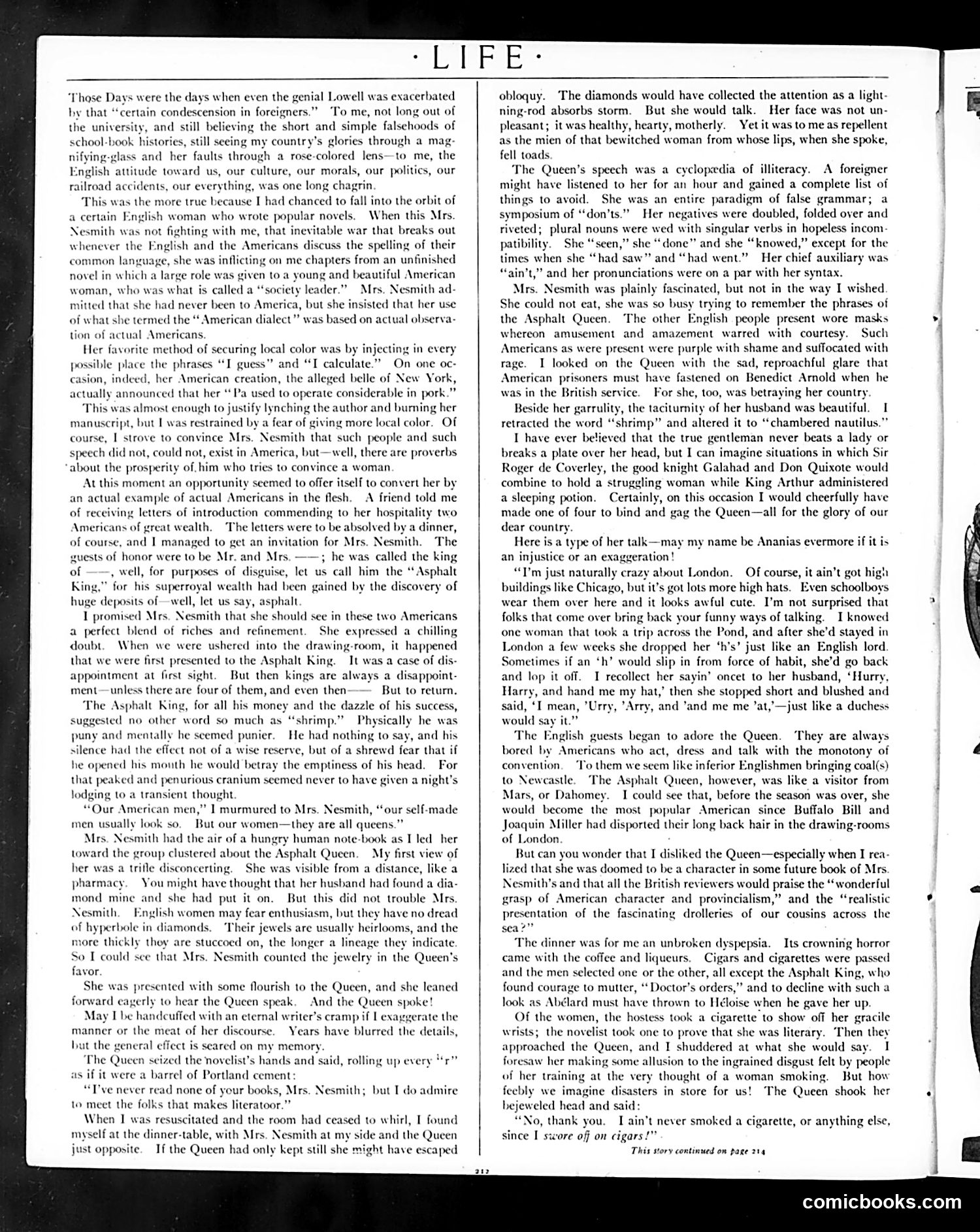
This is a satirical short story about Anglo-American cultural tensions, not primarily a political cartoon. The unnamed narrator, an American, attempts to convince a snobbish English novelist (Mrs. Nesmith) that Americans possess refinement and sophistication. Mrs. Nesmith stereotypes Americans using crude dialect ("I guess," "I calculate," "Pa used to operate considerable in pork"), which the narrator finds offensive. The narrator arranges an introduction to wealthy Americans—the "Asphalt King" and his wife—as living proof of American respectability. The joke: the Asphalt King proves the stereotype partially correct—he's described as physically "puny" and intellectually empty, appearing as a self-made industrialist lacking substance. His wife is presented more favorably. The satire targets both British condescension toward Americans and American nouveaux riches who gained fortunes through resource extraction (asphalt) rather than inherited gentility. It reflects early 20th-century anxiety about American social status in Anglo-American relations.
📄 Transcribed text from this page (OCR, searchable)
Machine-transcribed from the original scan — historical spelling and the odd misread are preserved.
op ley) | al rhose Days were the days when even the genial Lowell was exacerbated hy that “certain condescension in foreigners.” ‘To me, not long out of the university, and still believing the short and simple falsehoods of school-book histories, still seeing my country’s glories through a mag- nifying-glass and her faults through a rose-colored lens—to me, the English attitude toward us, our culture, our morals, our politics, our railroad accidents, our everything, was one long chagrin This was the more true because I had chanced to fall into the orbit of a certain English woman who wrote popular novels. When this Mrs. Nesmith was not fighting with me, that inevitable war that breaks out whenever the English and the Americans discuss the spelling of their common language, she was inflicting on me chapters from an unfinished novel in which a large role was given to a young and beautiful American woman, who was what is called a “society leader.” Mrs. Nesmith ad- mitted that she had never been to America, but she insisted that her use of what she termed the “ American dialect” was based on actual observa- tion tual Americans. Her favorite method of securing local color was by injecting in every possible place the phrases “I guess” and “I calculate.” On one oc- casion, indeed, her American creation, the alleged belle of New York, actually announced that her “Pa used to operate considerable in pork.” This was almost enough to justify lynching the author and burning her manuscript, but I was restrained by a fear of giving more local color. Of course, I strove to convince Mrs. Nesmith that such people and such speech did not, could not, exist in America, but—well, there are proverbs about the prosperity of, him who tries to convince a woman At this moment an opportunity seemed to offer itself to convert her by an actual example of actual Americans in the flesh. A friend told me of receiving letters of introduction commending to her hospitality two cat wealth. ‘The letters were to be absolved by a dinner, ged to get an invitation for Mrs. Nesmith. The guests of honor were to be Mr. and Mrs. ——; he was called the king of , well, for purposes of disguise, let us call him the “Asphalt Sing,” for his superroyal wealth had been gained by the discovery of huge deposits of —well, let us say, asphalt I promised Mrs, Nesmith that she should see in these two Americans a perfect blend of riches and refinement. She expressed a chilling doubt. When we were ushered into the drawing-room, it happened that we were first presented to the Asphalt King. It was a case of dis- appointment at first sight. But then kings are always a disappoint- ment—unless there are four of them, and even then But to return, The Asphalt King, for all his money and the dazzle of his success, suggested no other word so much as “shrimp.” Physically he was puny and mentally he seemed punier. He had nothing to say, and his silence had the effect not of a wise reserve, but of a shrewd fear that if he opened his mouth he would betray the emptiness of his head. For that peaked and penurious cranium seemed never to have given a night's g to a transient thought “Our American men,” 1 murmured to Mrs. Nesmith, “our self-made men usually look so, But our women—they are all queens.” Mrs. Nesmith had the air of a hungry human note-book as I led her toward the group clustered about the Asphalt Queen. My first view of her was a trifle disconcerting. She was visible from a distance, like a pharmacy. You might have thought that her husband had found a dia- mond mine and she had put it on. But this did not trouble Mrs. Nesmith. English women may fear enthusiasm, but they have no dread of hyperbole in diamonds. ‘Their jewels are usually heirlooms, and the more thickly thoy are stuccoed on, the longer a lineage they indicate So T could see that Mrs. Nesmith counted the jewelry in the Queen's favor. She was presented with some flourish to the Queen, and she leaned forward cayerly to hear the Queen speak. And the Queen spoke! May I be handcuffed with an eternal writer’s cramp if L exaggerate the manner or the meat of her discourse. Years have blurred the details, but the general effect is seared on my memory. ‘The Queen seized the novelist’s hands and said, rolling up every * as if it were a barrel of Portland cement: “T’ve never read none of your books, Mrs. Nesmith; but I do admire to meet the folks that makes literatoor.” When I was resuscitated and the room had ceased to whirl, I found myself at the dinner-table, with Mrs. Nesmith at my side and the Queen just opposite. If the Queen had only kept still she might have escaped Americans of of course, and I mana obloquy. The diamonds would have collected the attention as a light- ning-rod absorbs storm. But she would talk. Her face was not un- pleasant; it was healthy, hearty, motherly. Yet it was to me as repellent as the mien of that bewitched woman from whose lips, when she spoke, fell toads. The Queen’s speech was a cyclopedia of illiteracy. A. foreigner might have listened to her for an hour and gained a complete list of things to avoid. She was an entire paradigm of false grammar; a ymposium of “don’t.” Her negatives were doubled, folded over and riveted; plural nouns were wed with singular verbs in hopeless incom- patibility. She “seen,” she “done” and she “knowed,” except for the times when she had saw” and “had went.” Her chief auxiliary was “ain't,” and her pronunciations were on a par with her syntax, Mrs. Nesmith was plainly fascinated, but not in the way I wished. She could not eat, she was so busy trying to remember the phrases of the Asphalt Queen. The other English people present wore masks whereon amusement and amazement warred with courtesy. Such Americans as were present were purple with shame and suffocated with rage. I looked on the Queen with the sad, reproachful glare that American prisoners must have fastened on Benedict Arnold when he was in the British service. For she, too, was betraying her country Beside her garrulity, the taciturnity of her husband was beautiful. 1 retracted the word “shrimp” and altered it to ‘chambered nautilus.” I have ever believed that the true gentleman never beats a lady or breaks a plate over her head, but I can imagine situations in which Sir Roger de Coverley, the good knight Galahad and Don Quixote would combine to hold a struggling woman while King Arthur administered a sleeping potion. Certainly, on this occasion I would cheerfully have made one of four to bind and gag the Queen—all for the glory of our dear country. Here is a type of her talk—may my name be Ananias evermore if it is an injustice or an exaggeration! “T'm just naturally crazy about London. Of course, it ain’t got hi; buildings like Chicago, but it’s got lo > s more high hats. Even schoolboys wear them over here and it looks awful cute. I’m not surprised that folks that come over bring back your funny ways of talking. I knowed one woman that took a trip across the Pond, and after she'd stayed in London a few weeks she dropped her ‘h’s’ just like an English lord. Sometimes if an ‘h’ would slip in from force of habit, she’d go back and lop it off. I recollect her sayin’ oncet to her husband, ‘Hurry, y, and hand me my hat,’ then she stopped short and blushed and I mean, ’Urry, ‘Arty, and ‘and me me ’at,’—just like a duchess would say it.” The English guests began to adore the Queen. ‘They are always bored by Americans who act, dress and talk with the monotony of convention. ‘To them we seem like inferior Englishmen bringing coal(s) to Newcastle. The Asphalt Queen, however, was like a visitor from Mars, or Dahomey. I could see that, before the season was over, she would become the most popular American since Buffalo Bill and Joaquin Miller had disported their long back hair in the drawing-rooms of London. But can you wonder that I disliked the Queen—especially when I rea- lized that she was doomed to be a character in some future book of Mrs. Nesmith’s and that all the British reviewers would praise the ‘wonderful grasp of American character and provincialism,” and the “realistic presentation of the fascinating drolleries of our cousins across the sea?” ‘The dinner was for me an unbroken dyspepsia. Its crowninig horror came with the coffee and liqueurs. Cigars and cigarettes were passed and the men selected one or the other, all except the Asphalt King, who found courage to mutter, ‘* Doctor's orders,” and to decline with such a look as Abélard must have thrown to Heloise when he gave her up. Of the women, the hostess took a cigarette to show off her gracile wrists; the novelist took one to prove that she was literary. Then they approached the Queen, and I shuddered at what she would say. 1 foresaw her making some allusion to the ingrained disgust felt by people of her training at the very thought of a woman smoking. But how feebly we imagine disasters in store for us! The Queen shook her bejeweled head and said: “No, thank you, I ain’t never smoked a cigarette, or anything else, since I swore off on cigars!” This story continued on page 214 | q i | comicbooks.com