
Life, 1907-02-07 · page 15 of 52
Life — February 7, 1907 — page 15: what you’re looking at
What you’re looking at
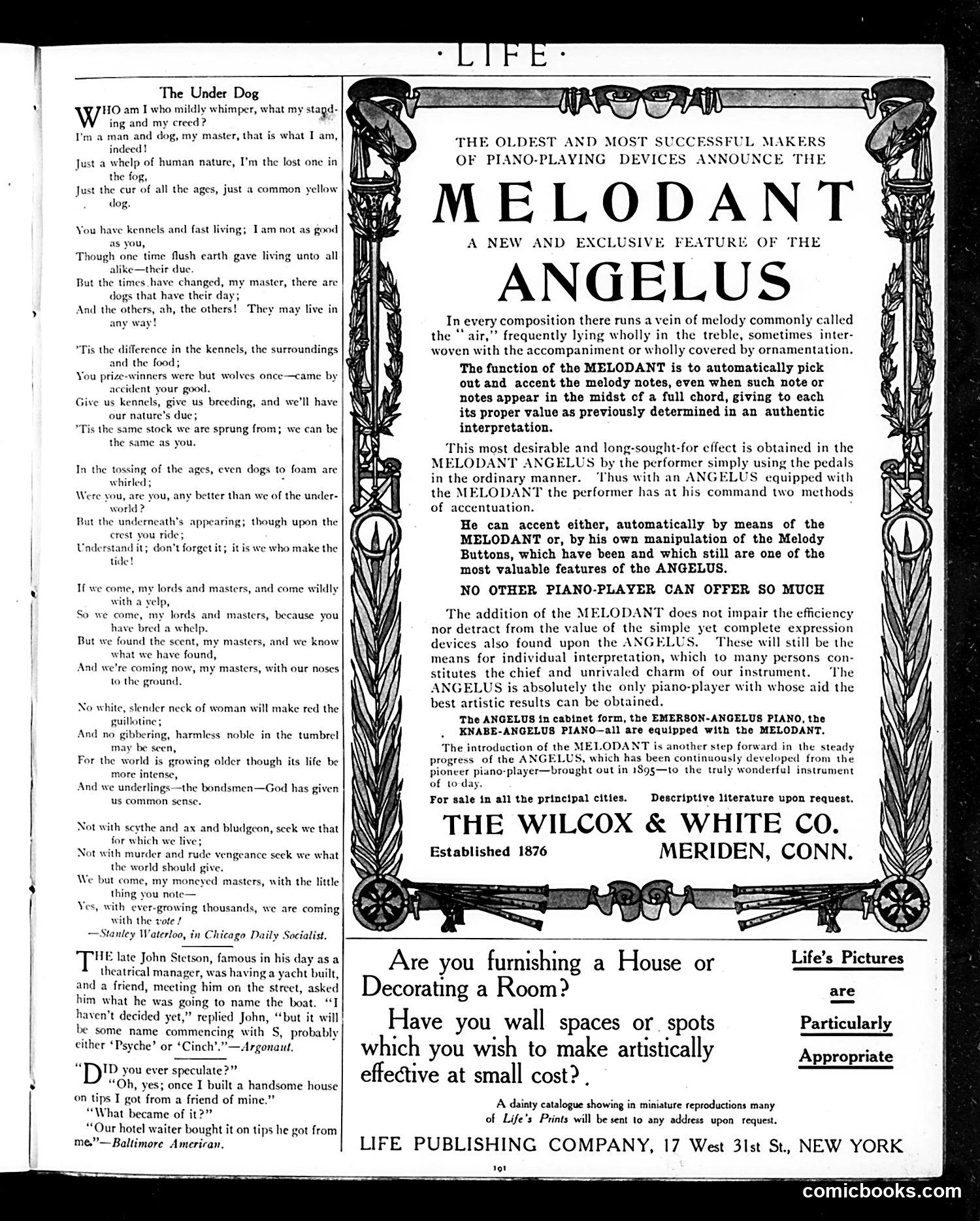
This page features a lengthy satirical poem titled "The Under Dog," attributed to Stanley Waterloo from the *Chicago Daily Socialist*. The poem uses a dog as metaphor for the working class or underclass, arguing for social equality through democratic means rather than violent revolution. The central conceit: a "common yellow dog" addresses the wealthy ("moneyed masters"), asserting that all classes share common origins ("same stock we are sprung from"). The satire critiques class privilege while making a radical argument—that the underclass possesses "common sense" and will achieve power "with the vote," not violence. The poem's final lines directly reference socialist concerns of the era: dismissing the French Revolution's guillotine and tumbrel, it advocates for democratic participation as the tool of social change. This represents early 20th-century American socialist rhetoric emphasizing ballot-box reform over violent upheaval. The surrounding advertisements (piano devices, house decorating) provide striking contrast to this revolutionary messaging—typical of *Life* magazine's dual commercial and editorial purposes.
📄 Transcribed text from this page (OCR, searchable)
Machine-transcribed from the original scan — historical spelling and the odd misread are preserved.
The Under Dog HO am I who mildly whimper, what my stagd- ing and my creed? 4 I'm aman and dog, my master, that is what I am, indeed! Just a whelp of human nature, I'm the lost one in the fog, Just the cur of all the ages, just a common yellow dog. You have kennels and fast living; Tam not as good as you, Though one time flush earth gave living unto all alike—their duc. But the times have changed, m dogs that have their day; And the others, ah, the others!) They may live in any wa master, there are ’Tis the difference in the kennels, the surroundings and the food; You prize-winners were but wolves once—came by accident your good, Give us kennels, give us breeding, and we'll have our nature’s duc; ‘Tis the same stock we are sprung from; we can be the same as you. In the tossing of the ages, even dogs to foam are whirled ; . Were you, are you, any better than we of the under- world ? But the underneath’s appearing; though upon the crest you ride; Understand it; don’t forget it; it is we who make the tide! If we come, my lords and masters, with a velp, So we come, my lords and masters, because you have bred a whelp. But we found the scent, my masters, and we know what we have found, And we're coming now, my masters, with our noses to the ground. and come wildly No white, slender neck of woman will make red the guillotine; And no gibbering, harmless noble in the tumbrel may be scen, For the world is growing older though its life be more intense, And we underlings—the bondsmen—God has given us common sense. Not with scythe and ax and bludgeon, seek we that for which we live; Not with murder and rude vengeance seck we what the world should give. We but come, my moneyed masters, with the little thing you note— Yes, with ever-growing thousands, we are coming with the vote / —Stanley Waterloo, in Chicago Daily Socialist. T! © late John Stetson, famous in his day as a theatrical manager, was having a yacht built, and a friend, meeting him on the street, asked him what he was going to name the boat. “I haven't decided yet,” replied John, “but it will be some name commencing with S, probably cither ‘Psyche’ or ‘Cinch’.”—Argonaut. “‘D? you ever speculate?” “Oh, yes; once I built a handsome house on tips I got from a friend of mine.” “What became of it?” “Our hotel waiter bought it on tips he got from me.”—Baltimore American. THE OLDEST AND MOST SUCCESSFUL MAKERS OF PIANO-PLAYING DEVICES ANNOUNCE THE MELODANT A NEW AND EXCLUSIVE FEATURE OF THE ANGELUS In every composition there runs a vein of melody commonly c: the “air,” frequently lying wholly in the treble, sometimes inter- woven with the accompaniment or wholly covered by ornamentation, The function of the MELODANT is to automatically pick out and accent the melody notes, even when such note or notes appear in the midst cf a full chord, giving to each its proper value as previously determined in an authentic interpretation. s most desirable and long-sought-for effect is obtained in the MELODANT ANGELUS by the performer simply using the pedals in the ordinary manner. ‘Thus with an ANGELUS equipped with the MELODANT the performer has at his command two methods of accentuation. He can accent either, automatically by means of the MELODANT or, by his own manipulation of the Melody Buttons, which have been and which still are one of the most valuable features of the ANGELUS. NO OTHER PIANO-PLAYER CAN OFFER SO MUCH The addition of the MELODANT does not impair the efficiency nor detract from the value of the simple yet complete expression devices also found upon the ANGELUS. These will still be the means for individual interpretation, which to many persons con- stitutes the chief and unrivaled charm of our instrument. ‘The ANGELUS is absolutely the only piano-player with whose aid the best artistic results can be obtained. The ANGELUS in cabinet form, the EMERSON-ANGELUS PIANO, the KNABE-ANGELUS PIANO—all are equipped with the MELODANT. ¢ introduction of the MELODANT is another step forward in the steady progress of the ANG which has been continuously developed from the pioneer piano-player—brought out in 1895—to the truly wonderful instrument of today. For sale in all the principal cities. THE WILCOX & WHITE CO. Established 1876 MERIDEN, CONN. Descriptive literature upon request. Are you furnishing a House or Life’s Pictures Decorating a Room? Have you wall spaces or. spots which you wish to make artistically effective at small cost? , A dainty catalogue showing in miniature reproductions many of Life's Prints will be sent to any address upon request. are Particularly Appropriate LIFE PUBLISHING COMPANY, 17 West 3lst St, NEW YORK 101 comicbooks.com