
Life, 1907-02-07 · page 29 of 52
Life — February 7, 1907 — page 29: what you’re looking at
What you’re looking at
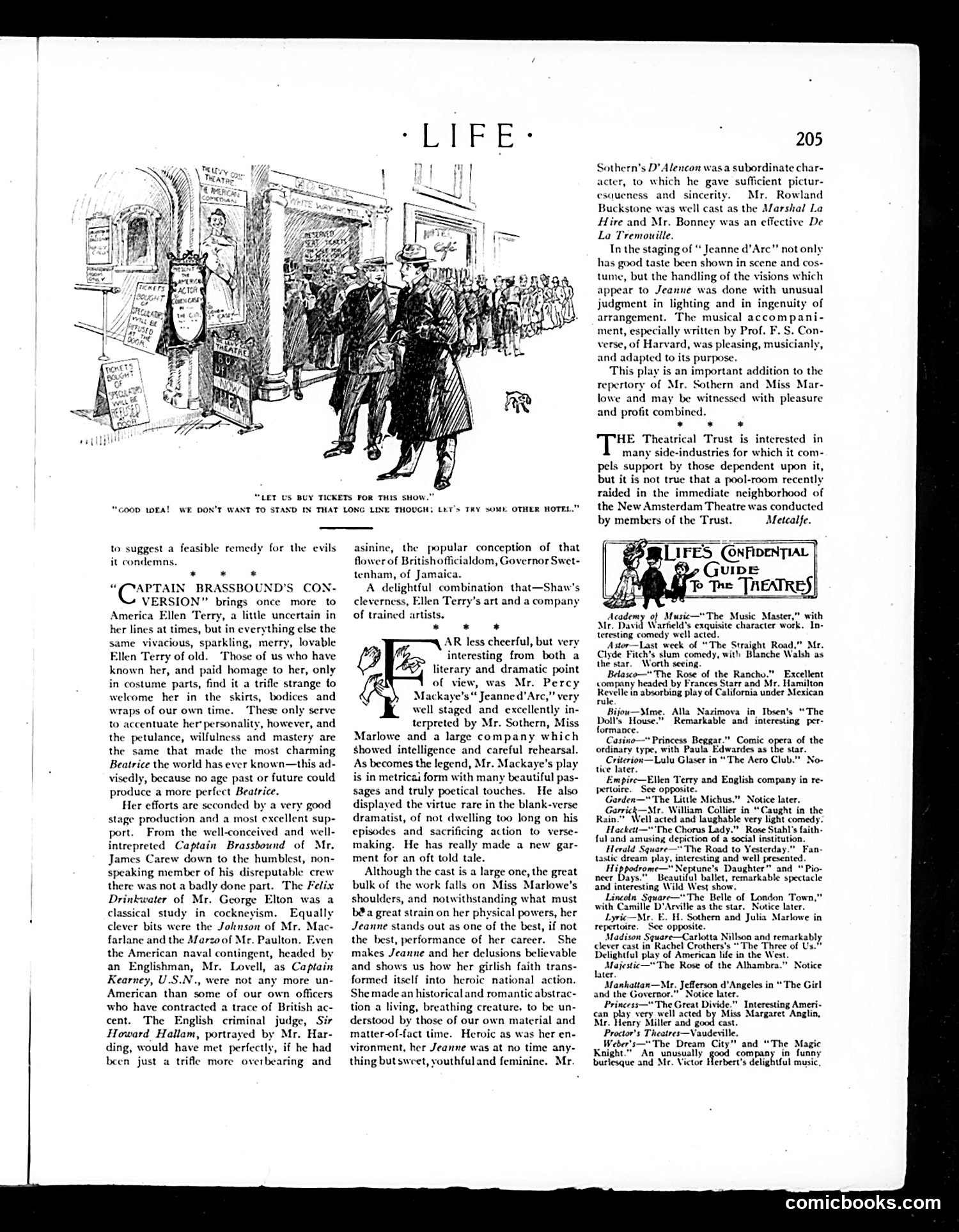
## The Cartoon The illustration depicts two well-dressed men outside a theater discussing ticket purchases. One suggests buying tickets for "this show," but his companion protests against standing in a long line, proposing they "try some other hotel" instead—implying they'll see a different theatrical production elsewhere. ## Meaning for Modern Readers This is **social satire about theatrical competition and consumer choice** in early 20th-century New York. The joke targets the inconvenience of popular shows: audiences faced long queues to purchase tickets, so patrons simply chose competing productions at rival theaters rather than wait. The cartoon humorously illustrates a real problem—**theater-going logistics**—while subtly mocking the disposable nature of theatrical entertainment. Rather than invest time in a desired show, audiences treated theaters as interchangeable commodities. The "hotel" reference likely alludes to theater lobbies or nearby hotel box offices where tickets were sold. This reflects the era's theatrical abundance and competitive marketplace, where entertainment options were plentiful enough that patience was unnecessary.
📄 Transcribed text from this page (OCR, searchable)
Machine-transcribed from the original scan — historical spelling and the odd misread are preserved.
2000 WEA! “LET US BUY TICKETS FoR THIS sHow, WE DON'T WANT TO STAND IN THAT LONG LINE THOUGH; Let's TRY sos: OTHER HOTEL.” to suggest a feasible remedy for the evils it condemns. * © «© PTAIN BRASSBOUND’S CON- VERSION” brings once more to ica Ellen Terry, a little uncertain in at times, but in everything else the same vivacious, sparkling, merry, lovable len Terry of old. Those of us who have known her, and paid homage to her, only in costume parts, find it a trifle strange to welcome her in the skirts, bodices and wraps of our own time. ‘These only serve to accentuate her' personality, however, and the petulance, wilfulness and mastery are the same that made the most charming Beatrice the world has ever known—this ad- visedly, because no age past or future could produce a more perfect Beatrice. Her efforts are seconded by a very good stage production and a most excellent sup- port. From the well-conceived and well- intrepreted Captain Brassbound of Mr. James Carew down to the humblest, non- speaking member of his disreputable crew there was not a badly done part. The Felix Drinkwater of Mr. George Elton was a classical study in cockneyism. Equally clever bits were the Johnson of Mr. Mac- farlane and the Mfarzoof Mr. Paulton. Even the American naval contingent, headed by an Englishman, Mr. Lovell, as Captain Kearney, U.S.N., were not any more un- American than some of our own officers who have contracted a trace of British a cent. The English criminal judge, Sir Howard Hallam, portrayed by Mr. Har- ding, would have met perfectly, if he had been just a trifle more overbearing and asinine, the popular conception of that flower of British officialdom, Governor Swet- tenham, of Jamaica. A delightful combination that—Shaw’'s cleverness, Ellen Terry’s art and a company of trained artists. * * * AR less cheerful, but very interesting from both a literary and dramatic point of view, was Mr. Percy Mackaye’s “ Jeanne d’Are,” very well staged and excellently in- terpreted by Mr. Sothern, Miss Marlowe and a large company which showed intelligence and careful rehearsal. As becomes the legend, Mr. Mackaye’s play is in metrical form with many beautiful pas- sages and truly poetical touches. He also displayed the virtue rare in the blank-verse dramatist, of not dwelling too long on his episodes and sacrificing action to. verse- making. He has really made a new gar- ment for an oft told tale. Although the cast is a large one, the great bulk of the work falls on Miss Marlowe's shoulders, and notwithstanding what must b@ a great strain on her physical powers, her Jeanne stands out as one of the best, if not the best, performance of her career. She makes Jeanne and her delusions believable and shows us how her girlish faith trans- formed itself into heroic national action. She made an historical and romantic abstrac- tion a living, breathing creature, to be un- derstood by those of our own material and matter-of-fact time. Heroic as was her en- vironment, her Jeanne was at no time any- thing but sweet, youthful and feminine. Mr 205 Sothern's D'Alencon wasa subordinate char- acter, to which he gave sufficient pictur- esaueness and sincerity. Mr. Rowland Buckstone was well cast as the Marshal La Hire and Mr. Bonney was an effective De La Tremouille. In the staging of “ Jeanne d’Arc” not only has good taste been shown in scene and cos tume, but the handling of the visions which appear to Jeanne was done with unusual judgment in lighting and in ingenuity of arrangement. The musical accom pani- ment, especi; written by Prof. F. S. Con- verse, of Harvard, was pleasing, musicianly, and adapted to its purpose. This play is an important addition to the repertory of Mr. Sothern and Miss Mar- lowe and may be witnessed with pleasure and profit combined. * es HE Theatrical Trust is interested in many side-industries for which it com- pels support by those dependent upon it, but it is not true that a pool-room recently raided in the immediate neighborhood of the New Amsterdam Theatre was conducted by members of the Trust. Metcalfe. Academy of Music—"The Music Master,” with Mr. David Wartield’s exquisite character work. In- teresting comedy well acted. Astor—Last week of “The Straight Road,” Mr. Clyde Fitch’s slum comedy, with Blanche Walsh as the star. Worth seeing. Bdasco—" The Rose of the Rancho.” Excellent company headed by Frances Starr and Mr. Hamilton Revelle in absorbing play of California under Mexican rw Bijou—Sme, Alla Nazimova in Ibsen's “The Doll’s House.” ‘Remarkable and interesting per- formance. Casino—* Princess Beggar.” Comic opera of the ordinary type, with Paula Edwardes as the star. Criterion—Lulu Glaser in “The Acro Club.” No- tice later. Empirc—Ellen Terry and English company in re- pettoire. See opposite. Garden—*The Little Michus.” Notice later. Garrick—Mr. William Collier in “Caught in the Rain.” Well acted and laughable very light comedy. Hackett—""The Chorus Lady.” Rose Stahl’s faith- ful and amusing depiction of a social institution. Herald Square—" The Road to Yesterday." Fan- tastic dream play, interesting and well presented. Hippodrome—" Neptune's Daughter" and *Pio- neer Days.” Beautiful ballet, remarkable spectacle and interesting Wild West show. Lincoln Square—"The Belle of London Town,” with Camille D'Arville as the star, Notice later. Lyric—Mr. E. H. Sothern and Julia Marlowe in repertoire. See opposite. Madison Square—Carlotta Nillson and remarkably clever cast in Rachel Crothers's "The Three of Us." Delightful play of American life in the West. Majestic—""The Rose of the Alhambra. later: Manhattan—Mr. Jefferson d'Angeles in “The Girl and the Governor.’"” Notice later. Princess—* The Great Divide.” Interesting Ameri- gan pay very well acted by Miss Margaret Anglin, Mr. Henry Miller and good cast. Proctor’s Theatres—Vaudeville. Weber's—"The Dream City” and “The Magic Knight.” An unusually good company, in funny burlesque and Me. Victor Herbert's delightful music Notice comicbooks.com