
A complete issue · 64 pages · 1906
Life — December 6, 1906
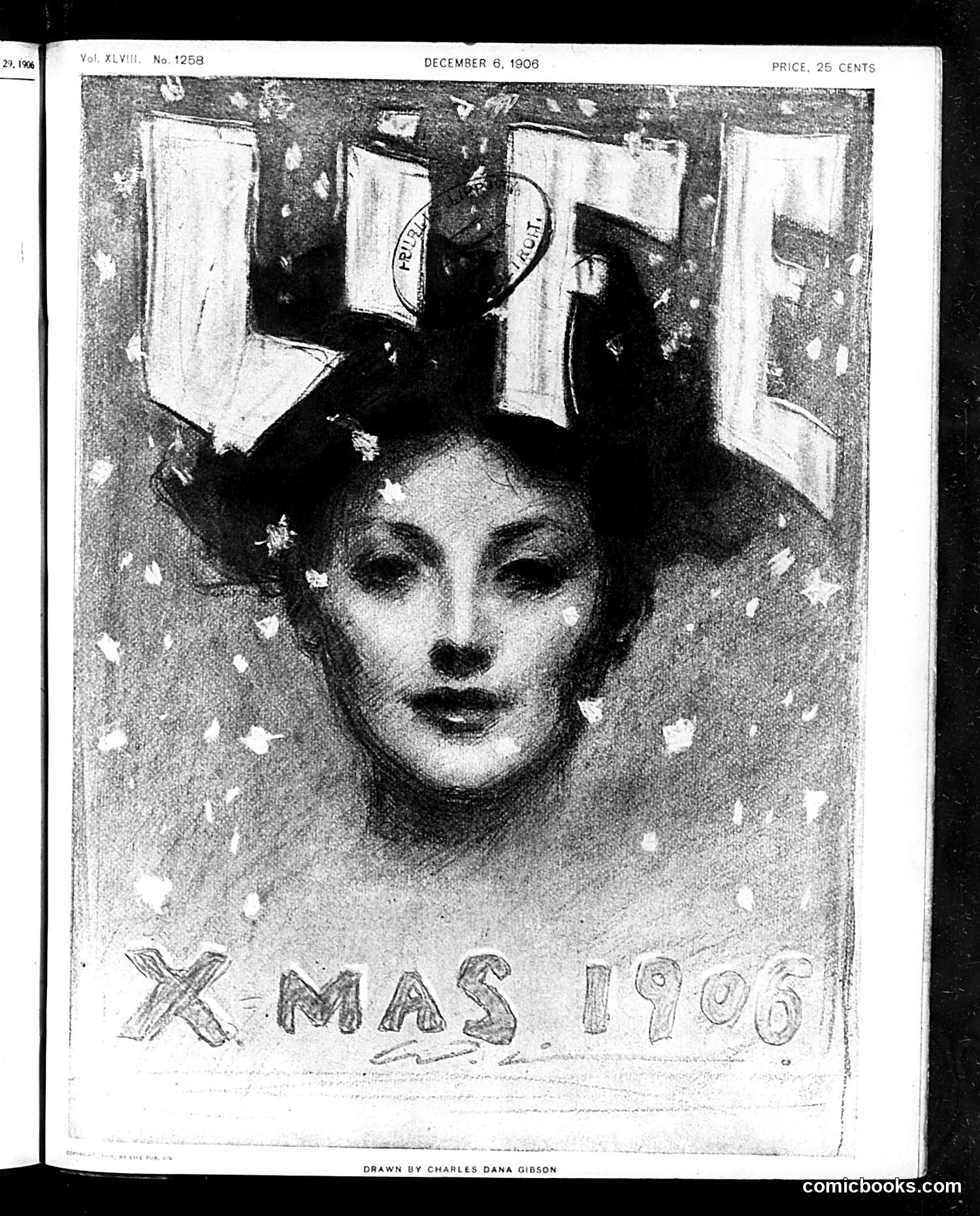
This is a satirical Christmas illustration drawn by Charles Dana Gibson (famous for the "Gibson Girl"). The image shows a woman's face surrounded by wrapped presents positioned above her head like a halo or crown. The text reads "XMAS 1906," indicating this is a holiday-themed piece from that year. The satire appears to target consumer culture and materialism associated with Christmas gift-giving—suggesting that for some people (likely wealthy women of the era), the holiday was defined by lavish material gifts rather than spiritual or traditional values. The Gibson Girl style and elegant presentation add ironic commentary on holiday excess and commercialism, themes Life magazine frequently satirized during this period.
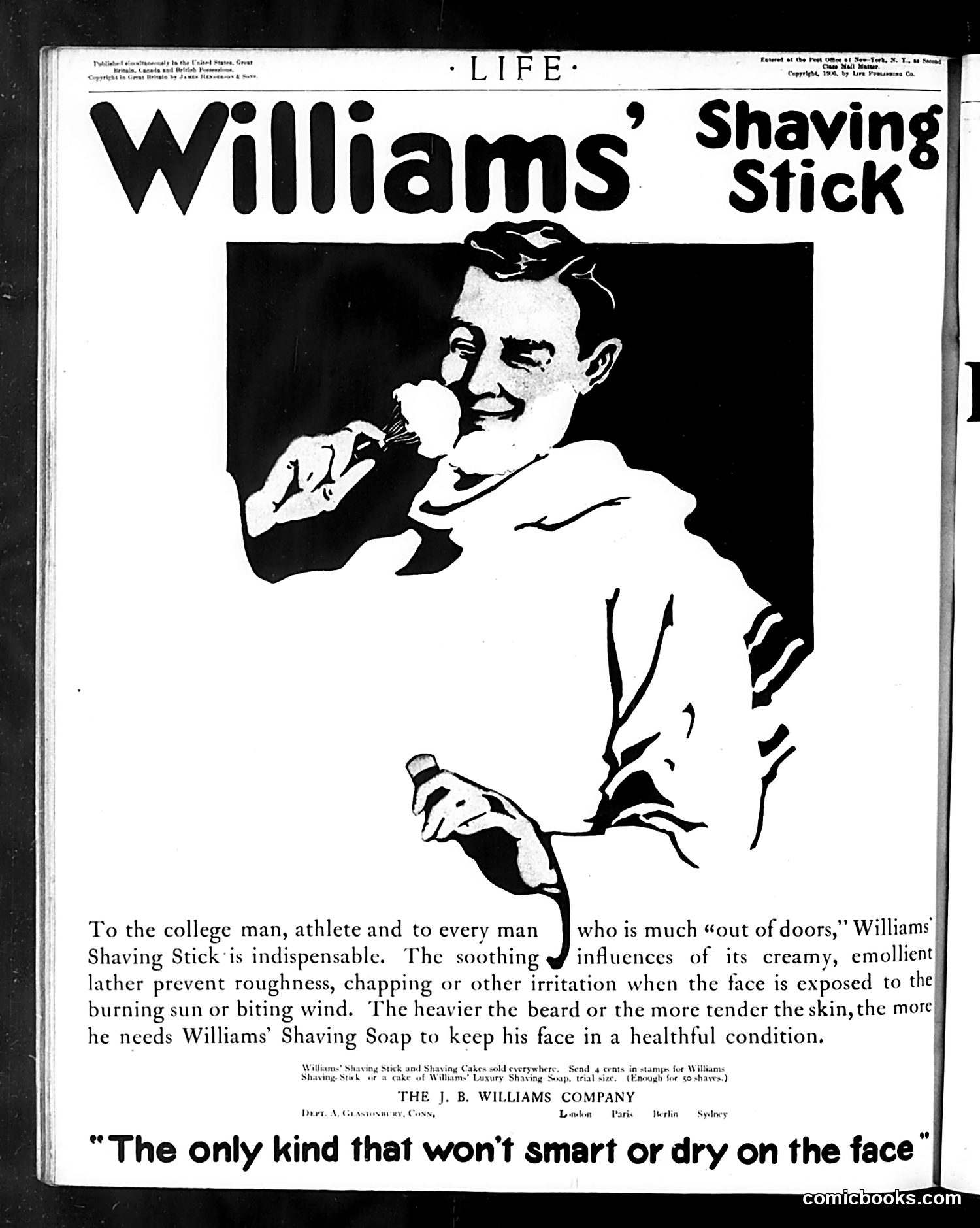
This is **not satire or political commentary** — it's a straightforward advertisement for Williams' Shaving Stick, published in *Life* magazine. The page shows a man applying shaving lather with a brush, smiling broadly. The ad targets "college men, athletes and...every man who is much 'out of doors,'" emphasizing that Williams' product prevents skin irritation from sun and wind exposure. The copy stresses the lather's soothing, protective qualities for "tender" skin. The tagline — "The only kind that won't smart or dry on the face" — highlights a practical product benefit (not drying out skin after shaving). This represents typical early-to-mid 20th century men's grooming advertising, positioning the product as essential for active, outdoorsy masculinity.
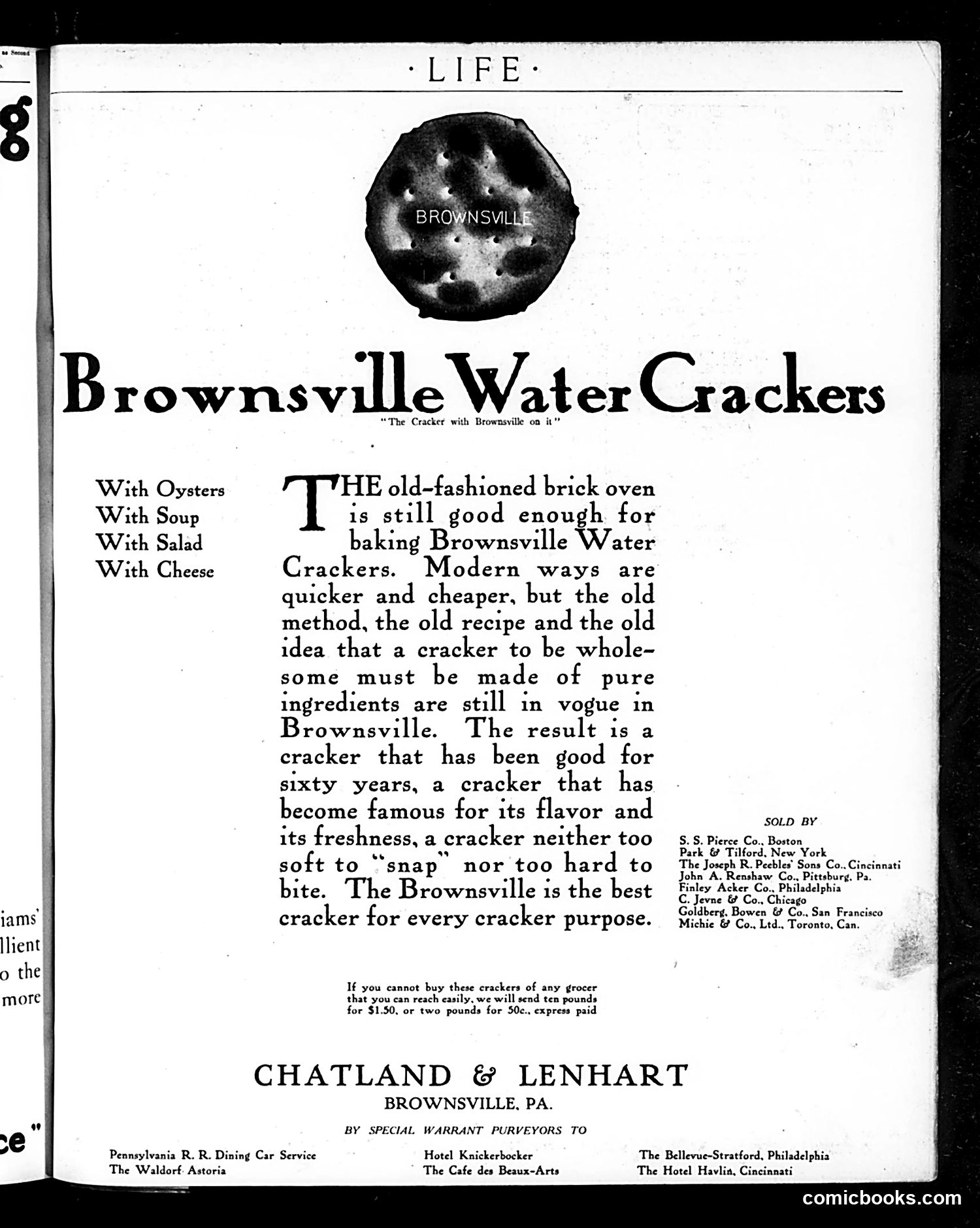
This page is primarily a **product advertisement**, not satire or political commentary. It promotes Brownsville Water Crackers made by Chatland & Lenhart in Brownsville, Pennsylvania. The ad emphasizes the product's traditional quality: the crackers are baked using "old-fashioned brick oven" methods with "pure ingredients," contrasting this against cheaper modern manufacturing. The text stresses the crackers' sixty-year reputation for "flavor and freshness." The circular image at top shows the actual cracker product. Left-column text lists serving suggestions (with oysters, soup, salad, cheese). A distribution list on the right indicates national availability through major retailers and hotels. The bottom includes mail-order pricing information. This represents early 20th-century *Life* magazine advertising—straightforward product promotion emphasizing artisanal, traditional manufacturing as a quality marker.
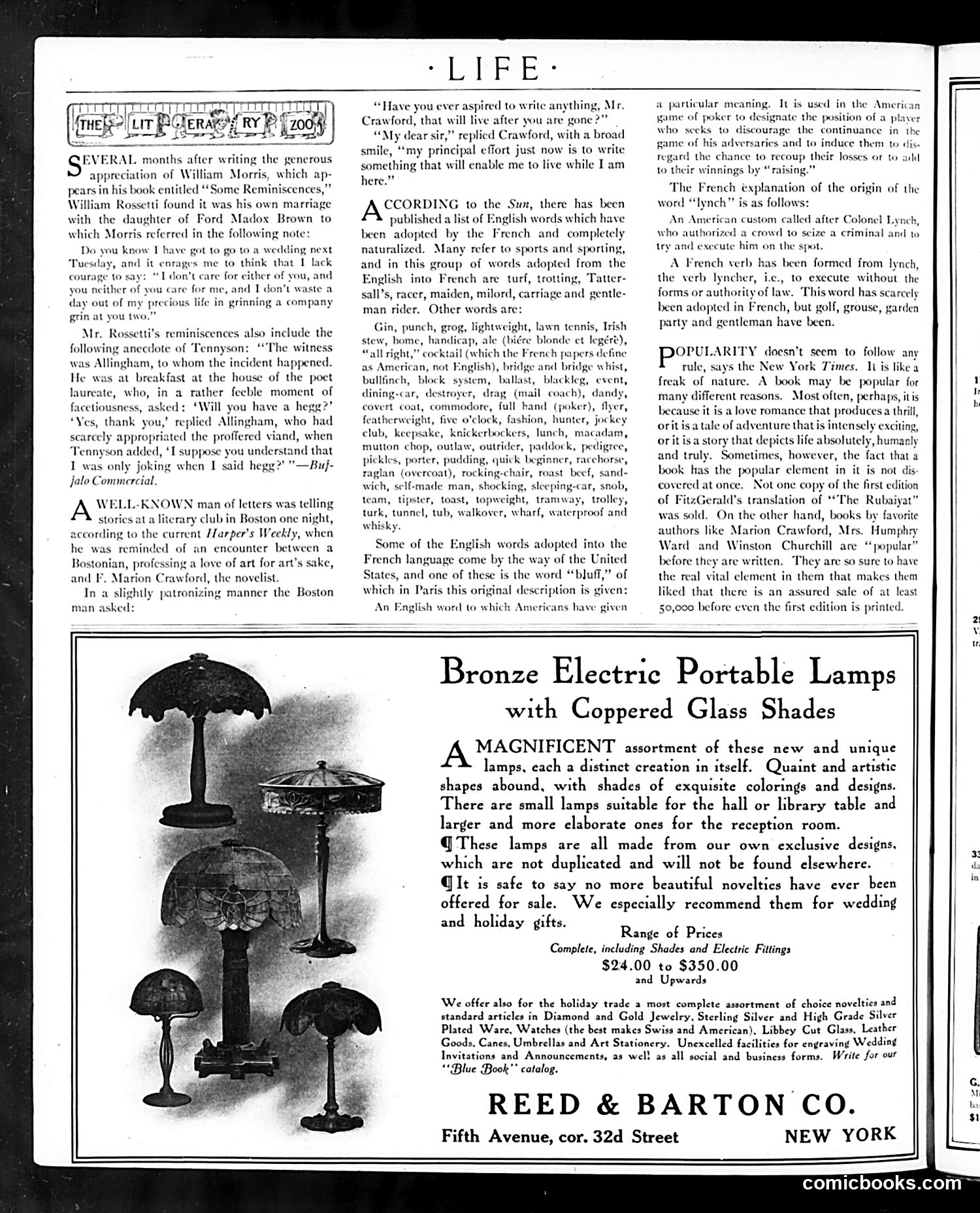
This page contains **no political cartoon**. The top section consists of literary anecdotes about writers William Morris, William Rossetti, and Marion Crawford, discussing their aspirations and literary accomplishments. The bottom half is a **product advertisement** for Reed & Barton Co., showcasing Bronze Electric Portable Lamps with coppered glass shades. The advertisement emphasizes the lamps' exclusivity, artistic designs, and suitability as wedding or holiday gifts, with prices ranging from $24 to $350 and upward. The page represents typical *Life* magazine content from the early 20th century: mixing cultural commentary with high-end consumer advertising targeting affluent readers.
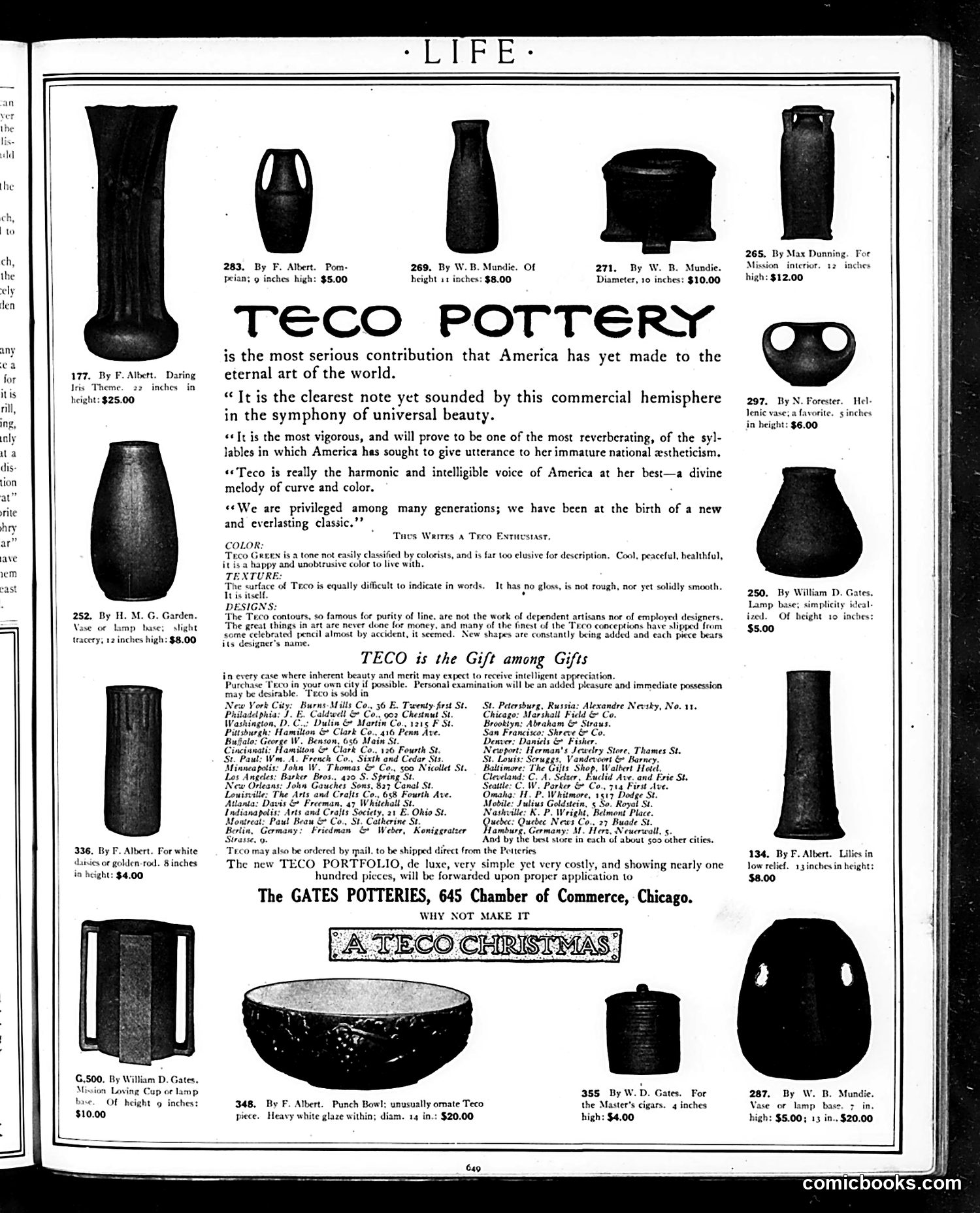
This page is **not a political cartoon**—it's an advertisement for Teco Pottery, a commercial product line manufactured by The Gates Potteries in Chicago. The page showcases various ceramic vessels with product numbers and prices, ranging from $4 to $25. The central text celebrates Teco pottery as "the most serious contribution that America has yet made to the eternal art of the world," using hyperbolic language typical of early 20th-century advertising. The "satire" here is commercial rather than political: Life magazine is ironically praising mass-produced American pottery with grandiose language usually reserved for fine art, playing on American pride and commercial ambition. The page includes purchase information and a holiday gift suggestion ("A TECO CHRISTMAS"). This reflects Life's role as both satirical publication and advertising vehicle.
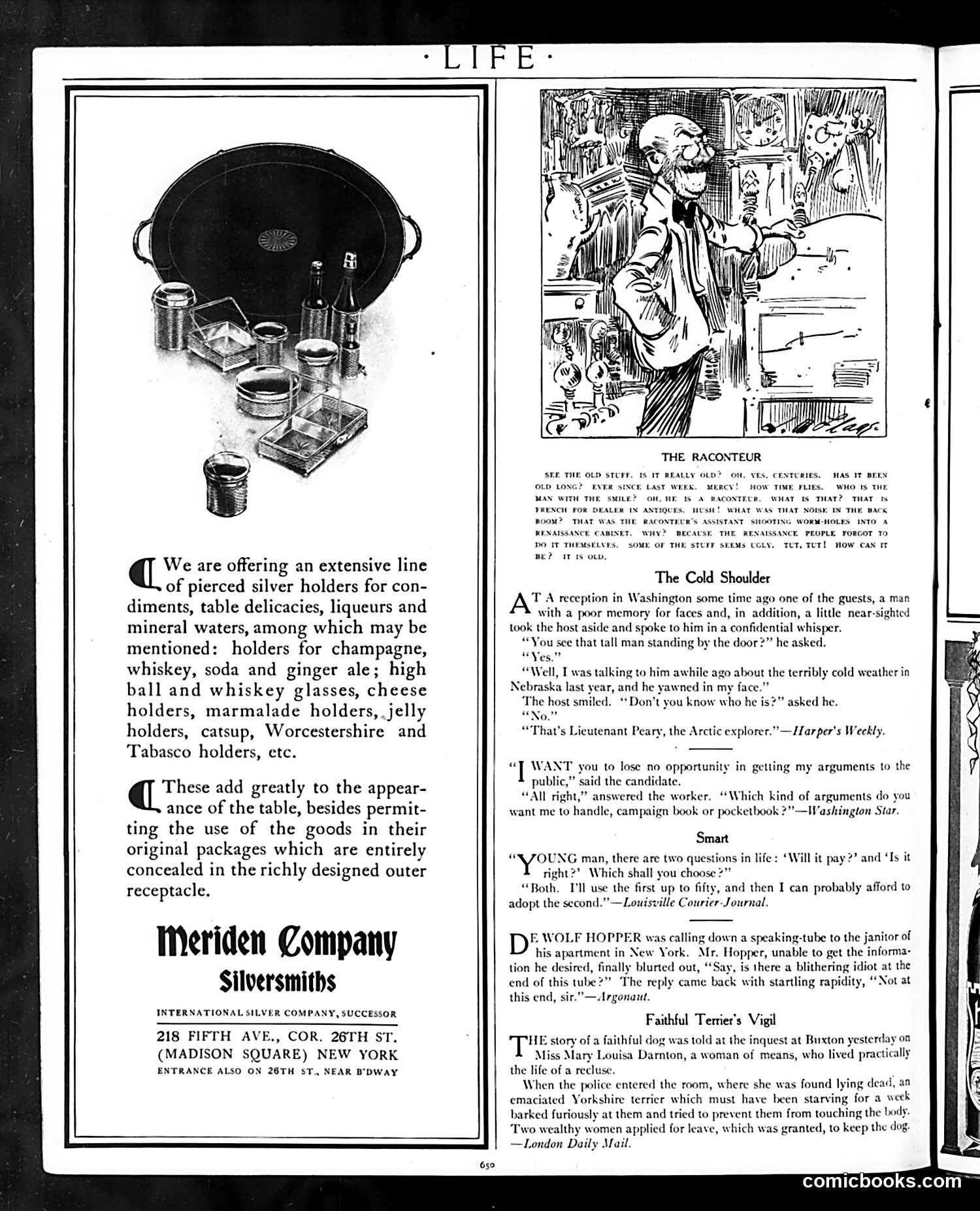
The cartoon depicts an elderly gentleman in ornate period clothing animatedly telling stories in what appears to be an elegant interior. The caption indicates he's a "raconteur"—a skilled storyteller—and the accompanying text humorously questions whether his anecdotes are genuinely "old long" or merely recycled recently. The joke targets a recognizable social type: the verbose older man at social gatherings who endlessly repeats the same tales, wearing out his audience's patience. The elaborate costume and formal setting suggest he's a figure of some distinction, making his tiresome habit more absurd. The other brief anecdotes on the page ("The Cold Shoulder," "Smart," "Faithful Terrier's Vigil") follow similar patterns—quick social observations and humorous situations typical of Life magazine's satirical humor.
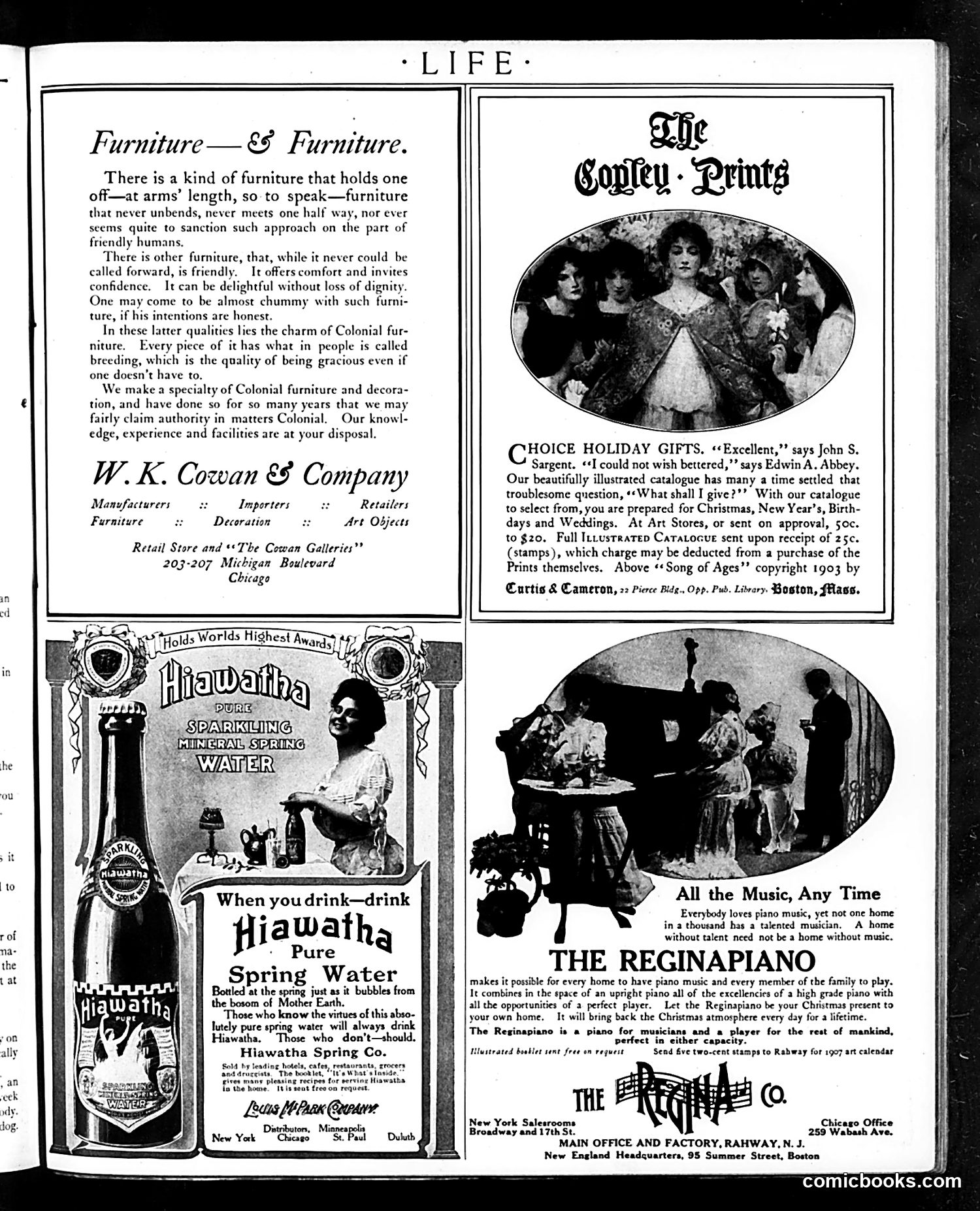
This page is primarily **advertising**, not satirical content. It contains four product advertisements from the early 1900s: 1. **W.K. Cowan & Company** (top left): Colonial furniture maker promoting their "gracious" aesthetic and expertise. 2. **Courtney Prints** (top right): Art prints marketed as holiday gifts, with an illustrated catalog available for 25 cents. 3. **Hiawatha Spring Water** (bottom left): Mineral water claiming to hold "World's Highest Awards," marketed as pure and healthful. 4. **The Reginapiano** (bottom right): A player piano allowing families to enjoy music without musical talent—a significant technological novelty of the era. Each ad reflects early 1900s consumer culture, emphasizing quality, status, and emerging domestic technologies. There is no political satire present on this page.
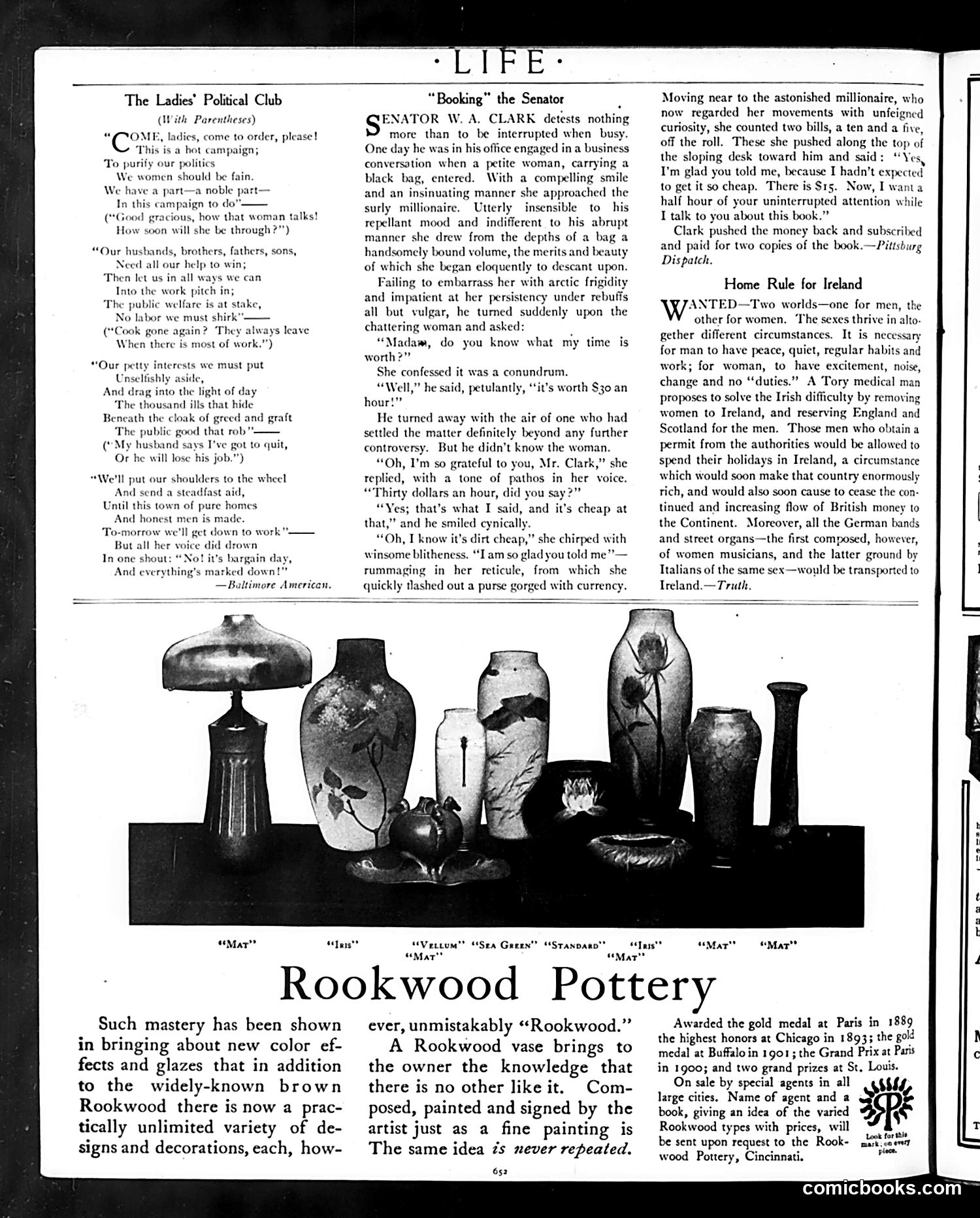
This page contains three distinct sections: 1. **"The Ladies' Political Club"** (top left): A satirical poem mocking women's political activism, suggesting women should focus on domestic duties rather than public campaigns. The verse uses condescending language ("Our petty interests") typical of anti-suffrage sentiment from this era. 2. **"Booking the Senator"** (top right): A humorous anecdote about Senator W. A. Clark being solicited by a woman for a charitable donation. The joke centers on her persistence and his attempt to negotiate a lower amount, ending with her extracting money anyway—satirizing both persistent female fundraisers and wealthy men's resistance to charitable giving. 3. **Rookwood Pottery Advertisement** (bottom): A substantial advertisement showcasing decorative vases and ceramics, highlighting the company's awards and artistic reputation. The page reflects early 20th-century attitudes toward women and gender roles.
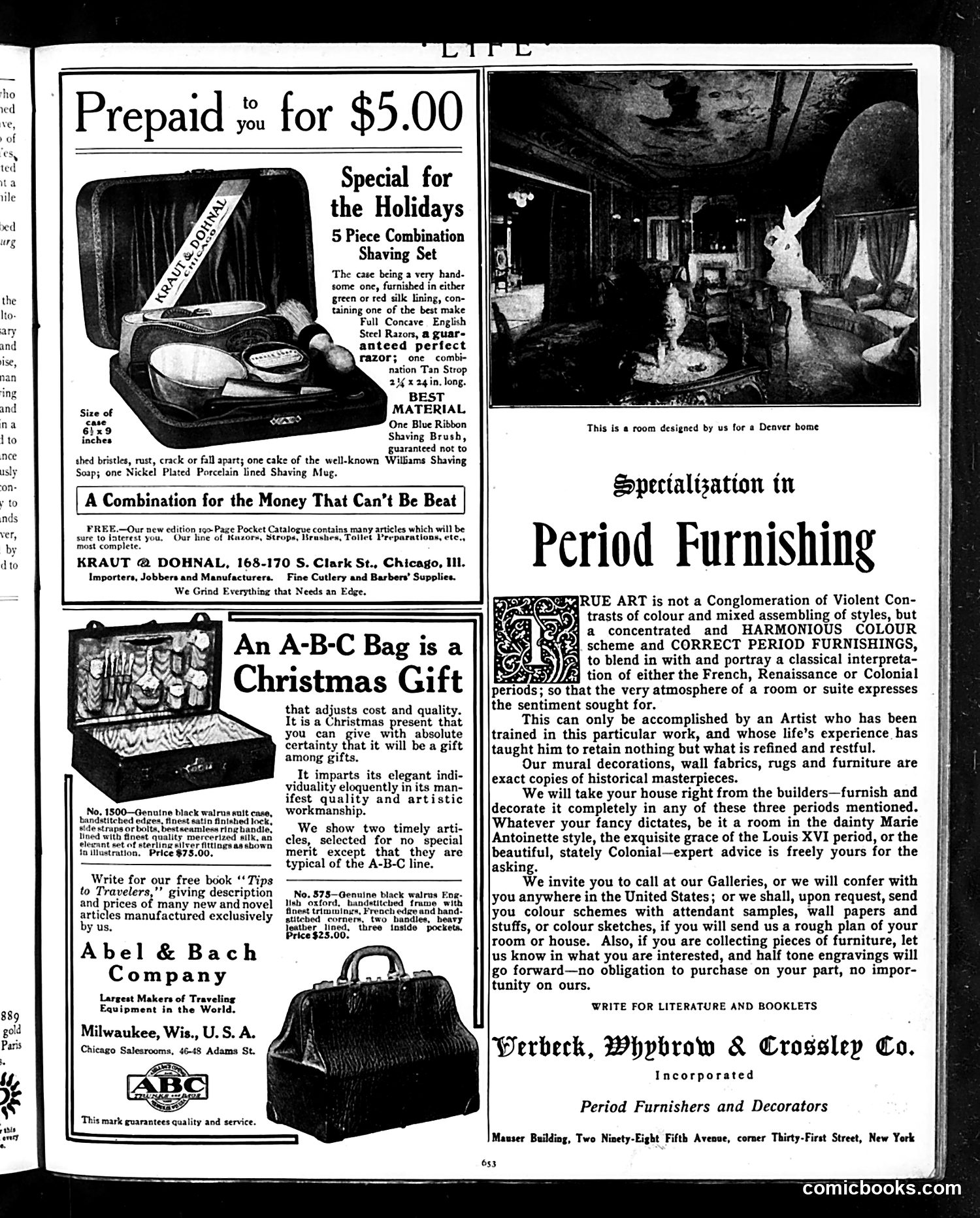
This page is primarily **advertising content**, not satirical cartoons. It contains four advertisements: 1. **Kraut & Dohnal** (Chicago): A $5 shaving set marketed as a holiday gift 2. **Abel & Bach Company** (Milwaukee): Luggage and travel equipment, promoting an A-B-C bag as a Christmas present 3. **Verbeck, Whybrow & Crossley Co.** (New York): A period furnishing and decorating service specializing in historically accurate French, Renaissance, and Colonial room designs The Verbeck advertisement includes a photograph of an elegantly furnished period room as an example of their work. **No political satire or cartoon commentary** is present on this page. It represents typical Life magazine revenue through paid advertising during this era.
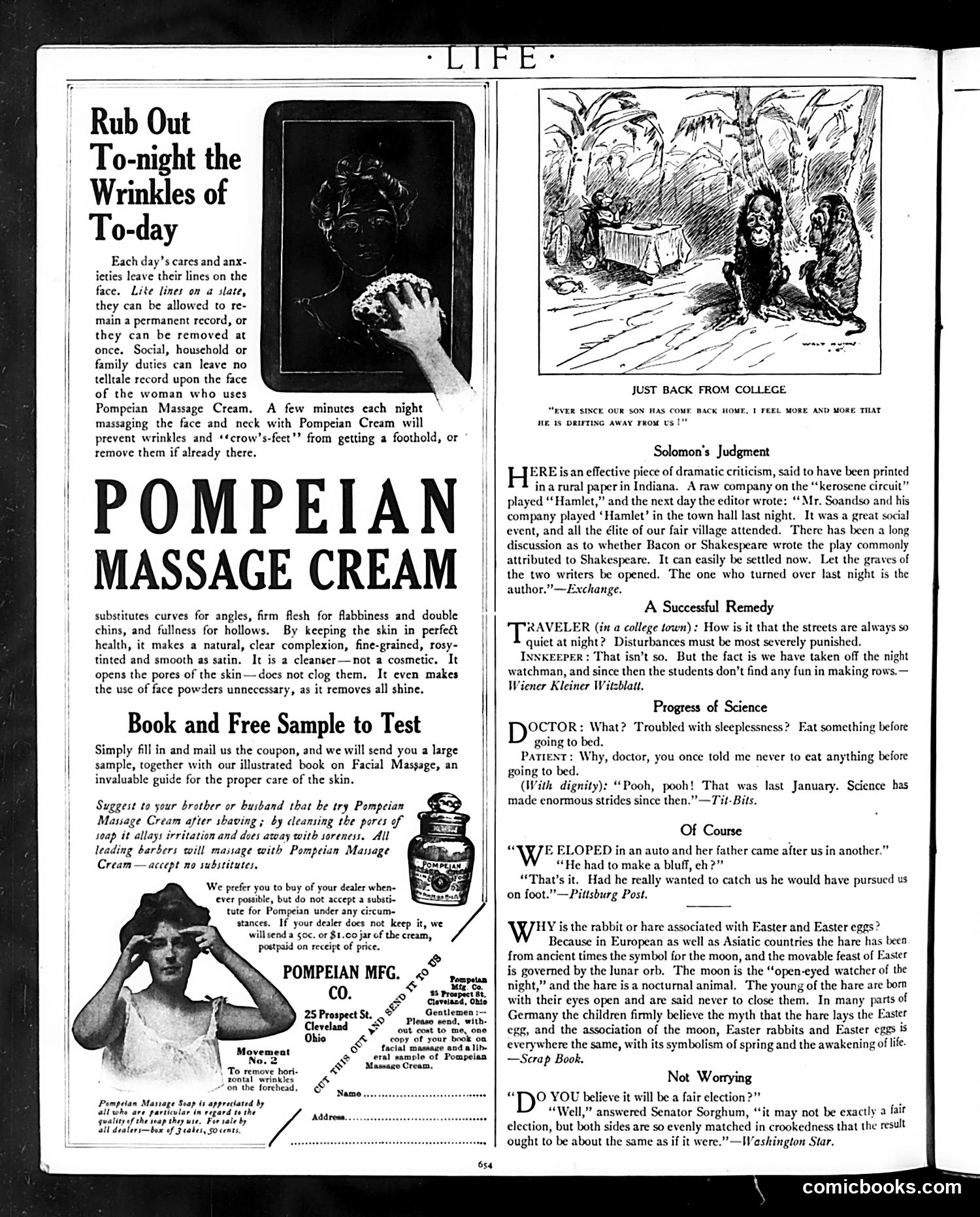
This page is primarily **advertising and humor pieces** rather than political satire. The left side features a large advertisement for Pompeian Massage Cream, promoting wrinkle removal through nightly facial massage—reflecting early 20th-century beauty standards and concerns. The right side contains several short humorous pieces: 1. **"Just Back From College"** (cartoon): A sketch showing someone appearing disheveled, with the caption about "drifting away" suggesting commentary on the college experience or generational change. 2. **"Solomon's Judgment"** and subsequent pieces: Brief anecdotes about theater criticism, street noise complaints, and scientific progress—typical satirical humor of the era poking fun at everyday situations, pretension, and social conventions. The content reflects *Life* magazine's format as a general-interest satirical publication mixing advertisements with light social commentary.
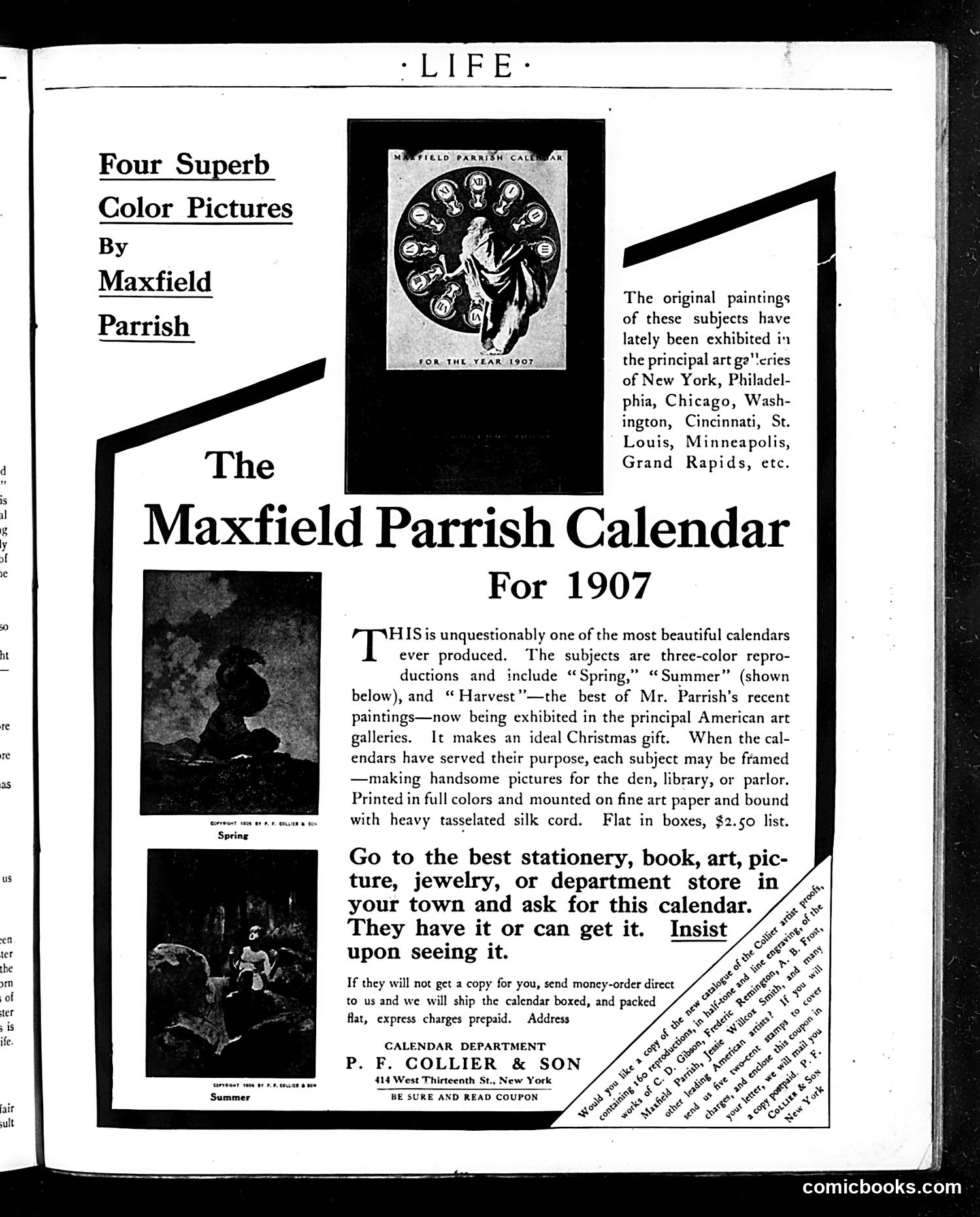
This page is primarily **advertising**, not satire or political commentary. It promotes "The Maxfield Parrish Calendar for 1907," featuring four color paintings by the renowned American artist Maxfield Parrish. The ad describes the calendar's subjects as three-color reproductions including "Spring," "Summer," and "Harvest"—described as "the best of Mr. Parrish's recent paintings." The text emphasizes the calendar's aesthetic value, suggesting that after serving as a functional calendar, each image could be framed as decorative art for home display. At $2.50, it's positioned as an upscale Christmas gift. The ad directs readers to purchase through local retailers or directly from P.F. Collier & Son in New York. This reflects early 20th-century marketing of fine art reproductions as affordable luxury goods for middle-class homes.
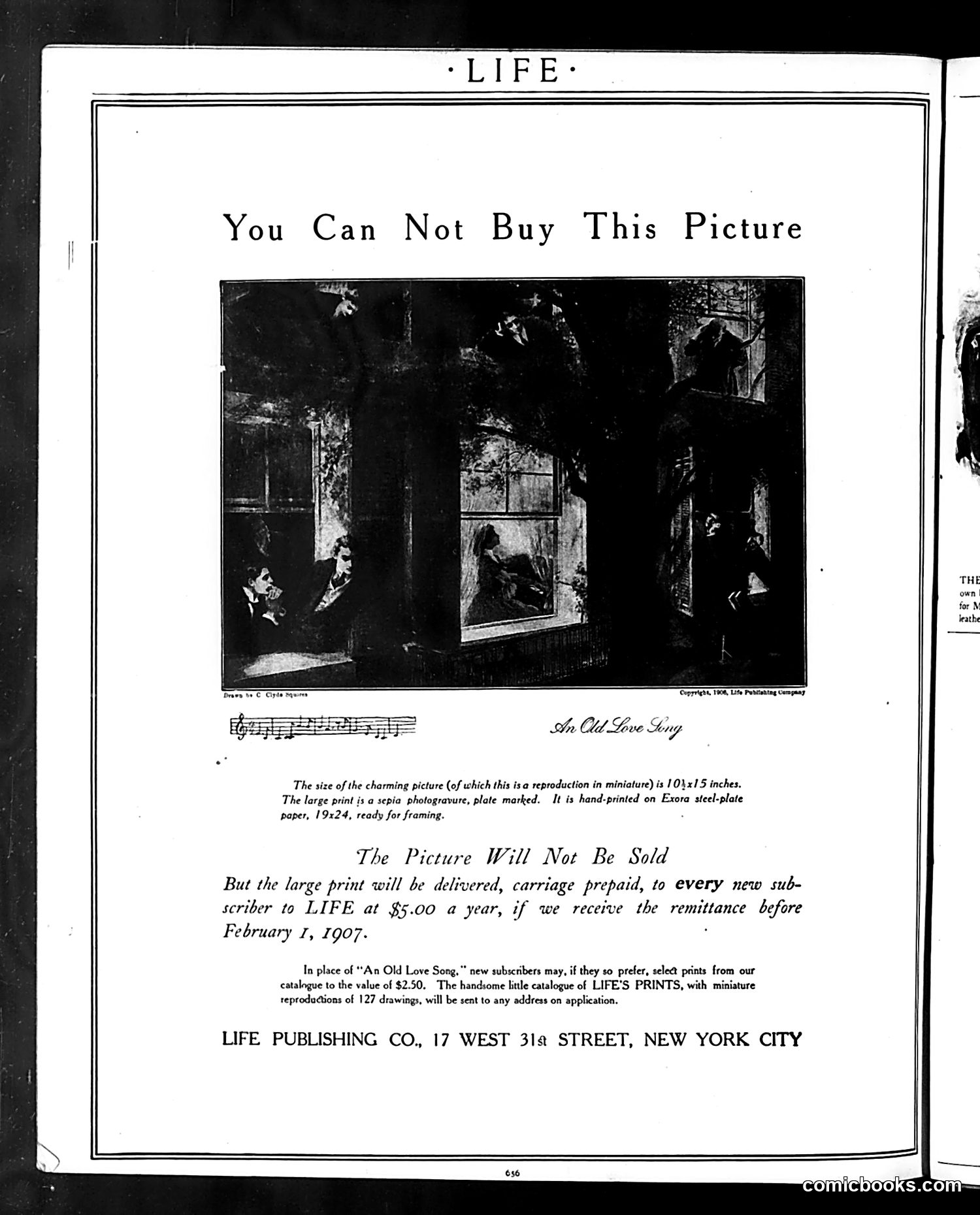
This is primarily **an advertisement page**, not a political cartoon. Life Publishing Company is promoting a subscription offer to new readers. The central image, titled "An Old Love Song," depicts a romantic street scene with figures beneath a window—a sentimental, sentimental illustration typical of early 1900s popular art. The key message is the **promotional offer**: new subscribers paying $5.00 annually would receive a large framed print of this picture (10½ x 15 inches), hand-printed on steel-plate paper, with carriage paid—**if payment was received before February 1, 1907**. The headline "You Can Not Buy This Picture" is clickbait: the print was exclusively offered as a subscription bonus, not sold separately. This was a common marketing tactic to incentivize magazine subscriptions in the early 20th century.
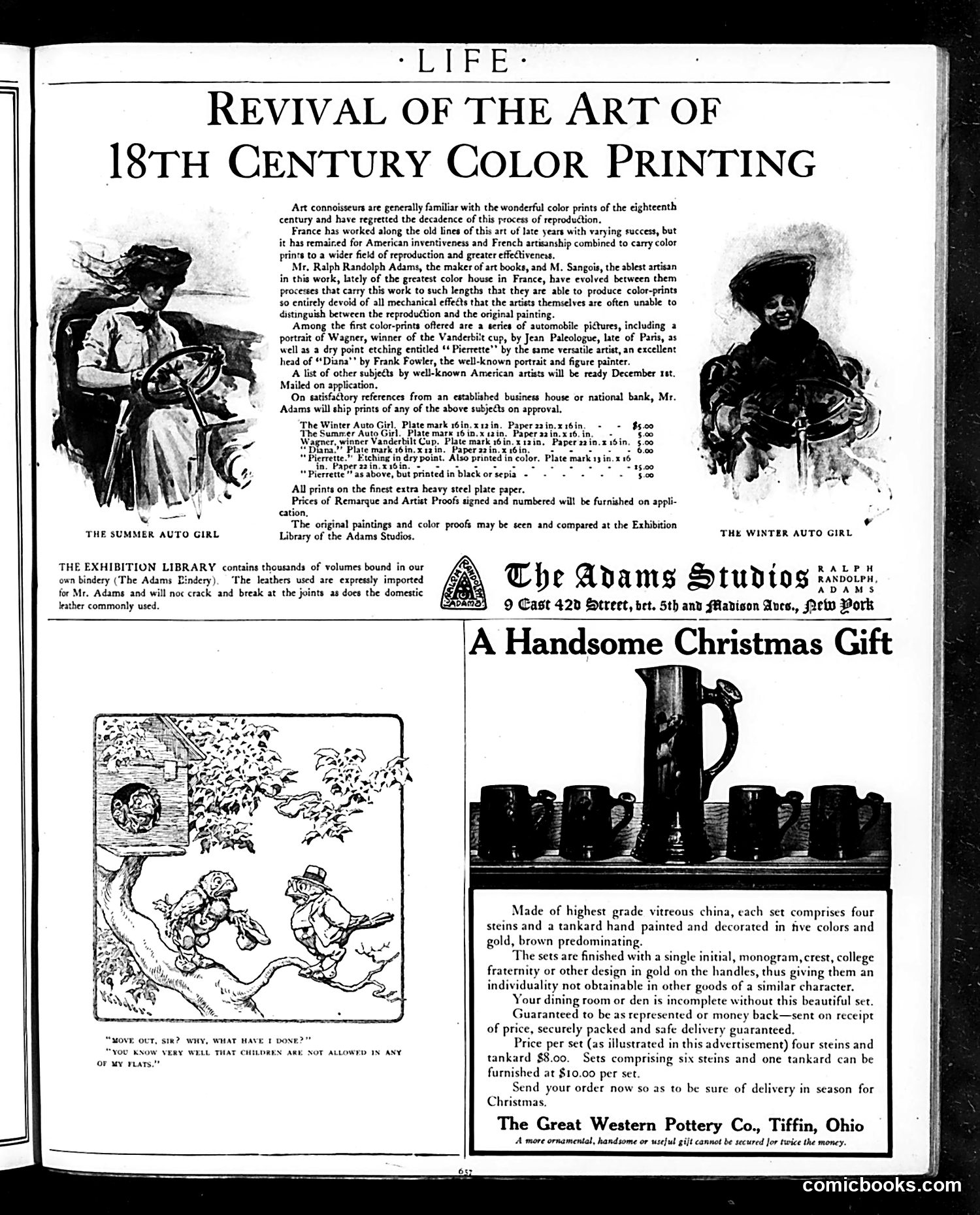
This page is primarily **advertising and editorial content**, not political satire. The top section features an article on "Revival of the Art of 18th Century Color Printing," discussing the Adams Studios' reproduction work. Two illustrations labeled "The Summer Auto Girl" and "The Winter Auto Girl" appear to be decorative artwork samples, not satirical commentary. The small cartoon at bottom-left shows children playing outdoors with the caption "Move out, sir? Why, what have I done? / You know very well that children are not allowed in any of my flats." This appears to be **gentle social satire about landlord discrimination** against families with children—a commentary on housing practices rather than political satire. The remainder of the page consists of **commercial advertisements** for The Adams Studios and The Great Western Pottery Co., promoting their products as Christmas gifts.
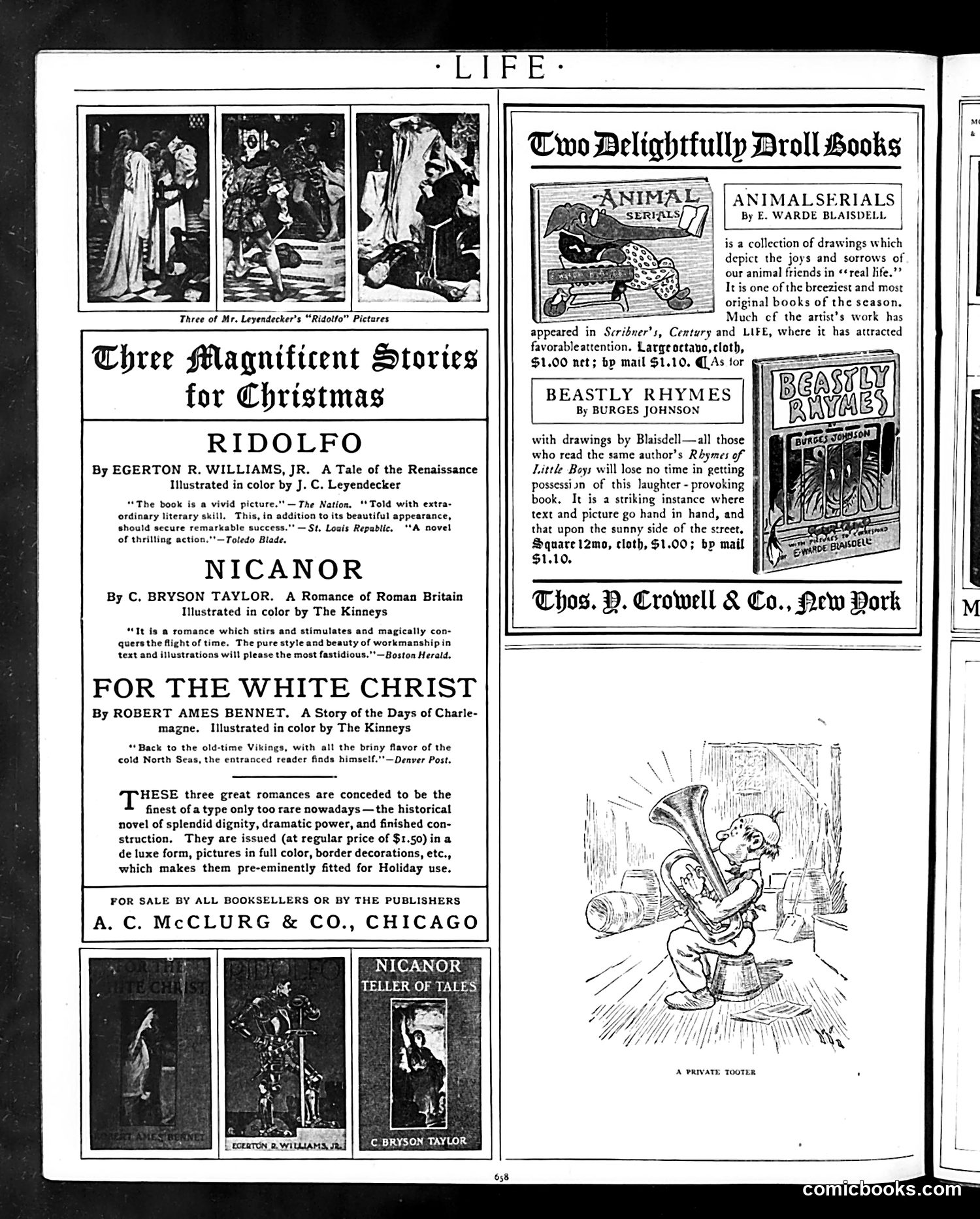
This is primarily an **advertising page** for books, not political satire. It features holiday gift book promotions from publisher A.C. McClung & Co., Chicago. The left column advertises three historical romance novels: *Ridolfo* (Renaissance tale), *Nicanor* (Roman Britain), and *For the White Christ* (Charlemagne era)—all illustrated in color and priced at $1.50, marketed as luxury gift editions. The right column advertises children's books: *Animal Serials* and *Beastly Rhymes*, both featuring animal drawings by E. Warde Blaisdell, priced at $1.00-$1.10. The single cartoon—labeled "A Private Tooter"—shows a small figure playing a large horn or trumpet, likely a humorous illustration accompanying the book advertisements rather than political commentary. The page reflects early 20th-century holiday publishing marketing, emphasizing illustrated, beautifully-produced books as premium gifts.
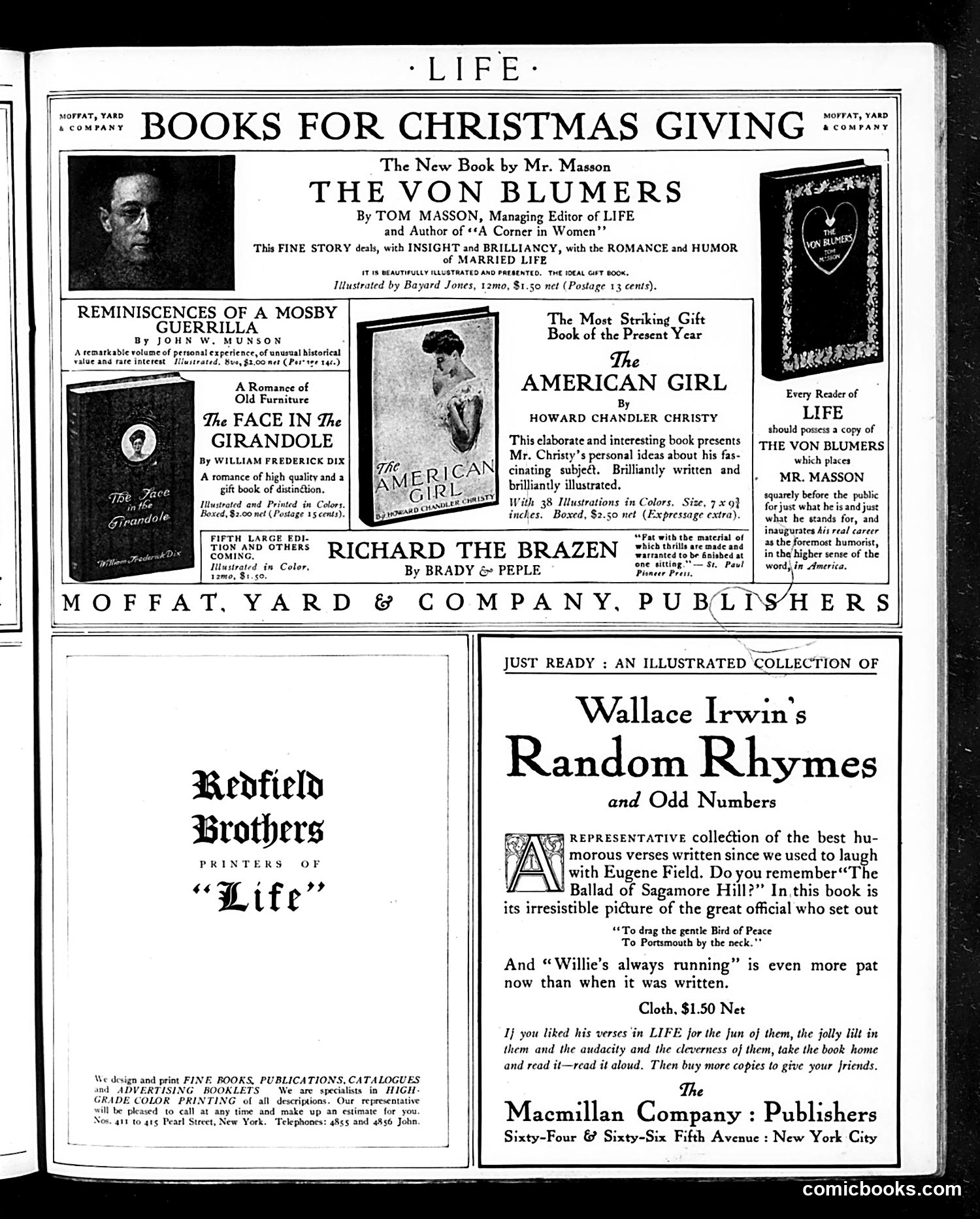
This is primarily a **book advertising page**, not a political cartoon. It showcases Christmas gift recommendations from major publishers like Moffat, Yard & Company and Macmillan. Key advertised titles include: - **"The Von Blumers"** by Tom Masson (Life's managing editor)—described as witty commentary on married life - **"The American Girl"** by Howard Chandler Christy—praised as the year's most striking gift book - **"Random Rhymes and Odd Numbers"** by Wallace Irwin—humorous verses, with references to Theodore Roosevelt's "Ballad of Sagamore Hill" and "Willie's always running" (likely political satire about Roosevelt) - **"Richard the Brazen"** and other titles The page reflects early 1900s literary culture, emphasizing illustrated, humor-focused books as appropriate Christmas gifts. The Roosevelt references suggest contemporary political humor was popular gift material.
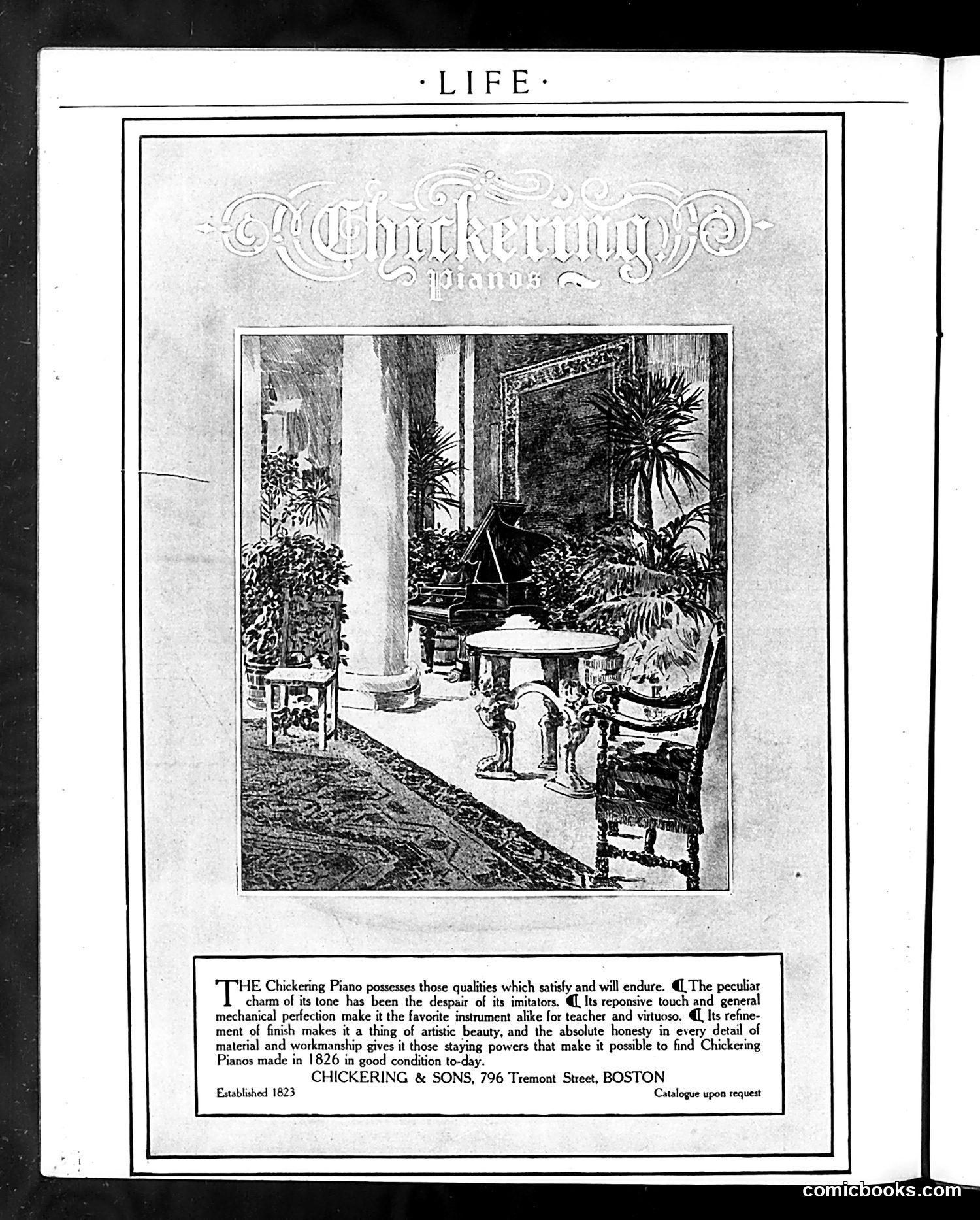
This is a **piano advertisement**, not a political cartoon. It's a full-page ad for Chickering & Sons pianos, a Boston-based manufacturer established in 1823. The image shows an elegant interior scene—a parlor with classical columns, potted palms, and a piano—depicting the aspirational domestic setting where such an instrument would belong. This appeals to upper-class consumers. The text emphasizes the piano's durability, quality craftsmanship, and prestige: its tone is supposedly so superior that competitors despair of imitating it. The claim that pianos from 1826 still survive in good condition serves as proof of lasting value—a marketing strategy emphasizing investment worthiness to wealthy buyers. The decorative "Chickering" lettering and genteel interior reflect the magazine's affluent readership.
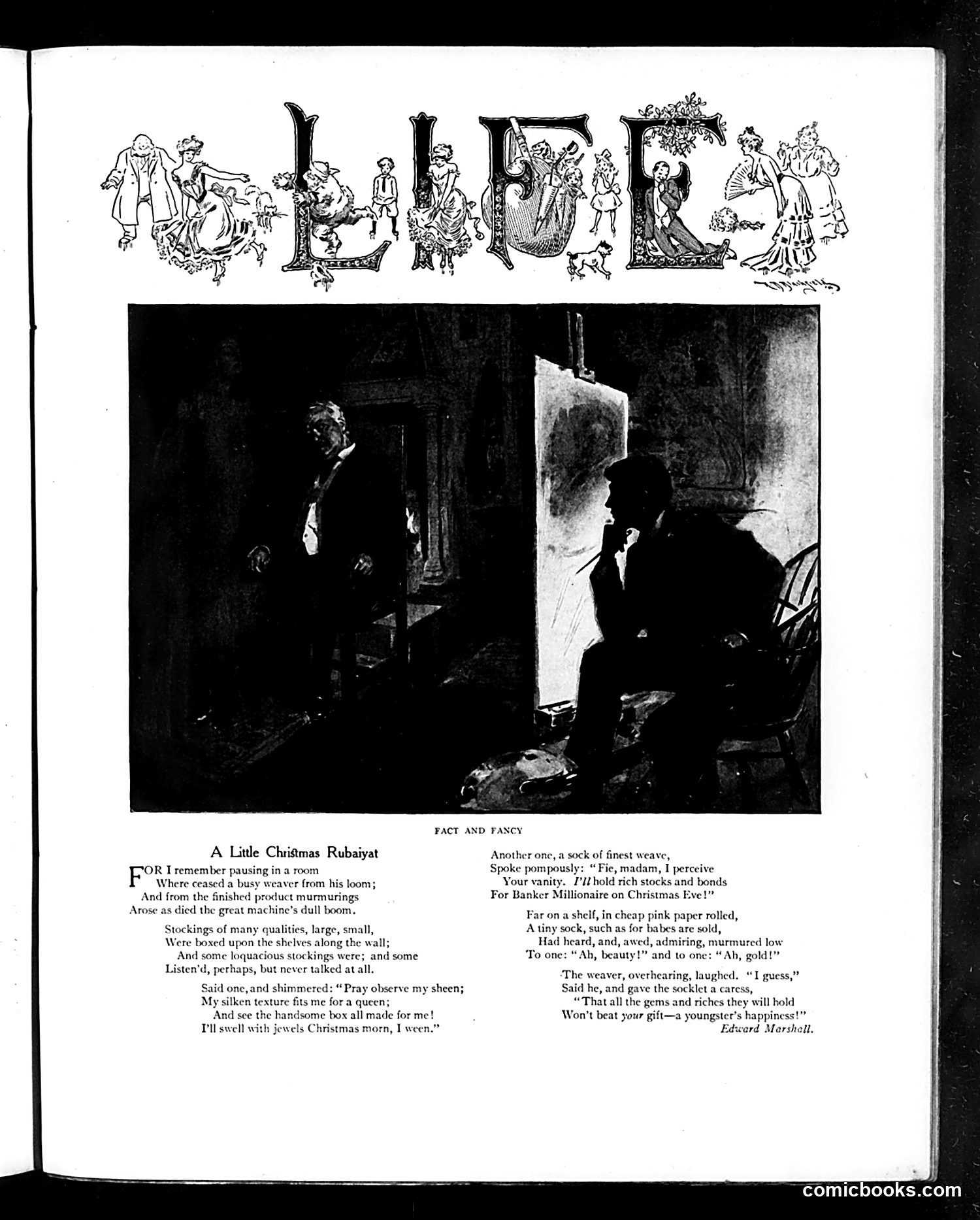
This is a satirical poem mocking class pretension during the Christmas season. It personifies stockings and socks as characters with different social standings. The narrative contrasts three figures: an expensive silk stocking boasting of her luxurious box and jeweled contents; a pompous sock claiming to hold "rich stocks and bonds / For Banker Millionaire"; and a humble, cheap baby's sock admiring the others with innocent awe. The weaver (representing working-class wisdom) delivers the moral: material wealth and status symbols cannot match the genuine happiness a child experiences on Christmas morning. The satire targets Gilded Age materialism and the obsession with expensive gift-giving among the wealthy, while celebrating modest, heartfelt generosity. The poem's structure mimics the classical Rubaiyat form to mock pretentious literary and social affectation.
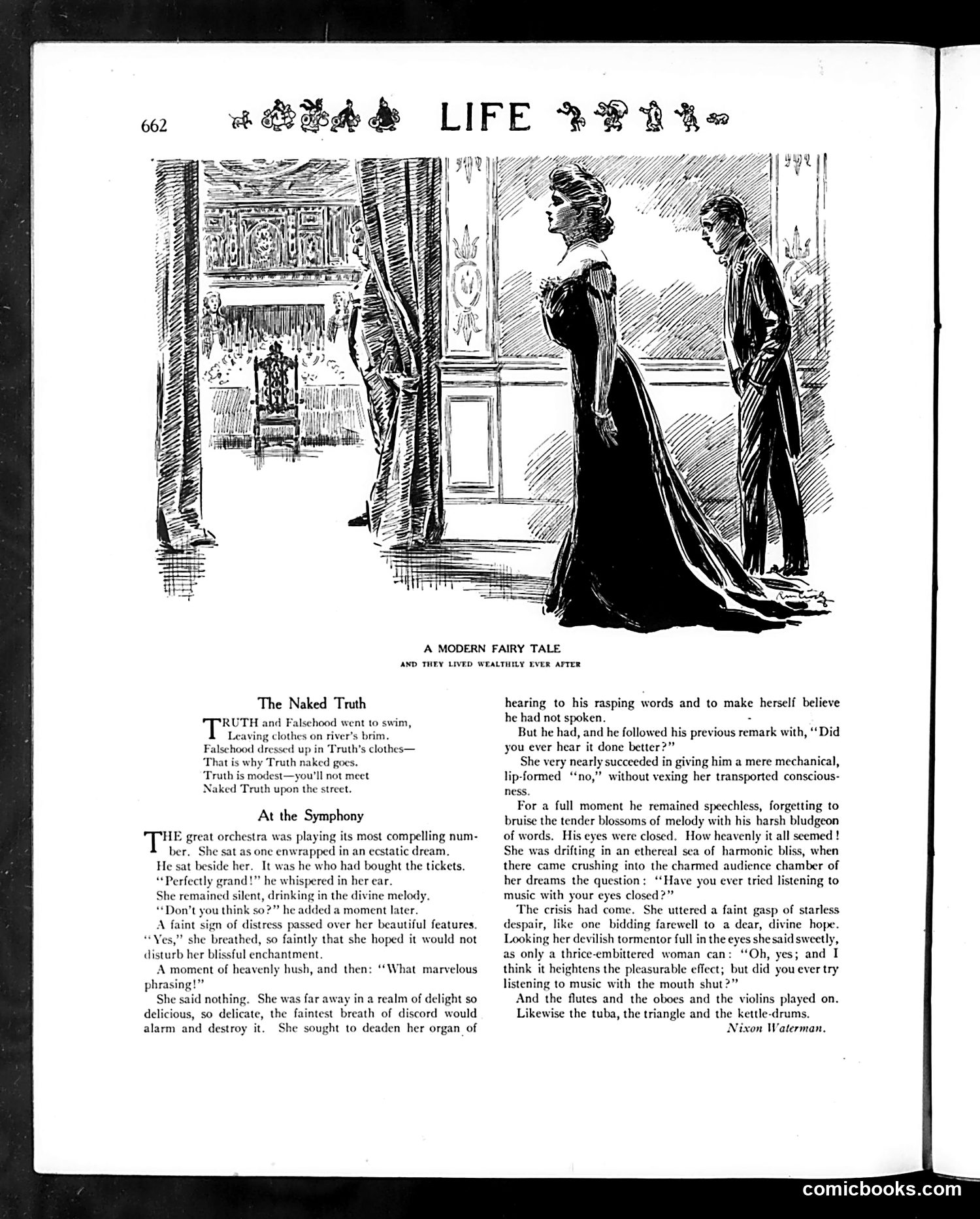
This page contains two satirical pieces mocking social hypocrisy and male behavior: **"The Naked Truth"** is a moral fable: Falsehood steals Truth's clothes while swimming, leaving Truth to wander naked. The point is that dishonesty disguises itself in respectability while truth goes unclothed and ignored in society—a critique of how lies flourish while honesty is marginalized. **"At the Symphony"** depicts a woman trying to enjoy a concert while her male companion repeatedly interrupts with inane commentary, ruining her experience. Her witty comeback—suggesting he listen "with the mouth shut"—delivers the satire: the joke is on men who talk constantly, unable to appreciate beauty in silence, and who cannot take subtle hints to be quiet. The author (Nixon Waterman) sympathizes with the woman's frustration at male obliviousness and rudeness. Both pieces use humor to critique social pretense and male behavior, typical of Life's satirical approach.
This is satirical commentary on Andrew Carnegie's *public philanthropy*. The cartoon mocks Carnegie (the wealthy Scottish industrialist) for his conspicuous charitable giving and self-promotion. **The Setup**: Carnegie announces he'll stop giving money *publicly* and disappear—a threat that panics his fellow industrialists John D. Rockefeller and J.P. Morgan, who depend on his philanthropic visibility for their own reputations. **The Joke**: They hire actress Sarah Bernhardt to convince Carnegie to resume public charity work. She succeeds, and Carnegie agrees to pose as Santa Claus at Madison Square Garden, distributing "Library Bricks of Ice Cream" with his name frozen into them. **The Satire's Point**: Life ridicules how wealthy industrialists of the Gilded Age used philanthropy as *public relations*—not genuine benevolence. Carnegie's willingness to abandon charity only when deprived of *recognition*, then eagerly resume it when convinced of its publicity value, exposes the vanity underlying his famous "Gospel of Wealth." The humor targets the calculation and self-aggrandizement behind ostensible generosity.
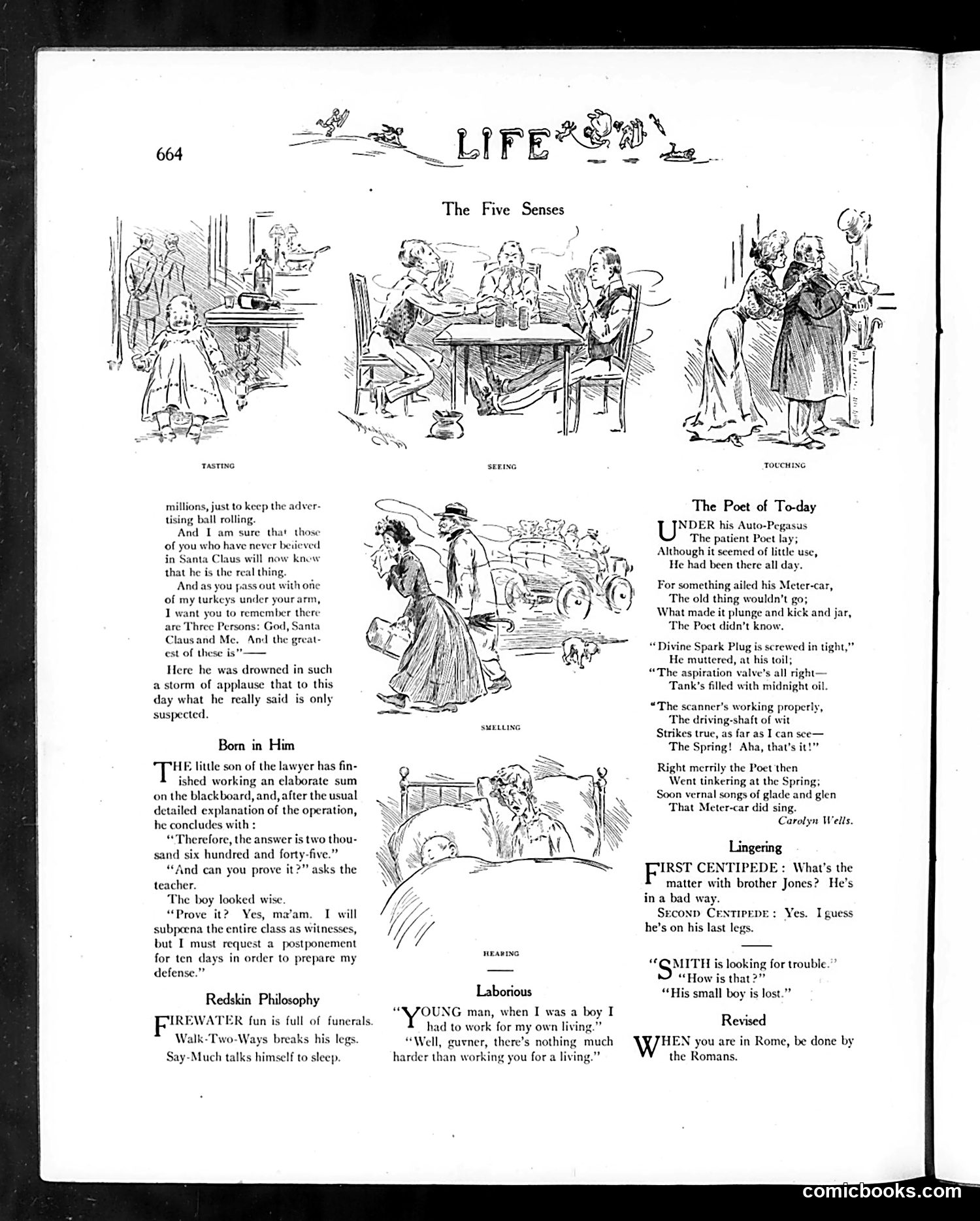
This page showcases Life magazine's characteristic blend of visual humor and short satirical pieces. The top section, "The Five Senses," features five illustrated vignettes depicting people engaged in tasting, seeing, and touching activities—likely humorous observations of everyday social behavior. Below are several brief comedic pieces: "Born in Him" mocks a lawyer's son who mimics legal procedure to justify a math answer; "Redkin Philosophy" presents jokes using stereotypical Native American names; and "The Poet of To-day" parodies romantic poets struggling with their automobiles rather than inspiration. The page concludes with brief joke segments: "Lingering" uses a centipede pun about losing legs; "Laborious" presents an employer-employee class joke; and "Revised" offers a play on the Roman proverb. The overall tone reflects early 20th-century Life magazine's satirical approach—targeting professional pretension, emerging automobile culture, and social hierarchies—with humor that was contemporary but now contains dated stereotypes.
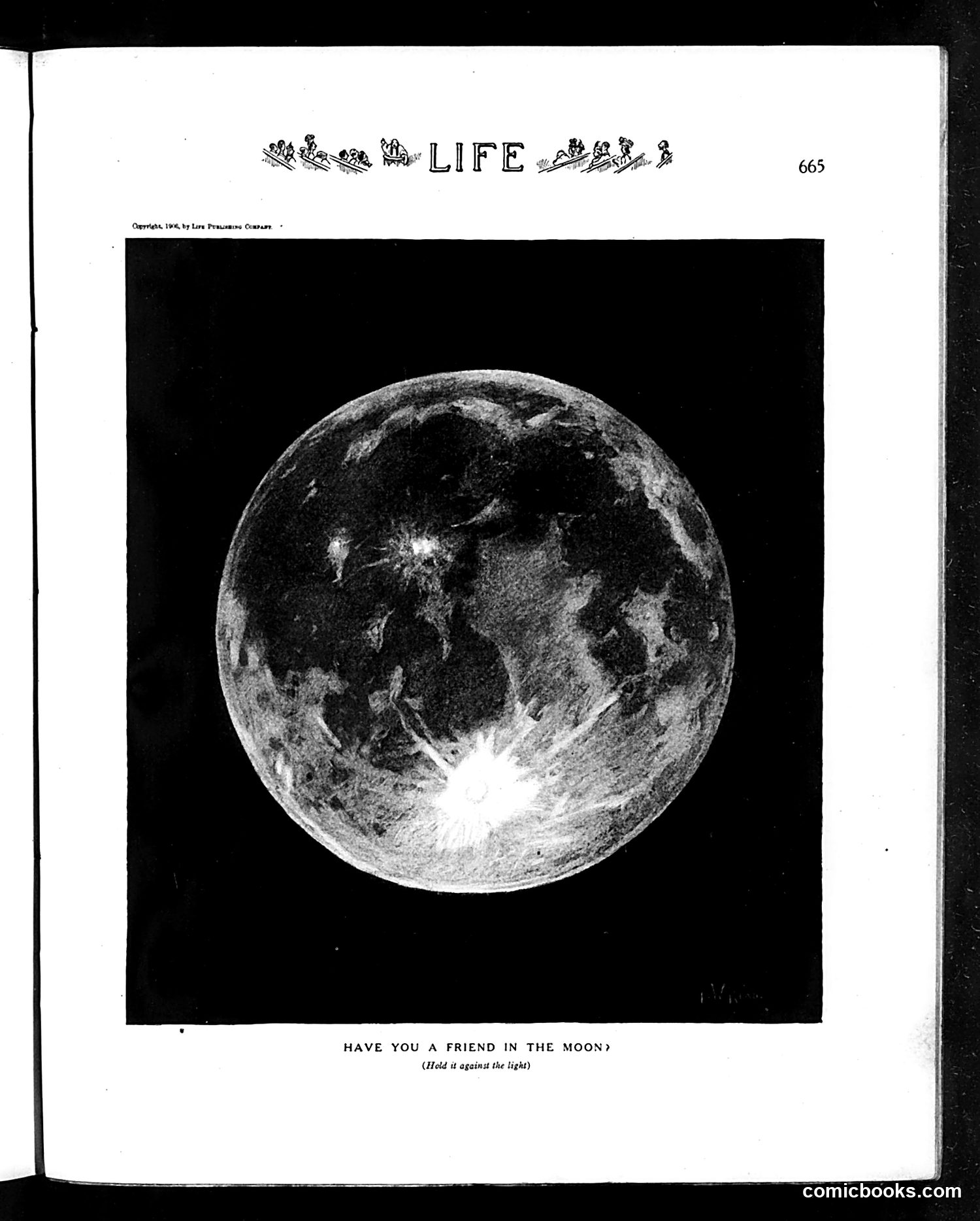
This is a visual joke from Life magazine (copyright 1916). The page presents a photograph of the moon with the caption "HAVE YOU A FRIEND IN THE MOON?" and instructs readers to "Hold it against the light." This appears to be an interactive optical illusion—when held to light, the moon's dark and light areas likely create a hidden image or face visible to the observer. The humor lies in the playful suggestion that one might discover a "friend" (a face or figure) in the moon's surface features, playing on humanity's tendency to see faces in random patterns (pareidolia). The joke is simple and whimsical rather than politically satirical, typical of Life's light entertainment content during the early 20th century.
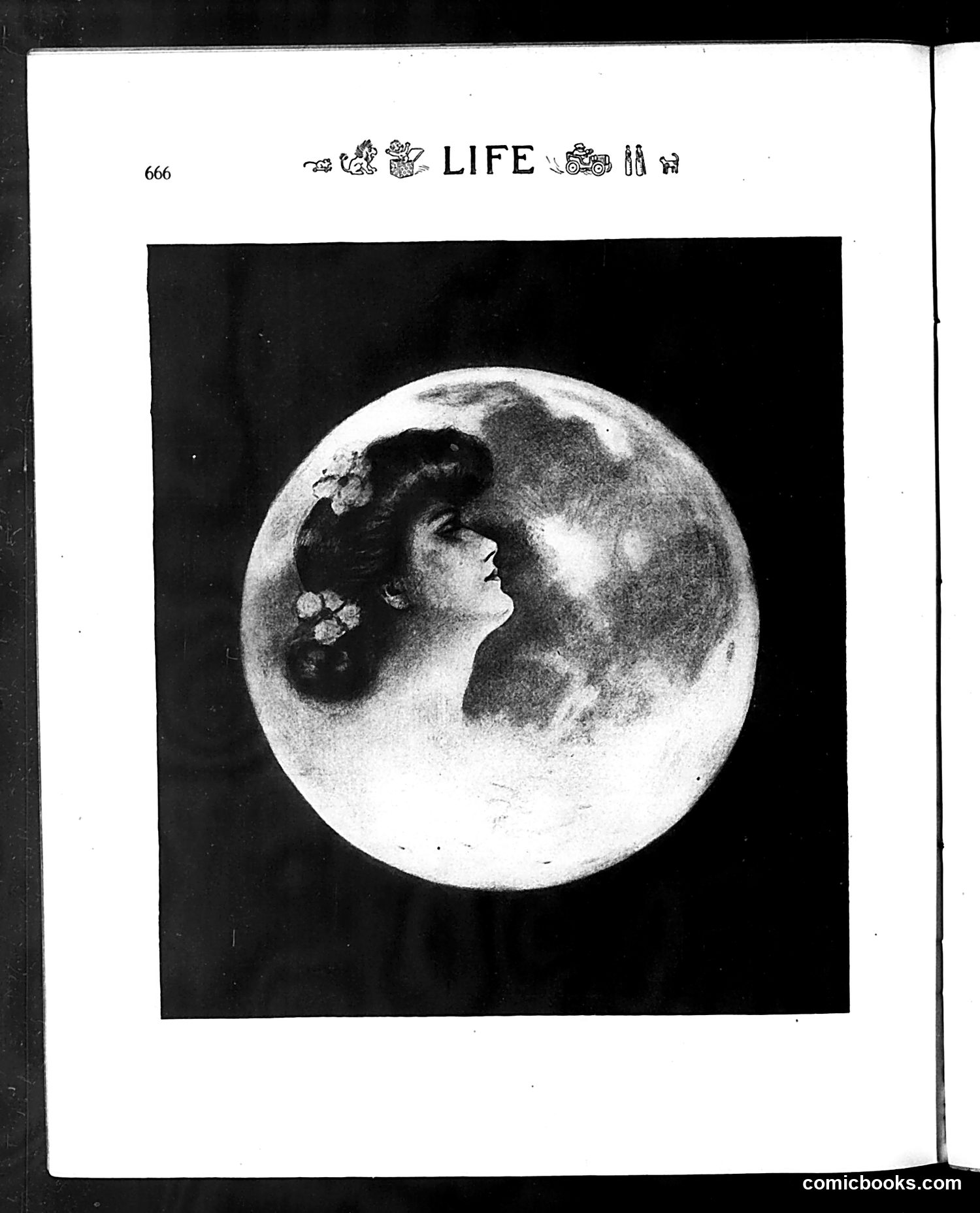
This appears to be a page from *Life* magazine (page 666) featuring an artistic illustration rather than a political cartoon. The image shows a woman's profile silhouetted against a large moon or circular background, rendered in a classical or romantic style. She wears her hair up with flowers. Without additional visible text or context on this page, I cannot definitively identify the specific political or social reference intended. The romantic, classical imagery suggests this may be an art-focused piece or advertisement rather than political satire. The page number and magazine header are clear, but the illustration's specific meaning or subject remains unclear from the image alone.
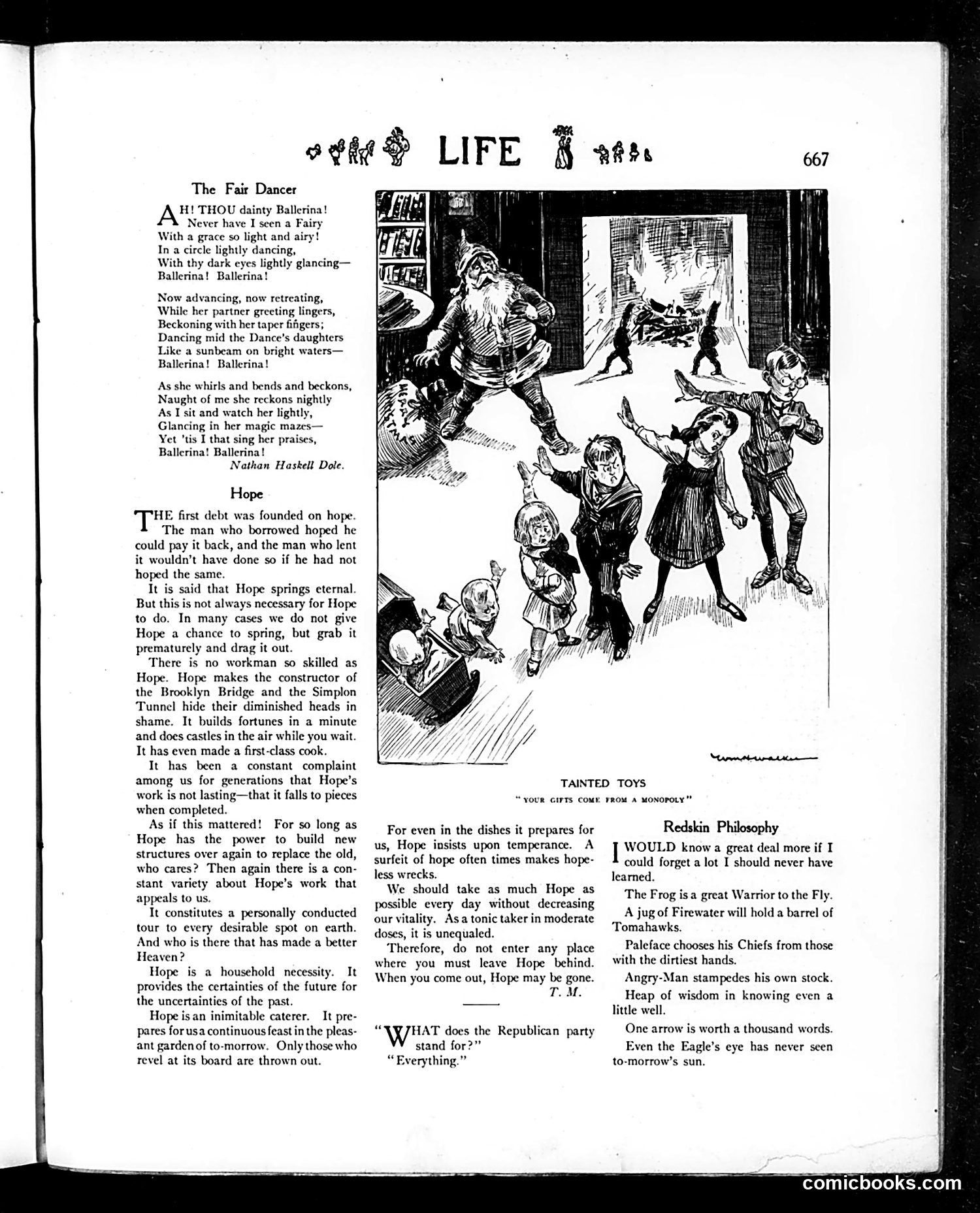
This page contains three distinct pieces of satirical content: **"The Fair Dancer"** is a romantic poem by Nathan Haskell Dote about a male observer admiring a ballerina's performance. The accompanying illustration shows Santa Claus dancing with children—a whimsical visual that contrasts with the poem's earnest tone. **"Hope"** is a philosophical essay satirizing the American tendency toward unbounded optimism. It mocks how Hope enables unrealistic projects (the Brooklyn Bridge, Simplon Tunnel) and creates "castles in the air," while warning that excessive Hope leads to disappointment. The subtle criticism targets American business confidence and speculation. **"Tainted Toys"** cartoon criticizes monopolies controlling toy manufacturing, with the caption suggesting gifts come from corporate monopolies rather than genuine sources. **"Redskin Philosophy"** offers stereotypical "Native American wisdom" statements—a common early-20th-century satirical device. References to "Paleface" and stereotypical imagery reflect period attitudes. The page satirizes American optimism, corporate consolidation, and includes period racial stereotypes typical of 1910s-era humor.
This is a satirical play about social pretension and the veneration of celebrity authors. Mr. Leo Jenkens is a "rising young novelist" invited to afternoon tea, where he becomes the object of fawning attention from status-conscious socialites. The satire targets: 1. **Fake literary enthusiasm**: The hostess claims to keep his book in every room yet admits she hasn't read it, only meaning to "lose herself in it" eventually. 2. **Amateur writers seeking validation**: Multiple guests pester Jenkens with their own mediocre creative work—one woman reads poetry she claims rivals Elizabeth Barrett Browning; another describes an absurdly impractical play requiring fifteen hours and $200,000 to stage. 3. **Insincere flattery**: A man admits he fell asleep on page two but praises the book as psychologically fascinating. The humor lies in showing how celebrity writers attract parasitic social climbers and wannabe artists rather than genuine readers—a timeless critique of literary culture and social climbing.
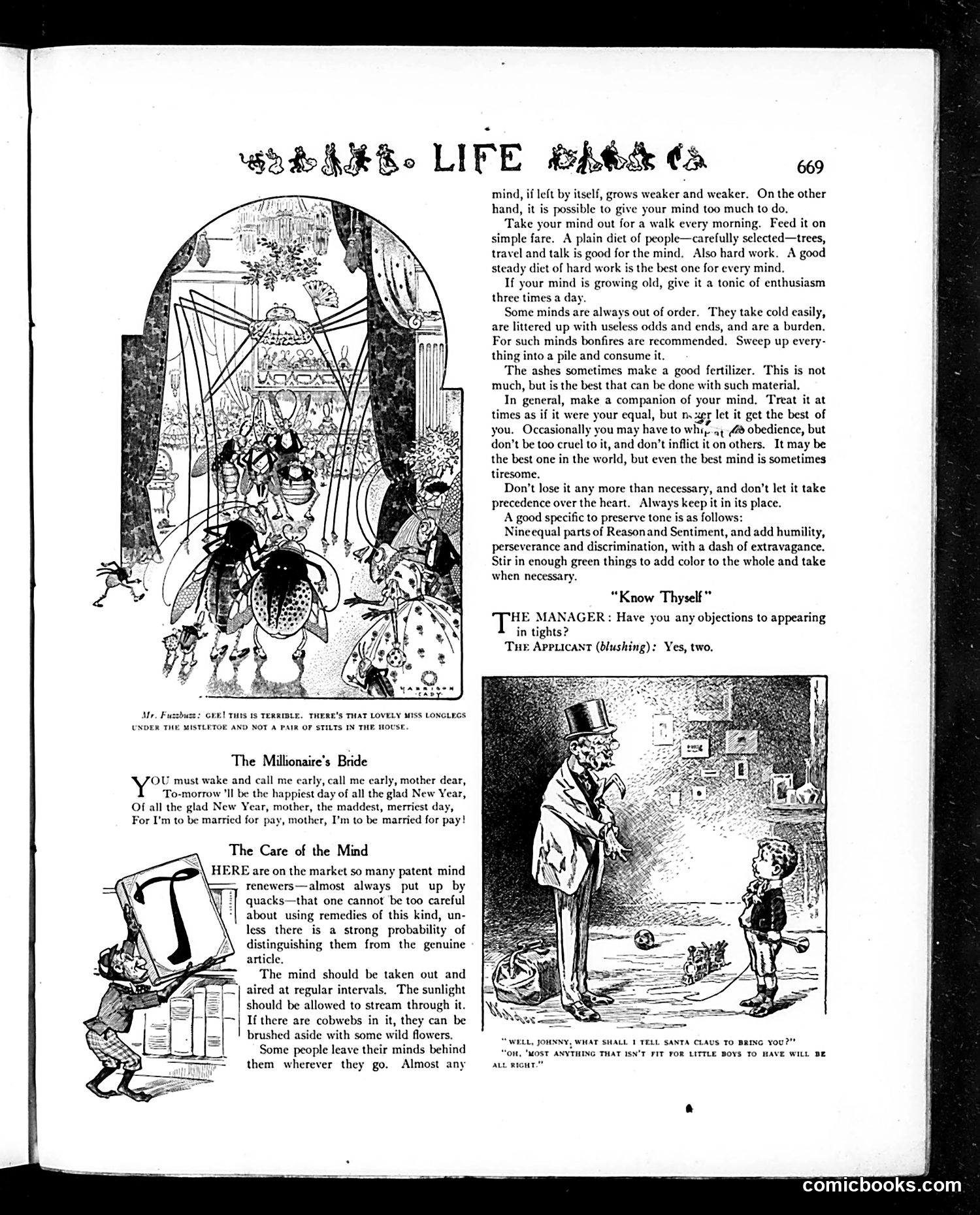
This page contains three distinct satirical pieces mocking contemporary society: 1. **"The Millionaire's Bride"**: A verse mocking marriages of convenience, where a woman explicitly sings she's marrying "for pay"—critiquing the era's practice of wealthy men purchasing brides from poor families. 2. **"The Care of the Mind"**: A mock-medical advice column sarcastically suggesting minds need maintenance like objects—"aired," cleaned of "cobwebs," fed simple diets of people and travel. This likely satirizes the period's proliferation of patent medicines and pseudoscientific "mind cure" products marketed to the gullible. 3. **"Know Thyself"**: Two brief comedy sketches—one about an actress refusing stage tights, another where a child asks Santa for adult contraband rather than toys—poking fun at social hypocrisy and changing attitudes toward propriety. The overall tone targets commercialism, quackery, and class exploitation of the era.
This illustrated short story by M.B. Stewart explores the bittersweet experience of returning to one's small hometown after years away. The narrative follows a city dweller who romanticizes returning "home" to visit elderly parents, repeatedly promising visits that never materialize due to urban business demands. The story satirizes modern American life's alienation: the protagonist finds his hometown physically and spiritually diminished—literally "shrunken by a half." His wife Sue, a city woman, cannot appreciate rural memories (the train conductor, caboose adventures) because she lacks the narrator's nostalgic connection. The detailed descriptions of waiting passengers and train observations capture the tedium of travel itself. The underlying critique suggests that twentieth-century capitalism and urban ambition have disconnected Americans from family roots and simpler living. The "deal or that one to chain us to our desks" represents how economic pressures prevent genuine human connection. The story mourns what industrialization costs: authentic community ties replaced by vague promises and faded memories.
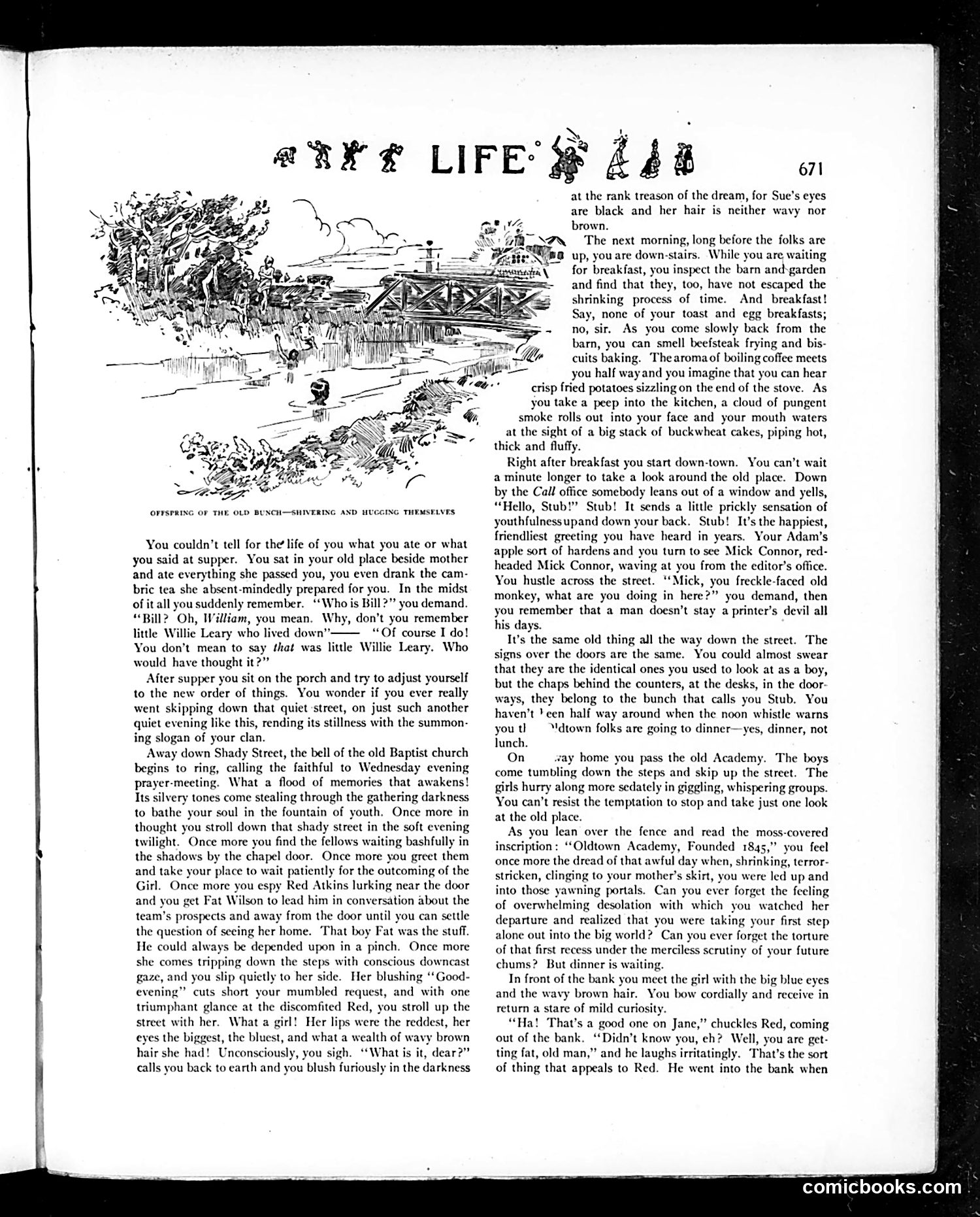
This page presents a nostalgic narrative essay rather than a political cartoon. The accompanying sketch shows a rural homestead ("Offspring of the Old Bunch"), illustrating the text's themes. The content depicts a protagonist returning to his hometown after years away, experiencing the bittersweet reality of revisiting childhood. The narrative satirizes nostalgia itself—the character's romanticized memories (a girl with "wavy brown hair") clash with present reality (his wife Sue has black, straight hair). The piece gently mocks small-town American life: the unchanged Baptist church, familiar figures like "Fat Wilson" and "Mick Connor," and the protagonist's disappointed realization that the town has physically deteriorated ("shrinking process of time"). Rather than political satire, this is social commentary on the universal human experience of homecoming—how places and people change, yet certain details remain frozen in memory. The humor derives from recognizable Americana: small-town geography, domestic details, and the gap between youthful memory and adult reality.
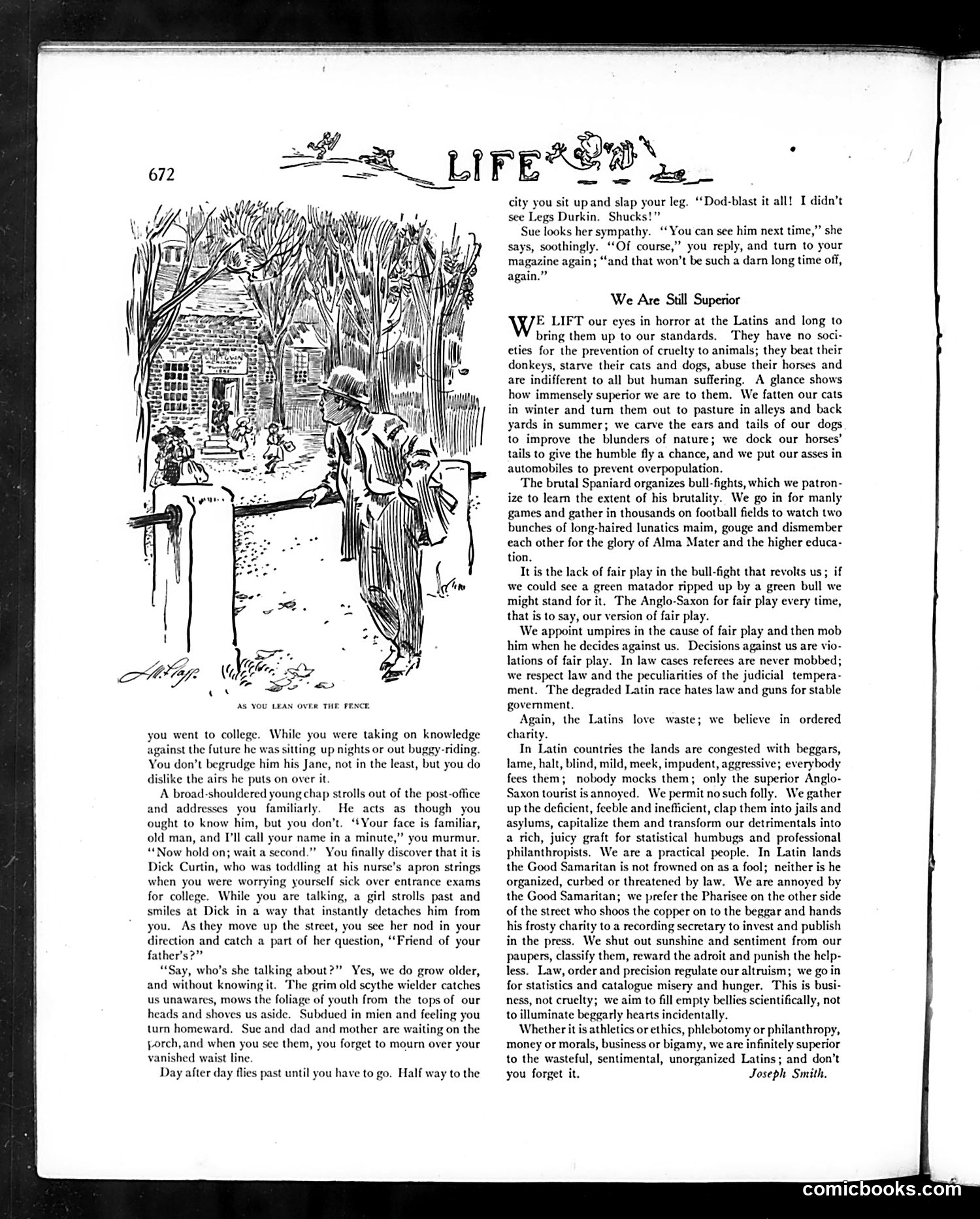
The left cartoon depicts a poignant moment of aging: a college-educated man encounters Dick Curtin, a childhood acquaintance who appears more successful and attractive to women. The joke's sting lies in the protagonist's realization that education didn't guarantee social superiority—and that time's passage has leveled their differences. The essay "We Are Still Superior" is biting satire mocking American moral smugness toward "Latins" (likely Southern Europeans). Life sarcastically catalogs supposed Anglo-Saxon superiority: we criticize Spanish bullfighting while mobbing umpires at football games; we claim to oppose animal cruelty while docking horses' tails and carving dogs' ears; we despise Latin "waste" on beggars while institutionalizing the poor. The satire exposes hypocrisy: Americans perform righteousness while practicing identical brutalities, merely disguised as civilization and efficiency. The author (Joseph Smith) demolishes the era's racial and cultural hierarchies by showing Western "superiority" as self-deception.
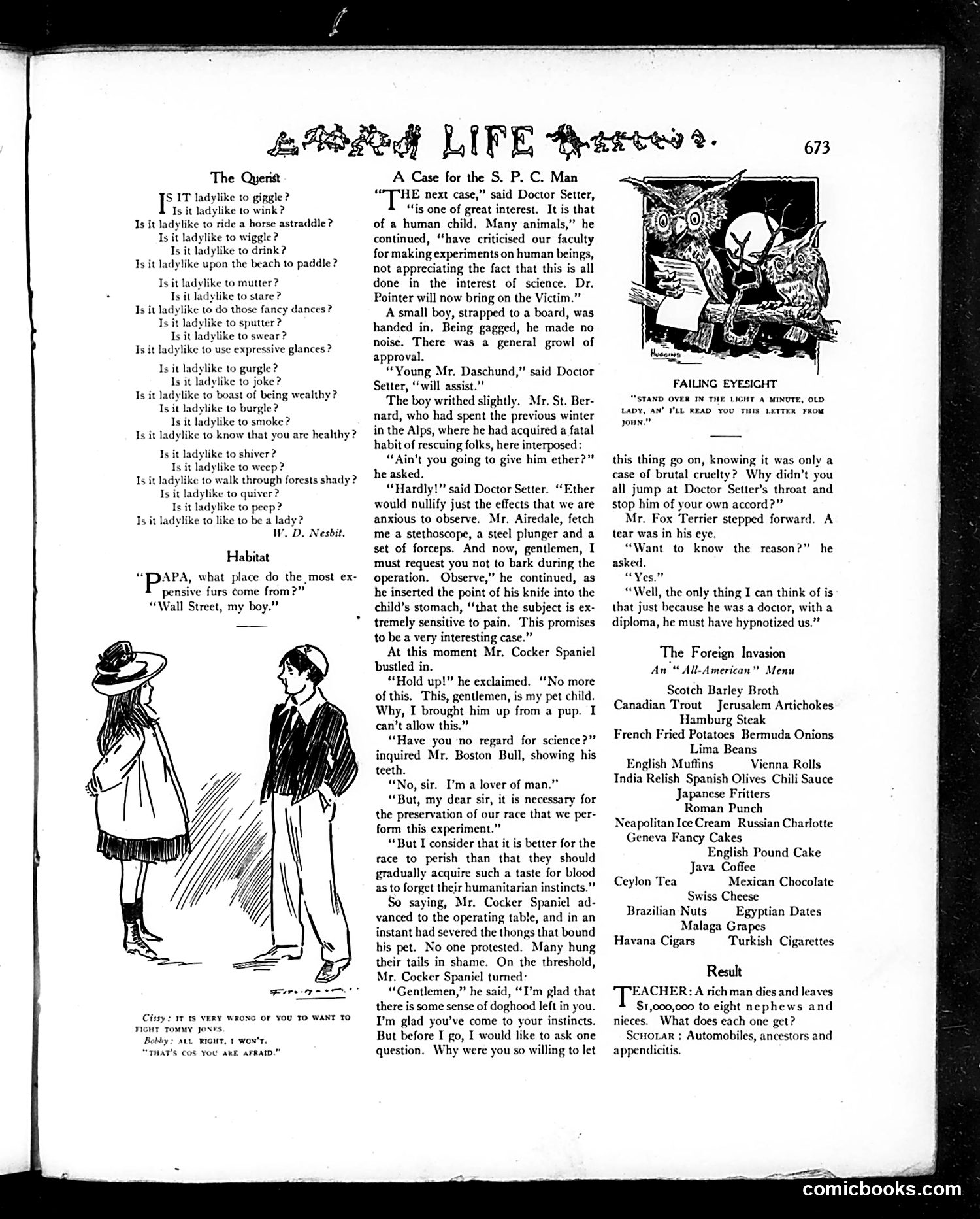
This page contains **two distinct satirical pieces** about early 20th-century social concerns: **"The Querist"** (left) humorously questions what constitutes "ladylike" behavior through a long list of increasingly absurd activities—from giggling and winking to burglary and smoking. It's satire on rigid gender expectations for women, suggesting the standards are so contradictory they're ridiculous. **"A Case for the S.P.C. Man"** (center/right) is a darker allegorical cartoon where animals conduct a vivisection on a human child. The animals represent specific breeds (Cocker Spaniel rescuing the child, Boston Bull, etc.). This satirizes vivisection—animal testing on humans for scientific advancement—a genuine ethical controversy of the era. The S.P.C. (Society for the Prevention of Cruelty) Man is invoked as moral authority. The story critiques how authority figures (the doctor) can manipulate people into accepting cruelty through credentials and appeals to "science." Both pieces target hypocrisy: gendered double standards in one, and the abuse of scientific authority in the other.
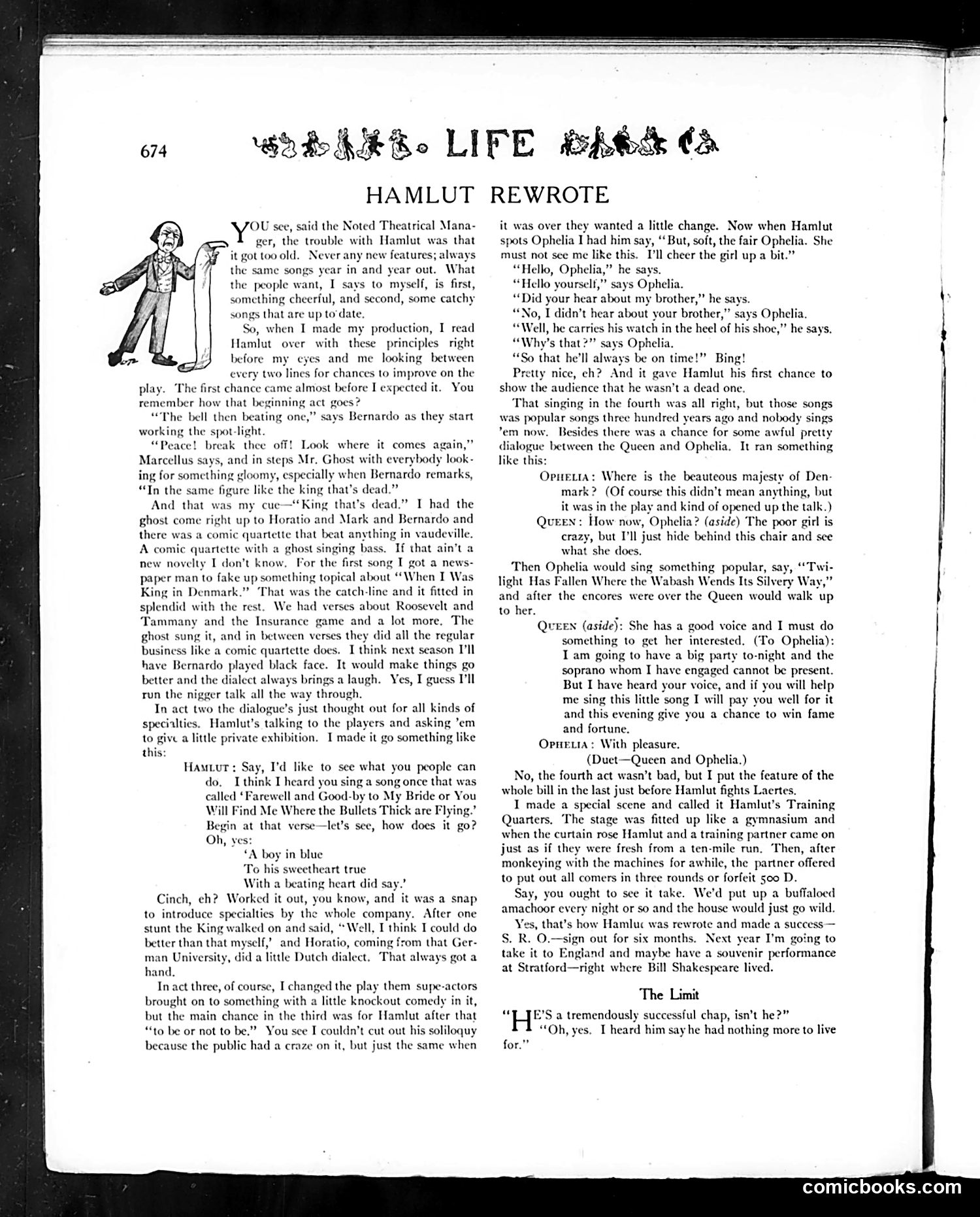
This is a satirical article about a theatrical manager who "modernizes" Shakespeare's *Hamlet* for contemporary audiences. The manager boasts of adding vaudeville-style comedy acts, topical songs about Roosevelt and Tammany Hall, and comic routines—transforming a tragedy into entertainment spectacle. The satire targets early 20th-century theater producers who prioritized commercial appeal over artistic integrity. The manager's casual racism (mentioning "nigger talk" for laughs) and dismissal of Shakespeare's original material ("the same songs year in and year out") exemplify crass commercialism. The irony is sharp: by trying to make *Hamlet* "modern" and "cheerful" with interpolated songs and vaudeville bits, the producer destroys the play itself. The inserted jokes—like the "watch in the heel of his shoe" gag—are painfully unfunny, underlining the absurdity of treating a masterpiece as a vehicle for variety acts. Life magazine uses this to mock producers who mistook audience tastes for artistic judgment, reducing literature to novelty entertainment.
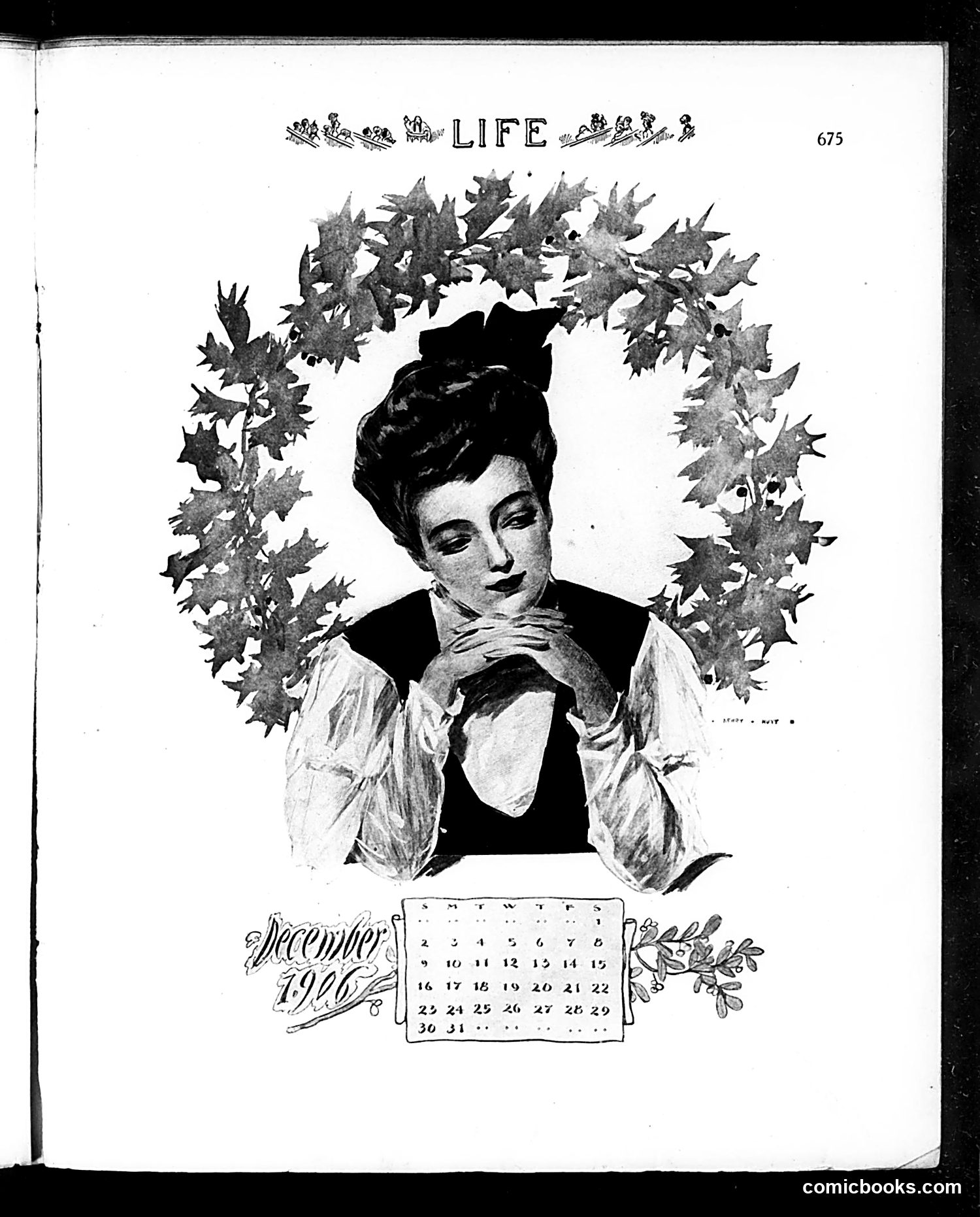
This is a calendar page from *Life* magazine featuring a stylized portrait of an elegant woman with upswept Edwardian hair, framed by decorative ivy or holly leaves. She wears a white blouse with puffy sleeves and a dark corset or vest, posed in a contemplative gesture with her hand near her face. The image functions as a decorative calendar for December 1906, characteristic of *Life's* frequent use of attractive illustrations for their monthly spreads. The botanical frame and the woman's refined pose reflect early 20th-century aesthetics celebrating feminine beauty and gentility. Without additional context or visible satirical captions, this appears to be primarily decorative rather than a political or social commentary—typical of *Life's* illustrated content during this period.
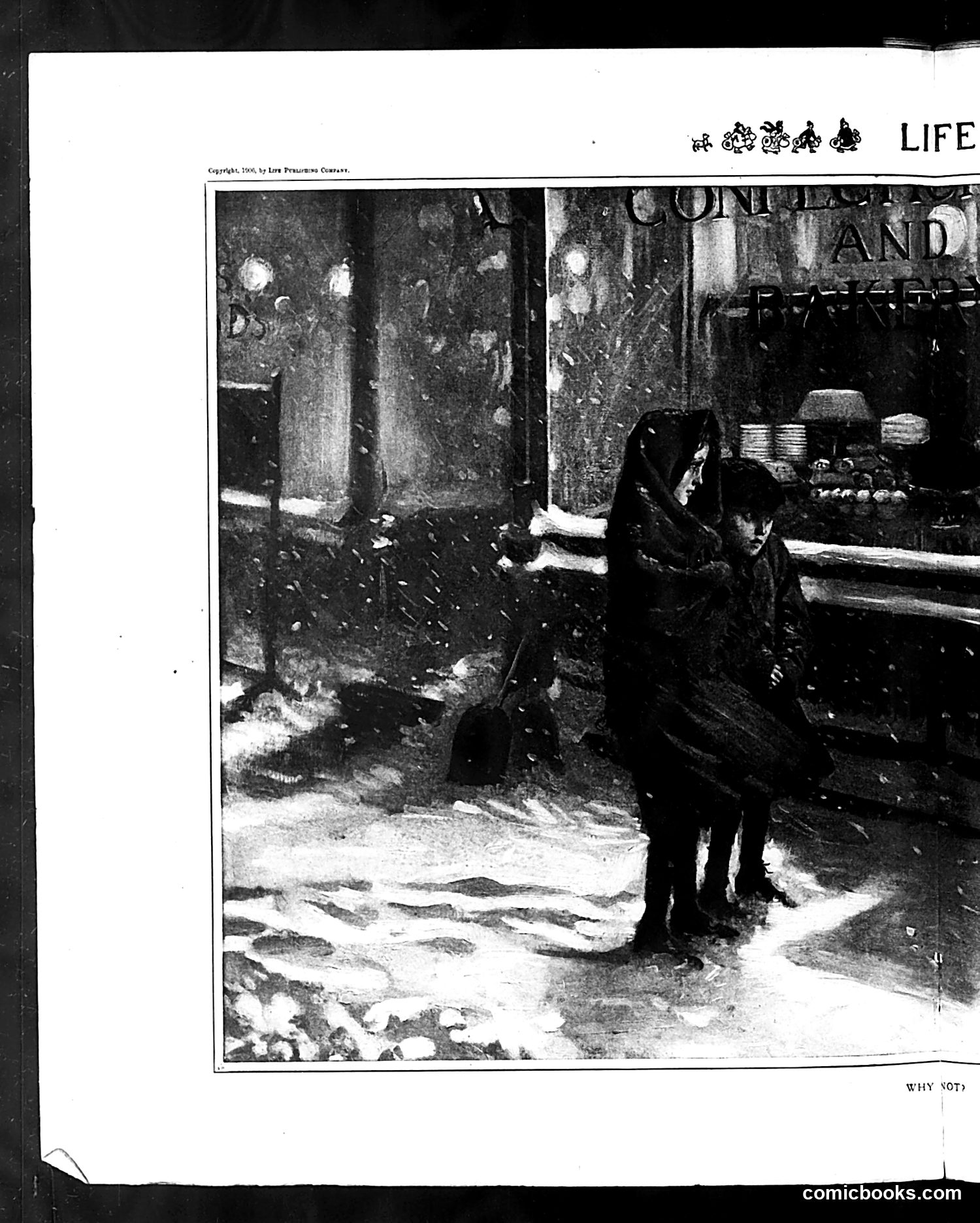
This appears to be a page from *Life* magazine showing a black-and-white photograph rather than a cartoon. The image depicts two figures in dark coats standing in snow outside a storefront, with a caption reading "WHY NOT?" The photograph appears to be social commentary, likely addressing poverty or economic hardship during winter conditions. The figures' positioning and the snowy, austere setting suggest the satire concerns economic inequality or inadequate social welfare—the "WHY NOT?" caption implies criticism of some policy or social practice. However, without additional context about the publication date or accompanying article text, I cannot definitively identify the specific historical event, political figures, or policy being critiqued. The image's documentary quality suggests it may illustrate a contemporary social issue rather than depicting caricatured figures.
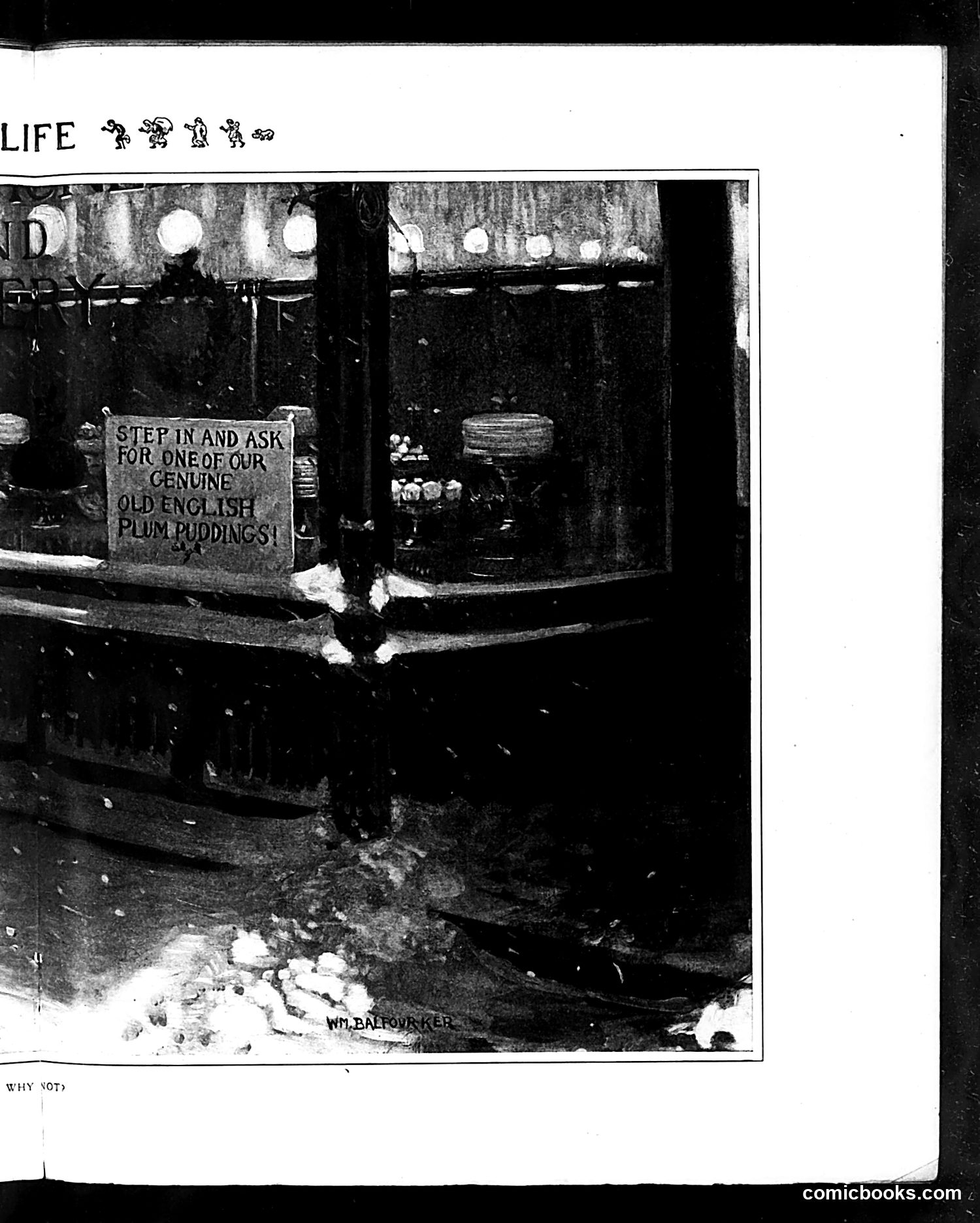
This Life magazine image shows a storefront window displaying what appears to be food products (possibly plum puddings, based on the visible sign). The sign reads: "STEP IN AND ASK FOR ONE OF OUR GENUINE OLD ENGLISH PLUM PUDDINGS!" The cartoon's point remains somewhat unclear from the visible elements. The caption "WHY NOT?" suggests satire about consumer culture or advertising practices of the era. The emphasis on "genuine" and "Old English" may mock either commercialism, nostalgia marketing, or British products being sold in America. The photographer credit reads "WM. BAIN WALKER." Without additional context about Life magazine's contemporary concerns or the specific historical moment, the precise satirical target is difficult to determine definitively.
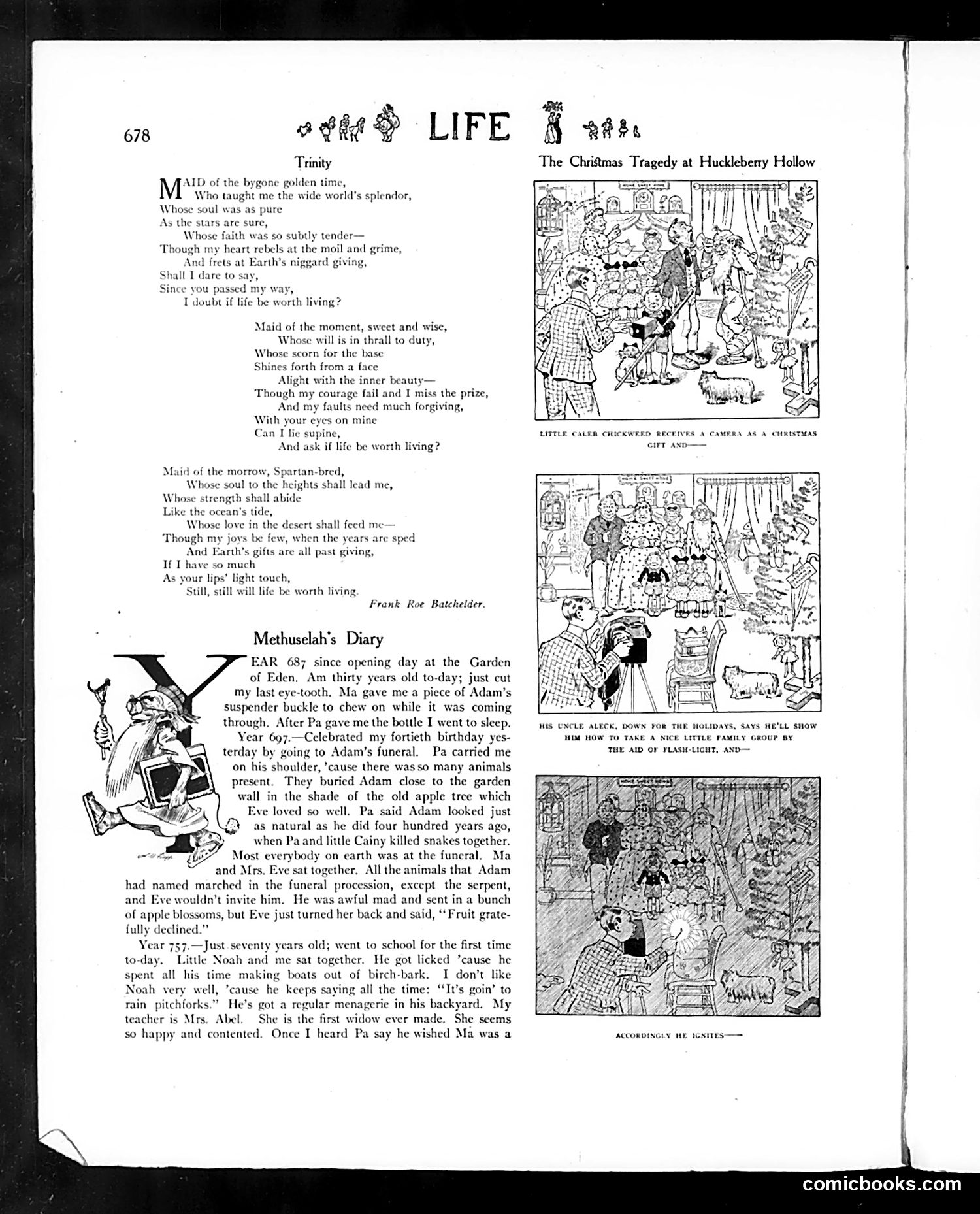
This page contains two distinct pieces: **"Trinity"** (left): A sentimental poem by Frank Roe Batchelder addressing three idealized women—representing past, present, and future—asking whether life is worth living. It's a romantic meditation on love across different life stages, typical of early 20th-century verse. **"Methuselah's Diary"** (center-left): A humorous fictional diary from the Biblical patriarch Methuselah, recording mundane details of ancient life (teething, funerals, schooling). The joke plays on the absurdity of applying modern diary conventions to legendary figures, with references to Adam, Eve, and Noah. It's gentle biblical satire rather than irreverent critique. **"The Christmas Tragedy at Huckleberry Hollow"** (right): A comic strip showing a domestic mishap—Uncle Aleck attempting to photograph a family gathering using flash powder, which apparently ignites, causing chaos. The humor derives from early photography's dangers and the Uncle's well-intentioned but bungled assistance. All three pieces reflect early 1900s Life magazine's blend of sentimental poetry, gentle satire, and domestic humor.
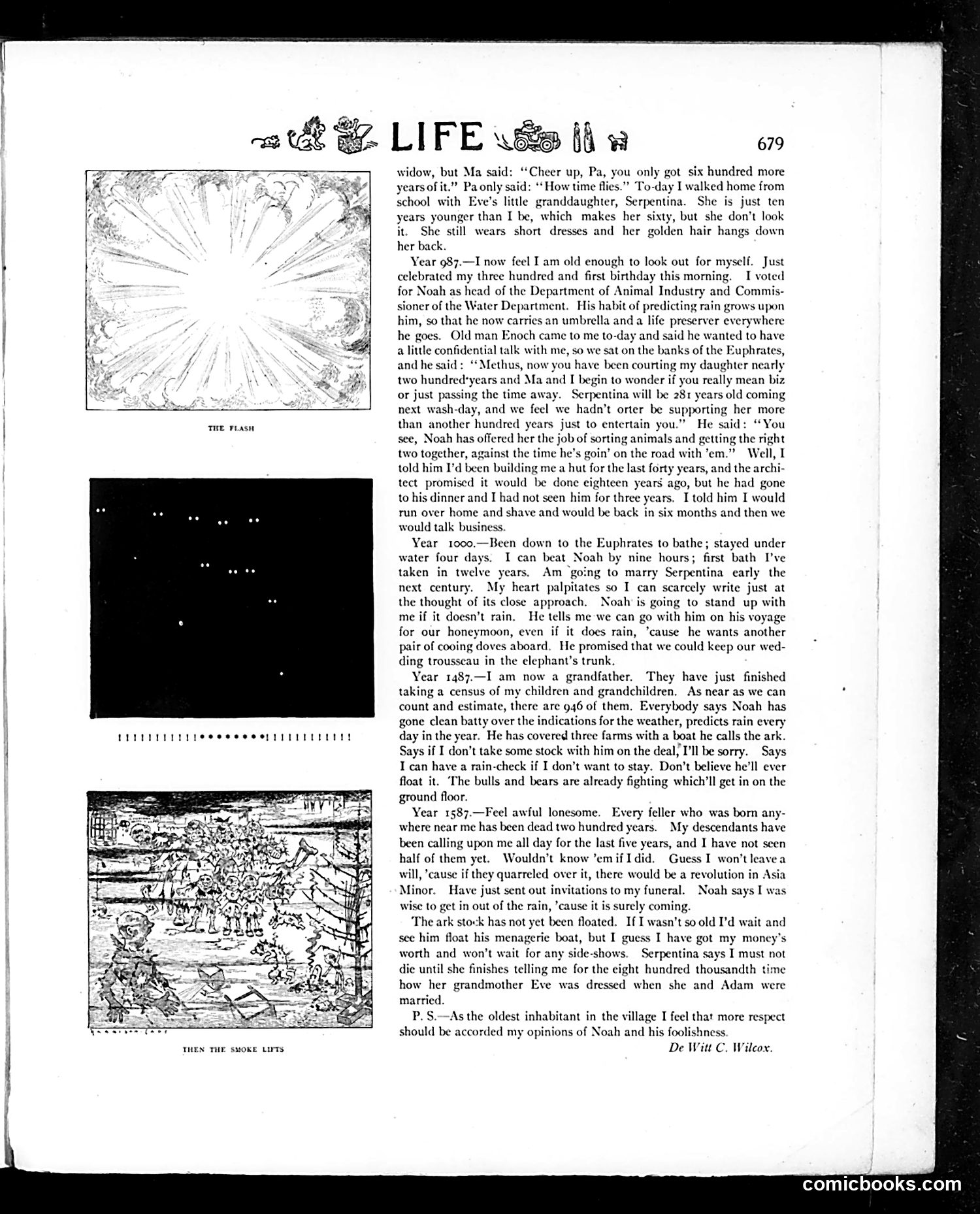
This page presents a satirical monologue depicting an impossibly long human lifespan, chronicling entries from "Year 987" through "Year 1587" of a man's life. The narrator appears to be **Methuselah**, the biblical figure famous for extraordinary longevity. The satire mocks the absurdities of extreme old age: courting for centuries, waiting decades for construction work, taking one bath every twelve years, accumulating 946 descendants. **Noah** appears as a character obsessed with predicting rain and promoting "ark stock"—a joke about the biblical flood narrative treated as a financial scheme. The illustrations labeled "THE FLASH" and "THEN THE SMOKE LIFTS" likely depict lightning and flood imagery, reinforcing the Noah's Ark references. The humor derives from applying mundane contemporary concerns (weddings, construction delays, financial schemes, family quarrels) to biblical timescales, creating absurdist comedy that satirizes both human folly and excessive longevity as curse rather than blessing.
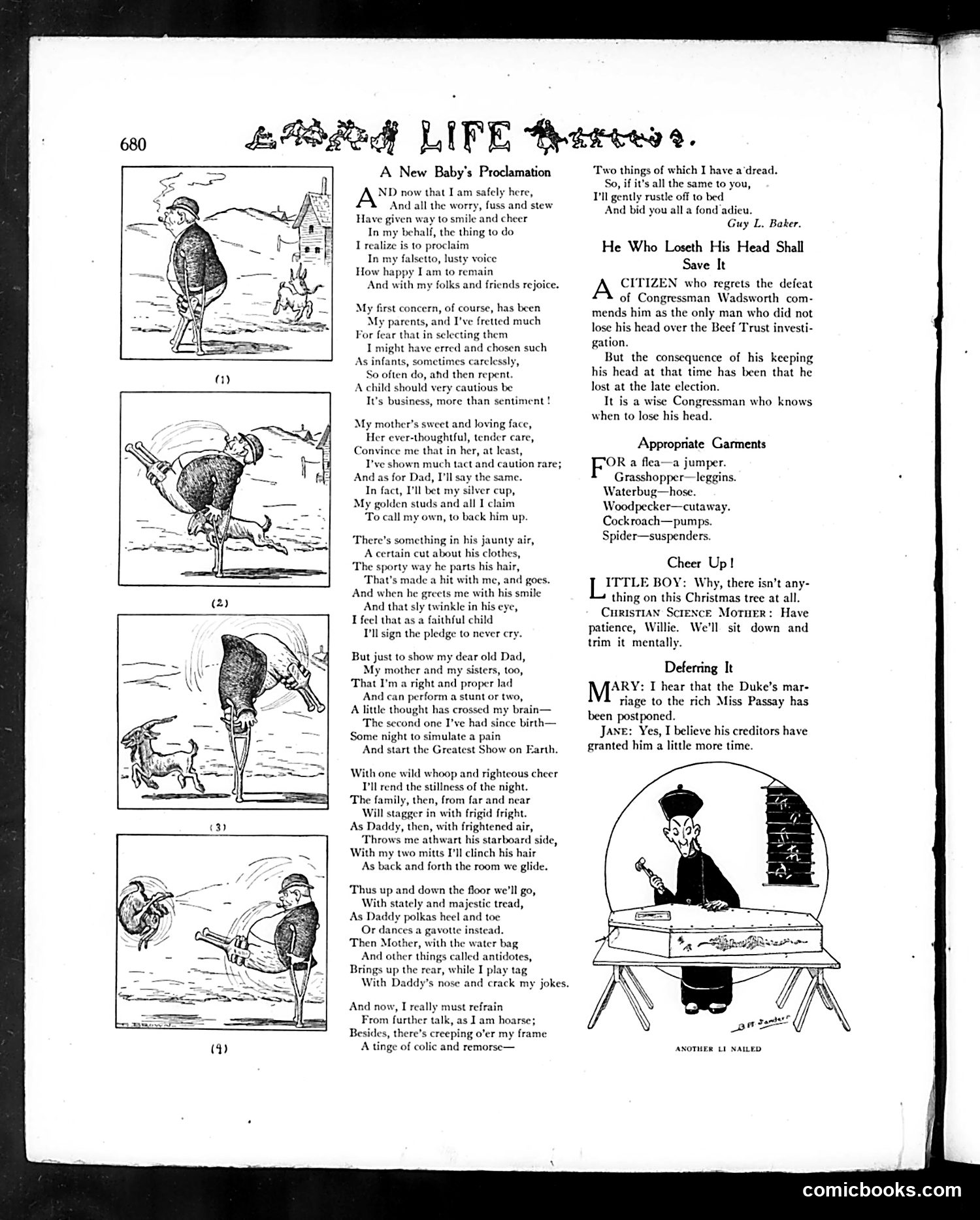
This page contains multiple satirical pieces typical of early 20th-century American humor: **"A New Baby's Proclamation"** is a humorous poem where a newborn "speaks" in adult language, ironically displaying parental anxiety and self-awareness. The four illustrations show acrobatic baby antics—the infant performs headstands and contortions—mocking both Victorian infant sentimentality and parents' exaggerated concerns. **"He Who Loseth His Head Shall Save It"** references Congressman Wadsworth's defeat despite maintaining composure during the Beef Trust investigation (a real political scandal). The satire suggests political success sometimes requires emotional reactions, not rational restraint. The remaining items are brief joke snippets: "Appropriate Garments" makes puns matching insects to clothing ("flea—jumper"), while "Cheer Up!" mocks Christian Science practitioners' mental-rather-than-physical approaches to problems, and "Deferring It" jokes about a nobleman delaying marriage due to creditors. The content reflects early 1900s concerns: politics, class anxiety, religious skepticism, and parenting trends.
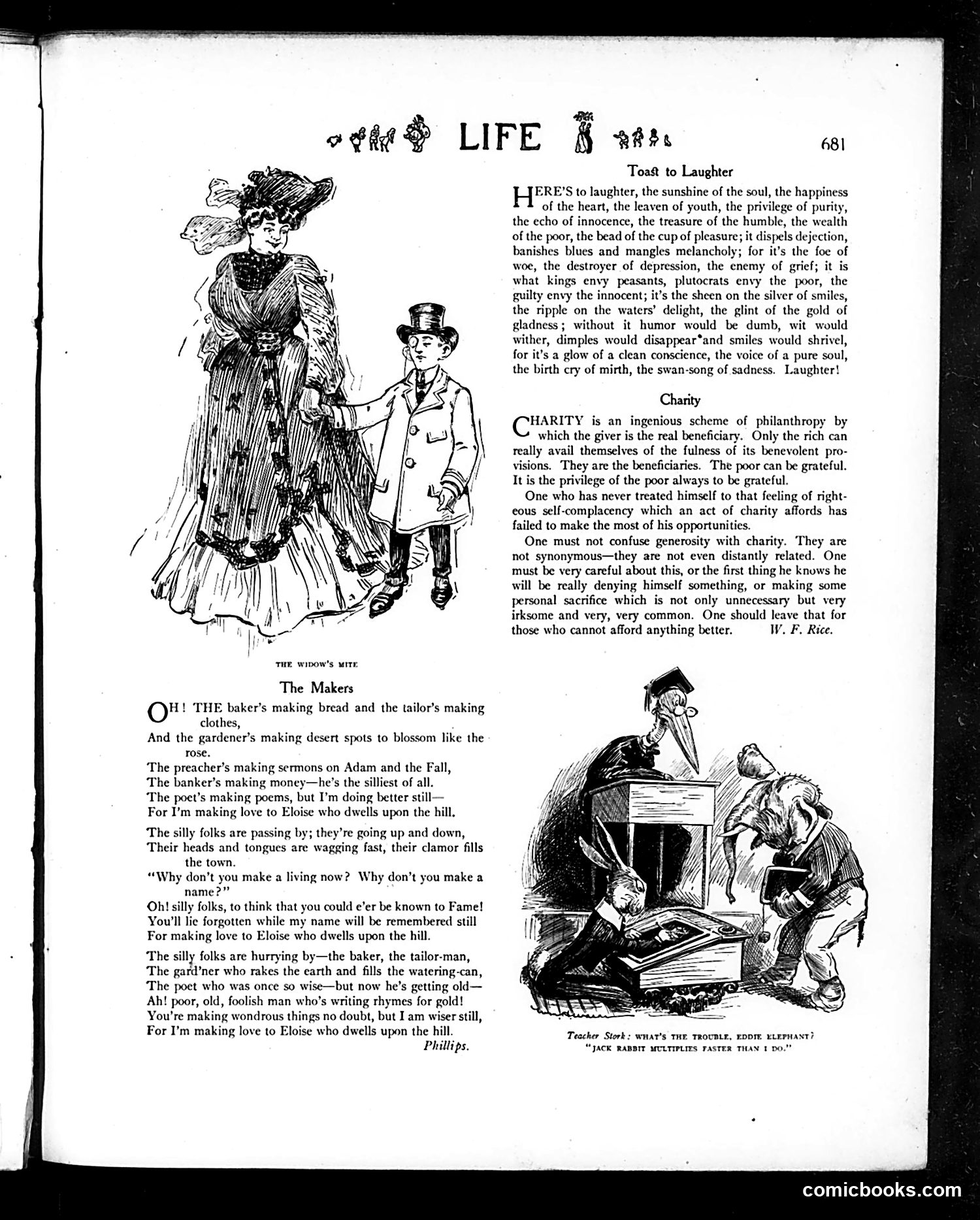
This page contains three satirical pieces typical of early 20th-century American humor: **"Toast to Laughter"** is a sentimental celebration of humor's social value—a common Life magazine trope praising laughter as universally beneficial and morally uplifting. **"Charity"** by W.F. Rice offers biting social satire. It mocks wealthy philanthropists' self-congratulation, arguing that the rich are actually the true beneficiaries of charity (feeling virtuous), not the poor. Rice satirizes how the wealthy confuse "generosity with charity" and warns against genuine personal sacrifice—suggesting the privileged should leave real sacrifice to those who can't afford otherwise. This critiques performative philanthropy. **"The Makers"** is a humorous poem contrasting productive workers (bakers, tailors, gardeners, preachers, bankers, poets) with a young man pursuing romance with "Eloise," whom he considers superior achievement. The joke: while society values tangible work, the narrator finds courtship more important. The accompanying illustration shows a teacher and student with rabbits, reinforcing the poem's final joke about reproduction rates.
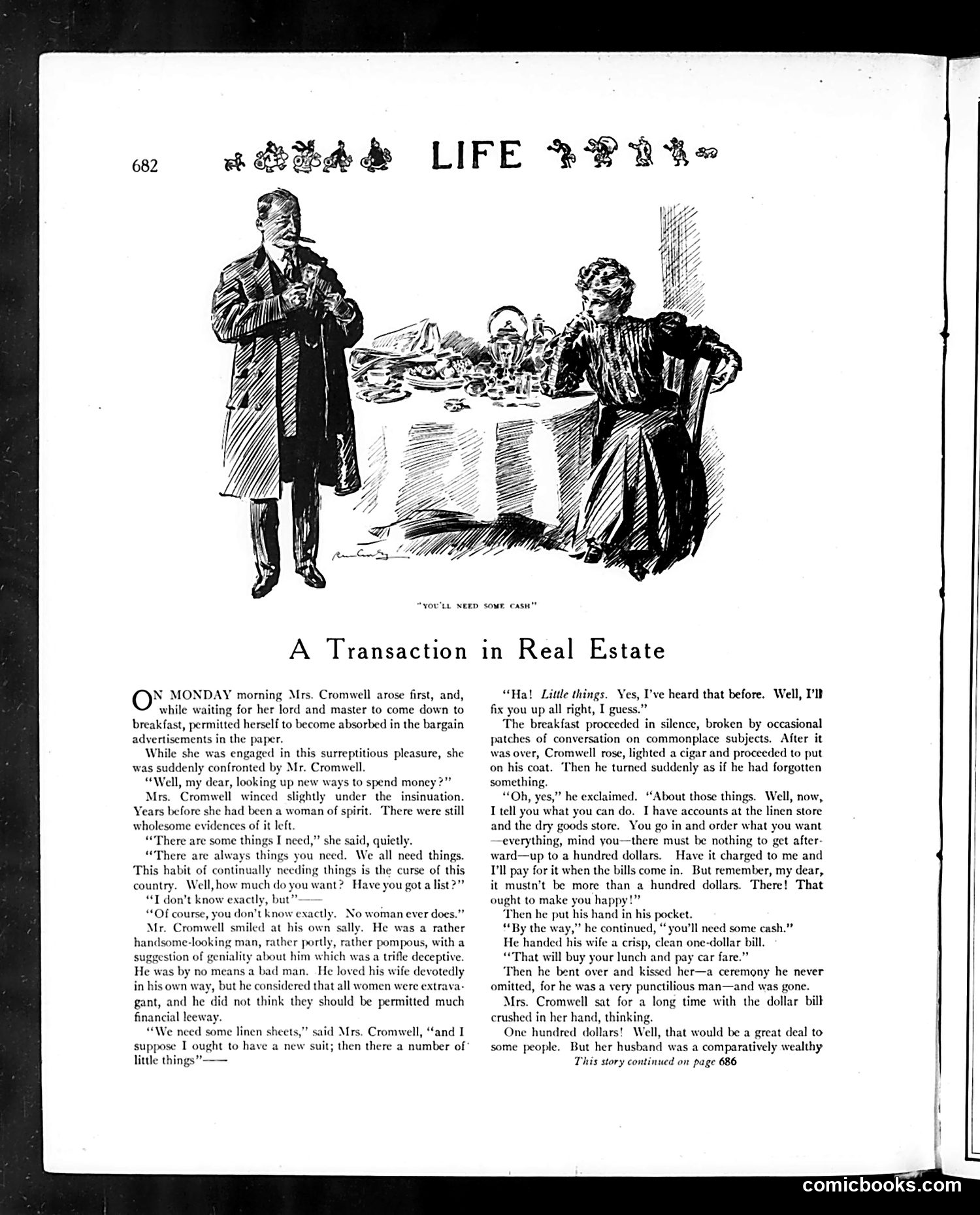
This satirical story skewers the condescending paternalism of early 20th-century husbands toward their wives' finances. Mr. Cromwell epitomizes the pompous, controlling husband who: - Mocks women's shopping habits as inherently wasteful ("No woman ever does" know what she wants) - Grants his wife a "generous" $100 budget for household necessities while giving her only $1 for lunch and carfare - Congratulates himself for his benevolence despite this absurd disparity - Uses affection (kissing her) to soften his financial dominance The cartoon's title suggests irony: this "transaction" is actually about power, not commerce. Mrs. Cromwell's silent reaction—sitting alone "crushed" with the dollar bill—conveys her helplessness. The satire targets the hypocrisy of husbands who consider themselves generous while maintaining iron control over household finances, leaving wives economically dependent despite managing the home.
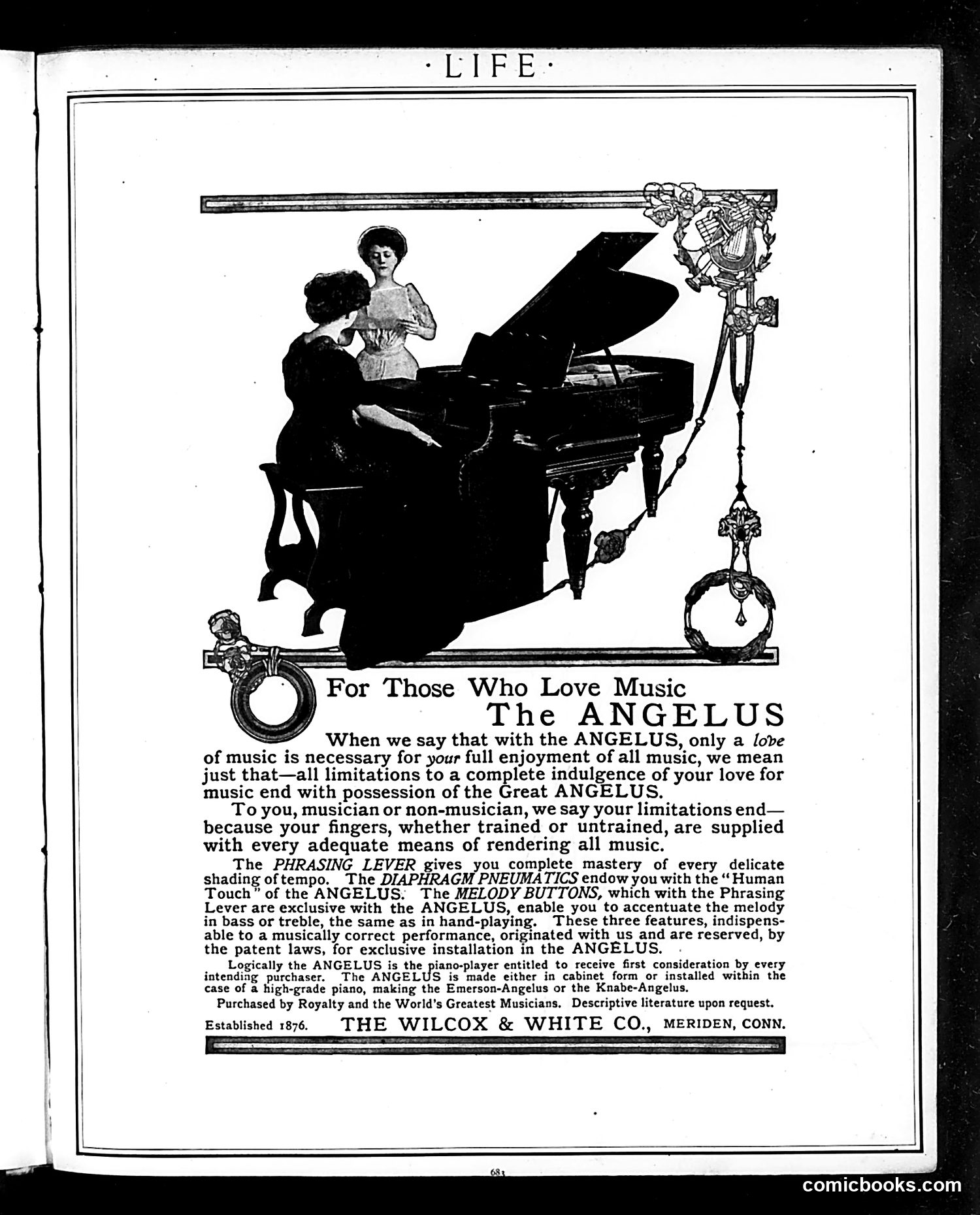
This is a **full-page advertisement**, not satire or political commentary. It promotes the Angelus, a player piano mechanism manufactured by Wilcox & White Company (established 1876). The image shows a man operating the device while a woman stands nearby—typical early-20th-century domestic imagery positioning the player piano as aspirational home entertainment. The advertisement's pitch targets both musicians and non-musicians, claiming the Angelus eliminates skill limitations through automated features: "Phrasing Lever," "Diaphragm Pneumatics" (providing "Human Touch"), and "Melody Buttons" allow untrained hands to play complex music professionally. The marketing emphasizes exclusivity—these features were patented and unavailable elsewhere—and prestige ("Purchased by Royalty and the World's Greatest Musicians"). This reflects the early 1900s fascination with mechanical music devices before recorded audio became standard.
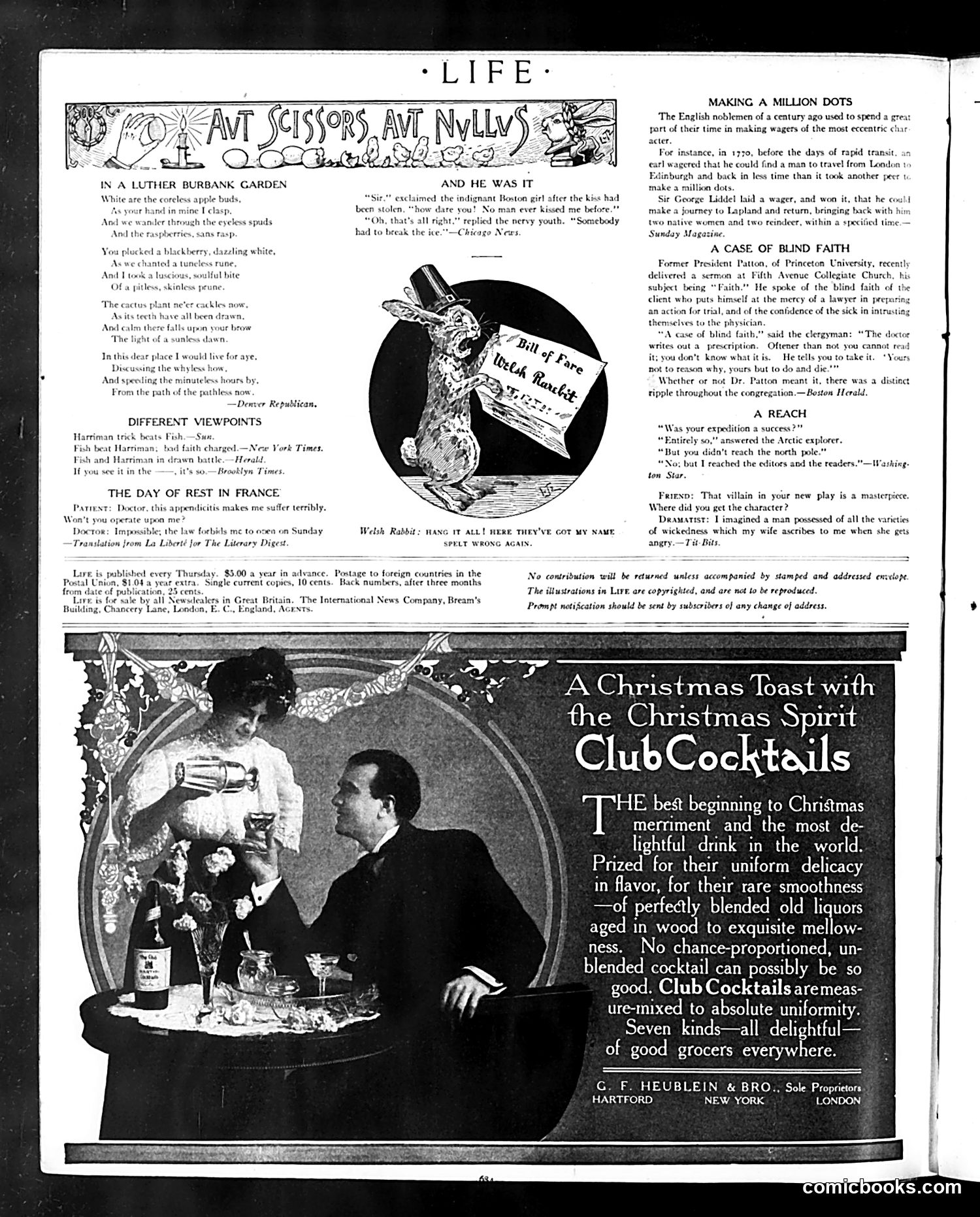
This page from *Life* magazine contains several satirical pieces and an advertisement: **Top Section:** Brief poems and jokes on unrelated topics—including wordplay about a "Welsh Rabbit" (a dish, also a pun), jabs at French law, and anecdotes about eccentric 18th-century English noblemen making absurd wagers. **"A Case of Blind Faith":** The satire targets Former Princeton President Patton's sermon about "blind faith." The joke: Patton illustrates faith by noting patients blindly trust doctors who write illegible prescriptions. The congregation sees the irony—Patton himself exemplifies such blind faith by trusting what he cannot read. It's light mockery of religious rhetoric's accidental self-contradiction. **"A Reach":** An Arctic explorer boasts his expedition succeeded because he reached *newspaper editors and readers*—satirizing how exploration's real success lies in publicity, not geography. **Bottom:** A full-page advertisement for Club Cocktails, positioned as a luxury Christmas drink. The page is typical *Life* fare: gentle, urbane satire targeting pretension and hypocrisy.
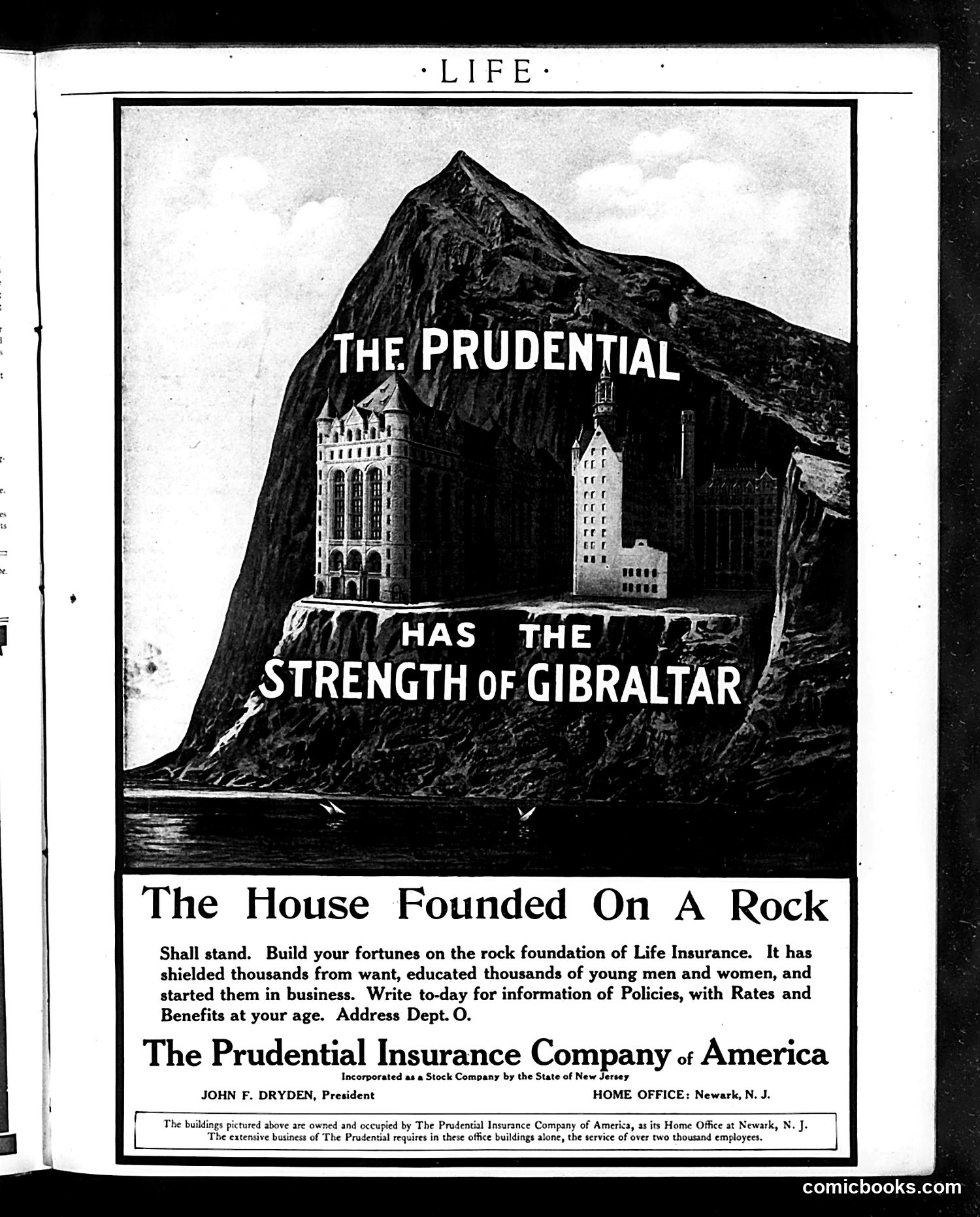
This is **advertising, not satire**. The page shows a full-page advertisement for The Prudential Insurance Company of America. The image depicts the company's Newark, New Jersey headquarters buildings nestled against the Rock of Gibraltar—a metaphor for stability and strength. The headline "The Prudential Has the Strength of Gibraltar" equates the insurance company with an impregnable fortress, promising security. The accompanying text uses biblical language ("The House Founded On A Rock / Shall stand") to reinforce trustworthiness, claiming the company has "shielded thousands from want" and helped young people start businesses. This is corporate messaging designed to persuade readers that life insurance with Prudential provides rock-solid financial protection. There is no political commentary or satire here—simply a major insurance corporation leveraging architecture, metaphor, and religious imagery to build consumer confidence during an era (early-to-mid 20th century) when such direct appeals were standard advertising practice.
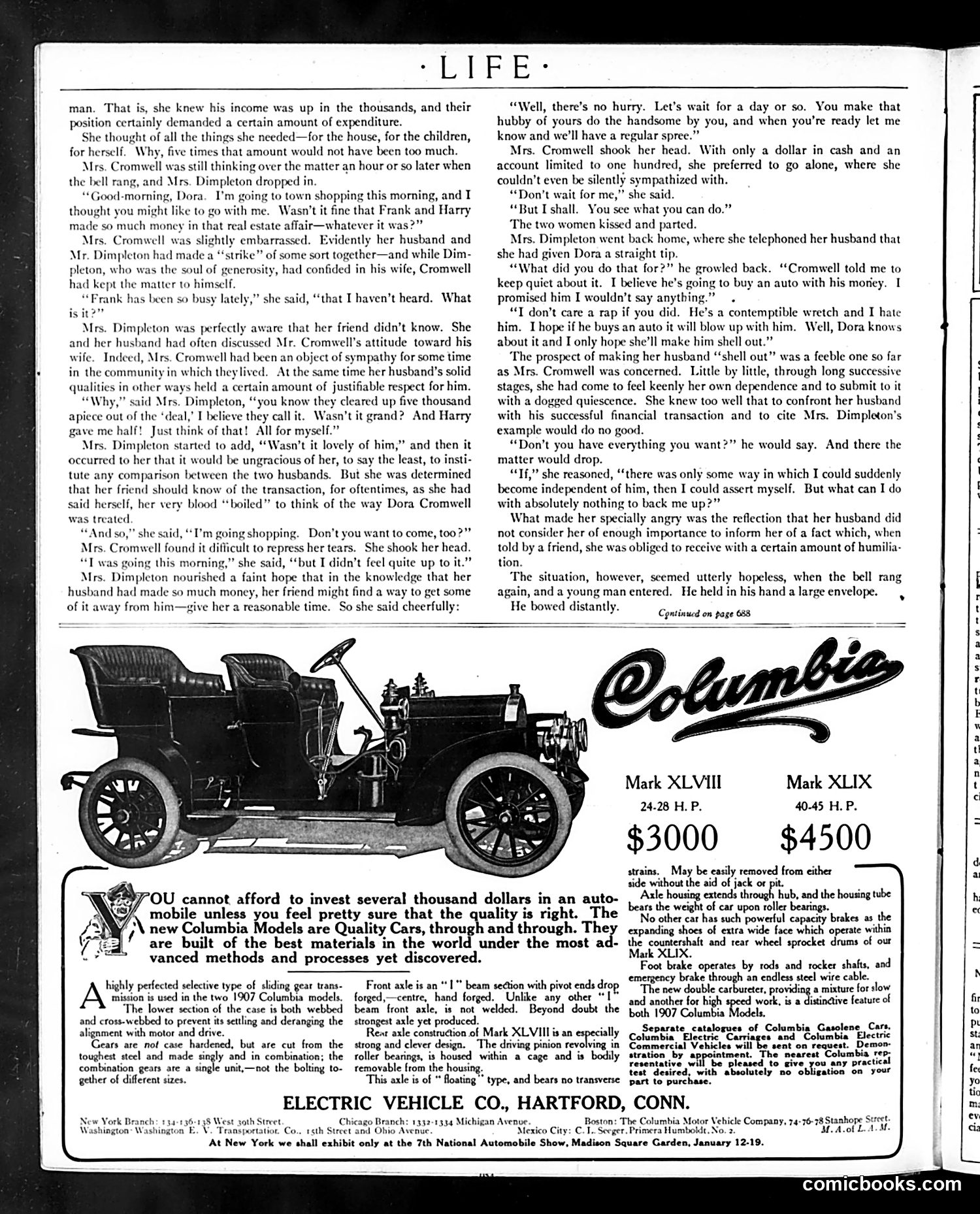
This page contains a serialized story about **marital financial inequality**, not a political cartoon. The narrative satirizes early-1900s gender dynamics around money and marriage. **The Plot:** Mrs. Cromwell's husband made $5,000 in a real estate deal but told her nothing. Her friend Mrs. Dimpleton learns this and reveals it, expecting Mrs. Cromwell to demand her share. However, Mrs. Cromwell—restricted to $1 cash and a $100 account—has become so conditioned to financial dependence that she cannot assert herself. Her husband plans secretly to buy an automobile with the money. **The Satire:** The story critiques husbands who control household finances while treating wives as helpless dependents. Mr. Dimpleton's generosity toward his wife contrasts sharply with Mr. Cromwell's secretiveness, highlighting how patriarchal control operates even among the prosperous classes. The **Columbia automobile advertisement** below represents the consumer goods wives like Mrs. Cromwell cannot access independently—reinforcing the story's point about feminine economic powerlessness.
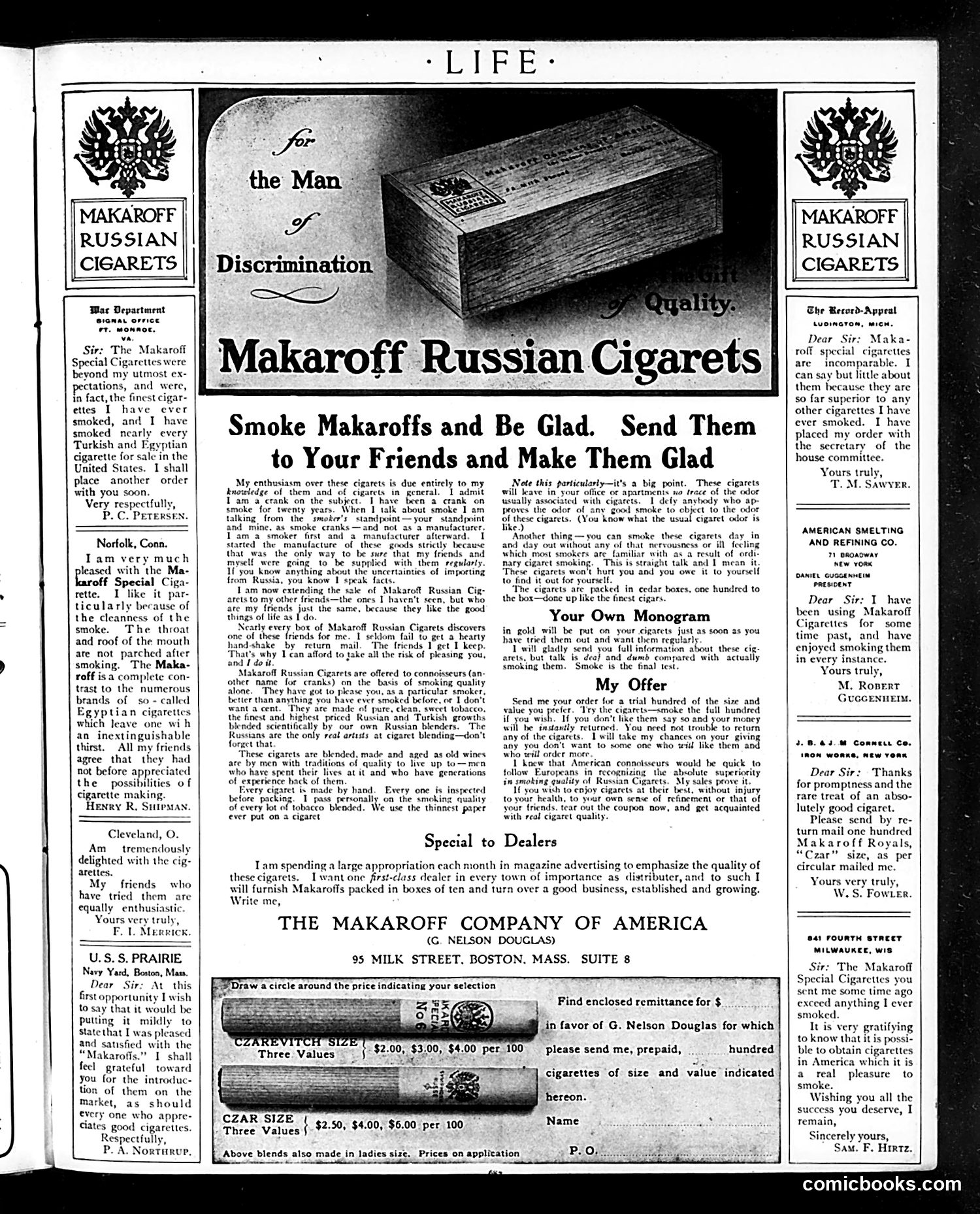
This page is primarily a **cigarette advertisement**, not political satire. It features Makaroff Russian Cigarets and includes testimonial letters from satisfied customers—including a War Department official and a U.S. Navy officer—praising the product's quality and lack of unpleasant odor. The advertisement emphasizes that these are premium imported Russian cigarettes, positioned as superior to common Egyptian varieties available in America. The manufacturer uses endorsements from military figures to establish credibility and prestige. There is **no political cartoon** on this page. The only visual elements are decorative Russian imperial eagles on the letterhead and product packaging images. The content is straightforward commercial promotion typical of early 20th-century advertising, when testimonials from authority figures were standard marketing practice. The page represents a historical moment when Russian products held exotic cachet in American markets, before geopolitical tensions made such associations problematic.
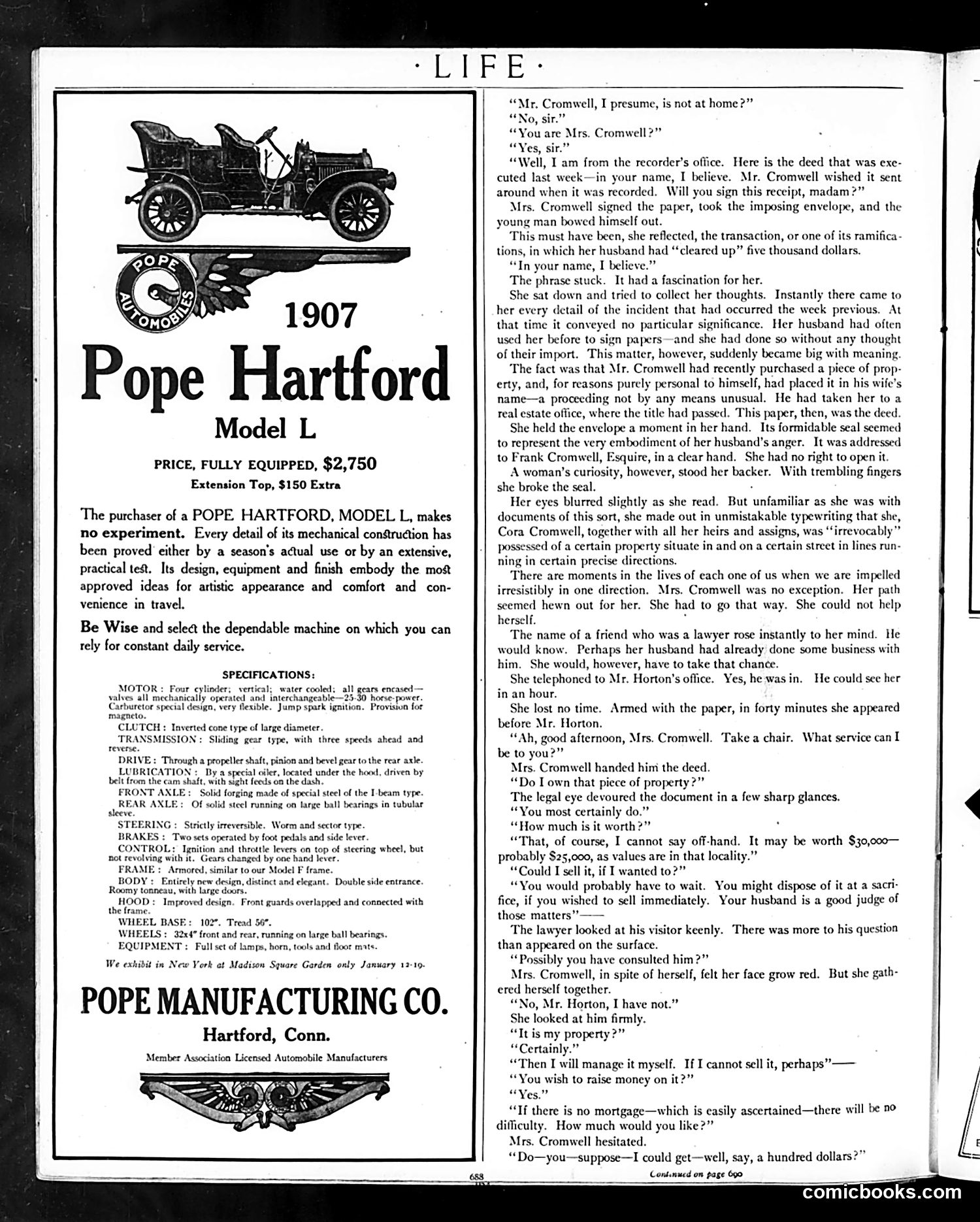
This page contains two distinct elements: a **Pope Hartford automobile advertisement** (left) and a **serialized short story** (right) titled "A Woman's Property." The story concerns **Mrs. Cromwell**, who receives a property deed signed in her name—ostensibly a routine transaction her husband arranged. However, upon reading the formal deed, she discovers the property is registered "irrevocably" in her name alone, which disturbs her. She consults a lawyer, Mr. Horton, uncertain of the implications. **The satirical point**: This reflects early-20th-century anxieties about **women's property rights**. The story plays on the dramatic tension of a woman suddenly realizing she legally owns property—a remarkable circumstance when married women typically had limited independent legal standing. Her confusion and need for legal counsel underscore how unfamiliar women were with property ownership, even as laws slowly granted them greater rights. The advertisement juxtaposition is coincidental—both simply occupy the same magazine page.
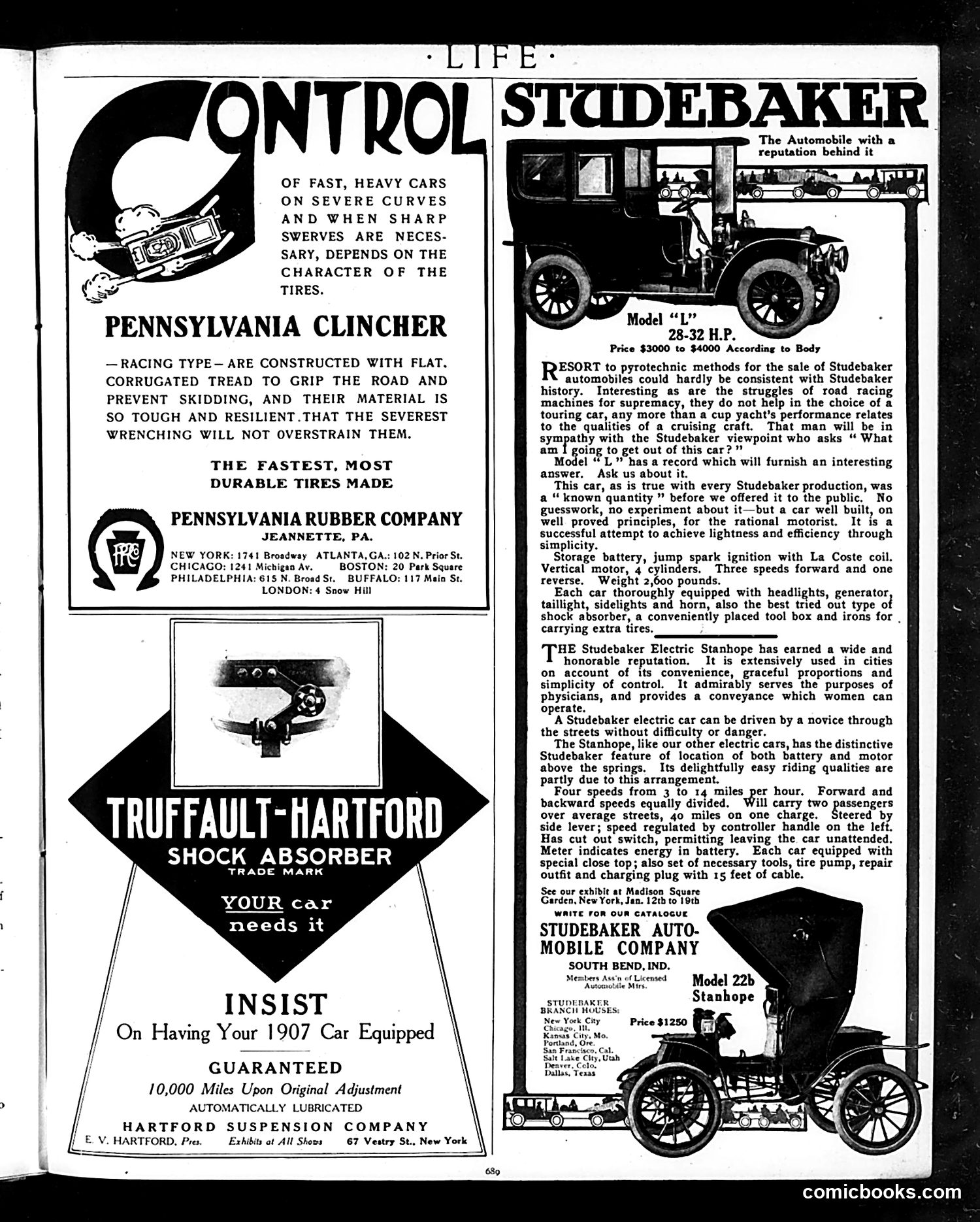
This is primarily an **advertising page** from an early 1907 Life magazine, not satirical content. It contains four automobile and automotive component advertisements: 1. **Pennsylvania Clincher Tires**: Emphasizes grip and skid-prevention for heavy cars on curves—addressing a genuine safety concern of early motoring. 2. **Truffault-Hartford Shock Absorber**: Promotes suspension technology as essential for 1907 vehicles. 3. **Studebaker Model "L"**: A touring car (gasoline-powered) priced $3,000-$4,000, marketed as reliable and practical rather than flashy—explicitly rejecting "pyrotechnic methods" (racing hype) in favor of proven engineering. 4. **Studebaker Electric Stanhope**: A luxury electric car for urban use, particularly marketed toward physicians and women drivers as safe, simple, and requiring no mechanical expertise. The page reflects early automotive concerns: tire technology, suspension reliability, and the competition between gasoline and electric vehicles for affluent buyers.
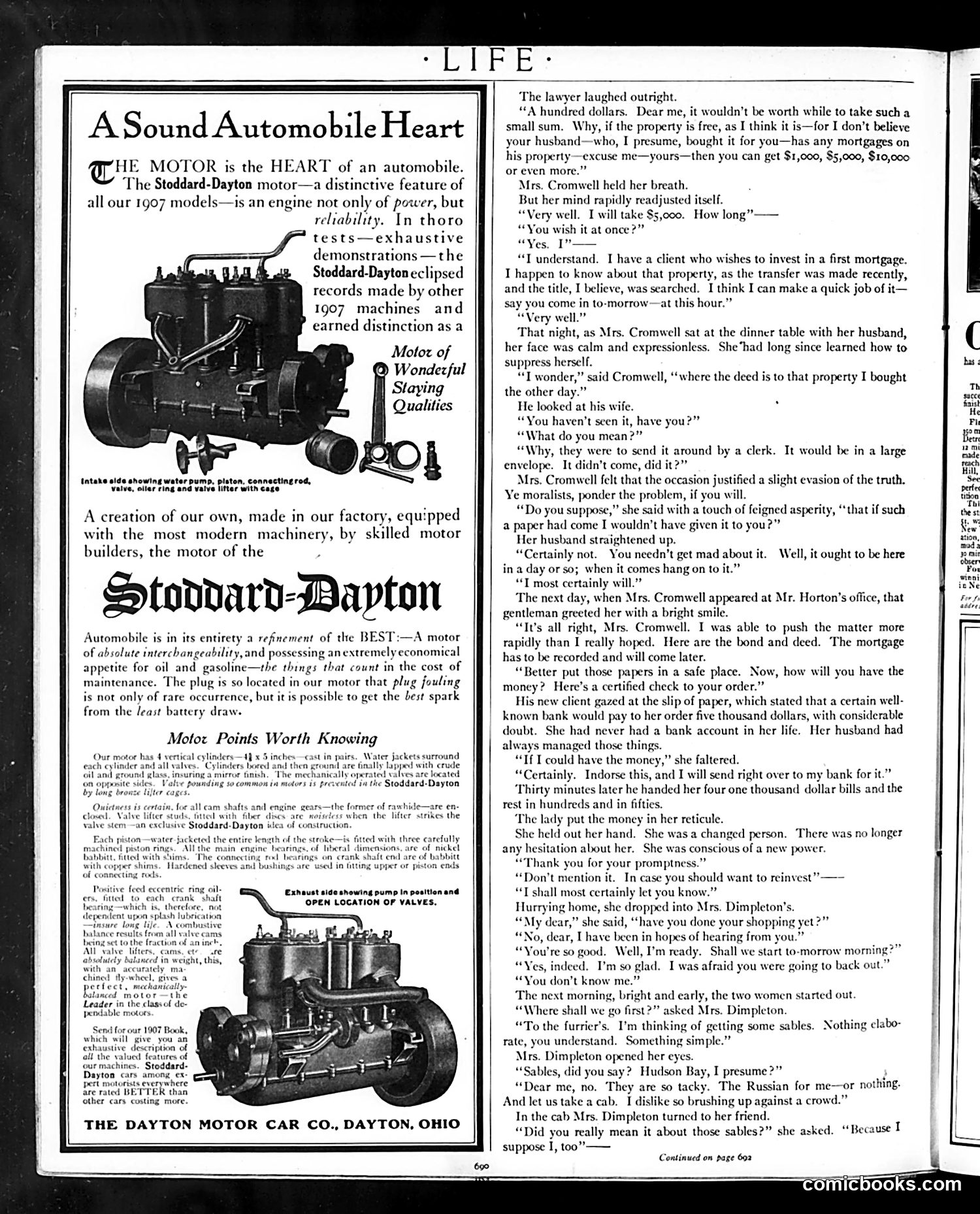
This page is **primarily an automobile advertisement** for the Stoddard-Dayton Motor Car Company (1907), featuring technical diagrams and specifications of their engine. The ad emphasizes reliability and modern engineering—standard promotional language for early automobiles. The right column contains a **serialized short story** (marked "Continued on page 603") about Mrs. Cromwell, a woman who discovers her husband has purchased property. When a lawyer offers her $5,000-$10,000 in mortgages on what she thought was debt-free property, she realizes her husband may have deceived her about the purchase. The story explores themes of **marital deception and women's financial vulnerability**—her husband bought property "for" her without her knowledge, and she must now secretly obtain the deed. This juxtaposition is likely intentional: the "modern" automobile technology contrasts with the old-fashioned legal/marital arrangements that leave women without full knowledge or control of family finances. The satire appears subtle but pointed about women's limited agency.
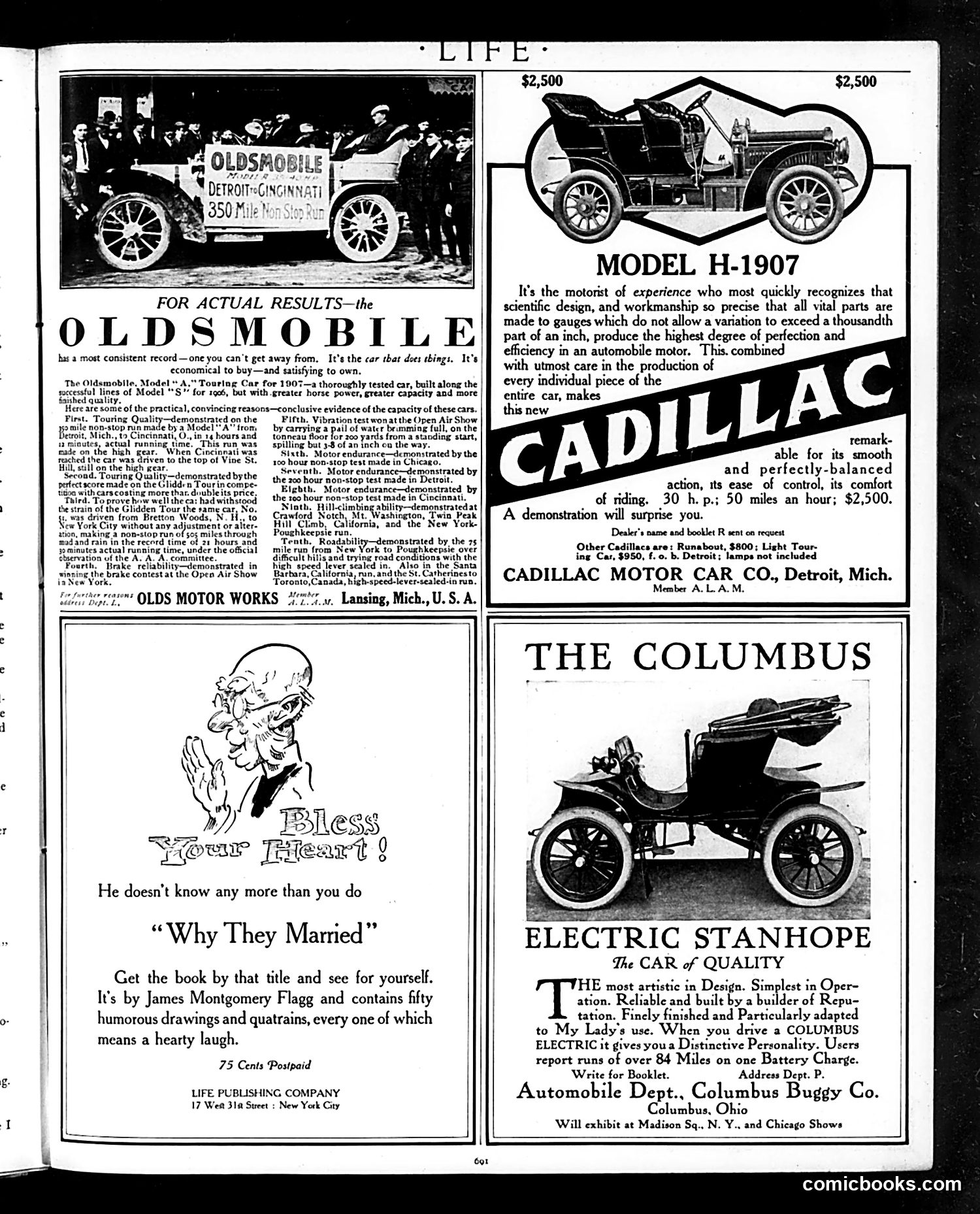
This page is primarily **automotive advertising** from the early 1900s, showcasing three competing car manufacturers competing for middle-to-upper-class buyers. **Main Content:** - **Oldsmobile** emphasizes durability through endurance tests (non-stop runs, vibration tests with water pails) - **Cadillac Model H-1907** ($2,500) stresses precision engineering and manufacturing standards - **Columbus Electric Stanhope** targets female drivers ("My Lady's use"), highlighting distinctive personality and 84-mile range **The Humor Section:** A small cartoon by James Montgomery Flagg promotes his book "Why They Married" with a simple gag: a man's face with text "Bless Your Heart! / He doesn't know any more than you do"—light domestic humor about marital ignorance, typical of early-20th-century magazine humor. **Historical Context:** These ads reflect an era when automobiles were luxury goods requiring extensive performance demonstrations to establish reliability and legitimacy as transportation. The emphasis on scientific measurement and precision manufacturing was novel marketing for industrial products.
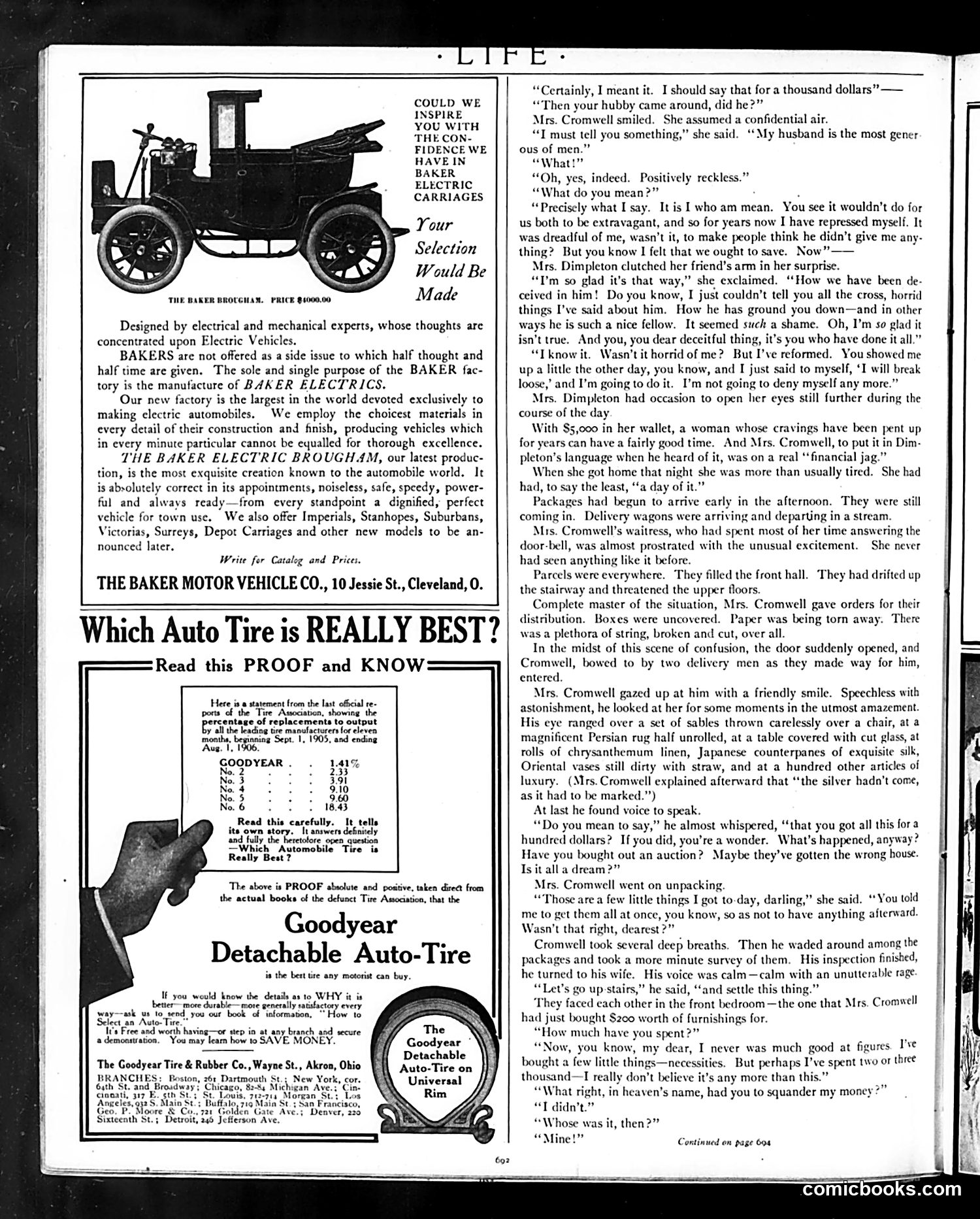
This page contains **primarily advertisements** for automobiles and auto tires, with a short fictional narrative excerpt interspersed. The ads promote the **Baker Electric Brougham** (an early electric automobile, priced at $4,000) and **Goodyear Detachable Auto-Tires**, using comparative data and appeals to quality and safety—typical early-1900s marketing. The narrative fragment depicts **Mrs. Cromwell and Mrs. Dimpleton**, society women discussing marital finances. The satire is genteel: Mrs. Cromwell has secretly been thrifty while allowing her husband to appear generous, cultivating a false reputation of his extravagance while she manages money. When discovered, Mrs. Dimpleton admits spreading rumors about the husband's stinginess. The joke targets **upper-class domestic deception** and gossip—a common theme in Life's satirical fiction of this era. No political figures or cartoon caricatures appear on this page.
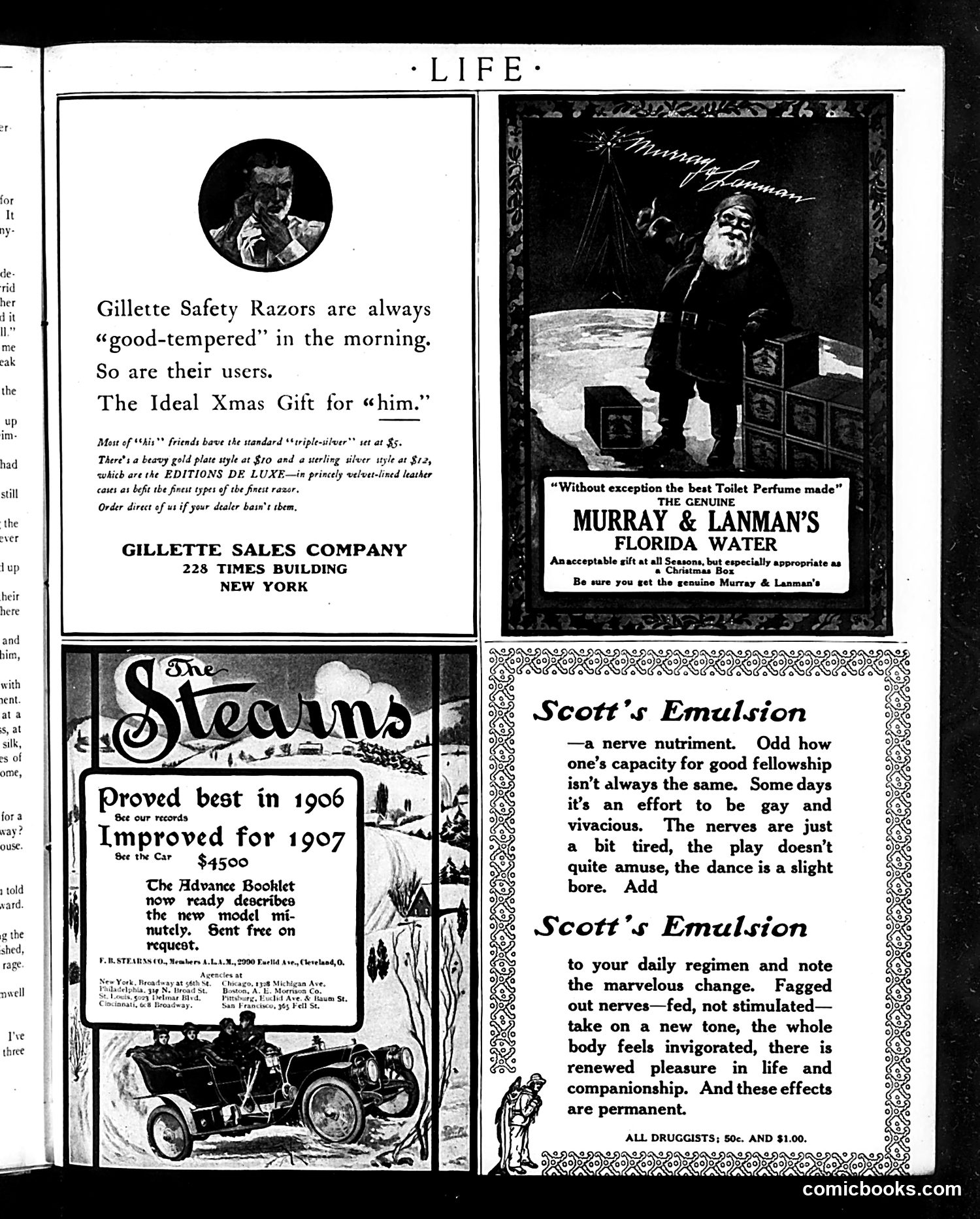
This is primarily an **advertising page**, not a satirical cartoon page. It contains four product advertisements typical of early 1900s magazines: 1. **Gillette Safety Razors** — positioned as an ideal Christmas gift for men, emphasizing quality with luxury leather cases and gold/silver options. 2. **Murray & Lanman's Florida Water** — a toilet perfume marketed as a Christmas gift, claiming to be "the best" made. 3. **Steams automobiles** — advertises a 1907 model with an "Advance Booklet," emphasizing improvements over 1906. 4. **Scott's Emulsion** — a nerve tonic/health supplement claiming to restore energy and social vitality to "fagged out nerves," suggesting it combats fatigue and restores enjoyment of social activities. The ads reflect early-20th-century consumer culture targeting affluent readers with luxury goods and patent medicines. Scott's Emulsion is particularly notable as representative of the era's unregulated health tonics marketed for vague ailments like "nerve fatigue."
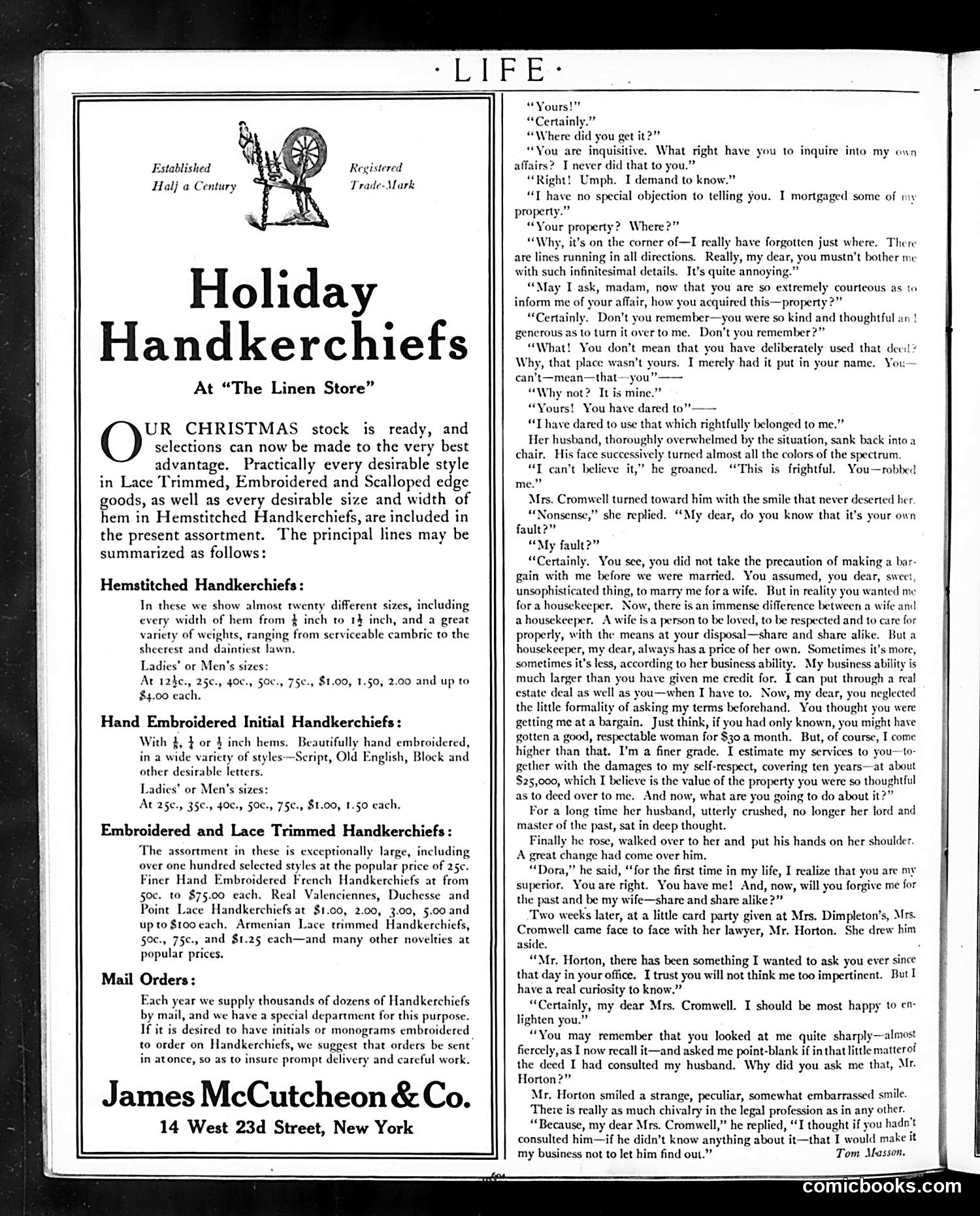
This page contains a **handkerchief advertisement** (left column) and the continuation of a **serialized short story** (right column) titled "Tom Mason" (byline visible at bottom). The story depicts a marital confrontation between Mr. and Mrs. Cromwell. Mrs. Cromwell has mortgaged property her husband had placed in her name without his permission. When confronted, she argues she had every right to do so—that the property became legitimately hers. She then pivots to a broader critique: her husband married her expecting a "wife" (implying romantic partnership and respect) but actually wanted a "housekeeper" (service and obedience). She suggests he failed to establish a "bargain" before marriage clarifying their respective roles and rights. **The satire targets** early-20th-century marriage law and gender dynamics. Women had limited legal control of property; husbands typically managed assets. The story appears to champion a wife's assertion of financial autonomy and equal partnership, using her "theft" as a vehicle to expose the implicit power imbalance in traditional marriage contracts. The humor derives from her unapologetic inversion of expected deference.
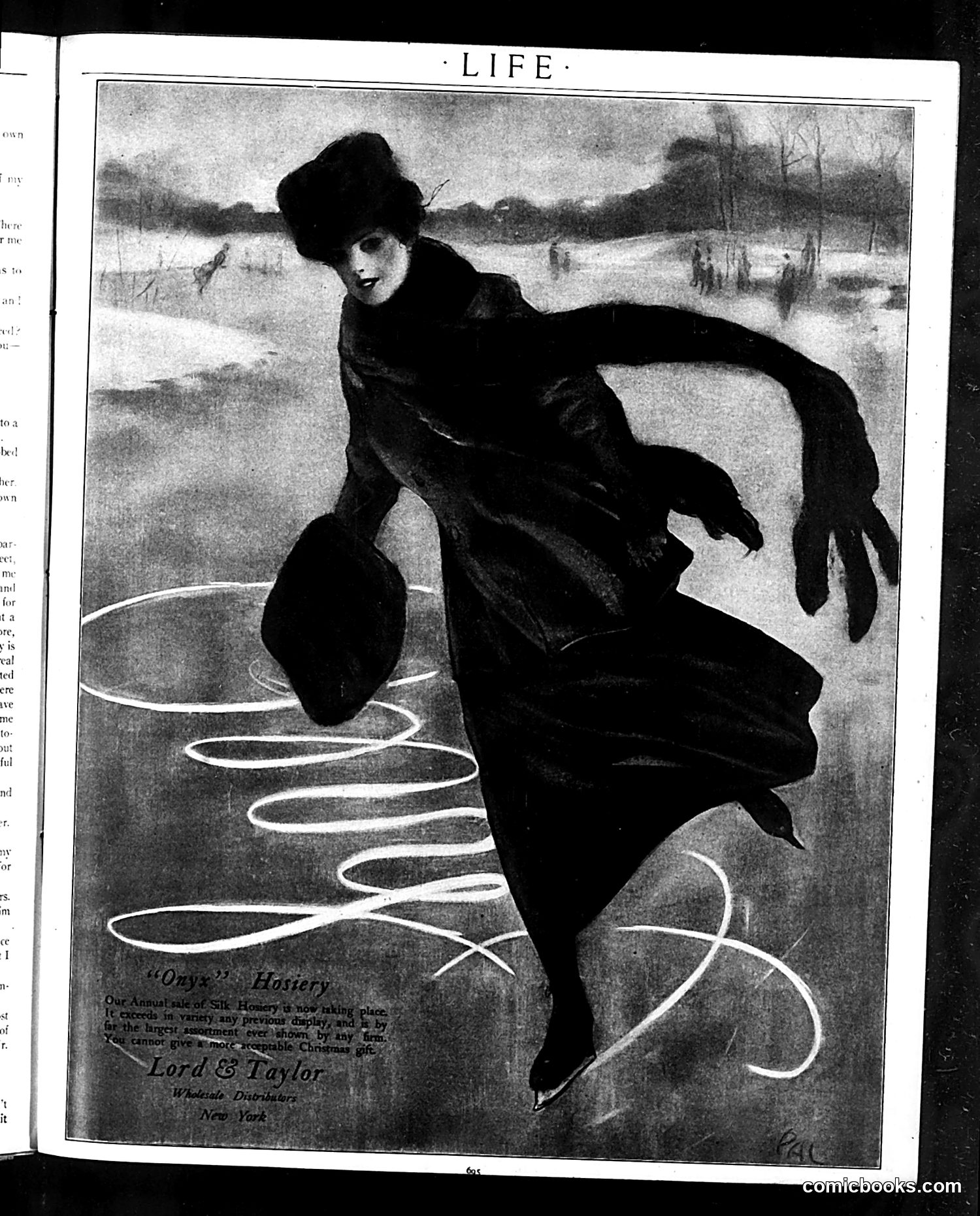
This page features an illustration titled "Winter's Hostelry" credited to Lord & Taylor, wholesale distributors. The image depicts a woman in dark winter clothing (hat, coat) ice skating on what appears to be a frozen pond or stream, with a winter landscape in the background. The illustration appears to be **advertising winter fashions** rather than political satire. The decorative white lines suggest flowing fabric or artistic stylization of her clothing. The text mentions "Our Annual sale is now taking place" and references Lord & Taylor's wholesale distribution. This is primarily a **fashion advertisement** using seasonal imagery to promote winter wear, not a political cartoon or social commentary. It's representative of Life magazine's mixed content of humor, satire, and commercial advertising.
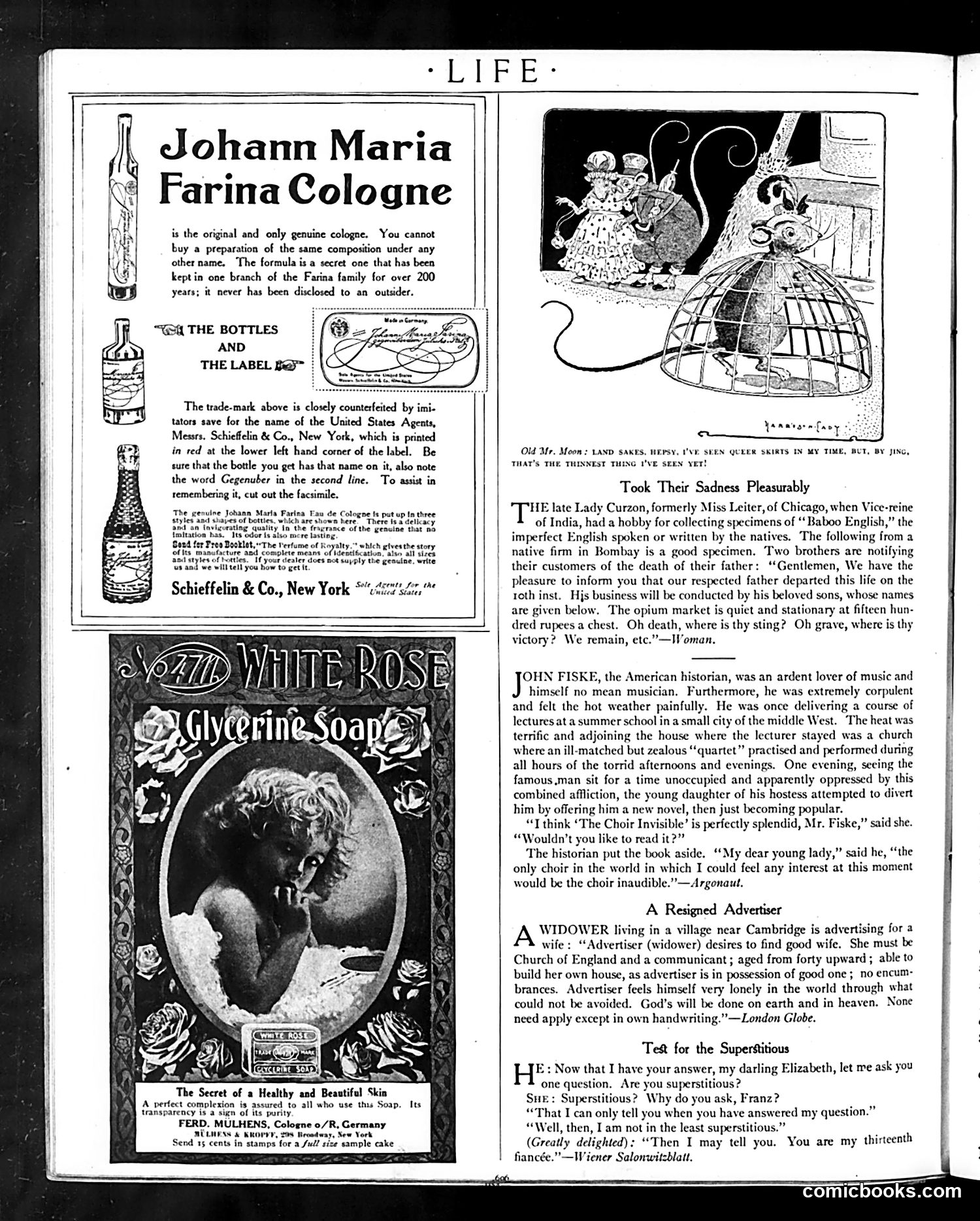
This page mixes **advertisements with satirical anecdotal humor**, typical of Life's format. The main advertisements promote **Johann Maria Farina Cologne** (emphasizing authenticity against counterfeits) and **White Rose Glycerine Soap**. The satirical stories mock social absurdities: 1. **"Old Mr. Moon"** cartoon: An elderly rural man comments on women's increasingly scanty skirts—satirizing changing fashion standards and generational shock. 2. **Lady Curzon anecdote**: Mocks the broken English ("Baboo English") of Indian natives writing business letters—combining comic misspellings with unexpectedly poignant phrasing about death and mortality. 3. **John Fiske story**: The corpulent historian, suffering in summer heat while enduring a poorly-practiced church choir nearby, rejects a novel titled "The Choir Invisible," preferring an actual "choir inaudible" (silence)—satire on both physical discomfort and literary pretension. 4. **"Resigned Advertiser"**: A widower's marriage advertisement listing practical requirements—satirizing both loneliness and Victorian propriety in matrimonial seeking. The humor relies on incongruity, understated wit, and social observation typical of early 20th-century American satire.
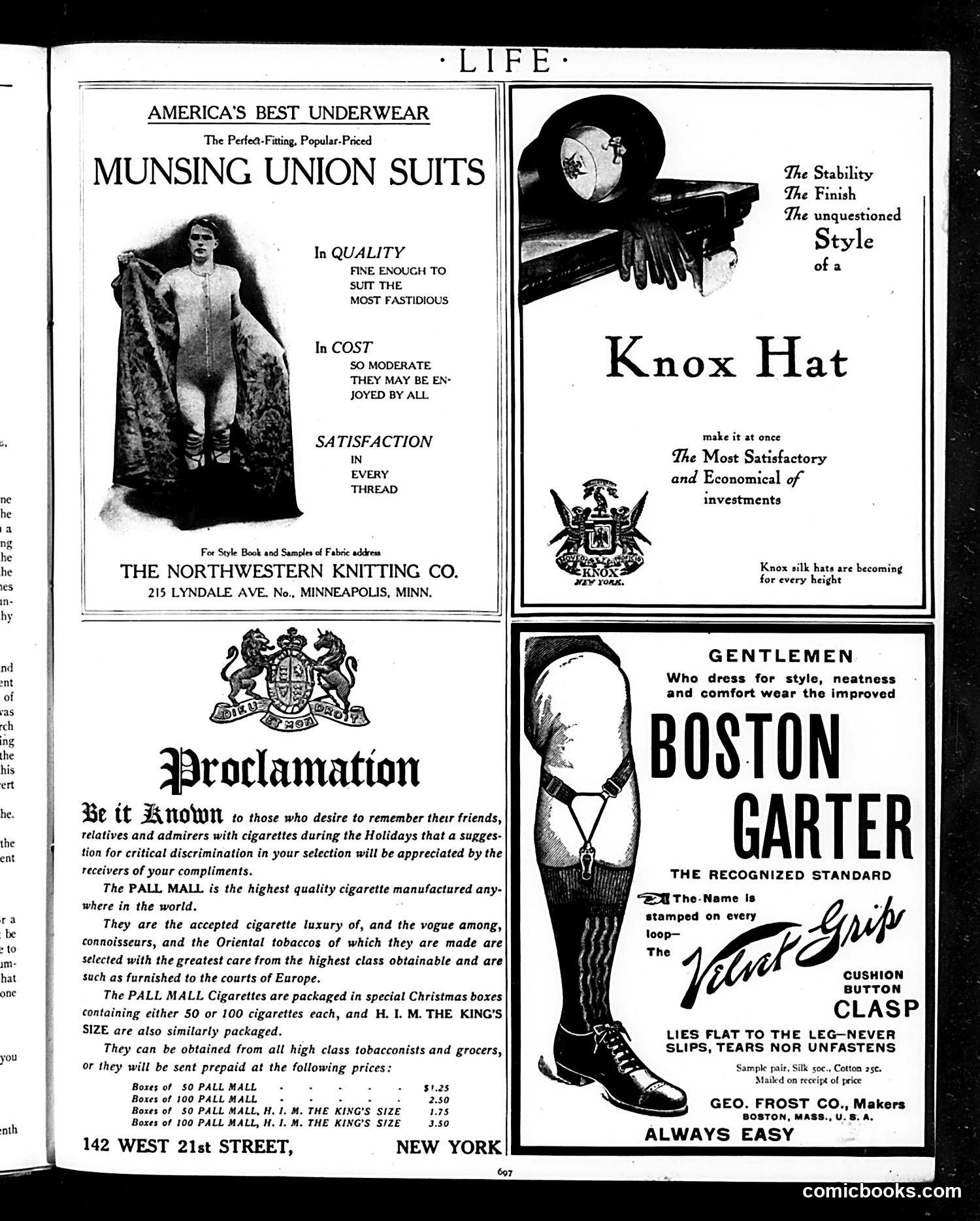
This page is **primarily advertising**, not satire or political commentary. It contains four separate ads from the early 20th century: 1. **Munsing Union Suits** — underwear marketed as affordable quality for all classes 2. **Pall Mall Cigarettes** — positioned as luxury goods, referencing "H.I.M. THE KING'S SIZE" and European court standards to appeal to aspirational consumers 3. **Knox Hat** — emphasizing style and economic value 4. **Boston Garter** — men's garter with a detailed product illustration The only element approaching satire is the Pall Mall "Proclamation," which uses mock-formal language and royal imagery to humorously elevate cigarettes as premium gift-giving for the holidays. The phrasing about "critical discrimination in your selection" gently mocks snobbish consumer habits while promoting the product as genuinely superior. The overall page reflects early 20th-century marketing strategies: associating products with European sophistication, class aspiration, and careful craftsmanship to justify premium pricing to middle and upper-class readers.
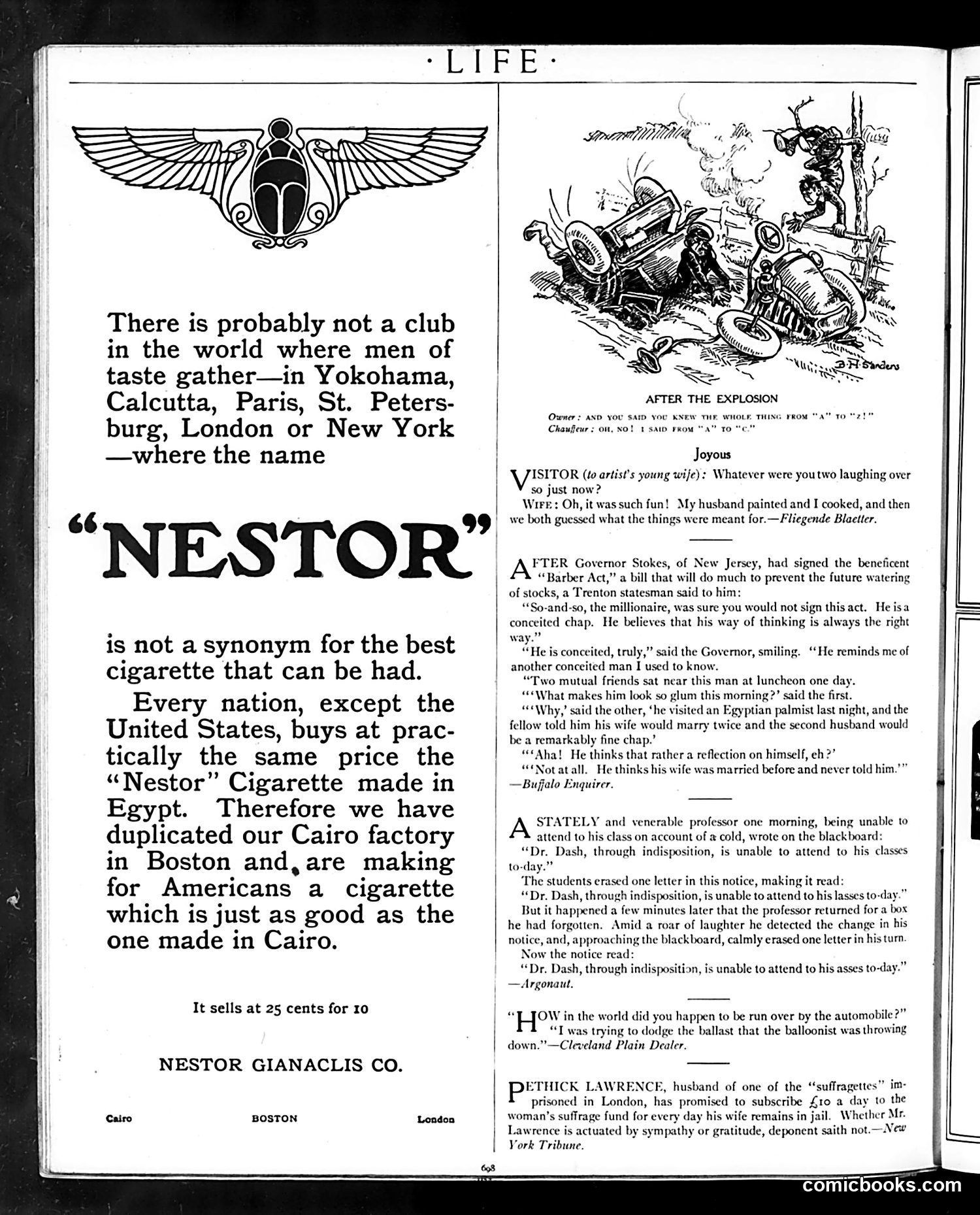
This page is primarily **advertising and humor content**, not political cartooning. The dominant feature is a **Nestor Cigarette advertisement** claiming their Egyptian-made product is superior and now manufactured in Boston. The ad emphasizes international prestige and quality. The cartoon titled "After the Explosion" shows a chauffeur and owner discussing a car accident, with wordplay about the chauffeur knowing only "A to C" of driving rather than the full alphabet. The remaining content consists of **brief humorous anecdotes** from various sources: a couple's domestic painting/cooking game, a governor's story about a conceited man's wife remarrying, a professor's notice where students change "classes" to "lasses" (and he retaliates by changing it to "asses"), a balloon accident joke, and a note about British suffragette Pethick Lawrence's financial support for his imprisoned wife. These are lighthearted social humor pieces typical of early 20th-century satirical magazines—no serious political satire is present on this page.
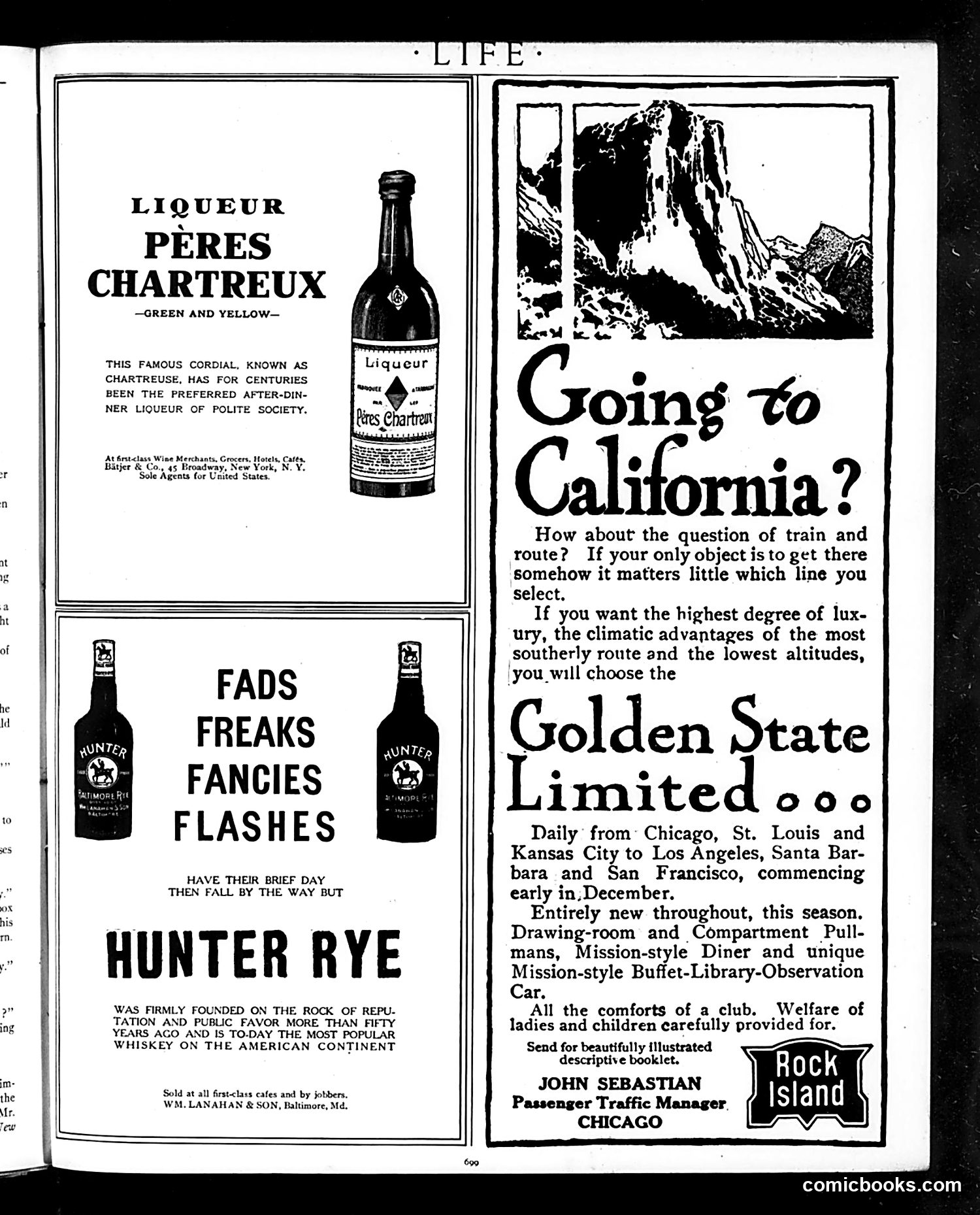
This page is primarily **advertising**, not satire or political content. It contains four commercial advertisements from what appears to be an early 20th-century Life magazine: 1. **Liqueur Pères Chartreux** — promoting a French cordial as a refined after-dinner drink for "polite society" 2. **Hunter Rye Whiskey** — contrasting itself against passing "fads, freaks, fancies, flashes," claiming 50+ years of established reputation and popularity 3. **Golden State Limited train** — advertising a luxury railway service from midwest cities to California, emphasizing comfort, climate, and amenities like Mission-style dining and observation cars The Hunter Rye ad contains the only satirical element: mocking trendy, short-lived consumer preferences while positioning the whiskey as timelessly reliable. The other ads simply promote luxury goods and travel to affluent readers. No political figures or specific events are referenced.
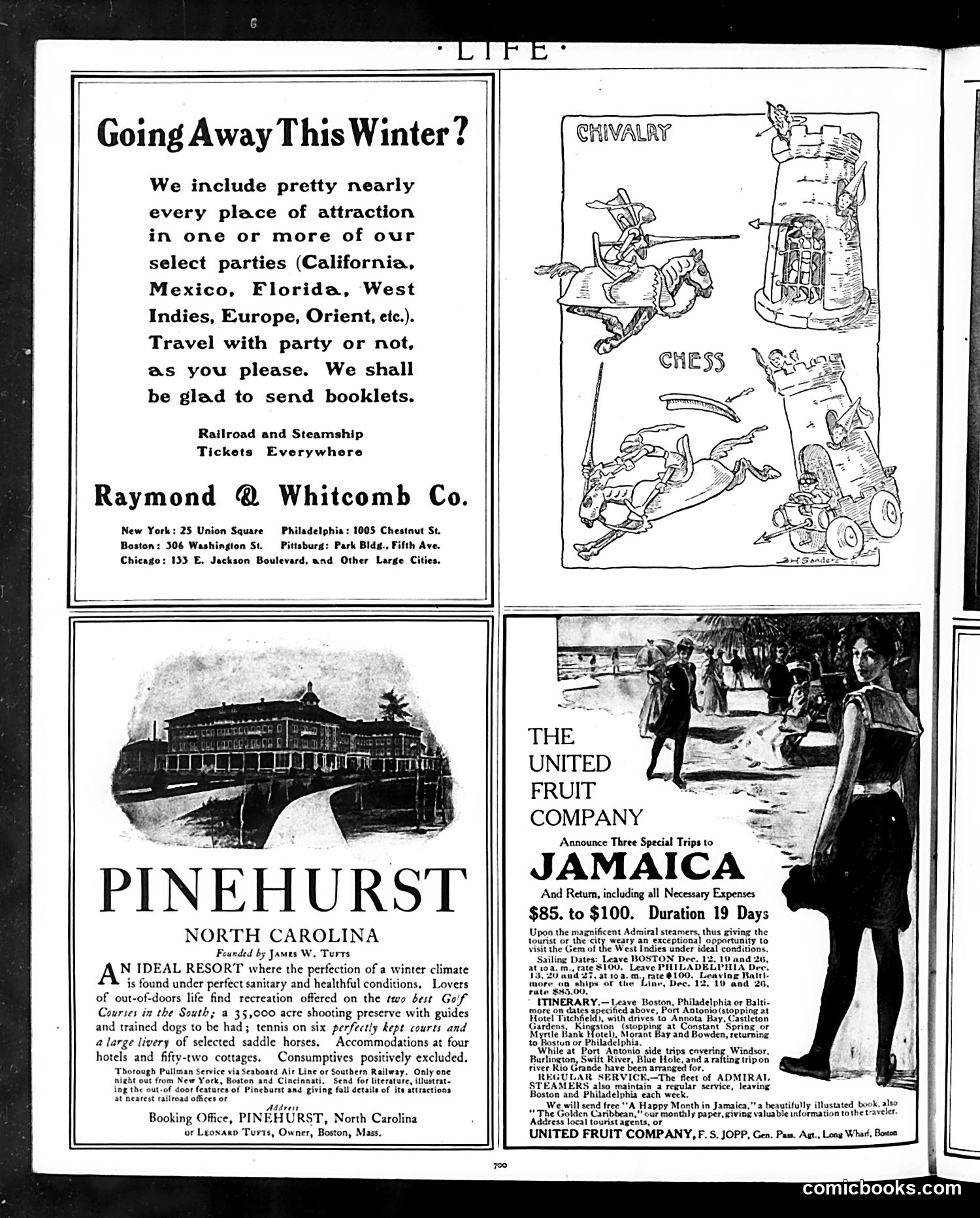
This page contains **travel advertisements**, not political satire. It presents four winter vacation offerings from early 20th-century American travel companies: 1. **Raymond & Whitcomb Co.** advertises organized tours to California, Mexico, Florida, the West Indies, Europe, and the Orient. 2. **Pinehurst, North Carolina** promotes itself as an exclusive winter resort with golf, hunting, and tennis—notably excluding "consumptives" (tuberculosis patients), reflecting the era's segregation of the sick. 3. **The United Fruit Company** offers Jamaica cruises on Admiral steamers for $85-$100, lasting 19 days, departing from Boston, Philadelphia, and Baltimore. 4. A decorative **chess/game illustration** titled "Chivalry" appears unrelated to the ads. The cartoons shown (Chivalry and Chess) are decorative filler, not commentary. This page reflects turn-of-the-century leisure culture aimed at wealthy Americans seeking winter escapes.
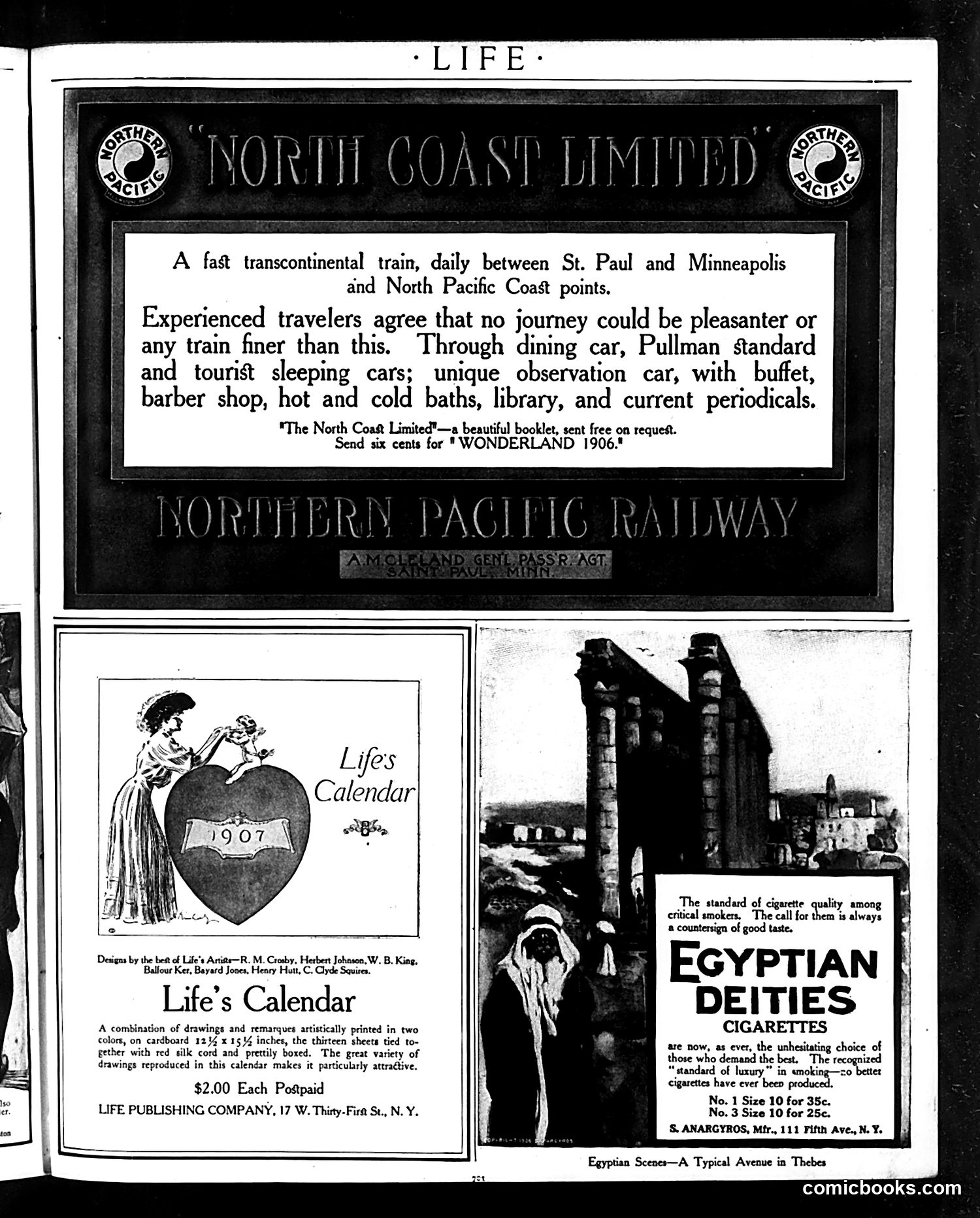
This is primarily an **advertising page** rather than satirical content. It contains three distinct ads: 1. **North Coast Limited train** (top): Promotes a transcontinental railroad service with luxury amenities (dining cars, Pullman sleepers, observation car with barber shop and library). This reflects early 1900s American fascination with rail travel as both practical transportation and leisure experience. 2. **Life's Calendar** (bottom left): A 1907 desk calendar featuring artistic drawings by prominent Life illustrators. The heart-shaped design with a classical female figure reflects the decorative, romantic aesthetic popular in Edwardian design. 3. **Egyptian Deities Cigarettes** (bottom right): Shows Egyptian architectural ruins and markets the product as a "standard of luxury" for "critical smokers." This reflects contemporary Orientalism and exoticism marketing common in the era—exotic imagery used to sell consumer goods. The page demonstrates early 1900s advertising targeting affluent travelers and cultured consumers, with emphasis on luxury, refinement, and exotic appeal.
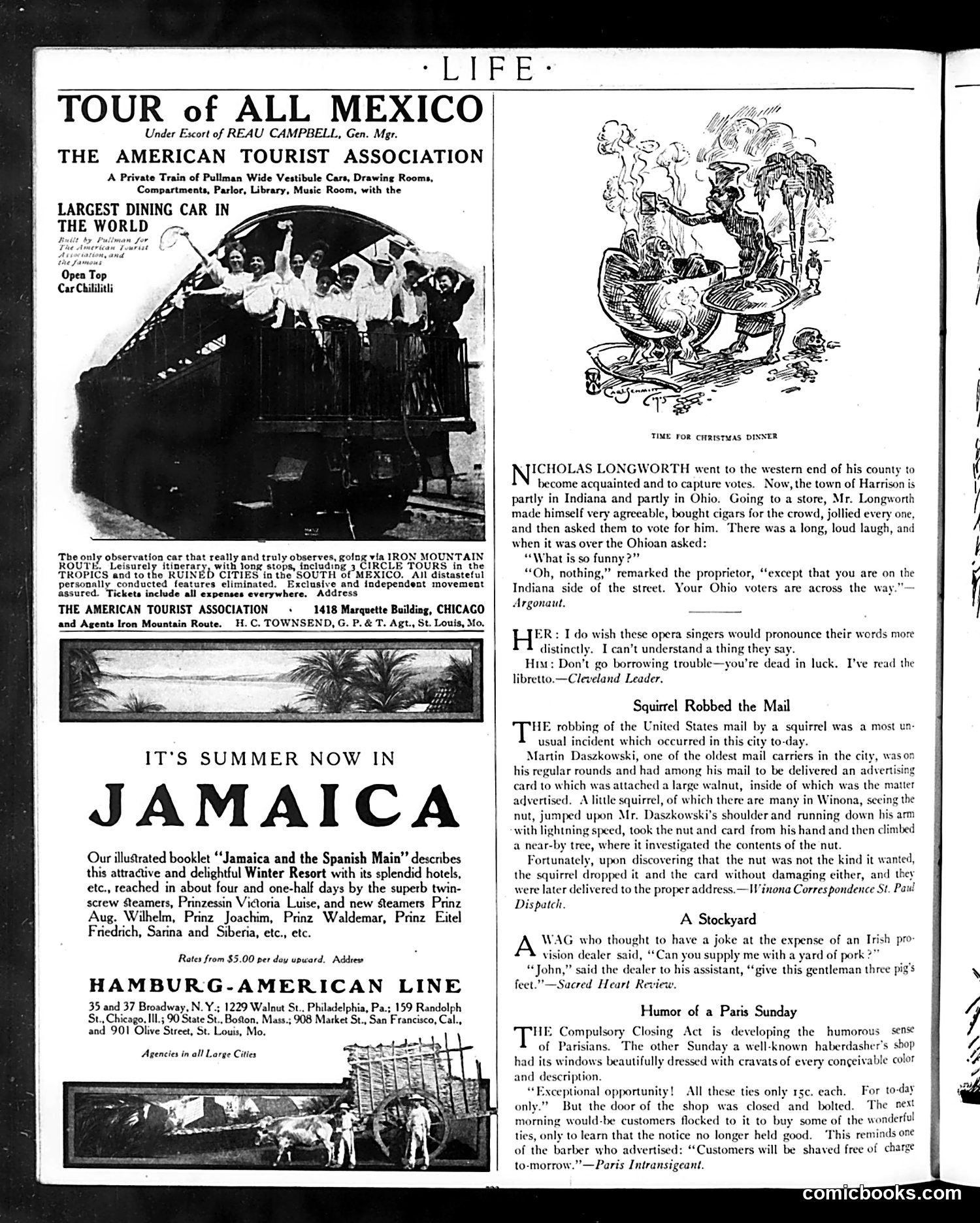
This page is primarily **advertising** for travel and cruise lines, with several brief humorous anecdotes interspersed. The main cartoon/story concerns **Nicholas Longworth**, a real Ohio politician seeking votes. The joke relies on a geographical quirk: while campaigning in Harrison (straddling the Indiana-Ohio border), Longworth charms voters on the *Indiana* side of the street, then asks why everyone laughed. The proprietor reveals the punchline—Longworth's potential voters are across the street in *Ohio*, making his efforts futile. The humor mocks Longworth's obliviousness and poor political strategy. Other brief items include complaints about opera singers' diction, an anecdote about a squirrel stealing mail, and wordplay about Irish provision dealers. These are light, apolitical satires typical of *Life* magazine's humor—focused on everyday absurdities rather than serious social commentary. The page reflects early 20th-century American leisure and travel culture.
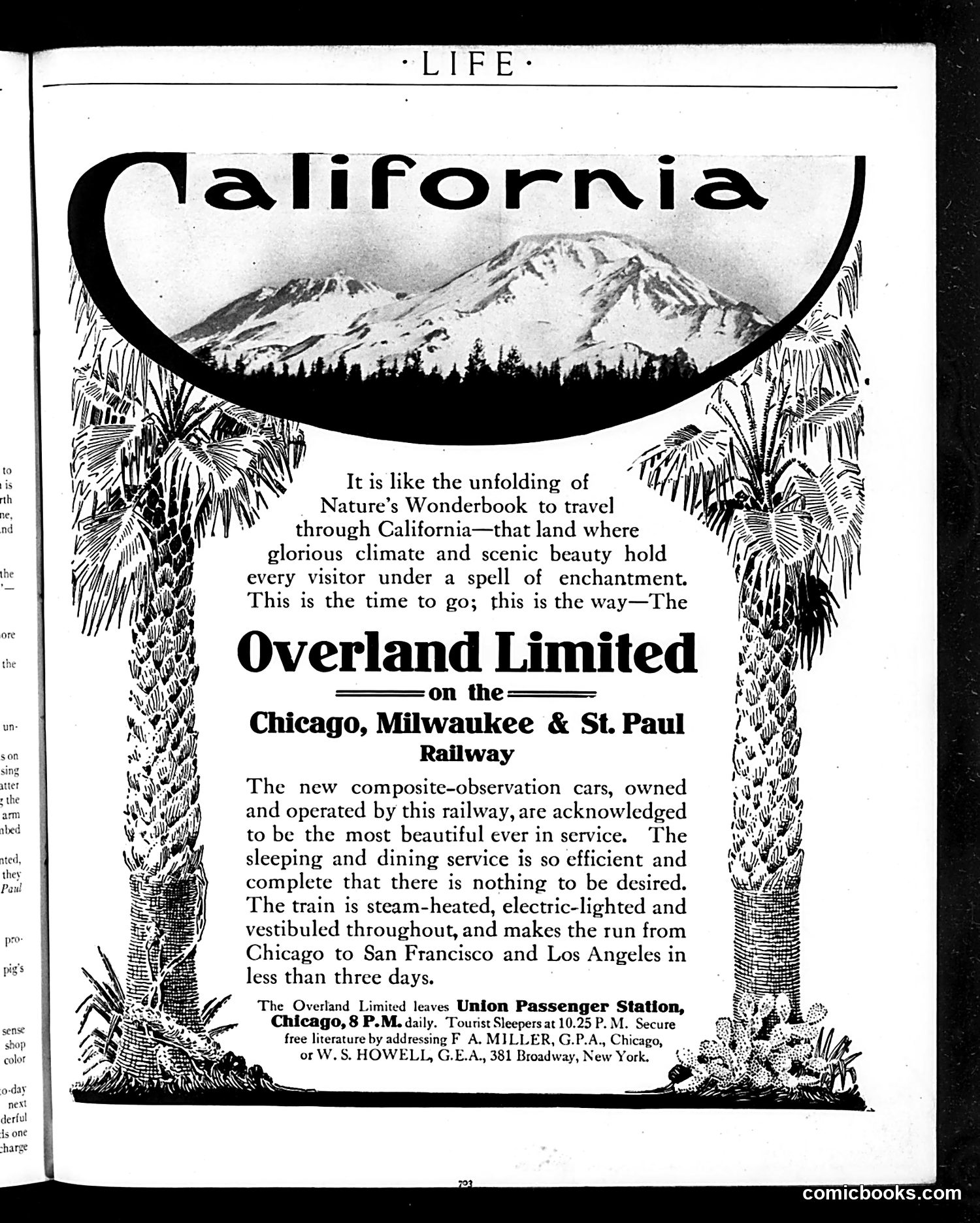
This page is **not a cartoon or satire**—it's a straightforward advertisement for the Overland Limited train service, published in *Life* magazine. The ad promotes the Chicago, Milwaukee & St. Paul Railway's passenger train running to California. It uses romantic, evocative language ("Nature's Wonderbook," "spell of enchantment") typical of early 20th-century travel marketing to appeal to leisure travelers seeking California's scenery and climate. The decorative border features palm trees framing a snow-capped mountain (likely Mount Shasta), emphasizing California's natural attractions. The copy emphasizes the train's modern amenities: observation cars, sleeping/dining service, steam heating, electric lighting, and speed (under three days Chicago to San Francisco/Los Angeles). For modern readers: this represents pre-automobile era vacation advertising, when transcontinental rail travel was a luxury experience marketed to affluent Americans. There is no political commentary or satirical intent on this particular page.
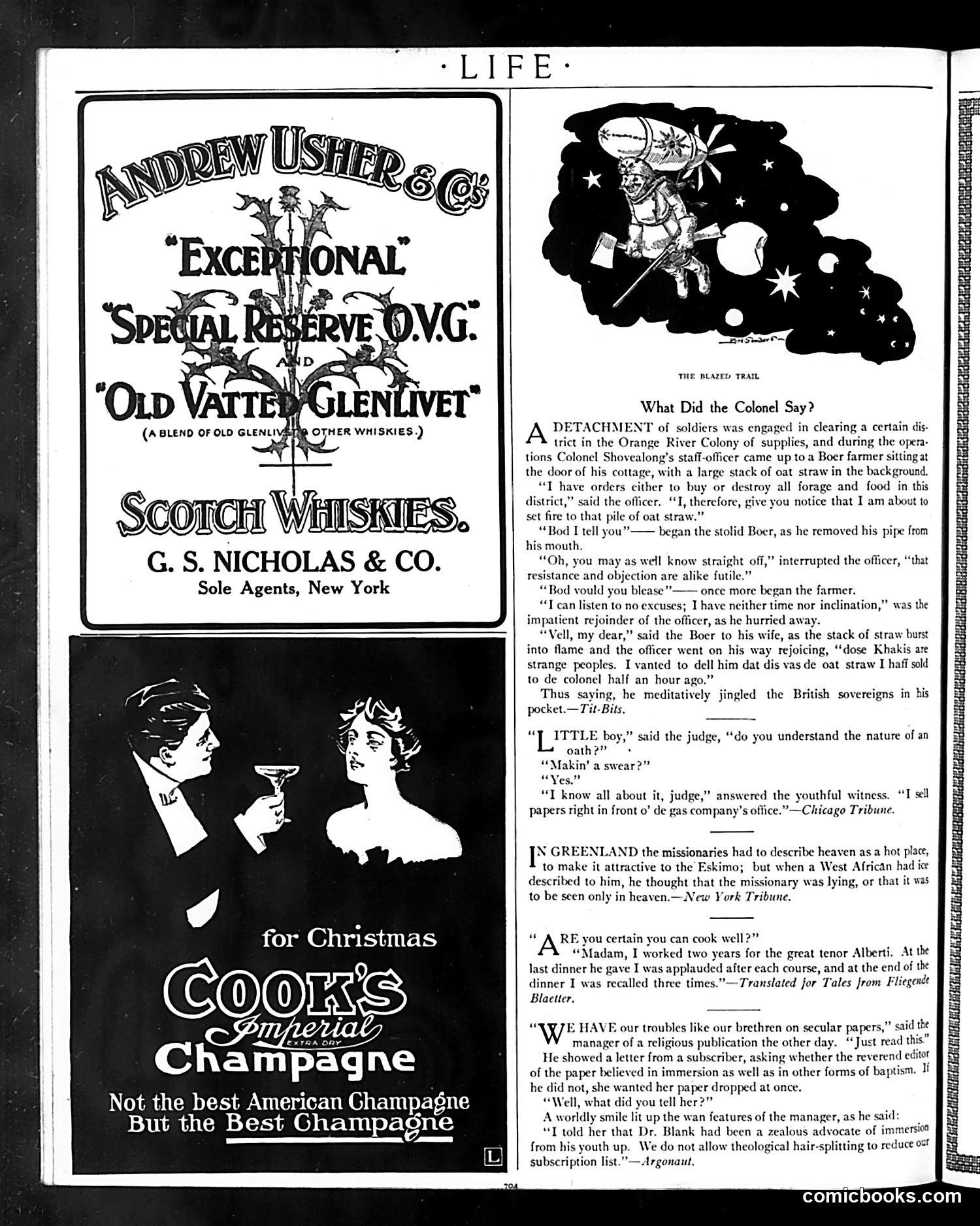
This page from *Life* contains several humorous anecdotes rather than political cartoons. **"The Blazed Trail"** satirizes British military incompetence during the Boer War (South African conflict, 1899-1902). A British officer orders a colonial soldier to burn a Boer farmer's oat straw as forage destruction, ignoring the farmer's attempts to speak. The joke: the farmer had already *sold* that straw to the British colonel an hour earlier. The officer destroys British property while thinking he's denying supplies to the enemy—illustrating military bureaucratic stupidity and the Boer farmer's cleverness in profiting from occupying forces. The other brief anecdotes mock: - A street urchin's cynical understanding of oaths - Missionary misunderstandings across cultures - A cook's dubious credentials - Religious publication hypocrisy about doctrine versus subscriptions The page is primarily **humorous commentary** on human folly—military, social, and institutional—rather than partisan political satire.
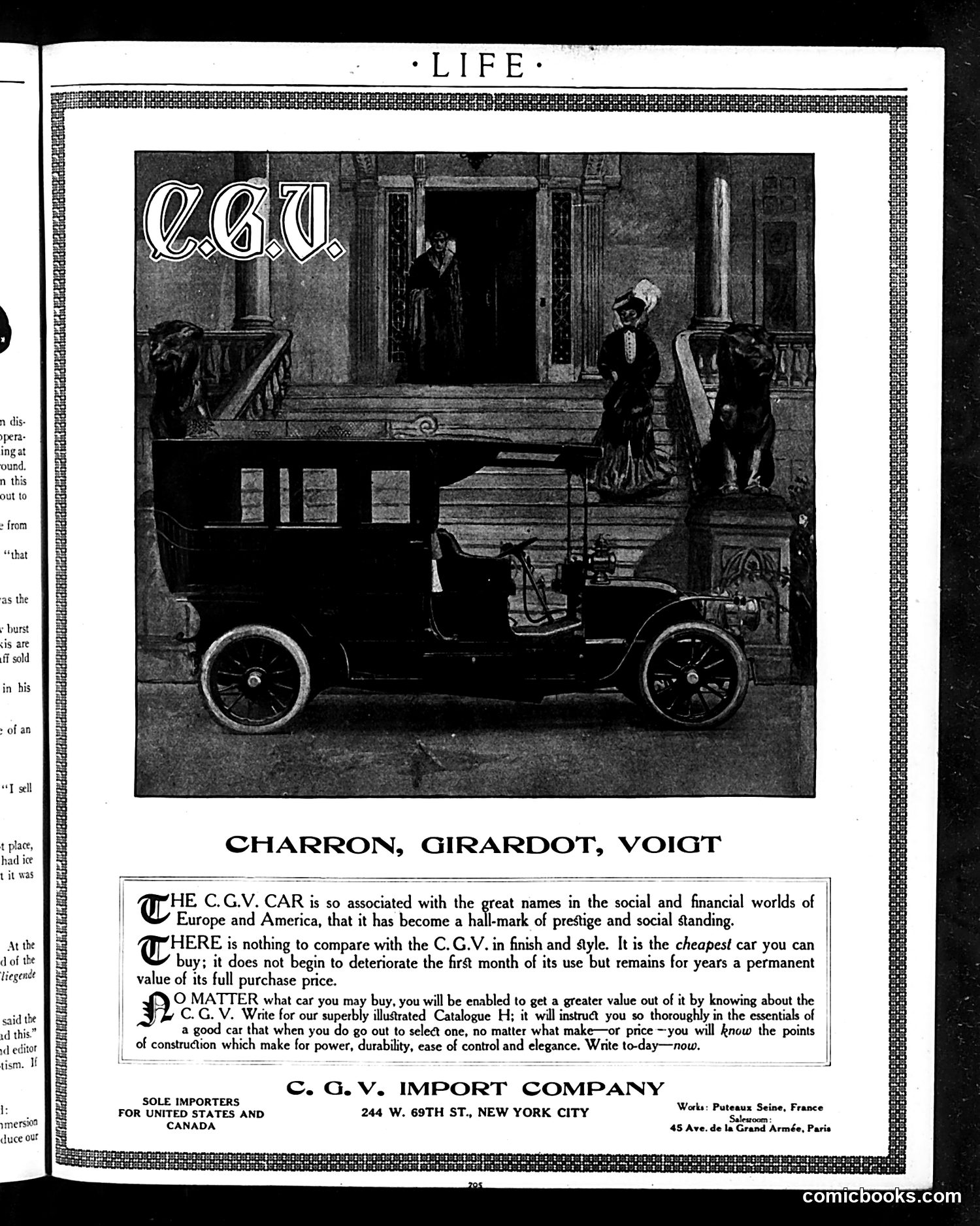
This is not a political cartoon but a **luxury automobile advertisement** for the C.G.V. (Charron, Girardot, Voigt), a French car being imported to America. The image shows an elegant early 1900s motorcar parked before a grand European mansion, with well-dressed figures nearby—establishing the vehicle's association with wealth and prestige. The advertisement's text emphasizes that the C.G.V. is "a hall-mark of prestige and social standing" among "great names in the social and financial worlds." The pitch claims it's simultaneously the cheapest quality car available while maintaining permanent value—a classic advertising paradox meant to appeal to affluent American buyers seeking European sophistication without excessive expense. The ad promotes requesting a detailed catalogue to educate potential buyers on automotive quality. This reflects early 1900s marketing targeting the American wealthy class's aspirations toward European culture and status symbols.
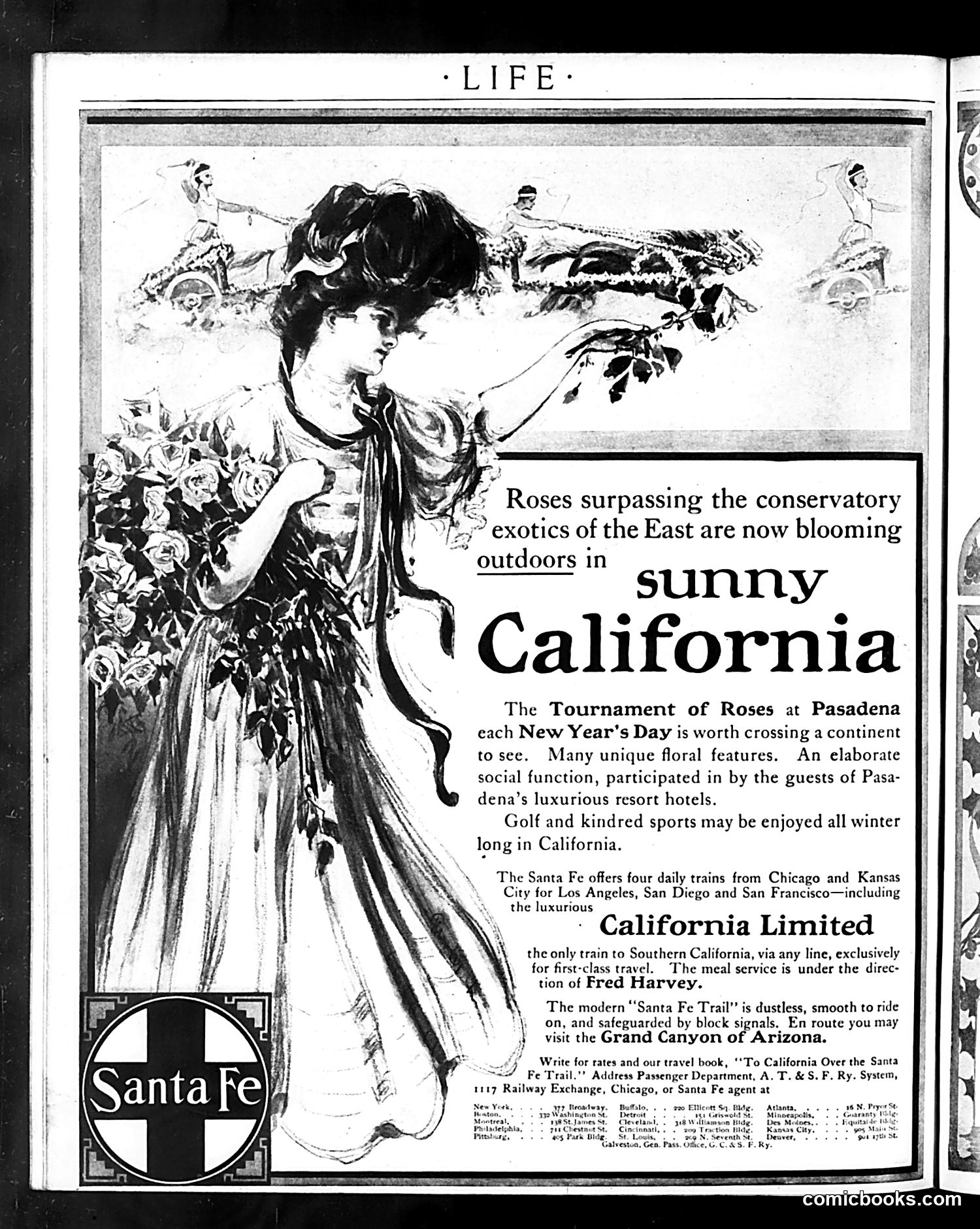
This page is primarily a **Santa Fe Railway advertisement**, not a political cartoon. The illustration depicts an idealized, classically-styled woman in flowing robes holding blooming roses and gesturing toward a scene of rose gardens and carriages in the background. The imagery is decorative and romantic rather than satirical. The ad promotes California travel—specifically the Tournament of Roses in Pasadena on New Year's Day—as an exotic destination accessible via Santa Fe's "California Limited" train. It emphasizes leisure activities (golf, sightseeing at the Grand Canyon) and luxury accommodations. There is **no apparent satire or political content**. This is straightforward early-20th-century travel marketing using romantic, classical female imagery to associate California with beauty, exoticism, and refined leisure—common advertising tropes of the era. The "Life" magazine context suggests it appeared alongside satirical content, but this particular page is commercial promotion.
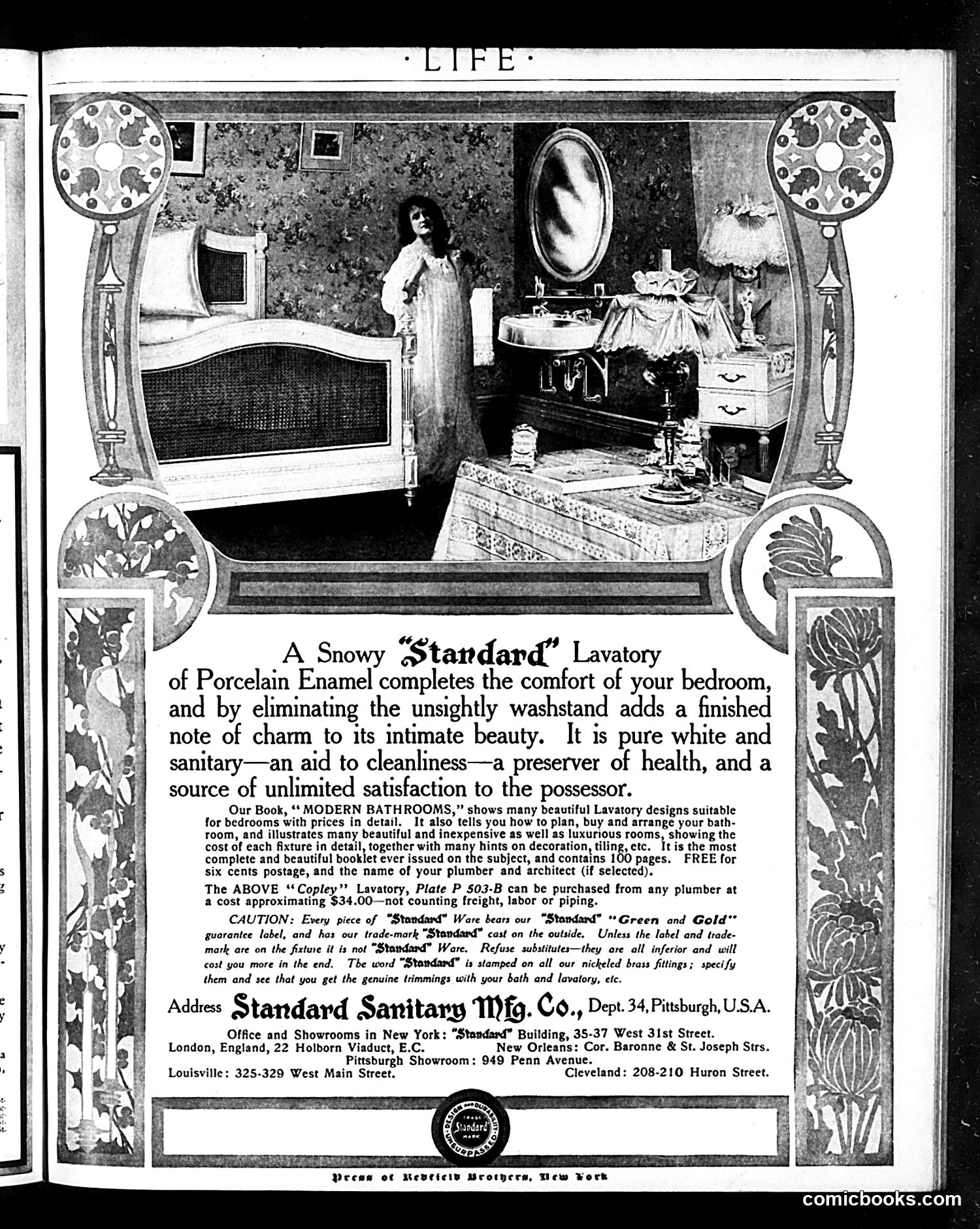
This is a **full-page advertisement**, not a cartoon or satirical content. It appears in *Life* magazine promoting Standard Sanitary Manufacturing Company's bathroom fixtures. # The Content The ad shows a bedroom with modern porcelain enamel lavatory (sink) and describes it as bringing "charm" and "cleanliness" to intimate spaces. The text emphasizes the product's sanitary benefits and aesthetic appeal—replacing unsightly traditional washstands. # Why It Matters to Modern Readers This reflects early 20th-century attitudes about indoor plumbing as a **luxury and status symbol**. The emphasis on cleanliness as "health" and the detailed pricing ($34 plus installation) show that modern bathrooms were still aspirational purchases for many households. The ornate decorative borders and detailed product warnings against counterfeits indicate an era when branded sanitary fixtures represented progress and respectability.
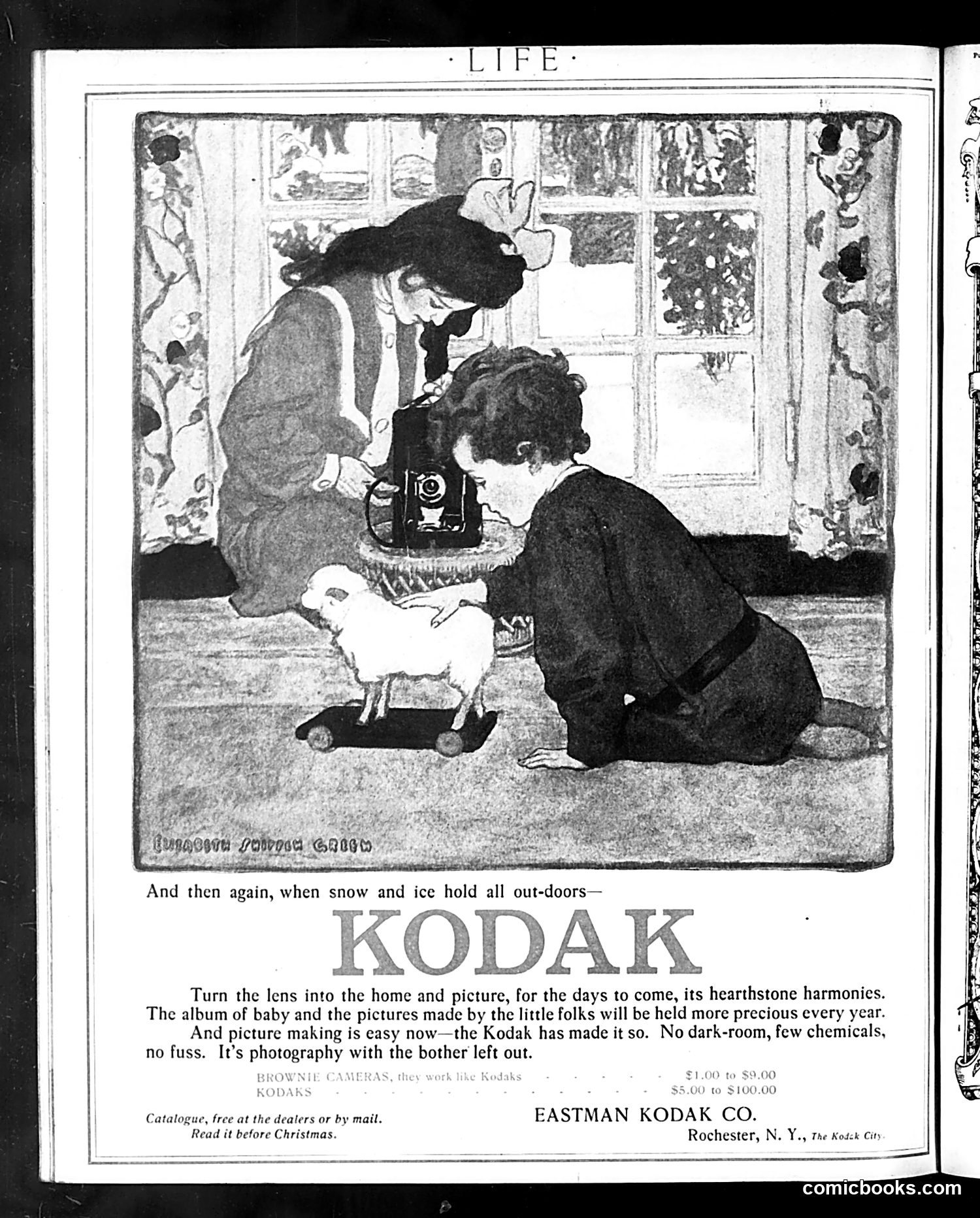
This is primarily a **Kodak camera advertisement**, not political satire. The image shows an indoor winter scene: a woman and child on the floor photographing a toy sheep with a Kodak camera, while another figure operates what appears to be a larger camera by a window. The "joke" or appeal is **not satirical but commercial**: the ad suggests that modern Kodak cameras make photography so easy that even children can use them indoors without darkrooms or chemicals. The tagline emphasizes capturing precious family moments—"hearthstone harmonies"—for posterity, positioning the camera as essential to domestic life. The message targets **holiday gift-giving** ("Read it before Christmas"), promoting cameras as affordable ($1-$100) and user-friendly alternatives to traditional photography's complexity. There is no political commentary visible—this is straightforward early-20th-century advertising copy.