
Life, 1906-12-06 · page 24 of 64
Life — December 6, 1906 — page 24: what you’re looking at
What you’re looking at
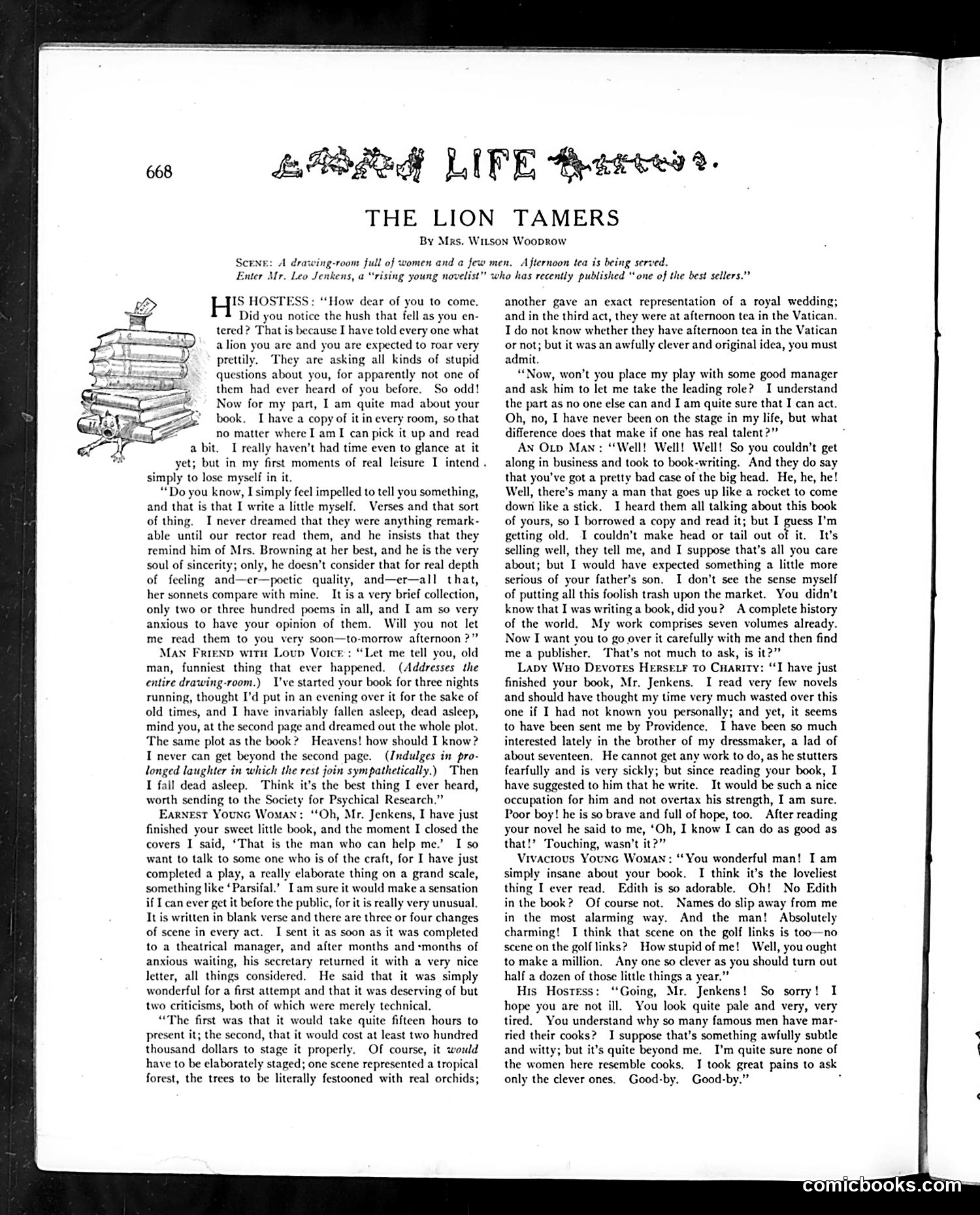
This is a satirical play about social pretension and the veneration of celebrity authors. Mr. Leo Jenkens is a "rising young novelist" invited to afternoon tea, where he becomes the object of fawning attention from status-conscious socialites. The satire targets: 1. **Fake literary enthusiasm**: The hostess claims to keep his book in every room yet admits she hasn't read it, only meaning to "lose herself in it" eventually. 2. **Amateur writers seeking validation**: Multiple guests pester Jenkens with their own mediocre creative work—one woman reads poetry she claims rivals Elizabeth Barrett Browning; another describes an absurdly impractical play requiring fifteen hours and $200,000 to stage. 3. **Insincere flattery**: A man admits he fell asleep on page two but praises the book as psychologically fascinating. The humor lies in showing how celebrity writers attract parasitic social climbers and wannabe artists rather than genuine readers—a timeless critique of literary culture and social climbing.
📄 Transcribed text from this page (OCR, searchable)
Machine-transcribed from the original scan — historical spelling and the odd misread are preserved.
LA SH LUPE Bearces 2. THE LION TAMERS By Mrs. Witson Wooprow ScENE: A drawing-room full of women and a few men. Afternoon tea is being served. Enter Mr. Leo Jenkens, a “rising young novelist IS HOSTE: “How dear of you to come. Did you notice the hush that fell as you en- tered? That is because I have told every one what alion you are and you are expected to roar very prettily, They are asking all kinds of stupid questions about you, for apparently not one of them had ever heard of you before. So odd! Now for my part, I am quite mad about your book. I have a copy of it in every room, so that no matter where I am I can pick it up and read a bit. I really haven’t had time even to glance at it yet; but in my first moments of real leisure I intend . simply to lose myself in it. “Do you know, I simply feel impelled to tell you something, and that is that I write a little my: Verses and that sort of thing. I never dreamed that they were anything remark- able until our rector read them, and he insists that they remind him of Mrs. Browning at her best, and he is the very soul of sincerity; only, he doesn’t consider that for real depth of feeling and—er—poctic quality, and—er—all that, her sonnets compare with mine. It isa very brief collection, only two or three hundred poems in all, and I am so very anxious to have your opinion of them. Will you not let me read them to you very soon—to-morrow afternoon ?” Man Frienp wit Loup Voice: “Let me tell you, old man, funniest thing that ever happened. (Addresses the entire drawing-room.) I've started your book for three nights running, thought I’d put in an evening over it for the sake of old times, and I have invariably fallen asleep, dead asleep, mind you, at the second page and dreamed out the whole plot. The same plot as the book? Heavens! how should I know? I never can get beyond the second page. (Indulges in pro- longed laughter in which the rest join sympathetically.) Then I fall dead asleep. Think it’s the best thing I ever heard, worth sending to the Society for Psychical Research.” Earnest Younc Woman: “Oh, Mr. Jenkens, I have just finished your sweet little book, and the moment I closed the covers I said, ‘That is the man who can help me.’ I so want to talk to some one who is of the craft, for I have just completed a play, a really elaborate thing on a grand scale, something like ‘Parsifal.’ Iam sure it would make a sensation if I can ever get it before the public, for it is really very unusual. It is written in blank verse and there are three or four changes of scene in every act. I sent it as soon as it was completed to a theatrical manager, and after months and+months of anxious waiting, his secretary returned it with a very nice letter, all things considered. He said that it was simply wonderful for a first attempt and that it was deserving of but two criticisms, both of which were merely technical. “The first was that it would take quite fifteen hours to present it; the second, that it would cost at least two hundred thousand dollars to stage it properly. Of course, it would have to be elaborately staged; one scene represented a tropical forest, the trees to be literally festooned with real orchids; ho has recently published “one of the best sellers.” another gave an exact representation of a royal wedding; and in the third act, they were at afternoon tea in the Vatican. I do not know whether they have afternoon tea in the Vatican or not; but it was an awfully clever and original idea, you must admit. “Now, won’t you place my play with some good manager and ask him to let me take the leading role? I understand the part as no one else can and I am quite sure that I can act. Oh, no, I have never been on the stage in my life, but what difference does that make if one has real talent?” An Otp Man: ‘Well! Well! Well! So you couldn’t get along in business and took to book-writing. And they do say that you’ve got a pretty bad case of the big head. He, he, he! Well, there’s many a man that goes up like a rocket to come down like a stick. I heard them all talking about this book of yours, so I borrowed a copy and read it; but I guess I’m getting old. I couldn’t make head or tail out of it. It’s selling well, they tell me, and I suppose that’s all you care about; but I would have expected something a little more serious of your father’s son. I don’t see the sense myself of putting all this foolish trash upon the market. You didn’t know that I was writing a book, did you? A complete history of the world. My work comprises seven volumes already. Now I want you to go over it carefully with me and then find me a publisher. That’s not much to ask, is it?” Lavy Wuo Devotes Hersetr To Cuarity: “I have just finished your book, Mr. Jenkens. I read very few novels and should have thought my time very much wasted over this one if I had not known you personally; and yet, it seems to have been sent me by Providence. I have been so much interested lately in the brother of my dressmaker, a lad of about seventeen. He cannot get any work to do, as he stutters. fearfully and is very sickly; but since reading your book, I have suggested to him that he write. It would be such a nice occupation for him and not overtax his strength, I am sure. Poor boy! he is so brave and full of hope, too, After reading your novel he said to me, ‘Oh, I know I can do as good as that!’ Touching, wasn’t it?” Vivacious YounG Woman: ‘‘You wonderful man! I am simply insane about your book. I think it’s the loveliest thing I ever read. Edith is so adorable. Oh! No Edith in the book? Of course not. Names do slip away from me in the most alarming way. And the man! Absolutely charming! I think that scene on the golf links is too—no scene on the golf links? How stupid of me! Well, you ought to make a million. Any one so clever as you should turn out half a dozen of those little things a year.” His Hostess: “Going, Mr. Jenkens! So sorry! I hope you are not ill. You look quite pale and very, very tired. You understand why so many famous men have mar- ried their cooks? I suppose that’s something awfully subtle and witty; but it’s quite beyond me. I’m quite sure none of the women here resemble cooks. I took great pains to ask only the clever ones, Good-by. Good-by.” : Ccomicbooks.com