
Life, 1906-12-06 · page 19 of 64
Life — December 6, 1906 — page 19: what you’re looking at
What you’re looking at
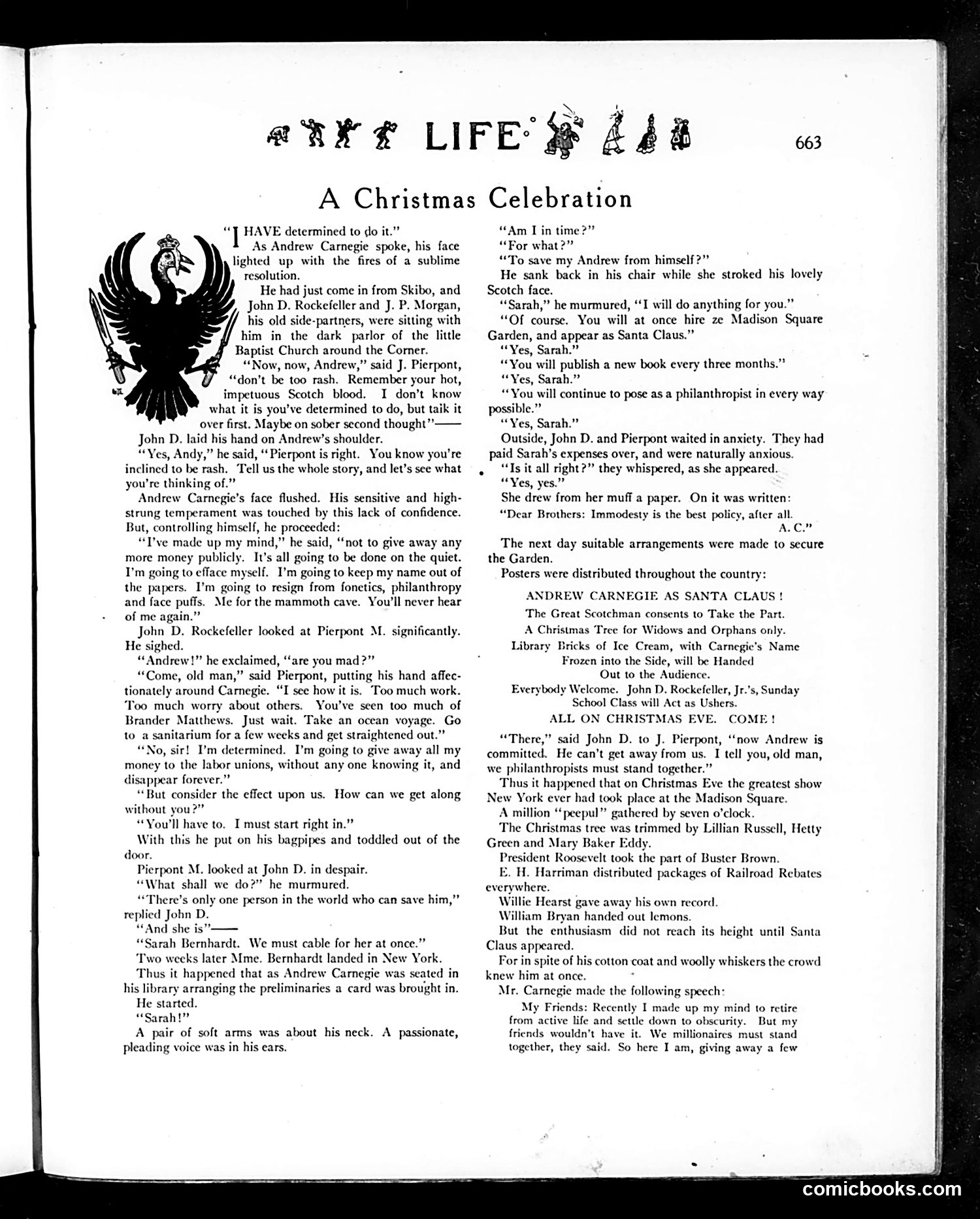
This is satirical commentary on Andrew Carnegie's *public philanthropy*. The cartoon mocks Carnegie (the wealthy Scottish industrialist) for his conspicuous charitable giving and self-promotion. **The Setup**: Carnegie announces he'll stop giving money *publicly* and disappear—a threat that panics his fellow industrialists John D. Rockefeller and J.P. Morgan, who depend on his philanthropic visibility for their own reputations. **The Joke**: They hire actress Sarah Bernhardt to convince Carnegie to resume public charity work. She succeeds, and Carnegie agrees to pose as Santa Claus at Madison Square Garden, distributing "Library Bricks of Ice Cream" with his name frozen into them. **The Satire's Point**: Life ridicules how wealthy industrialists of the Gilded Age used philanthropy as *public relations*—not genuine benevolence. Carnegie's willingness to abandon charity only when deprived of *recognition*, then eagerly resume it when convinced of its publicity value, exposes the vanity underlying his famous "Gospel of Wealth." The humor targets the calculation and self-aggrandizement behind ostensible generosity.
📄 Transcribed text from this page (OCR, searchable)
Machine-transcribed from the original scan — historical spelling and the odd misread are preserved.
axe e LIFE & 248 A Christmas Celebration “] HAVE determined to do it.” As Andrew Carnegie spoke, his face lighted up with the fires of a sublime resolution. He had just come in from Skibo, and John D. Rockefeller and J. P. Morgan, his old side-partners, were sitting with him in the dark parlor of the little Baptist Church around the Corner. “Now, now, Andrew,” said J. Pierpont, “don’t be too rash. Remember your hot, impetuous Scotch blood. I don’t know what it is you’ve determined to do, but taik it over first. Maybe on sober second thought’””—— John D. laid his hand on Andrew’s shoulder. “Yes, Andy,” he said, ‘Pierpont is right. You know you're inclined to be rash. Tell us the whole story, and let’s see what you're thinking of.” Andrew Carnegie’s face flushed. His sensitive and high- strung temperament was touched by this lack of confidence. But, controlling himself, he proceeded: “I’ve made up my mind,” he said, “not to give away any more money publicly. It’s all going to be done on the quiet. I'm going to efface myself. I’m going to keep my name out of the papers. I’m going to resign from fonetics, philanthropy and face puffs. Me for the mammoth cave. You'll never hear of me again.” John D. Rockefeller looked at Pierpont M. significantly. He sighed. “Andrew!” he exclaimed, ‘‘are you mad?” “Come, old man,” said Pierpont, putting his hand affec- tionately around Carnegie. “I see how it is. Too much work. Too much worry about others. You've seen too much of Brander Matthews. Just wait. Take an ocean voyage. Go to a sanitarium for a few weeks and get straightened out.” “No, sir! I’m determined. I’m going to give away all my moncy to the labor unions, without any one knowing it, and disappear forever.” “But consider the effect upon us. How can we get along without you “You'll have to. I must start right in.’” With this he put on his bagpipes and toddled out of the door. Pierpont M. looked at John D. in despair. “What shall we do?” he murmured. “There’s only one person in the world who can save him,” replied John D. “And she is”: rah Bernhardt. We must cable for her at once.” Two weeks later Mme. Bernhardt landed in New York. Thus it happened that as Andrew Carnegie was seated in his library arranging the preliminaries a card was brought in. He started. “Sarah!” A pair of soft arms was about his neck. A passionate, pleading voice was in his ears. “Am I in time?” “For what?” “To save my Andrew from himself?” He sank back in his chair while she stroked his lovely Scotch face. “Sarah,” he murmured, ‘‘I will do anything for you.” “Of course. You will at once hire ze Madison Square Garden, and appear as Santa Claus.” “Yes, Sarah.” “You will publish a new book every three months.”* “Yes, Sarah.” “You will continue to pose as a philanthropist in every way possible.”” “Yes, Sarah.” Outside, John D. and Pierpont waited in anxiety. They had paid Sarah’s expenses over, and were naturally anxious. “Is it all right?” they whispered, as she appeared. “Yes, yes.”” She drew from her muff a paper. On it was written: “Dear Brothers: Immodesty is the best policy, after all. A.C.” The next day suitable arrangements were made to secure the Garden. Posters were distributed throughout the country: ANDREW CARNEGIE AS SANTA CLAUS ! The Great A Christma: cotchman consents to Take the Part. ‘ce for Widows and Orphans only Library Bricks of Ice Cream, with Carnegic’s Name Frozen into the Side, will be Handed Out to the Audience. Everybody Welcome. John D. Rockefeller, Jr.'s, Sunday School Class will Act as Ushers. ALL ON CHRISTMAS EVE. COME “There,” said John D. to J. Pierpont, “now Andrew is committed. He can’t get away from us. I tell you, old man, we philanthropists must stand together.” Thus it happened that on Christmas Eve the greatest show New York ever had took place at the Madison Square. A million “peepul” gathered by seven o'clock. The Christmas tree was trimmed by Lillian Russell, Hetty Green and Mary Baker Eddy. President Roosevelt took the part of Buster Brown. E. H. Harriman distributed packages of Railroad Rebates erywhere. Willie Hearst gave away his own record William Bryan handed out lemons, But the enthusiasm did not reach its height until Santa Claus appeared. For in spite of his cotton coat and woolly whiskers the crowd knew him at once. Mr. Carnegie made the following speech: My Friends: Recently I made up my mind to retire from active life and settle down to obscurity. But my friends wouldn't have it. We millionaires must stand together, they said. So here I am, giving away a few comicbooks.com