
Life, 1906-12-06 · page 28 of 64
Life — December 6, 1906 — page 28: what you’re looking at
What you’re looking at
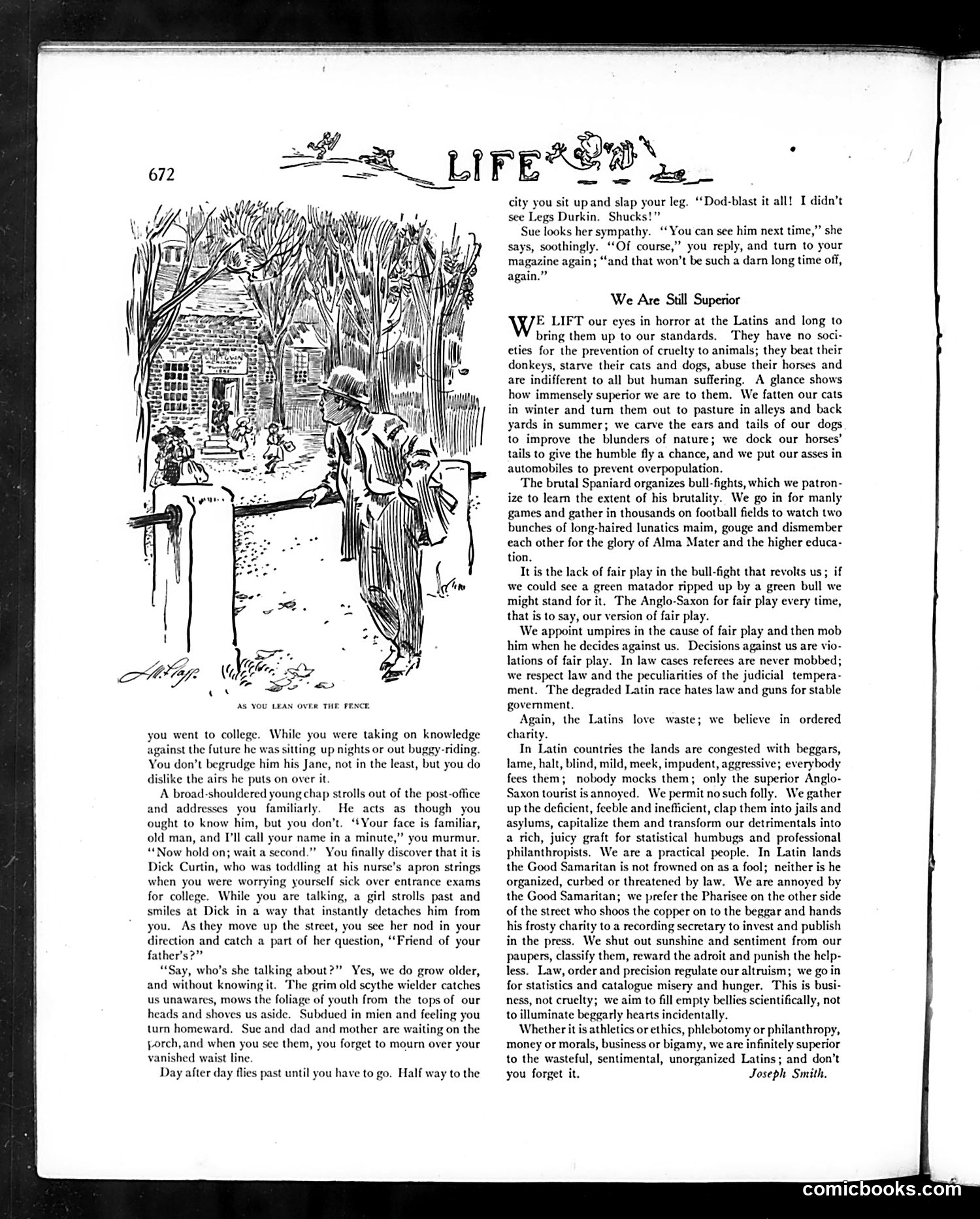
The left cartoon depicts a poignant moment of aging: a college-educated man encounters Dick Curtin, a childhood acquaintance who appears more successful and attractive to women. The joke's sting lies in the protagonist's realization that education didn't guarantee social superiority—and that time's passage has leveled their differences. The essay "We Are Still Superior" is biting satire mocking American moral smugness toward "Latins" (likely Southern Europeans). Life sarcastically catalogs supposed Anglo-Saxon superiority: we criticize Spanish bullfighting while mobbing umpires at football games; we claim to oppose animal cruelty while docking horses' tails and carving dogs' ears; we despise Latin "waste" on beggars while institutionalizing the poor. The satire exposes hypocrisy: Americans perform righteousness while practicing identical brutalities, merely disguised as civilization and efficiency. The author (Joseph Smith) demolishes the era's racial and cultural hierarchies by showing Western "superiority" as self-deception.
📄 Transcribed text from this page (OCR, searchable)
Machine-transcribed from the original scan — historical spelling and the odd misread are preserved.
Fam LIPEkOO AS YOU LEAN OVER THE FENCE you went to college. While you were taking on knowledge against the future he sitting up nights or out buggy-riding. You don’t begrudge him his Jane, not in the least, but you do dislike the airs he puts on over it. A broad-shouldered young chap strolls out of the post-office and addresses you familiarly. He acts as though you ought to know him, but you don’t. “Your face is familiar, old man, and I'll call your name in a minute,” you murmur. “Now hold on; wait a second.” You finally discover that it is Dick Curtin, who was toddling at his nurse’s apron strings when you were worrying yourself sick over entrance exams for college. While you are talking, a girl strolls past and smiles at Dick in a way that instantly detaches him from you. As they move up the street, you see her nod in your direction and catch a part of her question, “Friend of your father’s?” “Say, who's she talking about?” Yes, we do grow older, and without knowing it. The grim old scythe wielder catches us unawares, mows the foliage of youth from the tops of our heads and shoves side. Subdued in mien and feeling you turn homeward. Sue and dad and mother are waiting on the jorch, and when you see them, you forget to mourn over your vanished waist lin Day after day flies past until you have to go. Half way to the city you sit upand slap your leg. ‘‘Dod-blast it all! I didn’t see Legs Durkin. Shucks!” Sue looks her sympathy. ‘You can see him next time,” she says, soothingly. ‘Of course,” you reply, and turn to your magazine again ; “and that won’t be such a darn long time off, again.” We Are Still Superior W. LIFT our eyes in horror at the Latins and long to bring them up to our standards, They have no soci- eties for the prevention of cruelty to animals; they beat their dot starve their cats and dogs, abuse their horses and are indifferent to all but human suffering. A glance shows how immensely superior we are to them, We fatten our cats in winter and tum them out to pasture in alleys and back yards in summer; we carve the ears and tails of our dogs to improve the blunders of nature; we dock our horses’ tails to give the humble fly a chance, and we put our asses in automobiles to prevent overpopulation. The brutal Spaniard organizes bull-fights, which we patron- ize to learn the extent of his brutality. We go in for manly games and gather in thousands on football fields to watch two bunches of long-haired lunatics maim, gouge and dismember each other for the glory of Alma Mater and the higher educa- tion. It is the lack of fair play in the bull-fight that revolts us; if we could sce a green matador ripped up by a green bull we might stand for it. The Anglo-Saxon for fair play every time, that is to say, our version of fair play. We appoint umpires in the cause of fair play and then mob him when he decides against us. Decisions against us are vio- lations of fair play. In law cases referees are never mobbed; we respect law and the peculiarities of the judicial tempera- ment. The degraded Latin race hates law and guns for stable government. Again, the Latins love waste; we believe in ordered charity. In Latin countries the lands are congested with beggars, lame, halt, blind, mild, meek, impudent, aggressive; everybody fees them; nobody mocks them; only the superior Anglo- Saxon tourist is annoyed. We permit no such folly. We gather up the deficient, feeble and inefficient, clap them into jails and asylums, capitalize them and transform our detrimentals into a rich, juicy graft for statistical humbugs and professional philanthropists. We are a practical people. In Latin lands the Good Samaritan is not frowned on as a fool; neither is he organized, curbed or threatened by law. We are annoyed by the Good Samaritan; we prefer the Pharisee on the other side of the street who shoos the copper on to the beggar and hands his frosty charity to a recording secretary to invest and publish in the press. We shut out sunshine and sentiment from our paupers, classify them, reward the adroit and punish the help- less. Law, order and precision regulate our altruism; we go in for statistics and catalogue misery and hunger. This is busi- ness, not cruelty; we aim to fill empty bellies scientifically, not to illuminate beggarly hearts incidentally. Whether it is athletics or ethics, phlebotomy or philanthropy, money or morals, business or bigamy, we are infinitely superior to the wasteful, sentimental, unorganized Latins; and don’t you forget it. Joseph Smith. comicbooks.com