
Life, 1906-12-06 · page 42 of 64
Life — December 6, 1906 — page 42: what you’re looking at
What you’re looking at
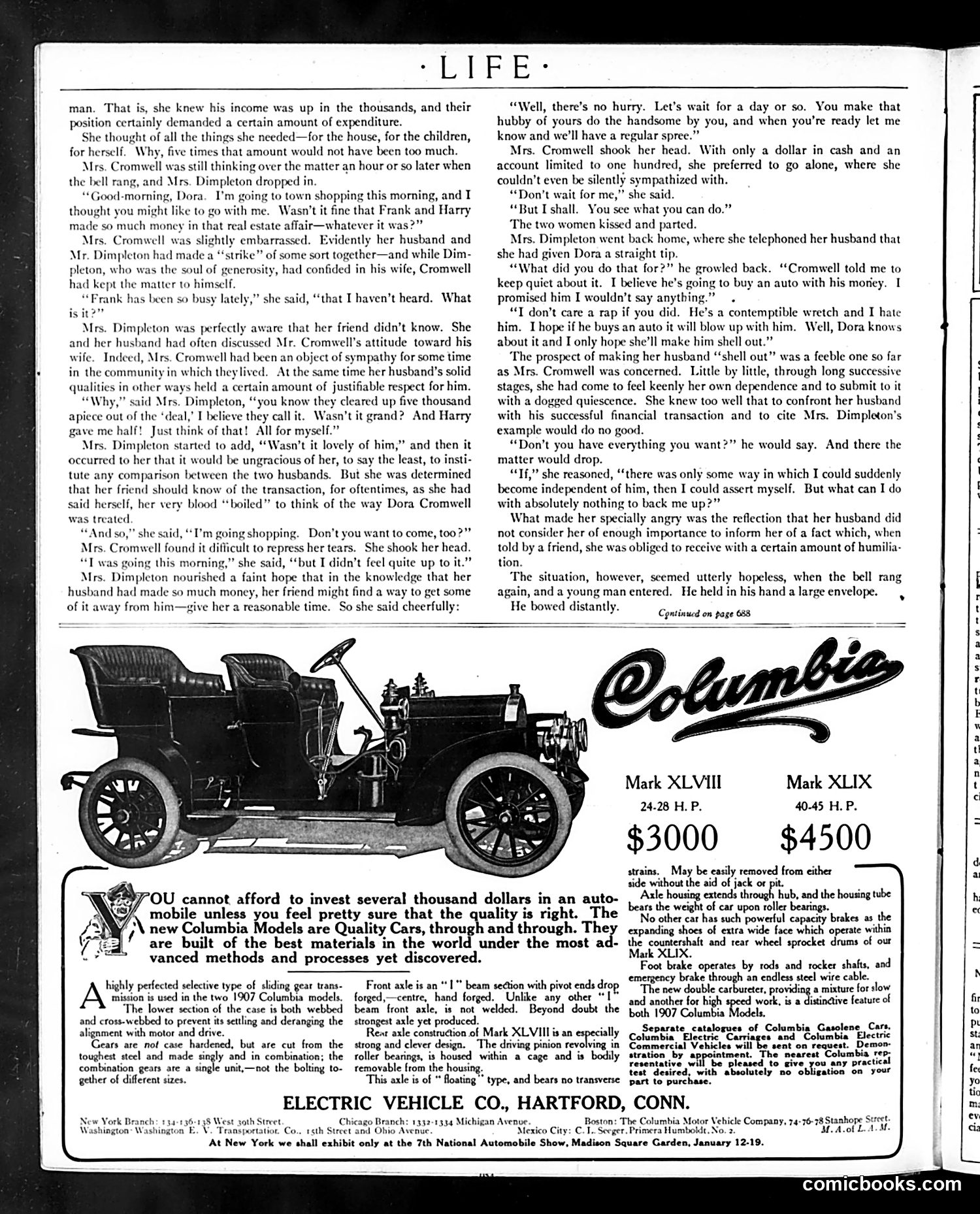
This page contains a serialized story about **marital financial inequality**, not a political cartoon. The narrative satirizes early-1900s gender dynamics around money and marriage. **The Plot:** Mrs. Cromwell's husband made $5,000 in a real estate deal but told her nothing. Her friend Mrs. Dimpleton learns this and reveals it, expecting Mrs. Cromwell to demand her share. However, Mrs. Cromwell—restricted to $1 cash and a $100 account—has become so conditioned to financial dependence that she cannot assert herself. Her husband plans secretly to buy an automobile with the money. **The Satire:** The story critiques husbands who control household finances while treating wives as helpless dependents. Mr. Dimpleton's generosity toward his wife contrasts sharply with Mr. Cromwell's secretiveness, highlighting how patriarchal control operates even among the prosperous classes. The **Columbia automobile advertisement** below represents the consumer goods wives like Mrs. Cromwell cannot access independently—reinforcing the story's point about feminine economic powerlessness.
📄 Transcribed text from this page (OCR, searchable)
Machine-transcribed from the original scan — historical spelling and the odd misread are preserved.
“EAB man. That is, she knew his income was up in the thousands, and their position certainly demanded a certain amount of expenditure. She thought of all the things she needed—for the house, for the children, for herself. Why, five times that amount would not have been too much. Mrs. Cromwell was still thinking over the matter an hour or so later when the bell rang, and Mrs. Dimpleton dropped in. “Good-morning, Dora. I'm going to town shopping this morning, and T thought you might like to go with me. Wasn't it fine that Frank and Harry made so much moncy in that real estate affair—whatever it was?” Mrs. Cromwell was slightly embarrassed. Evidently her husband and Mr. Dimpleton had made a “strike” of some sort together—and while Dim- pleton, who was the soul of generosity, had confided in his wife, Cromwell had kept the matter to himself. “Prank has been so busy lately,” she said, “that I haven’t heard. What is it?” Mrs. Dimpleton was perfectly aware that her friend didn’t know. She and her husband had often discussed Mr. Cromwell's attitude toward his wife. Indeed, Mrs. Cromwell had been an object of sympathy for some time in the community in which theylived. At the same time her husband’s solid qualities in other ways held a certain amount of justifiable respect for him. “Why,” said Mrs. Dimpleton, “you know they cleared up five thousand apiece out of the ‘deal,’ I believe they call it. Wasn’t it grand? And Harry ave me half! Just think of that! All for myself.” Mrs. Dimpleton started to add, ‘Wasn't it lovely of him,” and then it occurred to her that it would be ungracious of her, to say the least, to insti- tute any comparison between the two husbands. But she was determined that her friend should know of the transaction, for oftentimes, as she had said herself, her very blood “boiled” to think of the way Dora Cromwell was treated, “And so,” she said, “I’m going shopping. Don’t you want to come, too?” Mrs. Cromwell found it difficult to repress her tears. She shook her head. “Twas going this morning,” she said, “but I didn’t feel quite up to it.” Mrs. Dimpleton nourished a faint hope that in the knowledge that her husband had made so much money, her friend might find a way to get some of it away from him—give her a reasonable time. So she said cheerfully: “Well, there’s no hurry. Let’s wait for a day or so. You make that hubby of yours do the handsome by you, and when you're ready let me know and we'll have a regular spree.” Mrs. Cromwell shook her head. With only a dollar in cash and an account limited to one hundred, she preferred to go alone, where she couldn't even be silently sympathized with. “Don’t wait for me,” she said. “But shall. You see what you can do.” The two women kissed and parted. Mrs, Dimpleton went back home, where she telephoned her husband that she had given Dora a straight tip. “What did you do that for?” he growled back. ‘Cromwell told me to keep quict about it. I believe he’s going to buy an auto with his moriey. I promised him I wouldn’t say anything.” “T don’t care a rap if you did. He’s a contemptible wretch and I hate him. I hope if he buys an auto it will blow up with him. Well, Dora knows about it and I only hope she’ll make him shell out.” The prospect of making her husband ‘shell out” was a feeble one so far as Mrs. Cromwell was concerned. Little by little, through long successive stages, she had come to feel keenly her own dependence and to submit to it with a dogged quiescence. She knew too well that to confront her husband with his successful financial transaction and to cite Mrs. Dimpleton’s example would do no good. “Don’t you have everything you want?” he would say. And there the matter would drop. “Tf,” she reasoned, “there was only some way in which I could suddenly become independent of him, then I could assert myself. But what can I do with absolutely nothing to back me up?” What made her specially angry was the reflection that her husband did not consider her of enough importance to inform her of a fact which, when told by a friend, she was obliged to receive with a certain amount of humilia- ton. The situation, however, seemed utterly hopeless, when the bell rang again, and a young man entered. He held in his hand a large envelope. He bowed distantly. . Continued on page 688 Mark XLVIII 24-28 H. P. 40-45 H. P. $3000 $4500 strains. May be easily removed from either side without the aid of jack or pit Mark XLIX or pit. Axle housing extends through hub, and the housing tube OU cannot afford to invest several thousand dollars in an auto- |“ the weal of car upon bile be mobile unless you feel pretty sure that the quality is right. The “N¢ oth, had Gach ateerfal ‘croaeny bridienvas the new Columbia Models are Quality Cars, through and through. The expanding shoes of cairn Wide [ace eich am wha are built of the best materials in the world under the most ad- the countershaft and rear wheel sprocket drums of our i Mark XLIX. vanced methods and processes yet discovered. Fost beake ‘operates, by ands and ‘rocker shal and forged,—centre, hand forged. Unlike any other “I” aod another for high speed work. is a diatindve feature of Beyond doubt the both 1907 Columbia Models, aligament with motor and drive. Rene arle construction of Mark XLVIII is an especially Seperate, catalorues of Columbia Gasolene., Core Gears are not case hardened, but are cut from the strong and clever design. ‘The driving pinion revolving in Commercial Vehicles will be sent on request. Demon- toughest steel and made singly and in combination; the roller bearings, i» housed within a ‘cage and is bodily stration by appointment, The nearest Columbia, re; Vell combination, geats are a single unit,—not the bolting tox femovable from the housing. resentative will be pleased to give you any practical grihes of dilerens ex: This axle is of “ floating” type, and bears no transverse part to purchase. ELECTRIC VEHICLE CO., HARTFORD, CONN. 34-136-138 West zoth Street Chicago Branch: 1332-1334 Michigan Avenve. Boston: The Columbia Motor Vehicle Company, 74-76-78 Stanhope ton E. V. Transportation. Co.. rsth Street and Ohio Aven Mexico City: C. 1.. Seeger. Primera Humboldt. No. 2. 3M. Avot L. At New York we shall exhibit only at the 7th National Automobile Show, Madison Square Garden, January 12-19. mission is used in the two 1907 Columbia models. “The lower section of the case is both webbed beam ‘front axle, is not welded and cross-webbed to prevent its settling and deranging the strongest axle yet produced. A, bial perfected selective type of siding eat tans New York Branch Washington Wash comicbooks.com