
Life, 1906-12-06 · page 30 of 64
Life — December 6, 1906 — page 30: what you’re looking at
What you’re looking at
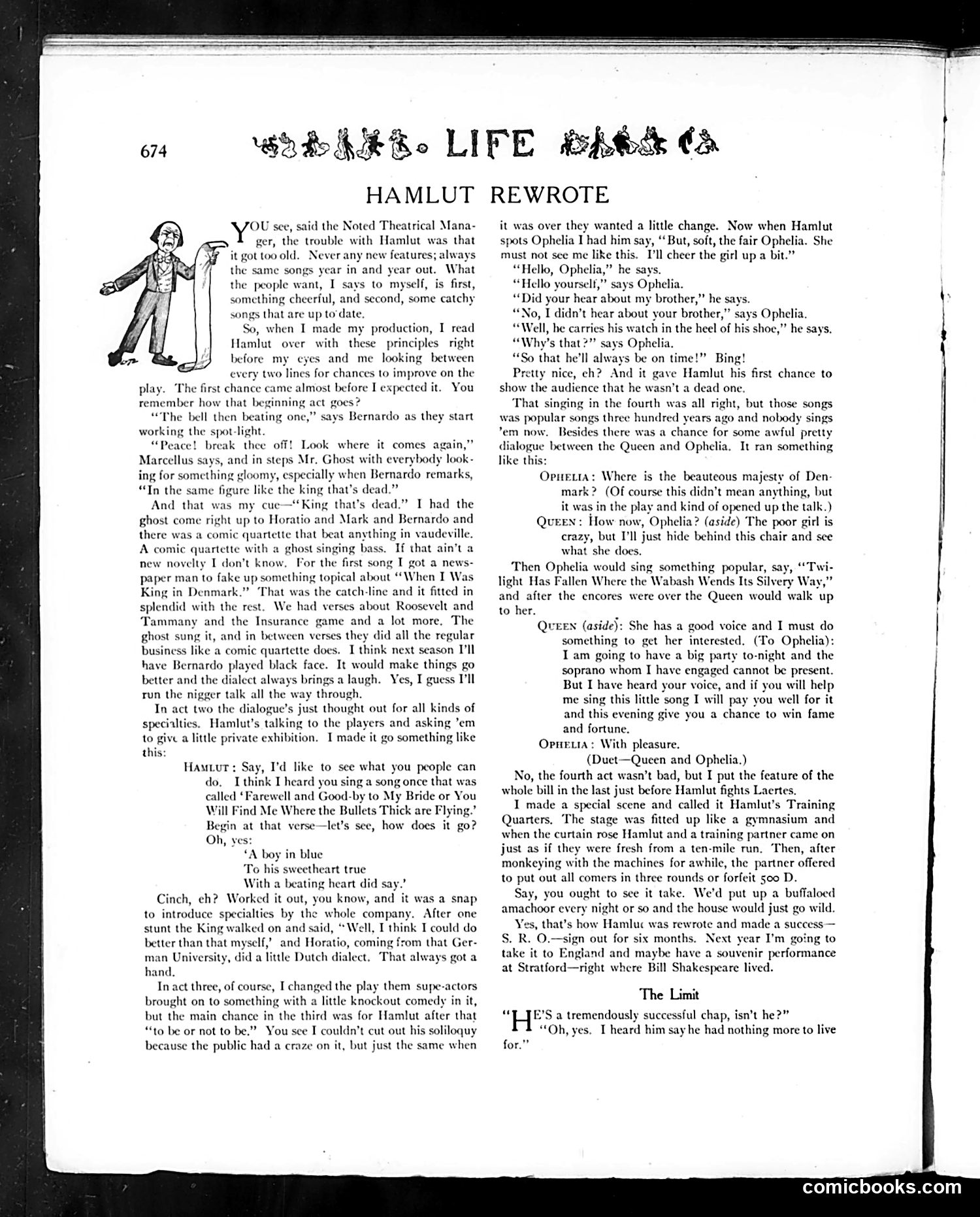
This is a satirical article about a theatrical manager who "modernizes" Shakespeare's *Hamlet* for contemporary audiences. The manager boasts of adding vaudeville-style comedy acts, topical songs about Roosevelt and Tammany Hall, and comic routines—transforming a tragedy into entertainment spectacle. The satire targets early 20th-century theater producers who prioritized commercial appeal over artistic integrity. The manager's casual racism (mentioning "nigger talk" for laughs) and dismissal of Shakespeare's original material ("the same songs year in and year out") exemplify crass commercialism. The irony is sharp: by trying to make *Hamlet* "modern" and "cheerful" with interpolated songs and vaudeville bits, the producer destroys the play itself. The inserted jokes—like the "watch in the heel of his shoe" gag—are painfully unfunny, underlining the absurdity of treating a masterpiece as a vehicle for variety acts. Life magazine uses this to mock producers who mistook audience tastes for artistic judgment, reducing literature to novelty entertainment.
📄 Transcribed text from this page (OCR, searchable)
Machine-transcribed from the original scan — historical spelling and the odd misread are preserved.
HAMLUT ee, said the Noted Theatrical Mana- the trouble with Hamlut was that it got too old. Never any new features; always the same songs year in and year out. What the people want, I says to myself, is first, something cheerful, and second, some catchy songs that are up to'date, So, when I made my production, I read Hamlut over with these principles right before my cyes and me looking between every two lines for chances to improve on the pla Phe first chance came almost before I expected it. You remember how that beginning act goes? “The bell then beating one,” says Bernardo as they start off! Look where it comes again,” , and in steps Mr. Ghost with everybody look- ing for something gloomy, especially when Bernardo remarks, “In the same figure like the king that’s dead.” And that was my cue—‘King that’s dead.” I had the ghost come right up to Horatio and Mark and Bernardo and there was a comic quartette that beat anything in vaudeville. A comic quartette with a ghost singing bass. If that ain’t a new novelty I don’t kn For the first song I got a news- paper man to fake up something topical about “When I Was King in Denmark.” That was the catch-line and it fitted in splendid with the rest. We had verses about Roosevelt and Tammany and the Insurance game and a lot more. The ghost sung it, and in between verses they did all the regular business like a comic quartette does. I think next season I'll have Bernardo played black face. It would make things go better and the dialect always brings a laugh. Yes, I guess I'll run the nigger talk all the way through. In act two the dialogue’s just thought out for all kinds of specialties. Hamlut’s talking to the players and asking ’em to give a little private exhibition. I made it go something like this: Marcellus say Haut: Say, I'd like to see what you people can do, Ithink I heard you sing a song once that called ‘Farewell and Good-by to My Bride or You Will Find Me Where the Bullets Thick are Flying.” Begin at that verse—let’s see, how does it go? Oh, yes: “A boy in blue To his sweetheart true With a beating heart did say.’ Cinch, ch? Worked it out, you know, and it was a snap to introduce specialties by the whole company. After one stunt the King walked on and said, “Well, I think T could do better than that myself,’ and Horatio, coming from that € man University, did a little Dutch dialect. That always got a hand. In act three, of course, I changed the play them supe-actors brought on to something with a little knockout comedy in it, but the main chance in the third was for Hamlut after that “to be or not to be.” You see I couldn’t cut out his soliloquy because the public had a craze on it, but just the same when wWhd hE LIFE hOd& A REWROTE it was over they wanted a little change. Now when Hamlut spots Ophelia I had him say, “But, soft, the fair Ophelia. She must not sce me like this. I’ll cheer the girl up a bit.” “Hello, Ophelia,” he says. “Hello yourself,” says Ophelia. “Did your hear about my brother,” he sa “No, I didn’t hear about your brother,” says Ophelia. “Well, he carries his watch in the heel of his shoe,” he says, “Why’s that?” says Ophelia. “So that he’ll always be on time!”” Bing! Pretty nice, ch? And it gave Hamlut his first chance to show the audience that he wasn’t a dead one, That singing in the fourth was all right, but those songs s popular songs three hundred years ago and nobody sings tem now. Besides there was a chance for some awful pretty dialogue between the Queen and Ophelia, It ran something like this: Opuetta: Where is the beauteous majesty of Den- mark? (Of course this didn’t mean anything, but it was in the play and kind of opened up the talk.) EEN: How now, Ophelia? (aside) The poor girl is crazy, but I'll just hide behind this chair and see what she does. ‘Then Ophelia would sing something popular, say, “Twi- light Has Fallen Where the Wabash Wends Its Silvery Way,” and after the encores were over the Queen would walk up to her. Q (aside): She has a good voice and I must do something to get her interested. (To Ophelia): Tam going to have a big party to-night and the soprano whom I have engaged cannot be present. But I have heard your voice, and if you will help me sing this little song I will pay you well for it and this evening give you a chance to win fame and fortune. OpuHetta: With pleasure. (Duet—Queen and Ophelia.) No, the fourth act wasn’t bad, but I put the feature of the whole bill in the last just before Hamlut fights Laertes. I made a special scene and called it Hamlut’s Training Quarters, The stage was fitted up like a gymnasium and when the curtain rose Hamlut and a training partner came on just as if they were fresh from a ten-mile run, Then, after monkeying with the machines for awhile, the partner offered to put out all comers in three rounds or forfeit 500 D. Say, you ought to see it take. We'd put up a buffaloed amachoor every night or so and the house would just go wild. s, that’s how Hamluc was rewrote and made a success— S. R. O.—sign out for six months. xt year I'm going to nd and maybe have a souvenir performance ht where Bill Shakespeare lived. The Limit “FES 2 tremendously sucessful chap, isn’t he?” “Oh, yes. TI heard him say he had nothing more to live take it to Engi. at Stratford—i for.” comicbooks.com