
Life, 1906-12-06 · page 8 of 64
Life — December 6, 1906 — page 8: what you’re looking at
What you’re looking at
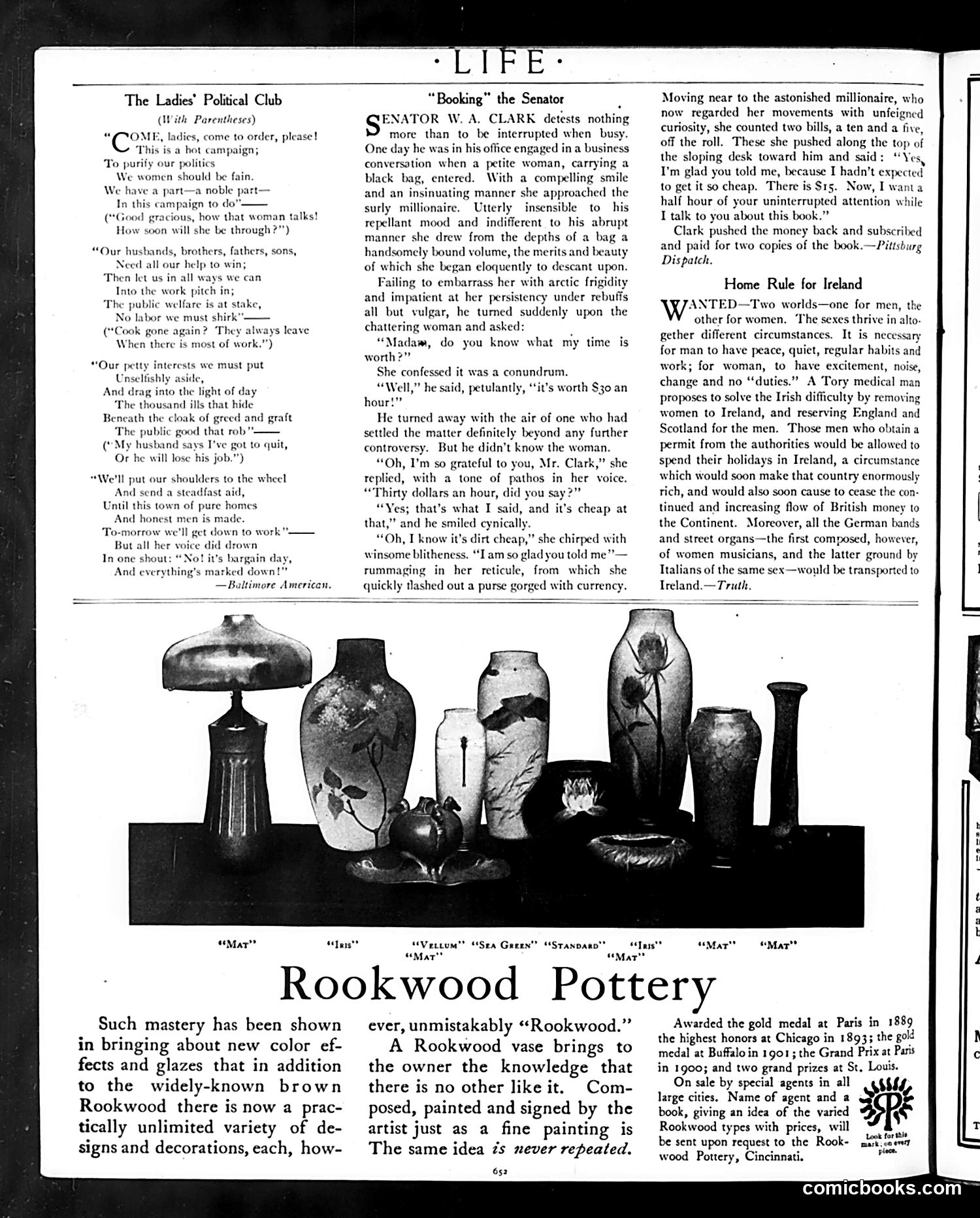
This page contains three distinct sections: 1. **"The Ladies' Political Club"** (top left): A satirical poem mocking women's political activism, suggesting women should focus on domestic duties rather than public campaigns. The verse uses condescending language ("Our petty interests") typical of anti-suffrage sentiment from this era. 2. **"Booking the Senator"** (top right): A humorous anecdote about Senator W. A. Clark being solicited by a woman for a charitable donation. The joke centers on her persistence and his attempt to negotiate a lower amount, ending with her extracting money anyway—satirizing both persistent female fundraisers and wealthy men's resistance to charitable giving. 3. **Rookwood Pottery Advertisement** (bottom): A substantial advertisement showcasing decorative vases and ceramics, highlighting the company's awards and artistic reputation. The page reflects early 20th-century attitudes toward women and gender roles.
📄 Transcribed text from this page (OCR, searchable)
Machine-transcribed from the original scan — historical spelling and the odd misread are preserved.
The Ladies’ Political Club (With Parentheses) “COME, ladies, come to order, please! s is a hot campaign; To purify our politics We women should be fain. We have a part—a noble In this campaign to do’ (“Good gracious, how that woman talks! How soon will she be through ?”) “Our husbands, brothers, fathers, sons, Need all our help to win; Then let us in all ways we can Into the work pitch in; he public welfare is at stake, No labor we must shirk” (“Cook gone again? They always leave When there is most of work.”) “Our petty interests we must put Unseltisbly aside, And drag into the light of day ‘The thousand ills that hide Beneath the cloak of greed and graft public good that rob” (/My husband says I’ve got to quit, Or he will lose his job.”) “We'll put our shoulders to the wheel And send a steadfast aid, Until this town of pure homes And honest men is made. To-morrow we'll get down to work" —— But all her voice did drown Not it’s bargain day, And everything’s marked down!” —Baltimore American. In one shout: “Booking” the Senator ATOR W. A. CLARK detests nothing more than to be interrupted when busy. One day he was in his office engaged in a business conversation when a petite woman, carrying a black bag, entered. With a compelling smile and an insinuating manner she approached the surly millionaire. Utterly insensible to his repellant mood and indifferent to his abrupt manner she drew from the depths of a bag a handsomely bound volume, the merits and beauty of which she began eloquently to descant Failing to embarrass her with arctic fri and impatient at her persistency under rebuffs all but vulgar, he turned suddenly upon the chattering woman and asked: “Madam, do you know what my time is worth?” She confessed it was a conundrum. “Well,” he said, petulantly, ‘it’s worth $30 an hour!” He tumed away with the air of one who had settled the matter definitely beyond any further controversy. But he didn’t know the woman. “Oh, I’m so grateful to you, Mr. Clark,” she replied, with a tone of pathos in her voice. “Thirty dollars an hour, did you say?” that’s what I said, and it’s cheap at ind he smiled cynically. “Oh, I know it’s dirt cheap,” she chirped with winsome blitheness. “I am so glad you told me” — rummaging in her reticule, from which she quickly flashed out a purse gorged with currenc Moving near to the astonished millionaire, who now regarded her movements with unfeigned curiosity, she counted two bills, a ten and a five, off the roll. These she pushed along the top of the sloping desk toward him and said: “Ves, I'm glad you told me, because I hadn’t expected to get it so cheap. There is $15. Now, I want a half hour of your uninterrupted attention while I talk to you about this book.” Clark pushed the money back and subscribed and paid for two copies of the book.—Pittsburg Dispatch, Home Rule for Ireland NTED—Two worlds—one for men, the other for women. The sexes thrive in alto- gether different circumstances. It is necessary for man to have peace, quiet, regular habits and work; for woman, to have excitement, noise, change and no “duties.” A Tory medical man proposes to solve the Irish difficulty by removing women to Ireland, and reserving England and Scotland for the men. Those men who obtain a permit from the authorities would be allowed to spend their holidays in Ireland, a circumstance which would soon make that country enormously rich, and would also soon cause to cease the con- tinued and increasing flow of British money to the Continent. Moreover, all the German bands and street organs—the first composed, however, of women musicians, and the latter ground by Italians of the same se Ireland.—Truth. —would be transported to “Mar” “Tass” **Vettum”™ ‘Sea Gaeen’’ “Stanpaao™’ “Mat “Tass? “Mat” “Mat “Mat"* Rookwood Pottery Such mastery has been shown in bringing about new color ef- fects and glazes that in addition to the widely-known brown Rookwood there is now a prac- tically unlimited variety of de- signs and decorations, each, how- ever, unmistakably “Rookwood.” A Rookwood vase brings to the owner the knowledge that there is no other like it. Com- posed, painted and signed by the artist just as a fine painting is The same idea zs never repeated. 652 Awarded the gold medal at Paris in 1889 the highest honors at Chicago in 1893; the gold medal at Buffalo in 1901 ; the Grand Prix at Paris in 1900; and two grand prizes at St, Louis. On sale by special agents in all $ large cities. Name of agent and a x book, giving an idea of the varied aR Rookwood types with prices, will be sent upon request to the Rook- wood Pottery, Cincinnati, Look for thls mark, co ere piece. comicbooks.com ~