
Life, 1906-12-06 · page 18 of 64
Life — December 6, 1906 — page 18: what you’re looking at
What you’re looking at
This page contains two satirical pieces mocking social hypocrisy and male behavior: **"The Naked Truth"** is a moral fable: Falsehood steals Truth's clothes while swimming, leaving Truth to wander naked. The point is that dishonesty disguises itself in respectability while truth goes unclothed and ignored in society—a critique of how lies flourish while honesty is marginalized. **"At the Symphony"** depicts a woman trying to enjoy a concert while her male companion repeatedly interrupts with inane commentary, ruining her experience. Her witty comeback—suggesting he listen "with the mouth shut"—delivers the satire: the joke is on men who talk constantly, unable to appreciate beauty in silence, and who cannot take subtle hints to be quiet. The author (Nixon Waterman) sympathizes with the woman's frustration at male obliviousness and rudeness. Both pieces use humor to critique social pretense and male behavior, typical of Life's satirical approach.
📄 Transcribed text from this page (OCR, searchable)
Machine-transcribed from the original scan — historical spelling and the odd misread are preserved.
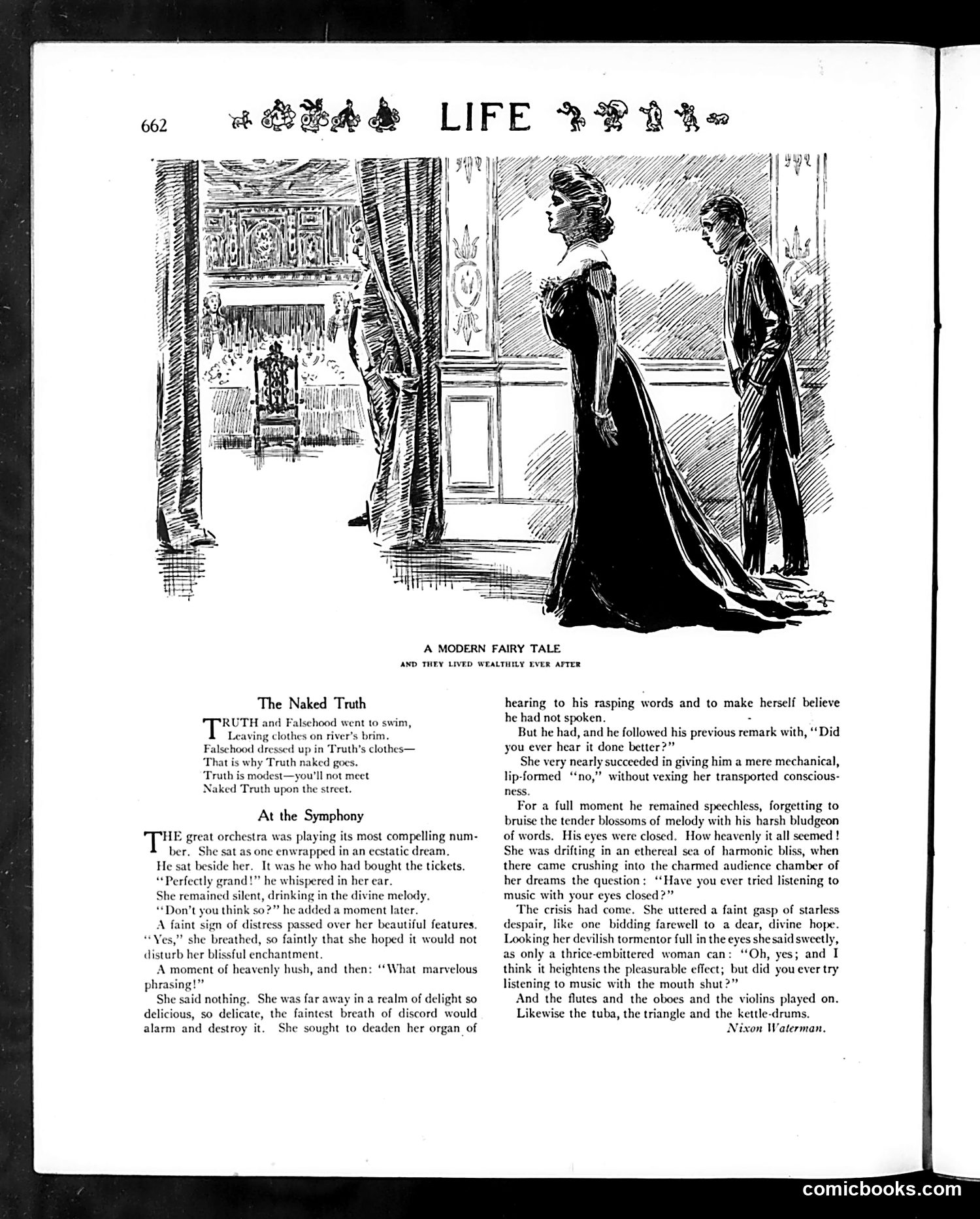
A MODERN FAIRY TALE AND THEY LIVED WEALTHILY EVER AFTER The Naked Truth RUTH and Falsehood went to swim, Leaving clothes on river's brim. jood dressed up in Truth’s clothes— That is why Truth naked gocs. Truth is modest—you'll not meet Naked Truth upon the street. At the Symphony TH great orchestra was playing its most compelling num- J sat as one enwrapped in an ecstatic dream. He sat beside her. It was he who had bought the tickets. “Perfectly grand!” he whispered in her ear. She remained silent, drinking in the divine melody, “Don’t you think so?” he added a moment later. A faint sign of distress passed over her beautiful features. “Yes,” she breathed, so faintly that she hoped it would not disturb her blissful enchantment. A moment of heavenly hush, and then: ‘What marvelous phrasing!” She said nothing. She was far away in a realm of delight so delicious, so delicate, the faintest breath of discord would alarm and destroy it. She sought to deaden her organ_of hearing to his rasping words and to make herself believe he had not spoken. _ But he had, and he followed his previous remark with, “Did you ever hear it done better?” She very nearly succeeded in giving him a mere mechanical, lip-formed ‘‘no,” without vexing her transported conscious- ness. For a full moment he remained speechless, forgetting to bruise the tender blossoms of melody with his harsh bludgeon of words. His eyes were closed. How heavenly it all seemed ! She was drifting in an ethereal sea of harmonic bliss, when there came crushing into the charmed audience chamber of her dreams the question: ‘Have you ever tried listening to music with your eyes closed?” The crisis had come. She uttered a faint gasp of starless despair, like one bidding farewell to a dear, divine hope. Looking her devilish tormentor full in the eyes she said sweetly, as only a thrice-embittered woman can: ‘Oh, yes; and I think it heightens the pleasurable effect; but did you ever try listening to music with the mouth shut?” And the flutes and the oboes and the violins played on. Likewise the tuba, the triangle and the kettle-drums. Nixon Waterman, comicbooks.com