
Life, 1906-12-06 · page 60 of 64
Life — December 6, 1906 — page 60: what you’re looking at
What you’re looking at
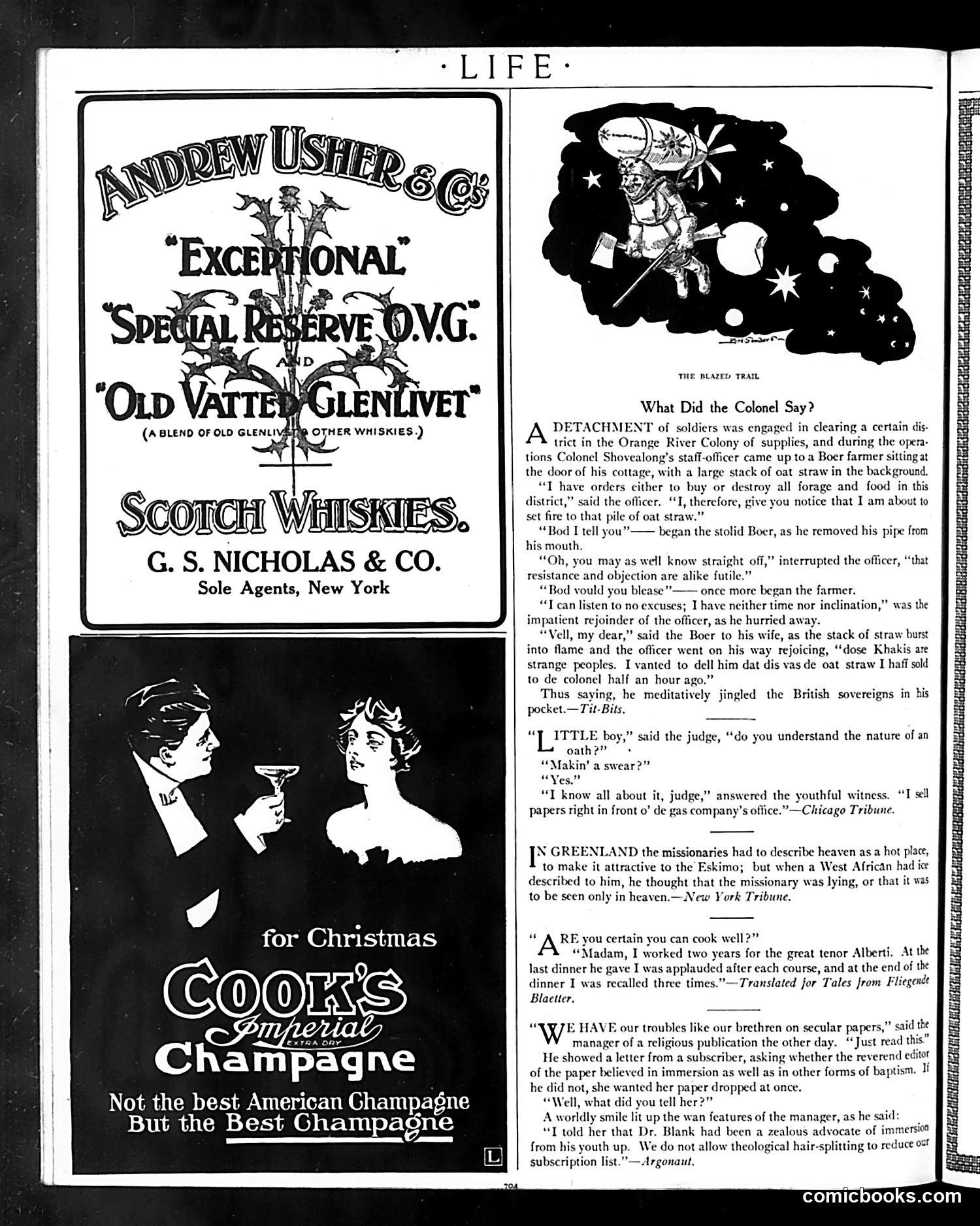
This page from *Life* contains several humorous anecdotes rather than political cartoons. **"The Blazed Trail"** satirizes British military incompetence during the Boer War (South African conflict, 1899-1902). A British officer orders a colonial soldier to burn a Boer farmer's oat straw as forage destruction, ignoring the farmer's attempts to speak. The joke: the farmer had already *sold* that straw to the British colonel an hour earlier. The officer destroys British property while thinking he's denying supplies to the enemy—illustrating military bureaucratic stupidity and the Boer farmer's cleverness in profiting from occupying forces. The other brief anecdotes mock: - A street urchin's cynical understanding of oaths - Missionary misunderstandings across cultures - A cook's dubious credentials - Religious publication hypocrisy about doctrine versus subscriptions The page is primarily **humorous commentary** on human folly—military, social, and institutional—rather than partisan political satire.
📄 Transcribed text from this page (OCR, searchable)
Machine-transcribed from the original scan — historical spelling and the odd misread are preserved.
THE BLAZED TRAIL What Did the Colonel Say? DETACHMENT of soldiers was engaged in clearing a certain dis- trict in the Orange River Colony of supplies, and during the opera- tions Colonel Shovealong’s staff-officer came up to a Boer farmer sitting at the door of his cottage, with a large stack of oat straw in the background, “T have orders cither to buy or destroy all forage and food in this district,” said the officer. ‘‘I, therefore, give you notice that I am about to set fire to that pile of oat straw.” “Bod I tell you” — began the stolid Boer, as he removed his pipe from his mouth. G. S. NICHOLAS & Co. “Oh, you may as well know straight off,” interrupted the officer, “that resistance and objection are alike futile.” Sole Agents, New York “Bod vould you blease once more began the farmer. “I can listen to no excuses; I have neither time nor inclination,” impatient rejoinder of the officer, as he hurried away. “Vell, my dear,” said the Boer to his wife, as the stack of straw burst into flame and the officer went on his way rejoicing, ‘dose Khakis are strange peoples. I vanted to dell him dat as de oat straw I hafi sold to de colonel half an hour ago.” Thus saying, he meditatively jingled the British sovereigns in his pocket.—Tit-Bits, ” was the “TITTLE boy,” said the judge, “do you understand the nature of an oath?” + “ Makin’ a swear?” “Yes. “T know all about it, judge,” answered the youthful witness. “I sell papers right in front o’ de gas company’s office.” —Chicago Tribune. N GREENLAND the missionaries had to describe heaven as a hot place, to make it attractive to the Eskimo; but when a West African had ice described to him, he thought that the missionary was lying, or that it was to be seen only in heaven.—New York Tribune. for Christmas “ARE you certain you can cook well?” “Madam, I worked two years for the great tenor Alberti. At the {9) last dinner he gave I was applauded after each course, and at the end of the dinner I was recalled three times.”—Translated jor Tales jrom Fliegendt Blaetter, cAlyreuaw “YE HAVE our troubles like our brethren on secular papers,” said the manager of a religious publication the other day. ‘Just read this” Cc ha mpadqcne He showed a letter from a subscriber, asking whether the reverend editor of the paper believed in immersion as well as in other forms of baptism. If he did not, she wanted her paper dropped at once. Not the best American Ghampagne “Well, what did you tell her?” But the Best Ghampagne A worldly smile lit up the wan features of the manager, as he said: Cm “T told her that Dr. Blank had been a zealous advocate of immersioo from his youth up. We do not allow theological hair-splitting to reduce oo subscription list.” —Argonaut, comicbooks.com