
Life, 1906-12-06 · page 37 of 64
Life — December 6, 1906 — page 37: what you’re looking at
What you’re looking at
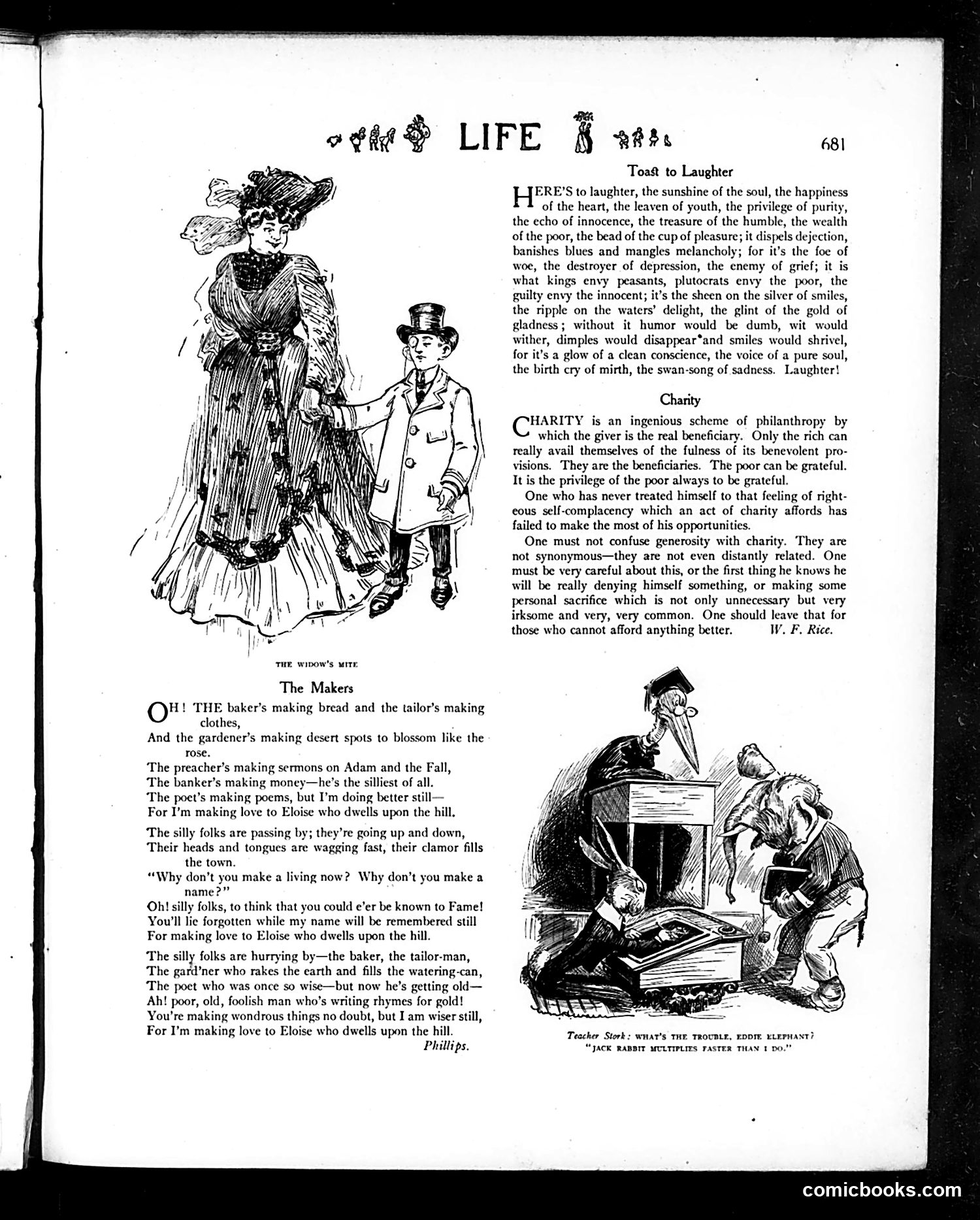
This page contains three satirical pieces typical of early 20th-century American humor: **"Toast to Laughter"** is a sentimental celebration of humor's social value—a common Life magazine trope praising laughter as universally beneficial and morally uplifting. **"Charity"** by W.F. Rice offers biting social satire. It mocks wealthy philanthropists' self-congratulation, arguing that the rich are actually the true beneficiaries of charity (feeling virtuous), not the poor. Rice satirizes how the wealthy confuse "generosity with charity" and warns against genuine personal sacrifice—suggesting the privileged should leave real sacrifice to those who can't afford otherwise. This critiques performative philanthropy. **"The Makers"** is a humorous poem contrasting productive workers (bakers, tailors, gardeners, preachers, bankers, poets) with a young man pursuing romance with "Eloise," whom he considers superior achievement. The joke: while society values tangible work, the narrator finds courtship more important. The accompanying illustration shows a teacher and student with rabbits, reinforcing the poem's final joke about reproduction rates.
📄 Transcribed text from this page (OCR, searchable)
Machine-transcribed from the original scan — historical spelling and the odd misread are preserved.
a dhe LIFE BK aan 681 Toagt to Laughter ERE’S to laughter, the sunshine of the soul, the happiness of the heart, the leaven of youth, the privilege of purity, the echo of innocence, the treasure of the humble, th of the poor, the bead of the cup of pleasure; it dispels dej banishes blues and mangles melancholy; for it’s the foe of woe, the destroyer of depression, the enemy of grief; it is what kings envy peasants, plutocrats envy the poor, the guilty envy the innocent; it’s the sheen on the silver of smiles, the ripple on the waters’ delight, the glint of the gold of gladness ; without it humor would be dumb, wit would wither, dimples would disappear*and smiles would shrivel, for it’s a glow of a clean conscience, the voice of a pure soul, the birth cry of mirth, the swan-song of sadness. Laughter! Charity HARITY jis an ingenious scheme of philanthropy by which the giver is the real beneficiary. Only the rich can really avail themselves of the fulness of its benevolent pro- visions. They are the beneficiaries. The poor can be grateful. It is the privilege of the poor always to be grateful. One who has never treated himself to that feeling of right- eous self-complacency which an act of charity affords has failed to make the most of his opportunities. One must not confuse generosity with charity. ‘They are not synonymous—they are not even distantly related. One must be very careful about this, or the first thing he knows he will be really denying himself something, or making some personal sacrifice which is not only unnecessary but very irksome and very, very common. One should leave that for those who cannot afford anything better. W. F, Rice. THe wivow's wiTr, The Makers H! THE baker’s making bread and the tailor’s making clothes, And the gardener’s making desert spots to blossom like the rose. The preacher’s making sermons on Adam and the Fall, The banker’s making money—he’s the silliest of all. The poet’s making poems, but I’m doing better still— For I’m making love to Eloise who dwells upon the hill, The silly folks are passing by; they’re going up and down, ‘Their heads and tongues are wagging fast, their clamor fills the town. “Why don’t you make a living now? Why don’t you make a name?” Oh! silly folks, to think that you could e’er be known to Fame! You'll lie forgotten while my name will be remembered still For making love to Eloise who dwells upon the hill. The silly folks are hurrying by—the baker, the tailor-man, The gard’ner who rakes the earth and fills the watering-can, The poet who was once so wise—but now he’s getting old— Ah! poor, old, foolish man who’s writing rhymes for gold! You're making wondrous things no doubt, but I am wiser still, For I’m making love to Eloise who dwells upon the hill. Teachet Stock: wna’ rae recunce: ‘enor Muar? Phillips. “JACK RABBIT MULTIPLIES TASTER THAN 1 DO.” comicbooks.com