
Life, 1906-12-06 · page 26 of 64
Life — December 6, 1906 — page 26: what you’re looking at
What you’re looking at
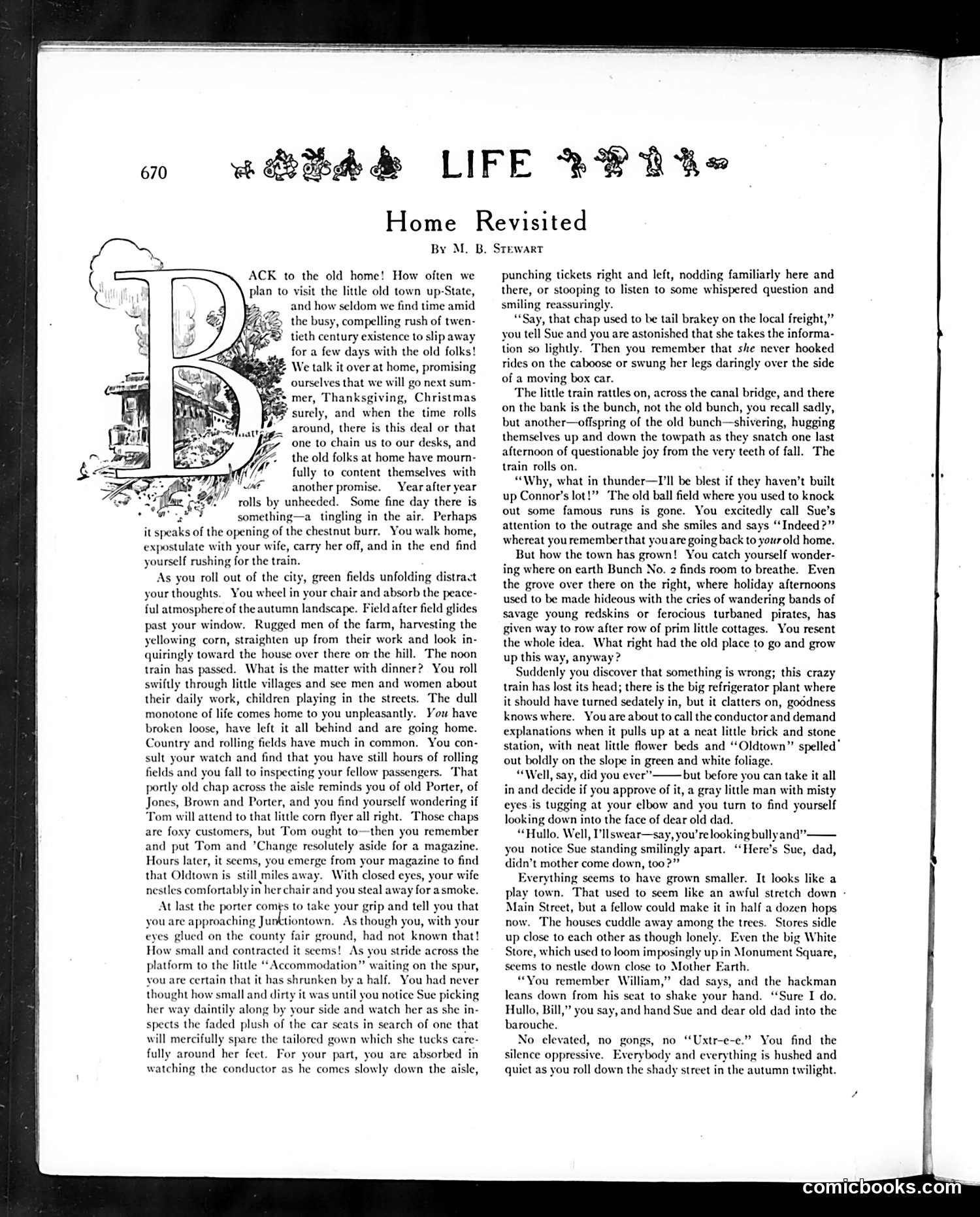
This illustrated short story by M.B. Stewart explores the bittersweet experience of returning to one's small hometown after years away. The narrative follows a city dweller who romanticizes returning "home" to visit elderly parents, repeatedly promising visits that never materialize due to urban business demands. The story satirizes modern American life's alienation: the protagonist finds his hometown physically and spiritually diminished—literally "shrunken by a half." His wife Sue, a city woman, cannot appreciate rural memories (the train conductor, caboose adventures) because she lacks the narrator's nostalgic connection. The detailed descriptions of waiting passengers and train observations capture the tedium of travel itself. The underlying critique suggests that twentieth-century capitalism and urban ambition have disconnected Americans from family roots and simpler living. The "deal or that one to chain us to our desks" represents how economic pressures prevent genuine human connection. The story mourns what industrialization costs: authentic community ties replaced by vague promises and faded memories.
📄 Transcribed text from this page (OCR, searchable)
Machine-transcribed from the original scan — historical spelling and the odd misread are preserved.
aed & LIFE BP R4o~ Home Revisited By M. ACK to the old home! How often we plan to visit the little old town up-State, and how seldom we find time amid the busy, compelling rush of twen- tieth century existence to slip away for a few days with the old folks! We talk it over at home, promising ourselves that we will go next sum- mer, Thanksgiving, Christmas surely, and when the time rolls around, there is this deal or that one to chain us to our desks, and the old folks at home have mourn- fully to content themselves with another promise. Year after year rolls by unheeded. Some fine day there is something—a tingling in the air. Perhaps it speaks of the opening of the chestnut burr, You walk home, expostulate with your wife, carry her off, and in the end find yourself rushing for the train. As you roll out of the city, green fields unfolding distract your thoughts. You wheel in your chair and absorb the peace- ful atmosphere of the autumn landscape. Field after field glides past your window. Rugged men of the farm, harvesting the yellowing corn, straighten up from their work and look in- quiringly toward the house over there or the hill. The noon train has passed. What is the matter with dinner? You roll swiftly through little villages and see men and women about their daily work, children playing in the streets. The dull monotone of life comes home to you unpleasantly. You have broken loose, have left it all behind and are going home. Country and rolling fields have much in common. You con- sult your watch and find that you have still hours of rolling fields and you fall to inspecting your fellow passengers. ‘That portly old chap across the aisle reminds you of old Porter, of Jones, Brown and Porter, and you find yourself wondering if Tom will attend to that little corn flyer all right. Those chaps are foxy customers, but Tom ought to—then you remember and put Tom and ’Change resolutely aside for a magazine. Hours later, it seems, you emerge from your magazine to find that Oldtown is still miles away. With closed eyes, your wife nestles comfortably in her chair and you steal away for asmoke. At last the porter comes to take your grip and tell you that you are approaching Junttiontown. As though you, with your eyes glued on the county fair ground, had not known that! How small and contracted it seems! As you stride across the platform to the little “Accommodation” waiting on the spur, you are certain that it has shrunken by a half. You had never thought how small and dirty it was until you notice Sue picking her way daintily along by your side and watch her as she in- spects the faded plush of the car seats in search of one that will mercifully spare the tailored gown which she tucks care- fully around her feet. For your part, you are absorbed in watching the conductor as he comes slowly down the aisle, iz y os!) pee! ¥ B. Stewart punching tickets right and left, nodding familiarly here and there, or stooping to listen to some whispered question and smiling reassuringly. “Say, that chap used to be tail brakey on the local freight,” you tell Sue and you are astonished that she takes the informa- tion so lightly. Then you remember that she never hooked rides on the caboose or swung her legs daringly over the side of a moving box car. The little train rattles on, across the canal bridge, and there on the bank is the bunch, not the old bunch, you recall sadly, but another—offspring of the old bunch—shivering, hugging themselves up and down the towpath as they snatch one last afternoon of questionable joy from the very teeth of fall. The train rolls on. “Why, what in thunder—I’ll be blest if they haven’t built up Connor's lot!” ‘The old ball field where you used to knock out some famous runs is gone. You excitedly call Sue’s attention to the outrage and she smiles and says “Indeed?” whereat you remember that you are going back to your old home. But how the town has grown! You catch yourself wonder- ing where on earth Bunch No. 2 finds room to breathe. Even the grove over there on the right, where holiday afternoons used to be made hideous with the cries of wandering bands of savage young redskins or ferocious turbaned pirates, has given way to row after row of prim little cottages. You resent the whole idea. What right had the old place to go and grow up this way, anyway? Suddenly you discover that something is wrong; this crazy train has lost its head; there is the big refrigerator plant where it should have turned sedately in, but it clatters on, goodness knows where. You are about to call the conductor and demand explanations when it pulls up at a neat little brick and stone station, with neat little flower beds and “Oldtown” spelled’ out boldly on the slope in green and white foliage. “Well, say, did you ever” but before you can take it all in and decide if you approve of it, a gray little man with misty eyes .is tugging at your elbow and you turn to find yourself looking down into the face of dear old dad. “Hullo, Well, I'llswear—say, you're looking bully and” — you notice Sue standing smilingly apart. ‘“Here’s Sue, dad, didn’t mother come down, too?” Everything seems to have grown smaller. It looks like a play town. That used to seem like an awful stretch down - Main Street, but a fellow could make it in half a dozen hops now. The houses cuddle away among the trees. Stores sidle up close to each other as though lon Even the big White Store, which used to loom imposingly up in Monument Square, seems to nestle down close to Mother Earth. “You remember William,” dad says, and the hackman leans down from his seat to shake your hand. ‘Sure I do. Hullo, Bill,” you sa id hand Sue and dear old dad into the barouche. No elevated, no gongs, no ‘“Uxtr-e-e.” You find the silence oppressive. Everybody and everything is hushed and quict as you roll down the shady street in the autumn twilight. comicbooks.com