
A complete issue · 36 pages · 1922
Judge — April 22, 1922
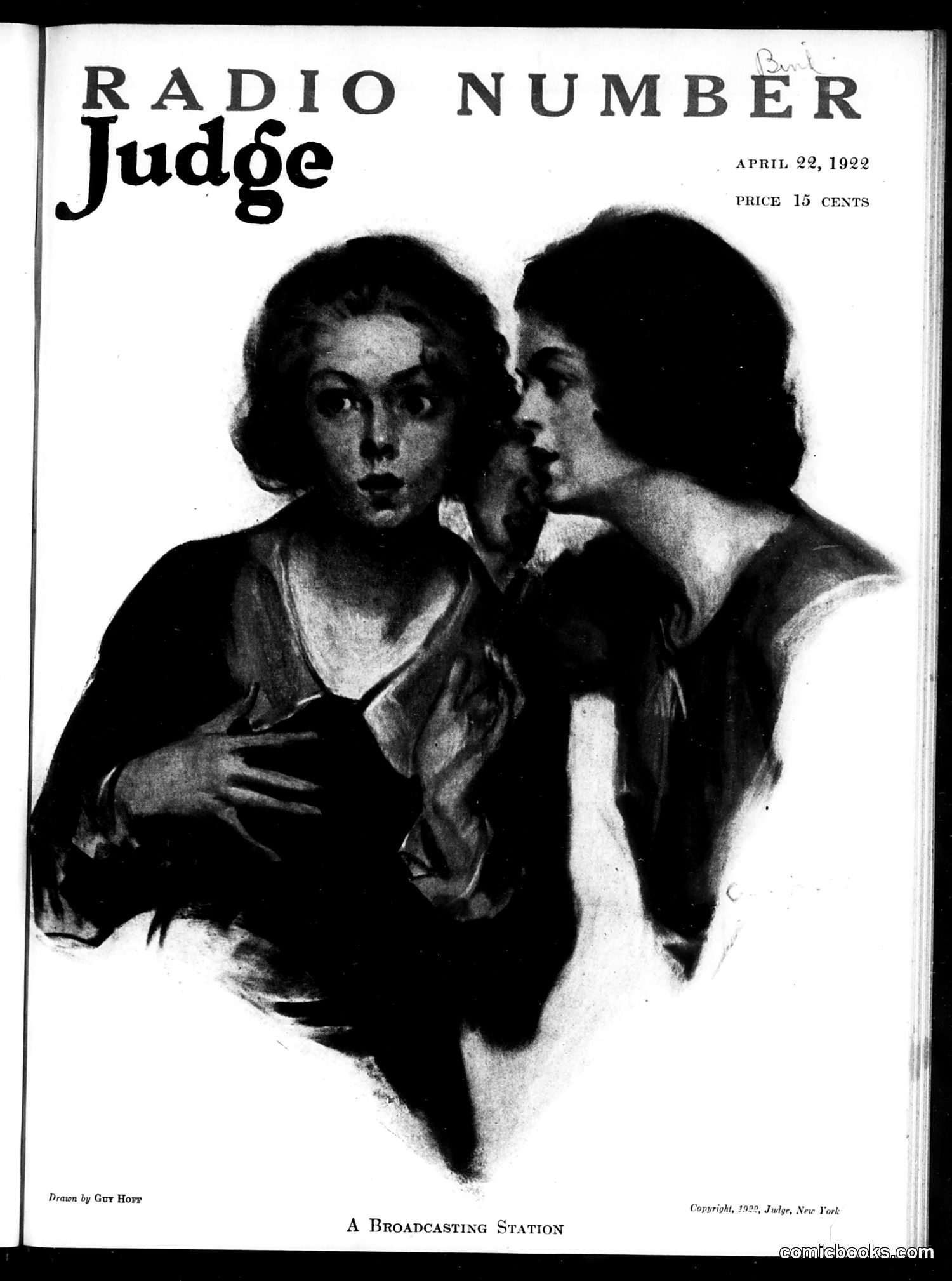
This cover illustration, titled "A Broadcasting Station" and drawn by Cesare Hore, depicts two figures in what appears to be a radio broadcasting scenario. The composition shows one person speaking or performing while another listens or observes—likely representing the new technology of radio broadcasting that was becoming prominent in 1922. The satire likely comments on early radio as a novel medium. The expressions and body language suggest commentary on the awkwardness or novelty of this emerging form of mass communication. Given *Judge* magazine's satirical nature, the cartoon probably mocks either radio enthusiasts, the technology itself, or how broadcasting was changing American communication—though the specific satirical target remains somewhat unclear from the image alone.
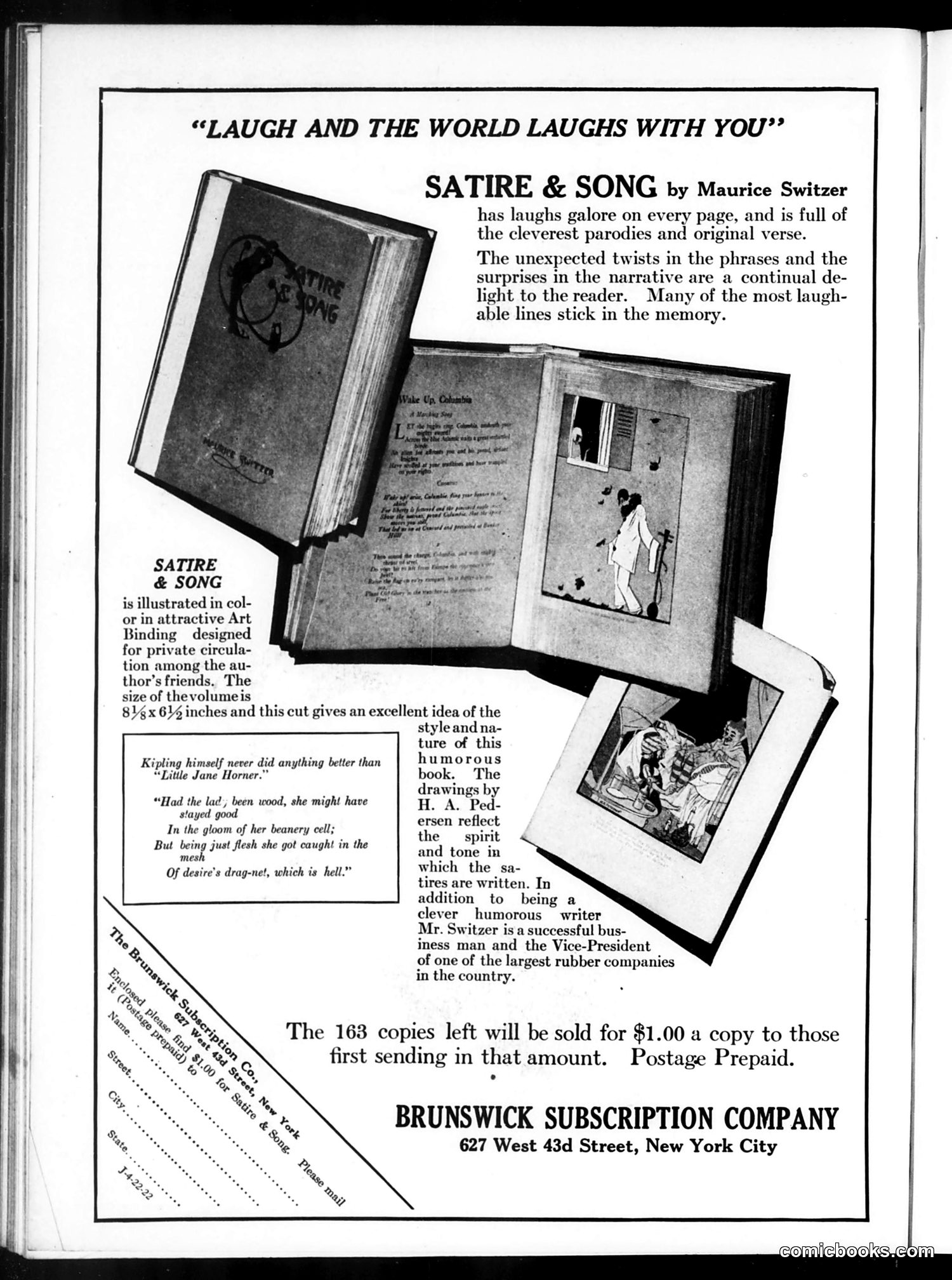
This page is primarily **advertising**, not political satire. It promotes "Satire & Song" by Maurice Switzer, a humorous book of parodies and verse illustrated by H. A. Pedersen. The ad emphasizes the book's appeal through: - Sample illustrations showing its Art Binding design - A quoted excerpt mocking Kipling's "Lays of the Hooligan," suggesting Switzer specialized in literary parody - Details about dimensions (8.5 x 6.5 inches) and price ($1.00) The advertisement targets wealthy readers through references to "private circulation among the author's friends," indicating limited distribution among elites. Switzer is identified as a rubber company executive, positioning the book as a gentleman's humorous publication rather than mass-market satire. The page contains no identifiable political cartoons or contemporary political commentary.
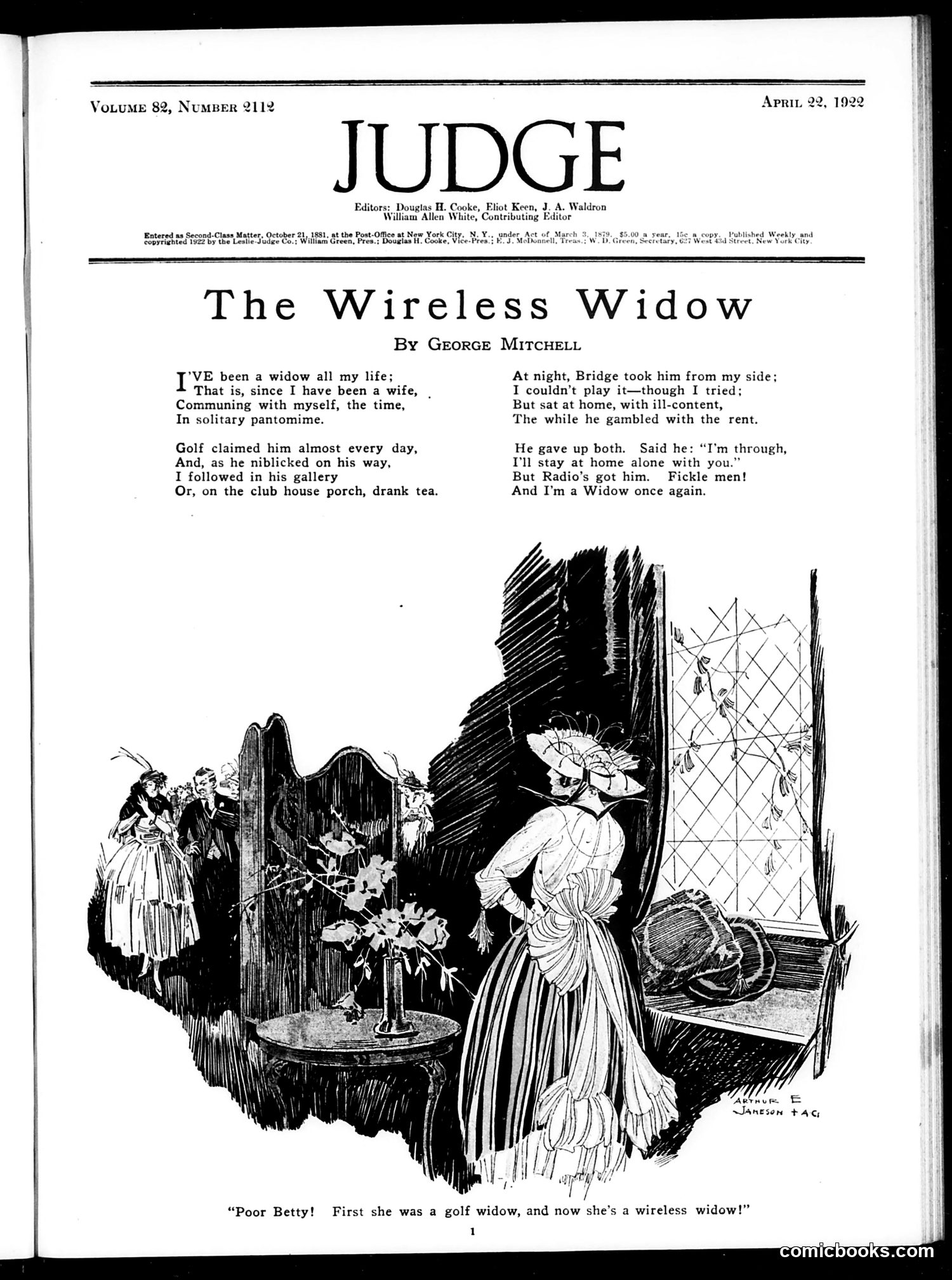
This poem by George Mitchell satirizes a wife whose husband has abandoned domestic life for golf and radio—two emerging technologies/leisure activities of the 1920s. The humor pivots on "widow" having a double meaning: she's a "golf widow" (neglected wife whose husband golfs constantly) and now a "wireless widow" (her husband prefers radio entertainment at home to her company). The illustration shows the wife looking out a window while her husband enjoys indoor radio, having given up golf. The satire critiques how new technologies—particularly radio's novelty in the early 1920s—were fracturing household attention and marital companionship, replacing time together with solitary male leisure.
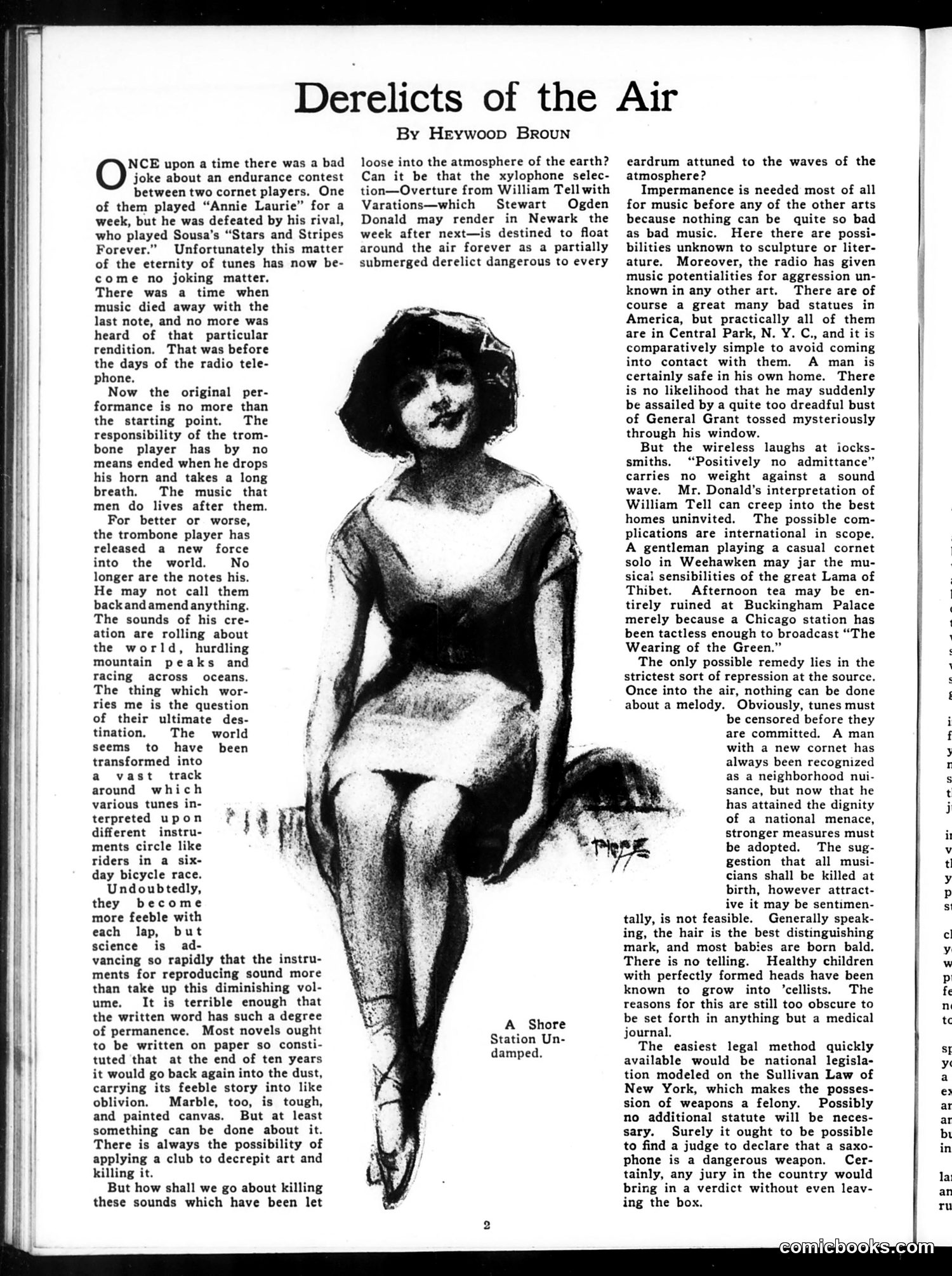
This satirical article criticizes radio broadcasts of poor musical quality. Broun argues that once music is transmitted over airwaves, it becomes public and uncontrollable—unlike a live performance you can leave. He complains that bad radio music invades homes and cannot be stopped. The illustration shows a nude figure appearing distressed or suffering, likely representing the listener assaulted by unwanted broadcast sounds. Broun's central complaint is that radio lacks quality control: musicians perform sub-standard material that spreads widely, and unlike written words, these "derelicts" cannot be recalled or improved. He proposes stricter regulation at the broadcast source to prevent inferior musical content from reaching homes. The satire targets both radio stations' permissiveness and the inescapable nature of wireless transmission.
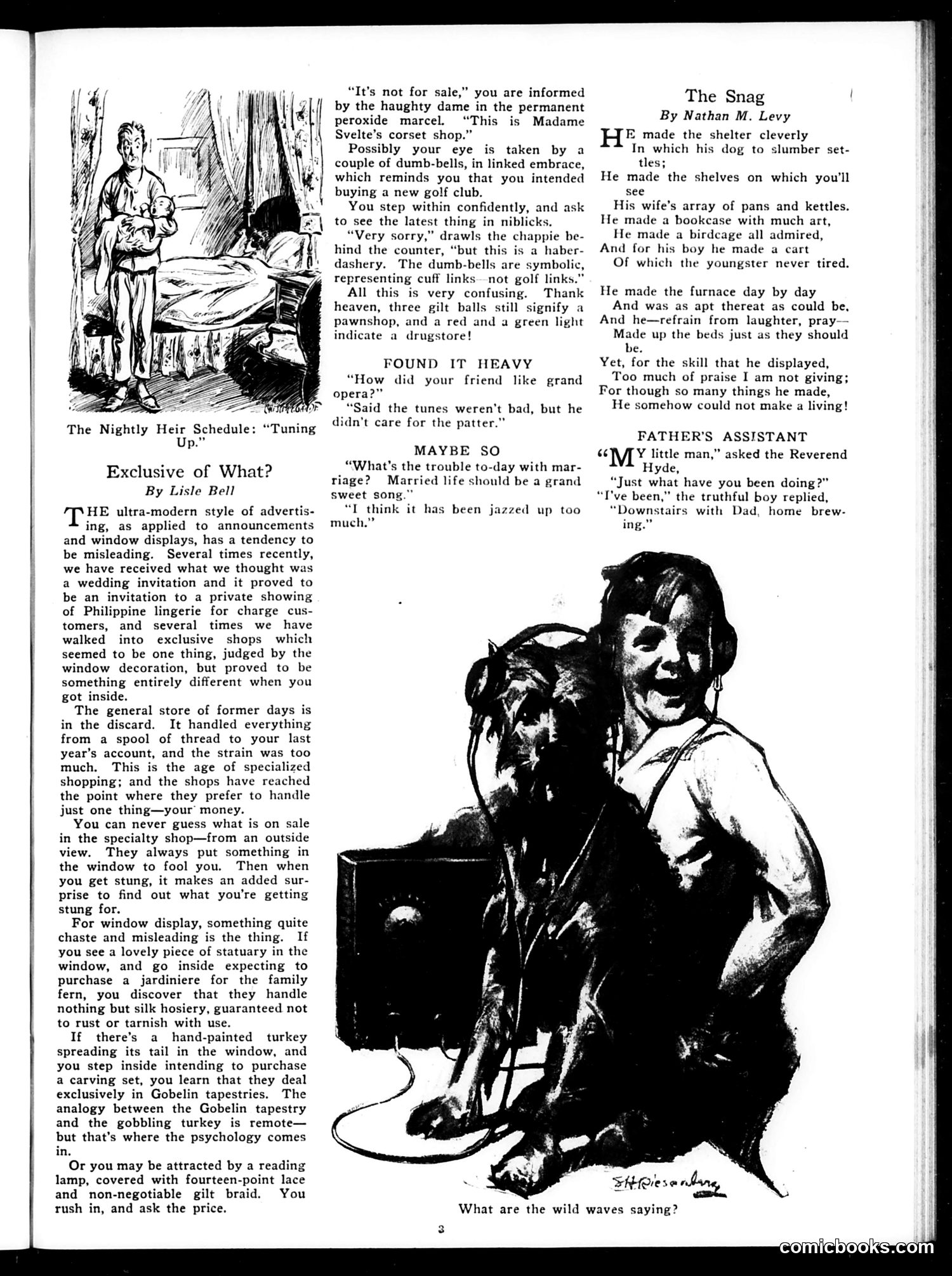
This page contains three unrelated pieces: 1. **"Exclusive of What?"** by Elsie Bell satirizes misleading modern retail advertising. The author describes entering shops displayed as "exclusive" yet finding they stock only common items (silk hosiery, Gobelin tapestries, hand-painted turkeys). The satire mocks how specialty shops use fancy window displays to trick customers into believing they're purchasing rare or unique goods, when actually the items are mass-produced or ordinary. 2. **"The Snag"** by Nathan M. Levy is a poem praising a skilled working man who builds household items and furnishings. 3. **"Father's Assistant"** features a cartoon of a man with a dog listening to radio headphones. The caption "What are the wild waves saying?" references a Victorian-era song, creating humor from the incongruity of modern radio technology paired with dated literary allusion.
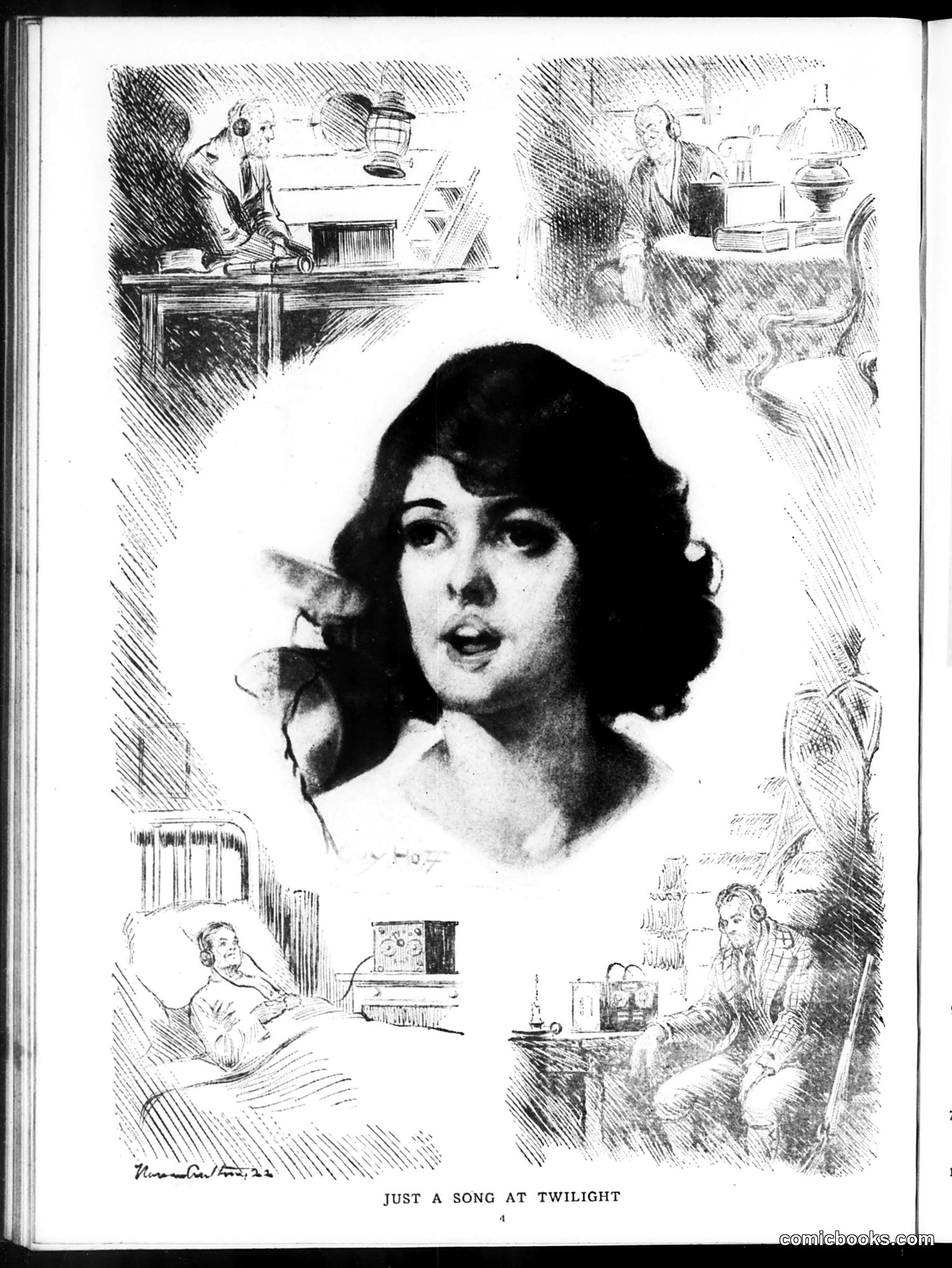
This page from *Judge* magazine features a central portrait of a woman with 1920s-style short, wavy hair, surrounded by four vignette sketches depicting domestic scenes. The title "Just a Song at Twilight" references a popular sentimental Victorian parlor song, likely evoking nostalgic domesticity. The surrounding sketches appear to show various indoor scenes—people at desks, in bedrooms, and at work—suggesting commentary on modern domestic life or women's roles. Without additional context identifying the specific woman portrayed or the magazine's publication date, the exact satirical target remains unclear, though the juxtaposition of sentimental title against contemporary scenes suggests irony about outdated romantic ideals versus modern reality.
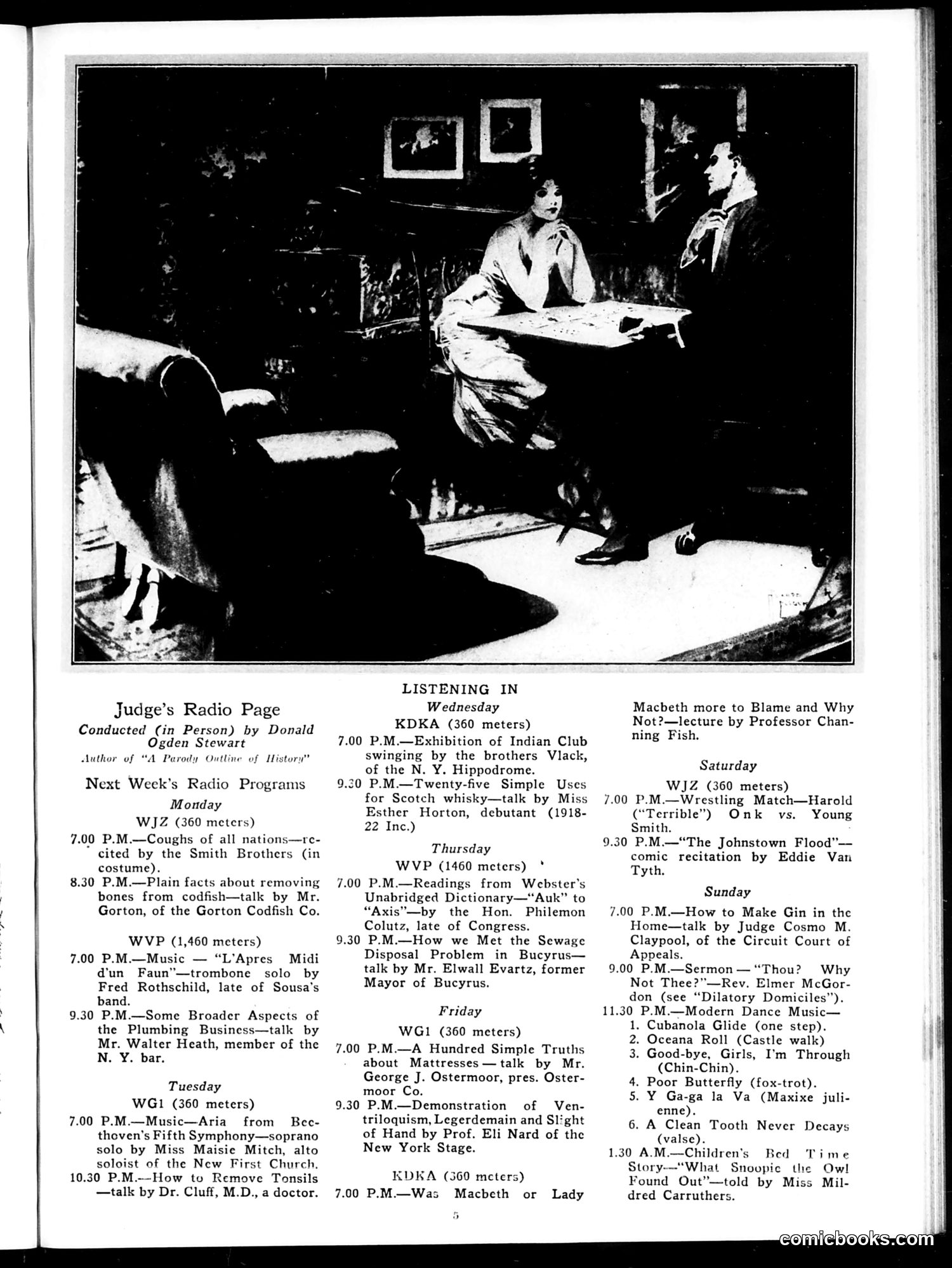
This is a humorous parody of early 1920s radio programming by satirist Donald Ogden Stewart. The joke mocks the mundane, absurdly specific content actually broadcast on radio stations (WJZ, WVP, etc. were real networks). The satire presents deliberately tedious programming: the Smith Brothers reciting "coughs of all nations," lectures on removing fish bones, plumbing business talks, and dictionary readings. It peaks with a Sunday broadcast on "How to Make Gin in the Home"—likely a Prohibition-era joke, since home distilling was illegal during this period (1920-1933). The cartoon image shows people gathered around an early radio, apparently listening to this mediocre content. Stewart's exaggerated program listings mock both radio's novelty and the low-quality, sponsor-driven educational or commercial content that actually dominated early broadcasts, presenting them as simultaneously tedious and absurd.
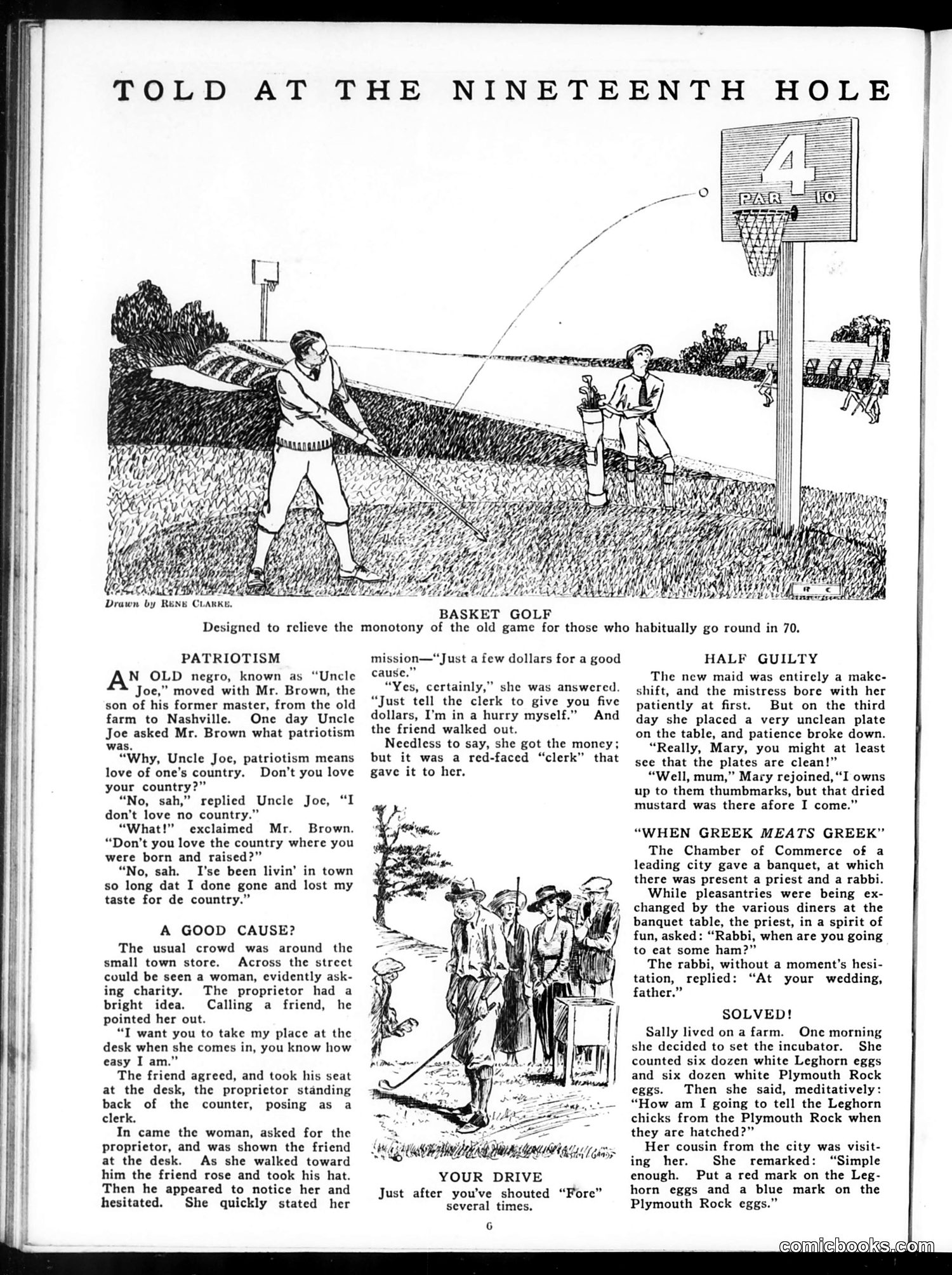
This page collects humorous anecdotes told among golfers. The title refers to the nineteenth hole—the clubhouse bar where golfers gather after playing eighteen holes. **"Patriotism"**: Uses a racist dialect-heavy joke mocking an elderly Black man ("Uncle Joe") who, having moved to town, claims to have lost his taste for country life. The "joke" relies on caricature and outdated rural stereotypes. **"A Good Cause"**: A proprietor tricks a friend into approving charity by pretending the friend is the clerk. The friend, embarrassed at being duped into generosity, must pay. **"Half Guilty"**: A new maid admits to some but not all kitchen negligence, deflecting blame for dried mustard already present. **"When Greek Meets Greek"**: A priest asks a rabbi when he'll eat ham; the rabbi quips he'll do so at the priest's (future) wedding—implying priests don't marry. **"Basket Golf"**: The illustration shows golf reimagined with basketball hoops, designed to entertain older golfers who shoot around 70 strokes. These are genteel country-club humor typical of early 20th-century Judge magazine.
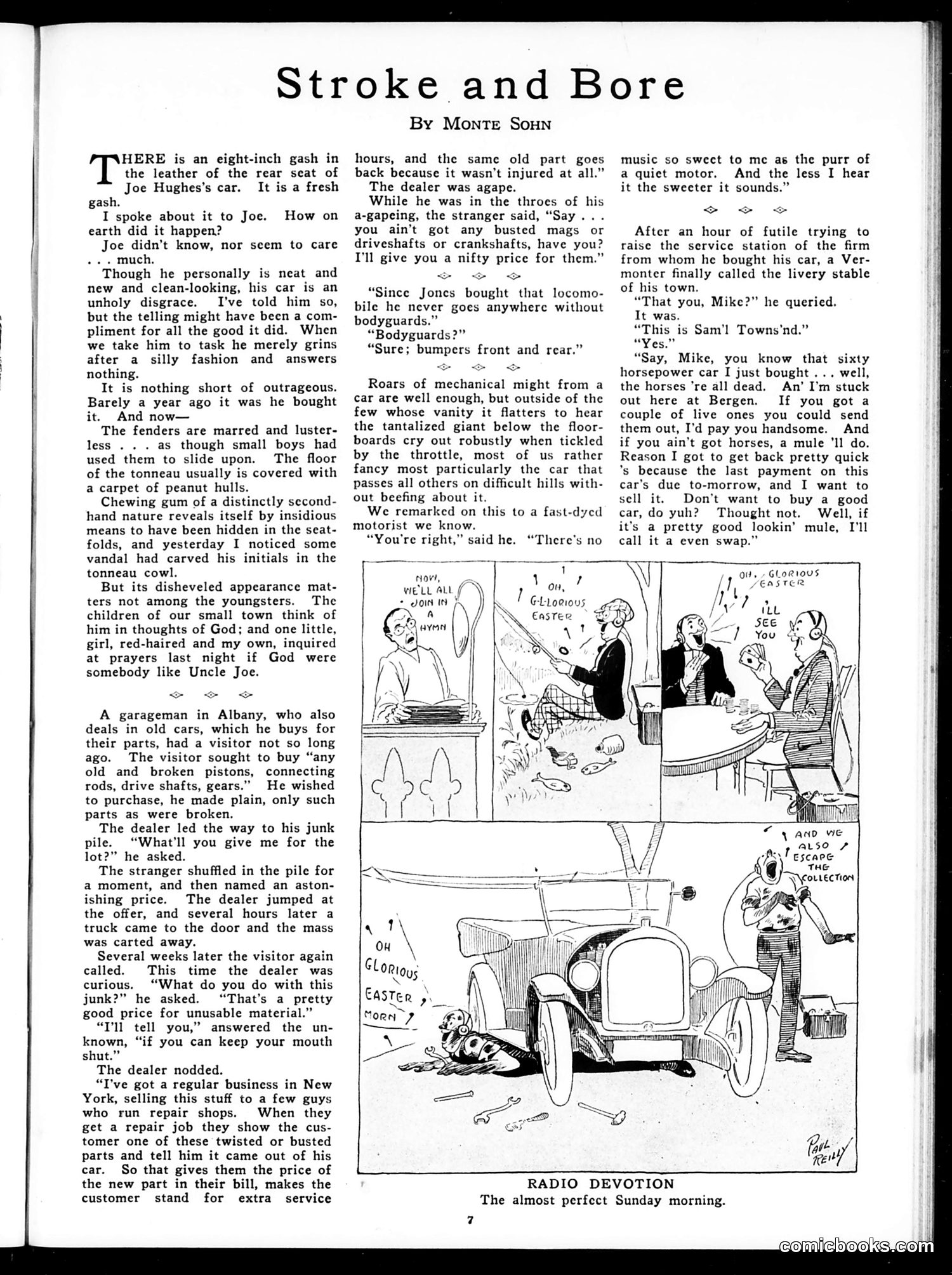
This page contains three automotive humor pieces by Monte Sohn, reflecting early-20th-century car culture anxieties. The main story satirizes a **repair shop fraud scheme**: a New York operator buys broken auto parts from junkyards, then repair shops show these damaged components to customers claiming they came from their cars, charging for replacements while reinstalling the worthless originals. It's a scam exploiting customers' inability to verify mechanical claims. The accompanying cartoon ("Radio Devotion") depicts this fraud in action—a mechanic showing a customer a broken part supposedly from their vehicle while actually performing unnecessary repairs. Two short jokes follow: one mocking the newly wealthy ("Since Jones bought that locomotive..."), and another contrasting motorists who value quiet, reliable engines over loud, boastful ones. The opening anecdote about Joe Hughes's deteriorating car serves as a gentle character study—the owner's indifference to maintenance contrasts with children's reverence for him, suggesting virtue transcends material conditions. The satire targets **mechanic dishonesty and consumer vulnerability** in an era before standardized repair regulations.
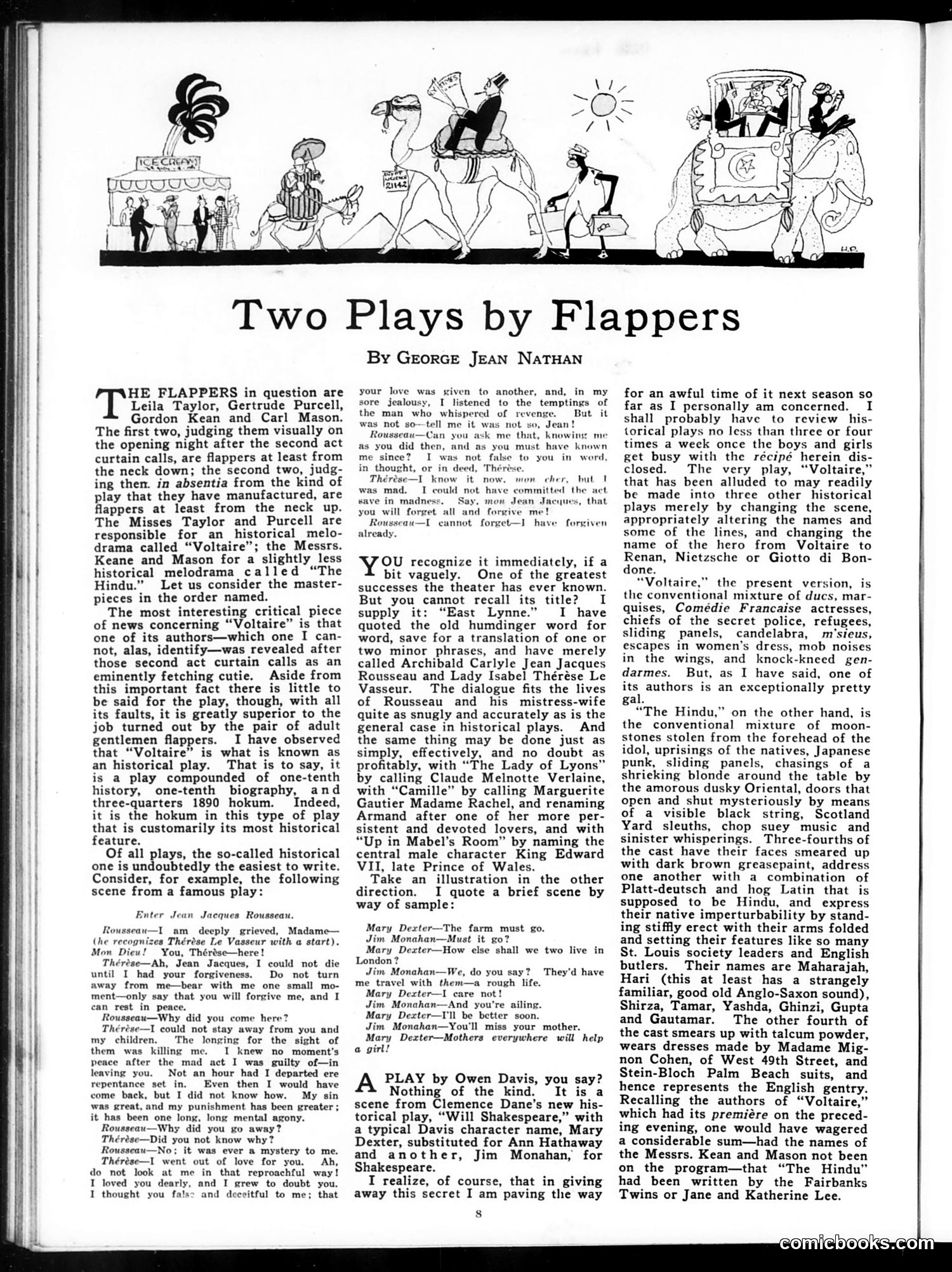
This is a theater review by George Jean Nathan critiquing two plays written by young women ("flappers"—1920s slang for modern, liberated women): "Voltaire" by Taylor and Purcell, and "The Hindu" by Kean and Mason. **The Satire:** Nathan mocks historical melodramas as formulaic trash. He demonstrates this by showing how "East Lynne" (a famous Victorian play) can be recycled with different character names—proving the genre relies on stock plots rather than authentic history or originality. **The Point:** He's simultaneously mocking the young female playwrights for producing derivative, sensationalized "hokum," while also making a broader critique of the entire historical melodrama genre itself. The review suggests these "flapper" writers are merely mimicking tired theatrical conventions, producing work inferior even to established bad plays. The tone is condescending toward both the playwrights and the theatrical form they're working in.
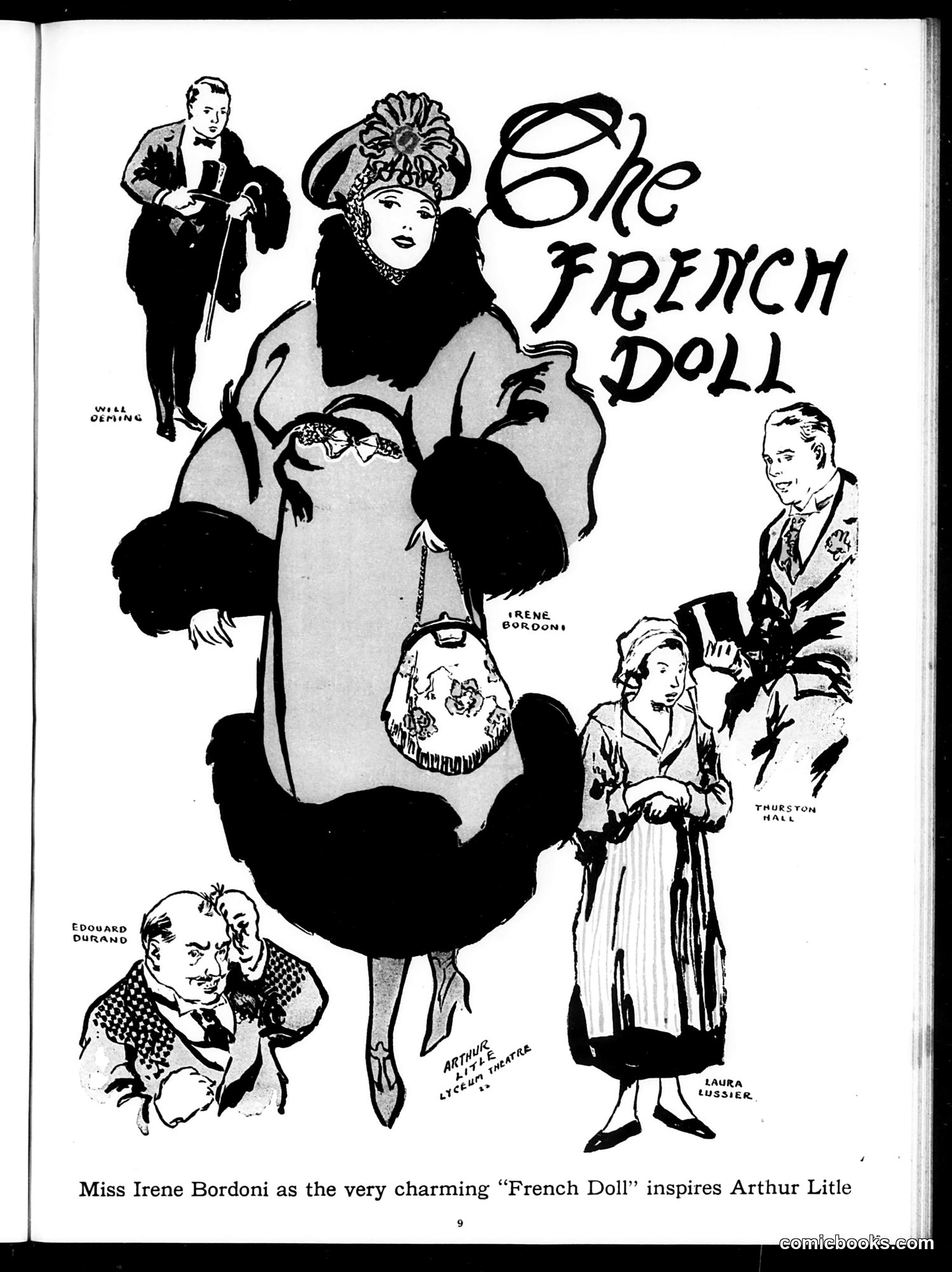
This page promotes Arthur Little's theatrical production "The French Doll," featuring actress Irene Bordoni in the title role. The central illustration shows an elegantly dressed woman in fashionable 1920s attire—including a decorative hat, fur stole, and beaded handbag—embodying the glamorous "French" aesthetic that would have appealed to American audiences. The surrounding smaller portraits identify cast members (Will Deming, Edward Durand, Thurston Hall, and Laura Lussier), suggesting this is promotional material rather than political satire. The piece reflects the era's fascination with Continental sophistication and the popularity of French-themed entertainment on Broadway. The sophisticated illustration style and prominent billing indicate this was a significant theatrical production of its period.
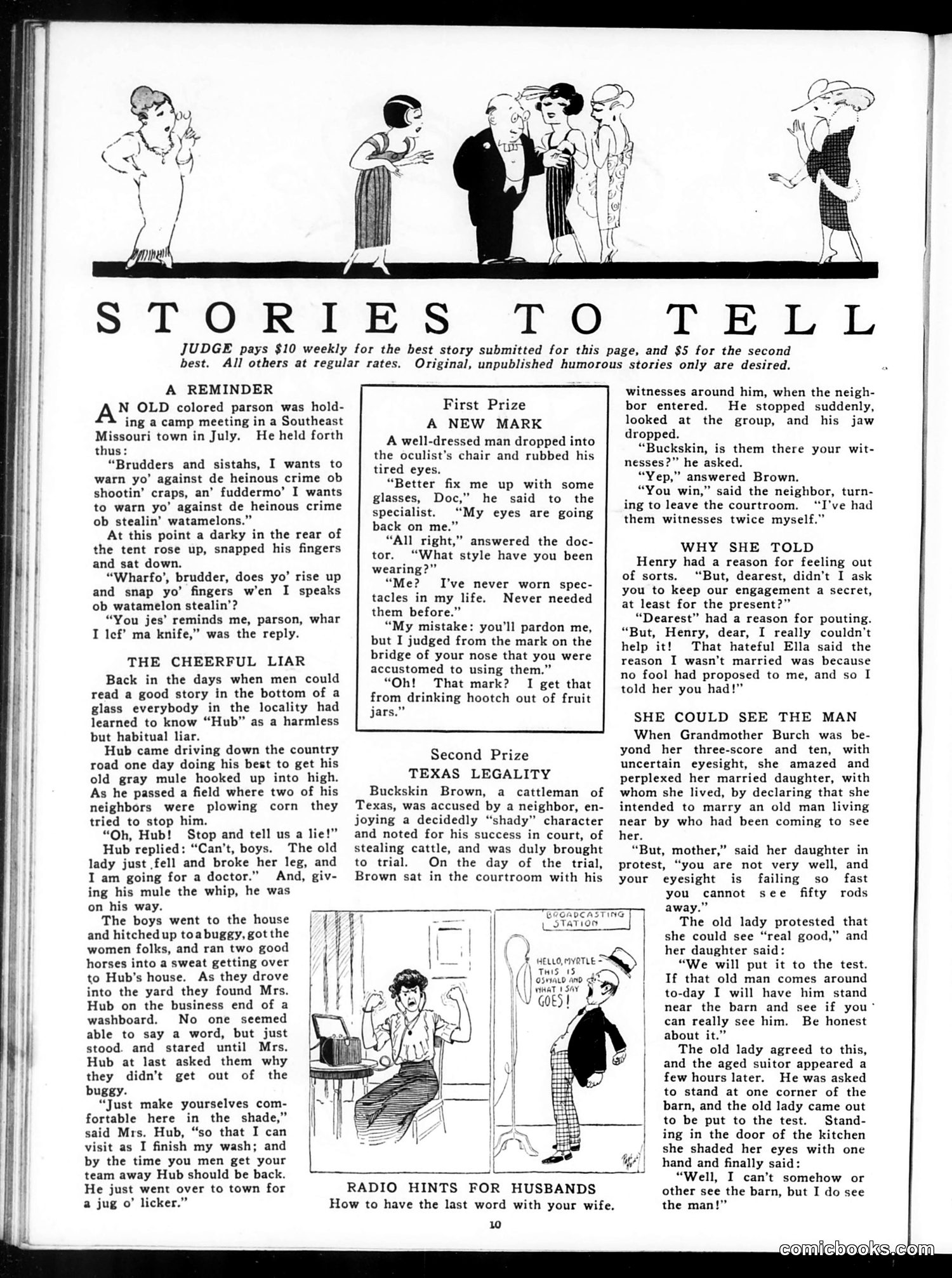
This page from Judge magazine contains three humorous short stories submitted by readers. The content reflects early-20th-century American attitudes and stereotypes: **"A Reminder"** uses racist dialect humor, depicting a Black preacher and congregation in a stereotypical manner typical of the era's casual racism. **"The Cheerful Liar"** is a straightforward anecdote about a habitual liar whose emergency claim finally goes unbelieved—a classic "boy who cried wolf" setup. **"A New Mark"** jokes about Prohibition-era drinking, showing a man with a visible mark on his nose from illegal "hootch" bottles rather than eyeglasses. **"Texas Legality"** satirizes frontier justice, suggesting witnesses can be bought or reused across trials in Texas courts. The remaining stories focus on romantic entanglements and domestic situations. Overall, the page represents Judge's "Stories to Tell" submission section, offering payment for humorous anecdotes reflecting contemporary social attitudes and values.
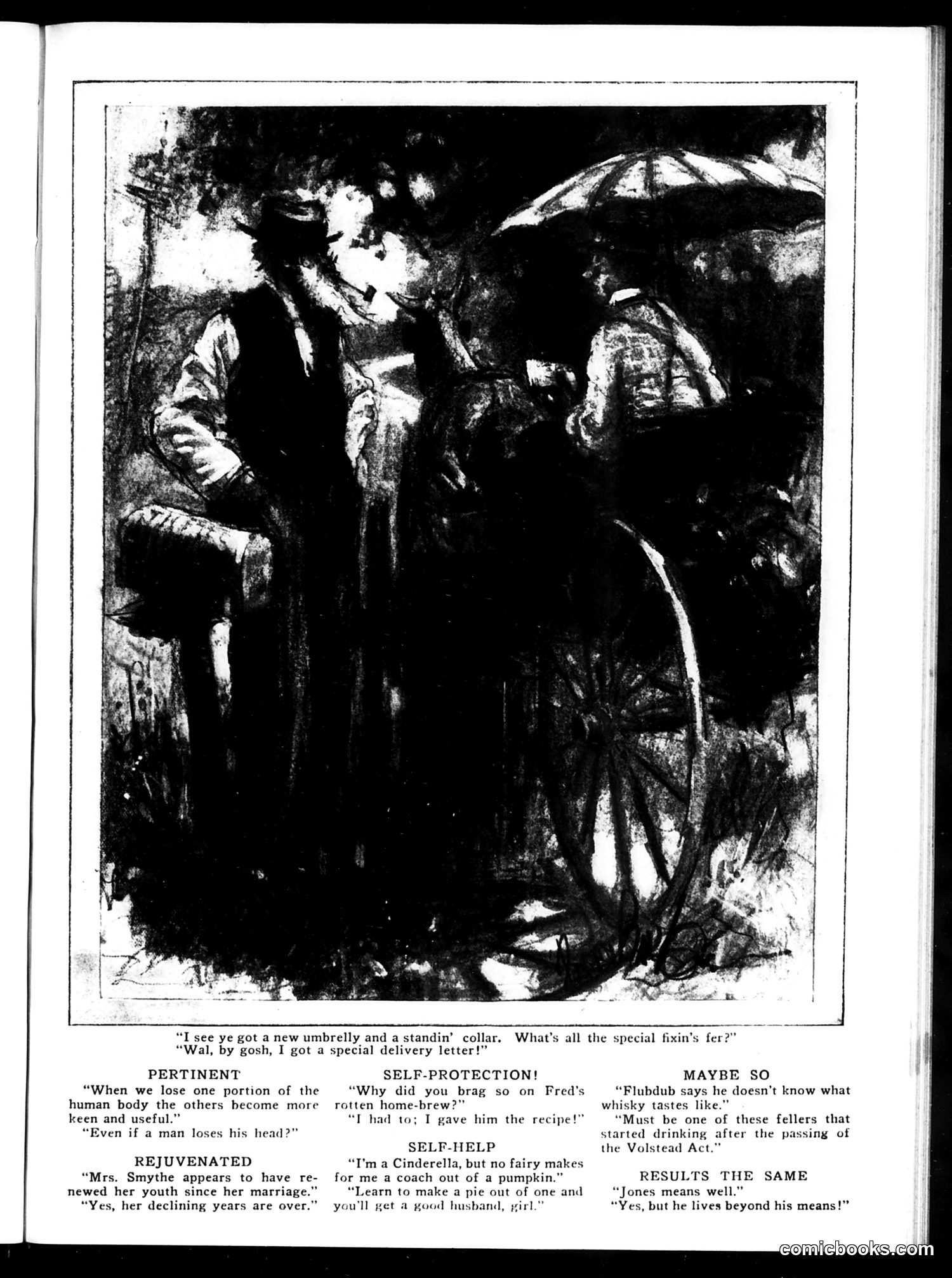
This page contains six brief comic vignettes mocking early 20th-century social attitudes and domestic life. The cartoons target common stereotypes: rural simplicity ("special delivery letter"), domestic deception (homemade alcohol), gender roles ("Cinderella" woman learning to cook for a husband), and marital dynamics (rejuvenation through marriage, wives managing finances). One reference is clearly topical: "Volstead Act" alludes to Prohibition (1920-1933), joking that someone who doesn't know whiskey's taste must have started drinking *after* alcohol became illegal—a satirical jab at either hypocrisy or the absurdity of Prohibition enforcement. The humor relies on period stereotypes about class, gender, and morality that would resonate with Judge's educated, middle-class readership. The page uses these domestic scenarios to gently mock human foibles and social conventions rather than advocate for change.
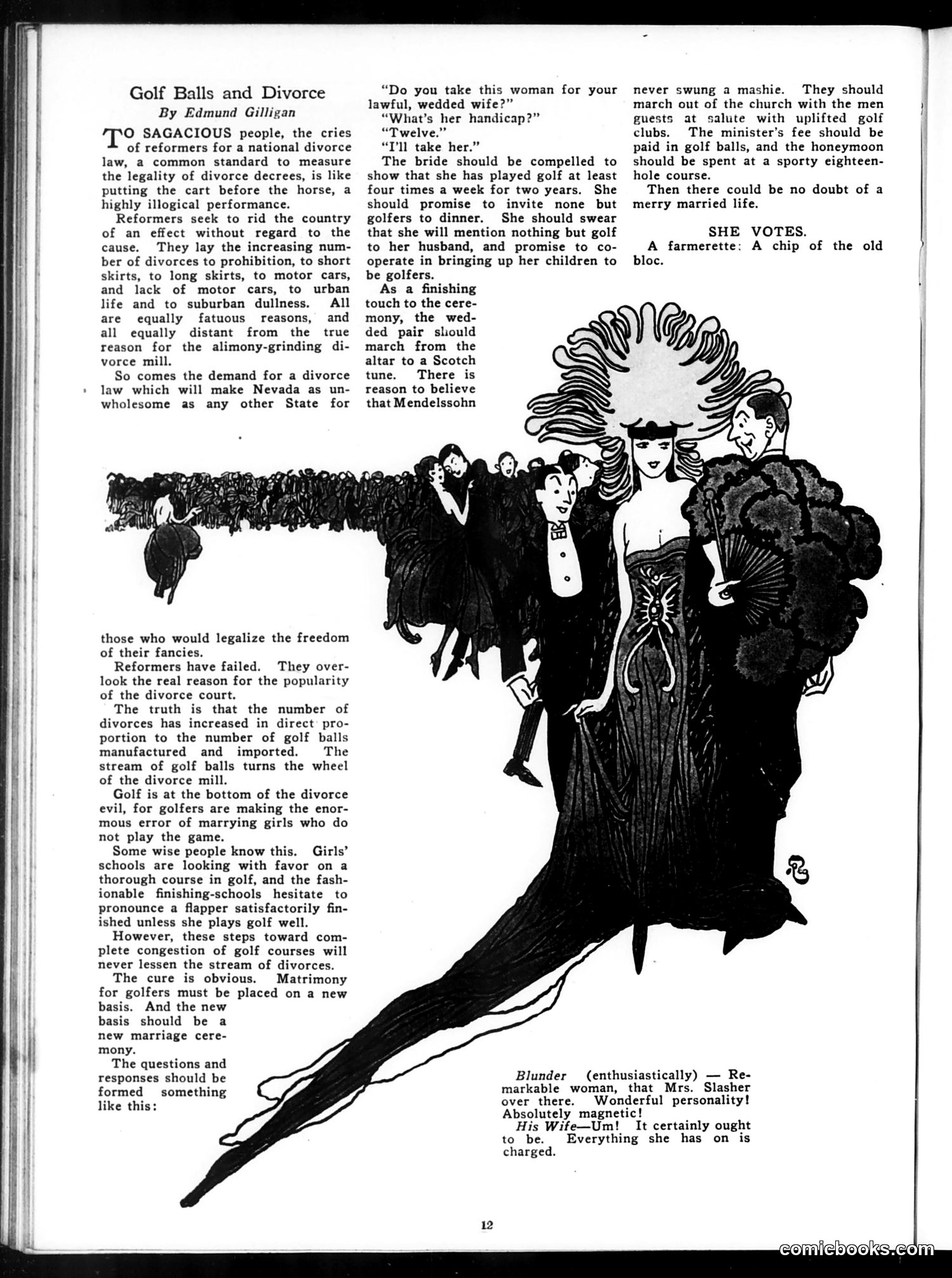
This article by Edmund Gilligan satirizes 1920s anxieties about rising divorce rates and changing social norms. The author mockingly argues that divorce increases correlate with golf ball manufacturing—a absurd claim used to critique how reformers blame divorce on tangential causes (prohibition, fashion, cars) rather than addressing real issues. The actual target: women's changing roles. Gilligan argues men marry women who don't play golf, causing marital discord. His "solution" parodies marriage vows, demanding brides prove golf competency and promise to discuss only golf—mocking both golf obsession and the period's anxiety about women's independence and leisure activities. The accompanying illustration shows fashionably-dressed women in 1920s attire (flappers), representing the "new woman" reformers blamed for social upheaval. The "She Votes" caption references women's recent suffrage (1920), suggesting this "modern woman" disrupts traditional society—the actual anxiety beneath the satire.
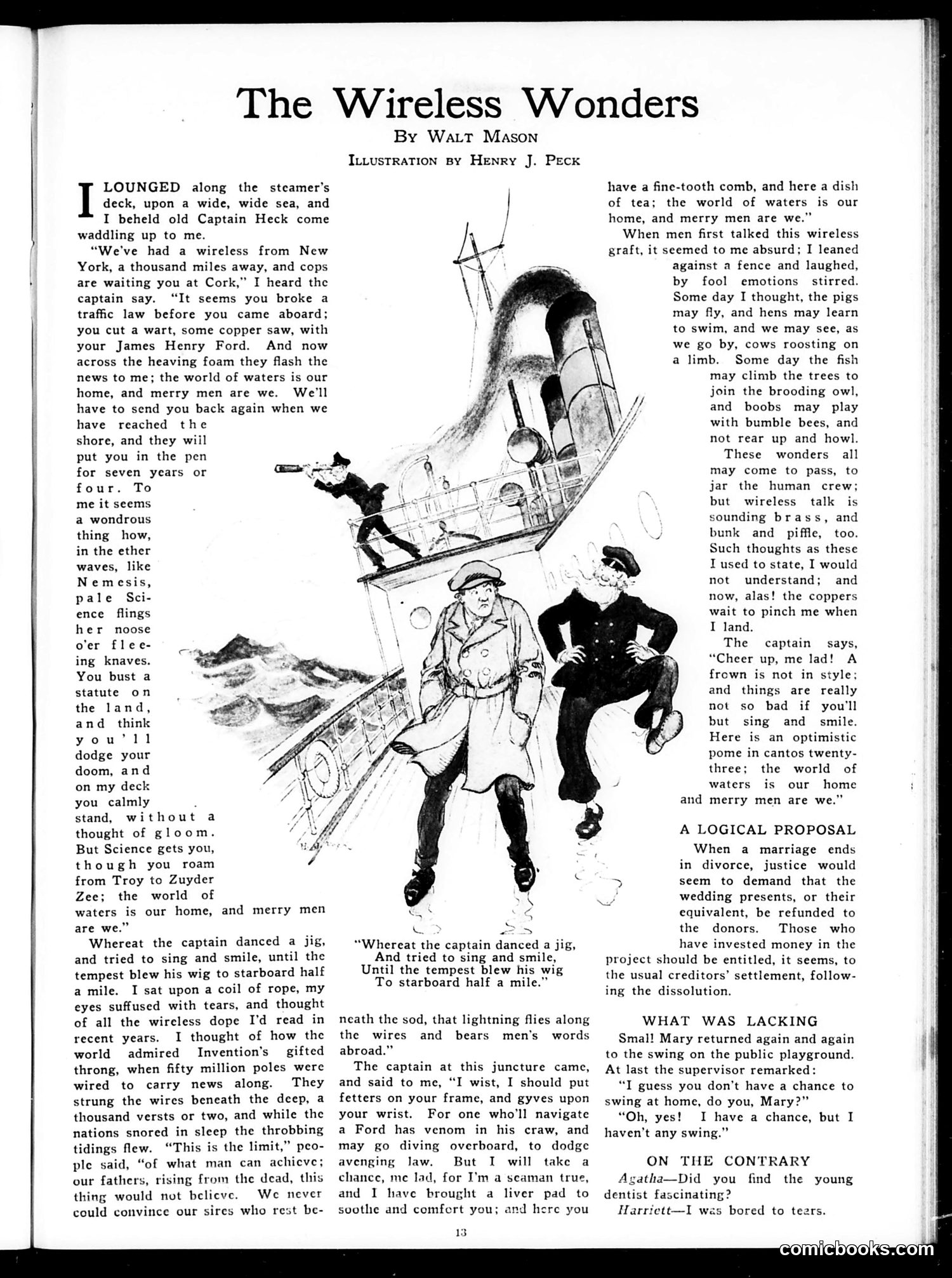
This humorous poem by Walt Mason satirizes the newly marvel of wireless telegraphy. The narrator, aboard a ship, encounters Captain Heck who delivers shocking news via wireless: the narrator is wanted by police ashore for traffic violations involving a "James Henry Ford" (likely a Model T automobile reference). The satire operates on two levels: First, it mocks the narrator's initial skepticism about wireless technology as impossible—he compares it to pigs flying and cows roosting in trees. Second, it ironically celebrates wireless as miraculous human achievement, yet demonstrates its use catching lawbreakers mid-ocean escape. The joke is that while the narrator dismissed wireless as "bunk and piffle," this same technology now prevents him from evading justice. The captain's cheerful acceptance ("the world of waters is our home") contrasts with the narrator's dismay. Mason uses the unreliable narrator to gently ridicule those who underestimate scientific progress, while acknowledging wireless technology's genuinely revolutionary impact on modern life.
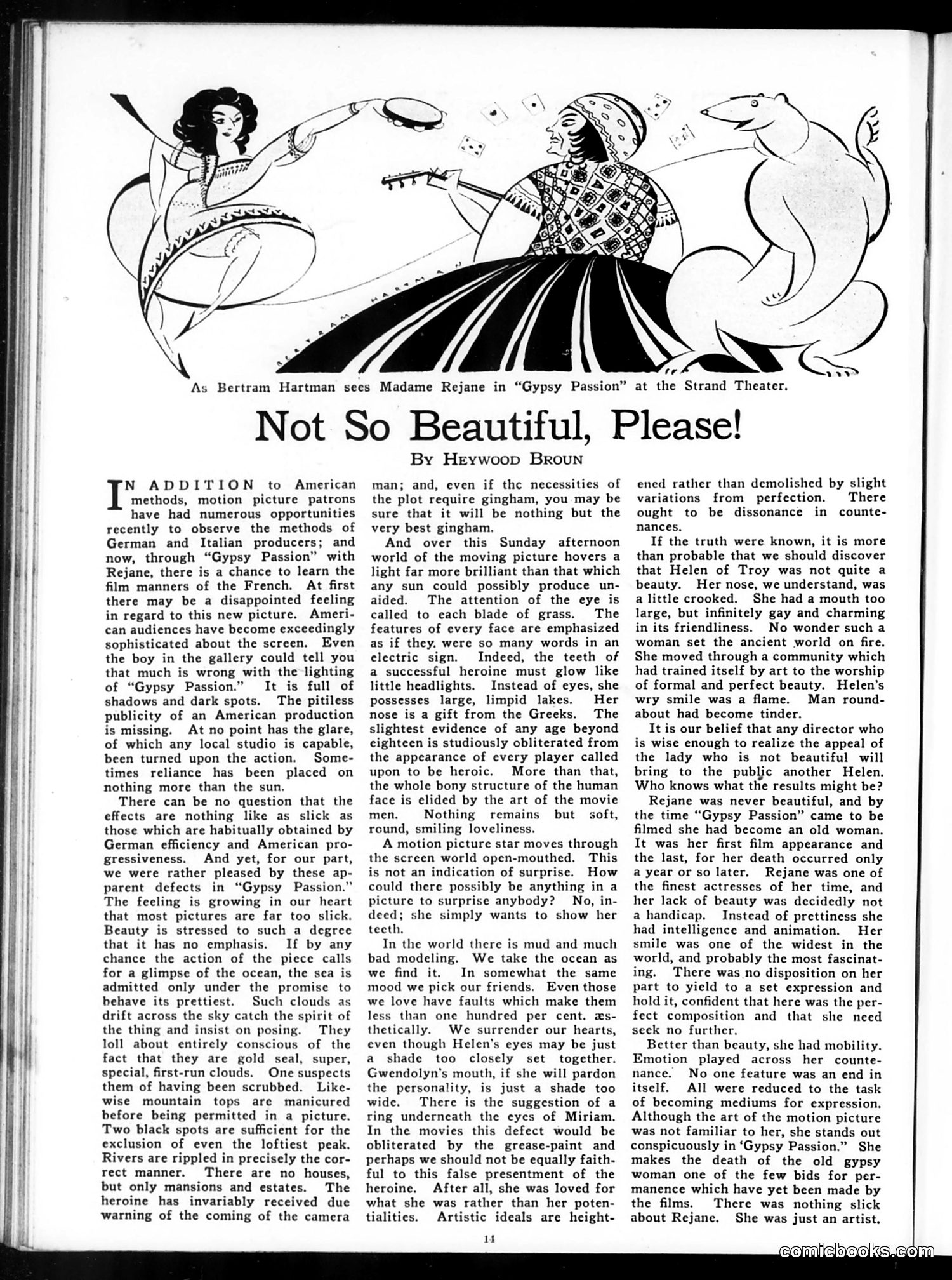
This 1920s-era article critiques the artificiality of American cinema by praising the French film "Gypsy Passion" starring actress Madame Rejane. **The Point:** Heywood Broun argues that American movie studios over-polish everything—artificially lighting scenes, perfecting landscapes, whitening actors' teeth to "headlights," erasing any signs of age or imperfection. He celebrates the French film's grittier, more naturalistic approach: real shadows, unmanicured nature, and an actress (Rejane) valued for intelligence and charm rather than manufactured beauty. **The Satire:** Broun mocks Hollywood's obsession with pristine artificiality—even clouds appear "scrubbed," rivers are "rippled in precisely the correct manner," and heroines must glow like neon signs. He contrasts this with real life's messiness. **The Cartoon:** Shows Rejane performing with expressive, natural gestures, contrasting the article's theme that genuine artistry surpasses cosmetic perfection. This reflects 1920s debates about European versus American filmmaking sophistication.
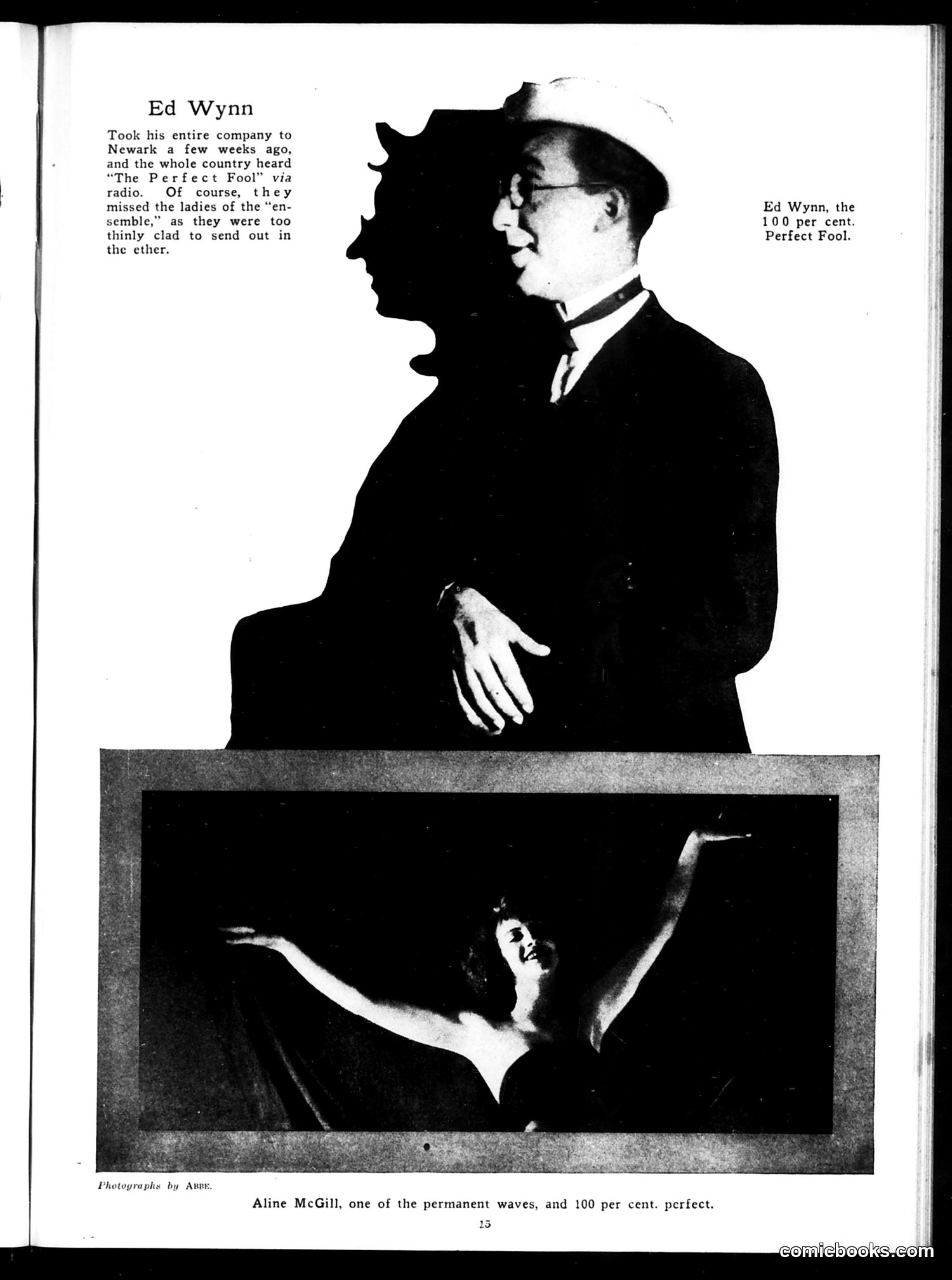
This page satirizes **Ed Wynn**, a famous vaudeville and early radio comedian known as "The Perfect Fool." The joke operates on multiple levels: **The Setup:** Wynn toured his stage show to Newark and broadcast it on radio. However, radio couldn't transmit the visual appeal of his ensemble's female dancers—described as "too thinly clad" (wearing revealing costumes typical of 1920s stage entertainment). **The Satire:** Judge mocks radio's limitations by contrasting what audiences *heard* (Wynn's comedy) versus what they *missed* (the scantily-dressed chorus line). The accompanying photo of dancer **Aline McGill** emphasizes what radio's invisible medium couldn't convey. **The Humor:** This plays on the tension between emerging radio technology and traditional stage entertainment, suggesting radio strips away the visual spectacle that made live shows appealing—particularly the aesthetic appeal of female performers in revealing costumes, reflecting 1920s attitudes toward entertainment and sexuality.
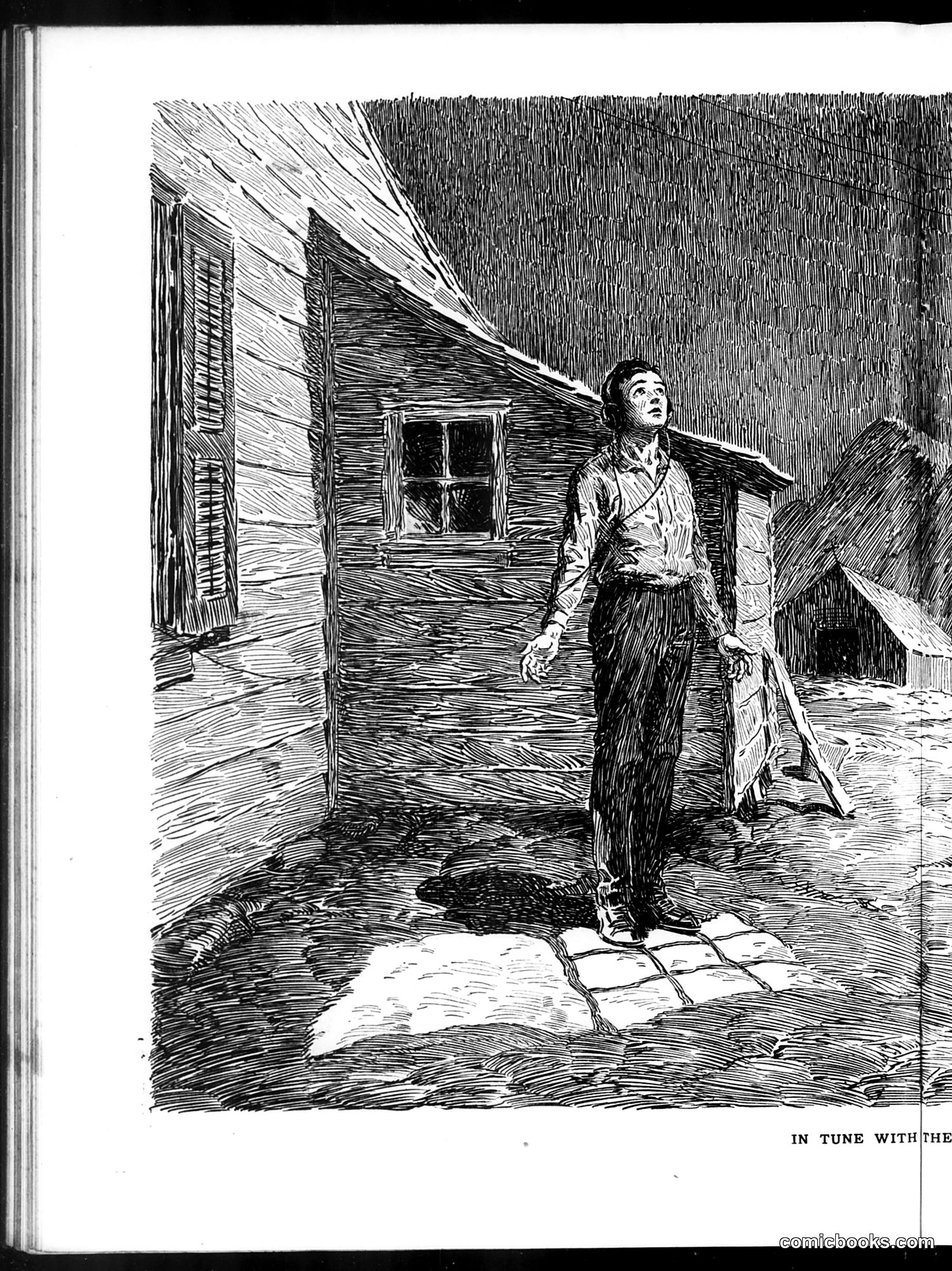
This appears to be a page from *Judge* magazine featuring a wood-engraved illustration of a man standing in a rural or impoverished setting, looking upward. He's dressed in simple work clothes and holds what appears to be a tool or implement. The visible text reads "IN TUNE WITH THE" (the caption is cut off), suggesting this is a satirical commentary on someone or something being "in tune" with a particular condition or ideology. However, **the OCR text is heavily corrupted and illegible**, making it impossible to determine the specific political reference, the identity of the figure, or the satirical point intended. Without a readable caption or date, I cannot reliably explain what this cartoon satirizes for a modern reader. The image alone shows rural hardship or labor, but the satire's actual target remains unclear.
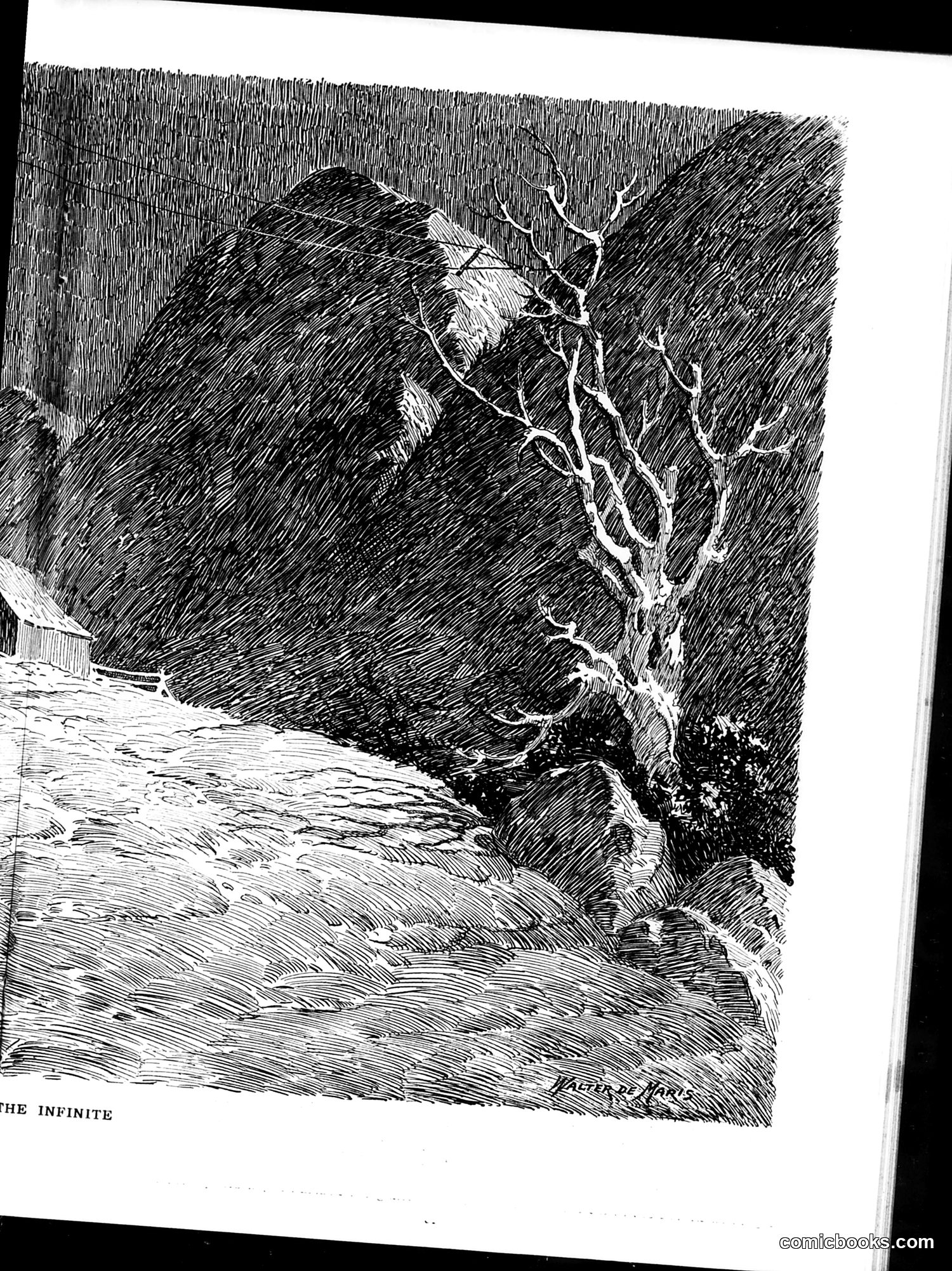
This appears to be a dramatic landscape engraving rather than political satire. The image depicts a bare, twisted tree standing before towering dark cliffs or canyon walls, with what looks like a small human structure (possibly a cabin) in the lower left. The title "THE INFINITE" suggests the work explores themes of human insignificance against nature's vastness—a Romantic or transcendentalist concept popular in 19th-century American art and literature. The stark contrast between the fragile, leafless tree and the massive geological formations emphasizes humanity's smallness within nature's scale. Without additional context about the artist or publication date, the exact satirical intent remains unclear, though it may comment on humanity's relationship to the natural world.
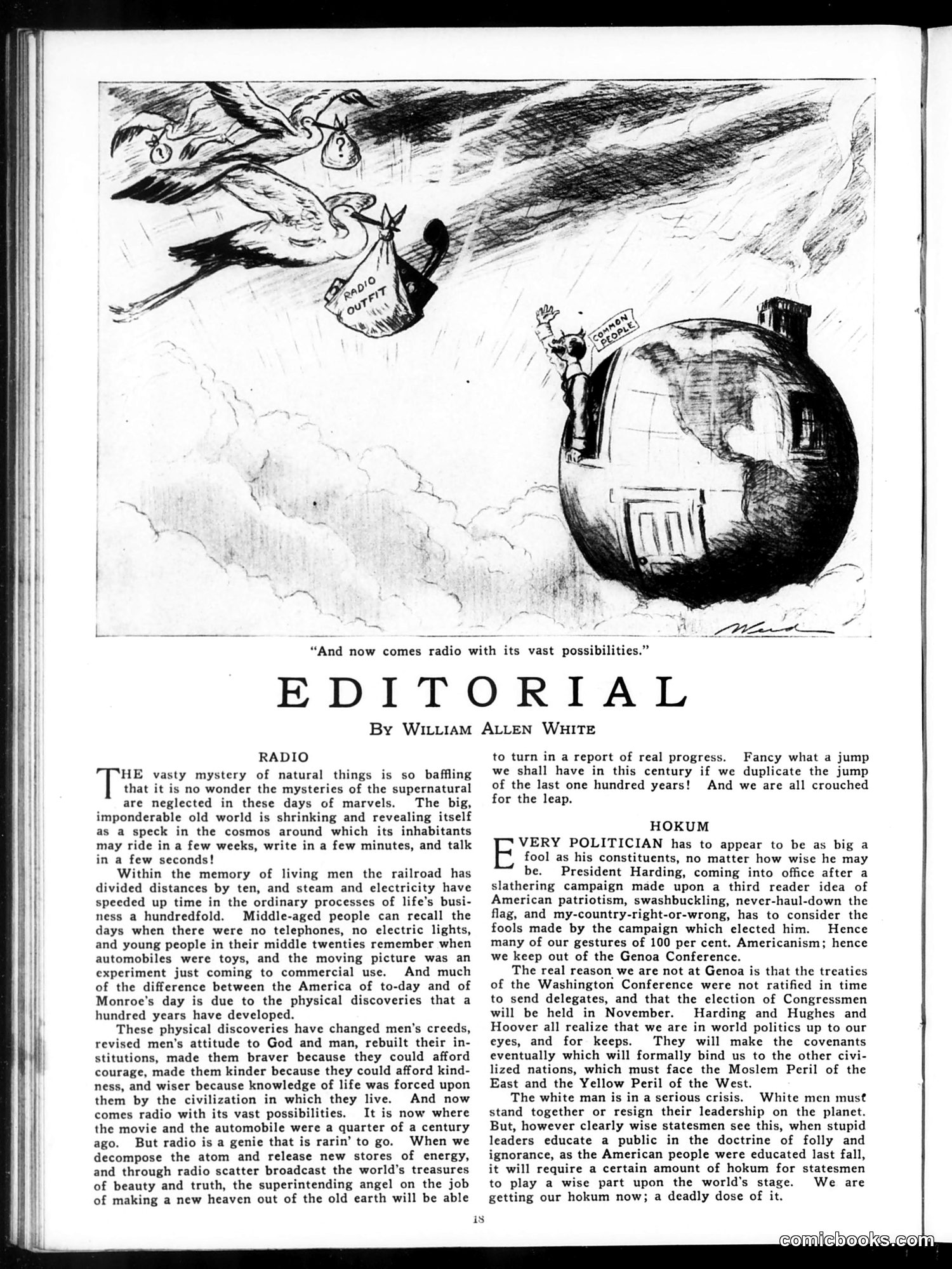
This 1922 editorial by William Allen White addresses two topics through text and political cartoon: **The Cartoon:** depicts radio as a genie emerging from a bottle labeled "Radio Outlawry," with Santa-like figures above representing supernatural/mystical forces. It illustrates White's central metaphor: radio as a powerful new technology with vast, barely-controlled possibilities. **Main Editorial ("Radio"):** celebrates technological progress—railroads, electricity, automobiles, moving pictures—as transformative forces that have made humanity braver and kinder. White argues radio represents the next frontier for broadcasting "world's treasures of beauty and truth." **"Hokum" Section:** critiques President Harding's administration for appearing foolish to satisfy constituents. White suggests Harding's isolationism (keeping America from the Genoa Conference) stems from campaign populism rather than actual wisdom. White argues that despite leaders' private understanding of global political realities—particularly regarding "Moslem Peril" and "Yellow Peril"—they must feed the public "hokum" because voters were educated in "folly and ignorance." The page reveals early 1920s concerns about technology, isolationism, and the gap between political leaders' actual knowledge and public opinion.
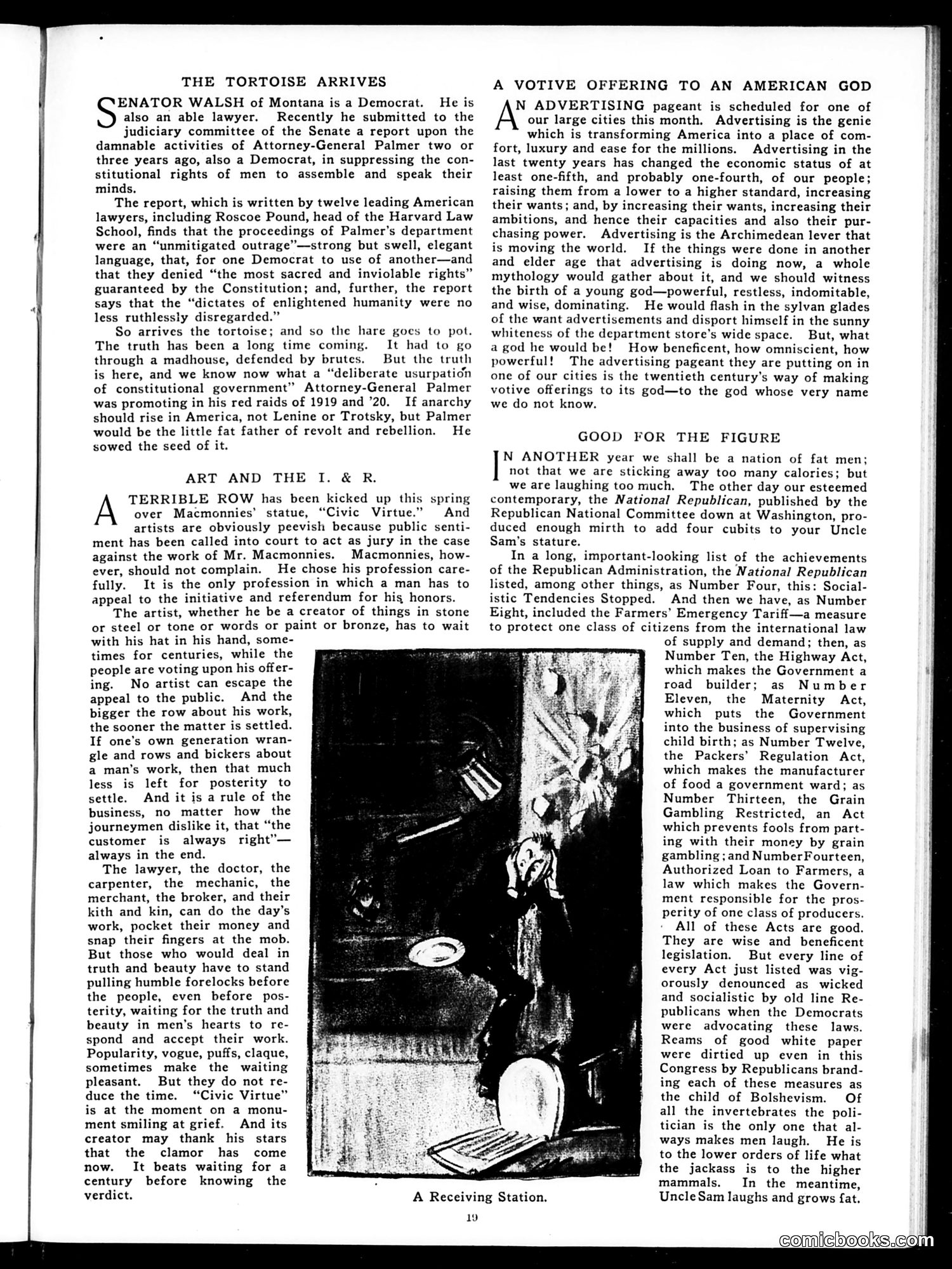
This page contains three distinct articles attacking different targets: **"The Tortoise Arrives"** praises Senator Walsh's delayed report exposing Attorney-General Palmer's "Red Raids" (1919-1920)—aggressive federal crackdowns on suspected communists and anarchists that violated constitutional rights. The "tortoise" metaphor suggests truth moves slowly but inevitably arrives. **"Art and the I. & R."** defends artist Macmonnies against public criticism of his statue "Civic Virtue," arguing artists uniquely must submit their work to popular judgment (via "Initiative and Referendum"—direct democracy mechanisms). The piece argues controversy actually helps settle artistic merit faster than waiting centuries for posterity's verdict. **"A Votive Offering to an American God"** (partially visible) satirizes advertising as a quasi-religious force transforming American consumer culture and economics, sardonically treating it as worshipped like a deity. The cartoon "A Receiving Station" appears to show immigration processing, likely supporting these pages' themes about American institutions and change.
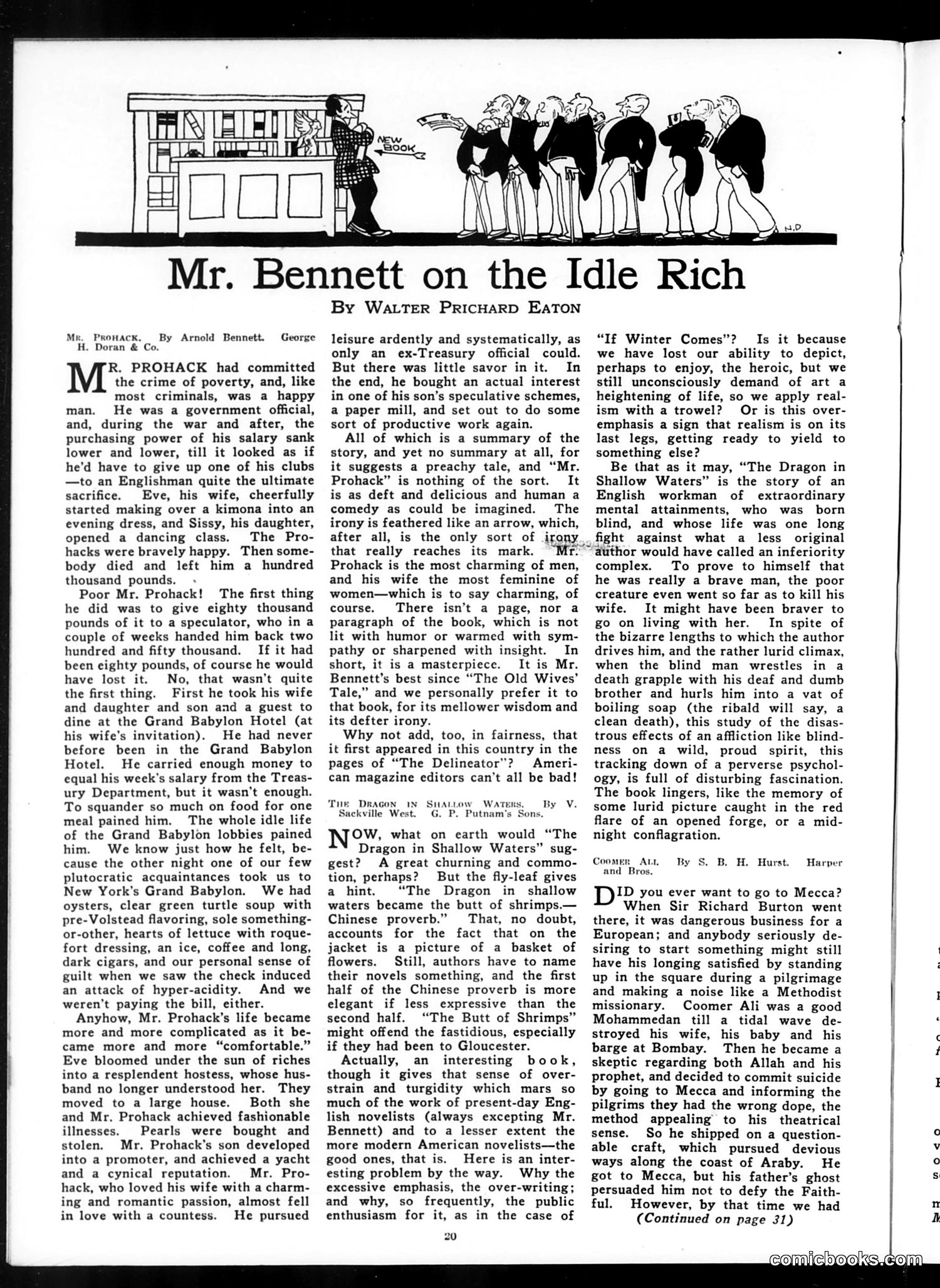
This page reviews Arnold Bennett's novel "Mr. Prohack," a social satire about a British Treasury official who inherits £100,000. The cartoon header (by H.D., likely Hubbard) depicts Bennett himself pointing toward a line of wealthy, idle figures—visualizing the novel's central theme. The satire targets the "idle rich": Mr. Prohack's sudden wealth transforms his dignified life into meaningless luxury and moral compromise. He overpays for restaurant meals, his wife becomes a status-obsessed hostess, his son becomes a cynical speculator, and Prohack himself nearly abandons his marriage for a countess. Only by returning to productive work (investing in a paper mill) does he find purpose. The reviewer (Walter Prichard Eaton) praises Bennett's "feathered irony"—subtle, well-aimed social criticism. The implicit message: inherited wealth corrupts character and happiness, while honest work provides genuine satisfaction. This reflects post-WWI anxieties about England's leisure class and concerns about moral decay through idleness.
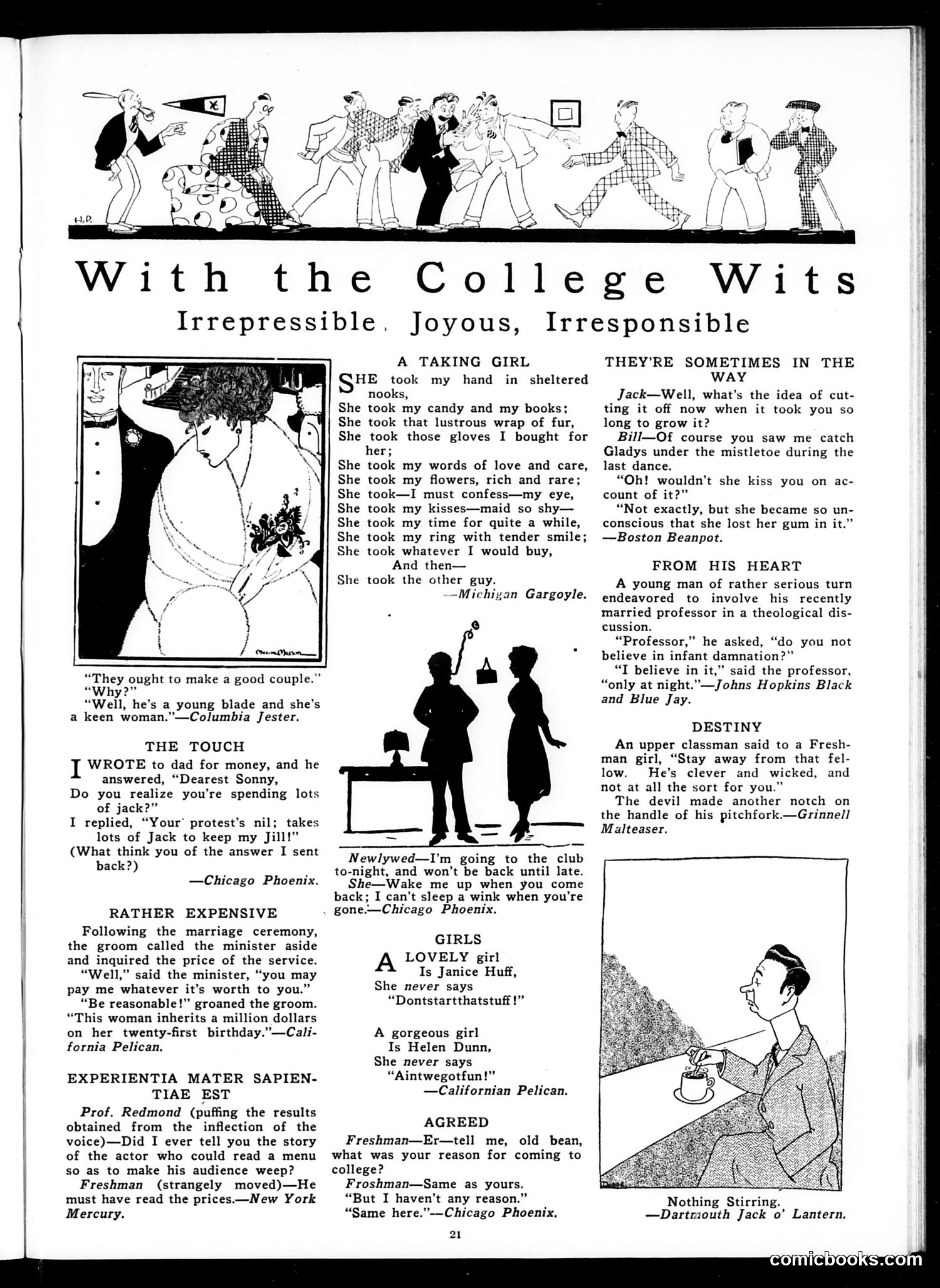
This is a humor page from Judge featuring college-themed jokes and cartoons, likely from the 1920s based on style and references. **Main Content:** The page collects brief humorous anecdotes and quips from college publications (Michigan Gargoyle, Boston Beanpot, Chicago Phoenix, etc.), targeting college-age romance and relationships. **Key Themes:** - **"A Taking Girl"**: Satirizes a young woman who extracts gifts and affection from a suitor, then leaves him for another man—mocking both female manipulation and male romantic gullibility - **Dating expenses**: Multiple jokes about money spent on courtship and marriage costs - **Young romance**: Themes of kissing, mistletoes, and courtship rituals **Social Context:** These represent typical Jazz Age concerns about dating culture, gender relations, and the emerging "modern girl" who actively participated in courtship rather than being passive. The humor relies on period-specific details (furs, gloves as gifts) and assumes college audiences familiar with these social dynamics. The satirical tone suggests mild disapproval of both frivolous spending and assertive female behavior in romance.
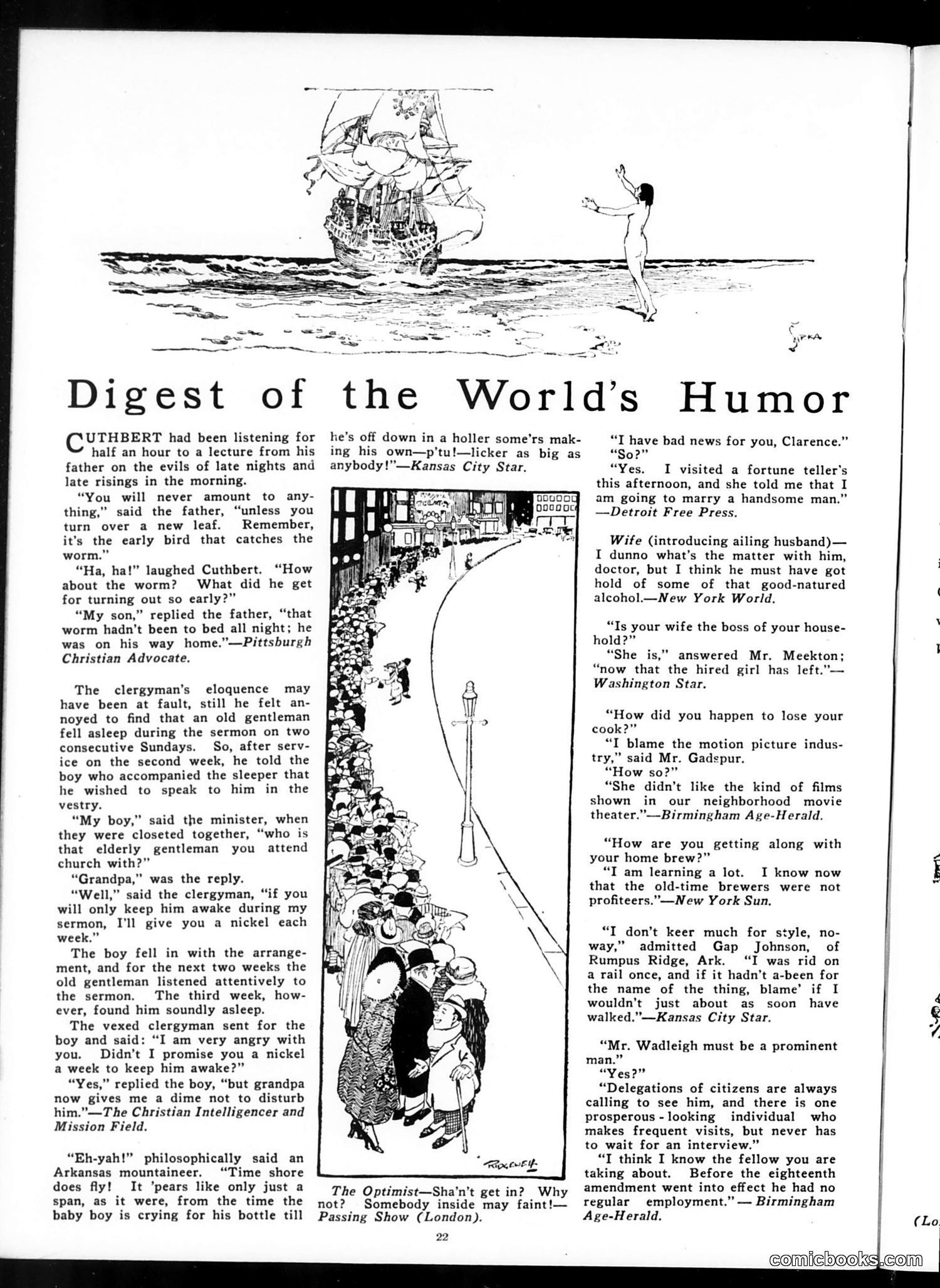
This page collects brief humorous anecdotes from various American newspapers, typical of Judge's "Digest of the World's Humor" format. The jokes reflect early 20th-century social concerns: a father lectures his son about early rising (the worm story subverts the proverb); a minister bribes a boy to keep his grandfather awake during sermons, only to be outbid; a wife jokes that a fortune-teller predicted she'd marry a handsome man (implying her husband isn't); domestic humor about servants leaving for movies; and Prohibition-era references (homemade alcohol, brewers as "profiteers"). The final cartoon depicts "The Optimist" reassuring someone they can enter a crowded venue because "somebody inside may faint"—dark humor about overcrowding. The central illustration shows a crowded beach scene, likely accompanying one of these jokes about crowds or leisure activity. The humor is predominantly domestic, targeting middle-class anxieties about servants, wives, and social change during the Prohibition era.
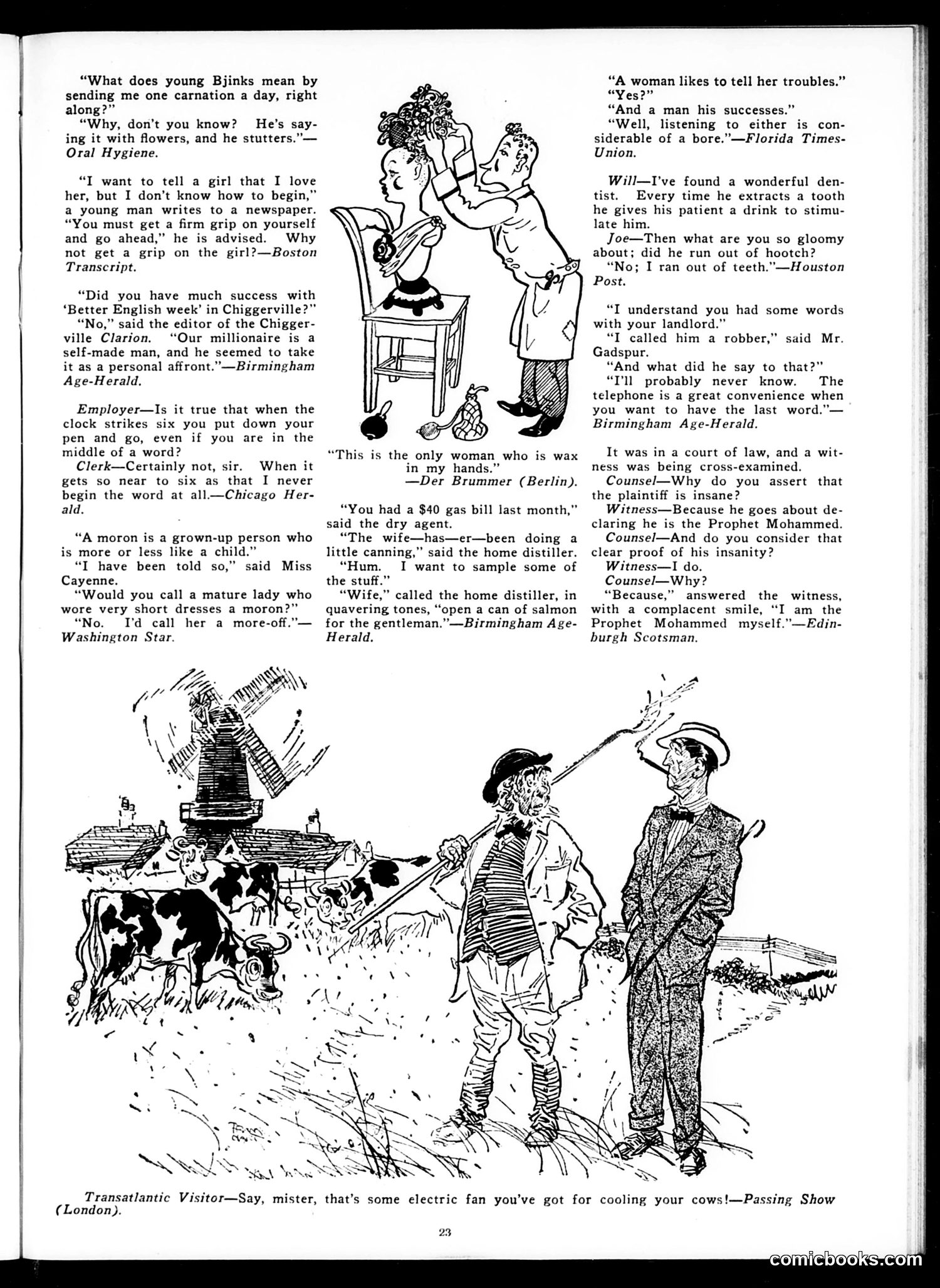
This page collects brief humorous anecdotes and one cartoon, typical of Judge's satirical format. **The cartoon** (bottom) depicts a "Transatlantic Visitor" commenting on what he assumes is an electric fan cooling cattle—likely satirizing European visitors' unfamiliarity with American farm technology or rural life. **The text jokes** target early 20th-century American social anxieties: - Dating conventions ("saying it with flowers") - Workplace labor dynamics (clerks leaving precisely at 6 PM) - Prohibition-era bootlegging (the "home distiller" hiding illegal alcohol production) - Gender stereotypes (women gossiping, men boasting) - New technology's social impact (telephones enabling the "last word") One joke mocks a "Better English week" campaign, suggesting self-made millionaires resisted educational refinement—commentary on class tension. The final courtroom joke plays on insanity definitions: a witness claims the plaintiff is mad for declaring himself Prophet Mohammed, but reveals *he himself* makes the same claim—absurdist humor highlighting illogical witness testimony. Overall, the page reflects 1920s-era concerns: modernization, class mobility, Prohibition, and shifting social norms.
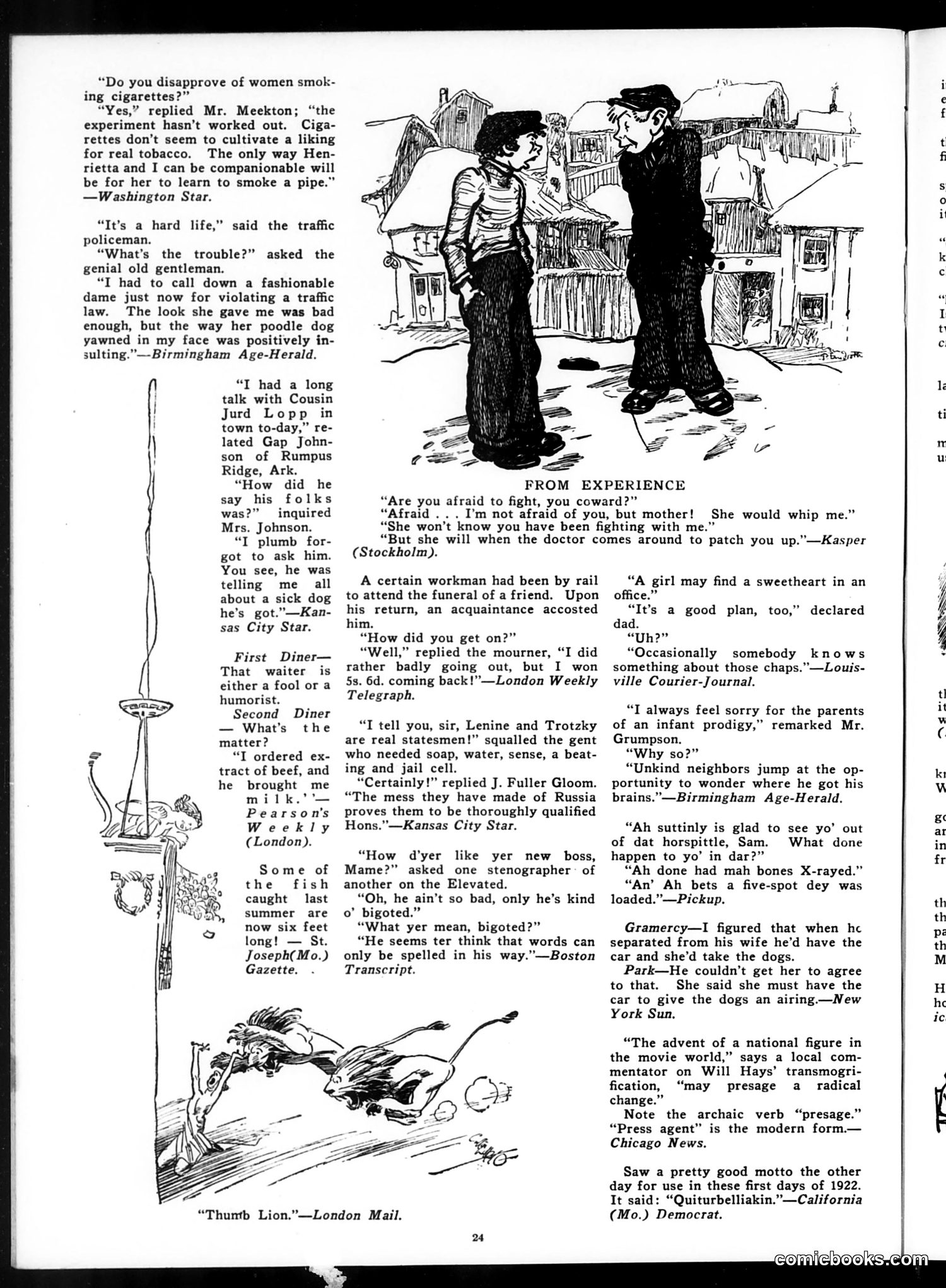
This page from Judge (circa 1922, based on the "first days of 1922" reference) collects humorous anecdotes and jokes rather than political cartoons. The content reflects post-WWI American social attitudes: **Key jokes include:** - Women smoking cigarettes as a modern social concern (Mr. Meekton disapproves) - A traffic policeman insulted by a fashionable woman's poodle dog - References to Lenin and Trotsky as incompetent statesmen (reflecting anti-Bolshevik sentiment common in 1920s America) - Urban/workplace humor about stenographers, bosses, and office romance - Racial dialect humor (the "Sam" hospital joke uses period-typical African American caricature speech) **The cartoon "From Experience"** depicts a boy choosing not to fight because his mother will punish him worse than his opponent—satirizing parental discipline and masculine bravado. The page is essentially filler content: miscellaneous one-liners from various newspapers, reflecting genteel American humor anxieties about modern women, labor unrest, and changing social norms.
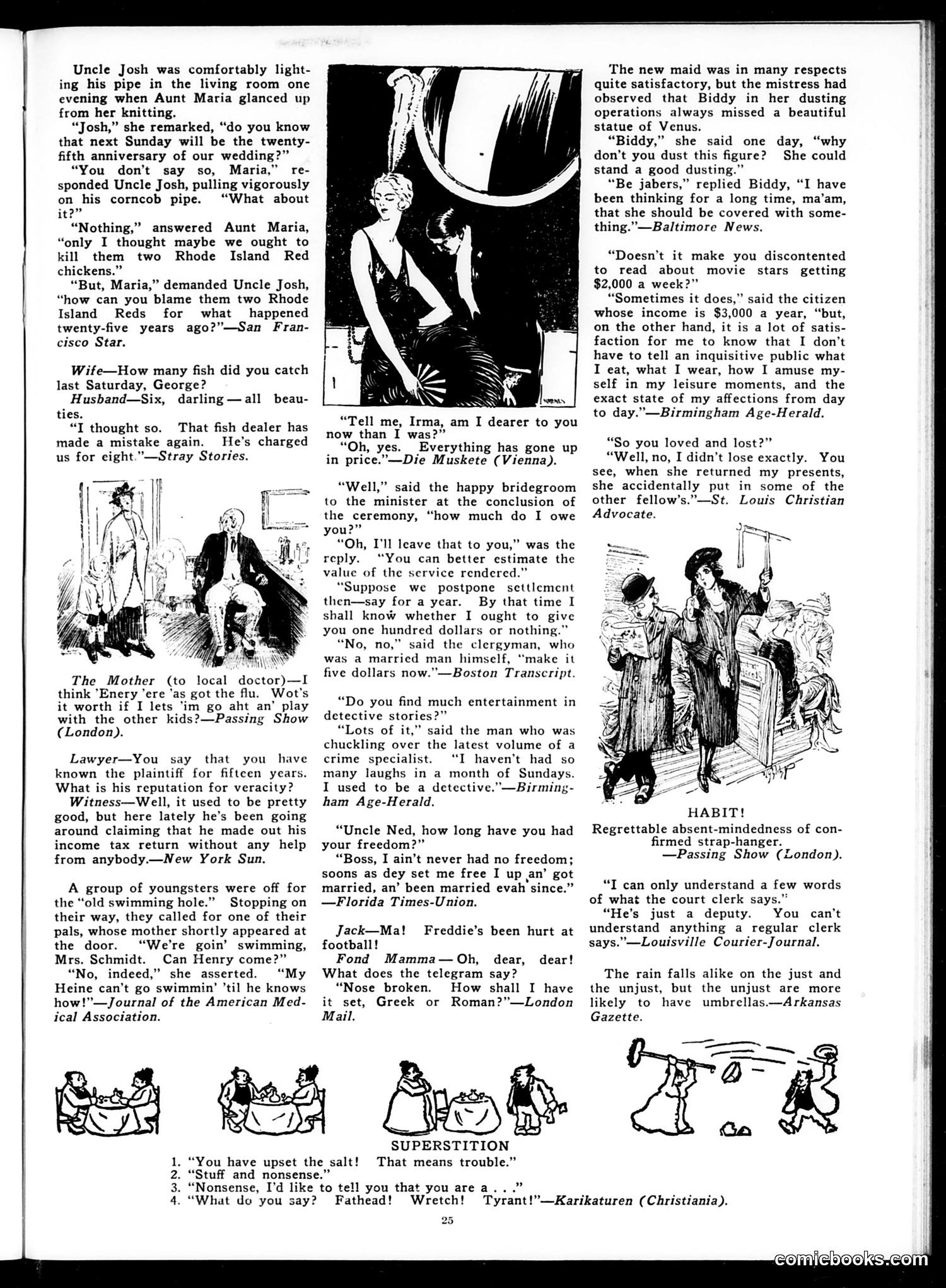
This page collects brief humorous anecdotes rather than political cartoons. The jokes satirize everyday American life circa early 20th century: **Key themes:** - **Marriage/domestic life**: Uncle Josh's obliviousness to his anniversary; a wife catching her husband in a fishing lie - **Class and wealth anxiety**: A man envious of movie stars earning $2,000/week while he makes $3,000/year—showing emerging consumer culture dissatisfaction - **Ethnic humor**: Irish maid ("Biddy") and German immigrant ("Heine") stereotypes were common period comedy - **Professional incompetence**: Lawyers claiming dishonesty, doctors' fees, ministers' vague payment arrangements The "Superstition" cartoon section (bottom) shows children's folk beliefs about spilled salt causing trouble. **Modern context**: These jokes reflect pre-Depression anxieties about income inequality, immigration, and professional trustworthiness—issues that remain relevant, though the ethnic stereotyping now appears offensive.
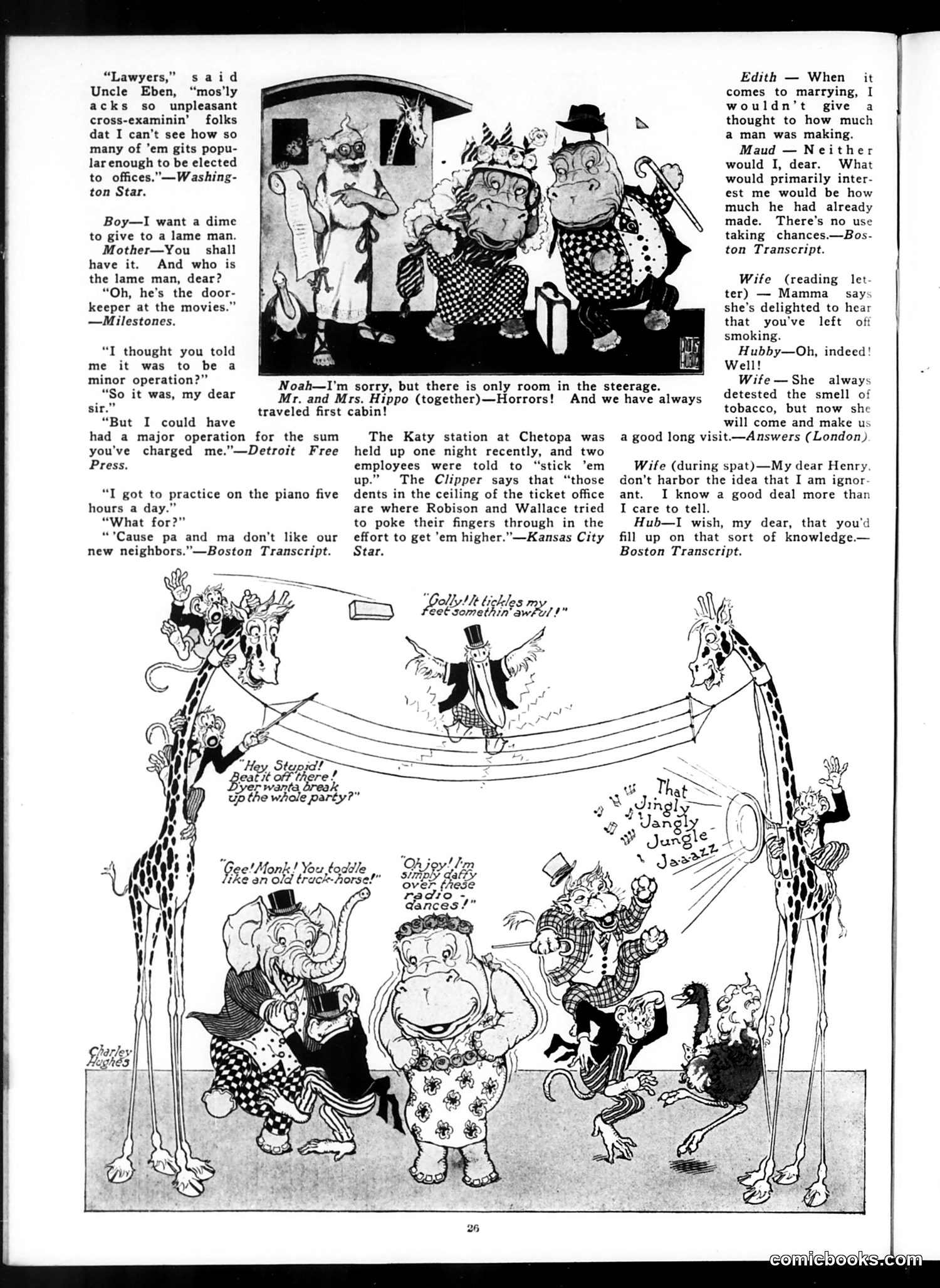
This page contains **multiple humor snippets and one larger cartoon**, typical of Judge's format. The main cartoon depicts **anthropomorphic animals** (hippos, giraffes, and other creatures) at what appears to be a steerage (ship's lowest-class accommodation). Mr. and Mrs. Hippo complain they traveled "first cabin" but have been relegated to steerage—satirizing either class discrimination or the absurdity of animals expecting luxury accommodations. The surrounding text consists of **short jokes on various themes**: lawyers' unpleasantness, economic anxiety about medical bills, piano practice as neighborhood annoyance, and marital dynamics. These reflect early 20th-century American concerns: professional ethics, healthcare costs, and gender relations. Several jokes target **wives' materialism** (caring about husbands' wealth) and smoking, reflecting period attitudes about women and domestic life. The overall tone is **lighthearted social commentary** rather than serious political satire, using exaggeration and animal characters for humor about everyday frustrations.
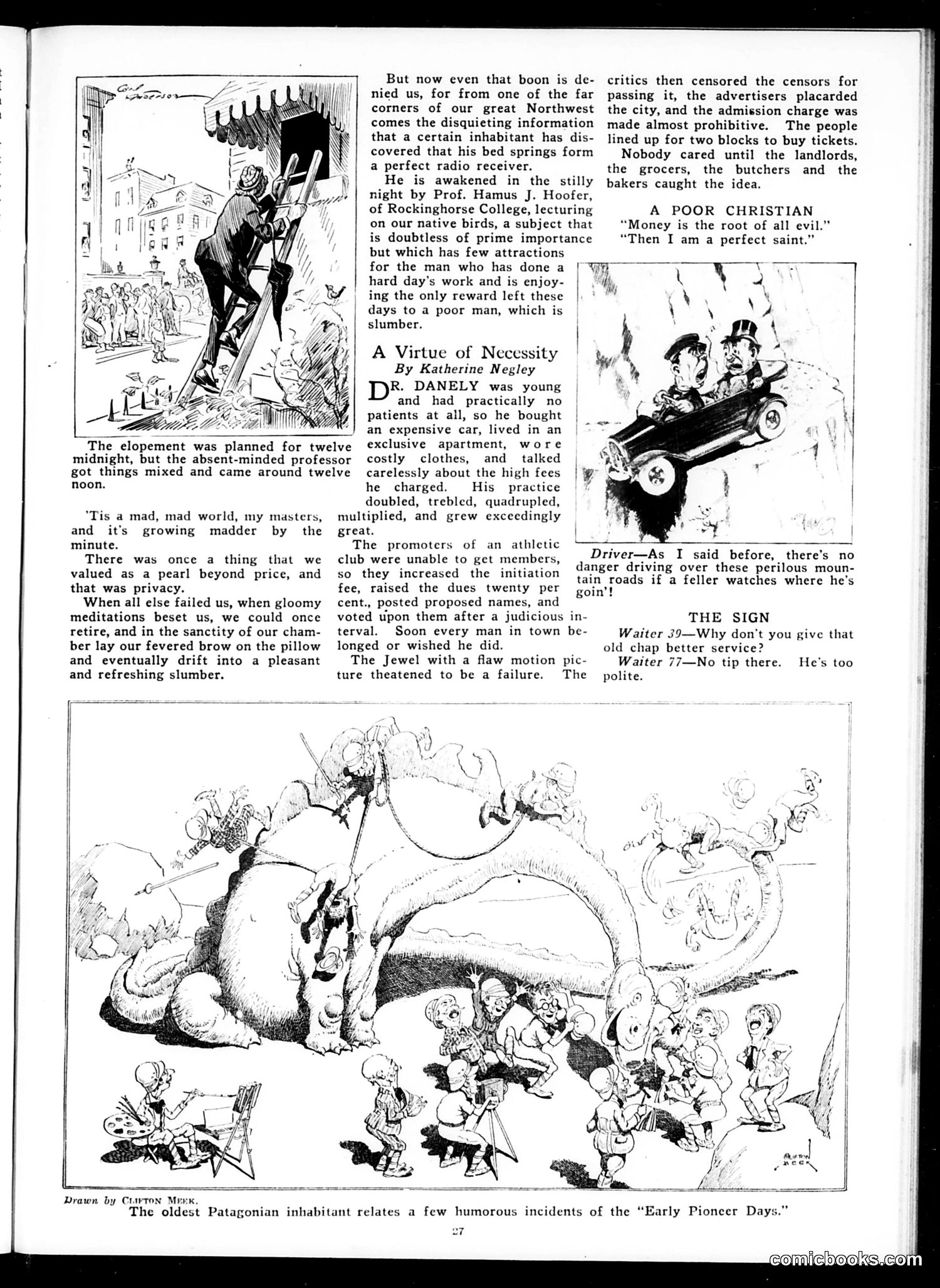
This page contains several satirical vignettes mocking early 20th-century American consumer culture and social pretension. **Top cartoon**: A professor arriving at midnight for an elopement instead appears at noon—satirizing absent-minded academics. **"A Virtue of Necessity"**: Mocks reverse psychology in business. Dr. Danely, struggling with no patients, adopts an expensive lifestyle and inflated fees. Counterintuitively, this *increases* his practice. The athletic club similarly gains members by raising initiation fees and requiring voting approval. The satire targets how artificial scarcity and perceived exclusivity drive consumer behavior, even when the underlying value is dubious. **"A Poor Christian"**: A brief joke about hypocrisy—someone claiming poverty (thus being a "perfect saint") while living comfortably. **"The Sign"**: A waiter refuses service to a customer he perceives as a poor tipper—satirizing service-industry mercenary attitudes. **Bottom illustration**: Apparently depicts Patagonian folklore, though its satirical meaning is unclear from this excerpt. The page reflects Jazz Age anxieties about materialism, status-seeking, and the erosion of genuine human values.
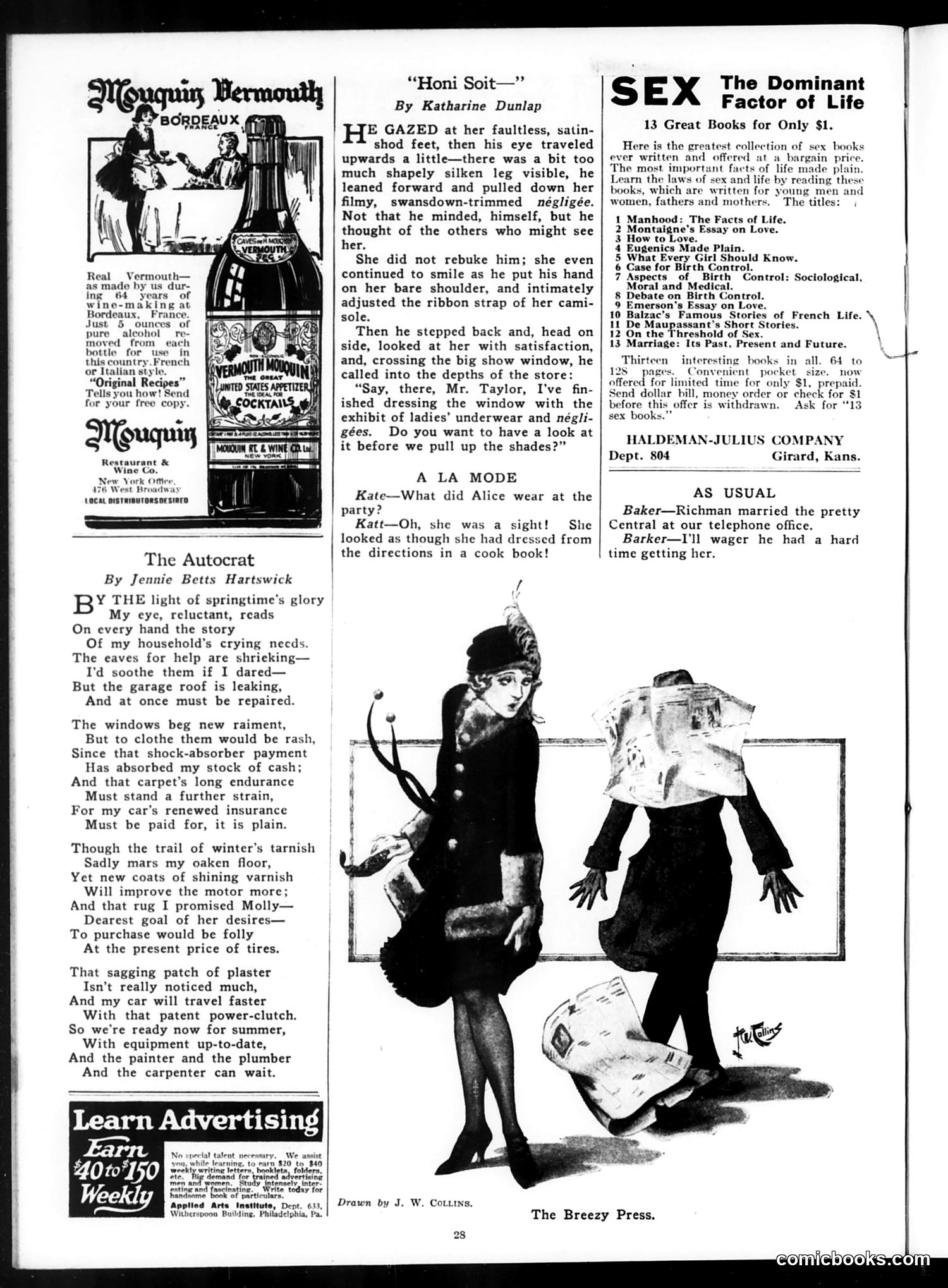
**"The Autocrat"** is a humorous poem about a homeowner's misplaced priorities. Despite obvious household repairs needed—leaking roof, broken windows, worn carpets, damaged plaster—the speaker prioritizes car maintenance and upgrades (insurance, power-clutch, new varnish). The satire mocks how automobile ownership has become so culturally dominant that homeowners neglect actual home maintenance, deferring the painter, plumber, and carpenter indefinitely. It's a commentary on 1920s car culture's grip on American consumer priorities. **"Honi Soit"** is a mildly risqué short fiction about a window dresser adjusting a mannequin dressed in ladies' undergarments and negligée. The humor lies in the ambiguous setup—readers initially might think the figure is a real woman—before the reveal that he's professionally arranging a store display. The page also advertises "13 Great Books for Only $1" on sex education, reflecting contemporary interest in practical information about reproduction, eugenics, and birth control.
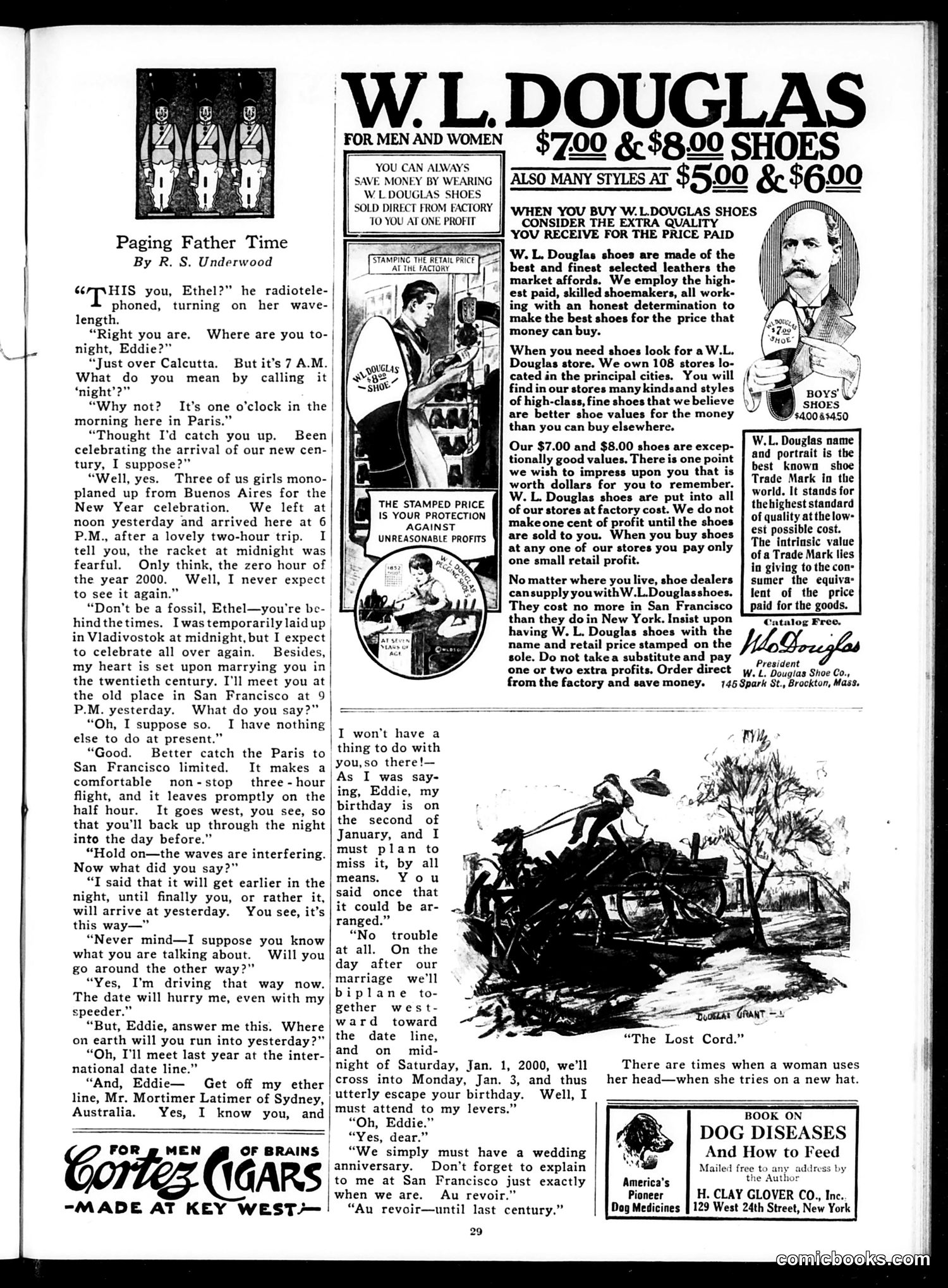
This story satirizes the technological acceleration of the early 20th century through romantic dialogue conducted via radio between two jet-setting characters, Eddie and Ethel. The joke centers on time-zone absurdity: using rapid aircraft and transcontinental travel, the couple can arrive at locations *before* they depart due to crossing international date lines. Eddie proposes meeting Ethel "at 9 P.M. yesterday"—a logical impossibility made theoretically feasible by modern transportation. The satire gently mocks: - The era's breathless enthusiasm for new technology (monoplanes, radiophone) - Globetrotting wealthy lifestyles (Buenos Aires to Paris trips) - The confusion and disorientation these technologies might create The piece reflects genuine early-1900s fascination with speed and instantaneous communication, treating these marvels with bemused affection rather than criticism. It's published near the century's turn (year 2000 references), playing on period anxieties and excitement about modernity.
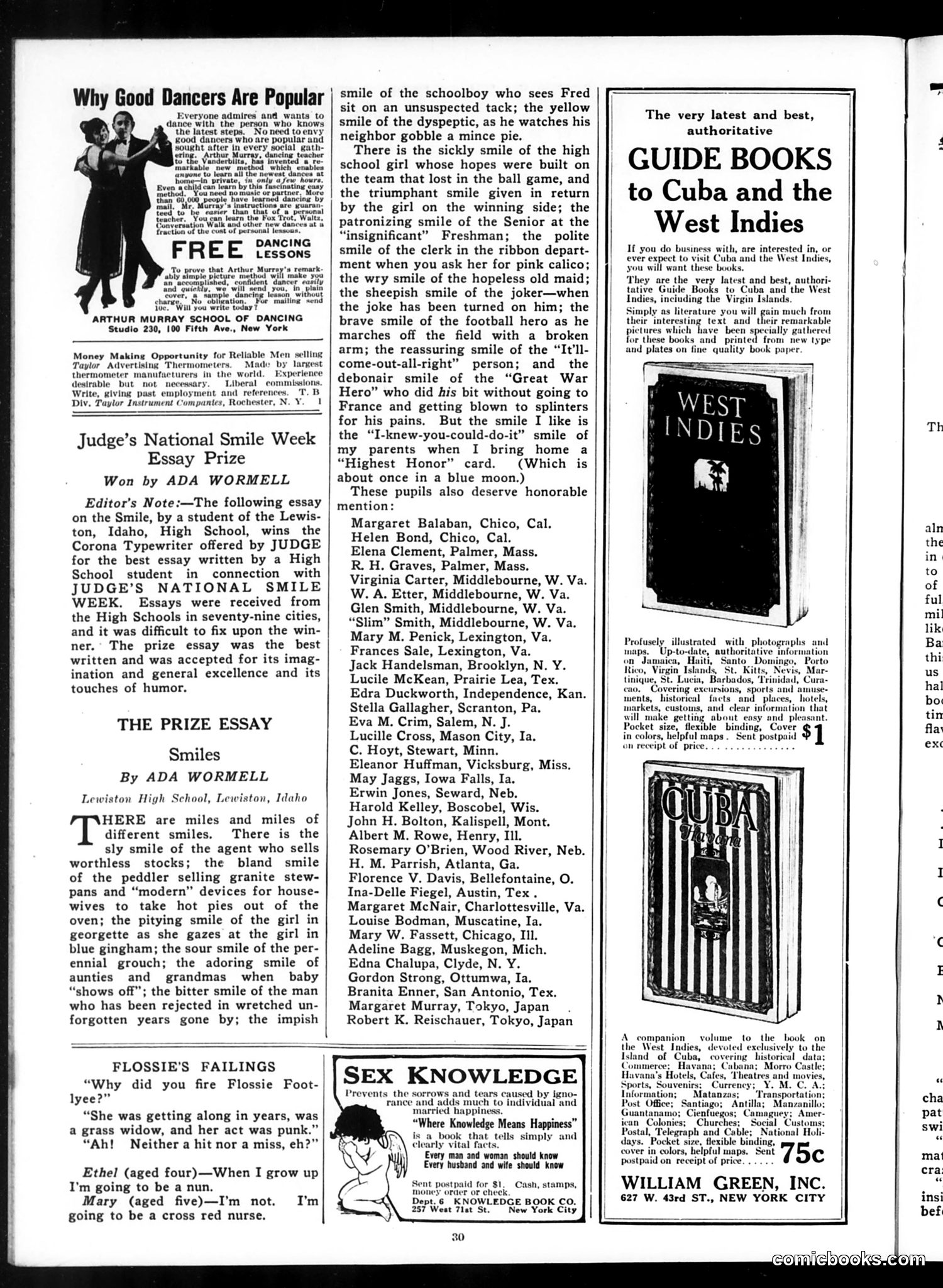
This page is primarily **advertising and editorial content** rather than political satire or comics. The main features are: **"Why Good Dancers Are Popular"** — An advertisement for the Arthur Murray School of Dancing, promoting dance lessons as a social asset. **"Judge's National Smile Week Essay Prize"** — The winning essay by Ada Wormell from Lewiston, Idaho High School, which catalogs different types of smiles observed in everyday American life: the con artist's smile, the disappointed girl's smile, the patronizing senior's smile, etc. The humor is gentle and observational rather than satirical—it's a lighthearted catalog of social types and their characteristic expressions. The page also contains other advertisements (thermometer sales, dance instruction, guidebooks to Cuba/West Indies, and "Sex Knowledge" books). There is **no discernible political commentary or caricature**. This appears to be a typical 1920s magazine page mixing commercial advertisements with reader-submitted content.
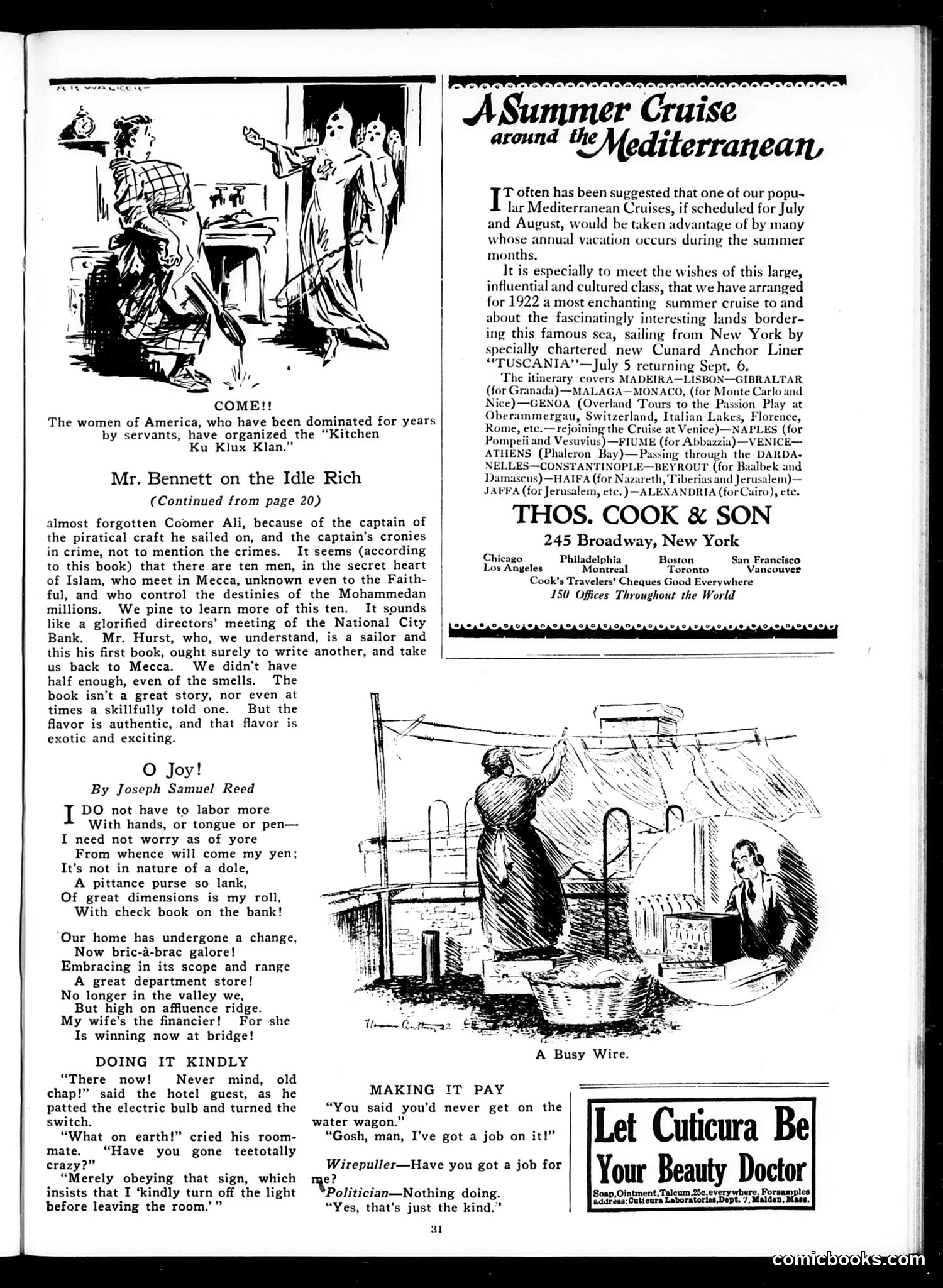
## Main Cartoon: "Kitchen Ku Klux Klan" The top cartoon satirizes American women's domestic frustration by claiming they've organized a "Kitchen Ku Klux Klan"—a pointed reference to the contemporary KKK (resurgent in the 1920s). The joke equates women's servitude to household servants with racial oppression, suggesting wives feel as dominated and powerless as marginalized groups. This is satirical commentary on gender inequality in domestic life, using the KKK comparison to emphasize the severity of women's lack of autonomy and authority in their own homes. ## Other Content The page includes: a book review of "Mr. Bennett on the Idle Rich" (discussing an exotic adventure novel); several humorous poems and short jokes about wealth, bridge-playing, and workplace matters; and advertisements for Mediterranean cruises and beauty products. These reflect 1920s preoccupations with leisure, class aspirations, and consumer goods.
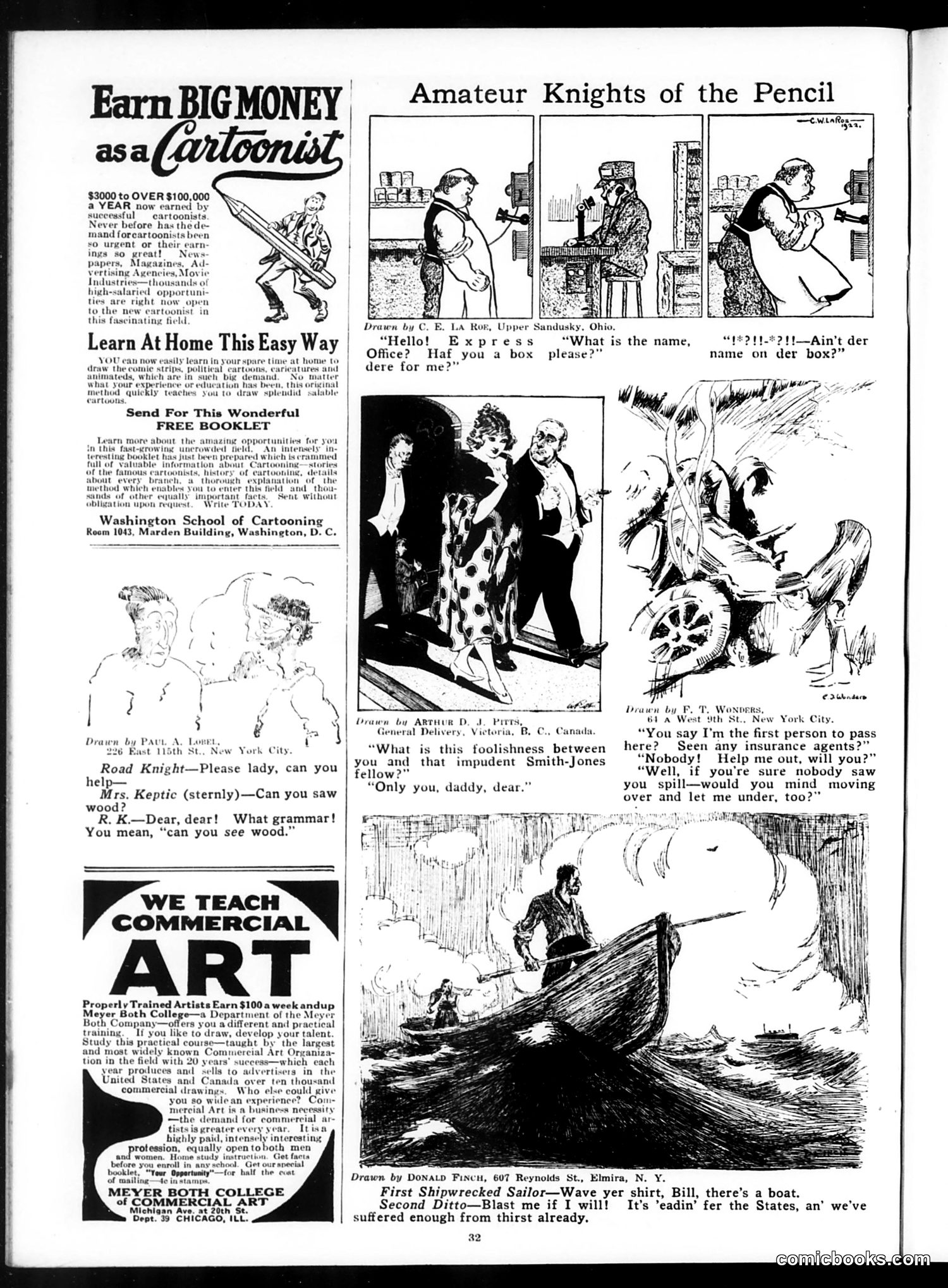
This page features a comic strip series mocking amateur or incompetent cartoonists and illustrators. The humor centers on visual misunderstandings and linguistic confusion: - A delivery person's broken English ("Haf you a box dere for me?") - A character mishearing "name on the box" as "?!!-?!!—Ain't der name on der box?" - A wealthy father's disapproval of his daughter's suitor - A drunk man asking about insurance agents while injured - Shipwrecked sailors refusing rescue from a boat heading to America The page also includes advertisements for cartooning schools promising easy money ($3,000-$100,000 yearly), which may be self-satirizing given the crude quality of these amateur submissions. The overall tone is gentle mockery of working-class characters, immigrants, and would-be artists, typical of Judge magazine's satirical approach.
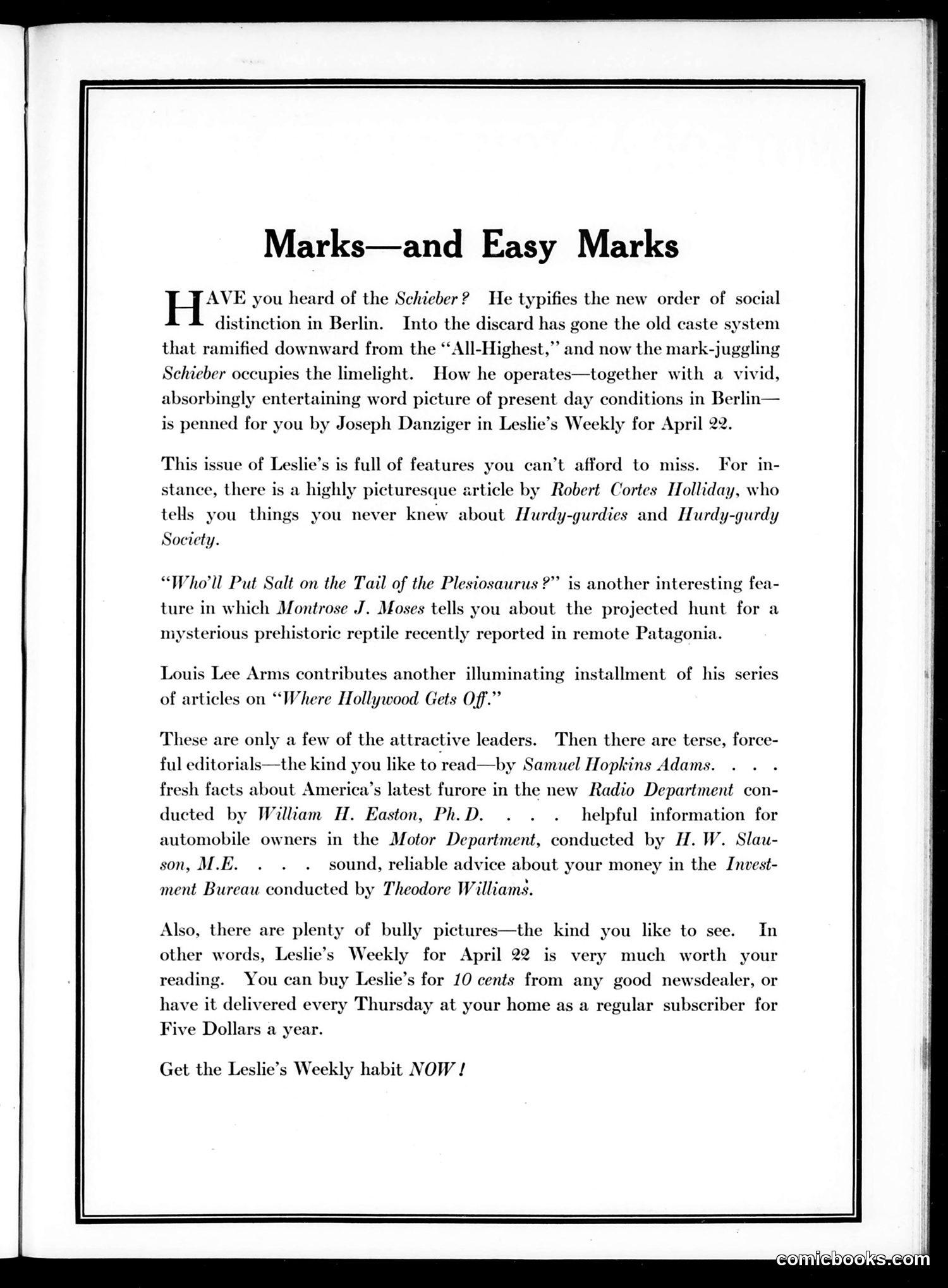
This is an advertisement for Leslie's Weekly promoting its April 22 issue. The headline references the "Schieber"—a German speculator or black-marketeer who emerged in post-WWI Berlin as the old aristocratic system collapsed. The ad highlights an article by Joseph Danziger explaining how these mark-jugglers operate in present-day Berlin conditions, appealing to American readers' curiosity about chaotic post-war Germany. The page lists other features: pieces on hurdy-gurdies, a hunt for a prehistoric creature in Patagonia, and Hollywood gossip. It's purely promotional content, not a political cartoon. The "easy marks" of the title refers to naive people susceptible to the Schieber's schemes—a pun on gullible readers the magazine hopes to attract with sensational content. Leslie's cost 10 cents per issue or $5 annually.
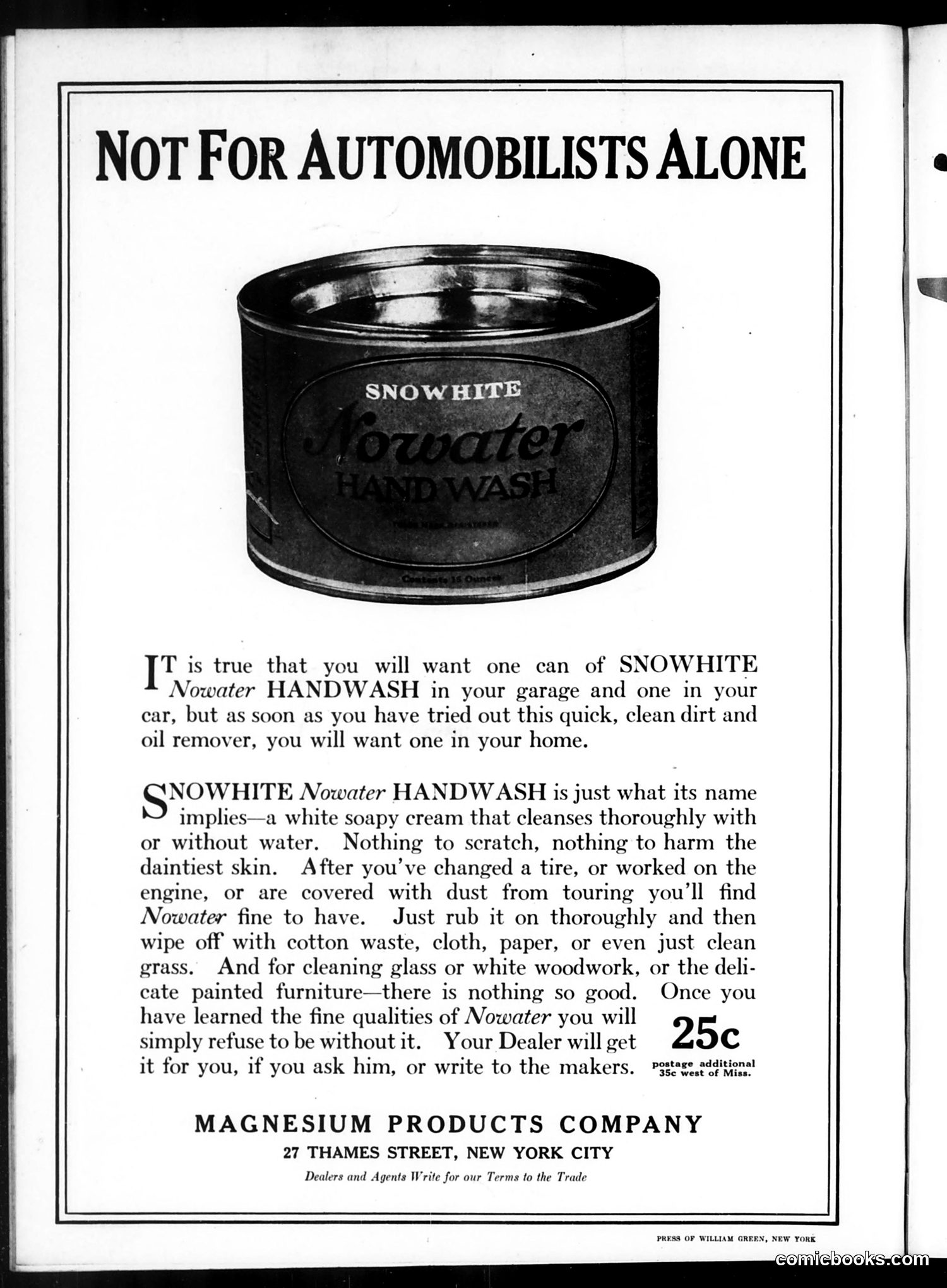
This page is **entirely an advertisement**, not satire or editorial content. It advertises "Snowhite Nowater Handwash," a cleaning product made by the Magnesium Products Company. The ad uses the headline "Not for Automobilists Alone" to expand the product's appeal beyond garage mechanics to general households. It emphasizes that while automobile workers need this soap for removing grease and dirt, homeowners will want it too—for cleaning furniture, woodwork, and glass. The product itself was a waterless hand cleaner popular in the early automotive era when mechanics needed effective cleaning solutions. The copy highlights its gentleness ("nothing to harm the daintiest skin") while emphasizing its cleaning power, positioning it as useful for both heavy industrial work and delicate household cleaning. At 25 cents, it was an affordable consumer product. This is a straightforward product advertisement, not political satire.