
Judge, 1922-04-22 · page 5 of 36
Judge — April 22, 1922 — page 5: what you’re looking at
What you’re looking at
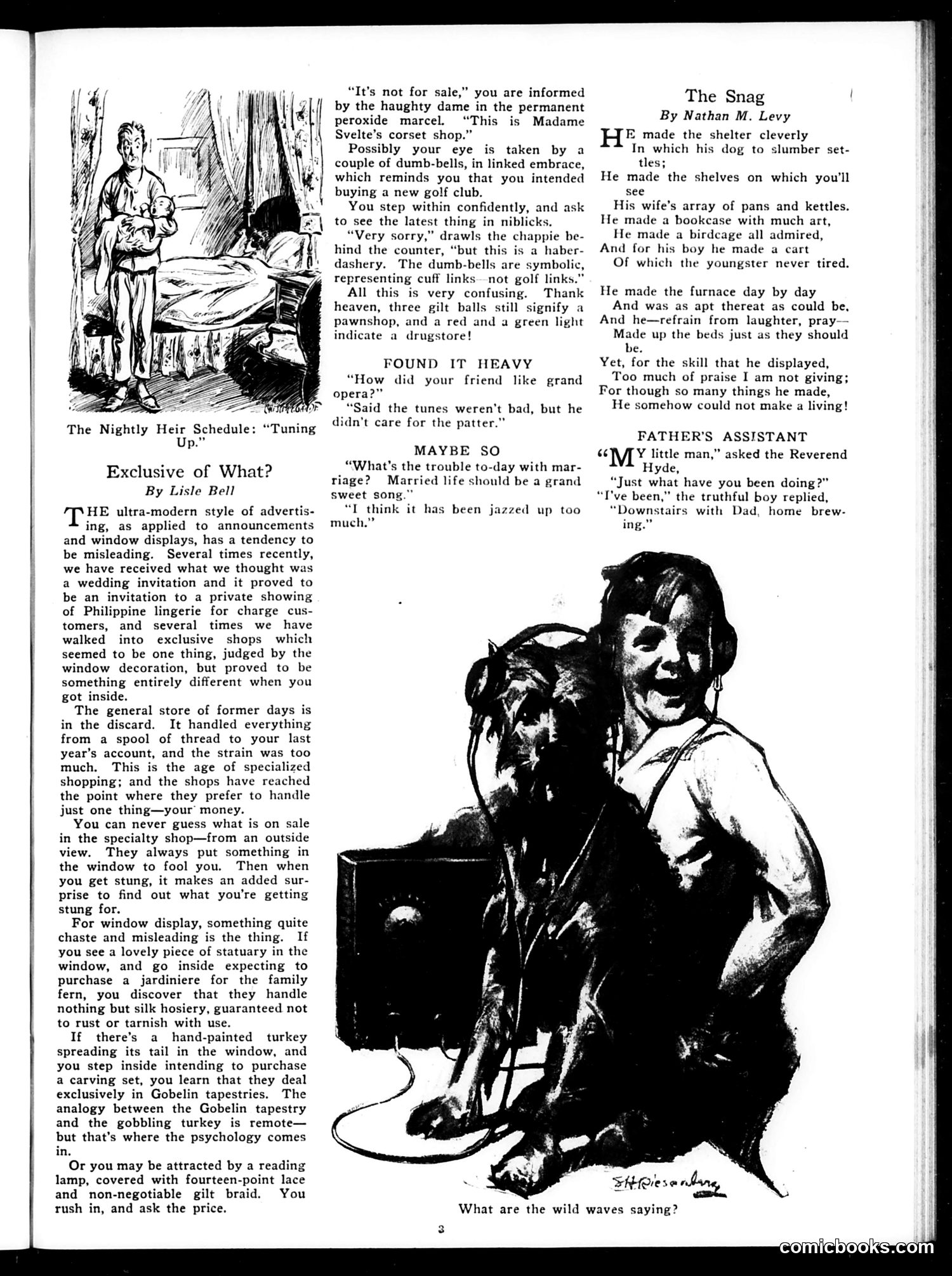
This page contains three unrelated pieces: 1. **"Exclusive of What?"** by Elsie Bell satirizes misleading modern retail advertising. The author describes entering shops displayed as "exclusive" yet finding they stock only common items (silk hosiery, Gobelin tapestries, hand-painted turkeys). The satire mocks how specialty shops use fancy window displays to trick customers into believing they're purchasing rare or unique goods, when actually the items are mass-produced or ordinary. 2. **"The Snag"** by Nathan M. Levy is a poem praising a skilled working man who builds household items and furnishings. 3. **"Father's Assistant"** features a cartoon of a man with a dog listening to radio headphones. The caption "What are the wild waves saying?" references a Victorian-era song, creating humor from the incongruity of modern radio technology paired with dated literary allusion.
📄 Transcribed text from this page (OCR, searchable)
Machine-transcribed from the original scan — historical spelling and the odd misread are preserved.
The Nightly Heir Schedule: “Tuning Up.” Exclusive of What? By Lisle Bell THE ultra-modern style of advertis- ing, as applied to announcements and window displays, has a tendency to be misleading. Several times recently, we have received what we thought was a wedding invitation and it proved to be an invitation to a private showing of Philippine lingerie for charge cus- tomers, and several times we have walked into exclusive shops which seemed to be one thing, judged by the window decoration, but proved to be something entirely different when you got inside. The general store of former days is in the discard. It handled everything from a spool of thread to your last year’s account, and the strain was too much. This is the age of specialized shopping; and the shops have reached the point where they prefer to handle just one thing—your money. You can never guess what is on sale in the specialty shop—from an outside view. They always put something in the window to fool you. Then when you get stung, it makes an added sur- prise to find out what you're getting stung for. For window display, something quite chaste and misleading is the thing. If you see a lovely piece of statuary in the window, and go inside expecting to purchase a jardiniere for the family fern, you discover that they handle nothing but silk hosiery, guaranteed not to rust or tarnish with use. If there’s a hand-painted turkey spreading its tail in the window, and you step inside intending to purchase a carving set, you learn that they deal exclusively in Gobelin tapestries. The analogy between the Gobelin tapestry and the gobbling turkey is remote— but that’s where the psychology comes in. Or you may be attracted by a reading lamp, covered with fourteen-point lace and non-negotiable gilt braid. You rush in, and ask the price. “It’s not for sale,” you are informed by the haughty dame in the permanent peroxide marcel. “This is Madame Svelte’s corset shop.” Possibly your eye is taken by a couple of dumb-bells, in linked embrace, which reminds you that you intended buying a new golf club. You step within confidently, and ask to see the latest thing in niblicks. “Very sorry,” drawls the chappie be- hind the counter, “but this is a haber- dashery. The dumb-bells are symboli representing cuff links not golf links.” All this is very confusing. Thank heaven, three gilt balls still signify a pawnshop, and a red and a green light indicate a drugstore! FOUND “How did your friend opera?” “Said the tunes weren't bad, but he didn’t care for the patter.” IT HEAVY like grand MAYBE SO “What's the trouble to-day with mar- riage? Married life should be a grand sweet song.” “T think it has been jazzed up too much.” What are the wild waves saying? The Snag By Nathan M. Levy HE made the shelter cleverly In which his dog to slumber set- tles; He made the shelves on which you'll see His wife’s array of pans and kettles. He made a bookcase with much art, He made a birdcage all admired, And for his boy he made a cart Of which the youngster never tired. He made the furnace day by day And was as apt thereat as could be, And he—refrain from laughter, pray— Made up the beds just as they should be. Yet, for the skill that he displayed, Too much of praise I am not giving; For though so many things he made, He somehow could not make a living! FATHER’S ASSISTANT “ ¥Y little man,” asked the Reverend Hyde, “Just what have you been doing?” “I've been,” the truthful boy replied, “Downstairs with Dad ing.” home brew-