
Judge, 1922-04-22 · page 4 of 36
Judge — April 22, 1922 — page 4: what you’re looking at
What you’re looking at
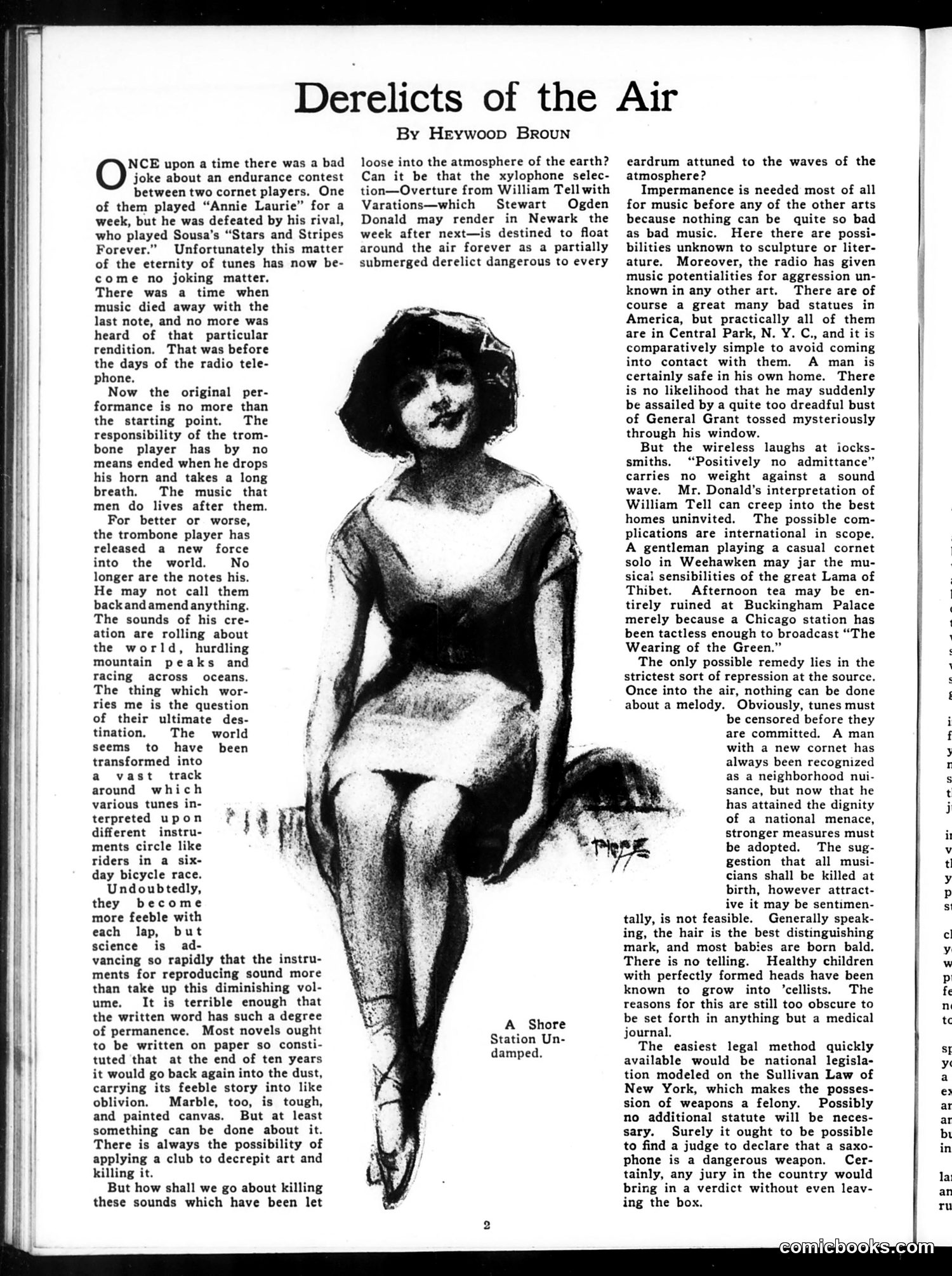
This satirical article criticizes radio broadcasts of poor musical quality. Broun argues that once music is transmitted over airwaves, it becomes public and uncontrollable—unlike a live performance you can leave. He complains that bad radio music invades homes and cannot be stopped. The illustration shows a nude figure appearing distressed or suffering, likely representing the listener assaulted by unwanted broadcast sounds. Broun's central complaint is that radio lacks quality control: musicians perform sub-standard material that spreads widely, and unlike written words, these "derelicts" cannot be recalled or improved. He proposes stricter regulation at the broadcast source to prevent inferior musical content from reaching homes. The satire targets both radio stations' permissiveness and the inescapable nature of wireless transmission.
📄 Transcribed text from this page (OCR, searchable)
Machine-transcribed from the original scan — historical spelling and the odd misread are preserved.
NCE upon a time there was a bad joke about an endurance contest between two cornet players. One of them played “Annie Laurie” for a week, but he was defeated by his rival, who played Sousa’s “Stars and Stripes Forever.” Unfortunately this matter of the eternity of tunes has now be- come no joking matter. There was a time when music died away with the last note, and no more was heard of that particular rendition. That was before the days of the radio tele- phone. Now the original per- formance is no more than the starting point. The responsibility of the trom- bone player has by no means ended when he drops his horn and takes a long breath, The music that men do lives after them. For better or worse, the trombone player has released a new force into the world. No longer are the notes his. He may not call them backandamendanything. The sounds of his cre- ation are rolling about the world, hurdling mountain peaks and racing across oceans. { The thing which wor- é ries me is the question of their ultimate des- tination. The world seems to have been transformed into a vast track around which various tunes in- terpreted upon different instru- ments circle like riders in a six- day bicycle race. Undoubtedly, they become more feeble with each lap, but science is ad- vancing so rapidly that the instru- ments for reproducing sound more than take up this diminishing vol- ume. It is terrible enough that the written word has such a degree of permanence. Most novels ought to be written on paper so consti- tuted that at the end of ten years it would go back again into the dust, carrying its feeble story into like oblivion. Marble, too, is tough, and painted canvas. But at least something can be done about it. There is always the possibility of applying a club to decrepit art and killing it. But how shall we go about killing these sounds which have been let Derelicts of the Air By Heywoop Broun loose into the atmosphere of the earth? Can it be that the xylophone selec- tion—Overture from William Tell with Varations—which Stewart Ogden Donald may render in Newark the week after next—is destined to float around the air forever as a partially submerged derelict dangerous to every A_ Shore Station Un- damped. eardrum attuned to the waves of the atmosphere? Impermanence is needed most of all for music before any of the other arts because nothing can be quite so bad as bad music. Here there are possi- bilities unknown to sculpture or liter- ature. Moreover, the radio has given music potentialities for aggression un- known in any other art. There are of course a great many bad statues in America, but practically all of them are in Central Park, N. Y. C., and it is comparatively simple to avoid coming into contact with them. A man is certainly safe in his own home. There is no likelihood that he may suddenly be assailed by a quite too dreadful bust of General Grant tossed mysteriously through his window. But the wireless laughs at iocks- smiths. “Positively no admittance” carries no weight against a sound wave. Mr. Donald's interpretation of William Tell can creep into the best homes uninvited. The possible com- plications are international in scope. A gentleman playing a casual cornet solo in Weehawken may jar the mu- sical sensibilities of the great Lama of Thibet. Afternoon tea may be en- tirely ruined at Buckingham Palace merely because a Chicago station has been tactless enough to broadcast “The Wearing of the Green.” The only possible remedy lies in the strictest sort of repression at the source. Once into the air, nothing can be done about a melody. Obviously, tunes must be censored before they are committed. A man with a new cornet has always been recognized as a neighborhood nui- sance, but now that he has attained the dignity of a national menace, stronger measures must be adopted. The sug- gestion that all musi- cians shall be killed at birth, however attract- ive it may be sentimen- tally, is not feasible. Generally speak- ing, the hair is the best distinguishing mark, and most babies are born bald. There is no telling. Healthy children with perfectly formed heads have been known to grow into ’cellists. The reasons for this are still too obscure to be set forth in anything but a medical journal. The easiest legal method quickly available would be national legisla- tion modeled on the Sullivan Law of New York, which makes the posses- sion of weapons a felony. Possibly no additional statute will be neces- sary. Surely it ought to be possible to find a judge to declare that a saxo- phone is a dangerous weapon. Cer- tainly, any jury in the country would bring in a verdict without even leav- ing the box. aaa ‘eats hae ae a