
Judge, 1922-04-22 · page 16 of 36
Judge — April 22, 1922 — page 16: what you’re looking at
What you’re looking at
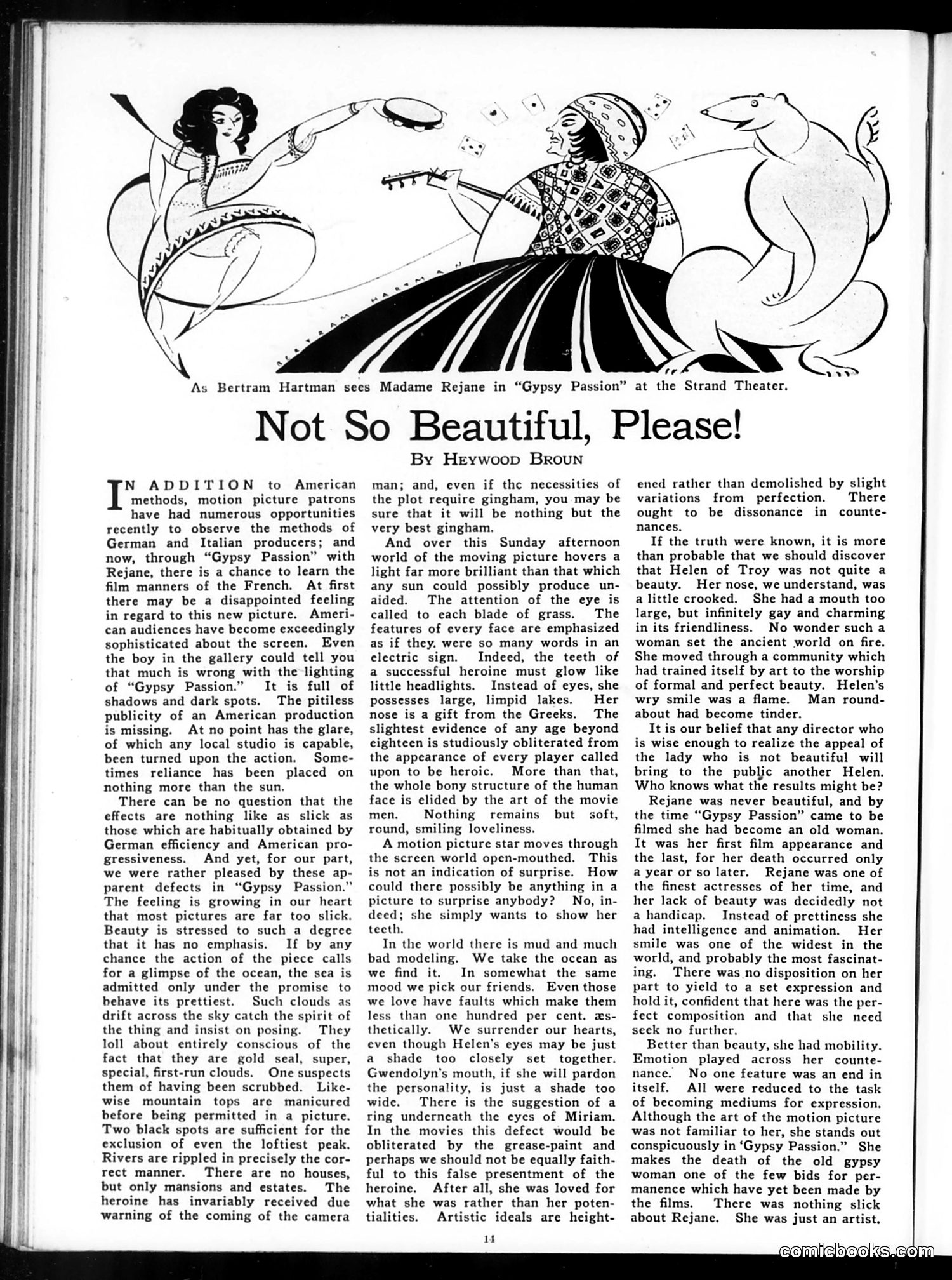
This 1920s-era article critiques the artificiality of American cinema by praising the French film "Gypsy Passion" starring actress Madame Rejane. **The Point:** Heywood Broun argues that American movie studios over-polish everything—artificially lighting scenes, perfecting landscapes, whitening actors' teeth to "headlights," erasing any signs of age or imperfection. He celebrates the French film's grittier, more naturalistic approach: real shadows, unmanicured nature, and an actress (Rejane) valued for intelligence and charm rather than manufactured beauty. **The Satire:** Broun mocks Hollywood's obsession with pristine artificiality—even clouds appear "scrubbed," rivers are "rippled in precisely the correct manner," and heroines must glow like neon signs. He contrasts this with real life's messiness. **The Cartoon:** Shows Rejane performing with expressive, natural gestures, contrasting the article's theme that genuine artistry surpasses cosmetic perfection. This reflects 1920s debates about European versus American filmmaking sophistication.
📄 Transcribed text from this page (OCR, searchable)
Machine-transcribed from the original scan — historical spelling and the odd misread are preserved.
As Bertram Hartman sees Madame Rejane in “Gypsy Passion” at the Strand Theater. Not So Beautiful, Please! N ADDITION to American methods, motion picture patrons have had numerous opportunities recently to observe the methods of German and Italian producers; and now, through “Gypsy Passion” with Rejane, there is a chance to learn the film manners of the French. At first there may be a disappointed feeling in regard to this new picture. Ameri- can audiences have become exceedingly sophisticated about the screen. Even the boy in the gallery could tell you that much is wrong with the lighting of “Gypsy Passion.” It is full of shadows and dark spots. The pitiless publicity of an American production is missing. At no point has the glare, of which any local studio is capable, been turned upon the action. Some- times reliance has been placed on nothing more than the sun. There can be no question that the effects are nothing like as slick as those which are habitually obtained by German efficiency and American pro- gressiveness. And yet, for our part, we were rather pleased by these ap- parent defects in “Gypsy Passion.” The feeling is growing in our heart that most pictures are far too slick. Beauty is stressed to such a degree that it has no emphasis. If by any chance the action of the piece calls for a glimpse of the ocean, the sea is admitted only under the promise to behave its prettiest. Such clouds as drift across the sky catch the spirit of the thing and insist on posing. They loll about entirely conscious of the fact that they are gold seal, super, special, first-run clouds. One suspects them of having been scrubbed. Like- wise mountain tops are manicured before being permitted in a picture. Two black spots are sufficient for the exclusion of even the loftiest peak. Rivers are rippled in precisely the cor- rect manner. There are no houses, but only mansions and estates. The heroine has invariably received due warning of the coming of the camera By Hreywoop Broun man; and, even if the necessities of the plot require gingham, you may be sure that it will be nothing but the very best gingham. And over this Sunday afternoon world of the moving picture hovers a light far more brilliant than that which any sun could possibly produce un- aided. The attention of the eye is called to each blade of grass. The features of every face are emphasized as if they. were so many words in an electric sign. Indeed, the teeth of a successful heroine must glow like little headlights. Instead of eyes, she possesses large, limpid lakes. Her nose is a gift from the Greeks. The slightest evidence of any age beyond eighteen is studiously obliterated from the appearance of every player called upon to be heroic. More than that, the whole bony structure of the human face is elided by the art of the movie men. Nothing remains but soft, round, smiling loveliness. A motion picture star moves through the screen world open-mouthed. This is not an indication of surprise. How could there possibly be anything in a picture to surprise anybody? No, in- deed; she simply wants to show her tecth, In the world there is mud and much bad modeling. We take the ocean as we find it. In somewhat the same mood we pick our friends. Even those we love have faults which make them less than one hundred per cent. xs- thetically. We surrender our hearts, even though Helen’s eyes may be just a shade too closely set together. Gwendolyn’s mouth, if she will pardon the personality, is just a shade too wide. There is the suggestion of a ring underneath the eyes of Miriam. In the movies this defect would be obliterated by the grease-paint and perhaps we should not be equally faith- ful to this false presentment of the heroine. After all, she was loved for what she was rather than her poten- tialities. Artistic ideals are height- iu ened rather than demolished by slight variations from perfection. There ought to be dissonance in counte- nances, If the truth were known, it is more than probable that we should discover that Helen of Troy was not quite a beauty. Her nose, we understand, was a little crooked. She had a mouth too large, but infinitely gay and charming in its friendliness. No wonder such a woman set the ancient world on fire. She moved through a community which had trained itself by art to the worship of formal and perfect beauty. Helen's wry smile was a flame. Man round- about had become tinder. It is our belief that any director who is wise enough to realize the appeal of the lady who is not beautiful will bring to the public another Helen. Who knows what the results might be? Rejane was never beautiful, and by the time “Gypsy Passion” came to be filmed she had become an old woman. It was her first film appearance and the last, for her death occurred only a year or so later. Rejane was one of the finest actresses of her time, and her lack of beauty was decidedly not a handicap. Instead of prettiness she had intelligence and animation. Her smile was one of the widest in the world, and probably the most fascinat- ing. There was no disposition on her part to yield to a set expression and hold it, confident that here was the per- fect composition and that she need seek no further, Better than beauty, she had mobility. Emotion played across her counte- nance. No one feature was an end in itself. All were reduced to the task of becoming mediums for expression. Although the art of the motion picture was not familiar to her, she stands out conspicuously in ‘Gypsy Passion.” She makes the death of the old gypsy woman one of the few bids for per- manence which have yet been made by the films. There was nothing slick about Rejane. She was just an artist. COMmiehHookssconm