
Judge, 1922-04-22 · page 29 of 36
Judge — April 22, 1922 — page 29: what you’re looking at
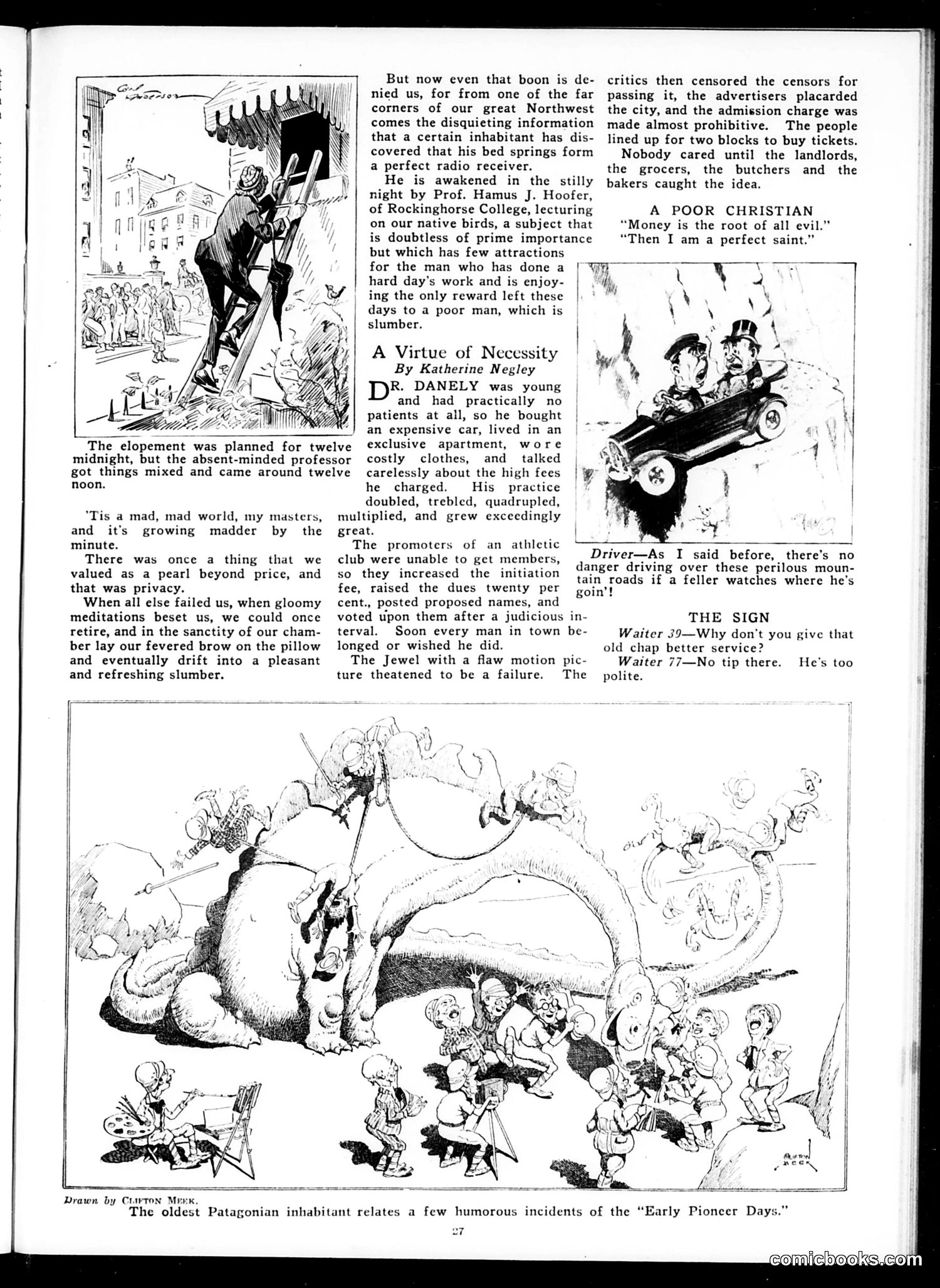
What you’re looking at
This page contains several satirical vignettes mocking early 20th-century American consumer culture and social pretension. **Top cartoon**: A professor arriving at midnight for an elopement instead appears at noon—satirizing absent-minded academics. **"A Virtue of Necessity"**: Mocks reverse psychology in business. Dr. Danely, struggling with no patients, adopts an expensive lifestyle and inflated fees. Counterintuitively, this *increases* his practice. The athletic club similarly gains members by raising initiation fees and requiring voting approval. The satire targets how artificial scarcity and perceived exclusivity drive consumer behavior, even when the underlying value is dubious. **"A Poor Christian"**: A brief joke about hypocrisy—someone claiming poverty (thus being a "perfect saint") while living comfortably. **"The Sign"**: A waiter refuses service to a customer he perceives as a poor tipper—satirizing service-industry mercenary attitudes. **Bottom illustration**: Apparently depicts Patagonian folklore, though its satirical meaning is unclear from this excerpt. The page reflects Jazz Age anxieties about materialism, status-seeking, and the erosion of genuine human values.
📄 Transcribed text from this page (OCR, searchable)
Machine-transcribed from the original scan — historical spelling and the odd misread are preserved.
But now even that boon is de- nied us, for from one of the far corners of our great Northwest comes the disquieting information that a certain inhabitant has dis- covered that his bed springs form a perfect radio receiver. He is awakened in the stilly night by Prof. Hamus J. Hoofer, of Rockinghorse College, lecturing on our native birds, a subject that is doubtless of prime importance but which has few attractions critics then censored the censors for passing it, the advertisers placarded the city, and the admission charge was made almost prohibitive. The people lined up for two blocks to buy tickets. Nobody cared until the landlords, the grocers, the butchers and the bakers caught the idea. A POOR CHRISTIAN “Money is the root of all evil.” “Then I am a perfect saint.” hard day’s work and is enjoy- ing the only reward left these | days to a poor man, which is slumber. | A Virtue of Necessity By Katherine Negley D® DANELY was young and had practically no patients at all, so he bought an expensive car, lived in an ‘The elopement was planned for twelve midnight, but the absent-minded professor got things mixed and came around twelve noon. ‘Tis a mad, mad world, my masters, and it’s growing madder by the minute. There was once a thing that we valued as a pearl beyond price, and that was privacy. When all else failed us, when gloomy meditations beset us, we could once retire, and in the sanctity of our cham- ber lay our fevered brow on the pillow and eventually drift into a pleasant and refreshing slumber. Brawn by Ciwton Merx. The oldest Patagonian inhabitant relates a few humorous incidents of the “E exclusive apartment, wore costly clothes, and talked carelessly about the high fees he charged. His practice doubled, trebled, quadrupled, multiplied, and grew exceedingly great. | for the man who has done a | ¥ The promoters of an athletic club were unable to get members, so they increased the initiation fee, raised the dues twenty per cent., posted proposed names, and voted upon them after a judicious in- terval. Soon every man in town be- longed or wished he did. The Jewel with a flaw motion pic- ture theatened to be a failure. The Driver—As I said before, there’s no danger driving over these perilous moun- tain roads if a feller watches where he's goin’! THE SIGN Waiter 39—Why don't you give that old chap better service? Waiter 77—No tip there. polite. He's too