
Judge, 1922-04-22 · page 10 of 36
Judge — April 22, 1922 — page 10: what you’re looking at
What you’re looking at
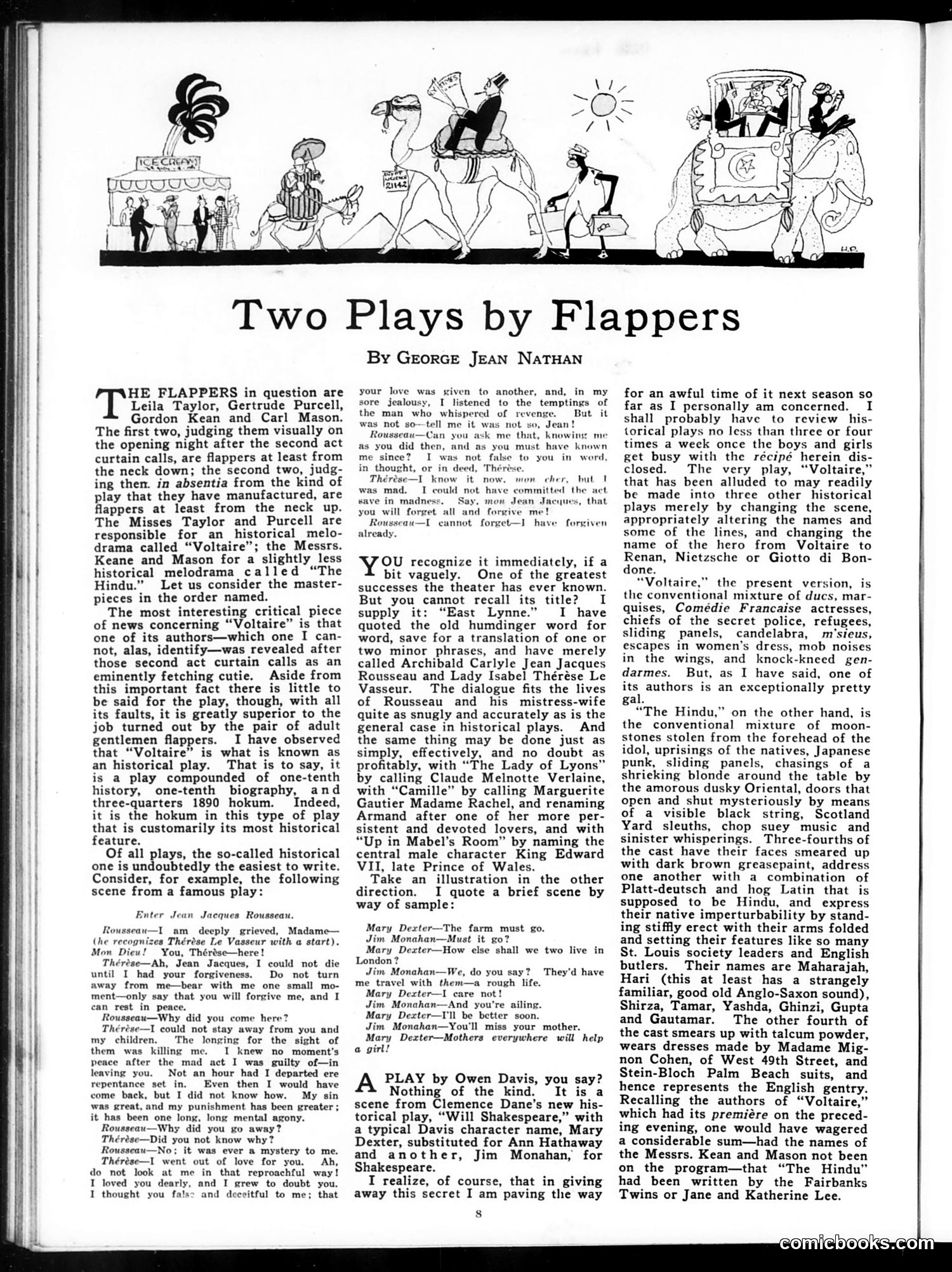
This is a theater review by George Jean Nathan critiquing two plays written by young women ("flappers"—1920s slang for modern, liberated women): "Voltaire" by Taylor and Purcell, and "The Hindu" by Kean and Mason. **The Satire:** Nathan mocks historical melodramas as formulaic trash. He demonstrates this by showing how "East Lynne" (a famous Victorian play) can be recycled with different character names—proving the genre relies on stock plots rather than authentic history or originality. **The Point:** He's simultaneously mocking the young female playwrights for producing derivative, sensationalized "hokum," while also making a broader critique of the entire historical melodrama genre itself. The review suggests these "flapper" writers are merely mimicking tired theatrical conventions, producing work inferior even to established bad plays. The tone is condescending toward both the playwrights and the theatrical form they're working in.
📄 Transcribed text from this page (OCR, searchable)
Machine-transcribed from the original scan — historical spelling and the odd misread are preserved.
a ST = | 1} i} HE FLAPPERS in question are I Leila Taylor, Gertrude Purcell, Gordon Kean and Carl Mason. The first two, judging them visually on the opening night after the second act curtain calls, are flappers at least from the neck down; the second two, judg- ing then. in absentia from the kind of play that they have manufactured, are flappers at least from the neck up. The Misses Taylor and Purcell are responsible for an_ historical melo- drama called “Voltaire”; the Messrs. Keane and Mason for a slightly less historical melodrama called “The Hindu.” Let us consider the master- pieces in the order named. . The most interesting critical piece of news concerning “Voltaire” is that one of its authors—which one I can- not, alas, identify—was revealed after those second act curtain calls as an eminently fetching cutie. Aside from this important fact there is little to be said for the play, though, with all its faults, it is greatly superior to the job turned out by the pair of adult gentlemen flappers. I have observed that “Voltaire” is what is known as an historical play. That is to say, it is a play compounded of one-tenth history, one-tenth biography, and three-quarters 1890 hokum. Indeed, it is the hokum in this type of play that is customarily its most historical feature. Of all plays, the so-called historical one is undoubtedly the easiest to write. Consider, for example, the following scene from a famous play: Enter Jean Jacques Rousseau. am deeply grieved, Madame— (he reeogn Thérdse Le Vasseur with a start). Mon Dieu! You, Thér’se—here! Thérése—Ah, Jean Jacques, I could not die until I had your forgiveness. Do not turn away from me—bear with me one small mo- ment—only say that you will forgive me, and I can rest in peace. Rousseau—Why did you come here? Thérése—I could not stay away from you and my children. The longing for the sight of them was killing me. I knew no moment's peace after the mad act I was guilty of—in leaving you. Not an hour had I departed ere repentance set in. Even then I would have come back, but I did not know how. My sin was great, and my punishment has been greater ; it has been one long, long mental agony. Rousseau—Why did you go away? Thérése—Did you not know why? Rousseau—No; it was ever a mystery to me. Thérése—I went out of love for you. Ah, do not look at me in that reproachful way! I loved you dearly, and I grew to doubt you. I thought you fals> and deceitful to me; that Roussean—1 Two Plays by Flappers By Grorce JEAN NaTHAN your love was given to another, and, in my sore jealousy, I listened to the temptings of the man who whispered of revenge. But it was not so—tell me it was not so, Jean! Rousseau—Can you ask me that, knowin: me s you did then, and as you must have known I was not false to you in word, or in deed, Thérése. you will fo! Rousseau—I_ cannot forget—I already. have forgiven You recognize it immediately, if a bit vaguely. One of the greatest successes the theater has ever known. But you cannot recall its title? I supply it: “East Lynne.” I have quoted the old humdinger word for word, save for a translation of one or two minor phrases, and have merely called Archibald Carlyle Jean Jacques Rousseau and Lady Isabel Thérése Le Vasseur. The dialogue fits the lives of Rousseau and his mistress-wife quite as snugly and accurately as is the general case in historical plays. And the same thing may be done just as simply, effectively, and no doubt as profitably, with “The Lady of Lyons” by calling Claude Meinotte Verlaine, with “Camille” by calling Marguerite Gautier Madame Rachel, and renaming Armand after one of her more per- sistent and devoted lovers, and with “Up in Mabel’s Room” by naming the central male character King Edward VII, late Prince of Wales. Take an illustration in the other direction. I quote a brief scene by way of sample: Mary Dexter—The farm must go. Jim Monahan—Must it go? Mary Dexter—How else shall we two live in London? Jim Monahan—We, do you say? me travel with them—a rough life. Mary Dexter—I care not! Jim Monahan—And you're ailing. Mary Dexter—I'll be better soon. Jim Monahan—You'll miss your mother. Mary Dezter—Mothers everywhere will help @ girl! They'd have A PLAY by Owen Davis, you say? Nothing of the kind. It is a scene from Clemence Dane’s new his- torical play, “Will Shakespeare,” with a typical Davis character name, Mary Dexter, substituted for Ann Hathaway and another, Jim Monahan, for Shakespeare. I realize, of course, that in giving away this secret I am paving the way 8 for an awful time of it next season so far as I personally am concerned. I shall probably have to review his- torical plays no less than three or four times a week once the boys and girls get busy with the récipé herein dis- closed. The very play, “Voltaire, that has been alluded to may readily be made into three other historical plays merely by changing the scene, appropriately altering the names and some of the lines, and changing the name of the hero from Voltaire to Renan, Nietzsche or Giotto di Bon- done. “Voltaire,” the present version, is the conventional mixture of ducs, mar- quises, Comédie Francaise actresses, chiefs of the secret police, refugees, sliding panels, candelabra, m'sieus, escapes in women’s dress, mob noises in the wings, and knock-kneed gen- darmes. But, as I have said, one of its authors is an exceptionally pretty gal. “The Hindu,” on the other hand, is the conventional mixture of moon- stones stolen from the forehead of the idol, uprisings of the natives, Japanese punk, sliding panels, chasings of a shrieking blonde around the table by the amorous dusky Oriental, doors that open and shut mysteriously by means of a visible black string, Scotland Yard sleuths, chop suey music and sinister whisperings. Three-fourths of the cast have their faces smeared up with dark brown greasepaint, address one another with a combination of Platt-deutsch and hog Latin that is supposed to be Hindu, and express their native imperturbability by stand- ing stiffly erect with their arms folded and setting their features like so many St. Louis society leaders and English butlers. Their names are Maharajah, Hari (this at least has a strangely familiar, good old Anglo-Saxon sound), Shirza, Tamar, Yashda, Ghinzi, Gupta and Gautamar. The other fourth of the cast smears up with talcum powder, wears dresses made by Madame Mig- non Cohen, of West 49th Street, and Stein-Bloch Palm Beach suits, and hence represents the English gentry. Recalling the authors of “Voltaire,” which had its premiére on the preced- ing evening, one would have wagered a considerable sum—had the names of the Messrs. Kean and Mason not been on the program—that “The Hindu” had been written by the Fairbanks Twins or Jane and Katherine Lee. comicbooks-com