
Judge, 1922-04-22 · page 22 of 36
Judge — April 22, 1922 — page 22: what you’re looking at
What you’re looking at
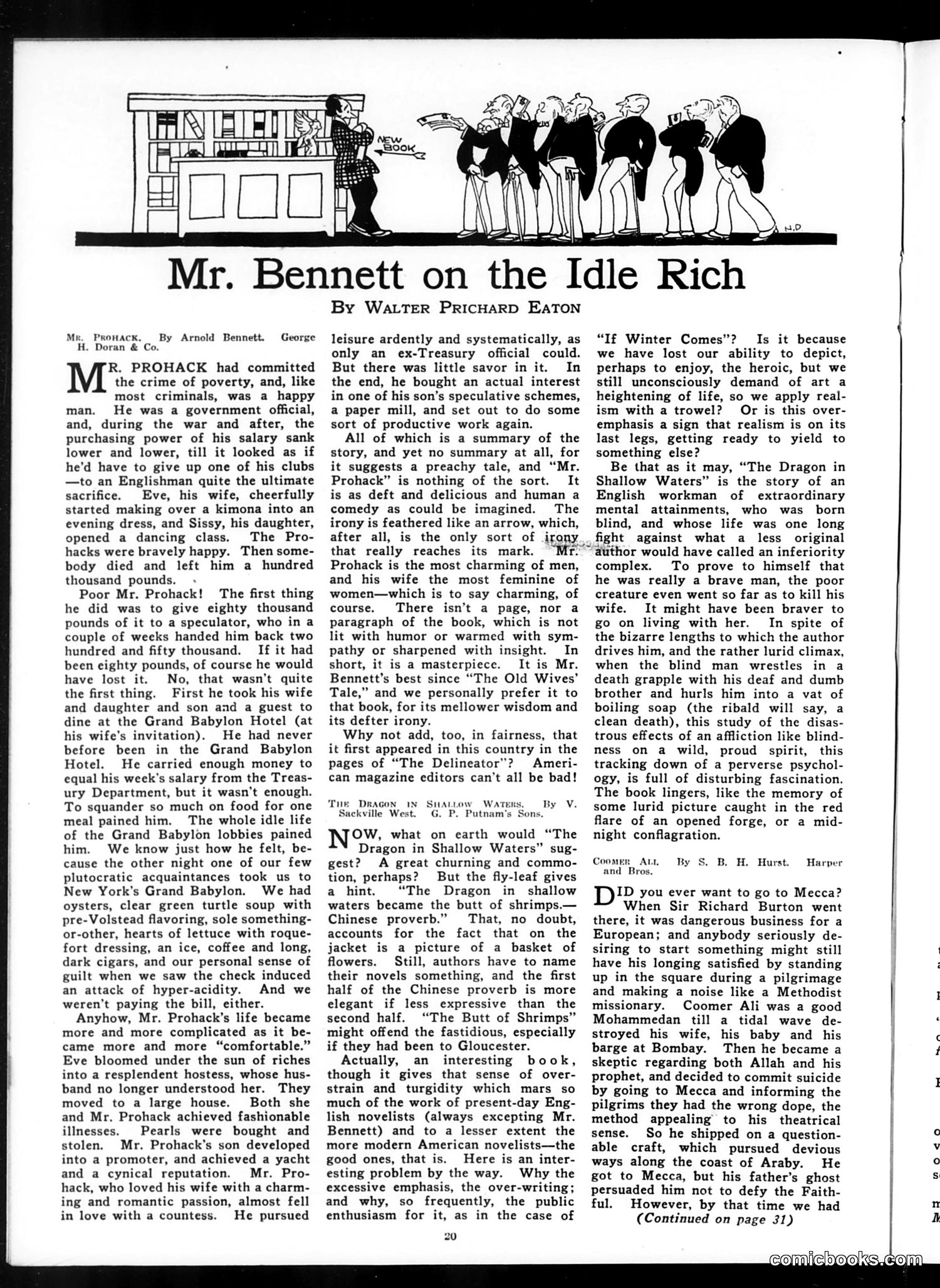
This page reviews Arnold Bennett's novel "Mr. Prohack," a social satire about a British Treasury official who inherits £100,000. The cartoon header (by H.D., likely Hubbard) depicts Bennett himself pointing toward a line of wealthy, idle figures—visualizing the novel's central theme. The satire targets the "idle rich": Mr. Prohack's sudden wealth transforms his dignified life into meaningless luxury and moral compromise. He overpays for restaurant meals, his wife becomes a status-obsessed hostess, his son becomes a cynical speculator, and Prohack himself nearly abandons his marriage for a countess. Only by returning to productive work (investing in a paper mill) does he find purpose. The reviewer (Walter Prichard Eaton) praises Bennett's "feathered irony"—subtle, well-aimed social criticism. The implicit message: inherited wealth corrupts character and happiness, while honest work provides genuine satisfaction. This reflects post-WWI anxieties about England's leisure class and concerns about moral decay through idleness.
📄 Transcribed text from this page (OCR, searchable)
Machine-transcribed from the original scan — historical spelling and the odd misread are preserved.
Mr. PROHACK. H. Doran & Co. R. PROHACK had committed the crime of poverty, and, like most criminals, was a happy man. He was a government official, and, during the war and after, the purchasing power of his salary sank lower and lower, till it looked as if he’d have to give up one of his clubs —to an Englishman quite the ultimate sacrifice. Eve, his wife, cheerfully started making over a kimona into an evening dress, and Sissy, his daughter, opened a dancing class. The Pro- hacks were bravely happy. Then some- body died and left him a hundred thousand pounds. Poor Mr. Prohack! The first thing he did was to give eighty thousand pounds of it to a speculator, who in a couple of weeks handed him back two hundred and fifty thousand. If it had been eighty pounds, of course he would have lost it. No, that wasn’t quite the first thing. First he took his wife and daughter and son and a guest to dine at the Grand Babylon Hotel (at his wife’s invitation). He had never before been in the Grand Babylon Hotel. He carried enough money to equal his week's salary from the Treas- ury Department, but it wasn’t enough. To squander so much on food for one meal pained him. The whole idle life of the Grand Babylon lobbies pained him. We know just how he felt, be- cause the other night one of our few plutocratic acquaintances took us to New York’s Grand Babylon. We had oysters, clear green turtle soup with pre-Volstead flavoring, sole something- or-other, hearts of lettuce with roque- fort dressing, an ice, coffee and long, dark cigars, and our personal sense of guilt when we saw the check induced an attack of hyper-acidity. And we weren't paying the bill, either. Anyhow, Mr. Prohack’s life became more and more complicated as it be- came more and more “comfortable.” Eve bloomed under the sun of riches into a resplendent hostess, whose hus- band no longer understood her. They moved to a large house. Both she and Mr. Prohack achieved fashionable illnesses. Pearls were bought and stolen. Mr. Prohack’s son developed By Arnold Bennett. George into a promoter, and achieved a yacht and a cynical reputation. Mr. Pro- hack, who loved his wife with a charm- ing and romantic passion, almost fell in love with a countess. He pursued Mr. Bennett on the Idle Rich By WALTER PRICHARD EATON leisure ardently and systematically, as only an ex-Treasury official could. But there was little savor in it. In the end, he bought an actual interest in one of his son’s speculative schemes, a paper mill, and set out to do some sort of productive work again. All of which is a summary of the story, and yet no summary at all, for it suggests a preachy tale, and “Mr. Prohack” is nothing of the sort. It is as deft and delicious and human a comedy as could be imagined. The irony is feathered like an arrow, which, after all, is the only sort of irony that really reaches its mark. “Mr. ~ Prohack is the most charming of men, and his wife the most feminine of women—which is to say charming, of course. There isn’t a page, nor a paragraph of the book, which is not lit with humor or warmed with sym- pathy or sharpened with insight. In short, it is a masterpiece. It is Mr. Bennett’s best since “The Old Wives’ Tale,” and we personally prefer it to that book, for its mellower wisdom and its defter irony. Why not add, too, in fairness, that it first appeared in this country in the pages of “The Delineator’? Ameri- can magazine editors can’t all be bad! Tue Dragon iw Suat : 9 Sackville West. G. P. am’s Sons, OW, what on earth would “The Dragon in Shallow Waters” sug- gest? A great churning and commo- tion, perhaps? But the fly-leaf gives a hint. “The Dragon in shallow waters became the butt of shrimps.— Chinese proverb.” That, no doubt, accounts for the fact that on the jacket is a picture of a basket of flowers. Still, authors have to name their novels something, and the first half of the Chinese proverb is more elegant if less expressive than the second half. “The Butt of Shrimps” might offend the fastidious, especially if they had been to Gloucester. Actually, an interesting book, though it gives that sense of over- strain and turgidity which mars so much of the work of present-day Eng- lish novelists (always excepting Mr. Bennett) and to a lesser extent the more modern American novelists—the good ones, that is. Here is an inter- esting problem by the way. Why the excessive emphasis, the over-writing; and why, so frequently, the public enthusiasm for it, as in the case of 20 Is it because we have lost our ability to depict, perhaps to enjoy, the heroic, but we still unconsciously demand of art a heightening of life, so we apply real- “If Winter Comes”? ism with a trowel? Or is this over- emphasis a sign that realism is on its last legs, getting ready to yield to something else? Be that as it may, “The Dragon in Shallow Waters” is the story of an English workman of extraordinary mental attainments, who was born blind, and whose life was one long fight against what a less original author would have called an inferiority complex. To prove to himself that he was really a brave man, the poor creature even went so far as to kill his wife. It might have been braver to go on living with her. In spite of the bizarre lengths to which the author drives him, and the rather lurid climax, when the blind man wrestles in a death grapple with his deaf and dumb brother and hurls him into a vat of boiling soap (the ribald will say, a clean death), this study of the disas- trous effects of an affliction like blind- ness on a wild, proud spirit, this tracking down of a perverse psychol- ogy, is full of disturbing fascination. The book lingers, like the memory of some lurid picture caught in the red flare of an opened forge, or a mid- night conflagration. Coom Au. By S. B. H. Hurst. Harper and Bros. Dp» you ever want to go to Mecca? When Sir Richard Burton went there, it was dangerous business for a European; and anybody seriously de- siring to start something might still have his longing satisfied by standing up in the square during a pilgrimage and making a noise like a Methodist missionary. Coomer Ali was a good Mohammedan till a tidal wave de- stroyed his wife, his baby and his barge at Bombay. Then he became a skeptic regarding both Allah and his prophet, and decided to commit suicide by going to Mecca and informing the pilgrims they had the wrong dope, the method appealing to his theatrical sense. So he shipped on a question- able craft, which pursued devious ways along the coast of Araby. He got to Mecca, but his father’s ghost persuaded him not to defy the Faith- ful. However, by that time we had (Continued on page 31) ee” ee So