
Judge, 1922-04-22 · page 8 of 36
Judge — April 22, 1922 — page 8: what you’re looking at
What you’re looking at
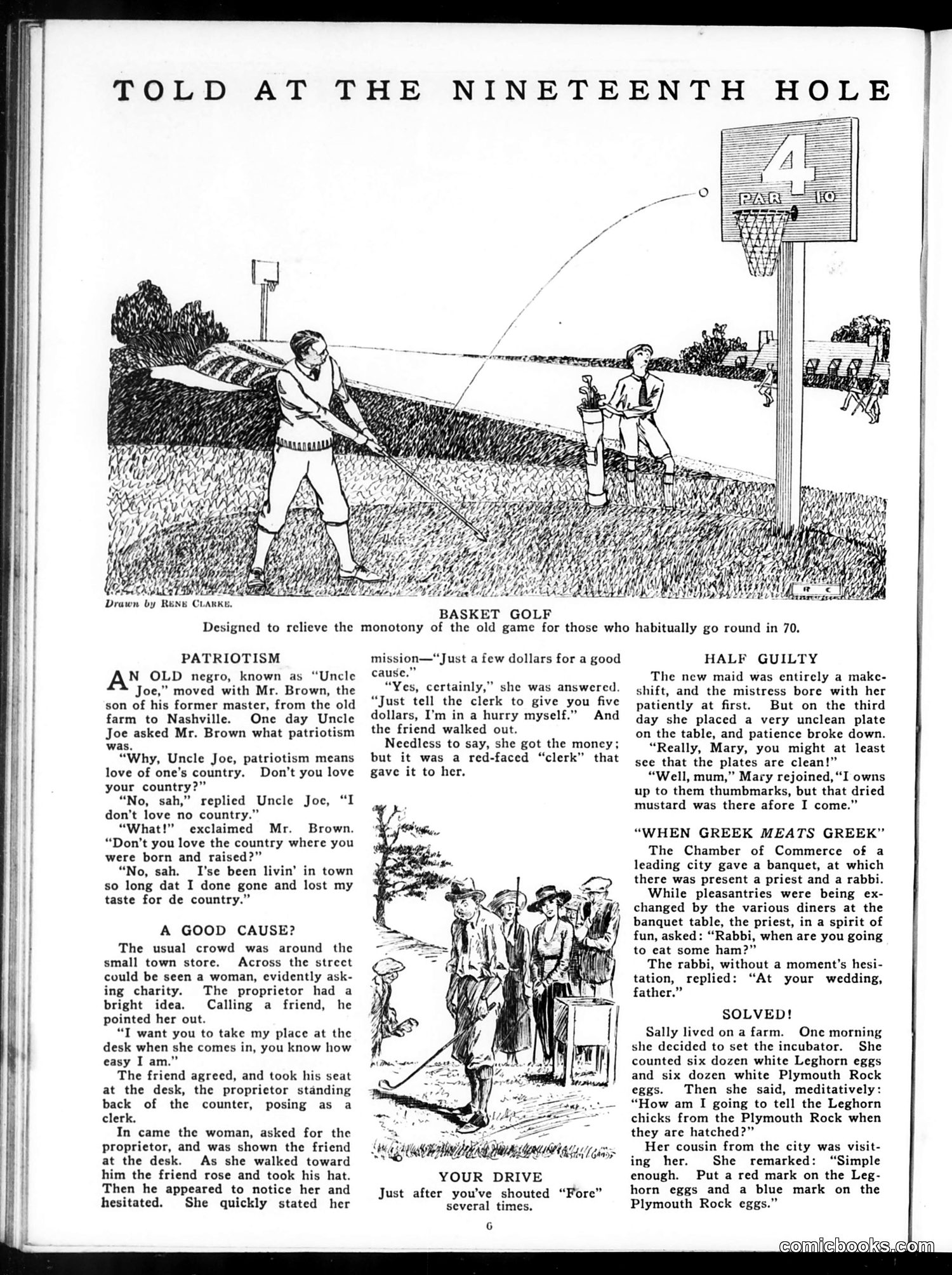
This page collects humorous anecdotes told among golfers. The title refers to the nineteenth hole—the clubhouse bar where golfers gather after playing eighteen holes. **"Patriotism"**: Uses a racist dialect-heavy joke mocking an elderly Black man ("Uncle Joe") who, having moved to town, claims to have lost his taste for country life. The "joke" relies on caricature and outdated rural stereotypes. **"A Good Cause"**: A proprietor tricks a friend into approving charity by pretending the friend is the clerk. The friend, embarrassed at being duped into generosity, must pay. **"Half Guilty"**: A new maid admits to some but not all kitchen negligence, deflecting blame for dried mustard already present. **"When Greek Meets Greek"**: A priest asks a rabbi when he'll eat ham; the rabbi quips he'll do so at the priest's (future) wedding—implying priests don't marry. **"Basket Golf"**: The illustration shows golf reimagined with basketball hoops, designed to entertain older golfers who shoot around 70 strokes. These are genteel country-club humor typical of early 20th-century Judge magazine.
📄 Transcribed text from this page (OCR, searchable)
Machine-transcribed from the original scan — historical spelling and the odd misread are preserved.
TOLD AT THE NINETEENTH HOLE Drawn by Rens Ciarke. vee Cee tot BASKET GOLF } a pee Han . oo aire BY) Bu Designed to relieve the monotony of the old game for those who habitually go round in 70. PATRIOTISM AN OLD negro, known as “Uncle Joe,” moved with Mr. Brown, the son of his former master, from the old farm to Nashville. One day Uncle Joe asked Mr. Brown what patriotism was. “Why, Uncle Joe, patriotism means love of one’s country. Don’t you love your country?” “No, sah,” replied Uncle Joe, don’t love no country.” “What!” exclaimed Mr. Brown. “Don’t you love the country where you were born and raised?” “No, sah. _I'se been livin’ in town so long dat I done gone and lost my taste for de country.” “] A GOOD CAUSE? The usual crowd was around the small town store. Across the street could be seen a woman, evidently ask- ing charity. The proprietor had a bright idea. Calling a friend, he pointed her out. “TI want you to take my place at the desk when she comes in, you know how easy I am.” The friend agreed, and took his seat at the desk, the proprietor standing back of the counter, posing as a clerk. In came the woman, asked for the proprietor, and was shown the friend at the desk. As she walked toward him the friend rose and took his hat. Then he appeared to notice her and hesitated. She quickly stated her mission—“Just a few dollars for a good cause.” “Yes, certainly,” she was answered. “Just tell the clerk to give you five dollars, I’m in a hurry myself.” And the friend walked out. Needless to say, she got the money; but it was a red-faced “clerk” that gave it to her. GUE RAL EL BOGE cas. YOUR DRIVE Just after you’ve shouted “Fore” several times. 6 HALF GUILTY The new maid was entirely a make- shift, and the mistress bore with her patiently at first. But on the third day she placed a very unclean plate on the table, and patience broke down. “Really, Mary, you might at least see that the plates are clean!” “Well, mum,” Mary rejoined, “I owns up to them thumbmarks, but that dried mustard was there afore I come.” “WHEN GREEK MEATS GREEK” The Chamber of Commerce of a leading city gave a banquet, at which there was present a priest and a rabbi. While pleasantries were being ex- changed by the various diners at the banquet table, the priest, in a spirit of fun, asked: “Rabbi, when are you going to eat some ham?” The rabbi, without a moment's hesi- tation, replied: “At your wedding, father.” SOLVED! Sally lived on a farm. One morning she decided to set the incubator. She counted six dozen white Leghorn eggs and six dozen white Plymouth Rock eggs. Then she said, meditatively: “How am I going to tell the Leghorn chicks from the Plymouth Rock when they are hatched?” Her cousin from the city was visit- ing her. She remarked: “Simple enough. Put a red mark on the Leg- horn eggs and a blue mark on the Plymouth Rock eggs.”