
Judge, 1922-04-22 · page 12 of 36
Judge — April 22, 1922 — page 12: what you’re looking at
What you’re looking at
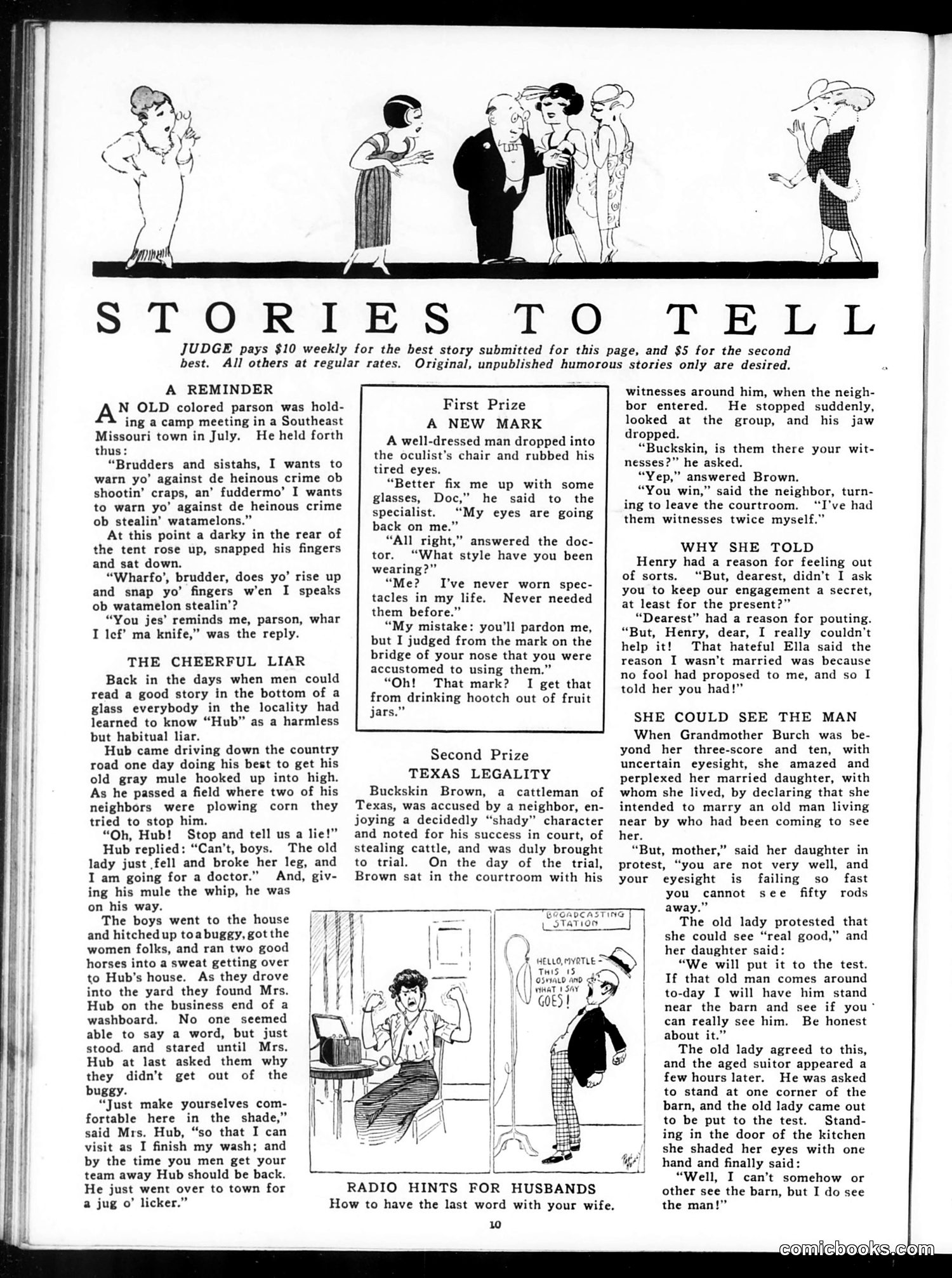
This page from Judge magazine contains three humorous short stories submitted by readers. The content reflects early-20th-century American attitudes and stereotypes: **"A Reminder"** uses racist dialect humor, depicting a Black preacher and congregation in a stereotypical manner typical of the era's casual racism. **"The Cheerful Liar"** is a straightforward anecdote about a habitual liar whose emergency claim finally goes unbelieved—a classic "boy who cried wolf" setup. **"A New Mark"** jokes about Prohibition-era drinking, showing a man with a visible mark on his nose from illegal "hootch" bottles rather than eyeglasses. **"Texas Legality"** satirizes frontier justice, suggesting witnesses can be bought or reused across trials in Texas courts. The remaining stories focus on romantic entanglements and domestic situations. Overall, the page represents Judge's "Stories to Tell" submission section, offering payment for humorous anecdotes reflecting contemporary social attitudes and values.
📄 Transcribed text from this page (OCR, searchable)
Machine-transcribed from the original scan — historical spelling and the odd misread are preserved.
S TORI ES TO TELL JUDGE pays $10 weekly for the best story submitted for this page, and $5 for the second best. A REMINDER AN OLD colored parson was hold- ing a camp meeting in a Southeast Missouri town in July. He held forth thus: “Brudders and sistahs, I wants to warn yo’ against de heinous crime ob shootin’ craps, an’ fuddermo’ I wants to warn yo’ against de heinous crime ob stealin’ watamelons.” At this point a darky in the rear of the tent rose up, snapped his fingers and sat down. “Wharfo’, brudder, does yo’ rise up and snap yo’ fingers w’en I speaks ob watamelon stealin’? “You jes’ reminds me, parson, whar I lcf’ ma knife,” was the reply. THE CHEERFUL LIAR Back in the days when men could read a good story in the bottom of a glass everybody in the locality had learned to know “Hub” as a harmless but habitual liar. Hub came driving down the country road one day doing his best to get his old gray mule hooked up into high. As he passed a field where two of his neighbors were plowing corn they tried to stop him. “Oh, Hub! Stop and tell us a lie!” Hub replied: “Can't, boys. The old lady just fell and broke her leg, and I am going for a doctor.” And, giv- ing his mule the whip, he was on his way. All others at regular rates. First Prize A NEW MARK A well-dressed man dropped into the oculist’s chair and rubbed his tired eyes. “Better fix me up with some glasses, Doc,” he said to the specialist. “My eyes are going back on me.” “All right,” answered the doc- tor. “What style have you been wearing?” “Me? tacles in my life. them before.” “My mistake: you'll pardon me, but I judged from the mark on the bridge of your nose that you were accustomed to using them.” “Oh! That mark? I get that from drinking hootch out of fruit jars.” I’ve never worn spec- Never needed Second Prize TEXAS LEGALITY Buckskin Brown, a cattleman of Texas, was accused by a neighbor, en- joying a decidedly “shady” character and noted for his success in court, of stealing cattle, and was duly brought to trial. On the day of the trial, Brown sat in the courtroom with his Original, unpublished humorous stories only are desired. witnesses around him, when the neigh- bor entered. He stopped suddenly, looked at the group, and his jaw dropped. “Buckskin, is them there your wit- nesses?” he asked. “Yep,” answered Brown. “You win,” said the neighbor, turn- ing to leave the courtroom. “I've had them witnesses twice myself.” WHY SHE TOLD Henry had a reason for feeling out of sorts. “But, dearest, didn’t I ask you to keep our engagement a secret, at least for the present?” “Dearest” had a reason for pouting. “But, Henry, dear, I really couldn't help it! That hateful Ella said the reason I wasn’t married was because no fool had proposed to me, and so I told her you had!” SHE COULD SEE THE MAN When Grandmother Burch was be- yond her three-score and ten, with uncertain eyesight, she amazed and perplexed her married daughter, with whom she lived, by declaring that she intended to marry an old man living near by who had been coming to see her. “But, mother,” said her daughter in protest, “you are not very well, and your eyesight is failing so fast you cannot see fifty rods away.” The boys went to the house and hitched up toa buggy, got the women folks, and ran two good horses into a sweat getting over to Hub’s house. As they drove into the yard they found Mrs. Hub on the business end of a washboard. No one seemed able to say a word, but just stood. and stared until Mrs. Hub at last asked them why they didn’t get out of the buggy. “Just make yourselves com- fortable here in the shade,” said Mrs. Hub, “so that I can visit as I finish my wash; and by the time you men get your The old lady protested that she could see “real good,” and her daughter said: “We will put it to the test. If that old man comes around to-day I will have him stand near the barn and see if you~ can really see him. Be honest about it.” The old lady agreed to this, and the aged suitor appeared a few hours later. He was asked to stand at one corner of the barn, and the old lady came out to be put to the test. Stand- ing in the door of the kitchen she shaded her eyes with one hand and finally said: team away Hub should be back. He just went over to town for a jug o’ licker.” RADIO HINTS FOR HUSBANDS How to have the last word with your wife. 10 “Well, I can’t somehow or other see the barn, but I do see the man!”