
A complete issue · 36 pages · 1922
Judge — February 18, 1922
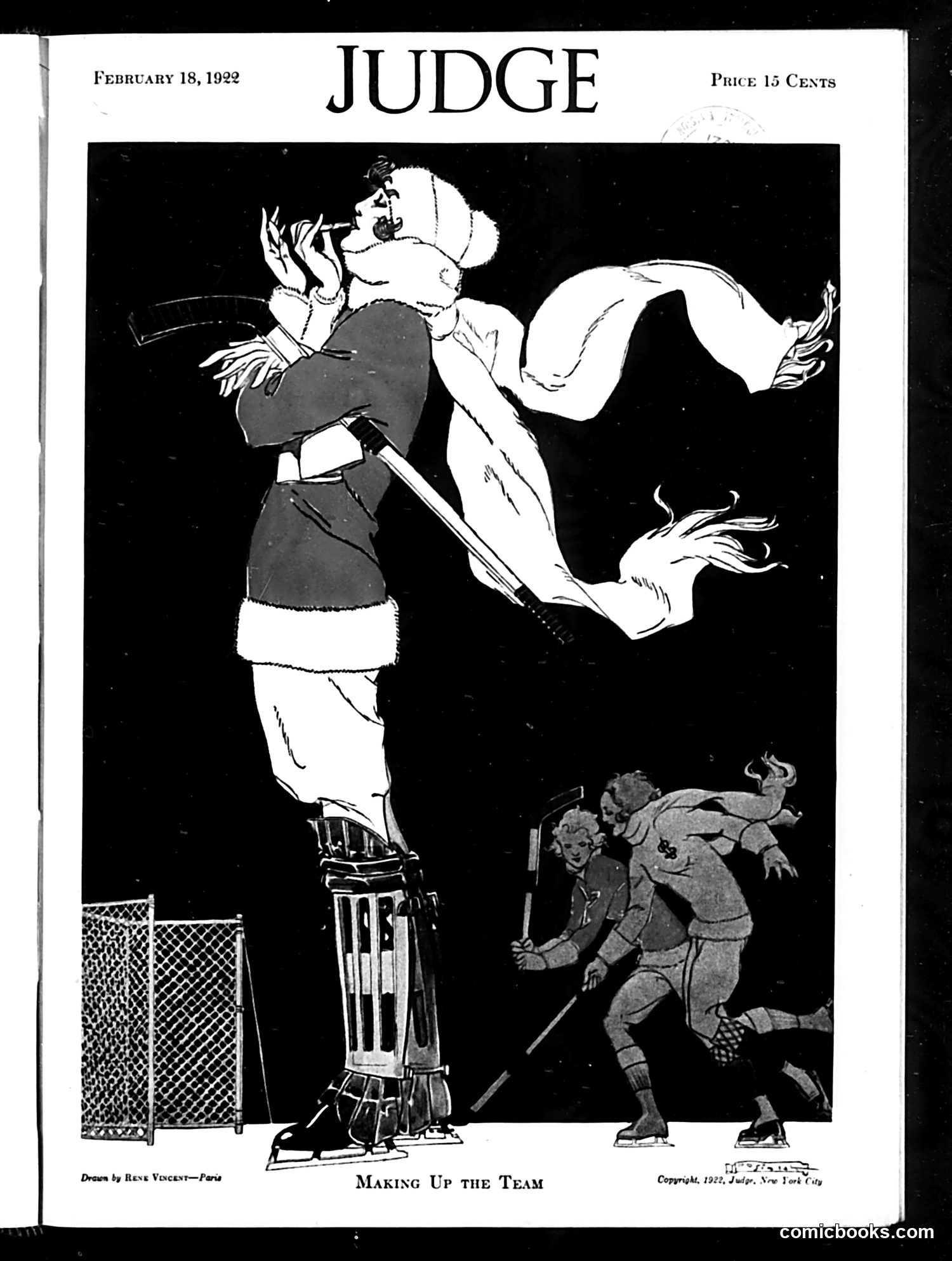
This **February 18, 1922** cartoon satirizes ice hockey team composition. The central figure—a tall woman in a dark dress and white fur stole—appears to represent either a team owner, manager, or society patron selecting players. She's wielding a hockey stick while examining two small male figures below, suggesting she's literally "making up" (assembling/choosing) a team. The satire likely mocks either: wealthy women's increasing influence in sports management during the 1920s, or the absurdity of unconventional team-building decisions. The exaggerated scale difference and the woman's confident pose emphasize the joke—her selection choices seem arbitrary or ridiculous compared to traditional management practices. The drawing style and subject matter reflect typical Judge magazine satire of upper-class social trends.
This is an advertisement for Leslie's Weekly magazine (February 18 issue), promoting an exposé article titled "The Disabliteers" by Theodore Waters. The piece investigates fraud involving individuals who deliberately injure themselves to file fake damage suits and extort money—what the ad calls a "well-organized business." The ad emphasizes this as investigative journalism, noting Waters previously contributed to Leslie's "Modern Mendicant" series exposing beggary fraud. The advertisement also promotes other content: a love story, a Seannon Lockwood serial, and an aviation article by Howard Mingos. The tone reflects early-20th-century concern about organized fraud schemes and insurance abuse, positioning Leslie's as an exposé publication. Pricing: 10 cents per copy or $5 yearly subscription.
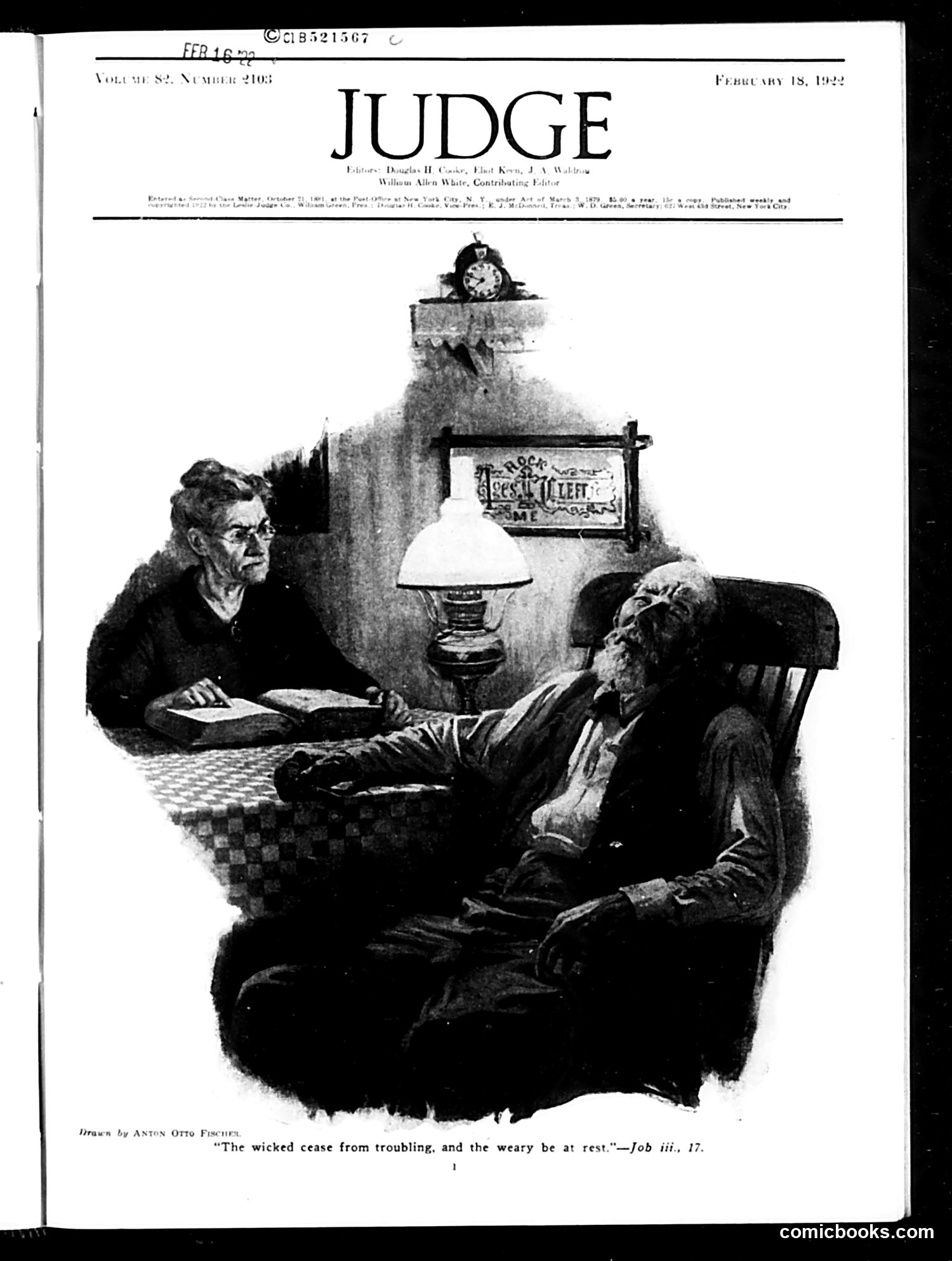
This illustration by Anton Otto Fischer depicts two figures in what appears to be a modest room with a clock and oil lamp. The caption quotes Job 3:17: "The wicked cease from troubling, and the weary be at rest." The cartoon likely comments on post-World War I fatigue and the desire for peace and stability. The two weary men—possibly representing working-class citizens or soldiers—sit in a spartan interior, suggesting themes of economic hardship or exhaustion following the war. The biblical reference reinforces the message of seeking respite from worldly troubles. The image appears to advocate for social rest or relief from contemporary social turmoil, though the specific political context remains unclear without additional historical information about Judge's coverage in early 1922.
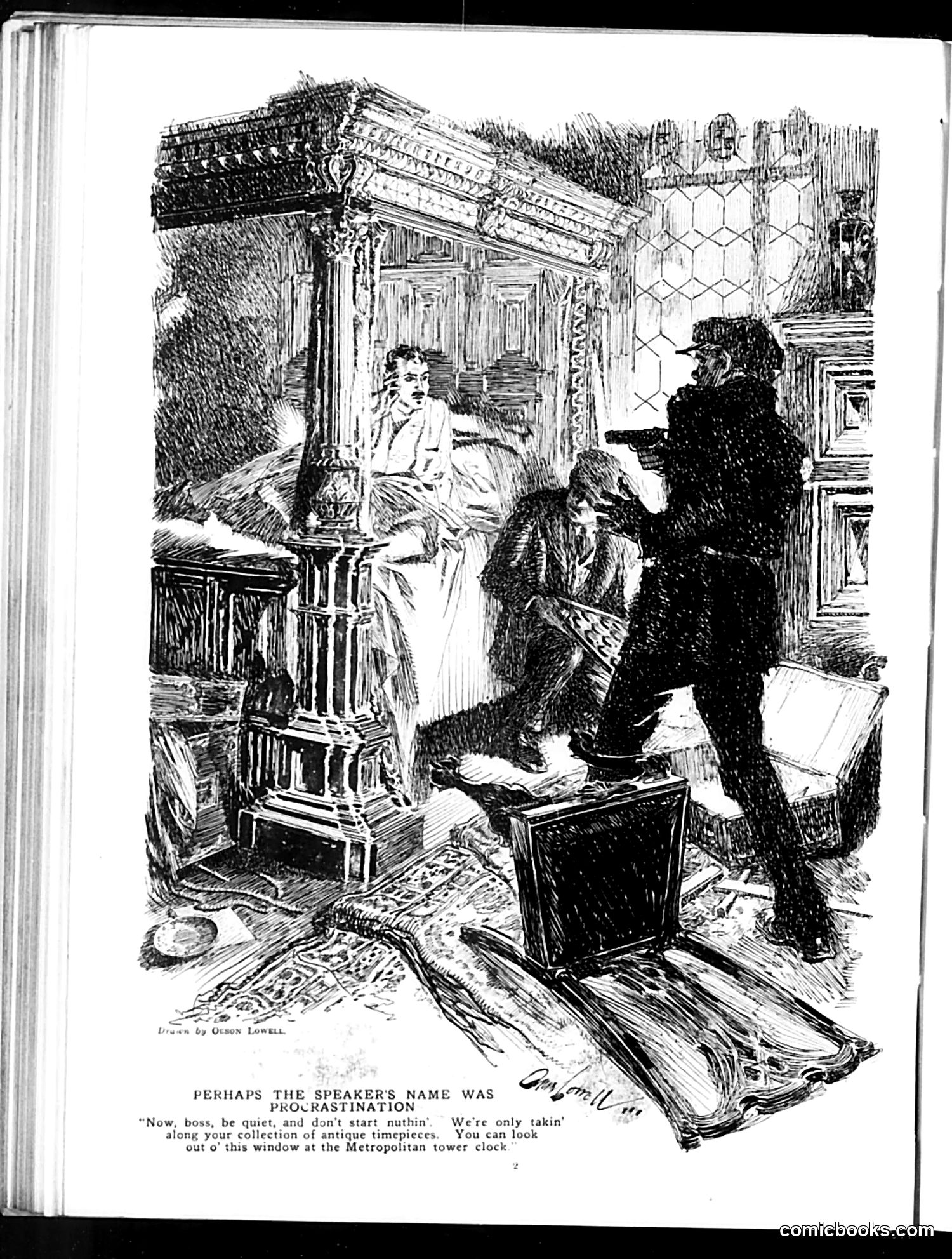
This sketch illustrates a conversation between two men in what appears to be an elegant interior (likely a shop or showroom). The figure on the left, dressed formally, is speaking to another man about a collection of antique timepieces. The dialogue reads: "Now, boss, be quiet, and don't start nuthin'. We're only takin' along your collection of antique timepieces. You can look out o' this window at the Metropolitan tower clock." The satire targets **procrastination**—the title suggests the speaker's name embodies this vice. The joke plays on the old adage about checking the time: the thieves are stealing the man's valuable clock collection while reassuring him he can still see the time via the Metropolitan tower clock visible from the window. It's a darkly humorous commentary on rationalization and accepting loss.
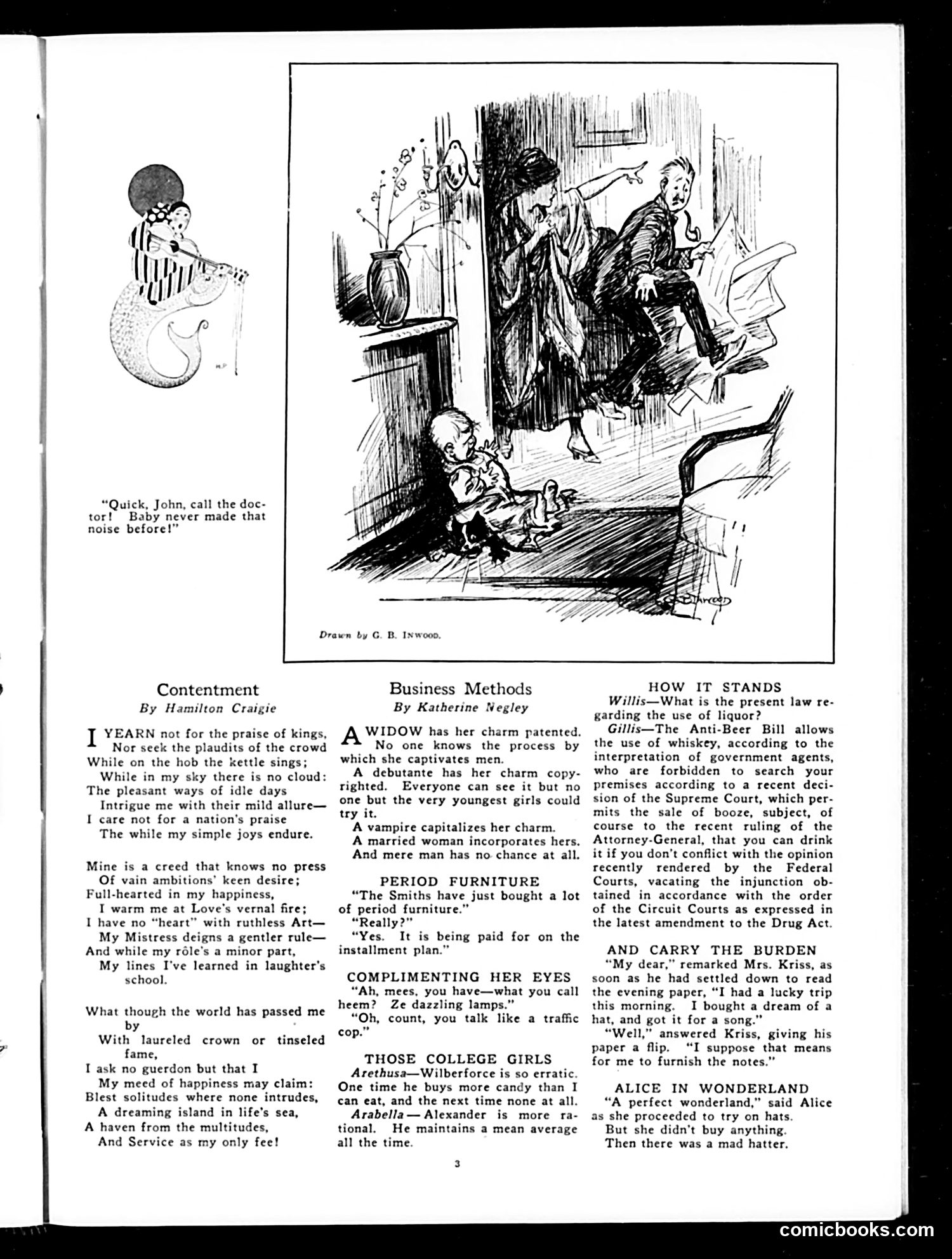
The main cartoon depicts a chaotic domestic scene where an exasperated father figure gestures wildly at a crying baby on the floor, while the mother appears distressed. The caption reads: "Quick, John, call the doctor! Baby never made that noise before!" **The satire:** This plays on new-parent anxiety and the tendency to over-medicalize minor infant complaints. The joke suggests that parents immediately assume a baby's unusual sound requires professional intervention, when it's likely just normal infant behavior. The surrounding text includes short humor pieces about social topics (widows' charm, college girls' behavior) typical of Judge magazine's satirical commentary on contemporary manners and relationships. **Artist credit:** G.B. Inwood drew the main cartoon.
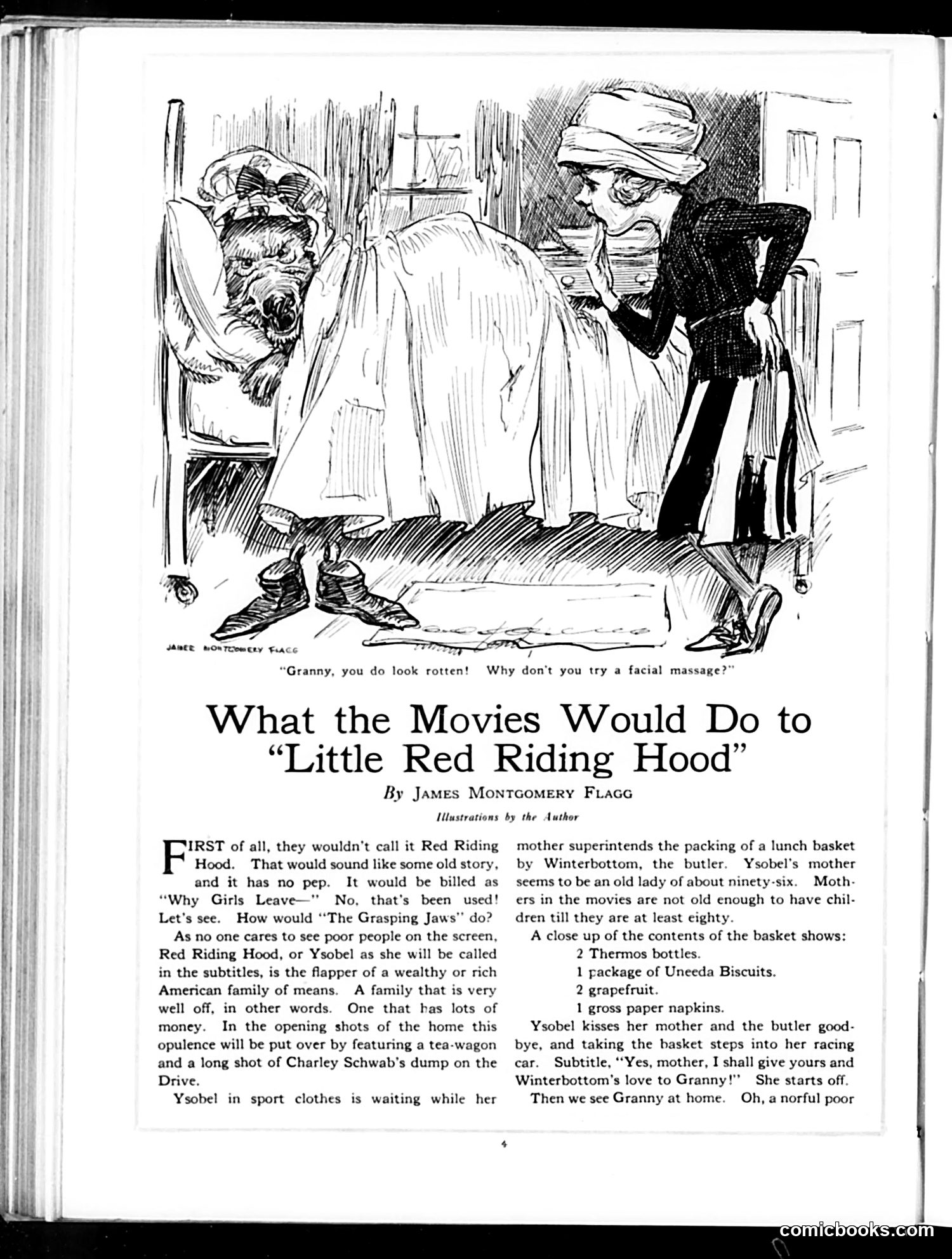
This page satirizes how Hollywood would adapt the fairy tale "Little Red Riding Hood" for film. The cartoon shows an elderly woman (labeled "Granny") in a run-down state, with the caption joking she needs a facial massage—mocking how movies glamorize poverty. The article by James Montgomery Flagg criticizes Hollywood's sanitization of classic stories. Key points: - Movies would rename the tale and recast it with wealthy characters - Red Riding Hood becomes "Ysobel," daughter of a rich family - The grandmother's cottage transforms into an opulent tea-wagon setting with Charley Schwab's dump visible - The simple lunch basket becomes an elaborate affair with thermoses and gourmet biscuits The satire targets Hollywood's inability to authentically depict working-class life, instead glamorizing or sentimentalizing poverty for entertainment.
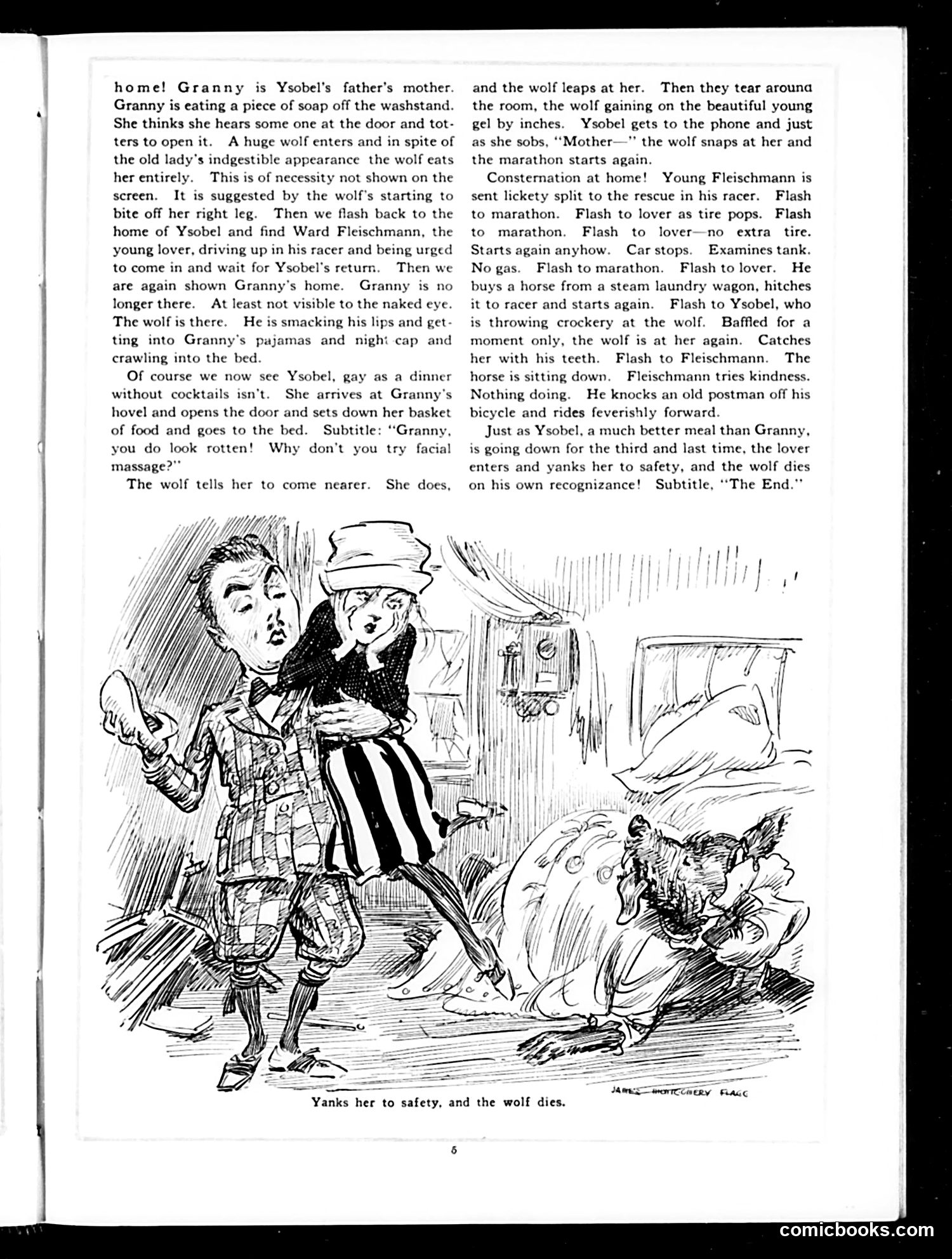
This page satirizes melodramatic silent films, particularly "Little Red Riding Hood" adaptations popular in the early 1900s. The text describes a film scenario where a wolf devours Granny, then attacks the young heroine Ysobel at her grandmother's home. The satire mocks the genre's absurd plot mechanics: improbable rescues, exaggerated peril, and convenient resolutions. The lover Ward Fleischmann's journey—his car running out of gas, stealing a horse from a laundry wagon, knocking over a postman—parodies the increasingly ridiculous obstacles silent films used to extend chase scenes and tension. The illustration shows the climactic moment: Fleischmann yanking Ysobel to safety while the wolf dies conveniently "on his own recognizance" (by its own choice). The phrase "Yanks her to safety, and the wolf dies" satirizes how these films resolved their melodrama through providence rather than logic. This was Judge's commentary on overwrought cinema conventions of the era.
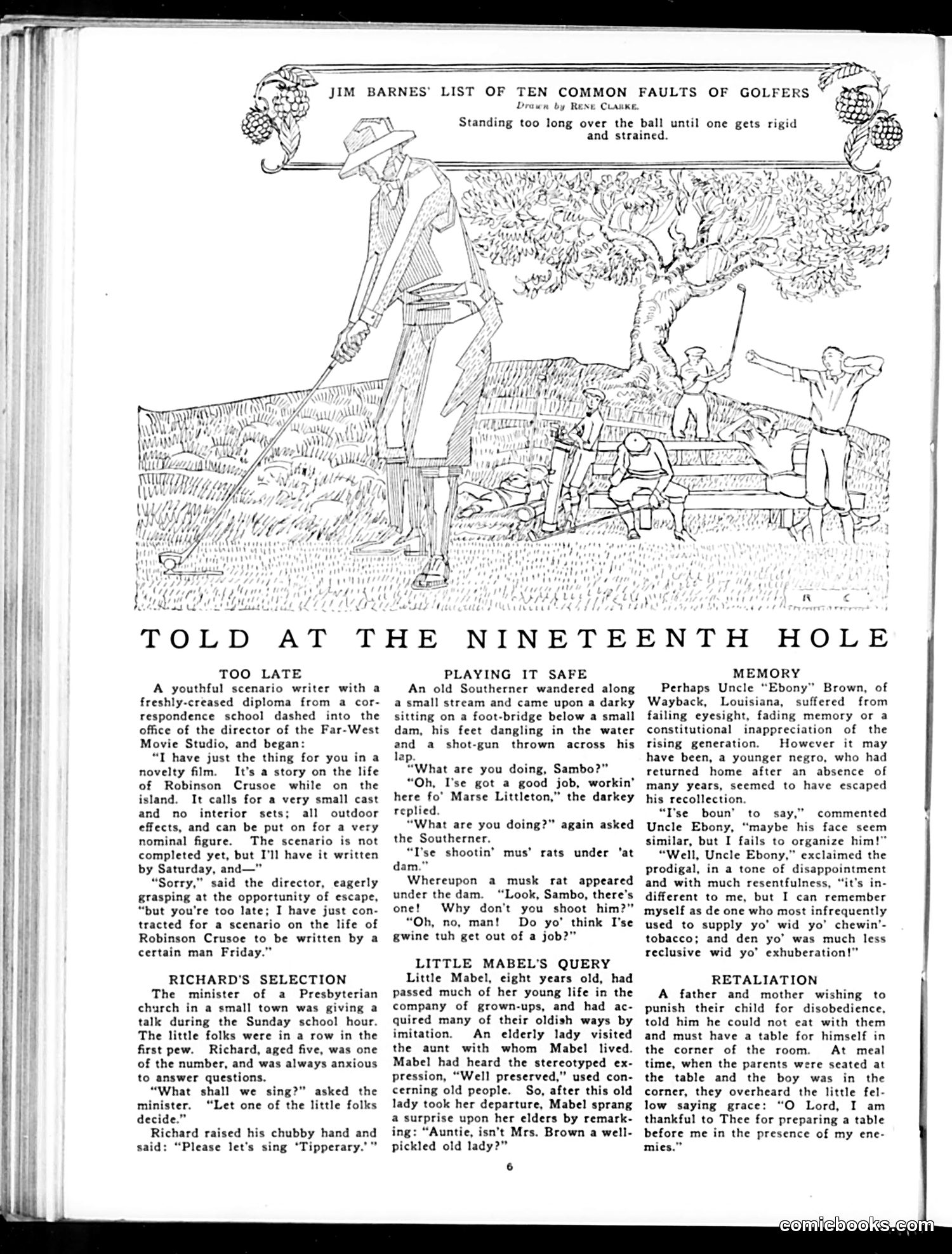
This Judge magazine page contains several satirical short stories and one instructional golf tip, all using humor to comment on early 20th-century American life. **The Golf Fault**: An illustrated tip about golfers standing too long over the ball, causing tension—practical advice presented visually. **The Jokes Themselves**: - "Too Late" mocks Hollywood scenario writers and the Robinson Crusoe craze in early cinema - "Richard's Selection" satirizes a child's innocent choice of the WWI song "Tipperary" in a religious context—likely mocking either the child's precocity or contemporary war sentiment - "Playing It Safe" and "Memory" feature racial stereotypes common to the era, depicting Black workers using dialect humor - "Little Mabel's Query" and "Retaliation" use children's innocent misunderstandings for comedic effect The page reflects Judge's formula: workplace satire (Hollywood), war-era topicality, and domestic humor relying on period attitudes that modern readers would find problematic. The golf instruction suggests this was a general-interest magazine mixing advice with entertainment.
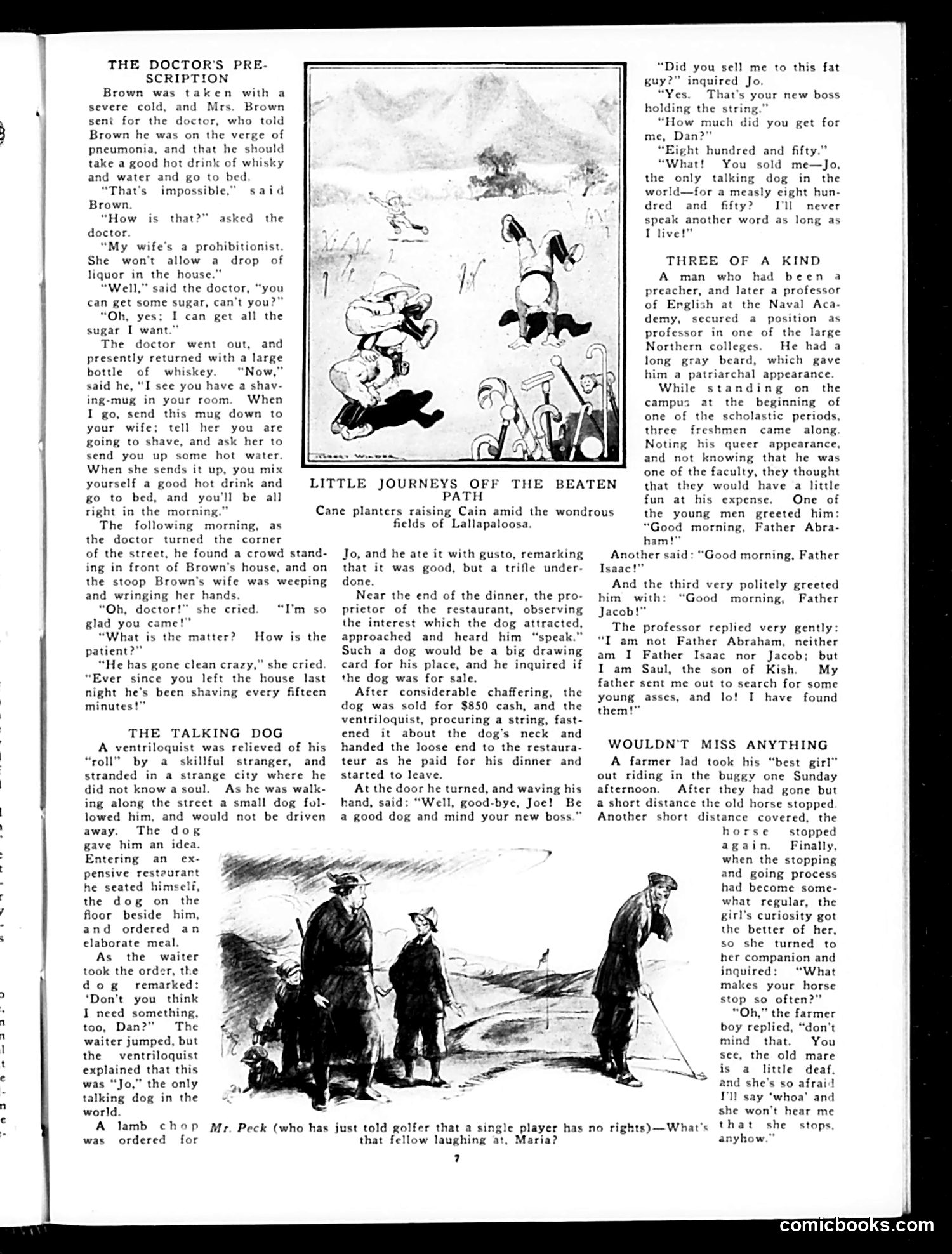
This page contains three humorous stories typical of Judge magazine's satirical approach: 1. **"The Doctor's Prescription"**: Satirizes Prohibition-era hypocrisy. A doctor prescribes whiskey for pneumonia but instructs the patient to deceive his prohibitionist wife by disguising it as shaving water in a mug. The joke: the man shaves obsessively, implying he drinks the "medicine" repeatedly and becomes unhinged—mocking both medical quackery and the absurdity of alcohol prohibition. 2. **"The Talking Dog"**: A ventriloquist cons a restaurant owner into buying his dummy dog (via ventriloquism) for $850. When "sold," the dog (actually the ventriloquist speaking) refuses to perform again, having "negotiated" its own labor dispute—a clever commentary on worker exploitation and contractual betrayal. 3. **"Three of a Kind"** (incomplete): Appears to mock academic pretension, showing freshmen approaching a bearded professor they don't recognize. All three stories use misdirection and ironic reversals to critique social conventions: prohibition enforcement, labor relations, and institutional authority.
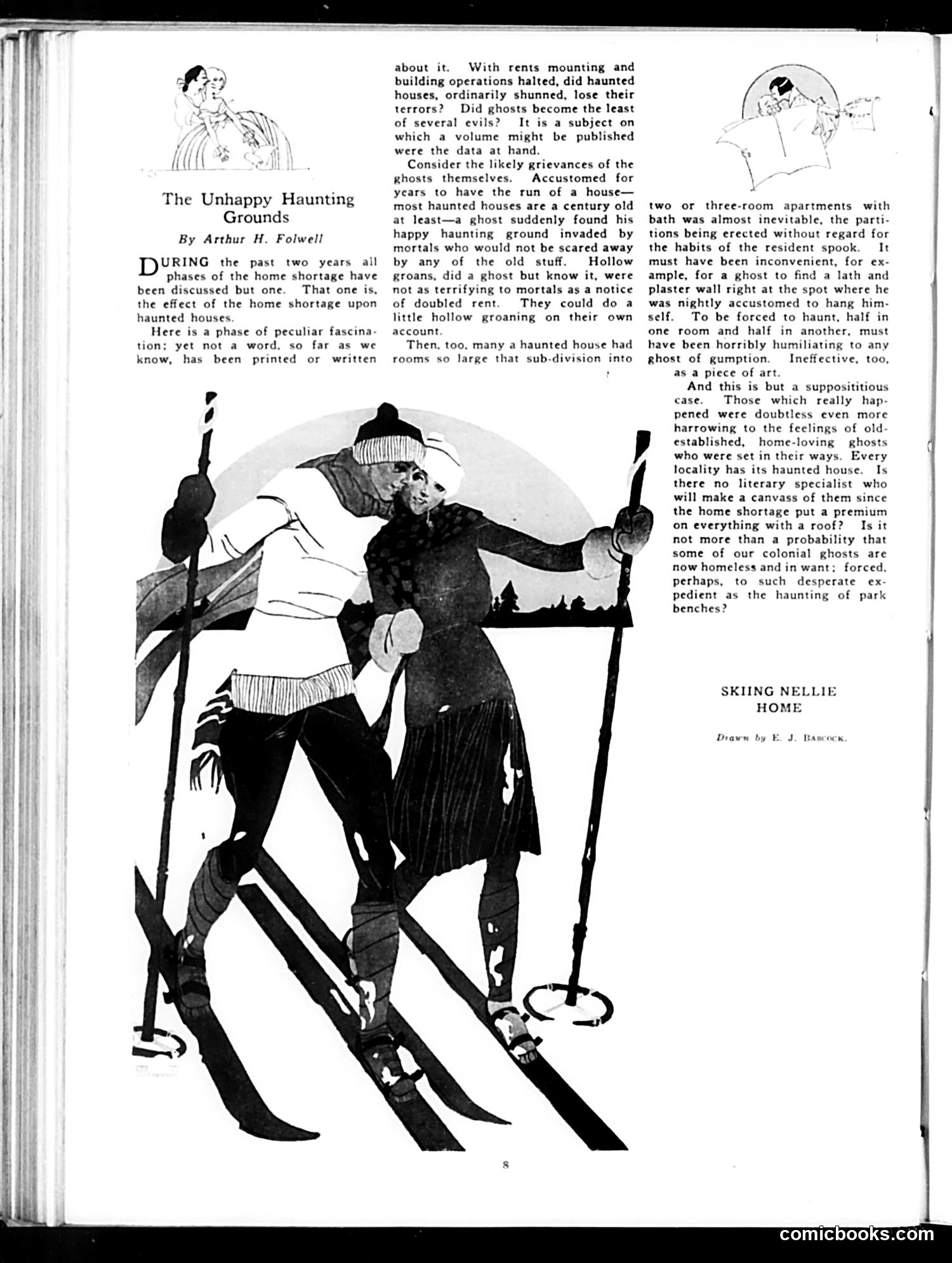
This is a humorous essay by Arthur H. Folwell addressing the post-WWI American housing shortage through an absurdist lens: what happens to ghosts when their traditional haunted houses get subdivided into rental apartments? The satire operates on multiple levels. On the surface, it's a joke about housing scarcity forcing even supernatural beings into precarious situations. But it's really commentary on the severe housing crisis of the early 1920s—rents mounting, building halted, desperate landlords converting old mansions into cramped multi-unit dwellings without regard for structural integrity or aesthetics. The cartoon "Skiing Nellie Home" (drawn by E.J. Haycock) shows a woman skiing, likely illustrating the absurdist premise that extreme measures (even winter sports) become necessary transportation when housing is so scarce that people might be displaced. The essay's final joke—that dispossessed ghosts might resort to "haunting park benches"—grimly suggests actual homelessness, using supernatural displacement as dark satire for real human suffering during this period.
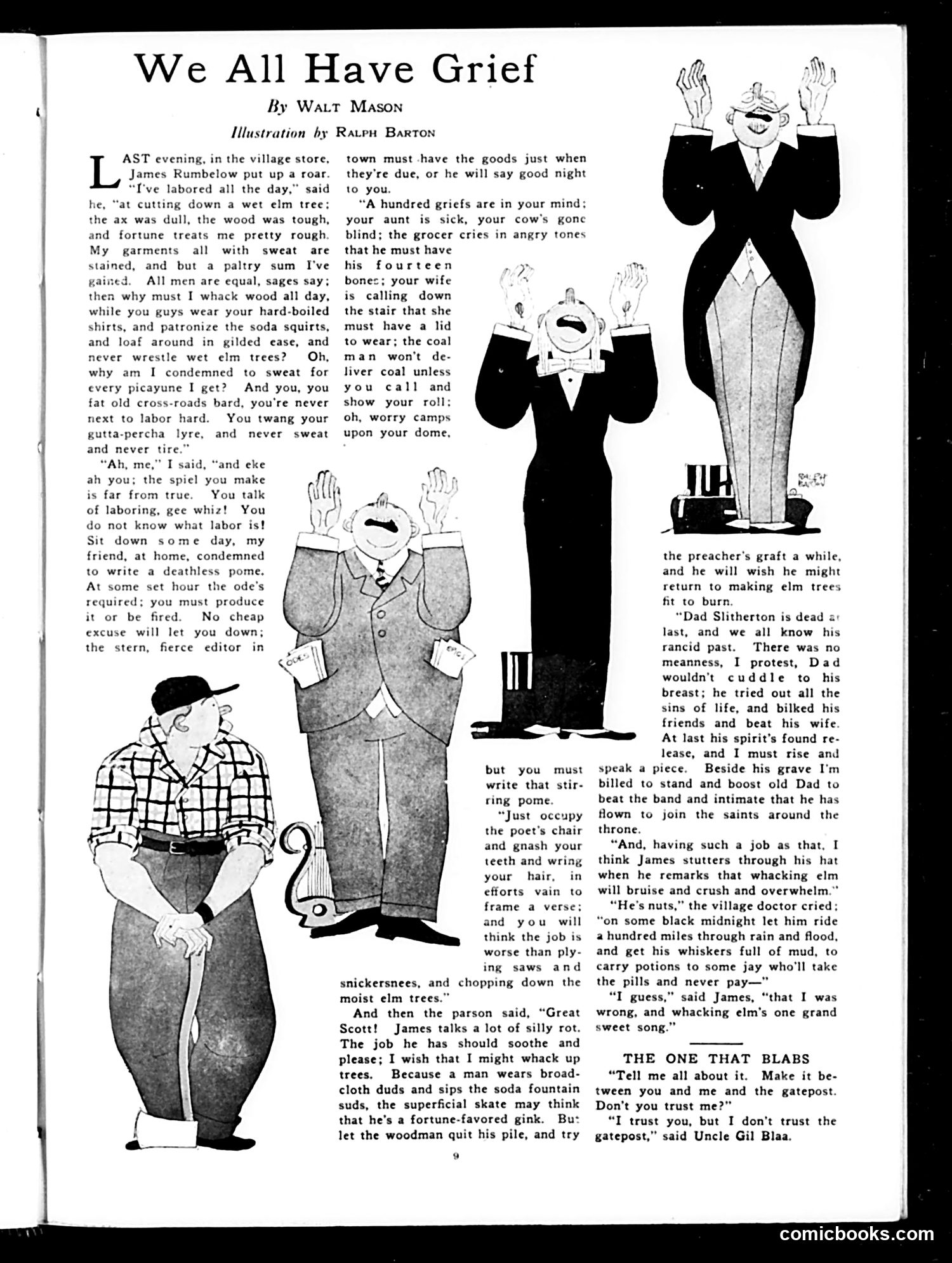
This is a humorous poem by Walt Mason arguing that **everyone has legitimate grievances**, regardless of social class or profession. James Rumbelow, a woodcutter, complains about his hard labor while others enjoy leisure. The narrator (a poet) counters that writing poetry under editorial deadlines is equally torturous. A parson then admits that even his cushy job—giving sermons at funerals for disreputable people like "Dad Slitherton"—is burdensome. Finally, a village doctor describes exhausting midnight medical calls through bad weather. The satire's point: **different occupations carry different hardships**. There's no hierarchy of suffering. The working-class woodcutter shouldn't envy white-collar professionals; they all face genuine stress. The accompanying illustrations by Ralph Barton show exaggerated, distressed figures to emphasize this universal condition. The brief joke at the end ("The One That Blabs") is separate, about Uncle Gil Blaa distrusting the gatepost—suggesting gossip spreads through even unlikely channels.
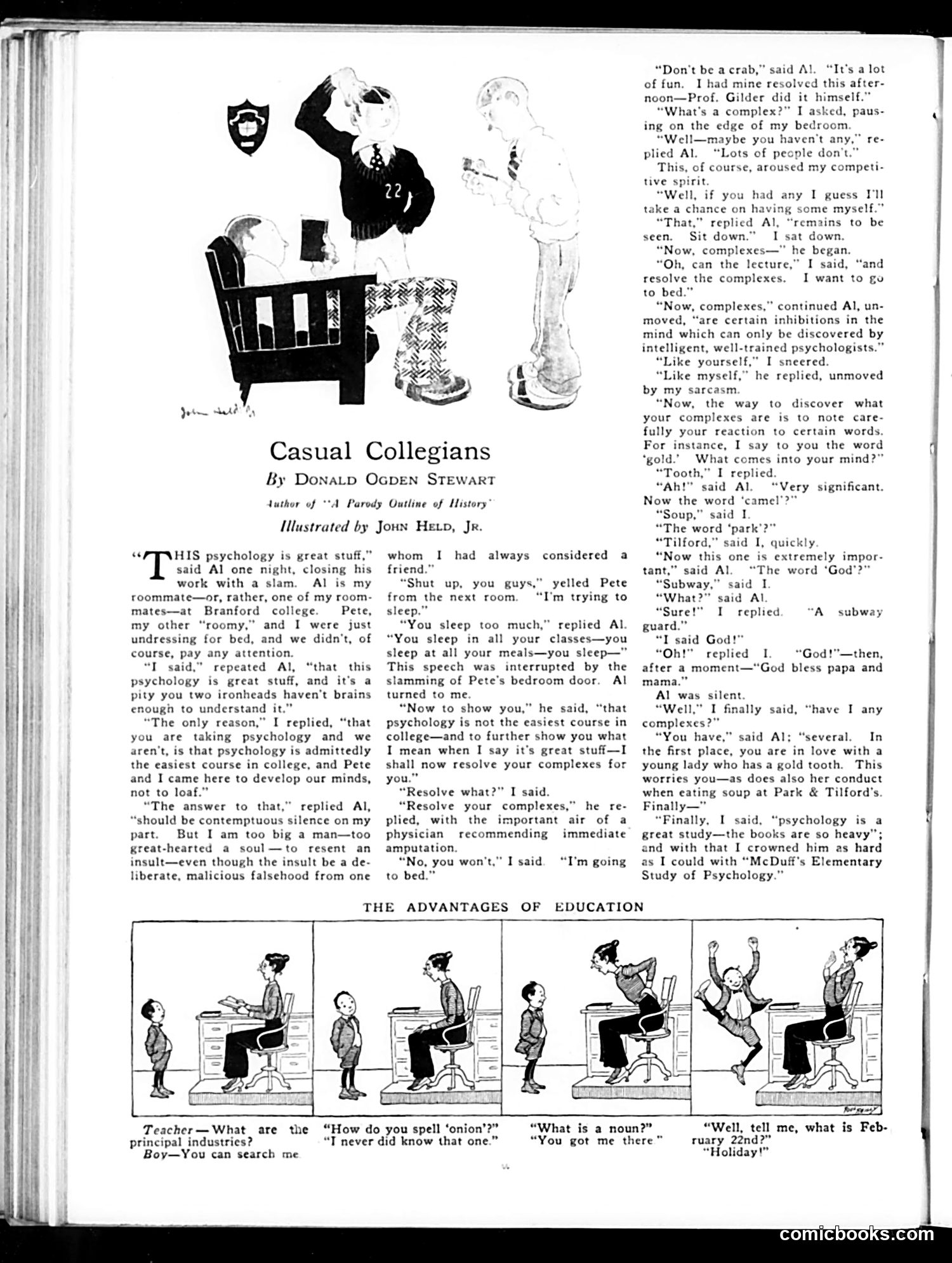
This humor piece satirizes college students' pretentious adoption of psychology—then a fashionable new academic field—as intellectual posturing. Al, a roommate, claims psychology proves he's intellectually superior, though the narrator notes he takes it precisely because it's "admittedly the easiest course in college." The satire peaks when Al attempts to "resolve complexes" using word-association tests (a contemporary psychological technique). His profound interpretations—finding deep significance in mundane responses like "tooth" for "gold"—mock how students misapply amateur psychology jargon to sound sophisticated. The joke culminates when the narrator, tired of Al's pseudo-intellectual bluffing, literally strikes him with a psychology textbook, suggesting the whole enterprise deserves physical rejection. The bottom cartoon strip ("Advantages of Education") reinforces the theme: it shows a teacher asking basic questions a student cannot answer, inverting the page's broader message that formal education doesn't guarantee actual knowledge or competence.
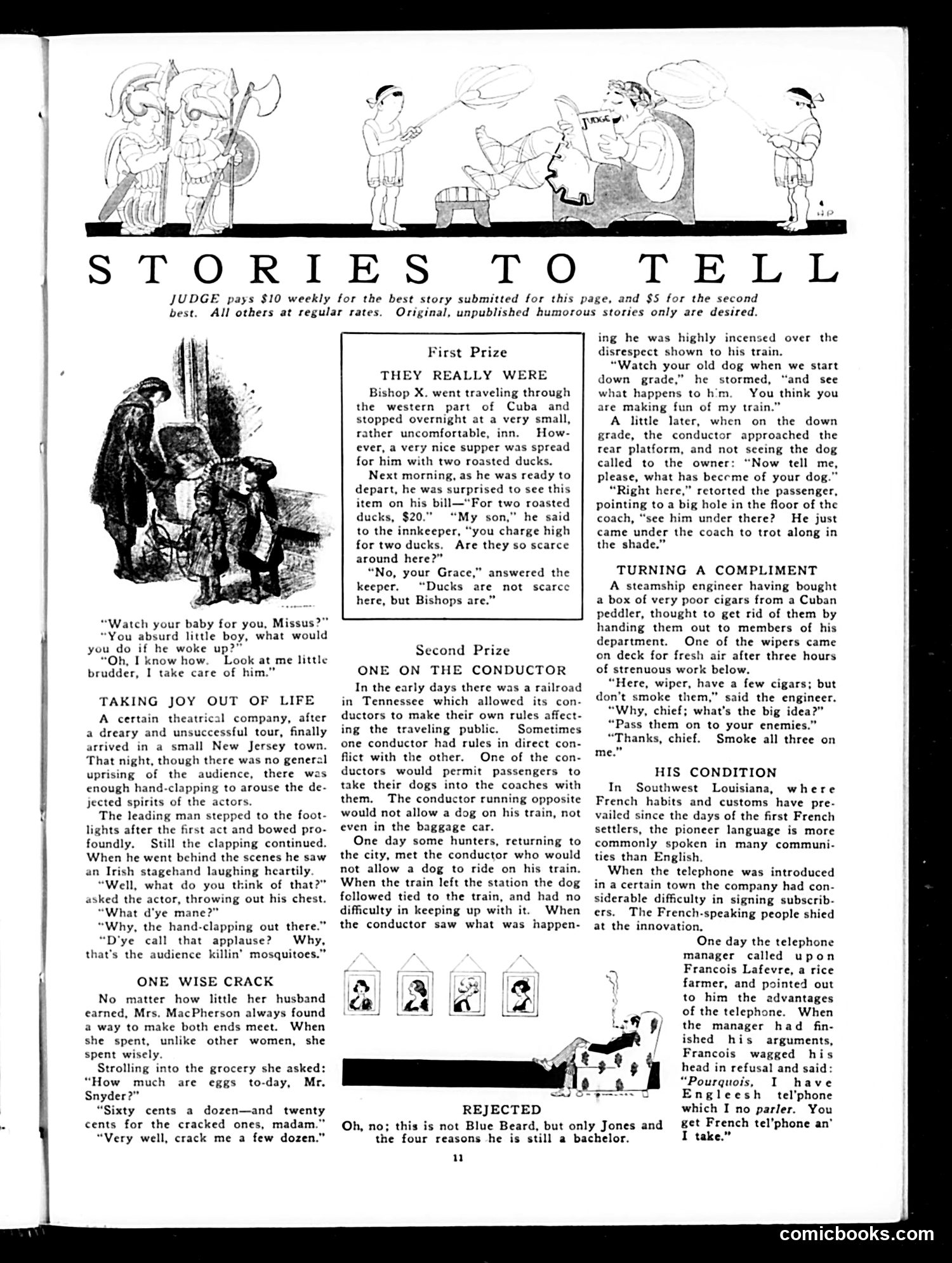
This page from Judge magazine features a "Stories to Tell" section—a humor column soliciting reader submissions. The content consists of five short comedic anecdotes rather than political cartoons: 1. **"They Really Were"** (First Prize): A bishop is charged exorbitant prices for roasted ducks at a Cuban inn; the innkeeper justifies the cost by claiming bishops are scarce. 2. **"One on the Conductor"**: A railroad conductor enforces rules inconsistently, permitting hunters' dogs but refusing a passenger's dog—until hunters tie their dog to the train, forcing the conductor's compliance. 3. **"Taking Joy Out of Life"**: An Irish stagehand's hand-clapping disrupts a theatrical performance; asked why, he replies the mosquitoes deserve it. 4. **"One Wise Crack"**: A frugal housewife strategically purchases cracked eggs at discount. 5. **"His Condition"** and **"Rejected"**: Brief anecdotes about telephone adoption and bachelorhood. These represent genteel, class-conscious humor typical of early 20th-century American magazines.
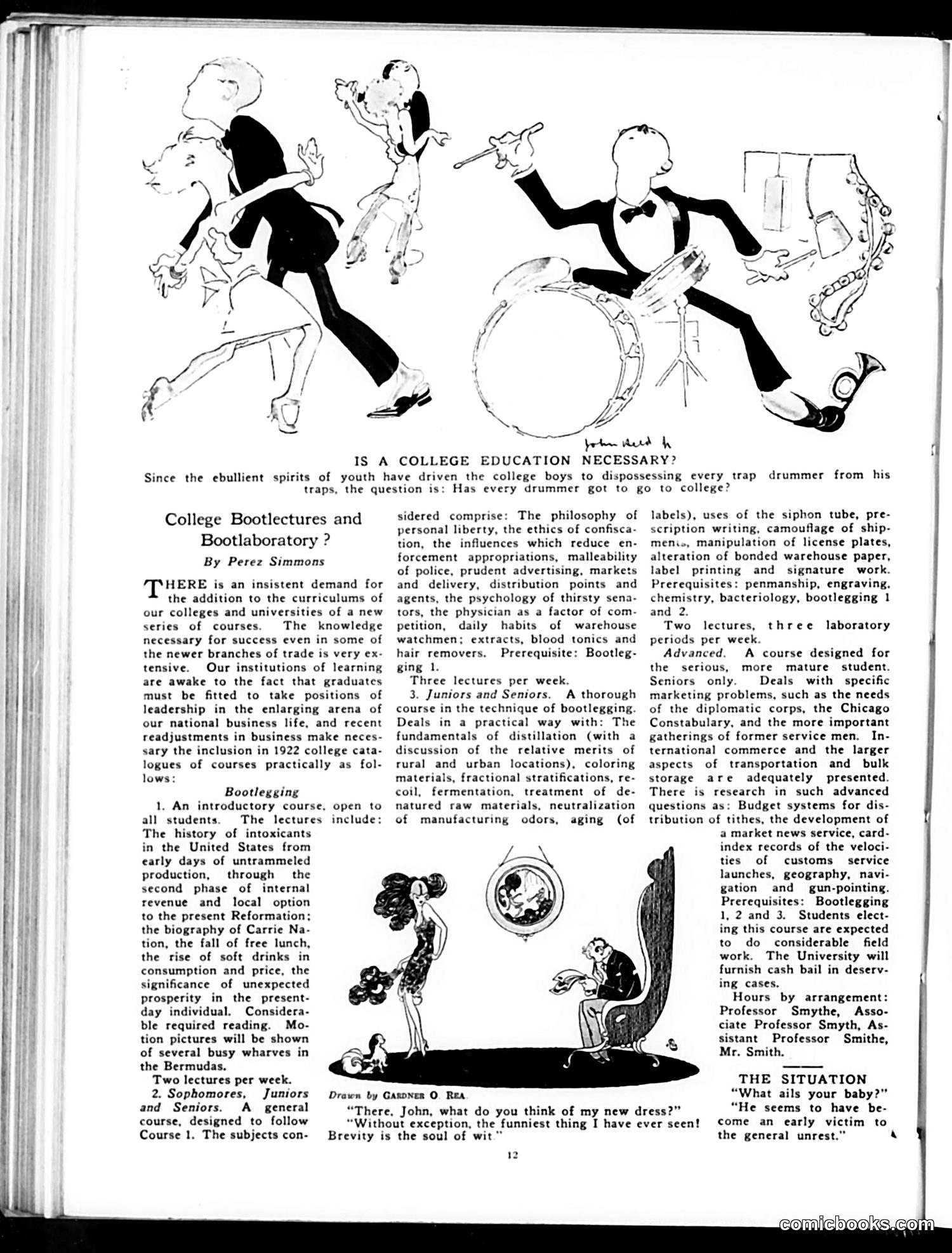
This page satirizes Prohibition-era bootlegging by proposing absurd college courses in illegal alcohol production. Written by Perez Simmons in 1922, it mocks how colleges were expanding curricula to teach practical business skills—here, hilariously applied to bootlegging. The "courses" progress from introductory history (tracing intoxicants from pre-Prohibition to present) through advanced seminars on distillation techniques, evasion tactics (license plate forgery, warehouse paper alteration), and even diplomatic supply chains. The satire suggests bootlegging had become so normalized and lucrative that it warranted academic legitimacy. The opening cartoon shows young men dancing with musical instruments, referencing the quip that college boys have "dispossessed every trap drummer"—likely alluding to college students' wild, destructive behavior during Prohibition's early years. The joke's target: Prohibition's obvious failure, with bootlegging now treated as a legitimate profession requiring formal education.
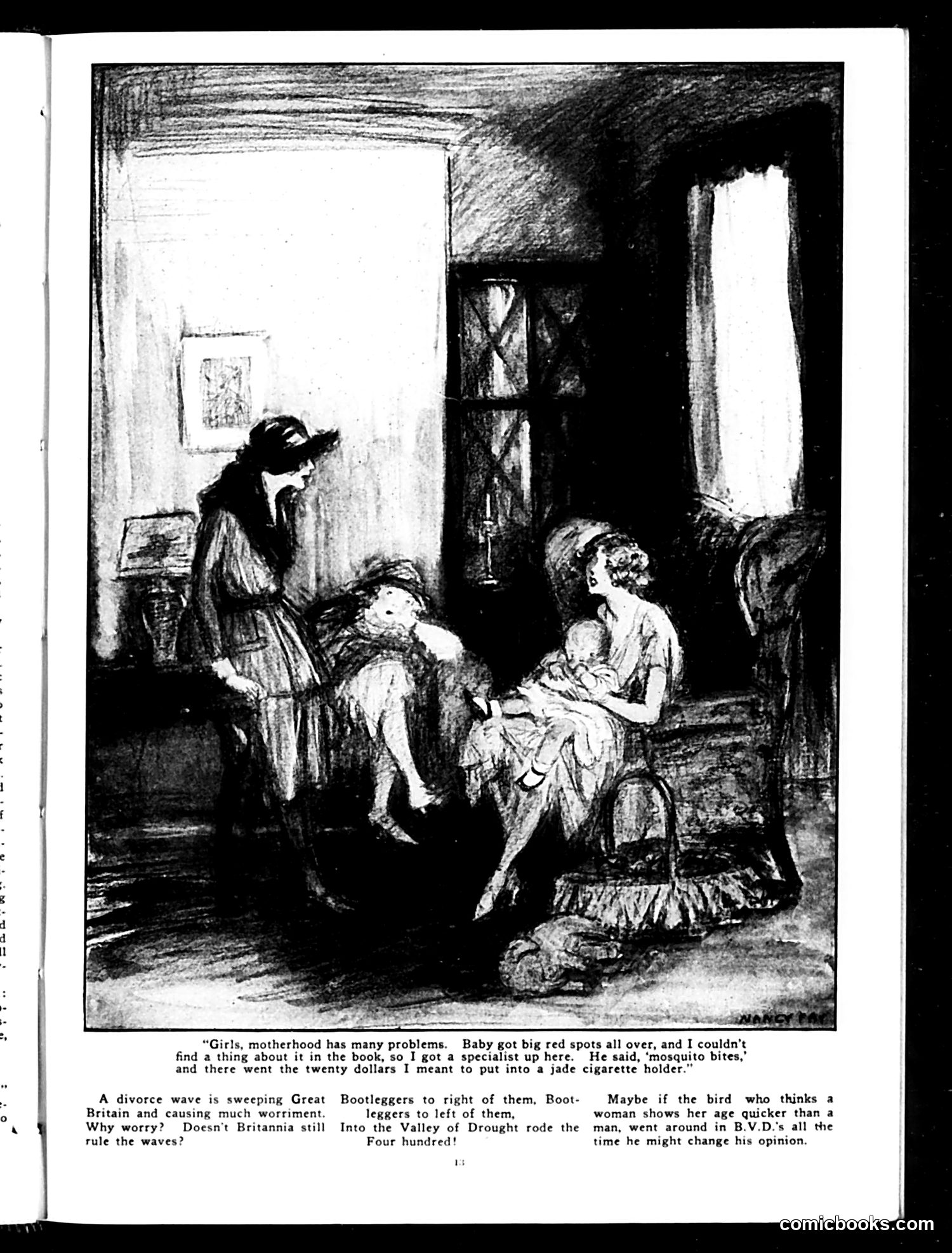
This Judge magazine page contains three separate satirical pieces mocking contemporary concerns: 1. **The main illustration** depicts a woman consulting a specialist doctor about her baby's illness, only to be told it's mosquito bites—a wasteful expense when she'd planned to buy a jade cigarette holder. This satirizes women's newfound consumer spending and the era's obsession with luxury goods. 2. **"Divorce wave" commentary** references the increase in British divorces and sarcastically suggests Britain shouldn't worry since it "rules the waves"—a patriotic boast undermined by domestic instability. 3. **The final quip** mocks male vanity, suggesting men concerned about aging should wear B.V.D.'s (underwear brand) in public, implying they'd change their views about women's aging if exposed to ridicule themselves. All three pieces satirize 1920s social anxieties: consumerism, marriage dissolution, and gender relations.
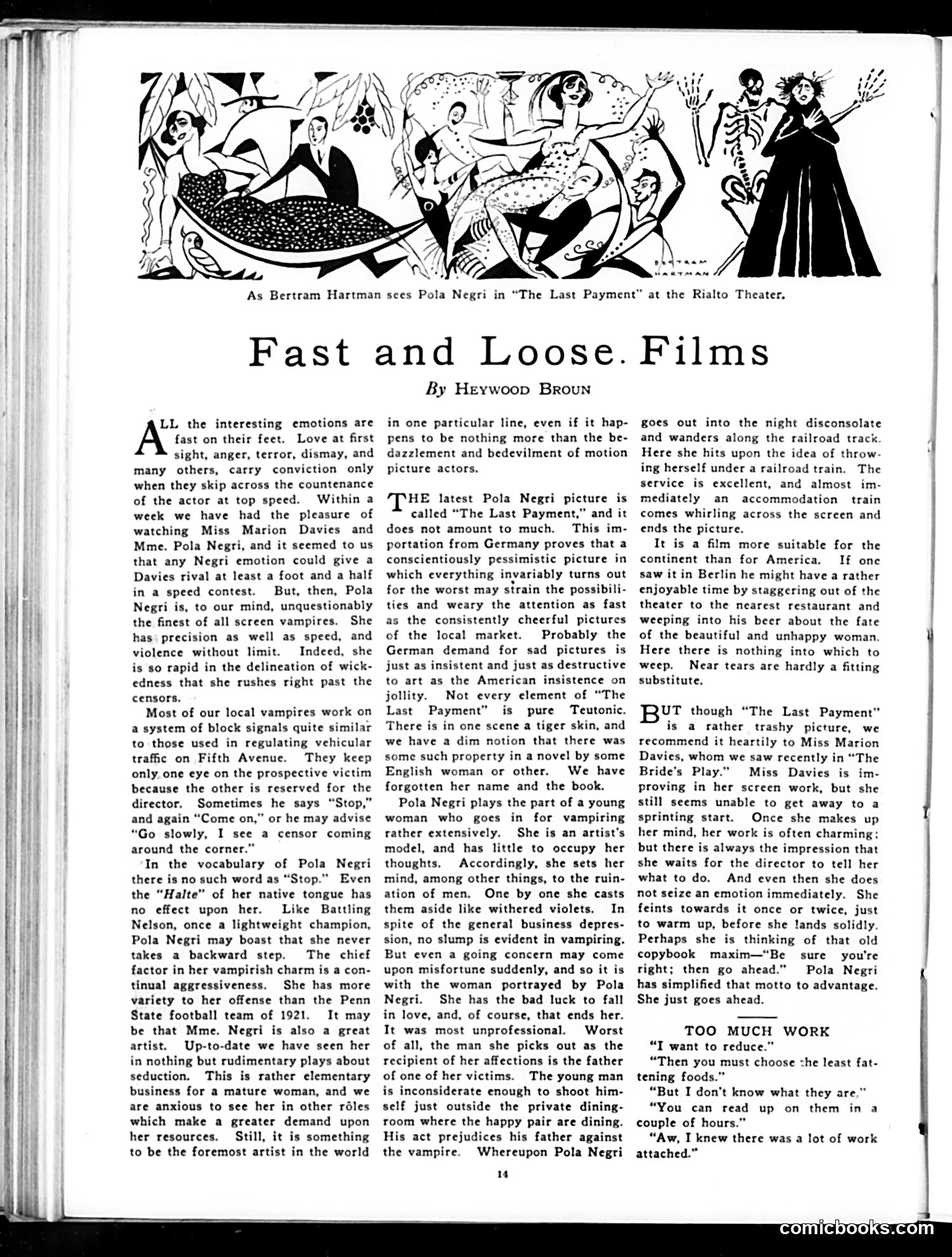
The top illustration shows cartoonist Bertram Hartman's artistic interpretation of actress Pola Negri in the film "The Last Payment" at the Rialto Theater—a visual commentary accompanying the review below. Heywood Broun's article compares silent film actresses' emotional expressiveness, particularly Pola Negri against Marion Davies. He argues Negri excels at portraying vampires (seductresses) because of her rapid, aggressive screen presence—she moves so fast emotionally that she "rushes right past the censors." The review is somewhat backhanded: Broun praises her vampire work while suggesting it's "rudimentary" material unworthy of her talents. He critiques "The Last Payment" as a pessimistic German import with a melodramatic plot about a female artist's model who ruins men through seduction until she foolishly falls in love herself. The satire's target is less political than cultural—mocking both the predictable morality tales of 1920s cinema and the limited roles available to actresses, even talented ones.
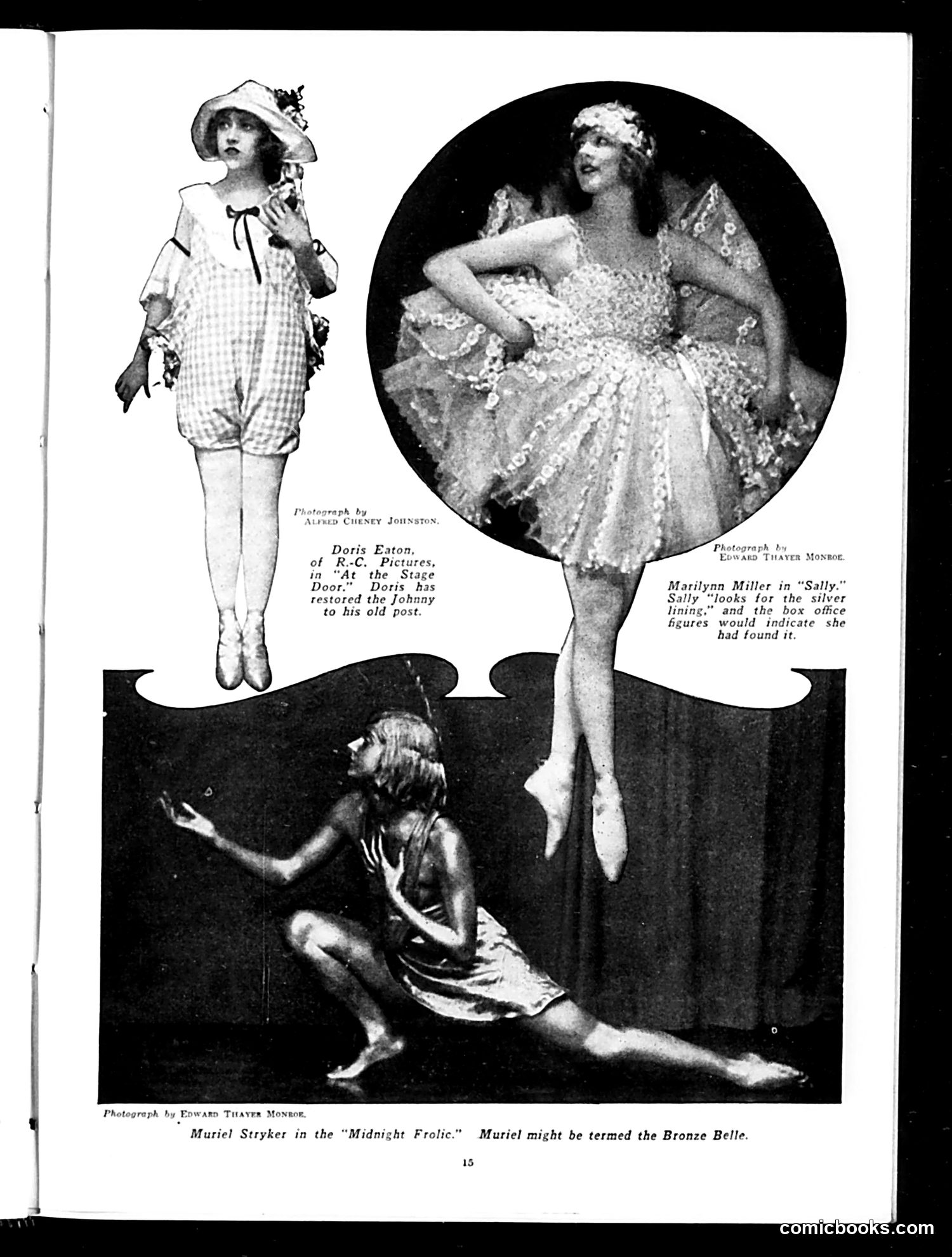
This is a **fashion and entertainment page** from Judge magazine featuring theatrical performers of the era. The page showcases three actresses in productions: Doris Eaton from "The Stage Door," Muriel Stryker from "Midnight Frolic," and Marilynn Miller from "Sally." The content reflects **1920s entertainment culture**—stage shows were major public attractions, and magazines regularly featured performers as fashion icons. The photographs emphasize leg display and fashionable attire typical of the Jazz Age, when women's clothing became notably more revealing than previous decades. The captions contain mild contemporary humor: calling Muriel Stryker the "Bronze Belle" (likely referencing her appearance or dancing style) and the oblique reference to Sally "looking for the silver lining" (a contemporary optimism phrase) are gentle jokes rather than sharp satire. This page primarily documents **popular entertainment and evolving women's fashion** during the 1920s rather than delivering political commentary.
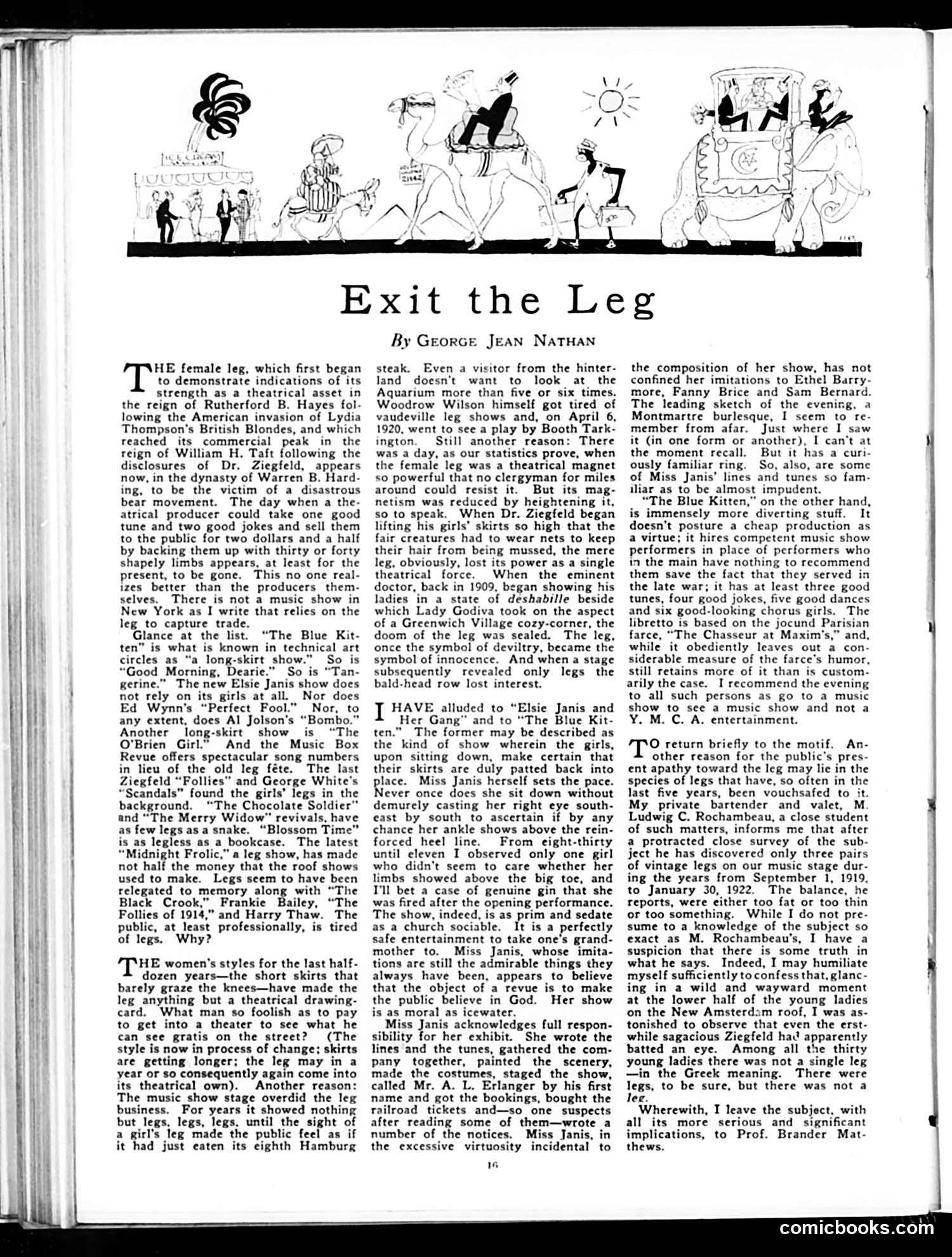
This article by George Jean Nathan analyzes the decline of the theatrical "leg show"—revues where producers relied primarily on displaying women's legs as the main attraction. Nathan traces this form from the 1870s (Lydia Thompson's British Blondes) through its peak under Florenz Ziegfeld during William Taft's presidency, to its apparent death in the early 1920s under Warren Harding. Nathan identifies three reasons for this decline: (1) women's fashion shifted to shorter skirts, making legs visible on the street for free; (2) theaters oversaturated audiences with leg shows, causing fatigue; and (3) Ziegfeld paradoxically destroyed the leg's power by progressively revealing more—once the full body appeared, isolated legs lost their theatrical appeal. The accompanying illustration shows theatrical performers in various costume states, likely satirizing this evolution from modest Victorian dress to increasingly revealing stage costumes.
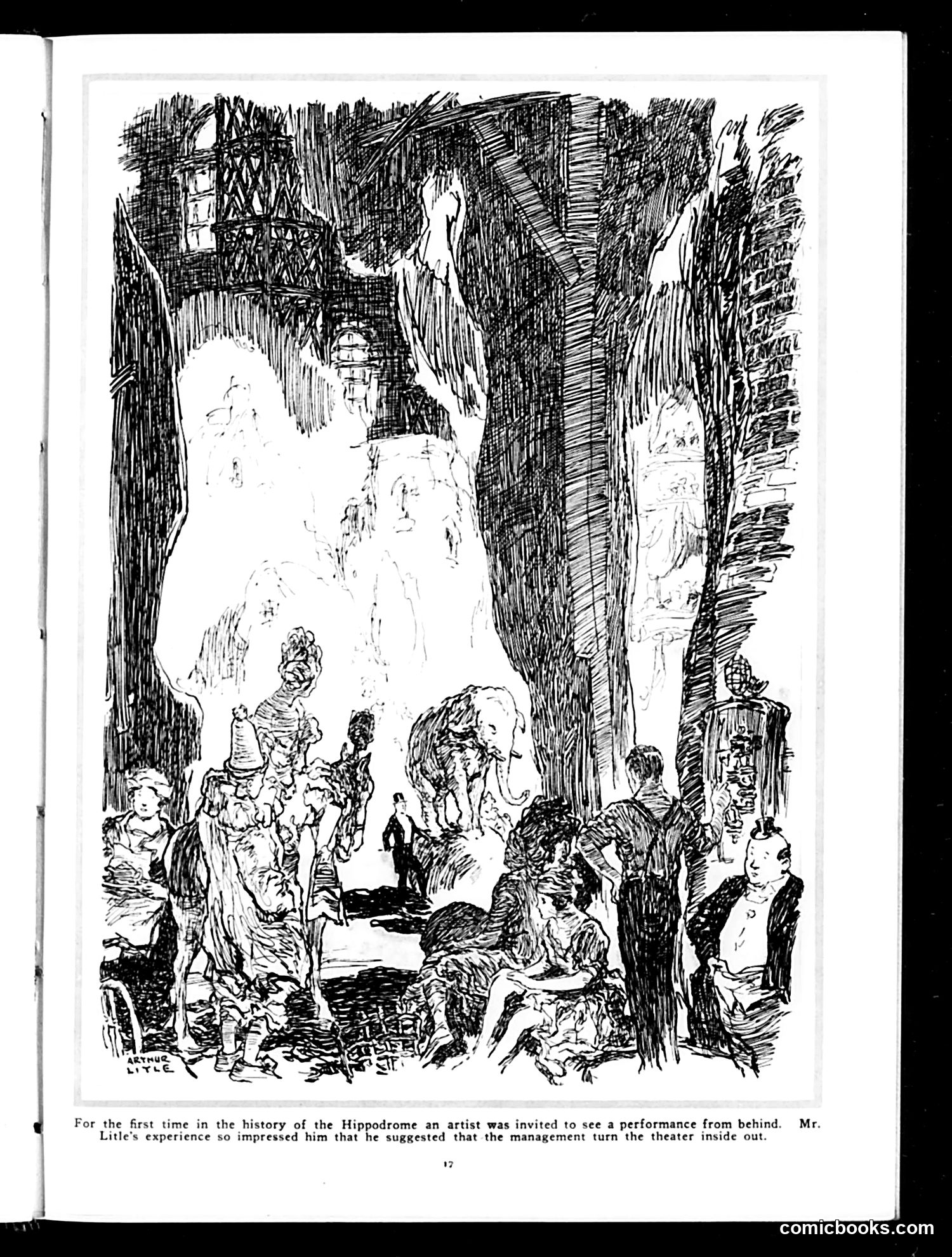
This is a single illustration by an artist named Little (signed lower left), depicting the backstage area of the Hippodrome theater in New York. The cartoon shows the chaotic, crowded scene behind the scenes—with performers, stagehands, and various figures amid theatrical equipment and props. The joke suggests that seeing the performance from this hidden backstage perspective was so impressive (or perhaps so revealing of the theater's operational chaos) that Little humorously suggested the management literally "turn the theater inside out"—reversing the audience's perspective to view from backstage instead. The satire mocks either the theater's impressive machinery or its behind-the-scenes disorder.
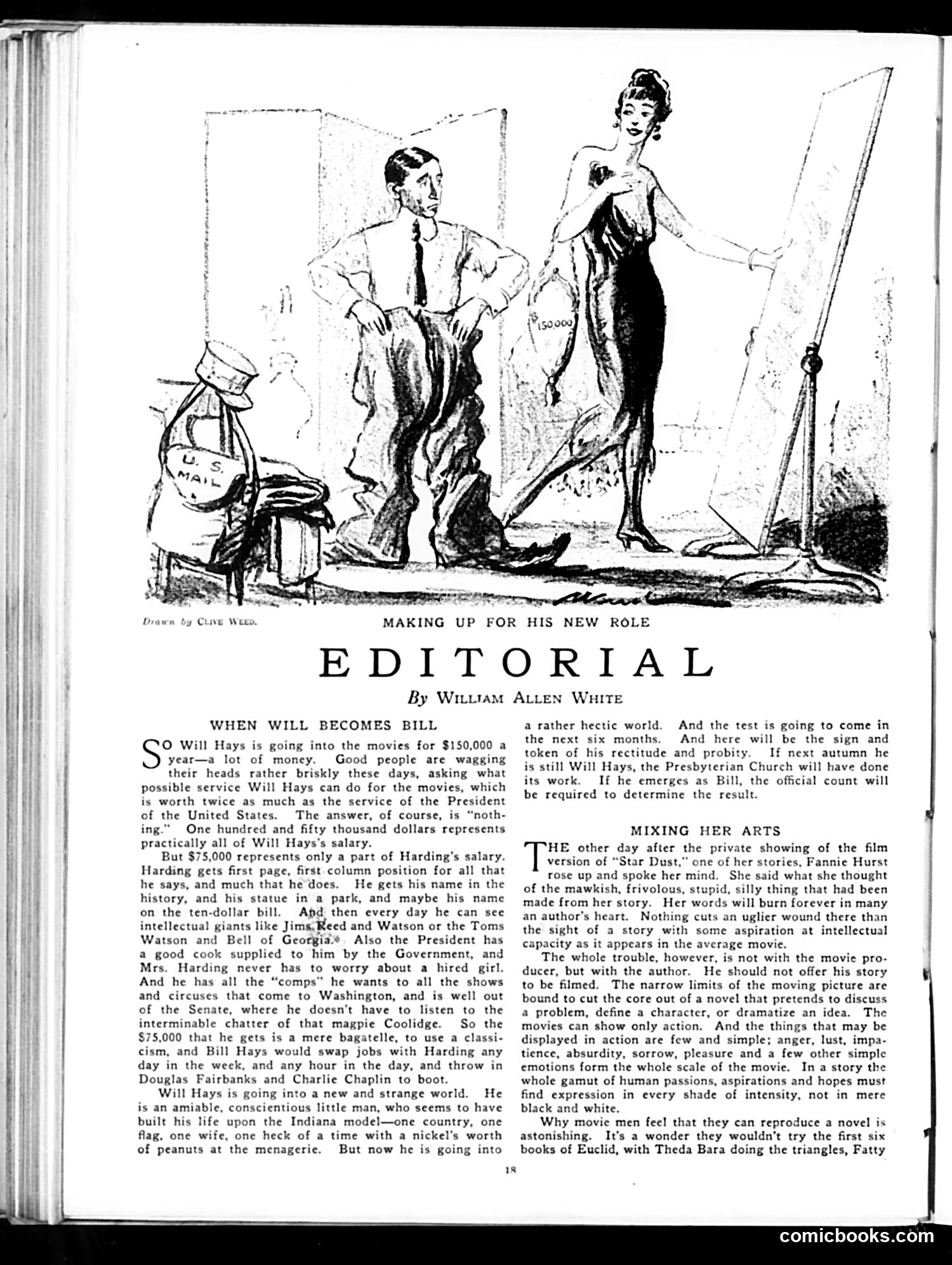
This editorial page by William Allen White satirizes Will Hays's $150,000-per-year appointment to regulate the movie industry. **The Cartoon:** Titled "Making Up for His New Role," it shows Hays being fitted for costumes—suggesting he's preparing a false persona for Hollywood, a visual pun on "making up." **The Main Satire:** White argues Hays's salary is excessive because he'll accomplish "nothing." The joke compares Hays's movie pay unfavorably to President Harding's lower official salary, yet Harding receives greater prestige and benefits. White suggests Hays would trade places with Harding instantly—implying the movie job, though lucrative, lacks real importance or dignity. **Secondary Satire:** The second editorial mocks authors like Fannie Hurst for complaining when their literary novels are adapted into simplistic films. White argues authors shouldn't blame producers; they shouldn't sell their complex stories to a medium (silent film) that can only depict basic emotions and action, not nuance. Both pieces critique the movie industry's pretensions to cultural significance.
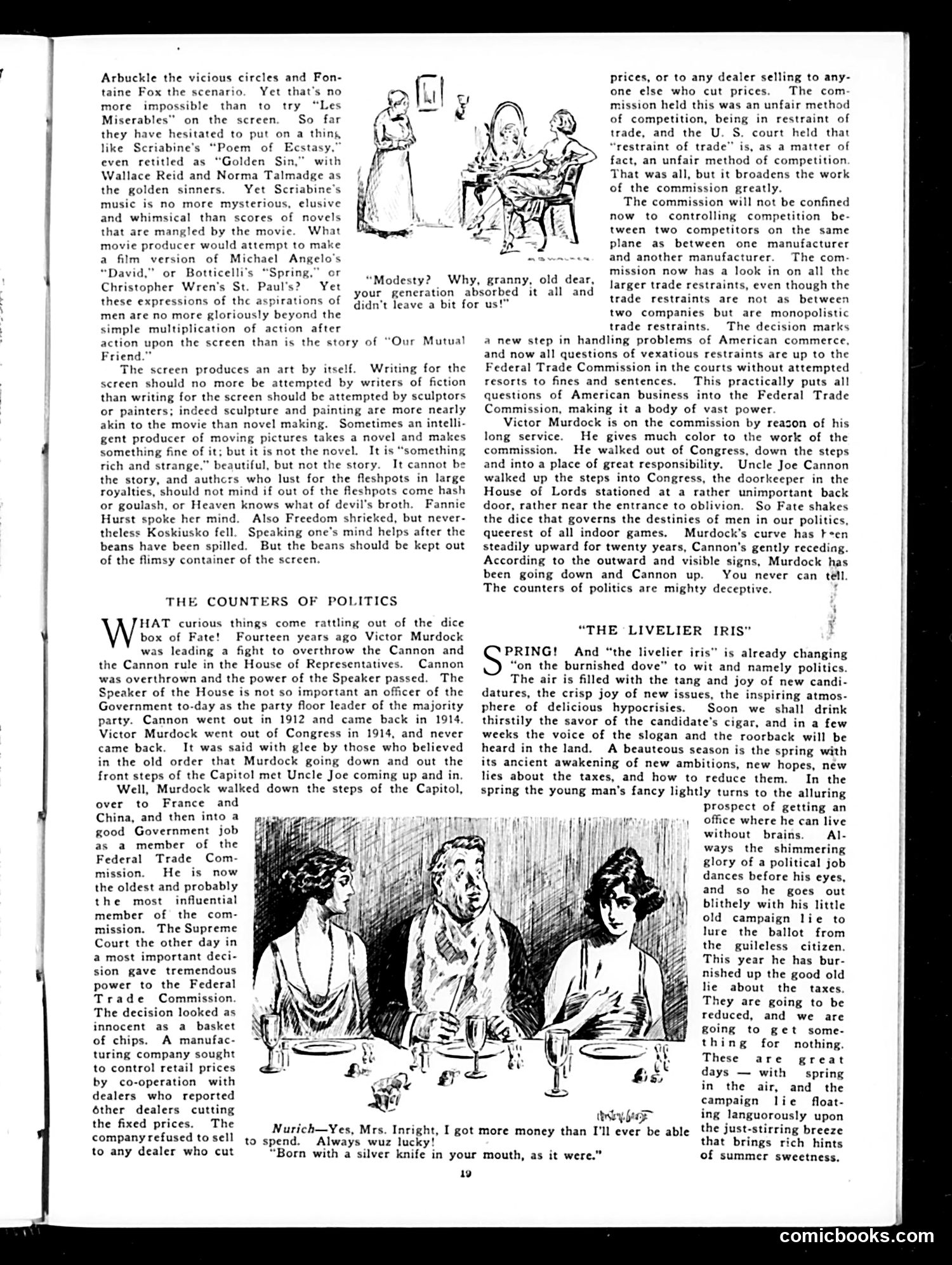
This *Judge* page contains two distinct pieces: **"The Counters of Politics"** discusses Victor Murdock, a Progressive congressman who fought Speaker Joseph "Uncle Joe" Cannon's control in 1912 but lost his seat in 1914. The irony: while Cannon regained power, Murdock—appearing defeated—actually landed at the Federal Trade Commission, where he became influential. A recent Supreme Court decision expanded the FTC's power to regulate "unfair methods of competition," including manufacturers controlling retail prices through dealer cooperation. The article celebrates this as broadening consumer protections against monopolistic practices. **"The Livelier Iris"** (lower section) appears to be satirical campaign writing, with the cartoon caption showing someone boasting about inherited wealth ("Born with a silver knife in your mouth"), likely mocking wealthy candidates' disconnection from ordinary voters facing reduced taxes and economic hardship during spring campaigning. The page satirizes both political ironies and the gap between wealthy elites and working citizens.
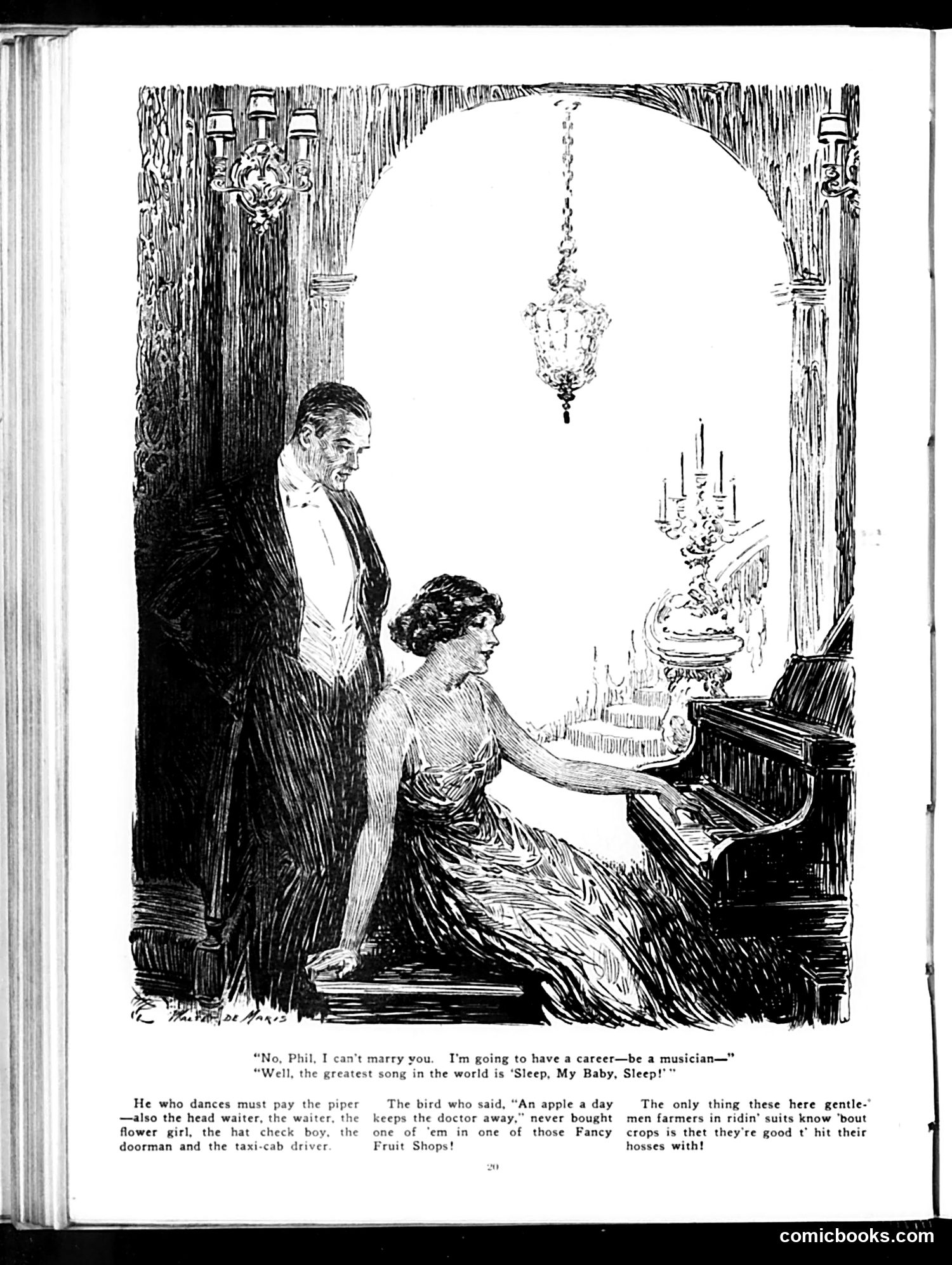
This page contains a single-panel cartoon satirizing women's ambitions versus traditional gender roles. **The Scene:** A woman seated at a piano refuses a marriage proposal from a man, declaring she wants a career as a musician instead. He responds dismissively, suggesting her greatest achievement should be performing the lullaby "Sleep, My Baby, Sleep!"—implying her proper role is motherhood, not professional music. **The Satire:** The cartoon mocks both the woman's pretension and the man's condescension. By having him suggest a lullaby as "the greatest song in the world," the cartoonist ridicules the notion that women should abandon artistic ambitions for domesticity. The accompanying aphorisms at the bottom offer unrelated folk wisdom, adding to the mockingly absurd tone. **Historical Context:** This reflects early-to-mid 20th century tensions over women's independence and workforce participation—a period when women entering professional careers faced significant social resistance and male derision.
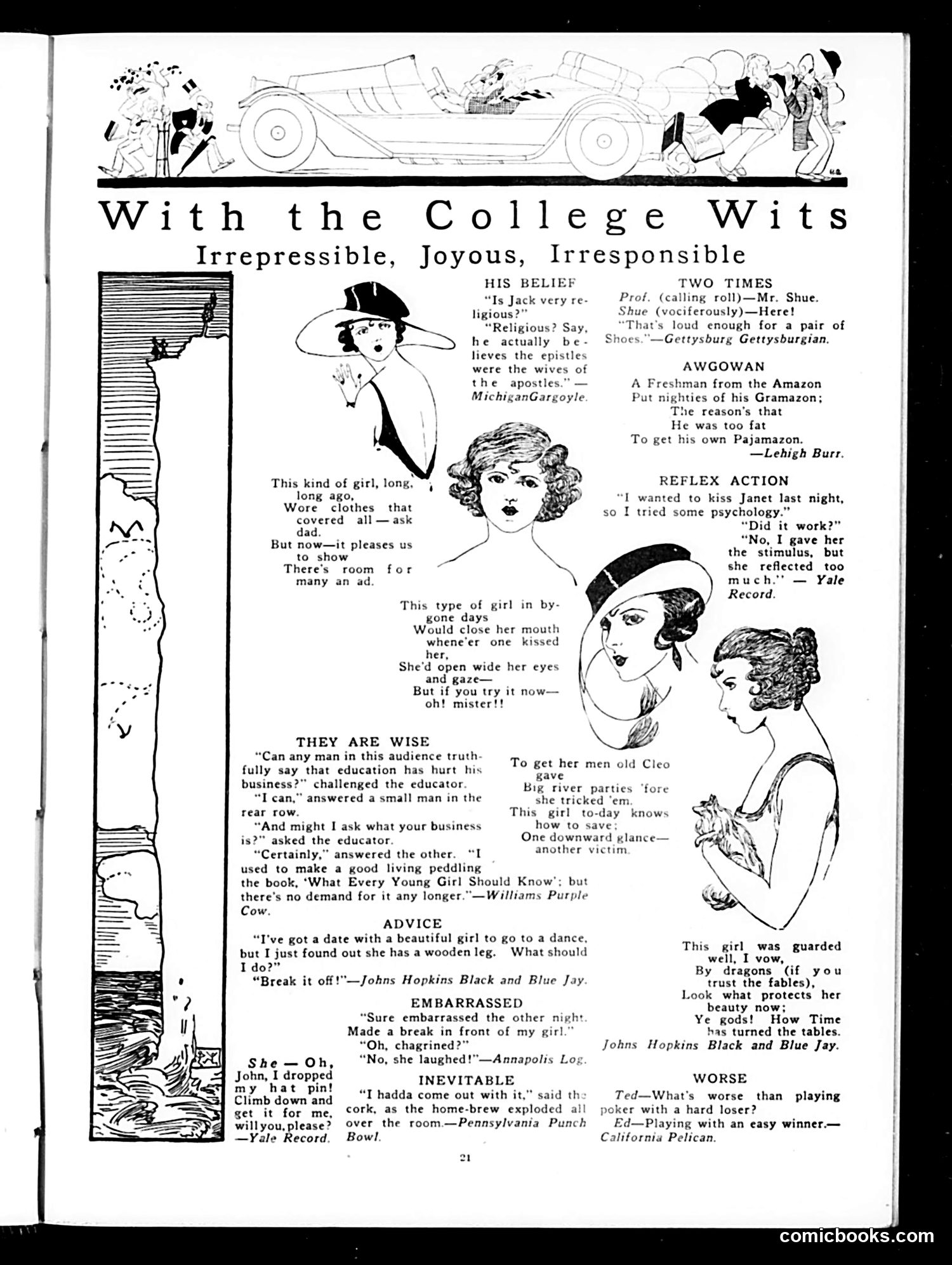
This is a collection of brief jokes and witticisms purportedly from various college publications, presented as satirical commentary on 1920s youth culture and modern dating. The page mocks college students' perceived ignorance (a student thinks apostles' wives were named "Epistles"), changing female fashion and behavior (girls now wear revealing clothes and are forward with men), and evolving courtship norms. References to "home-brew" reflect Prohibition-era humor. Several jokes target modern women's dating tactics—using "psychology" on men, manipulating suitors ("one downward glance"), and being less modest than previous generations. The recurring theme is that college youth, particularly young women, are "irrepressible, joyous, irresponsible"—embracing new freedoms that older generations find shocking. The satire reflects anxiety about rapidly changing social mores during the Jazz Age, positioning college humor magazines as safe outlets for generational commentary on these shifts.
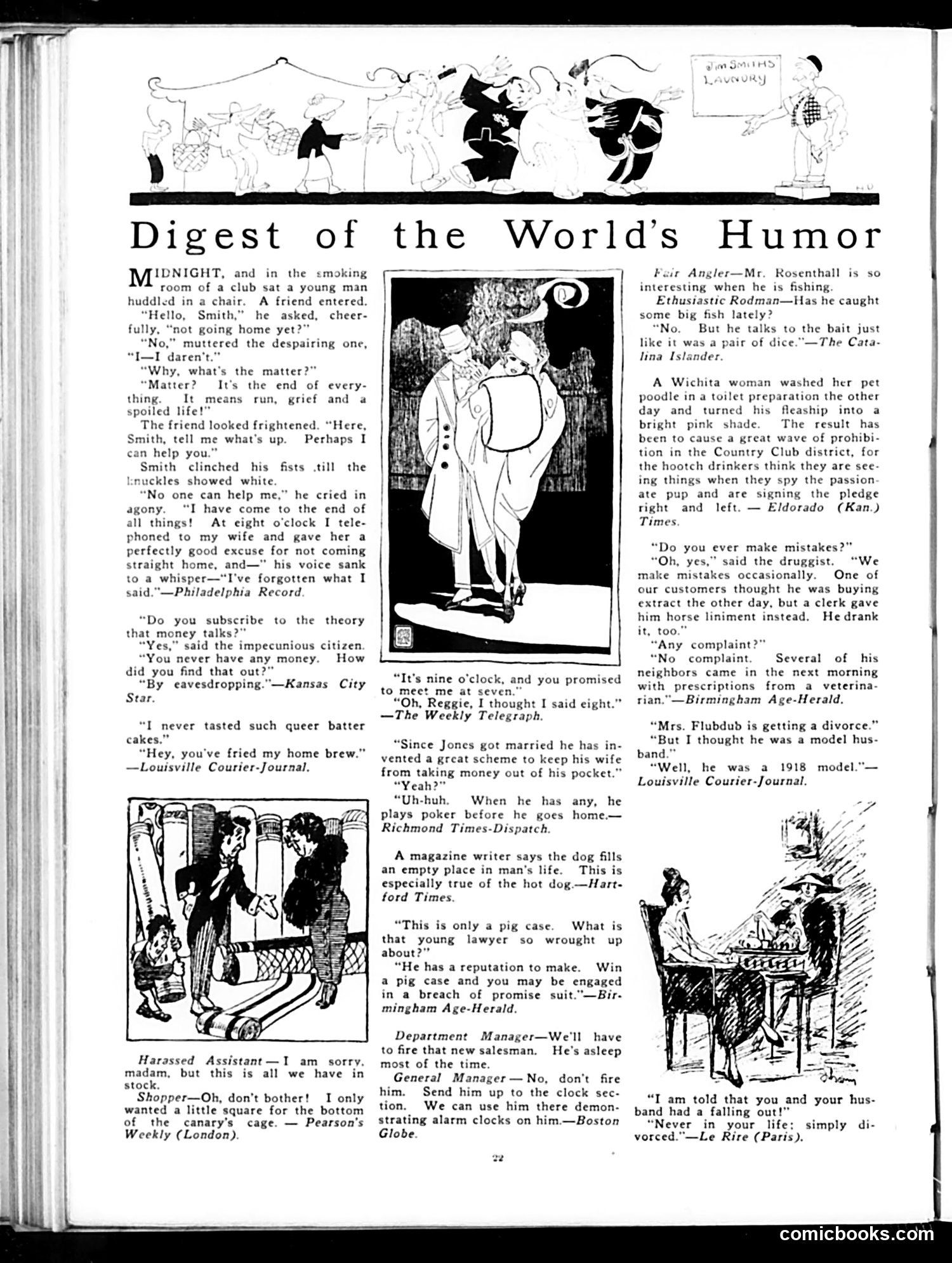
This page collects brief humorous anecdotes from various newspapers, typical of Judge's "World's Humor" feature. The jokes reflect early 20th-century domestic and social anxieties: **Key themes:** - **Marriage troubles**: A husband forgets his lie to avoid coming home; Jones plays poker to prevent his wife accessing his money; Mrs. Flubdub divorces her "1918 model" husband (suggesting obsolescence). - **Economic anxiety**: An impoverished man admits discovering money doesn't talk through eavesdropping; a druggist accidentally gives liniment instead of extract. - **Class/consumer humor**: A shopper wants cardboard for a canary cage; a woman dyes her poodle pink with toilet preparation, causing prohibition-era confusion in a country club. - **Professional satire**: A lazy salesman is reassigned to demonstrate alarm clocks (the joke being he'll fall asleep on them). The cartoons (lower left and right) visually support these domestic comedy themes. The humor relies on everyday middle-class predicaments—marital deception, economic precarity, and consumer mishaps—typical of Judge's satirical approach to American life.
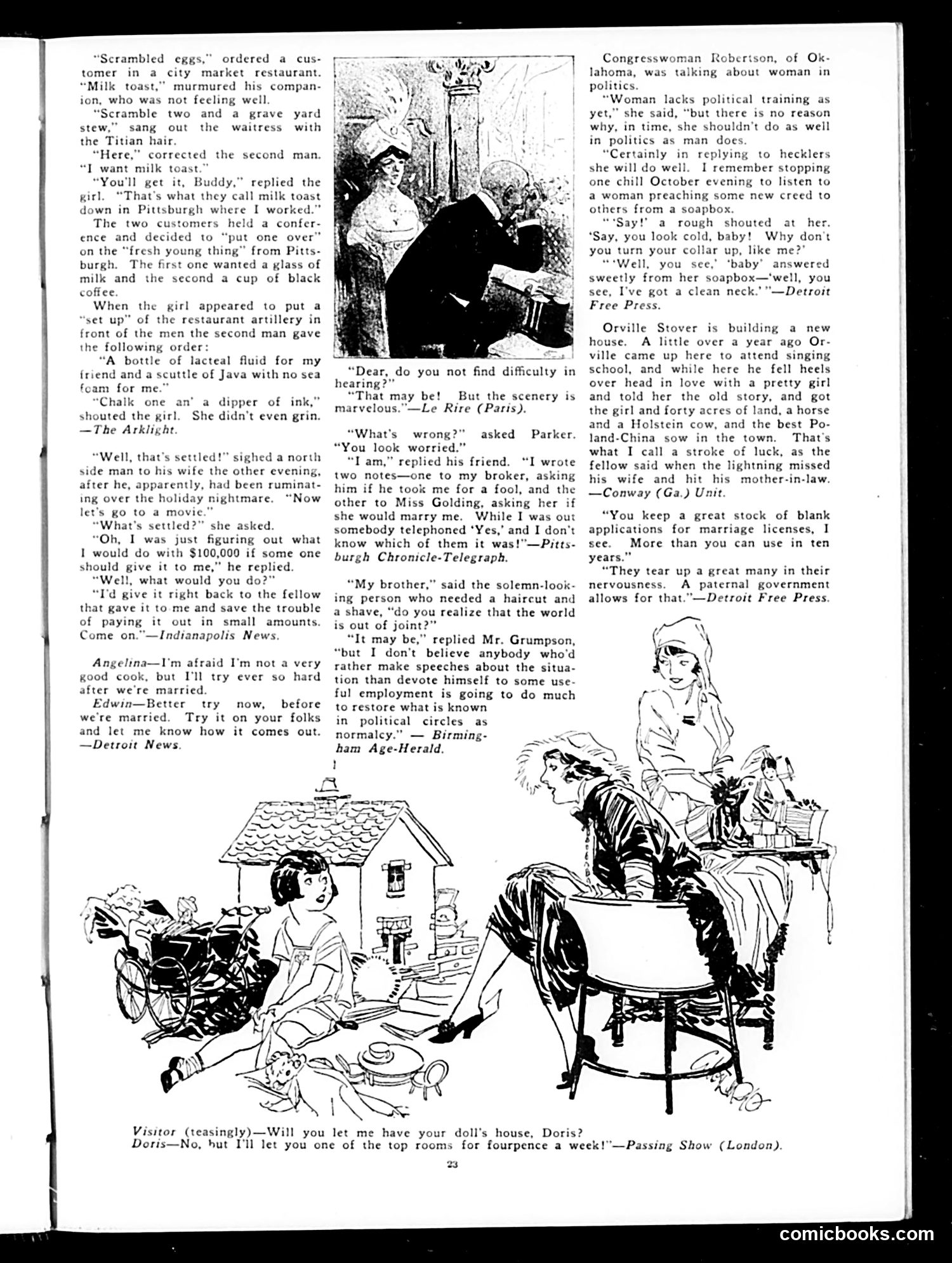
This page collects various humorous anecdotes and jokes typical of early-20th-century Judge magazine. Key content includes: **Main cartoons/jokes:** 1. **Waitress story**: A Pittsburgh waitress outwits two customers trying to trick her with fancy language ("lacteal fluid," "Java with no sea foam"), responding in diner slang ("Chalk one an' a dipper of ink"). The humor mocks pretentious speech. 2. **Congresswoman Robertson commentary**: A piece about women entering politics, featuring a soapbox preacher who witty deflects a heckler's rude comment about her appearance. This reflects 1920s-era debates over women's political participation. 3. **Multiple short jokes** about marriage, cooking, wealth, and relationships—common Judge fare satirizing everyday domestic life. 4. **Bottom illustration**: Shows a child negotiating rental terms for a dollhouse, humorously mimicking adult business transactions. The overall tone reflects period attitudes: lighthearted sexism, class-consciousness, and gentle ribbing of social pretension. The page demonstrates Judge's formula of mixing visual and textual humor targeting middle-class readers.
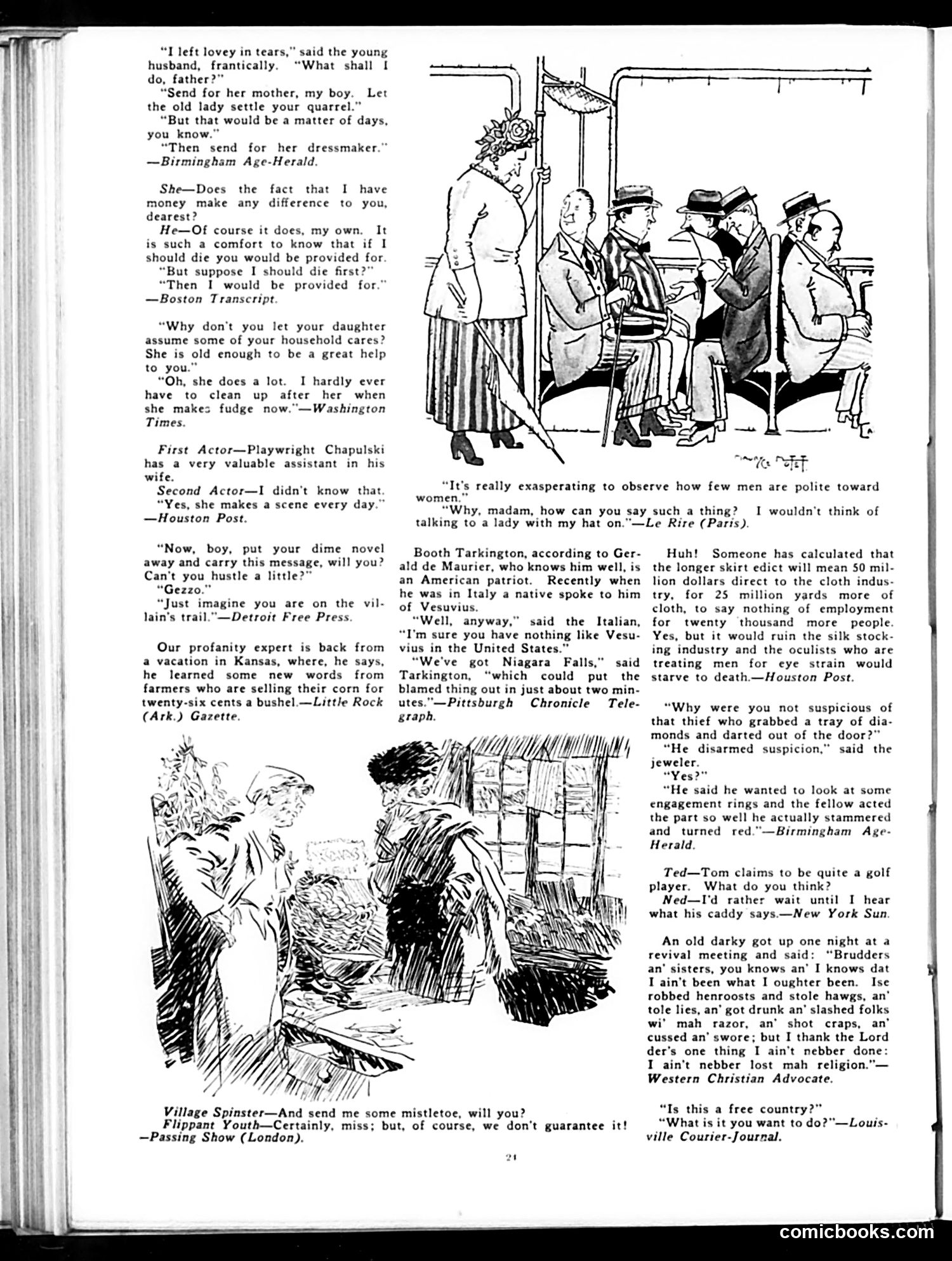
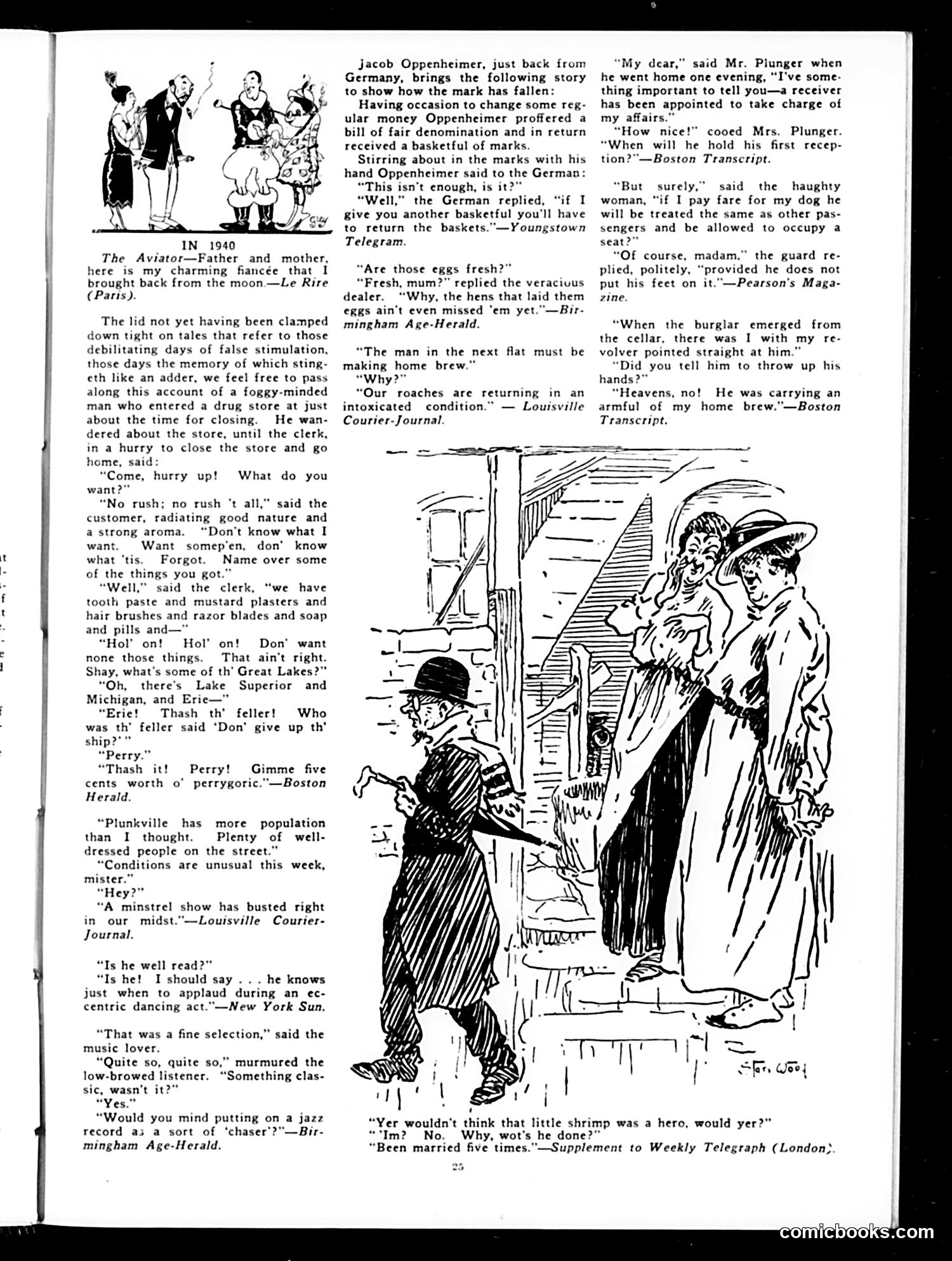
This page contains multiple short humorous anecdotes typical of Judge's satirical format, rather than political cartoons. The jokes reflect 1940s American concerns: **Key themes:** 1. **Economic depression**: A story about German currency collapse—someone exchanges money for "a basketful of marks," satirizing hyperinflation's aftermath from Weimar Germany. 2. **Prohibition/bootlegging**: Multiple jokes reference "home brew" (illegal alcohol), showing this remains a cultural concern even after Prohibition's 1933 repeal. 3. **Class commentary**: A "haughty woman" demanding her dog receive passenger seating; Mr. Plunger's wife misunderstanding a "receiver" (bankruptcy official) as something prestigious—mocking social pretension during economic hardship. 4. **Marriage as comedic target**: The final joke treats multiple marriages (five times) as inherently ridiculous. The small illustration (bottom right) appears unrelated—showing figures in period dress. Overall, this is **humor content rather than political satire**, reflecting Depression-era anxieties about money, drink, and social status.
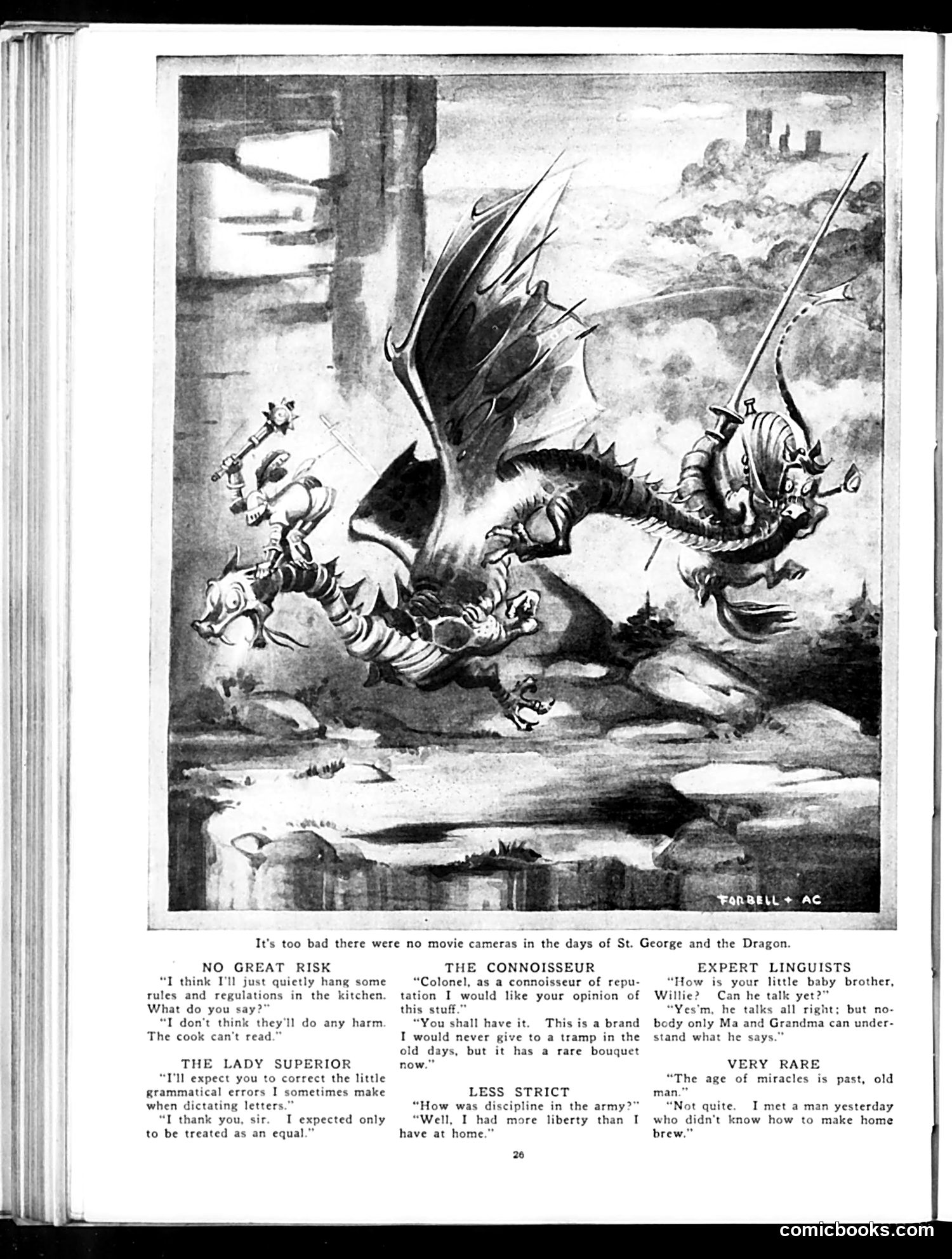
The page features a large illustration of St. George slaying the dragon, captioned wryly that it's unfortunate this wasn't filmed for movies—a joke about spectacle and modern entertainment value. Below are six short comic vignettes satirizing domestic life and social pretension: - **"No Great Risk"**: A master assumes kitchen rules won't matter because servants are illiterate—mocking both working-class stereotypes and upper-class condescension. - **"The Lady Superior"**: A woman demands her boss treat her as an equal while correcting her grammar—satirizing workplace hierarchies and feminist claims to equality. - **"The Connoisseur"**: A colonel praises cheap liquor's "rare bouquet," implying Prohibition-era bootleg alcohol is paradoxically improving in quality—mocking both snobbish taste and illegal drinking culture. - **"Less Strict"**: Military discipline exceeds home discipline—a common complaint about wives' authority. - **"Expert Linguists"**: Only parents understand a baby's speech—typical domestic observation humor. - **"Very Rare"**: Finding someone who doesn't make illegal home brew is miraculous—satirizing Prohibition's widespread violation.
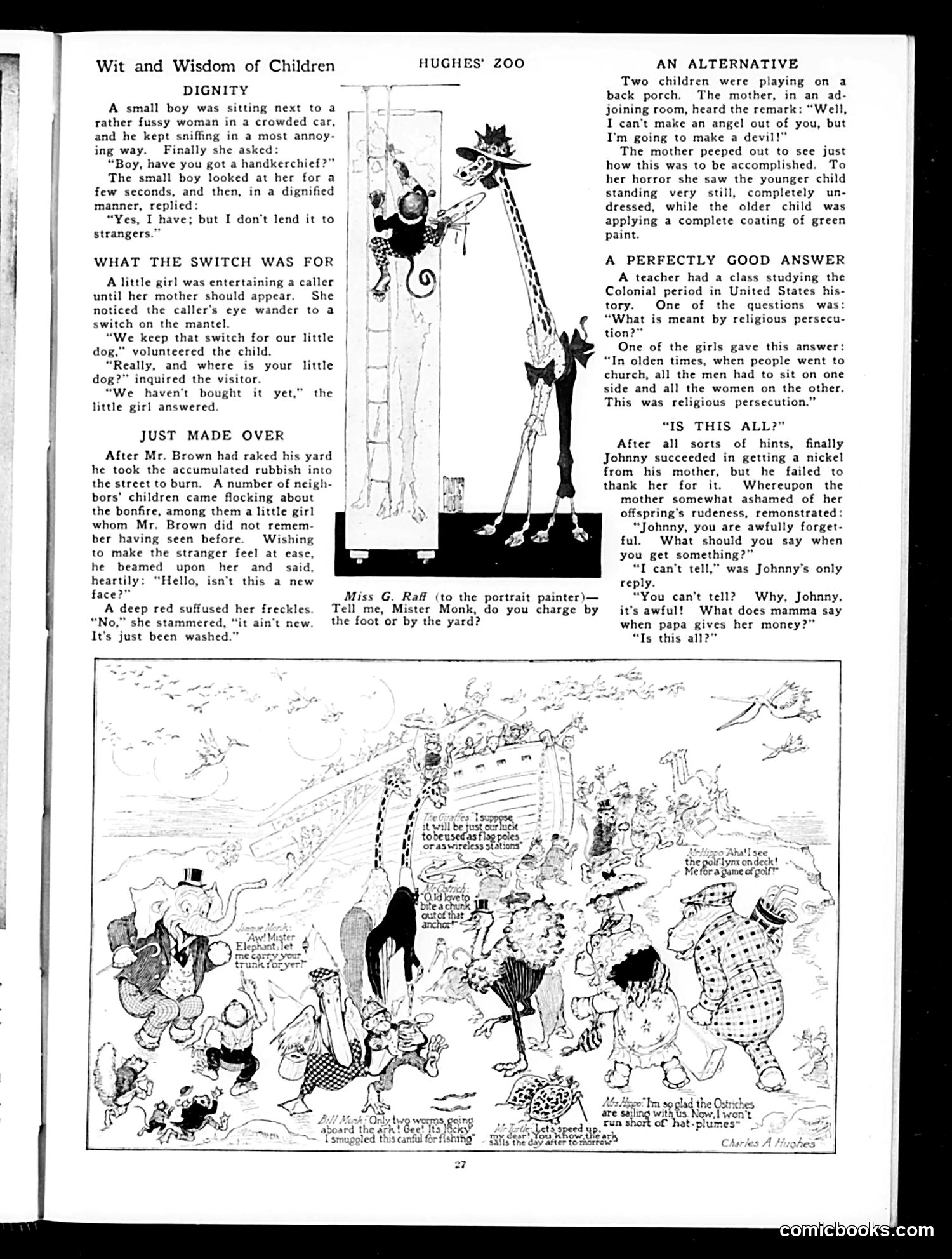
This page collects humorous anecdotes about children's literal-minded logic and innocent rudeness, a popular magazine format of the era. The stories showcase children's amusing misunderstandings and blunt honesty: - A boy refuses to lend his handkerchief to a "stranger" (the fussy woman) - A girl mentions a switch "for our little dog"—they haven't bought the dog yet - A child's "new face" turns out to be just newly washed - A portrait painter charges by "foot or yard" (a visual pun on measuring height) - Children paint one green to make a "devil" - A girl defines religious persecution as seating segregation in church - Johnny, given a nickel, responds to "what do you say?" with his mother's own complaint: "Is this all?" The bottom illustration shows a chaotic beach or seaside scene. The page's humor relies on the innocent logic of children that inadvertently exposes adult absurdities or hypocrisy—a common satirical device in early 20th-century humor magazines.
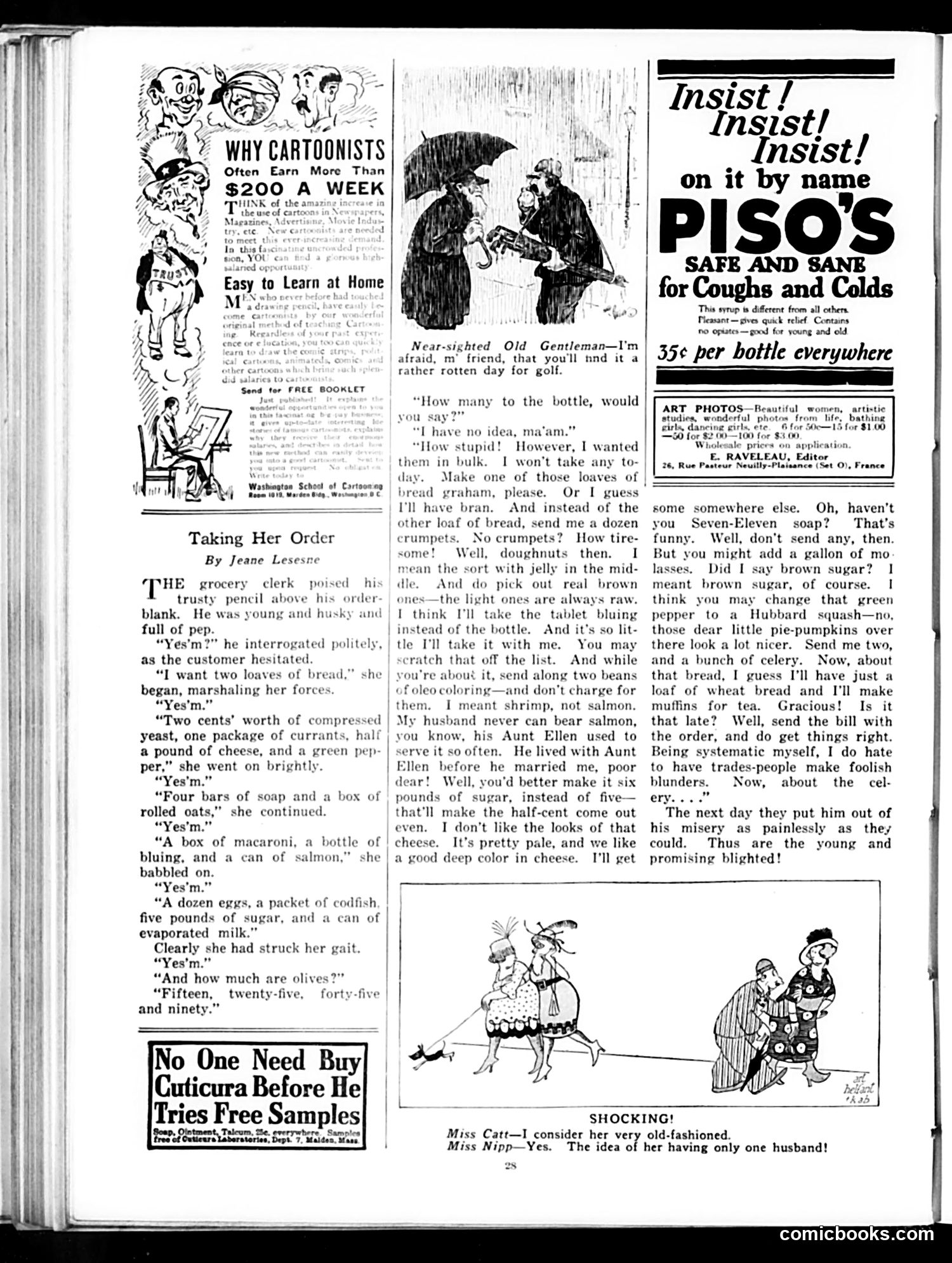
This story-comic satirizes an exhausting customer interaction. A young, eager grocery clerk patiently takes an increasingly complex order from an indecisive woman who constantly changes her mind—swapping bread types, questioning olive prices, rejecting items, complaining about product quality, and making personal tangents about her husband's Aunt Ellen. The satire targets both parties: the customer's excessive pickiness and the clerk's mechanical politeness ("Yes'm" repeated throughout). The punchline—"The next day they put him out of his misery as painlessly as they could"—darkly jokes that the clerk was driven to suicide by the experience, suggesting consumerism's emotional toll on service workers. The accompanying cartoon about the "old-fashioned" woman with only one husband reflects period attitudes toward marriage and propriety, though the specific reference is unclear without more context.
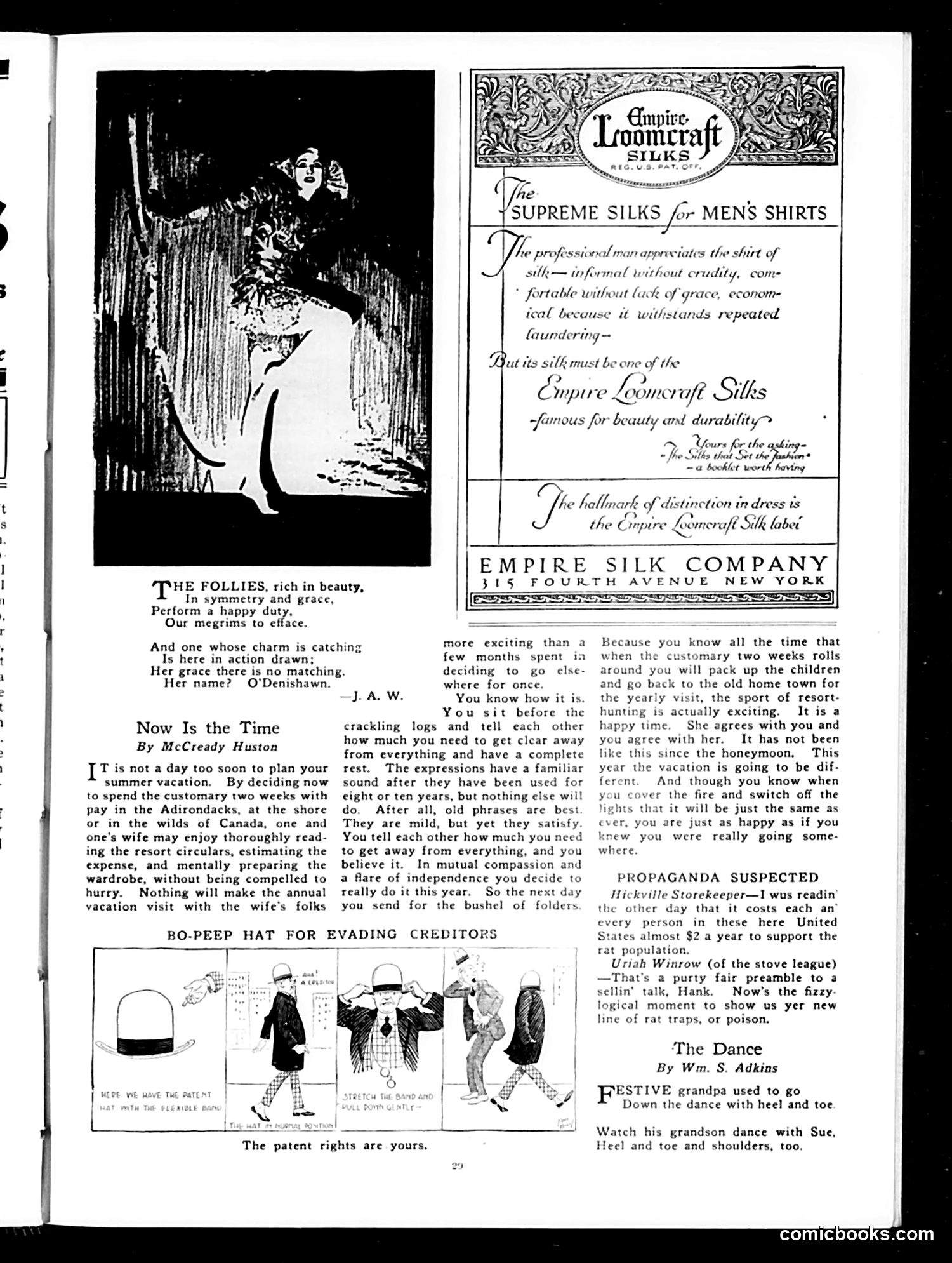
This cartoon satirizes the financial pressures of the era by depicting a humorous "patent" solution: a hat that supposedly allows debtors to hide from creditors. The four panels show progressive techniques for concealing oneself—stretching the hat band, contorting the body, and folding up—suggesting desperation during economically uncertain times. The joke relies on the assumption that readers would recognize debt evasion as a genuine social problem serious enough to joke about. The cartoon's "patent rights are yours" tagline suggests this imaginary invention is being offered as a tongue-in-cheek remedy to a real issue: people fleeing their financial obligations. The surrounding article "Now Is the Time" reinforces themes of spending and expense, making the creditor-evasion cartoon's ironic timing pointed commentary on middle-class financial anxiety.
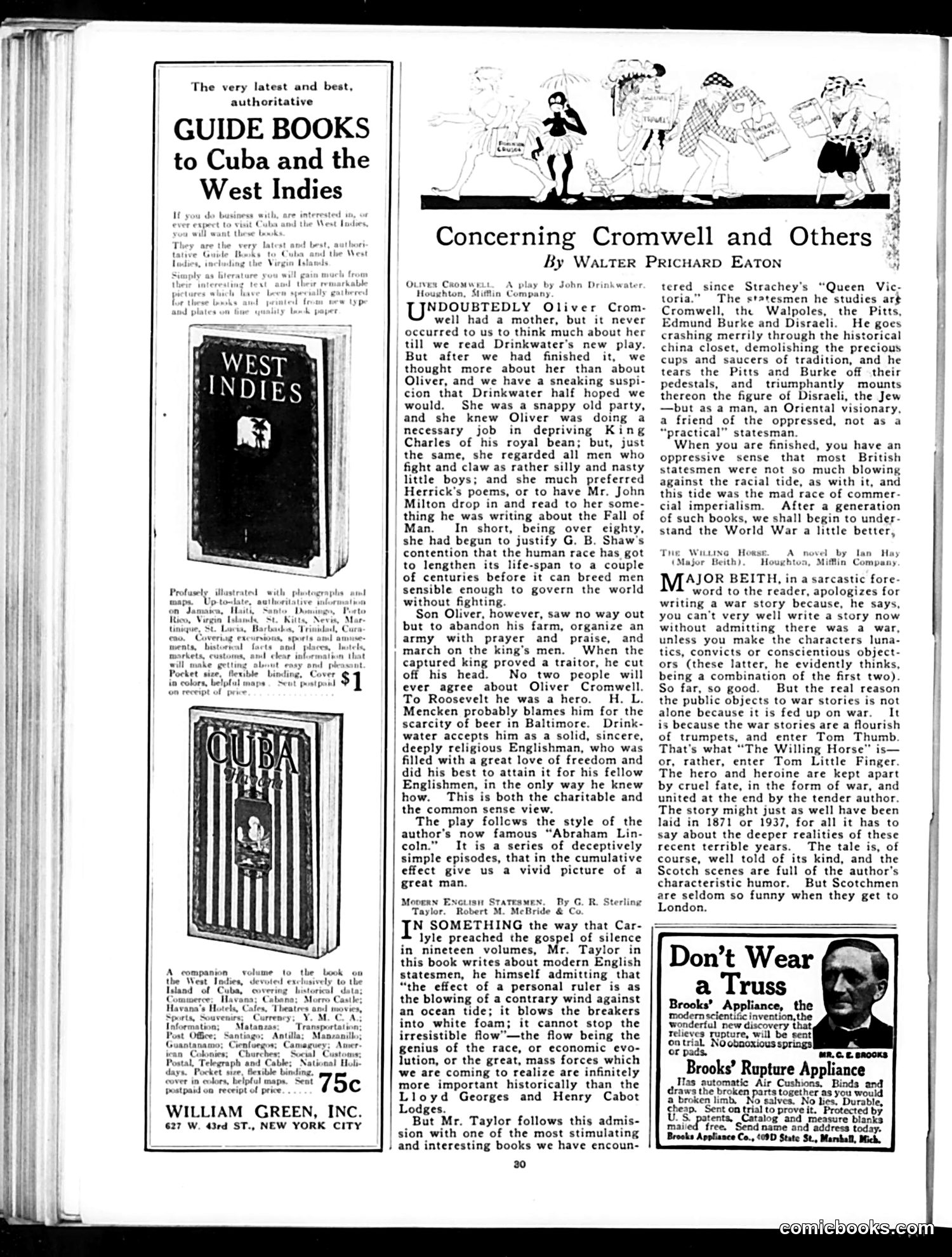
This page is primarily **advertising and book reviews**, not political cartoons. The substantive content is Walter Pritchard Eaton's review of plays and books about historical English statesmen. The review of "Oliver Cromwell" by John Drinkwater reveals period attitudes: Eaton notes disagreement over Cromwell's legacy—Theodore Roosevelt viewed him heroically, while H.L. Mencken apparently blamed him for beer scarcity in Baltimore (a satirical jab). Eaton endorses Drinkwater's portrayal of Cromwell as a sincere, religiously-motivated man fighting for English freedom. More pointedly, reviewing G.R. Sterling Taylor's "Modern English Statesmen," Eaton praises Taylor for elevating **Disraeli**—describing him explicitly as "the Jew" but emphasizing his role as "Oriental visionary" and "friend of the oppressed" rather than mere practical politician. This suggests early 20th-century literary circles were reconsidering Disraeli's historical significance beyond conventional "practical" statecraft. The page reflects Judge's literary-intellectual audience and 1920s-era historical reassessment of empire-era figures.
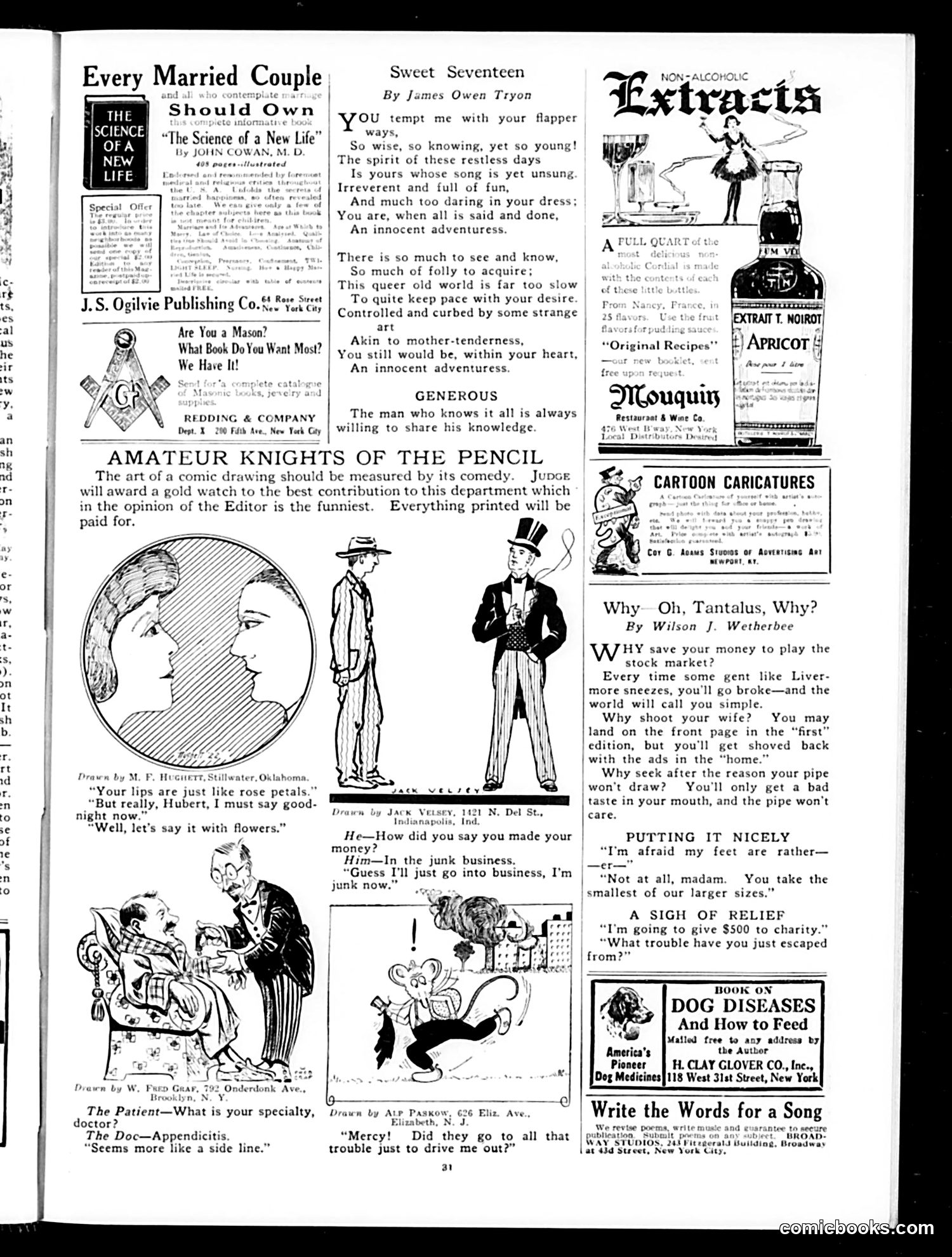
This is primarily a **humor and advertising page** from Judge, a satirical weekly. The main content includes: **"Sweet Seventeen"** poem by James Owen Tryon celebrates the "flapper" — the modern young woman of the 1920s with her daring dress, irreverence, and independence. The poem presents her as charming yet innocent, capturing cultural anxieties about liberated youth. **"Amateur Knights of the Pencil"** features comic submissions judged by humor quality. The cartoons depict domestic humor: a man suggesting his date end the evening "with flowers" (rather than romantic words), and a doctor admitting appendicitis is merely his "side line." **"Why, Oh Tantalus, Why?"** mocks speculation in stocks and pursuing fame through scandal — satirizing frivolous uses of wealth. Minor humor pieces joke about business junk, foot sizes, and charitable giving. The page is heavily **advertisement-laden**: marriage advice books, Masonic literature, restaurants, and a dog diseases book dominate the margins — typical of Judge's revenue model.
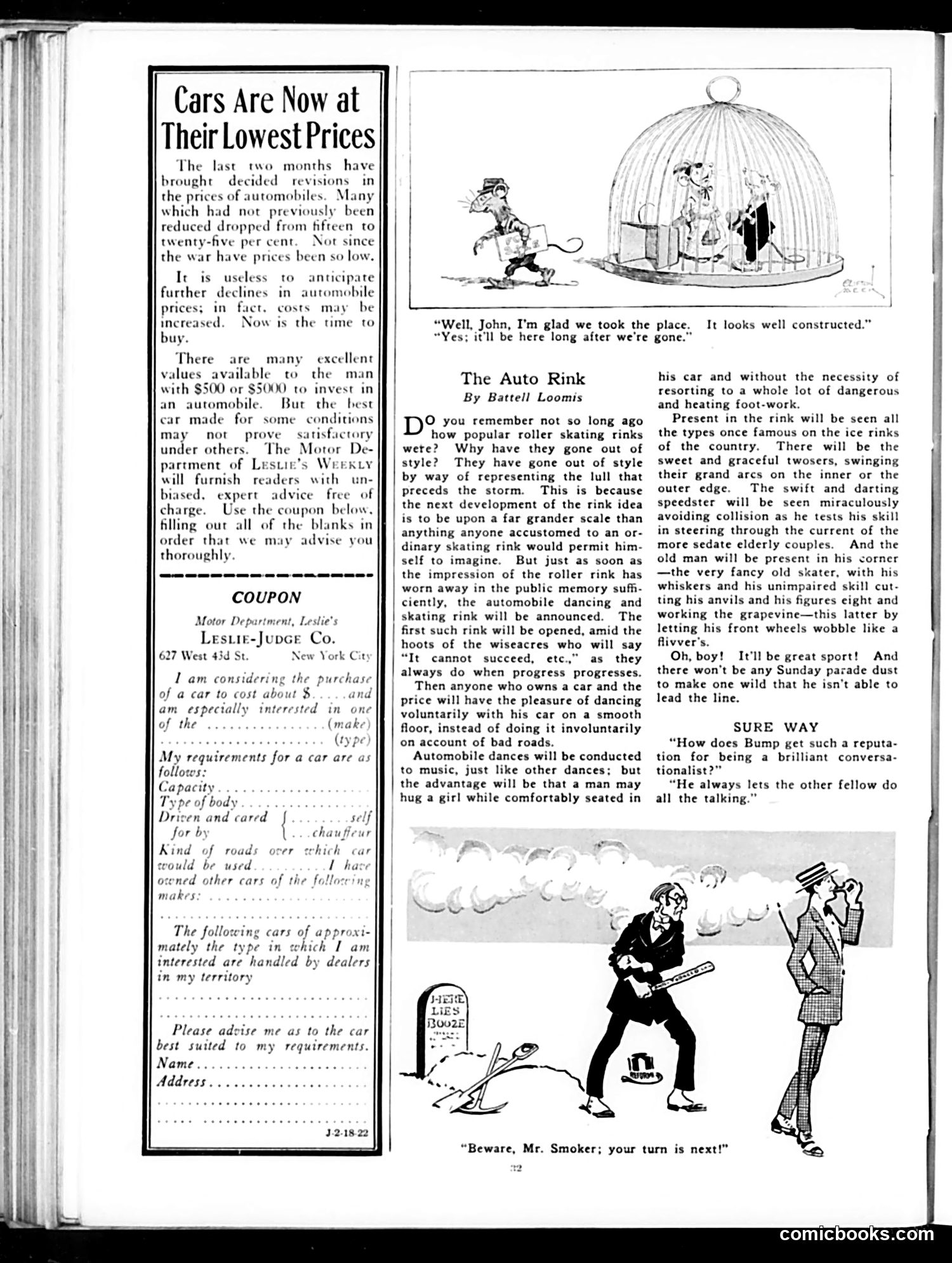
This page combines car-market advertising with satirical cartoons reflecting 1920s concerns. **Main Content:** A coupon ad touts automobiles at post-war low prices, encouraging readers to consult *Leslie's Weekly's* motor department for purchasing advice. **"The Auto Rink" Cartoon:** Battell Loomis satirizes the fad cycle. He predicts roller skating rinks will soon be replaced by "automobile dancing rinks"—where couples dance while sitting in parked cars on smooth floors. The joke mocks both technological optimism and dating customs: men could embrace women without the physical exertion of actual dancing. This is presented as inevitable "progress," though Loomis suggests skeptics will initially dismiss it (as they always do new ideas). **Other Cartoons:** Two smaller gags appear—one showing a birdcage with people inside (unclear context), another depicting a man attacking tombstones labeled "Lies" and "Booze" with the caption "Beware, Mr. Smoker; your turn is next!"—likely Prohibition-era social commentary. The page reflects 1920s preoccupation with automobiles, dating freedom, and social reform movements.
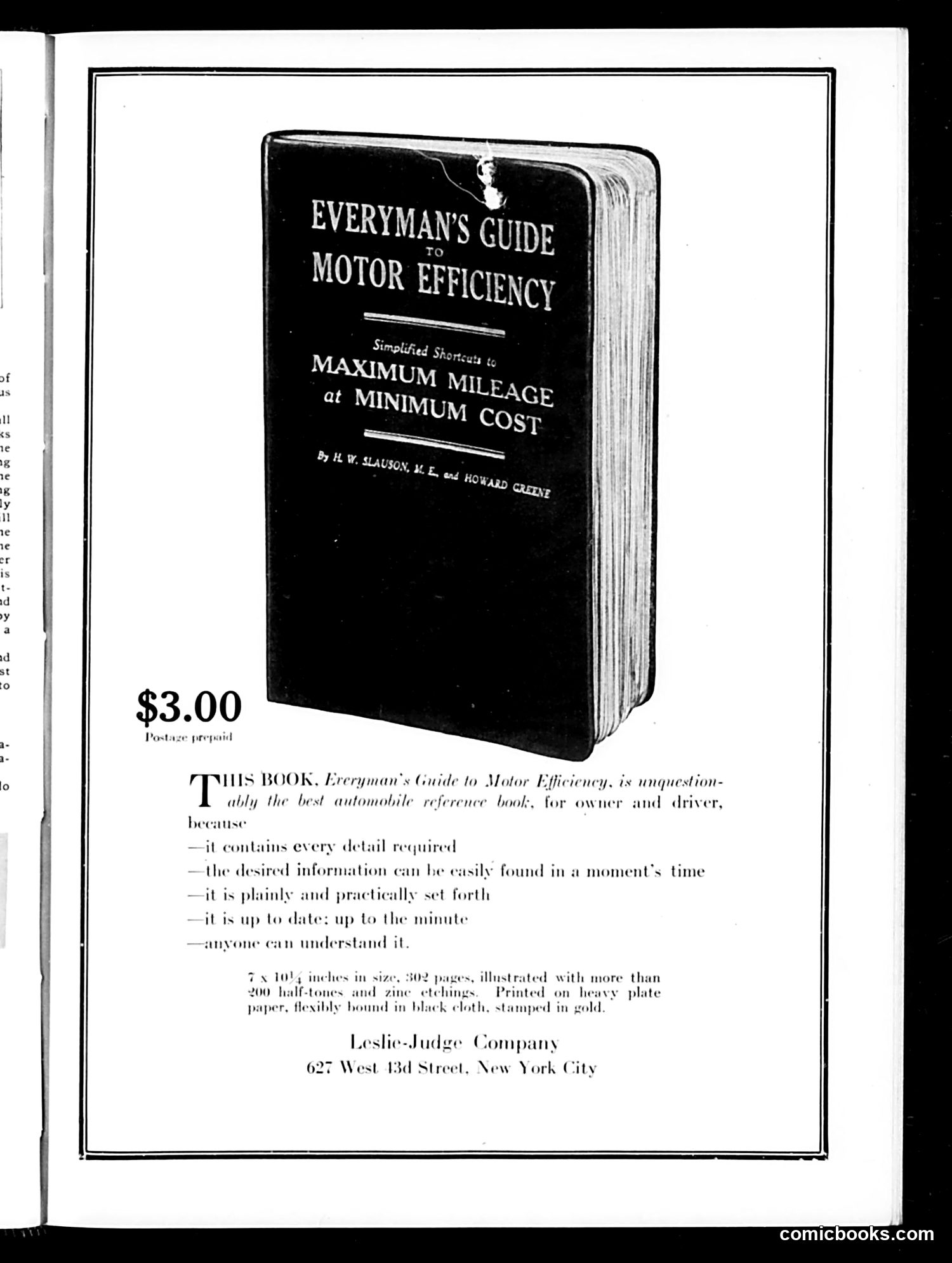
This is a **book advertisement**, not a cartoon or satirical content. It promotes "Everyman's Guide to Motor Efficiency," a practical automobile manual by H.W. Allarson and Howard Greene, priced at $3.00 (postage prepaid). The ad emphasizes the book's utility for car owners and drivers through bullet points highlighting its accessibility: comprehensive detail, easy navigation, plain language, up-to-date information, and universal understandability. The publication itself—802 pages with 200+ illustrations, bound in black cloth with gold stamping—suggests a substantial reference work aimed at the average motorist. Judge magazine, primarily satirical, ran advertisements like this alongside comic content. There is no political satire or caricature present on this page; it represents straightforward commercial promotion typical of early 20th-century publications.
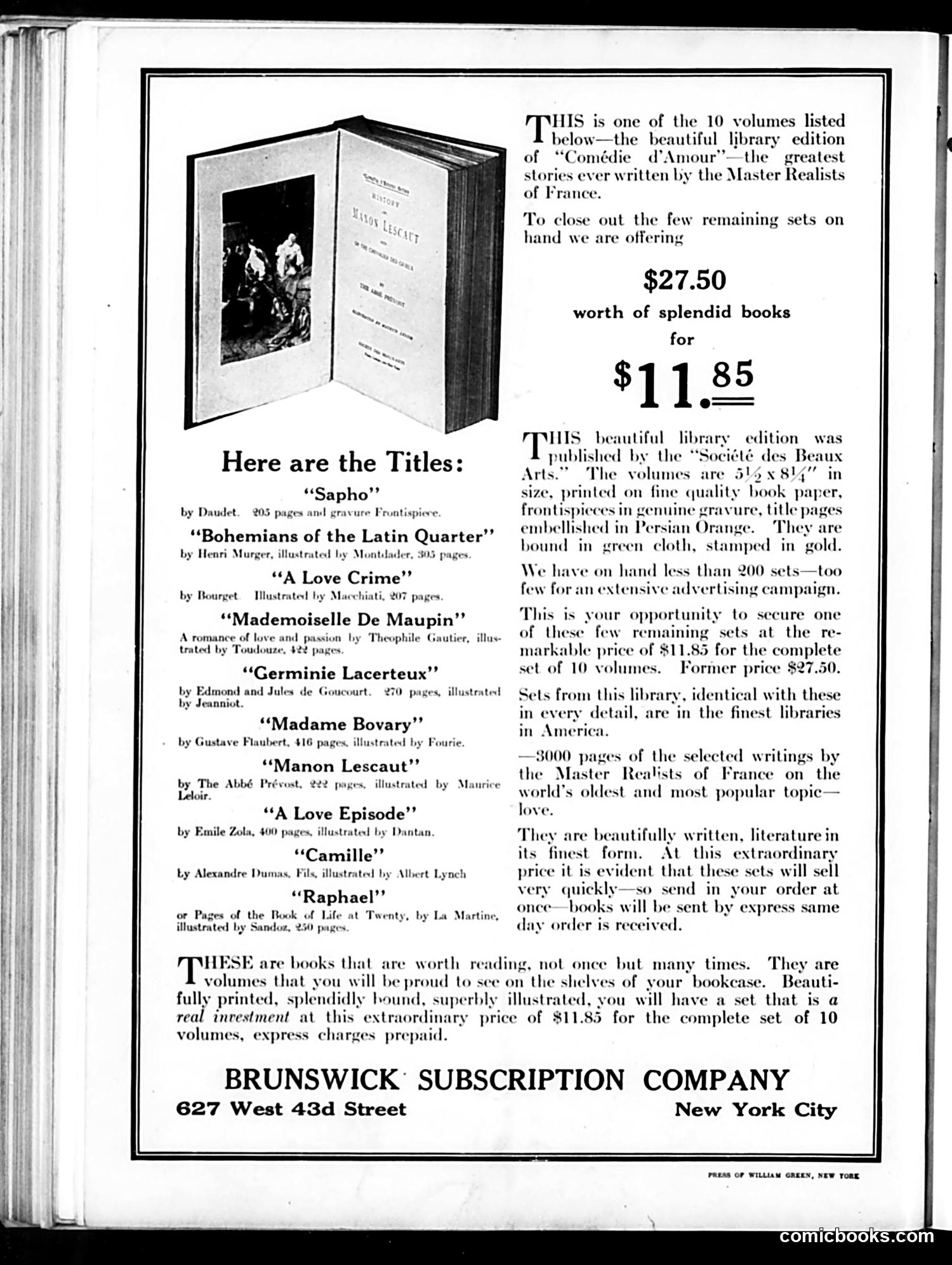
This page is not a cartoon but a **book advertisement** from Judge magazine. It promotes a discounted library edition of French literature—a 10-volume set of classic realist novels originally priced at $27.50, now offered for $11.85. The titles listed are genuine French literary works by authors like Émile Zola, Gustave Flaubert, and Alexandre Dumas—all focused, as the ad notes, on "the world's oldest and most popular topic—love." The advertisement emphasizes the books' quality (fine paper, gilt binding, illustrated) and their prestige (claimed to be "in the finest libraries in America"). This reflects early 20th-century consumer culture and aggressive marketing tactics: creating artificial scarcity ("less than 200 sets"), emphasizing urgency ("will sell very quickly"), and positioning expensive books as a status symbol—something readers would be "proud to see on the shelves of your bookcase." No satire or cartoon appears on this page.