
Judge, 1922-02-18 · page 10 of 36
Judge — February 18, 1922 — page 10: what you’re looking at
What you’re looking at
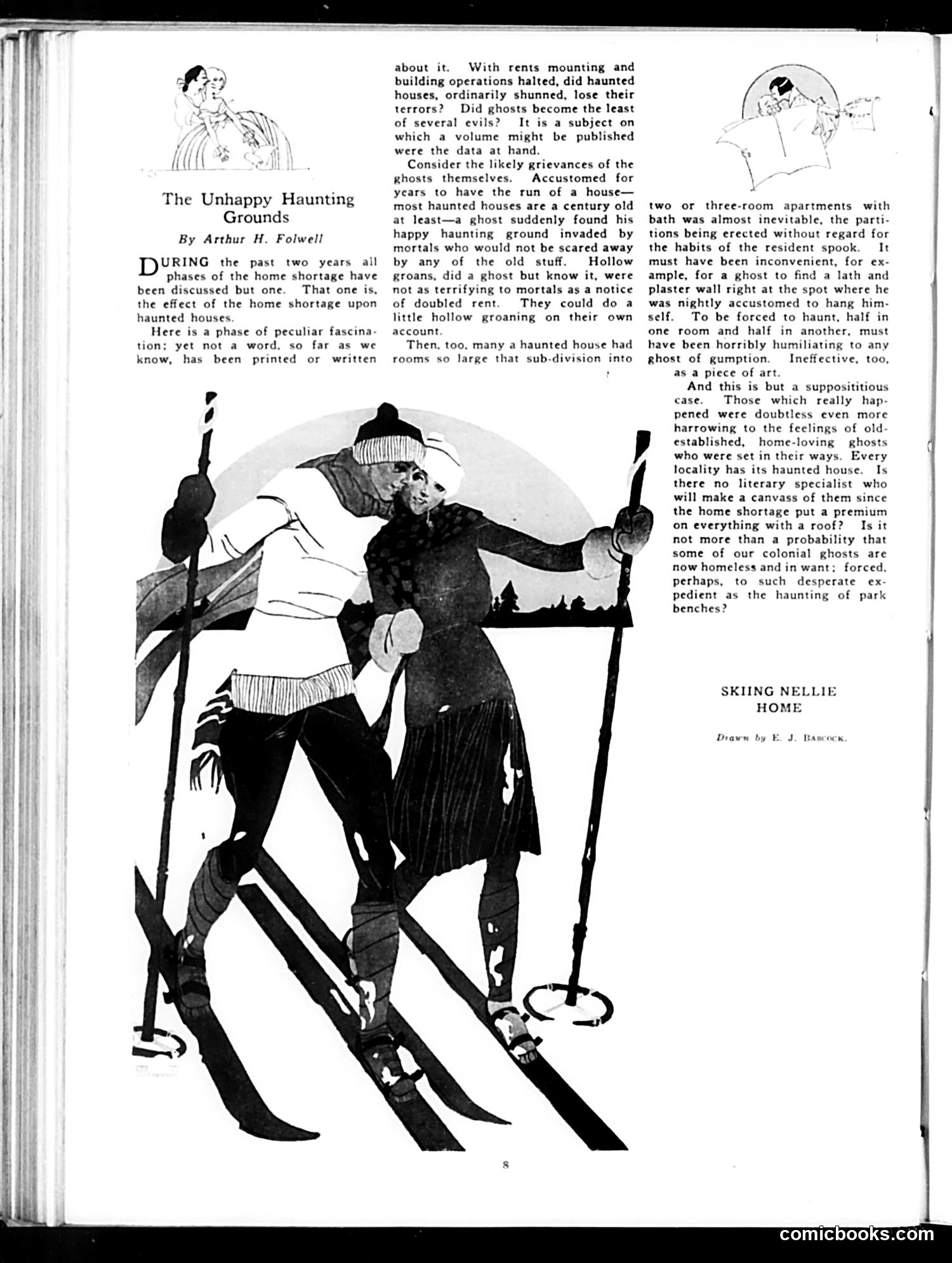
This is a humorous essay by Arthur H. Folwell addressing the post-WWI American housing shortage through an absurdist lens: what happens to ghosts when their traditional haunted houses get subdivided into rental apartments? The satire operates on multiple levels. On the surface, it's a joke about housing scarcity forcing even supernatural beings into precarious situations. But it's really commentary on the severe housing crisis of the early 1920s—rents mounting, building halted, desperate landlords converting old mansions into cramped multi-unit dwellings without regard for structural integrity or aesthetics. The cartoon "Skiing Nellie Home" (drawn by E.J. Haycock) shows a woman skiing, likely illustrating the absurdist premise that extreme measures (even winter sports) become necessary transportation when housing is so scarce that people might be displaced. The essay's final joke—that dispossessed ghosts might resort to "haunting park benches"—grimly suggests actual homelessness, using supernatural displacement as dark satire for real human suffering during this period.
📄 Transcribed text from this page (OCR, searchable)
Machine-transcribed from the original scan — historical spelling and the odd misread are preserved.
The Unhappy Haunting Grounds By Arthur H. Folwell DURING the past two years all phases of the home shortage have been discussed but one. That one is, the effect of the home shortage upon haunted houses. Here is a phase of peculiar fascina tion; yet not a word, so far as we know, has been printed or written 4 6 about it. With rents mounting and building operations halted, did haunted houses, ordinarily shunned, lose their terrors? Did ghosts become the least of several evils? It is a subject on which a volume might be published were the data at hand. Consider the likely grievances of the ghosts themselves. Accustomed for years to have the run of a house— most haunted houses are a century old at least—a ghost suddenly found his happy haunting ground invaded by mortals who would not be scared away by any of the old stuff. Hollow groans, did a ghost but know it, were not as terrifying to mortals as a notice of doubled rent They could do a little hollow groaning on their own account Then, too, many a haunted house had rooms so large that sub-division into two or three-room apartments with bath was almost inevitable, the parti- tions being erected without regard for the habits of the resident spook. It must have been inconvenient, for ex- ample, for a ghost to find a lath and plaster wall right at the spot where he was nightly accustomed to hang him- self. To be forced to haunt, half in one room and half in another, must have been horribly humiliating to any ghost of gumption. Ineffective, too, as a piece of art And this is but a supposititious case. Those which really hap- pened were doubtless even more harrowing to the feelings of old y established, home-loving ghosts who were set in their ways. Every locality has its haunted house. Is there no literary specialist who will make a canvass of them since the home shortage put a premium on everything with a roof? Is it not more than a probability that some of our colonial ghosts are now homeless and in want; forced, perhaps, to such desperate ex- pedient as the haunting of park benches? SKIING NELLIE HOME Drawn by E. J. Bascock | comicbooks.com