
Judge, 1922-02-18 · page 16 of 36
Judge — February 18, 1922 — page 16: what you’re looking at
What you’re looking at
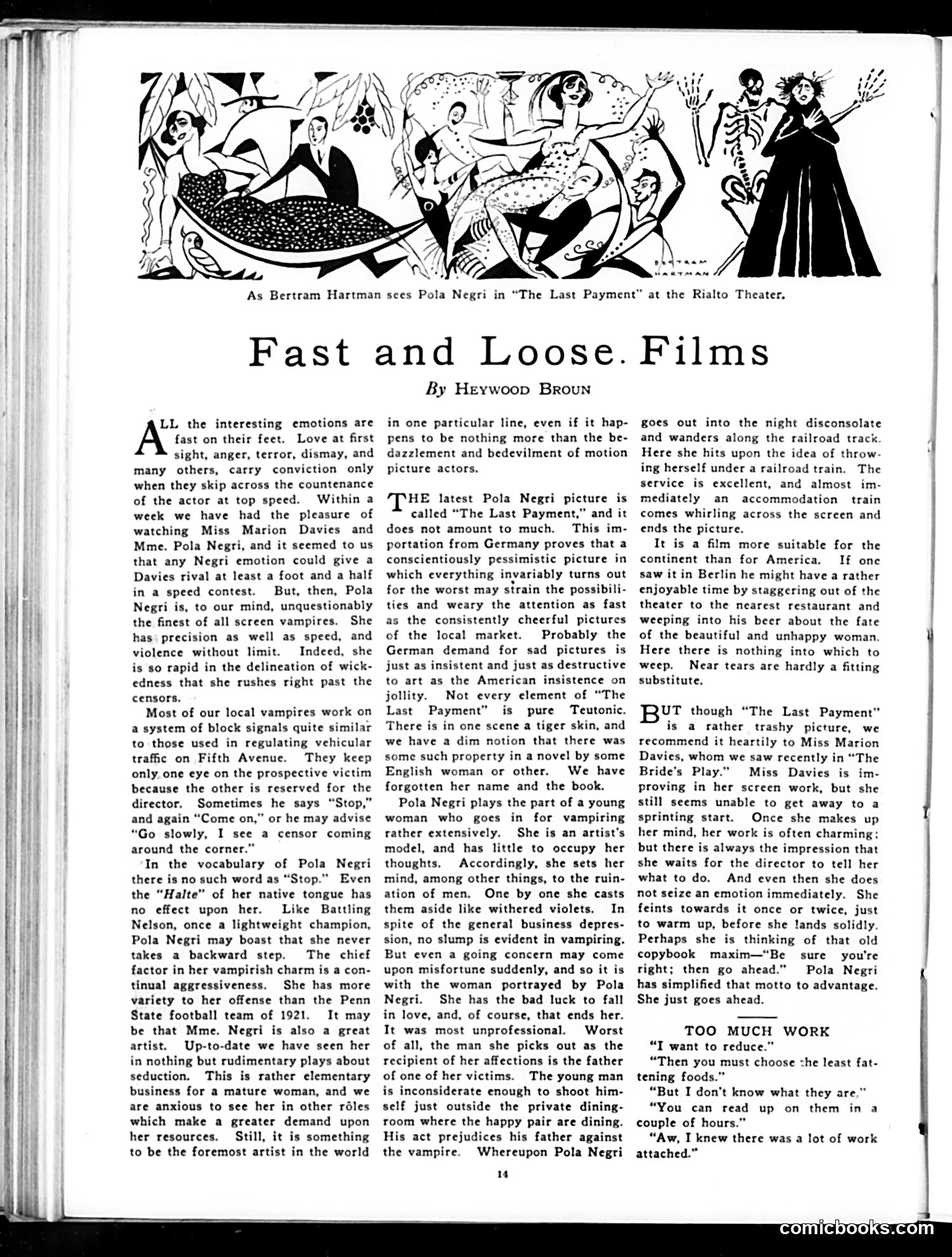
The top illustration shows cartoonist Bertram Hartman's artistic interpretation of actress Pola Negri in the film "The Last Payment" at the Rialto Theater—a visual commentary accompanying the review below. Heywood Broun's article compares silent film actresses' emotional expressiveness, particularly Pola Negri against Marion Davies. He argues Negri excels at portraying vampires (seductresses) because of her rapid, aggressive screen presence—she moves so fast emotionally that she "rushes right past the censors." The review is somewhat backhanded: Broun praises her vampire work while suggesting it's "rudimentary" material unworthy of her talents. He critiques "The Last Payment" as a pessimistic German import with a melodramatic plot about a female artist's model who ruins men through seduction until she foolishly falls in love herself. The satire's target is less political than cultural—mocking both the predictable morality tales of 1920s cinema and the limited roles available to actresses, even talented ones.
📄 Transcribed text from this page (OCR, searchable)
Machine-transcribed from the original scan — historical spelling and the odd misread are preserved.
As Bertram Hartman sees Pola Negri in “The Last Payment” at the Rialto Theater. Fast and Loose. Films LL the interesting emotions are A fast on their feet. Love at first sight, anger, terror, dismay, and many others, carry conviction only when they skip across the countenance of the actor at top speed. Within a week we have had the pleasure of watching Miss Marion Davies and Mme. Pola Negri, and it seemed to us that any Negri emotion could give a Davies rival at least a foot and a half in a speed contest. But, then, Pola Negri is, to our mind, unquestionably the finest of all screen vampires. She has precision as well as speed, and violence without limit. Indeed, she is so rapid in the delineation of wick- edness that she rushes right past the censors. Most of our local vampires work on a system of block signals quite similar to those used in regulating vehicular trafic on Fifth Avenue. They keep only. one eye on the prospective victim because the other is reserved for the director. Sometimes he says “Stop,” and again “Come on,” or he may advise “Go slowly, I see a censor coming around the corner.” In the vocabulary of Pola Negri there is no such word as “Stop.” Even the “Halte” of her native tongue has no effect upon her. Like Battling Nelson, once a lightweight champion, Pola Negri may boast that she never takes a backward step. The chief factor in her vampirish charm is a con- tinual aggressiveness. She has more variety to her offense than the Penn State football team of 1921. It may be that Mme. Negri is also a great artist. Up-to-date we have seen her in nothing but rudimentary plays about seduction. This is rather elementary business for a mature woman, and we are anxious to see her in other réles which make a greater demand upon her resources. Still, it is something to be the foremost artist in the world By Heywoop Broun in one particular line, even if it hap- pens to be nothing more than the be- dazzlement and bedevilment of motion picture actors. THE latest Pola Negri picture is called “The Last Payment,” and it does not amount to much. This im- portation from Germany proves that a conscientiously pessimistic picture in which everything invariably turns out for the worst may strain the possibili- ties and weary the attention as fast as the consistently cheerful pictures of the local market. Probably the German demand for sad pictures is just as insistent and just as destructive to art as the American insistence on jollity. Not every element of “The Last Payment” is pure Teutonic. There is in one scene a tiger skin, and we have a dim notion that there was some such property in a novel by some English woman or other. We have forgotten her name and the book. Pola Negri plays the part of a young woman who goes in for vampiring rather extensively. She is an artist's model, and has little to occupy her thoughts. Accordingly, she sets her mind, among other things, to the ruin- ation of men. One by one she casts them aside like withered violets. In spite of the general business depres- sion, no slump is evident in vampiring. But even a going concern may come upon misfortune suddenly, and so it is with the woman portrayed by Pola Negri. She has the bad luck to fall in love, and, of course, that ends her. It was most unprofessional. Worst of all, the man she picks out as the recipient of her affections is the father of one of her victims. The young man is inconsiderate enough to shoot him- self just outside the private dining- room where the happy pair are dining. His act prejudices his father against the vampire. Whereupon Pola Negri 4 goes out into the night disconsolate and wanders along the railroad track Here she hits upon the idea of throw- ing herself under a railroad train. The service is excellent, and almost im- mediately an accommodation train comes whirling across the screen and ends the picture. It is a film more suitable for the continent than for America. If one saw it in Berlin he might have a rather enjoyable time by staggering out of the theater to the nearest restaurant and weeping into his beer about the fate of the beautiful and unhappy woman. Here there is nothing into which to weep. Near tears are hardly a fitting substitute. But though “The Last Payment” is a rather trashy picture, we recommend it heartily to Miss Marion Davies, whom we saw recently in “The Bride's Play.” Miss Davies is im- proving in her screen work, but she still seems unable to get away to a sprinting start. Once she makes up her mind, her work is often charming; but there is always the impression that she waits for the director to tell her what to do. And even then she does not seize an emotion immediately. She feints towards it once or twice, just to warm up, before she !ands solidly. Perhaps she is thinking of that old copybook maxim—“Be sure you're right; then go ahead.” Pola Negri has simplified that motto to advantage. She just goes ahead. TOO MUCH WORK “I want to reduce.” “Then you must choose che least fat- tening foods.” “But I don't know what they are,” “You can read up on them in a couple of hours.” “Aw, I knew there was a lot of work attached.” —s