
Judge, 1922-02-18 · page 18 of 36
Judge — February 18, 1922 — page 18: what you’re looking at
What you’re looking at
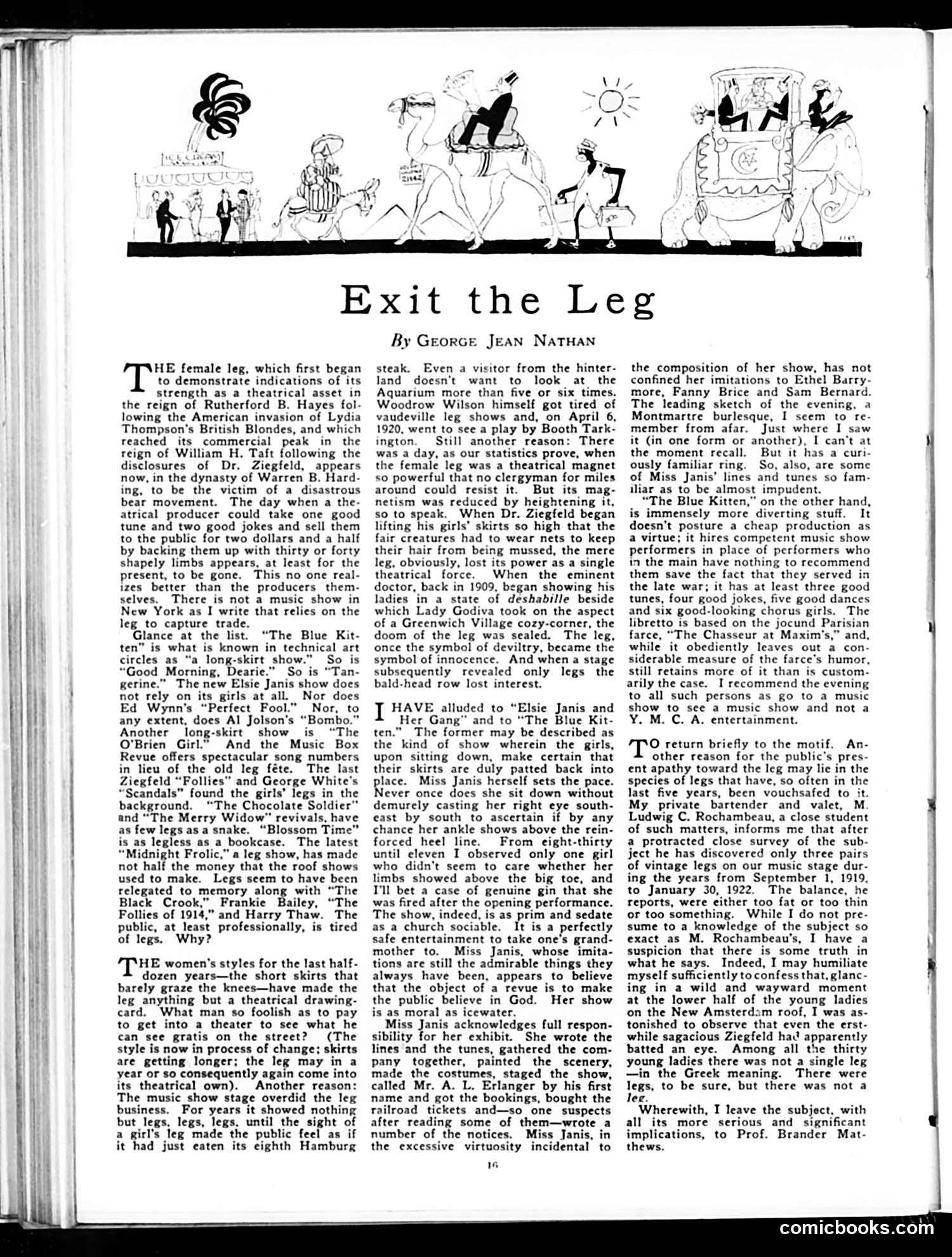
This article by George Jean Nathan analyzes the decline of the theatrical "leg show"—revues where producers relied primarily on displaying women's legs as the main attraction. Nathan traces this form from the 1870s (Lydia Thompson's British Blondes) through its peak under Florenz Ziegfeld during William Taft's presidency, to its apparent death in the early 1920s under Warren Harding. Nathan identifies three reasons for this decline: (1) women's fashion shifted to shorter skirts, making legs visible on the street for free; (2) theaters oversaturated audiences with leg shows, causing fatigue; and (3) Ziegfeld paradoxically destroyed the leg's power by progressively revealing more—once the full body appeared, isolated legs lost their theatrical appeal. The accompanying illustration shows theatrical performers in various costume states, likely satirizing this evolution from modest Victorian dress to increasingly revealing stage costumes.
📄 Transcribed text from this page (OCR, searchable)
Machine-transcribed from the original scan — historical spelling and the odd misread are preserved.
Exit the Leg HE female leg, which first began to demonstrate indications of its strength as a theatrical asset in the reign of Rutherford B. Hayes fol- lowing the American invasion of Lydia Thompson's British Blondes, and which reached its commercial peak in the reign of William H. Taft following the disclosures of Dr. Ziegfeld, appears now, in the dynasty of Warren B. Hard- ing, to be the victim of a disastrous bear movement. The day when a the- atrical producer could take one good tune and two good jokes and sell them to the public for two dollars and a half by backing them up with thirty or forty shapely limbs appears, at least for the present, to be gone. This no one real- izes better than the producers them- selves. There is not a music show in New York as I write that relies on the leg to capture trade. Glance at the list. “The Blue Kit- ten” is what is known in technical art circles as “a long-skirt show.” So is “Good Morning, Dearie.” So is “Tan- gerine.” The new Elsie Janis show does not rely on its girls at all. Nor does Ed Wynn's “Perfect Fool.” Nor, to any extent, does Al Jolson's “Bombo.” Another long-skirt show is “The O’Brien Girl.” And the Music Box Revue offers spectacular song numbers in lieu of the old leg féte. The last Ziegfeld “Follies” and George White's “Scandals” found the girls’ legs in the background. “The Chocolate Soldier” and “The Merry Widow” revivals, have as few legs as a snake. “Blossom Time” is as legless as a bookcase. The latest “Midnight Frolic,” a leg show, has made not half the money that the roof shows used to make. Legs seem to have been relegated to memory along with “The Black Crook,” Frankie Bailey, “The Follies of 1914,” and Harry Thaw. The public, at least professionally, is tired of legs. Why? ‘THE women's styles for the last half- dozen years—the short skirts that barely graze the knees—have made the leg anything but a theatrical drawing- card. What man so foolish as to pay to get into a theater to see what he can see gratis on the street? (The style is now in process of change; skirts are getting longer; the leg may in a year or so consequently again come into its theatrical own). Another reason: The music show stage overdid the leg business. For years it showed nothing but legs, legs, legs, until the sight of a girl’s leg made the public feel as if it had just eaten its eighth Hamburg By Georce JEAN NATHAN steak. Even a visitor from the hinter- land doesn’t want to look at the Aquarium more than five or six times. Woodrow Wilson himself got tired of vaudeville leg shows and, on April 6, 1920, went to see a play by Booth Tark- ington Still another reason: There was a day, as our statistics prove, when the female leg was a theatrical magnet so powerful that no clergyman for miles around could resist it. But its mag- netism was reduced by heightening it, so to speak. When Dr. Ziegfeld began lifting his girls’ skirts so high that the fair creatures had to wear nets to keep their hair from being mussed, the mere leg, obviously, lost its power as a single theatrical force. When the eminent doctor, back in 1909, began showing his ladies in a state of deshabille beside which Lady Godiva took on the aspect of a Greenwich Village cozy-corner, the doom of the leg was sealed. The leg, once the symbol of deviltry, became the symbol of innocence. And when a stage subsequently revealed only legs the bald-head row lost interest. HAVE alluded to “Elsie Janis and Her Gang” and to “The Blue Kit- ten.” The former may be described as the kind of show wherein the girls, upon sitting down, make certain that their skirts are duly patted back into lace. Miss Janis herself sets the pace. ever once does she sit down without demurely casting her right eye south- east by south to ascertain if by any chance her ankle shows above the rein- forced heel line. From eight-thirty until eleven I observed only one girl who didn’t seem to care whether her limbs showed above the big toe, and I'll bet a case of genuine gin that she was fired after the opening performance. The show, indeed, is as prim and sedate as a church sociable. It is a perfectly safe entertainment to take one’s grand- mother to. Miss Janis, whose imita- tions are still the admirable things they always have been, appears to believe that the object of a revue is to make the public believe in God. Her show is as moral as icewater. Miss Janis acknowledges full respon- sibility for her exhibit. She wrote the lines and the tunes, gathered the com- pany together, painted the scenery, made the costumes, staged the show, called Mr. A. L. Erlanger by his first name and got the bookings, bought the railroad tickets and—so one suspects after reading some of them—wrote a number of the notices. Miss Janis, in the excessive virtuosity incidental to the composition of her show, has not confined her imitations to Ethel Barry- more, Fanny Brice and Sam Bernard. The leading sketch of the evening, a Montmartre burlesque, I seem to re- member from afar. Just where I saw it (in one form or another), I can't at the moment recall. But it has a curi- ously familiar ring. So, also, are some of Miss Janis’ lines and tunes so fam- iliar as to be almost impudent. “The Blue Kitten,” on the other hand, is immensely more diverting stuff. It doesn’t posture a cheap production as a virtue; it hires competent music show performers in place of performers who in the main have nothing to recommend them save the fact that they served in the late war; it has at least three good tunes, four good jokes, five good dances and six good-looking chorus girls. The libretto is based on the jocund Parisian farce, “The Chasseur at Maxim's,” and, while it obediently leaves out a con- siderable measure of the farce’s humor, still retains more of it than is custom- arily the case. I recommend the evening to all such persons as go to a music show to see a music show and not a Y. M. C. A. entertainment. T° return briefly to the motif. An- other reason for the public's pres- ent apathy toward the leg may lie in the species of legs that have, so often in the last five years, been vouchsafed to it. My private bartender and valet, M Ludwig C. Rochambeau, a close student of such matters, informs me that after a protracted close survey of the sub- ject he has discovered only three pairs of vintage legs on our music stage dur- ing the years from September 1, 1919, to January 30, 1922. The balance, he reports, were either too fat or too thin or too something. While I do not pre- sume to a knowledge of the subject so exact as M. Rochambeau's, I have a suspicion that there is some truth in what he says. Indeed, I may humiliate myself sufficiently toconfess that, glanc- ing in a wild and wayward moment at the lower half of the young ladies on the New Amsterdam roof, I was as- tonished to observe that even the erst- while sagacious Ziegfeld hat apparently batted an eye. Among all the thirty young ladies there was not a single leg —in the Greek meaning. There were legs, to be sure, but there was not a “Wherewith, I leave the subject, with all its more serious and significant implications, to Prof. Brander Mat- thews. comicbooks.com