
Judge, 1922-02-18 · page 20 of 36
Judge — February 18, 1922 — page 20: what you’re looking at
What you’re looking at
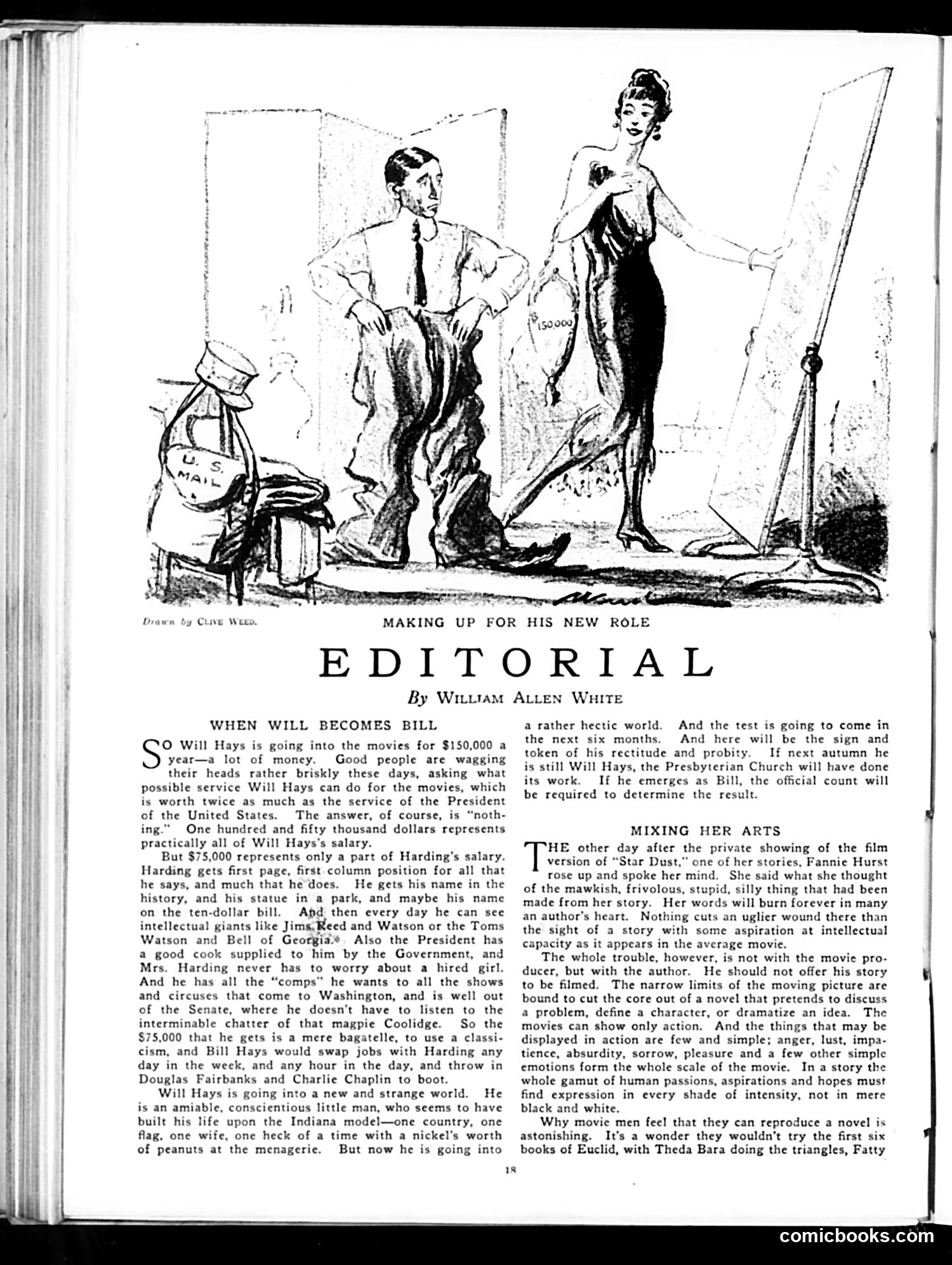
This editorial page by William Allen White satirizes Will Hays's $150,000-per-year appointment to regulate the movie industry. **The Cartoon:** Titled "Making Up for His New Role," it shows Hays being fitted for costumes—suggesting he's preparing a false persona for Hollywood, a visual pun on "making up." **The Main Satire:** White argues Hays's salary is excessive because he'll accomplish "nothing." The joke compares Hays's movie pay unfavorably to President Harding's lower official salary, yet Harding receives greater prestige and benefits. White suggests Hays would trade places with Harding instantly—implying the movie job, though lucrative, lacks real importance or dignity. **Secondary Satire:** The second editorial mocks authors like Fannie Hurst for complaining when their literary novels are adapted into simplistic films. White argues authors shouldn't blame producers; they shouldn't sell their complex stories to a medium (silent film) that can only depict basic emotions and action, not nuance. Both pieces critique the movie industry's pretensions to cultural significance.
📄 Transcribed text from this page (OCR, searchable)
Machine-transcribed from the original scan — historical spelling and the odd misread are preserved.
Drawn by Cuve Weer. MAKING UP FOR HIS NEW ROLE EDITORIAL By Wittram ALLEN WHITE WHEN WILL BECOMES BILL O Will Hays is going into the movies for $150,000 a year—a lot of money. Good people are wagging their heads rather briskly these days, asking what possible service Will Hays can do for the movies, which is worth twice as much as the service of the President of the United States. The answer, of course, is “noth- ing.” One hundred and fifty thousand dollars represents practically all of Will Hays’s salary. But $75,000 represents only a part of Harding's salary. Harding gets first page, first column position for all that he says, and much that he does. He gets his name in the history, and his statue in a park, and maybe his name on the ten-dollar bill. Afd then every day he can see intellectual giants like Jims,Reed and Watson or the Toms Watson and Bell of Georgia Also the President has a good cook supplied to him by the Government, and Mrs. Harding never has to worry about a hired girl. And he has all the “comps” he wants to all the shows and circuses that come to Washington, and is well out of the Senate, where he doesn’t have to listen to the interminable chatter of that magpie Coolidge. So the $75,000 that he gets is a mere bagatelle, to use a classi- cism, and Bill Hays would swap jobs with Harding any day in the week, and any hour in the day, and throw in Douglas Fairbanks and Charlie Chaplin to boot. Will Hays is going into a new and strange world. He is an amiable, conscientious little man, who seems to have built his life upon the Indiana model—one country, one flag, one wife, one heck of a time with a nickel’s worth of peanuts at the menagerie. But now he is going into And the test is going to come in the next six months. And here will be the sign and token of his rectitude and probity. If next autumn he is still Will Hays, the Presbyterian Church will have done its work. If he emerges as Bill, the official count will be required to determine the result. a rather hectic world. MIXING HER ARTS HE other day after the private showing of the film version of “Star Dust,” one of her stories, Fannie Hurst rose up and spoke her mind. She said what she thought of the mawkish, frivolous, stupid, silly thing that had been made from her story. Her words will burn forever in many an author’s heart. Nothing cuts an uglier wound there than the sight of a story with some aspiration at intellectual capacity as it appears in the average movie. The whole trouble, however, is not with the movie pro- ducer, but with the author. He should not offer his story to be filmed. The narrow limits of the moving picture are bound to cut the core out of a novel that pretends to discuss a problem, define a character, or dramatize an idea. The movies can show only action. And the things that may be displayed in action are few and simple; anger, lust, impa- tience, absurdity, sorrow, pleasure and a few other simple emotions form the whole scale of the movie. In a story the whole gamut of human passions, aspirations and hopes must find expression in every shade of intensity, not in mere black and white. Why movie men feel that they can reproduce a novel is astonishing. It’s a wonder they wouldn’t try the first six books of Euclid, with Theda Bara doing the triangles, Fatty comicbooks.com