
Judge, 1922-02-18 · page 32 of 36
Judge — February 18, 1922 — page 32: what you’re looking at
What you’re looking at
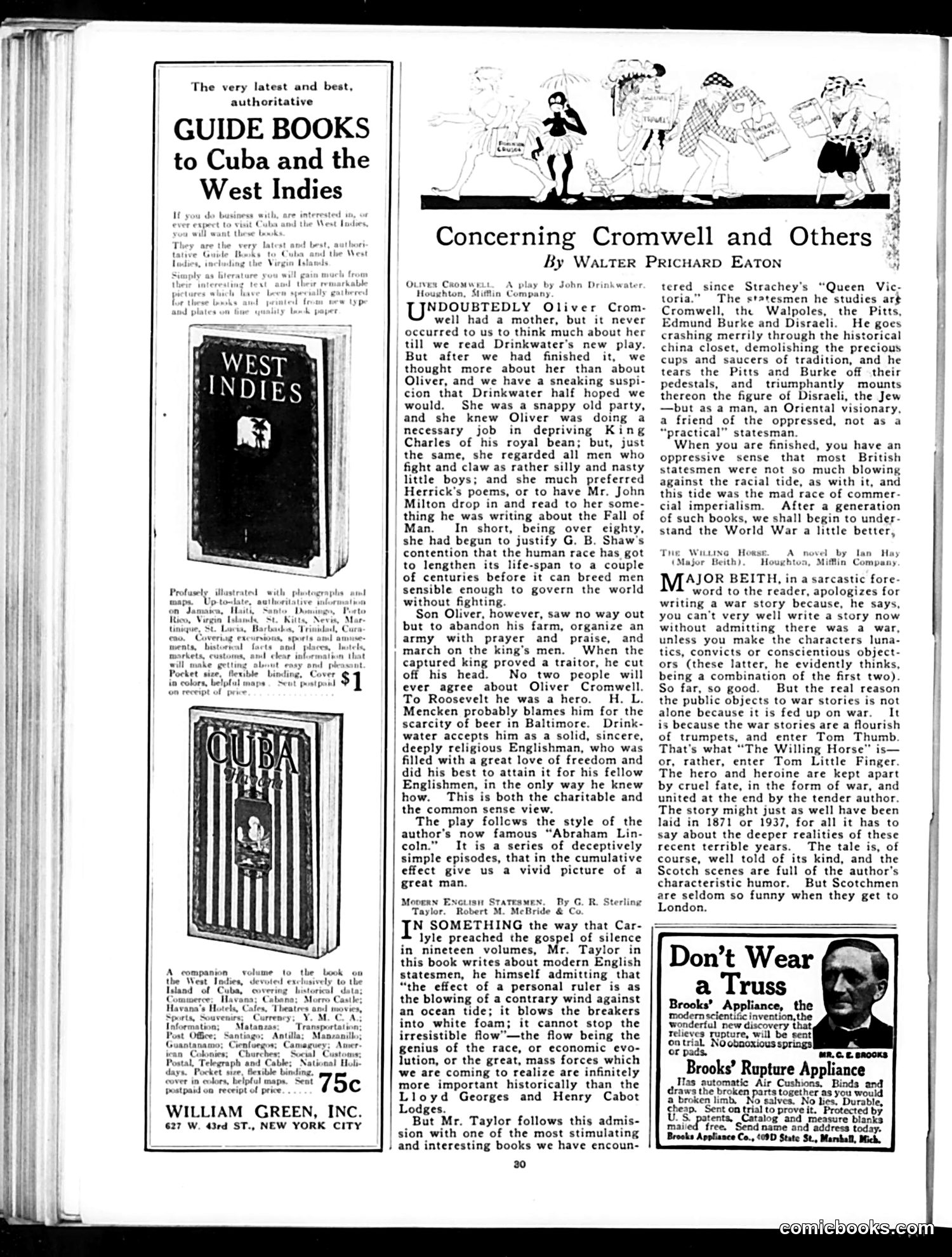
This page is primarily **advertising and book reviews**, not political cartoons. The substantive content is Walter Pritchard Eaton's review of plays and books about historical English statesmen. The review of "Oliver Cromwell" by John Drinkwater reveals period attitudes: Eaton notes disagreement over Cromwell's legacy—Theodore Roosevelt viewed him heroically, while H.L. Mencken apparently blamed him for beer scarcity in Baltimore (a satirical jab). Eaton endorses Drinkwater's portrayal of Cromwell as a sincere, religiously-motivated man fighting for English freedom. More pointedly, reviewing G.R. Sterling Taylor's "Modern English Statesmen," Eaton praises Taylor for elevating **Disraeli**—describing him explicitly as "the Jew" but emphasizing his role as "Oriental visionary" and "friend of the oppressed" rather than mere practical politician. This suggests early 20th-century literary circles were reconsidering Disraeli's historical significance beyond conventional "practical" statecraft. The page reflects Judge's literary-intellectual audience and 1920s-era historical reassessment of empire-era figures.
📄 Transcribed text from this page (OCR, searchable)
Machine-transcribed from the original scan — historical spelling and the odd misread are preserved.
The very latest and best, authoritative GUIDE BOOKS to Cuba and the West Indies They are the tative Guid Tod Profusely illustrated with photographs A. companion uba, covering al Havana; Cabana; Morro Castle Havana's Hotels, Cafes, Theatres and movies, Spurts, Souvenirs; Currenry; Y. M.C. A. Information; Matanzas: Transportatinn: Office: fanz cover in colors, belpful maps. Seat postpaid on receipt of price. WILLIAM GREEN, INC. 627 W. 43rd ST., NEW YORK CITY Concerning Cromwell and Others 4 By Watter PricHARD EaTon 4 Oures Cromwrit A play by John Drinkwater. tered since Strachey’s “Queen Vic- oushton, Sittin Company. toria.” The statesmen he studies ar NDOUBTEDLY Oliver Crom- Cromwell, the Walpoles, the Pitts, well had a mother, but it never Edmund Burke and Disraeli. He goes occurred to us to think much about her till we read Drinkwater’s new play. But after we had finished it, we thought more about her than about Oliver, and we have a sneaking suspi- cion that Drinkwater half hoped we would. She was a snappy old party, and she knew Oliver was doing a necessary job in depriving King Charles of his royal bean; but, just the same, she regarded all men who fight and claw as rather silly and nasty little boys; and she much preferred Herrick’s poems, or to have Mr. John Milton drop in and read to her some- thing he was writing about the Fall of Man. In short, being over eighty, she had begun to justify G. B. Shaw's | contention that the human race has got to lengthen its life-span to a couple of centuries before it can breed men sensible enough to govern the world without fighting. Son Oliver, however, saw no way out but to abandon his farm, organize an army with prayer and praise, and march on the king’s men. When the captured king proved a traitor, he cut off his head. No two people will ever agree about Oliver Cromwell. To Roosevelt he was a hero. L. Mencken probably blames him for the scarcity of beer in Baltimore. Drink- water accepts him as a solid, sincere, deeply religious Englishman, who was filled with a great love of freedom and did his best to attain it for his fellow Englishmen, in the only way he knew how. This is both the charitable and the common sense view. The play follows the style of the author's now famous “Abraham Lin- coln.” It is a series of deceptively simple episodes, that in the cumulative effect give us a vivid picture of a great man. Moverx Exctisn Statesmen. Ry G. R. Sterling Taylor. Robert M. McBride & Co. IN SOMETHING the way that Car- lyle preached the gospel of silence in nineteen volumes, Mr. Taylor in this book writes about modern English statesmen, he himself admitting that “the effect of a personal ruler is as the blowing of a contrary wind against an ocean tide; it blows the breakers into white foam; it cannot stop the irresistible flow’—the flow being the genius of the race, or economic evo- lution, or the great, mass forces which we are coming to realize are infinitely more important historically than the Lloyd Georges and Henry Cabot Lodges. But Mr. Taylor follows this admis- sion with one of the most stimulating and interesting books we have encoun- 20 crashing merrily through the historical china closet, demolishing the precious cups and saucers of tradition, and he tears the Pitts and Burke off their pedestals, and triumphantly mounts thereon the figure of Disraeli, the Jew —but as a man, an Oriental visionary, a friend of the oppressed, not as a “practical” statesman. When you are finished, you have an oppressive sense that most British statesmen were not so much blowing against the racial tide, as with it, and this tide was the mad race of commer- cial imperialism. After a generation of such books, we shall begin to under- stand the World War a little better, The Wittina Hoesr. A novel by lan Hay (Major Beith). Hous Miffin Company Mor BEITH, in a sarcastic fore- word to the reader, apologizes for writing a war story because, he says, you can't very well write a story now without admitting there was a war, unless you make the characters luna- tics, convicts or conscientious object- ors (these latter, he evidently thinks, being a combination of the first two). So far, so good. But the real reason the public objects to war stories is not alone because it is fed up on war. It is because the war stories are a flourish of trumpets, and enter Tom Thumb. That's what “The Willing Horse” is— or, rather, enter Tom Little Finger The hero and heroine are kept apart by cruel fate, in the form of war, and united at the end by the tender author. The story might just as well have been laid in 1871 or 1937, for all it has to say about the deeper realities of these recent terrible years. The tale is, of course, well told of its kind, and the Scotch scenes are full of the author's characteristic humor. But Scotchmen are seldom so funny when they get to London. Brooks’ Appliance, the modern scientific invention,the wonderful new discovery that, yollaves Rear will be sent] on trial. NO obnoxious springs| or pads, AR. C. E. BROOKS 5 : Brooks’ Rupture Appliance Mas automatic Air Cushions. Binds and draws the broken parts together as you would a broken limb, No salves. No lies, Durable, cheap. Sent on trial to prove it. Protected by U.S. patents, Catalog and measure blanks mailed free. Send name and address today. Brooks Appliance Co., ‘09D State St., Marshall, Mich,