
Judge, 1922-02-18 · page 21 of 36
Judge — February 18, 1922 — page 21: what you’re looking at
What you’re looking at
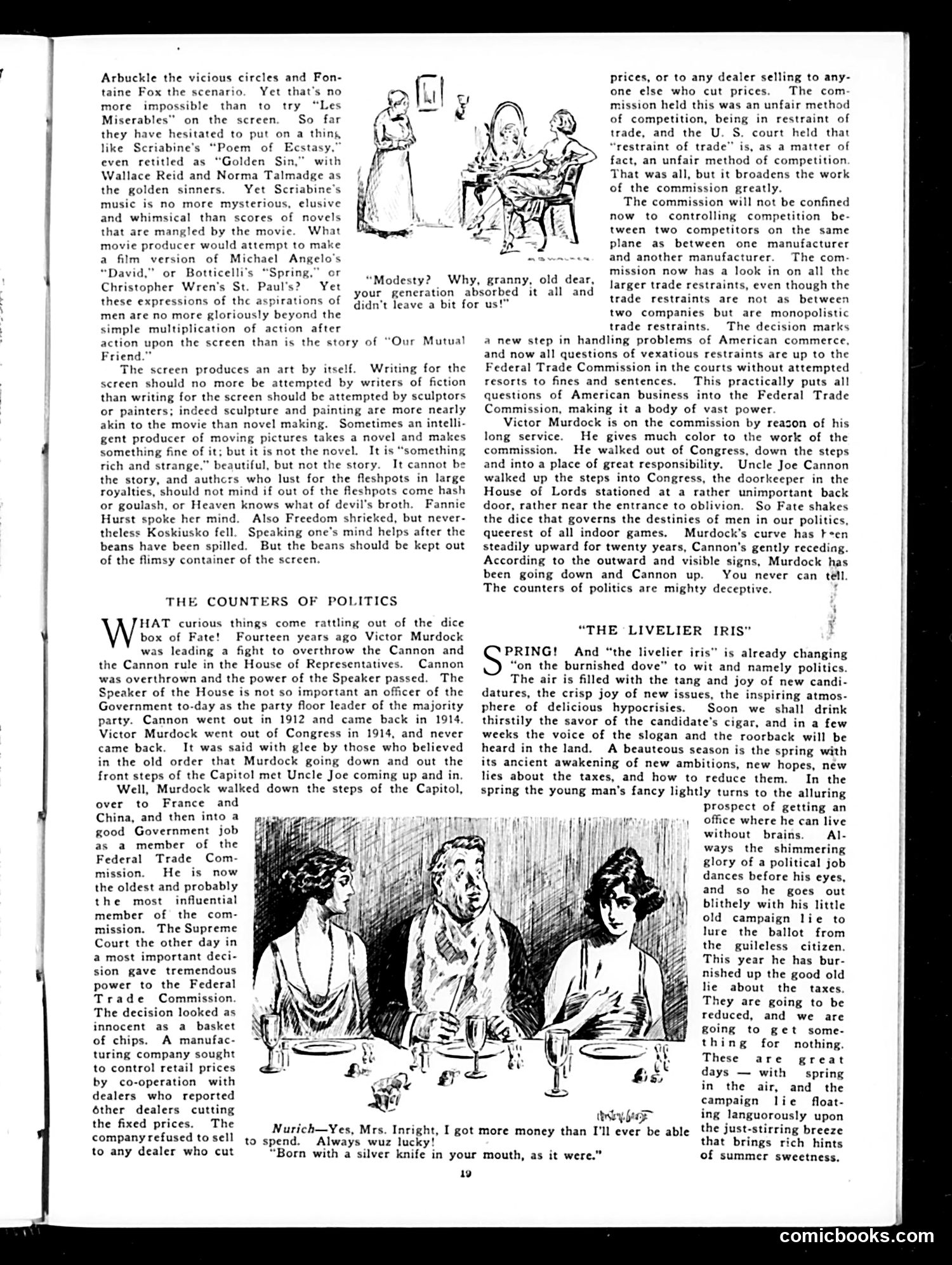
This *Judge* page contains two distinct pieces: **"The Counters of Politics"** discusses Victor Murdock, a Progressive congressman who fought Speaker Joseph "Uncle Joe" Cannon's control in 1912 but lost his seat in 1914. The irony: while Cannon regained power, Murdock—appearing defeated—actually landed at the Federal Trade Commission, where he became influential. A recent Supreme Court decision expanded the FTC's power to regulate "unfair methods of competition," including manufacturers controlling retail prices through dealer cooperation. The article celebrates this as broadening consumer protections against monopolistic practices. **"The Livelier Iris"** (lower section) appears to be satirical campaign writing, with the cartoon caption showing someone boasting about inherited wealth ("Born with a silver knife in your mouth"), likely mocking wealthy candidates' disconnection from ordinary voters facing reduced taxes and economic hardship during spring campaigning. The page satirizes both political ironies and the gap between wealthy elites and working citizens.
📄 Transcribed text from this page (OCR, searchable)
Machine-transcribed from the original scan — historical spelling and the odd misread are preserved.
ee Arbuckle the vicious circles and Fon- taine Fox the scenario. Yet that’s no more impossible than to try “Les Miserables” on the screen. So far they have hesitated to put on a thing like Scriabine’s “Poem of Ecstasy,” even retitled as “Golden Sin,” with Wallace Reid and Norma Talmadge as the golden sinners. Yet Scriabine’s music is no more mysterious, elusive and whimsical than scores of novels that are mangled by the movie. What movie producer would attempt to make a film version of Michael Angelo’s “David,” or Botticelli’s “Spring,” or Christopher Wren's St. Paul's? Yet these expressions of the a ‘ations of men are no more gloriously beyond the simple multiplication of action after action upon the screen than is the story of “Our Mutual Friend.” The screen produces an art by itself. Writing for the screen should no more be attempted by writers of fiction than writing for the screen should be attempted by sculptors or painters; indeed sculpture and painting are more nearly akin to the movie than novel making. Sometimes an intelli- gent producer of moving pictures takes a novel and makes something fine of it; but it is not the novel. It is “something rich and strange,” beautiful, but not the story. It cannot be the story, and authcrs who lust for the fleshpots in large royalties, should not mind if out of the fleshpots come hash or goulash, or Heaven knows what of devil's broth. Fannie Hurst spoke her mind. Also Freedom shriecked, but never- theless Koskiusko fell. Speaking one’s mind helps after the beans have been spilled. But the beans should be kept out of the flimsy container of the screen. “Modesty? THE COUNTERS OF POLITICS HAT curious things come rattling out of the dice box of Fate! Fourteen years ago Victor Murdock was leading a fight to overthrow the Cannon and the Cannon rule in the House of Representatives. Cannon was overthrown and the power of the Speaker passed. The Speaker of the House is not so important an officer of the Government to-day as the party floor leader of the majority party. Cannon went out in 1912 and came back in 1914. Victor Murdock went out of Congress in 1914, and never came back. It was said with glee by those who believed in the old order that Murdock going down and out the front steps of the Capitol met Uncle Joe coming up and in. Well, Murdock walked down the steps of the Capitol, over to France and China, and then into a good Government job as a member of the Federal Trade Com- mission. He is now the oldest and probably the most influential member of the com- mission. The Supreme Court the other day in a most important deci- sion gave tremendous power to the Federal Trade Commission The decision looked as innocent as a basket of chips. A manufac- turing company sought to control retail prices by co-operation with dealers who reported Other dealers cutting the fixed prices. The company refused to sell Alwa i i to any dealer who cut 7s wee ey to spend. Why, granny, old dear, your generation absorbed it all and didn’t leave a bit for us!” “Born with a silver knife in your mouth, as it were.” r0) prices, or to any dealer selling to any- one else who cut prices. The com mission held this was an unfair method of competition, being in restraint of trade, and the U. S. court held that “restraint of trade” is, as a matter of fact, an unfair method of competition. That was all, but it broadens the work of the commission greatly. The commission will not be confined now to controlling competition be- tween two competitors on the same plane as between one manufacturer and another manufacturer. The com- mission now has a look in on all the larger trade restraints, even though the trade restraints are not as between two companies but are monopolistic trade restraints. The decision marks a new step in handling problems of American commerce, and now all questions of vexatious restraints are up to the Federal Trade Commission in the courts without attempted resorts to fines and sentences. This practically puts all questions of American business into the Federal Trade Commission, making it a body of vast power. Victor Murdock is on the commission by reason of his long service. He gives much color to the work of the commission. He walked out of Congress, down the steps and into a place of great responsibility. Uncle Joe Cannon walked up the steps into Congress, the doorkeeper in the House of Lords stationed at a rather unimportant back door, rather near the entrance to oblivion. So Fate shakes the dice that governs the destinies of men in our politics, queerest of all indoor games. Murdock’s curve has teen steadily upward for twenty years, Cannon's gently receding. According to the outward and visible signs, Murdock has been going down and Cannon up. You never can tell. The counters of politics are mighty deceptive. 4 ¢ “THE LIVELIER IRIS” PRING! And “the livelier iris” is already changing “on the burnished dove” to wit and namely politics. The air is filled with the tang and joy of new candi- datures, the crisp joy of new issues, the inspiring atmos- phere of delicious hypocrisi Soon we shall drink thirstily the savor of the candidate's cigar, and in a few weeks the voice of the slogan and the roorback will be heard in the land. A beauteous season is the spring with its ancient awakening of new ambitions, new hopes, new lies about the taxes, and how to reduce them. In the spring the young man's fancy lightly turns to the alluring Prospect of getting an office where he can live without brains. Al- ways the shimmering glory of a political job dances before his eyes, and so he goes out blithely with his little old campaign lie to lure the ballot from the guileless citizen. This year he has bur- nished up the good old lie about the taxes. They are going to be reduced, and we are going to get some- thing for nothing. These are great days — with — spring in the air, and the campaign lie float- trey fae Nurich—Yes, Mrs. Inright, I got more money than I'll ever be able ing languorously upon the just-stirring breeze that brings rich hints of summer sweetness. comicbooks.com