
A complete issue · 36 pages · 1922
Judge — February 11, 1922
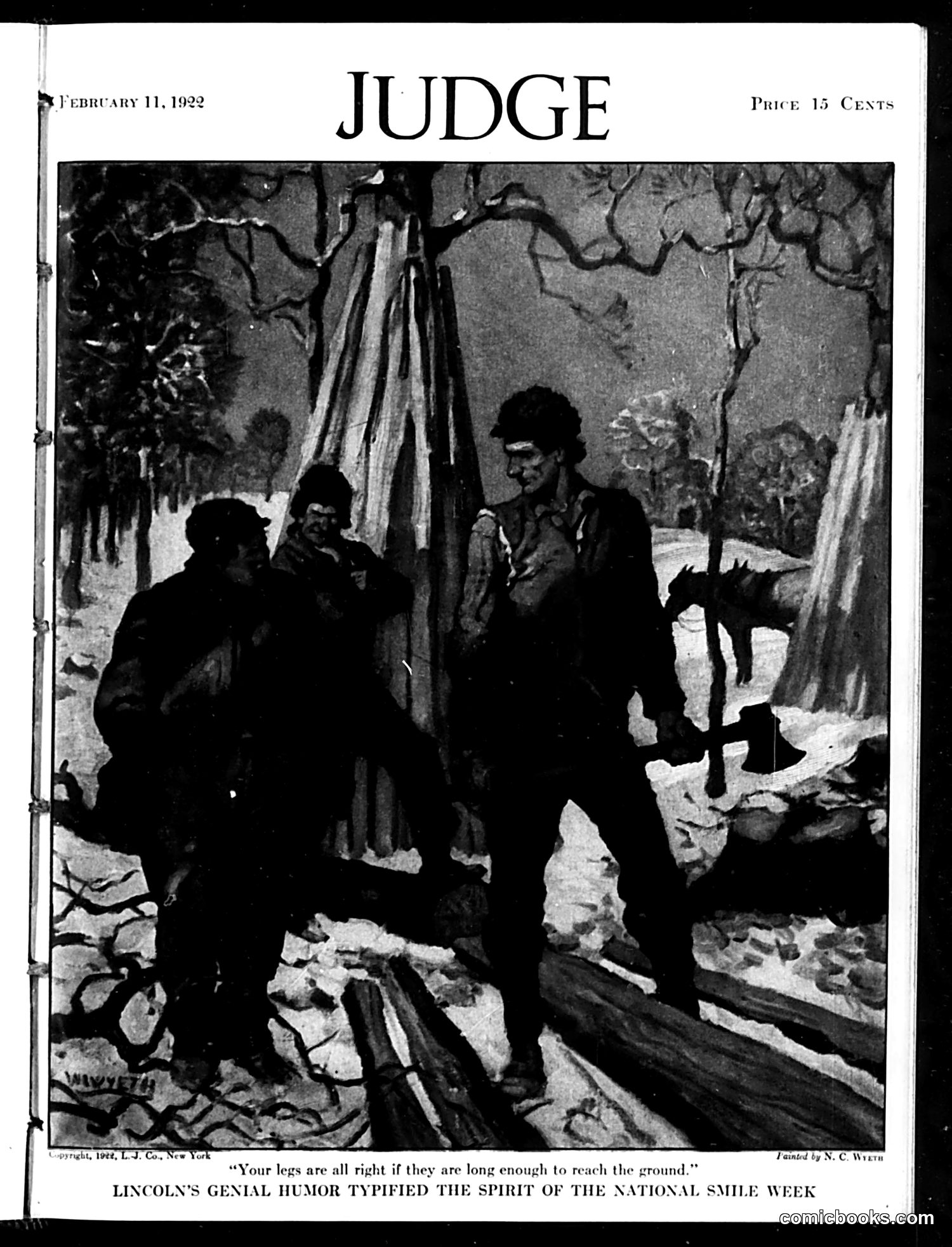
This February 11, 1922 Judge magazine page features a winter scene with silhouetted figures gathered around what appears to be a campfire or gathering place among bare trees and snow. The caption attributes the humor to Lincoln, quoting: "Your legs are all right if they are long enough to reach the ground." The headline references "Lincoln's Genial Humor" and "National Smile Week." The joke appears to be a visual pun playing on Lincoln's famous wit. The silhouetted figures' proportions—particularly their leg lengths relative to body size—likely create the humor Lincoln's quote suggests. This was likely published during a designated "Smile Week" promotional period, using Lincoln's reputation for folksy humor and jokes to encourage public good cheer during the early 1920s.
This page is primarily **advertising content**, not satirical editorial material. It promotes Leslie's Weekly magazine, highlighting features in their February 11 issue. The main article discussed is "Lincoln's Silent Son"—a feature about **Robert Todd Lincoln**, Abraham Lincoln's surviving son, who was nearly eighty years old at the time of publication and lived in retirement near the White House. The piece emphasizes his lifelong preference for privacy and avoiding public attention. The ad also mentions other magazine content: a "Buck Up, Business!" series by Samuel Hopkins Adams featuring Secretary of Commerce Herbert Hoover's economic views, and a serial story called "The Safety Valve" by Scammon Lockwood. The page aims to attract subscribers at five dollars annually.
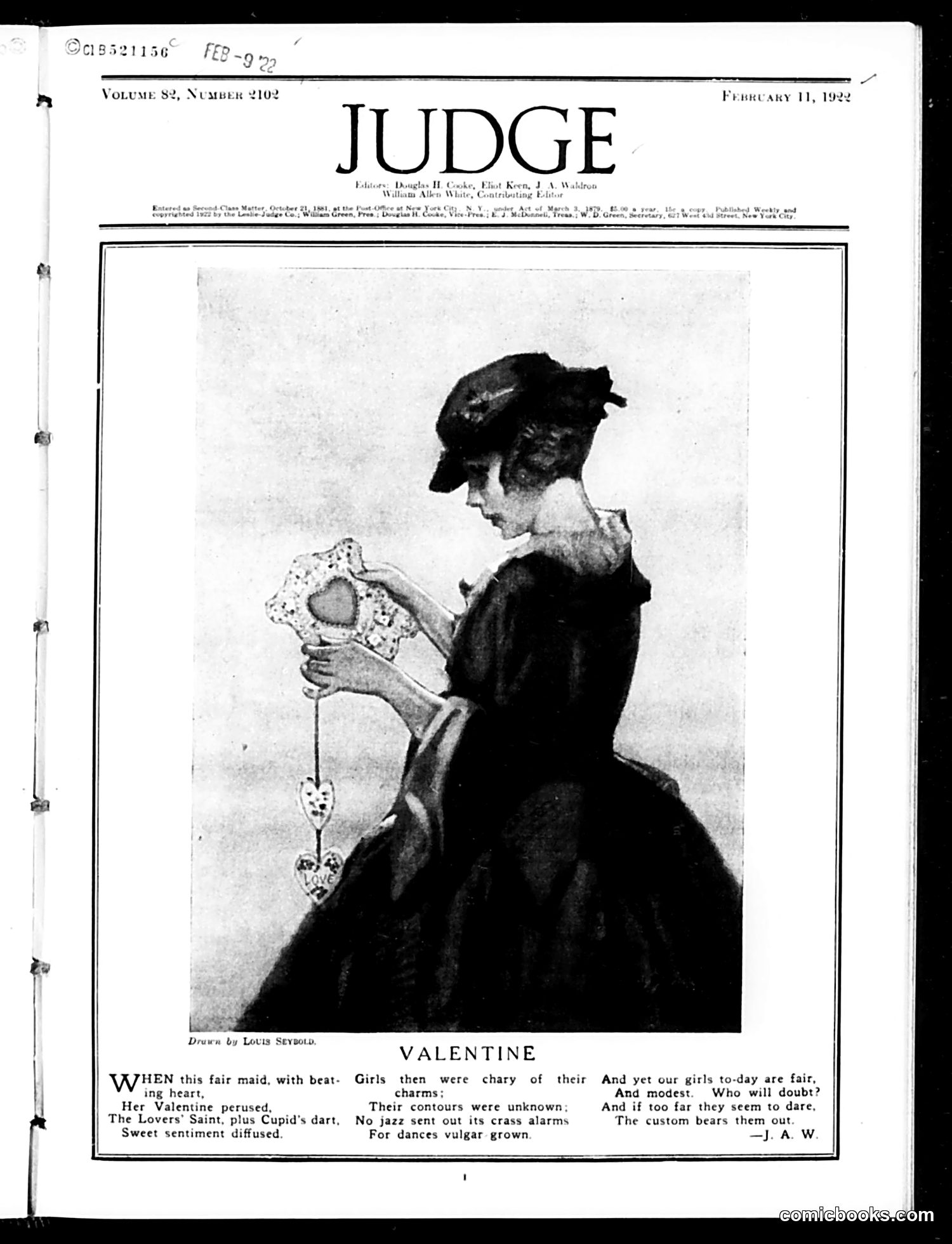
This illustration by Louis Seybold depicts a young woman in fashionable 1920s attire holding a decorative Valentine's Day card. The accompanying poem contrasts old and new courtship customs. The satire critiques modern femininity: the text nostalgically describes how "fair maids" of the past possessed traditional "charms" and modest behavior, while avoiding jazz culture's "vulgar" influence. By contrast, the poem notes that contemporary girls are "fair and modest" too—but sarcastically questions whether they'll actually "dare" to embrace old-fashioned sentiment given their modern freedoms. The cartoon reflects 1920s anxieties about changing gender roles and the "flapper" generation: concerns that jazz-age women were abandoning traditional courtship rituals and Victorian modesty for contemporary social independence.
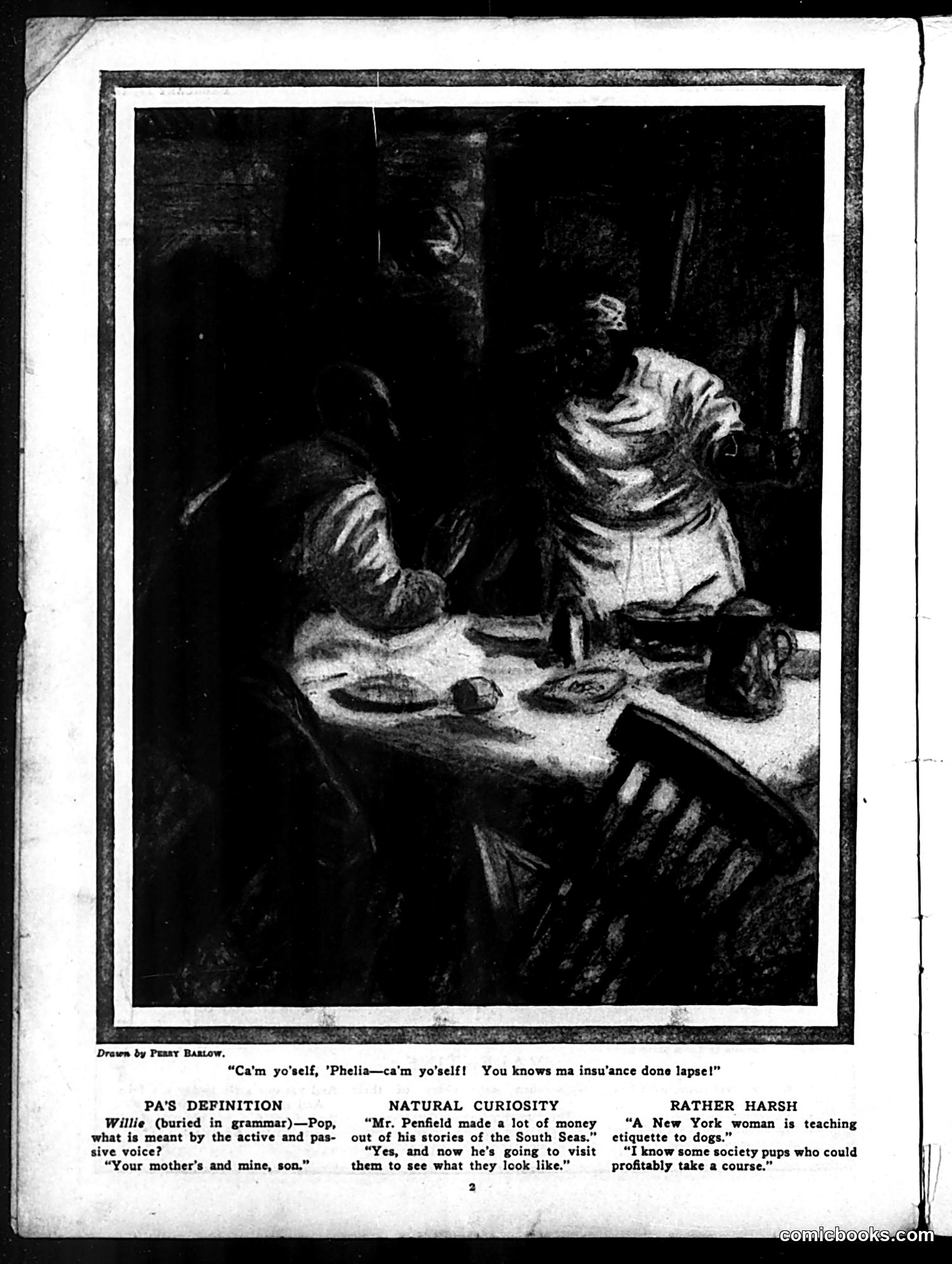
This page features a Perry Barlow illustration depicting a scene between two figures at a table. The caption "'Ca'm yo'self, 'Phelia—ca'm yo'self! You knows ma insur'ance done lapse!'" uses dialect stereotyping typical of early 20th-century American humor. Below are three separate joke items: **"Pa's Definition"** plays on grammar humor—a child's malapropism about "passive voice." **"Natural Curiosity"** references Mr. Penfield making money from "stories of the South Seas" and now visiting to observe the subjects, mocking travel narratives and colonial attitudes. **"Rather Harsh"** satirizes etiquette instruction, suggesting New York society women teaching "dogs" manners to "society pups." The page demonstrates Judge's reliance on ethnic/class stereotypes, gender humor, and social commentary typical of this era's satirical journalism.
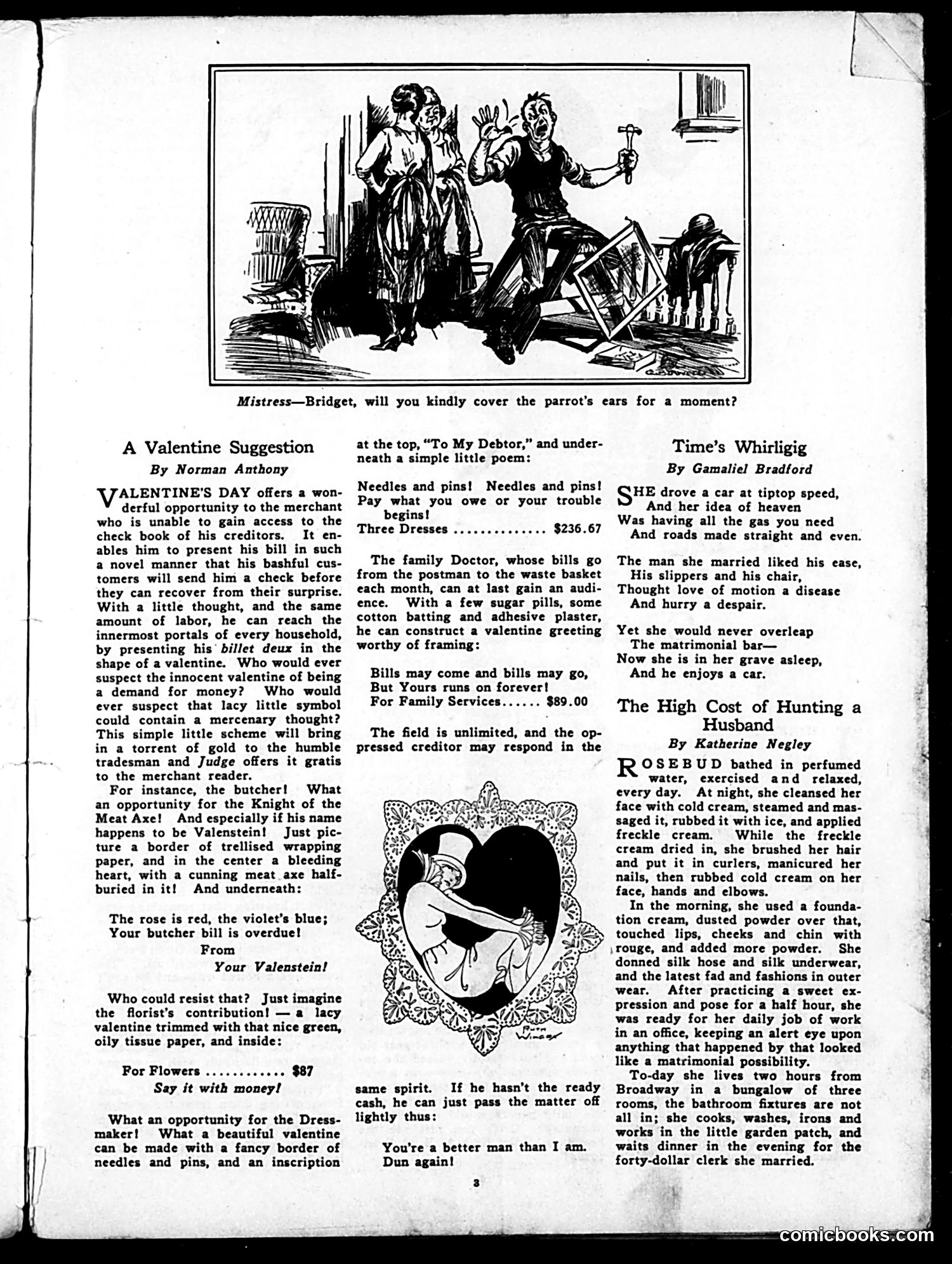
The main cartoon shows a domestic scene with the caption "Mistress—Bridget, will you kindly cover the parrot's ears for a moment?" A woman (the mistress) appears to be scolding or arguing with a maid named Bridget, while they're positioned near furniture and household items. The joke satirizes class dynamics and Victorian propriety: the mistress is concerned that the parrot will overhear improper language during what appears to be an argument, suggesting she wants to shield the bird from "unseemly" words—while having no concern about the maid hearing them. This mocks upper-class hypocrisy about morality and their treatment of servants as essentially invisible or undeserving of the same propriety standards applied to pets.
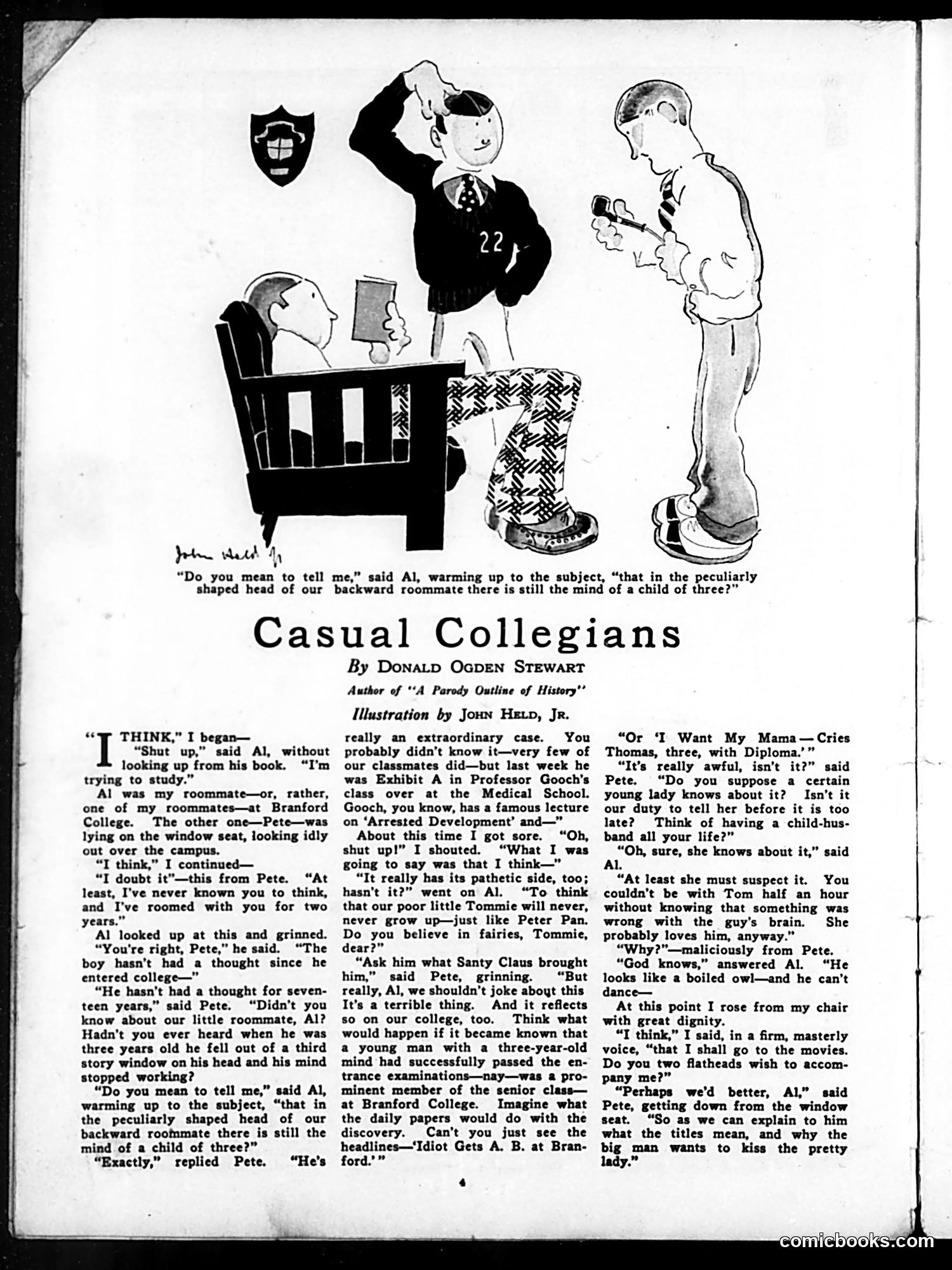
This satirical piece mocks college life and intellectual pretension. The cartoon shows three young men discussing their "backward roommate" — one sitting in a chair reading, one standing in a sports jersey (#22), and one holding what appears to be a pipe. The satire targets how college students gossip about peers they consider intellectually inferior. The joke centers on calling their roommate childish because he supposedly still has "the mind of a child of three," yet the three speakers demonstrate their own immaturity through mockery and baseless assumptions about his intelligence. Stewart's humor exposes collegiate snobbery and the shallow judgments privileged students make about classmates, suggesting that mocking others isn't actually a sign of sophistication.
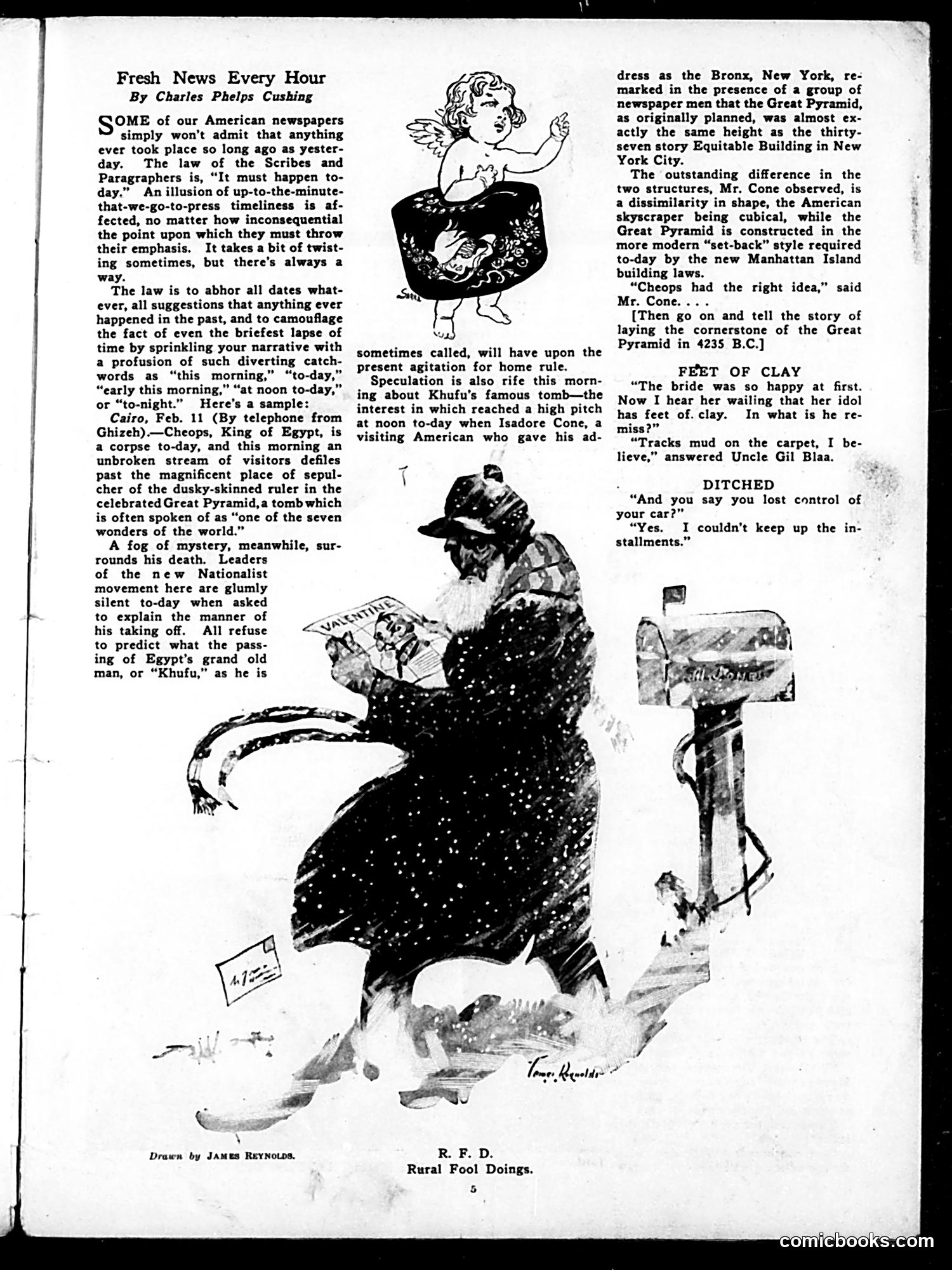
**Main Article ("Fresh News Every Hour"):** Cushing satirizes newspapers' obsession with presenting everything as happening "today," regardless of actual timeliness. The absurdist example—reporting Egyptian Pharaoh Cheops's death with modern datelines and comparing the Great Pyramid to Manhattan's Equitable Building—mocks this artificial urgency. The joke: newspapers twist facts to seem perpetually breaking news, even when covering ancient history. **"Rural Fool Doings" Cartoons:** The top cartoon shows a peasant discovering mud on his boots—illustrating the idiom "feet of clay" (hidden weakness in someone seemingly impressive). A bride's "idol" husband tracks dirt indoors, revealing his ordinariness. The bottom cartoon plays on "ditched" (abandoned). A driver claims he "lost control" of his car, but admits he couldn't afford the installment payments—a Depression-era joke about repossession masquerading as mechanical failure. Both mock rural/working-class misunderstandings of sophistication and financial precarity.
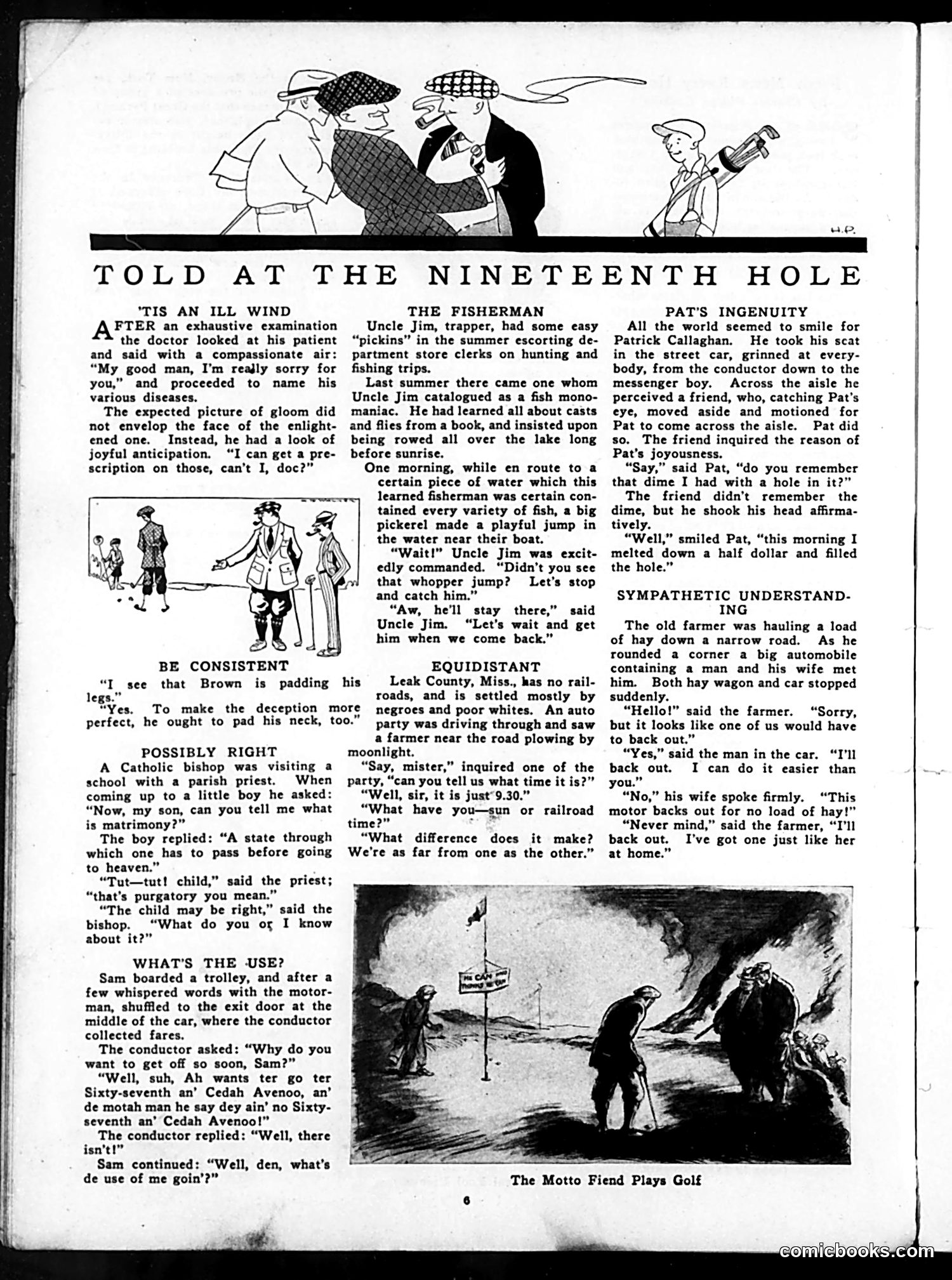
This page collects humorous anecdotes, a common feature in early 20th-century Judge magazine. The cartoons and jokes target recognizable social types: **"The Fisherman"** mocks overeducated city folk (department store clerks) who learn fishing from books but lack practical sense—the clerk obsesses over rules while missing obvious opportunities. **"Equidistant"** satirizes rural Southern race relations and indifference, depicting a farmer unbothered by modern progress or time itself. **"What's the Use?"** uses dialect humor (common but now offensive) to joke about a confused Black passenger on a trolley—the humor relies on the character's supposed illogic. **"Pat's Ingenuity"** presents an Irish immigrant character solving a problem through dubious logic (melting a half-dollar to fill a hole in a dime), playing on ethnic stereotypes of Irish cleverness and resourcefulness. These jokes reflect period attitudes toward immigrants, rural people, and racial groups through caricature and dialect.
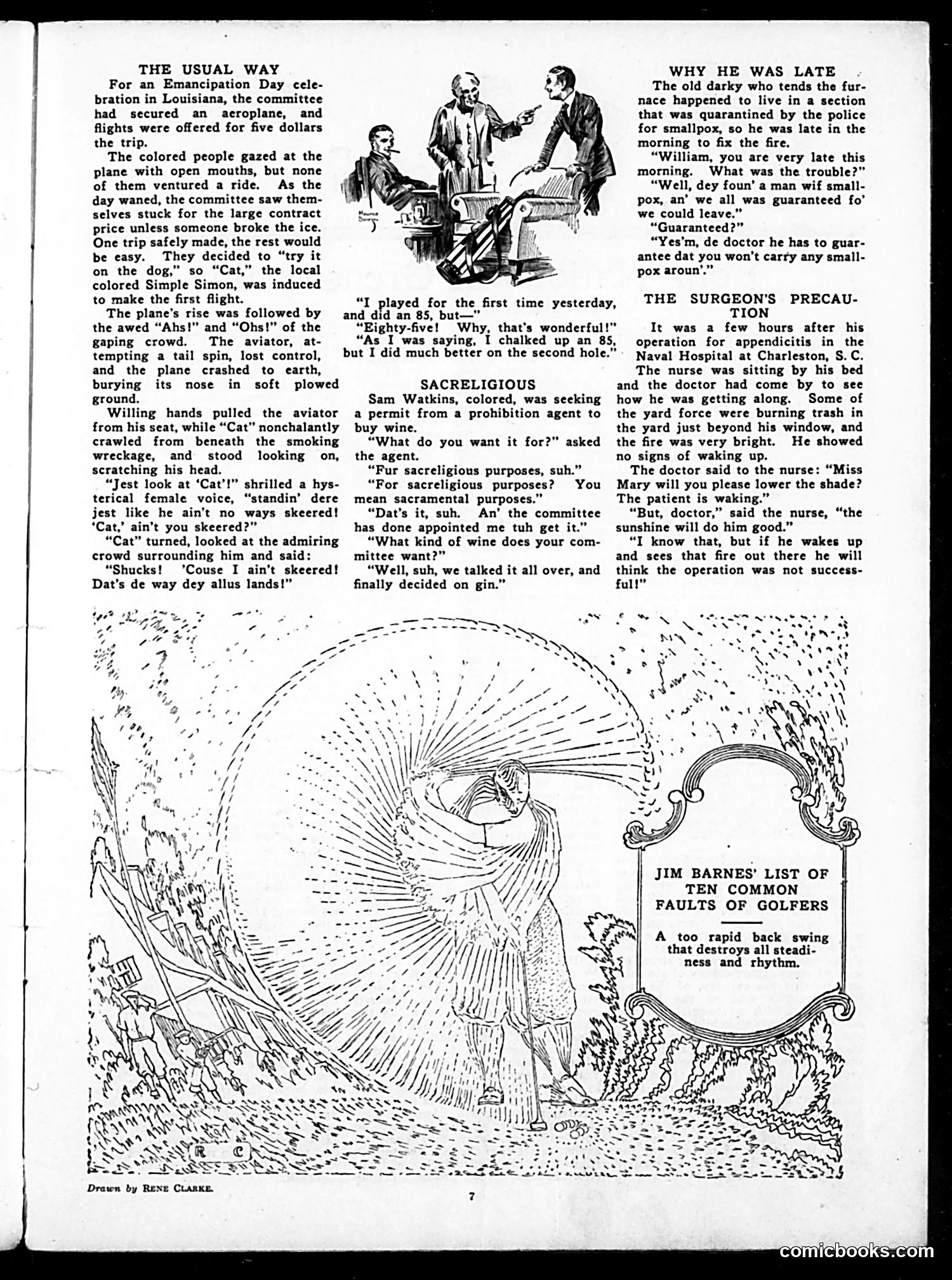
This page contains four brief humorous stories stereotyping African Americans, reflecting the racist humor common in early 20th-century American magazines. **"The Usual Way"** mocks Black people's unfamiliarity with airplanes. A Black man called "Cat" is tricked into taking the first airplane ride; when it crashes, he emerges unharmed but supposedly unafraid—portrayed as foolish rather than brave. **"Sacreligious"** plays on a Black man's malapropism: he seeks alcohol for "sacreligious purposes" when he means "sacramental" (religious use), then admits the committee chose "gin" anyway, mocking both the man's speech patterns and Prohibition-era hypocrisy. **"Why He Was Late"** satirizes a furnace attendant's misunderstanding of medical quarantine terminology, using dialect humor. **"The Surgeon's Precaution"** is the only non-racial joke: a doctor shields a post-operative patient from seeing a yard fire, fearing he'll think the surgery failed. The page exemplifies Judge's reliance on ethnic and racial caricature as entertainment for white readers.
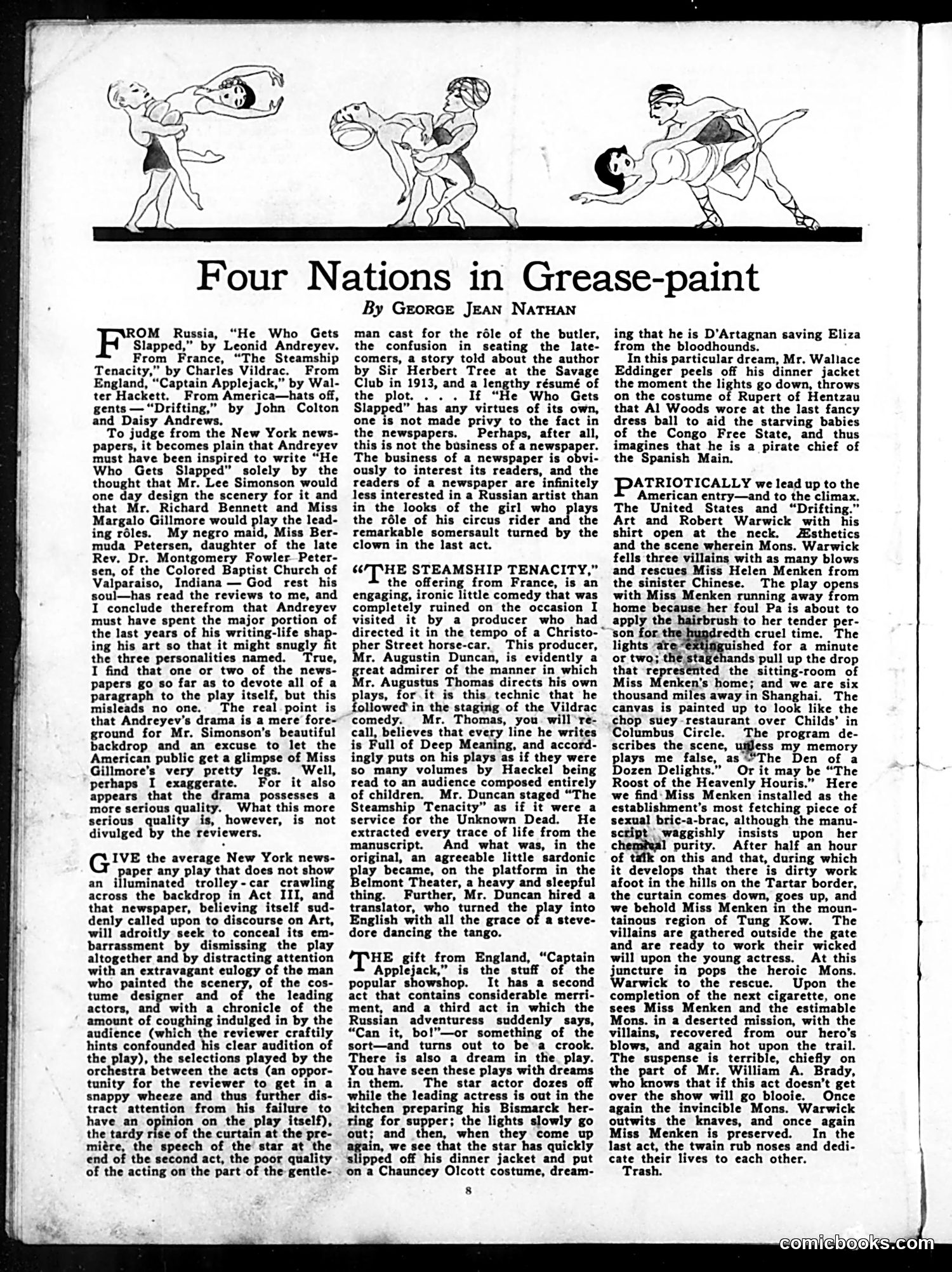
This page reviews four recent theatrical productions—one each from Russia ("He Who Gets Slapped"), France ("The Steamship Tenacity"), England ("Captain Applejack"), and America ("Drifting"). Critic George Jean Nathan satirizes New York theater reviewers for their superficiality. Rather than discussing plays on merit, reviewers obsess over scenic design, costume, actors' legs, and backstage anecdotes while ignoring actual theatrical quality. Nathan mocks this by sarcastically claiming Andreyev must have written his Russian play specifically to showcase the American set designer and actress. The cartoon illustrations (top) appear to depict theatrical scenes from these international productions, showing actors in various dramatic poses. Nathan's central joke: American newspaper critics care more about spectacle, gossip, and trolley cars in backdrops than genuine artistic critique—reducing serious international drama to entertainment column fodder.
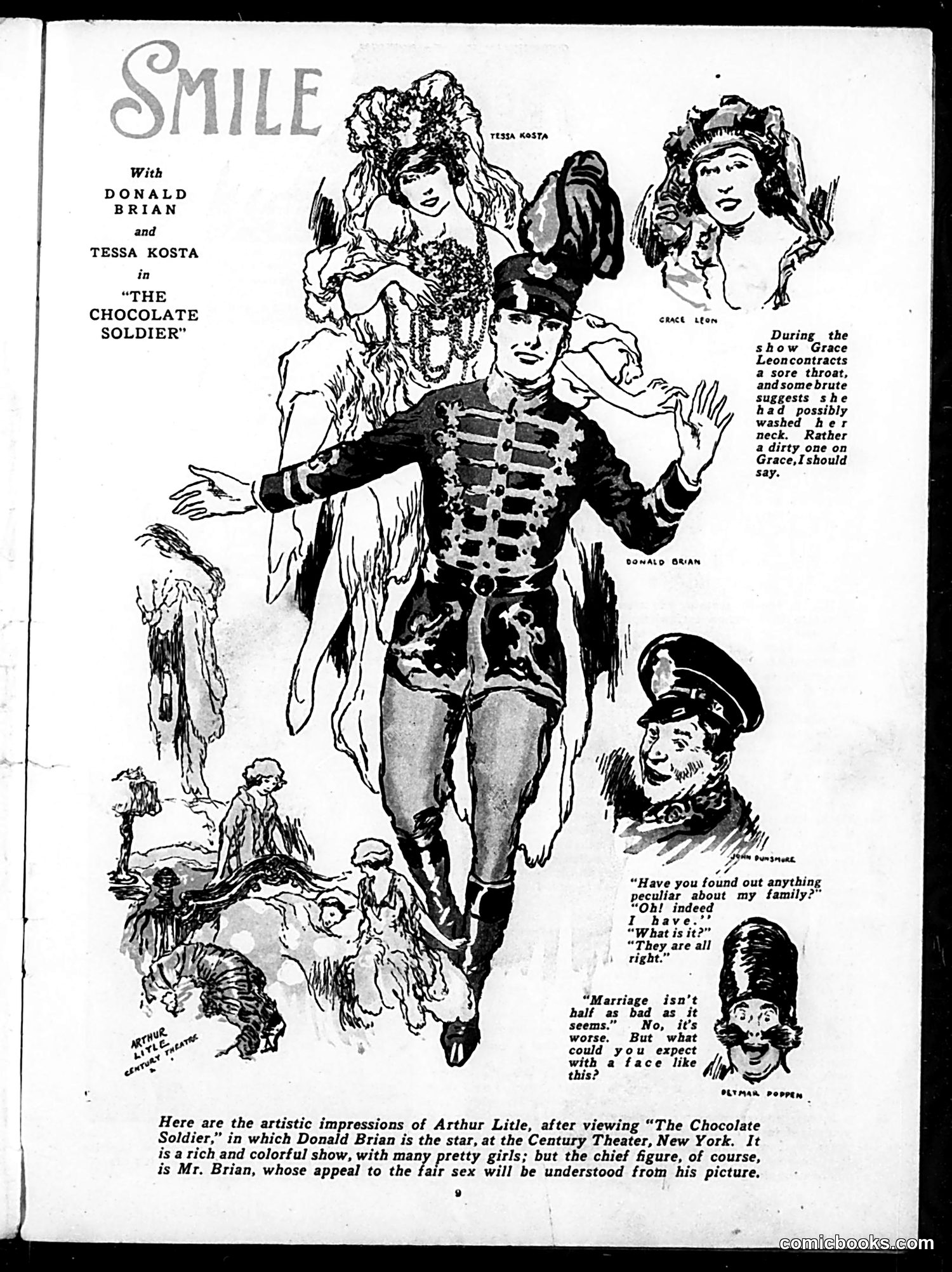
This is an illustrated theatre review of the operetta "The Chocolate Soldier" starring Donald Brian at New York's Century Theater. The page presents satirical sketches by artist Arthur Litle commenting on the production and its star. The central image depicts Brian in military uniform surrounded by women, emphasizing his romantic appeal. The surrounding vignettes mock various theatrical moments: a joke about actress Grace Leon's hygiene when she develops a sore throat, quips about marriage being worse than it seems, and comedic exchanges about discovering family peculiarities. The satire targets both the show's content (a "rich and colorful" musical with "many pretty girls") and Brian's celebrity status as a romantic lead with obvious female admirers. The humor relies on early-20th-century theatrical gossip and physical comedy typical of Judge's entertainment coverage.
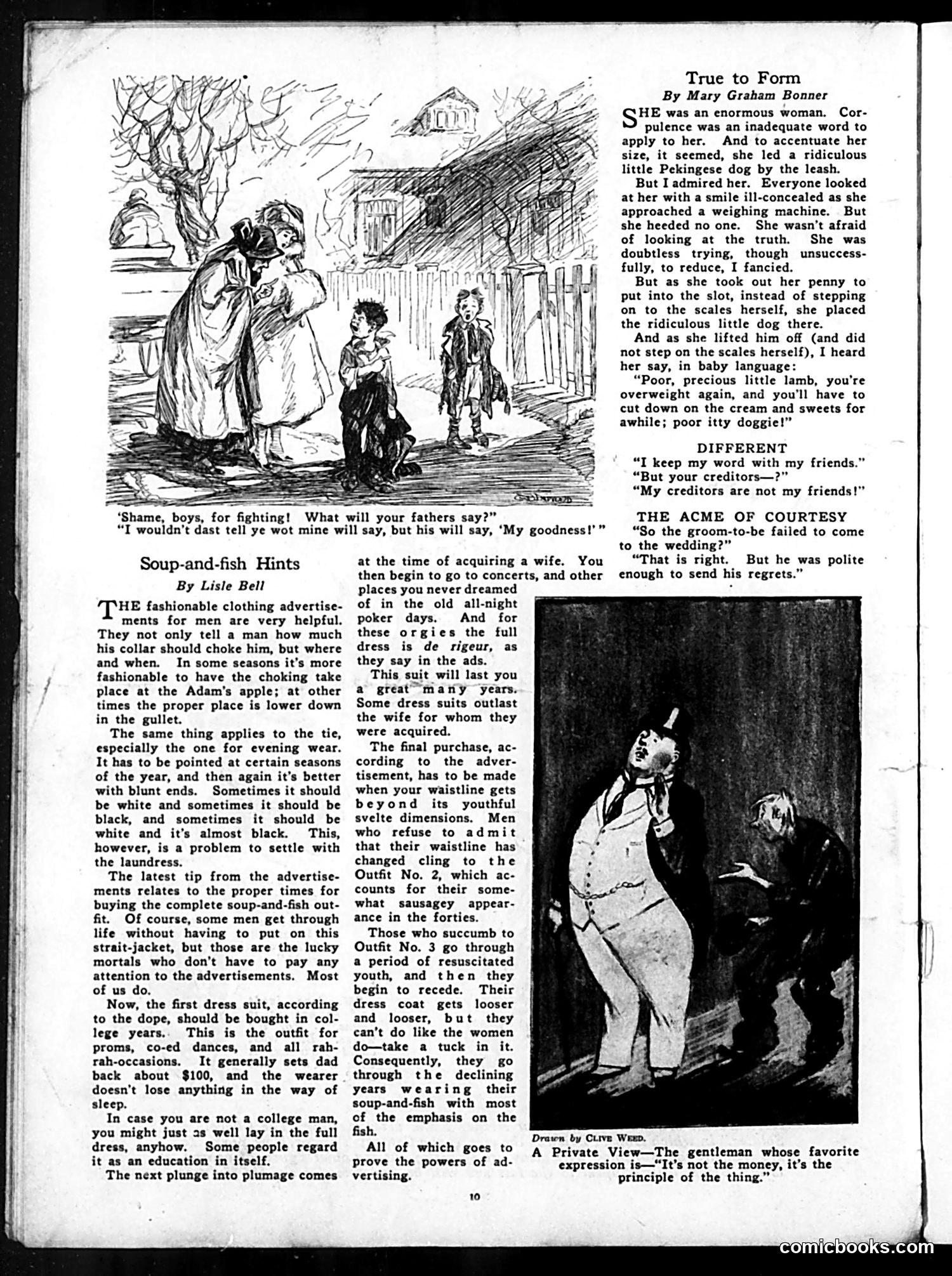
This page contains three satirical pieces targeting social pretension and hypocrisy: **"Soup-and-Fish Hints"** mocks men's fashion advertising's obsessive dictation of formal wear. The author sardonically notes that ads pressure men to buy expensive dress suits ("soup-and-fish") at life milestones—college, marriage, middle age—while constantly changing style requirements. The joke: men are enslaved to arbitrary fashion rules and advertising manipulation, yet some navigate life without these expensive "strait-jackets." **"True to Form"** satirizes an obese woman who weighed her tiny Pekingese dog instead of herself on a public scale, then scolded the dog for being overweight. The satire targets her obvious self-deception and hypocrisy—blaming her pet rather than confronting her own weight. **"The Acme of Courtesy"** appears to reference a groom failing to attend his wedding, then claiming politeness in sending regrets. The satire mocks hollow courtesy masking fundamental social failure. The cartoon illustration shows boys fighting while an adult scolds them about parental shame—juxtaposing their honest boyish behavior against adult hypocrisy discussed in the surrounding text.
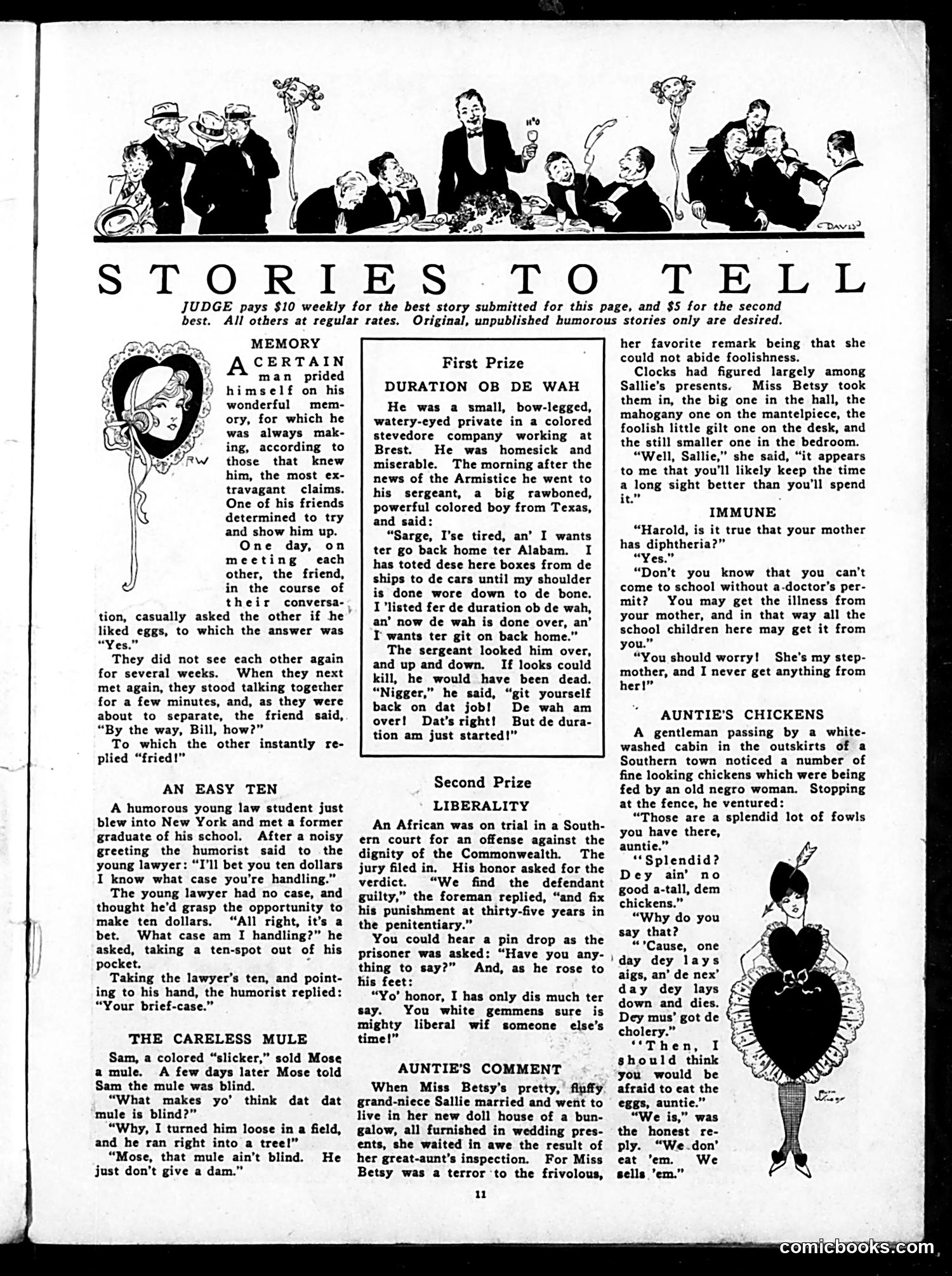
This page features a "Stories to Tell" contest where Judge magazine paid readers for humorous short stories. The content reflects early 20th-century American humor, relying heavily on racial stereotypes that were then considered acceptable entertainment. The stories include: - **"Memory"** and **"An Easy Ten"**: Wordplay jokes with no political content - **"Duration ob de Wah"**: A dialect-heavy story about a Black soldier after WWI's Armistice, using exaggerated "Negro" speech patterns. The sergeant's refusal to discharge him is presented as humorous - **"Liberality"**: Similar stereotyped dialect humor depicting a Black defendant in court - **"Auntie's Chickens"** and **"Auntie's Comment"**: Gentler domestic humor The cartoons above depict well-dressed white men at what appears to be a formal gathering, unrelated to the stories below. The racial caricatures and dialect humor reflect attitudes of that era but would be considered deeply offensive today.
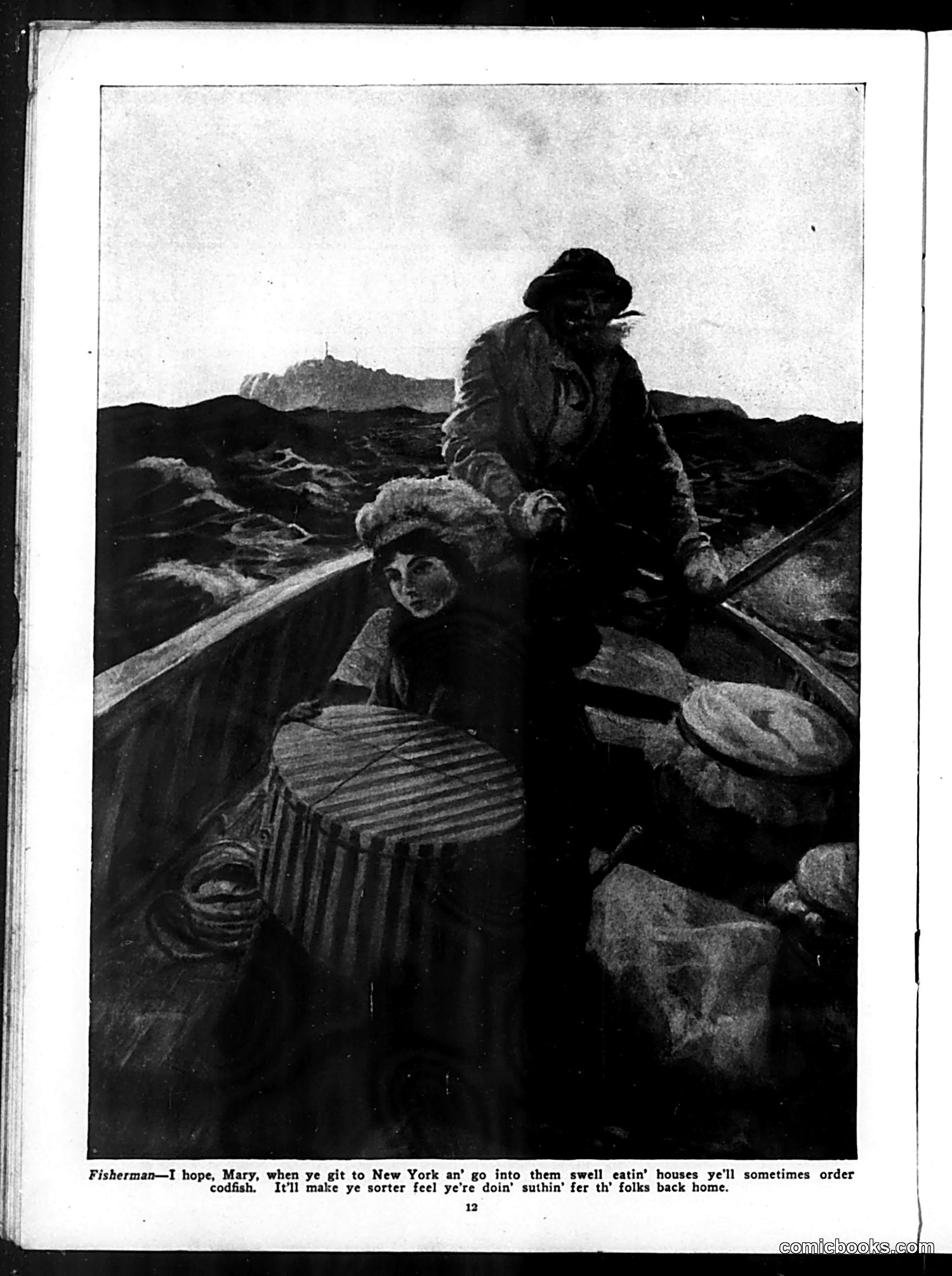
This is a satirical cartoon about class and regional identity in early 20th-century America. An older fisherman (likely from a coastal New England community) advises his companion Mary that when she goes to fancy New York restaurants, she should order codfish—a humble, local catch. The humor and social commentary lie in the contrast: the fisherman hopes Mary will remember her working-class roots and support her home community's industry, even while enjoying the "swell eating houses" of wealthy urban society. The satire gently mocks both the pretensions of fancy city dining and the fisherman's touching faith that wealthy urbanites might sentimentally maintain ties to humble provincial labor. It reflects tensions between rural/coastal working communities and cosmopolitan urban culture in the period.
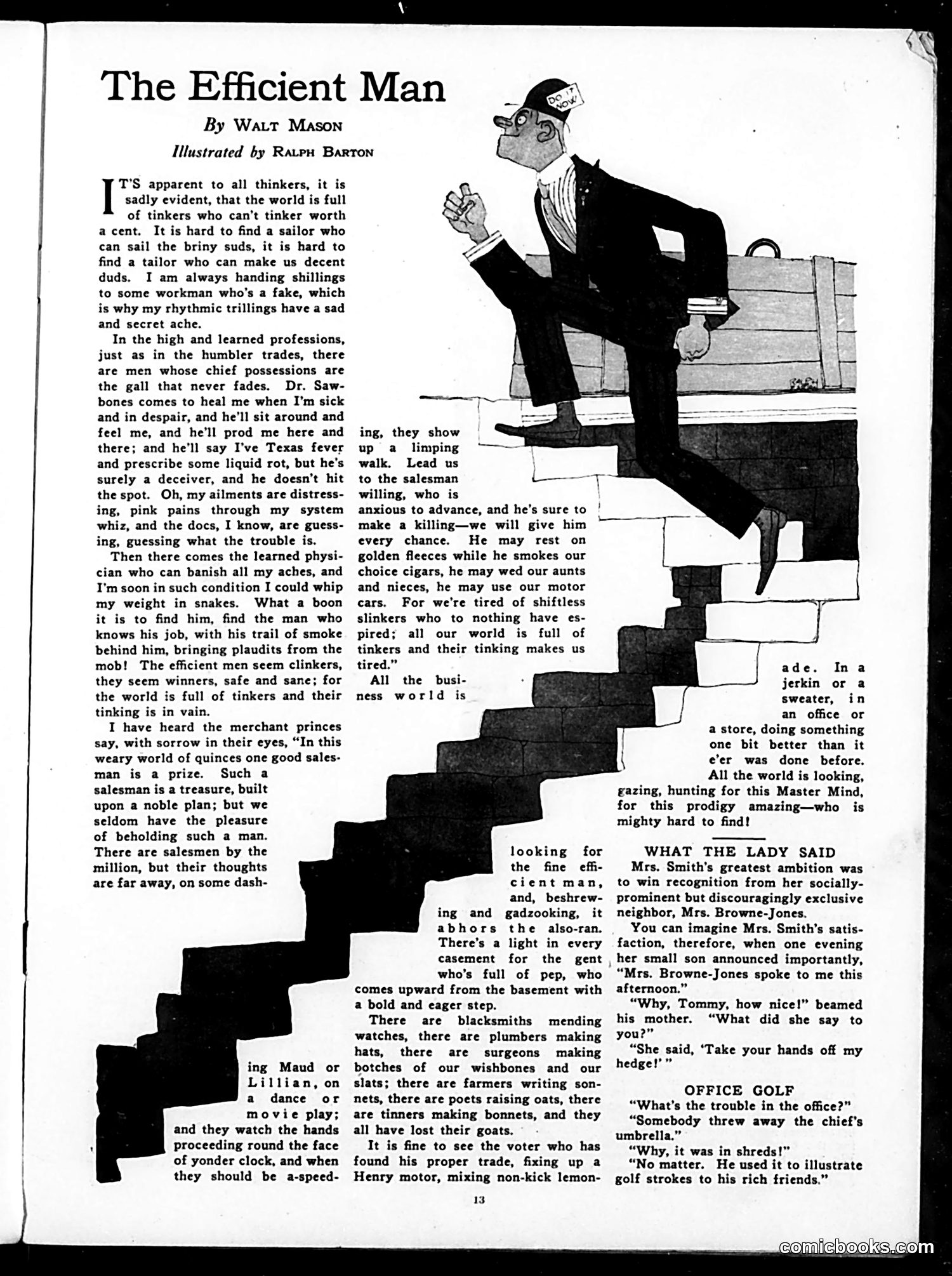
This is a narrative poem by Walt Mason satirizing incompetence across professions. The central complaint: the world is full of workers—sailors, tailors, doctors, salesmen—who are fundamentally bad at their jobs. They possess "gall" and fake competence rather than genuine skill. The illustration shows a caricatured "efficient man"—depicted as an exaggerated, self-satisfied figure in business attire, climbing upward with swagger. He represents the rare ideal the poem desperately seeks: someone actually *good* at his work. The satire is scathing: incompetent professionals are everywhere (doctors who "guess," salesmen distracted by romance), yet finding one genuinely competent person is nearly impossible. The sidebar anecdote about Mrs. Smith's social ambitions adds lighter humor about social pretension. The overall message critiques workplace mediocrity in early 20th-century America—a common theme in Judge's class-conscious humor.
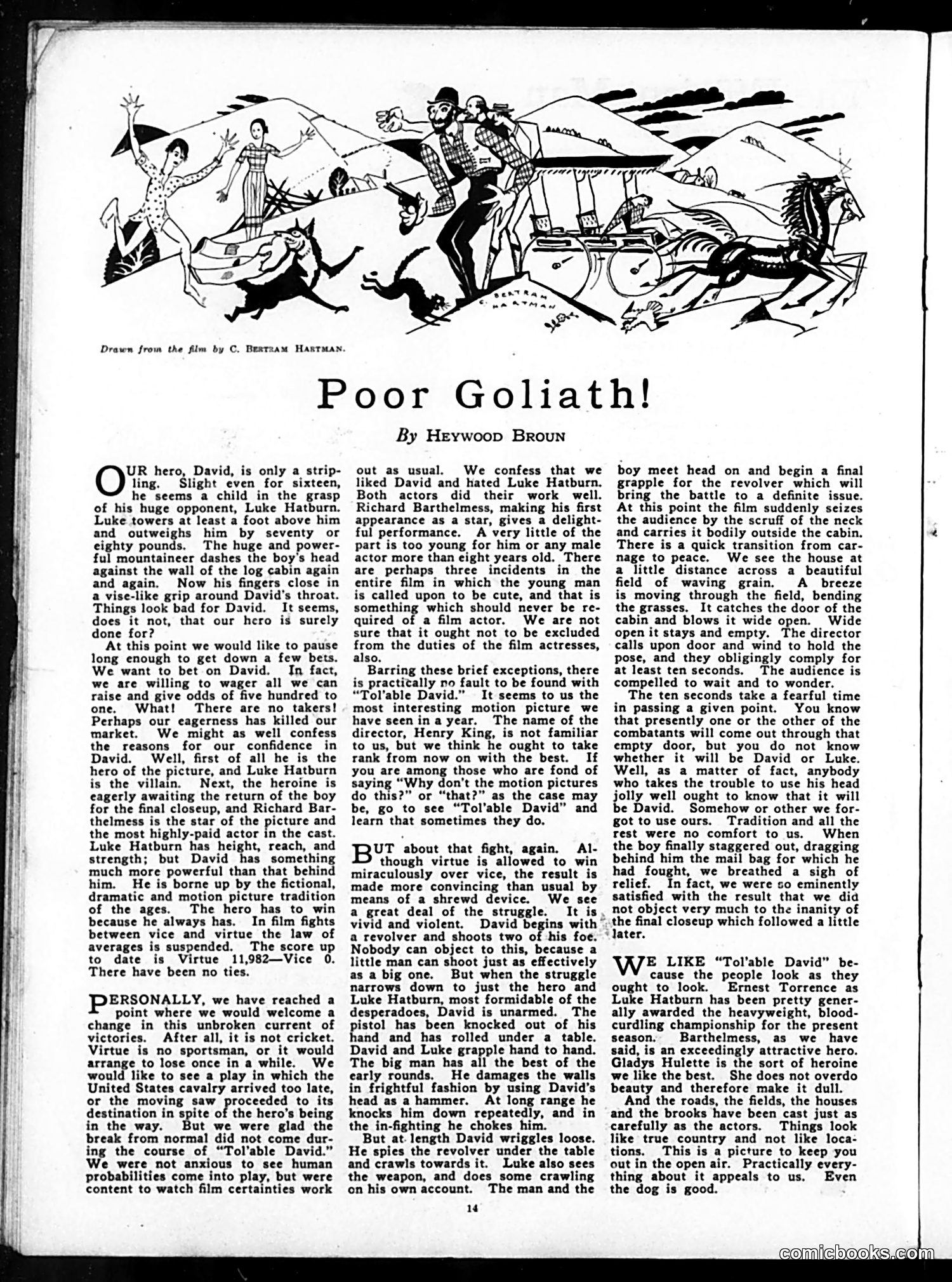
This is a 1921 film review by Heywood Broun critiquing "Tol'able David," a motion picture starring Richard Barthelmess. The illustration shows a scene from the film depicting the fight between the protagonist David (a slight sixteen-year-old) and the villain Luke Hatburn (a massive mountaineer). Broun's satire mocks Hollywood's predictable moral formulas: the hero *always* wins because he's the hero—Virtue's score stands at 11,982 to Vice's 0. He playfully bemoans this absence of realistic stakes, wishing cinema would occasionally let the cavalry arrive too late or allow the villain to triumph. Yet he admits he actively *wanted* David to win anyway, demonstrating how completely narrative convention overrides rationality. The review praises Barthelmess's performance and director Henry King while critiquing the few moments requiring the young star to perform cuteness—deemed inappropriate for male actors.
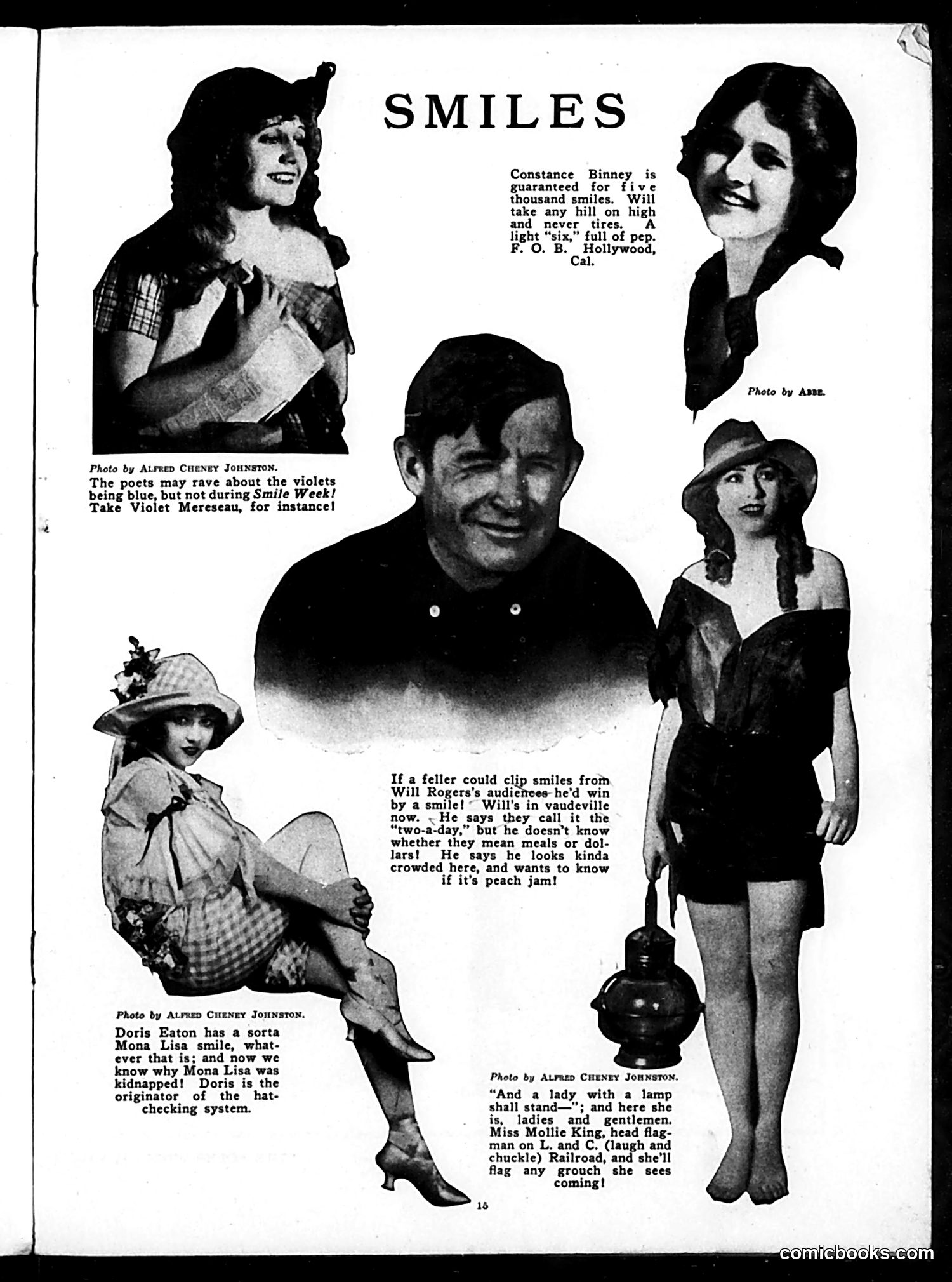
This is a lighthearted entertainment page celebrating Hollywood and vaudeville performers during "Smile Week." The layout showcases five performers known for their smiles: **Constance Binney** (top left) is humorously advertised like a car model—guaranteed for "five thousand smiles," can handle hills, never tires. **Violet Mereseau** is praised for her smile during the themed week. **Will Rogers** (center), a famous vaudeville performer, is joked about performing "two-a-day" shows (the vaudeville standard), with wordplay on whether "two-a-day" means meals or dollars. **Doris Eaton** (lower left) is compared to the Mona Lisa's mysterious smile and credited as originating the "hat-checking system." **Mollie King** (right) is humorously described as a "flagman" on the "Laugh and Chuckle Railroad"—a playful personification suggesting her job is making grouch people smile. The satire gently mocks both entertainment industry marketing and the celebrities' personas.
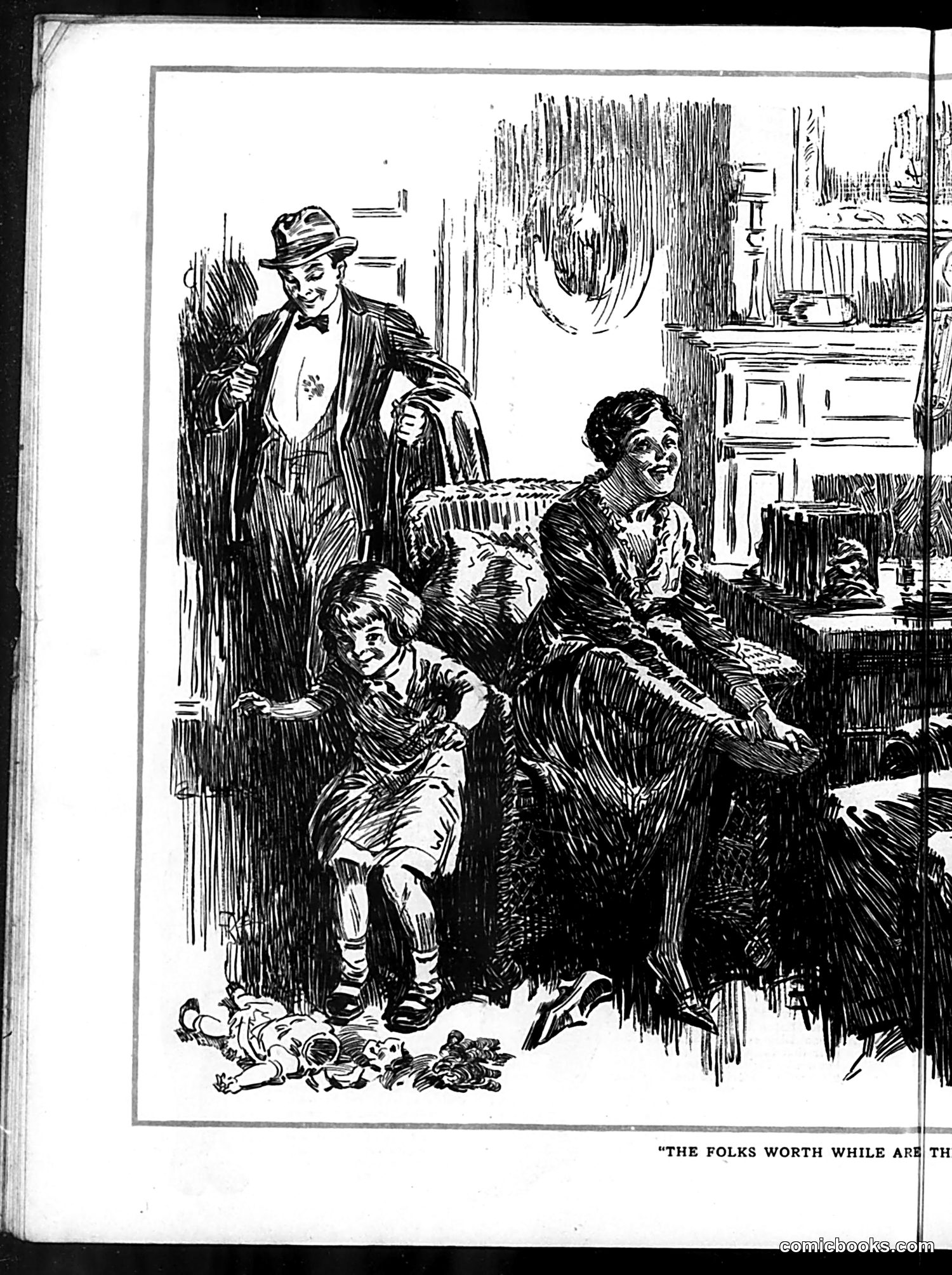
This ink sketch depicts a domestic scene with four figures: a well-dressed gentleman in formal attire (top hat, tuxedo) standing behind a woman seated with two children. The woman appears to be sewing or doing needlework. The partially visible caption reads "THE FOLKS WORTH WHILE ARE TH[E]..." suggesting commentary on family values or social worth. The illustration likely satirizes Victorian-era ideas about respectable domesticity and class status. The formal dress of the man contrasts with the humble domestic labor, possibly mocking either the pretensions of the middle class or celebrating traditional family roles as the true measure of worth—common Judge magazine themes. Without the complete caption, the specific satirical target remains **unclear**, though the domestic setting and formal presentation suggest social commentary on family, class, or gender roles.
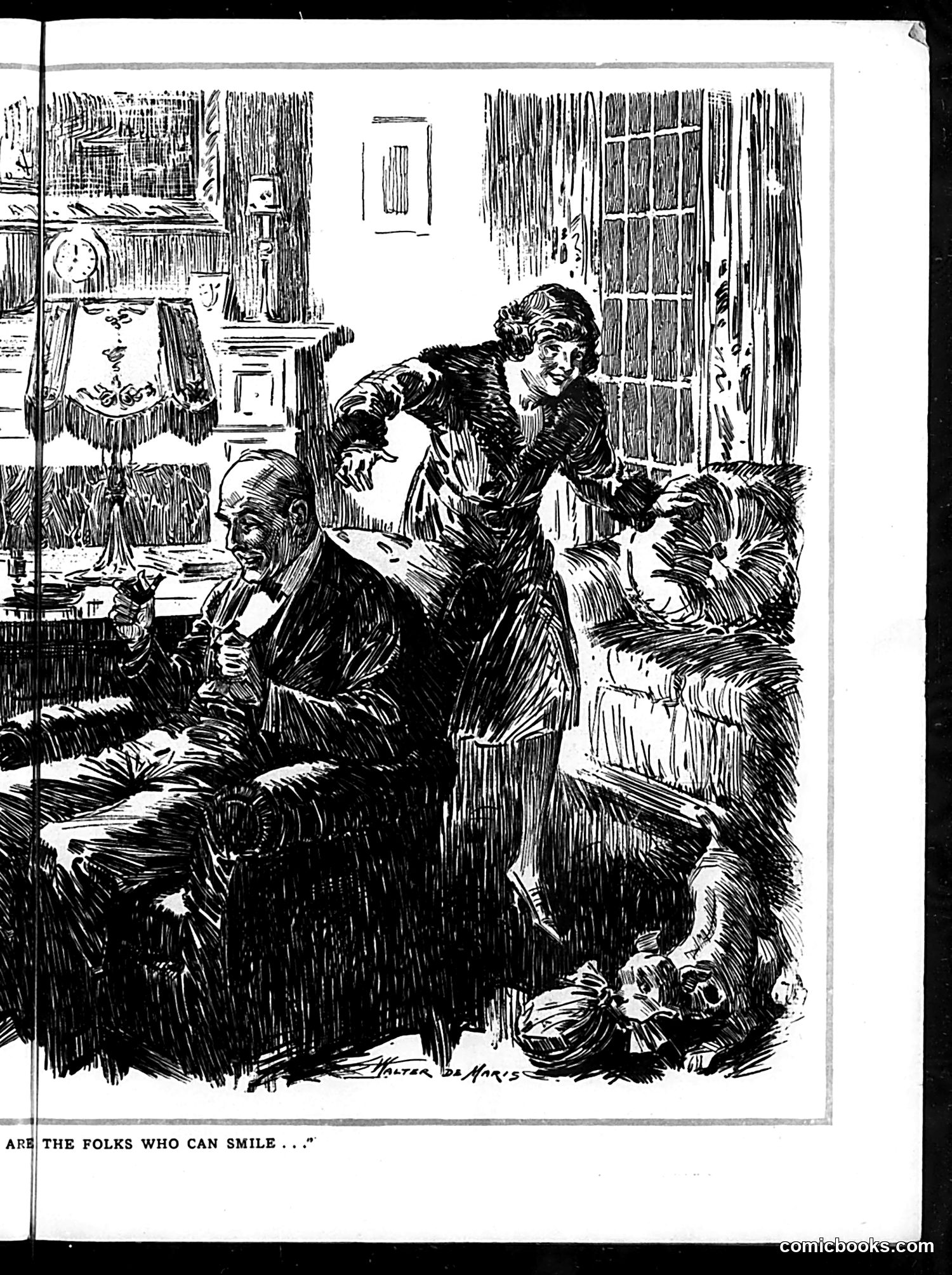
This political cartoon depicts an interior scene with several well-dressed figures in what appears to be a formal drawing room or office. The central standing figure gestures toward seated individuals with an expression suggesting irony or skepticism. The caption "Are the Folks Who Can Smile...?" is incomplete, likely continuing on an adjacent page. Without the full caption, the specific political or social satire is unclear. The formal dress and interior setting suggest commentary on upper-class society or politics, but the precise target—whether politicians, industrialists, or social figures—cannot be definitively identified from the visible text alone. The artist's signature appears to read "Walters or Walton."
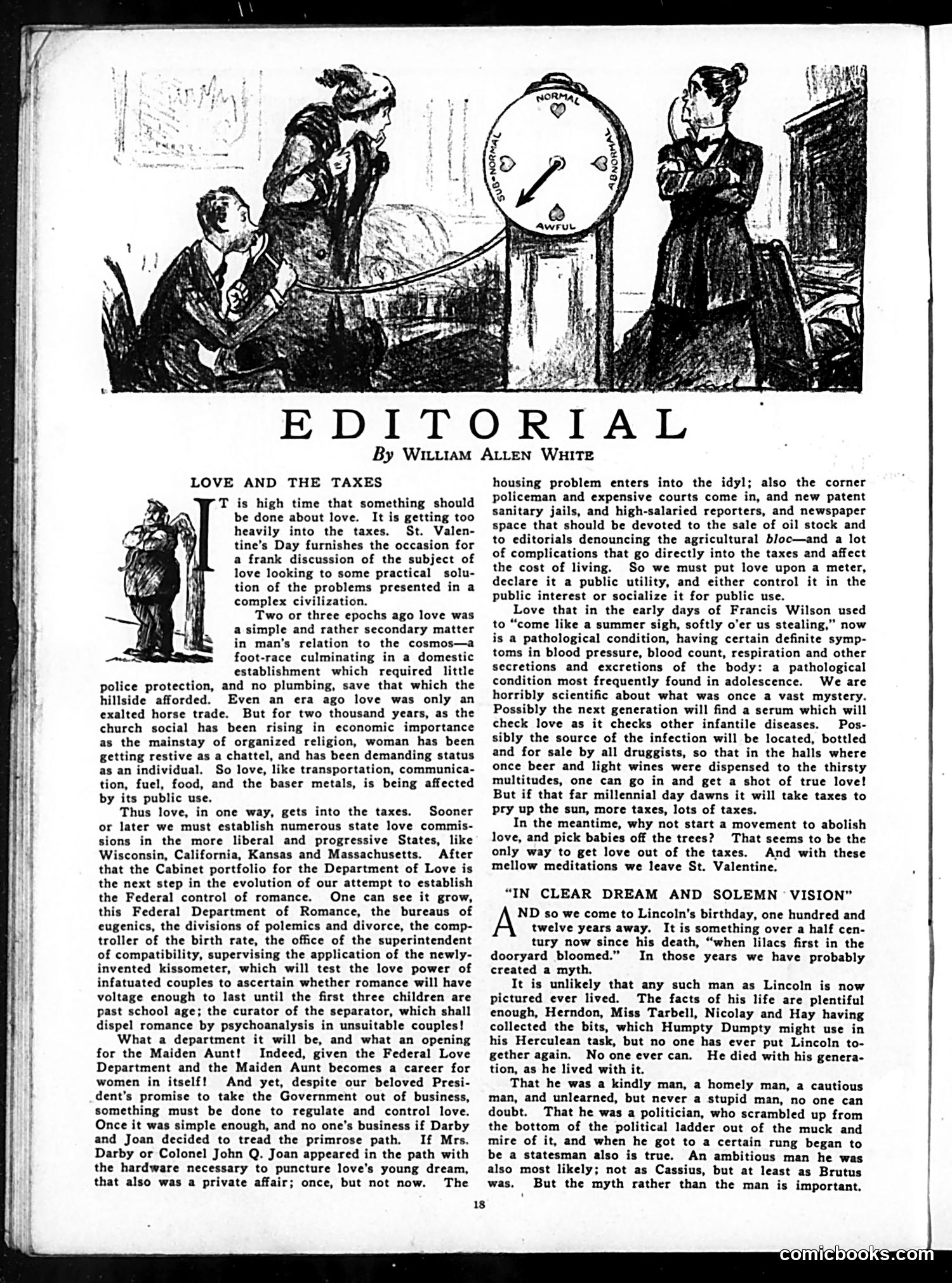
This editorial by William Allen White satirizes Progressive Era government expansion by proposing—tongue-in-cheek—a federal "Department of Love" to regulate romance as a public utility. **The Satire's Point:** White mocks the tendency of liberal states (Wisconsin, California, Massachusetts) to bureaucratize every aspect of life. He imagines absurd new government bureaus: "divisions of eugenics," "comptroller of the birth rate," a "kissometer" to measure romantic compatibility, and psychoanalysts to dissolve unsuitable couples. **The Underlying Complaint:** Love was once private; now taxes and social complications (housing, courts, reporters) make it "public use." White ironically suggests that if government must regulate everything affecting "cost of living," why not regulate love itself? **Historical Context:** This reflects genuine Progressive-era anxiety about expanding state power, even among reformers. The reference to the President's promise to "take the Government out of business" likely dates this to a specific administration's campaign rhetoric. The cartoon header (figures examining a "Normal-Awful" meter) visualizes this absurd regulatory impulse.
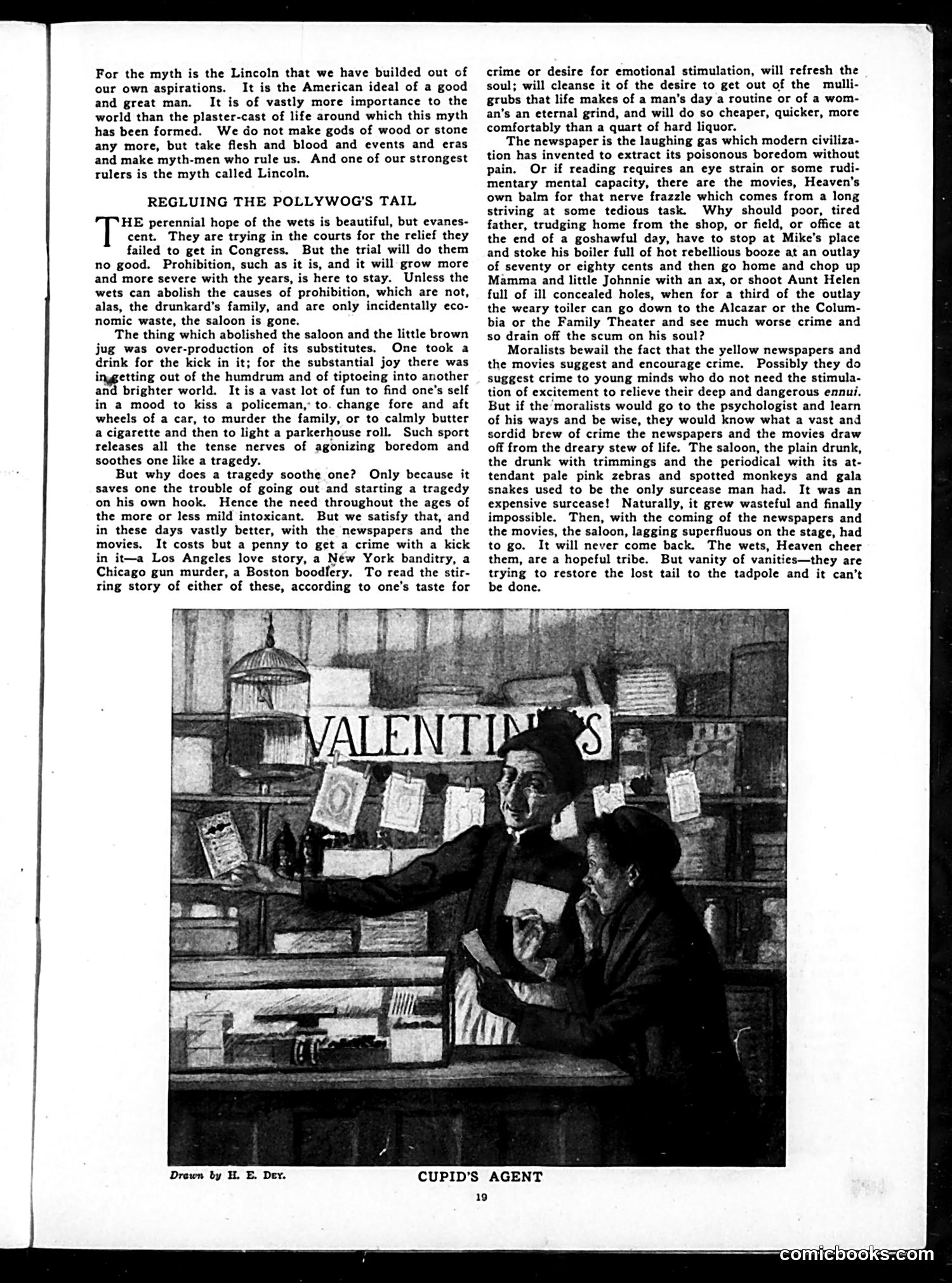
The cartoon depicts a Valentine's Day shop scene with two men examining cards displayed in a window. The drawing is credited to H. E. Dey. The accompanying text is a satirical essay titled "Regluing the Pollywog's Tail," attacking Prohibition advocates (the "wets" refers to anti-Prohibition forces, though the logic is complex). The author argues that Prohibition will endure because saloons were abolished by their own excess, not by temperance campaigns. The piece's main point: modern newspapers and movies have replaced alcohol as the public's escape from tedium and boredom. Rather than drinking to relieve "agonizing boredom," citizens now consume sensational crime stories and films. The author sardonically suggests these provide superior, cheaper thrills—allowing the tired worker to experience vicarious crime drama at a theater instead of committing actual violence while drunk. The satire critiques both moralists who blame media for crime and society's underlying desperation for stimulation.
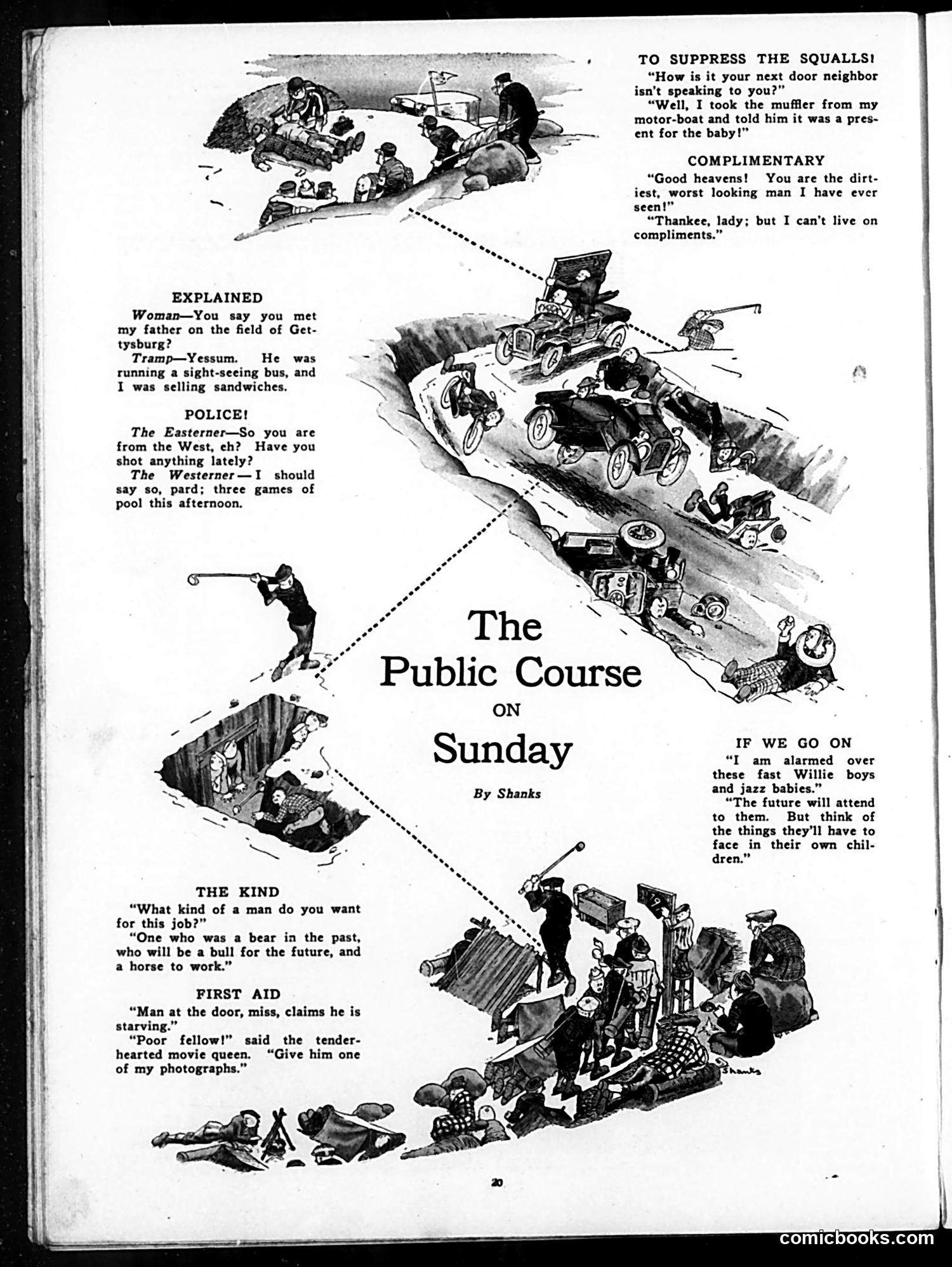
This page from *Judge* magazine presents several short joke panels satirizing early 20th-century American life. The central illustration depicts a chaotic "public course" of Sunday activities—vehicles, leisure activities, and crowds—suggesting the emerging consumer culture and modernization of weekend recreation. The individual jokes mock contemporary social anxieties: a man's thoughtless gift of a noisy motorboat muffler to a neighbor's baby; class differences between a dirty vagrant and a refined woman; confusion between Western frontier mythology and urban reality (the "Westerner" shoots pool, not game); generational concerns about "fast Willie boys and jazz babies"; job interview clichés using animal metaphors; and the absurdity of a movie star offering her photograph instead of food to a starving person. The satire reflects anxieties about modernity, wealth disparity, and changing social values in the Jazz Age era.
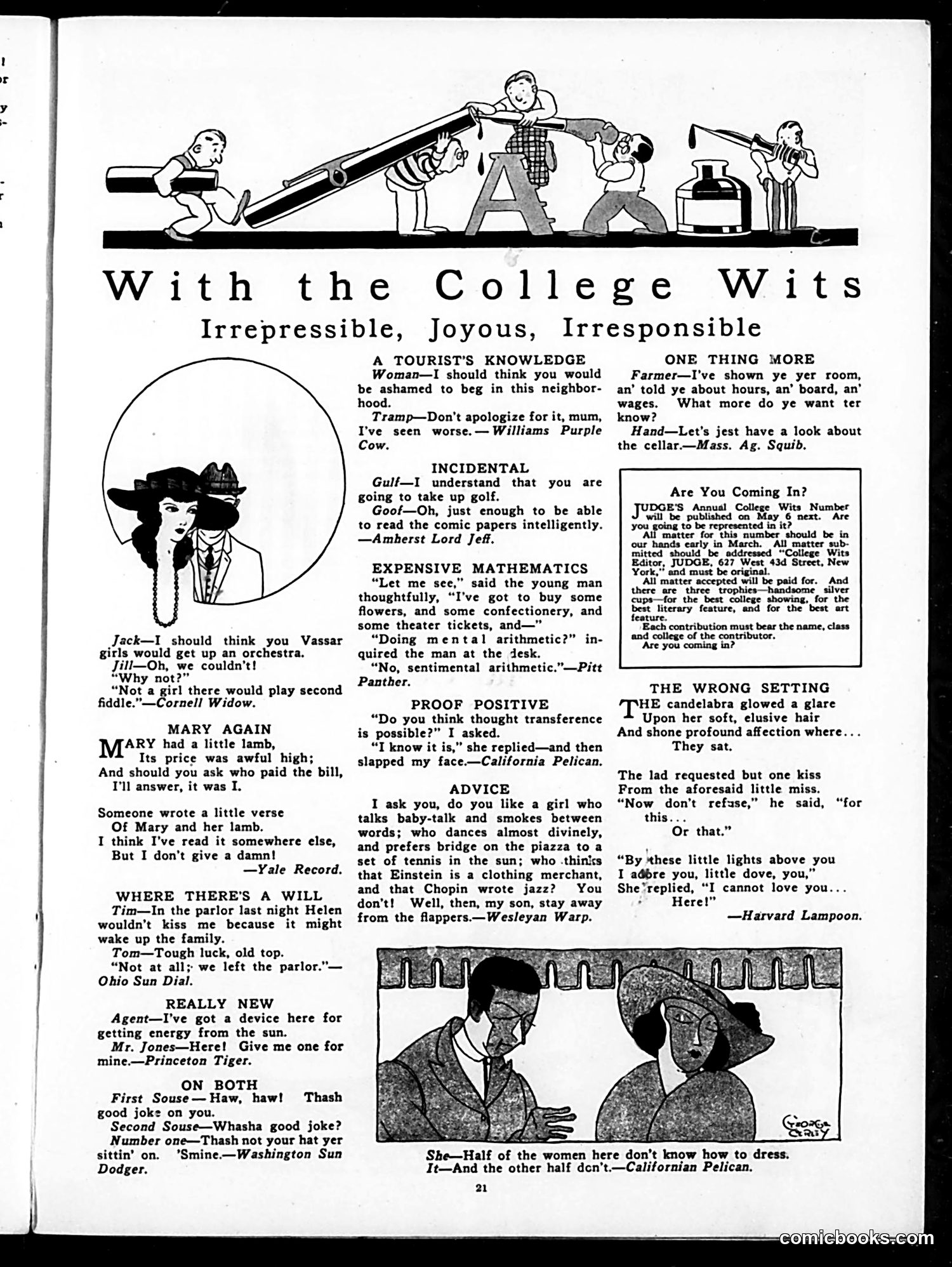
This page collects humorous quips and jokes submitted by student publications from various American colleges (Vassar, Cornell, Yale, Princeton, etc.), a popular feature in early 20th-century magazines. The humor relies on period-specific references and assumptions: **Social commentary:** Jokes about women (Vassar girls unwilling to "play second fiddle") reflect anxieties about female independence. References to "flappers" and their behavior (smoking, baby-talk, preferring bridge to tennis) mock the modern "New Woman" emerging in the 1920s. **Campus life**: Recurring themes include romantic pursuits, student poverty, and intellectual pretense—young men buying flowers and theater tickets they can't afford; Einstein referenced as unknown to some women. **The visual cartoon** (bottom right) shows a romantic scene with subtle innuendo—a woman's willingness to kiss the man, contradicting her initial refusal. The overall tone is lighthearted mockery of college students' romantic and social follies, filtered through contemporary gender roles and class anxieties.
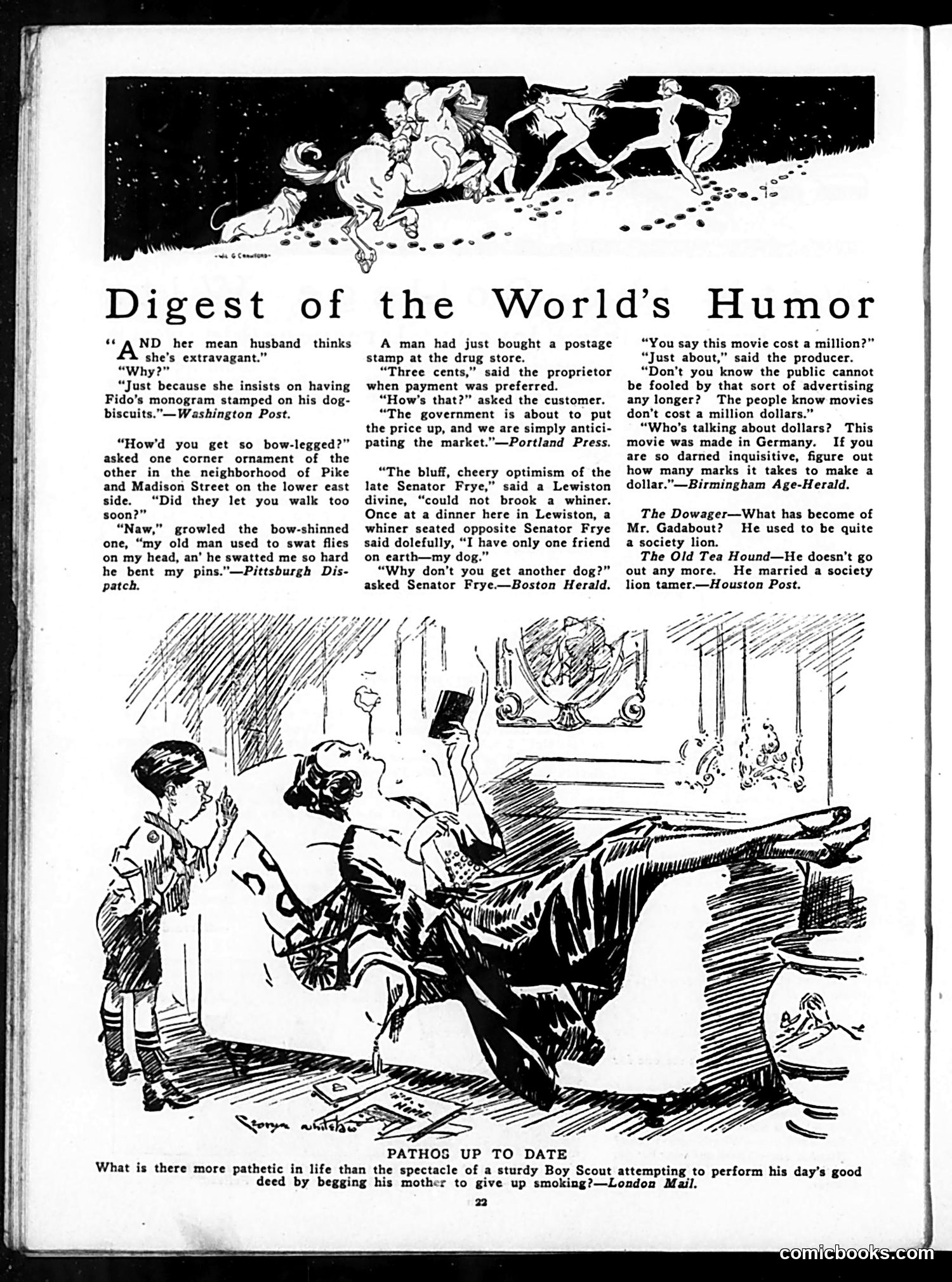
This page collects brief humorous anecdotes from various newspapers. Key jokes include: **Social commentary**: A wife insists on monogramming her dog's biscuits—satirizing upper-class extravagance and pampering of pets. **Economic satire**: A druggist anticipates a postage stamp price increase by charging more now, mocking opportunistic pricing before official changes. **Political reference**: Senator Frye (a real Maine senator) is recalled as bluntly optimistic—when someone complains of having only one friend (his dog), Frye cheerfully suggests getting another dog, dismissing sentimentality. **Post-WWI commentary**: A movie supposedly costs a million dollars, but the producer reveals it was made in Germany—implying German currency (marks) was worthless post-war, so the actual cost in dollars was trivial. This reflects 1920s hyperinflation and anti-German sentiment. **Social observation**: The cartoon "Pathos Up to Date" shows a Boy Scout begging his mother to quit smoking—finding it pathetic that a youth performing his "good deed" must target his own mother's habits.
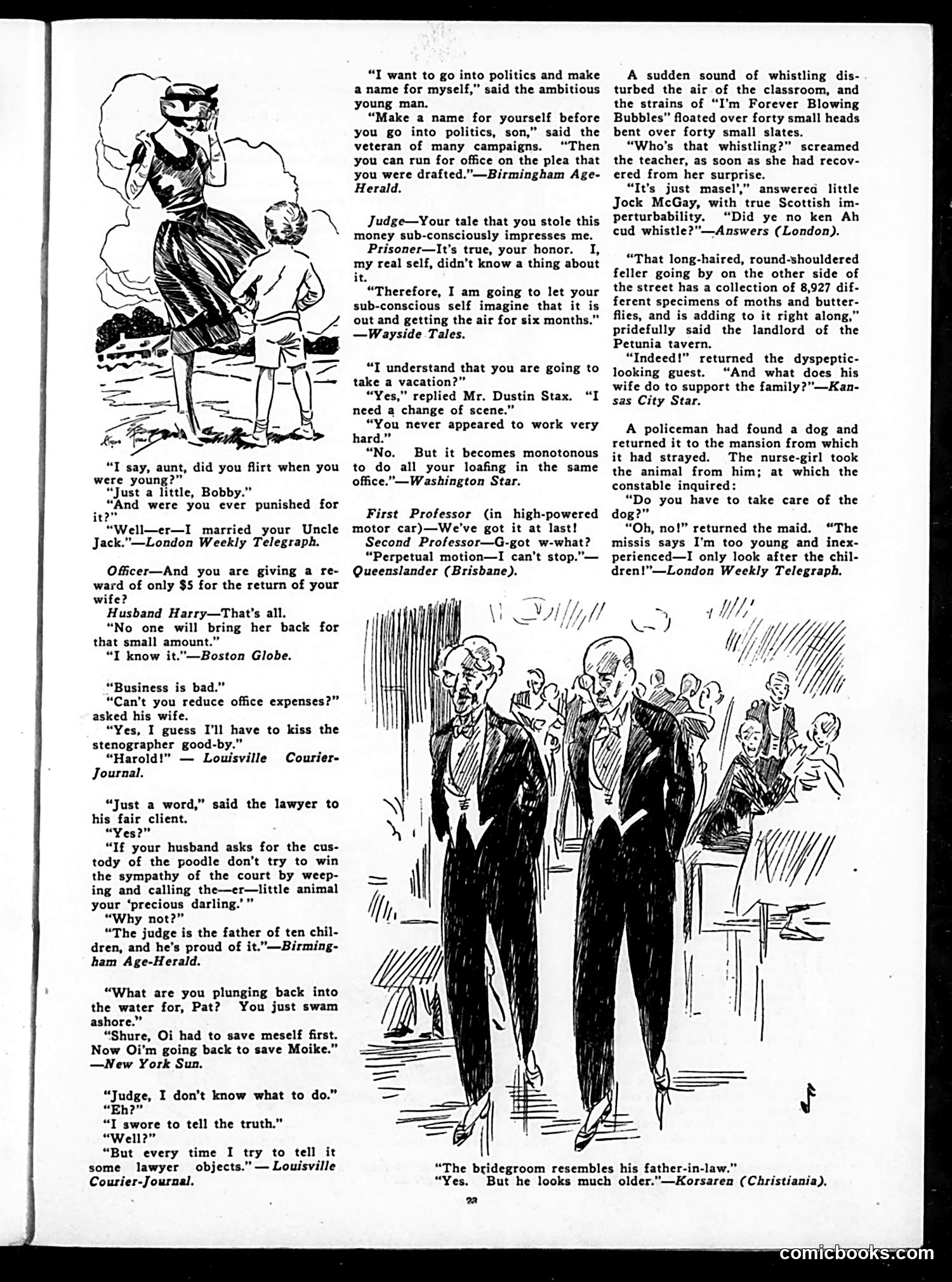
This page from Judge contains multiple short humorous anecdotes typical of early 20th-century American satire. The cartoons mock contemporary social conventions and human nature: **Key themes:** - **Marriage satire**: Several jokes depict wives as financial burdens or obstacles (the $5 reward joke, the stenographer dismissal) - **Legal/judicial absurdity**: A lawyer advises a client to hide emotion from a judge with ten children; a witness complains lawyers prevent truth-telling - **Class commentary**: A young man is advised to build reputation before entering politics to claim he was "drafted" into service—mocking political opportunism - **Everyday ironies**: A man prefers vacation to escape monotonous office loafing; a maid cannot watch dogs but manages children The Scottish schoolboy anecdote and immigrant "Pat" dialogue use dialect humor, common in period humor magazines. **Visual cartoon (bottom)**: Two men in formal dress, captioned about a bridegroom resembling his father-in-law but looking older—implying hasty or mismatched marriage. These jokes reflect period attitudes toward marriage, work, and social climbing rather than specific political events.
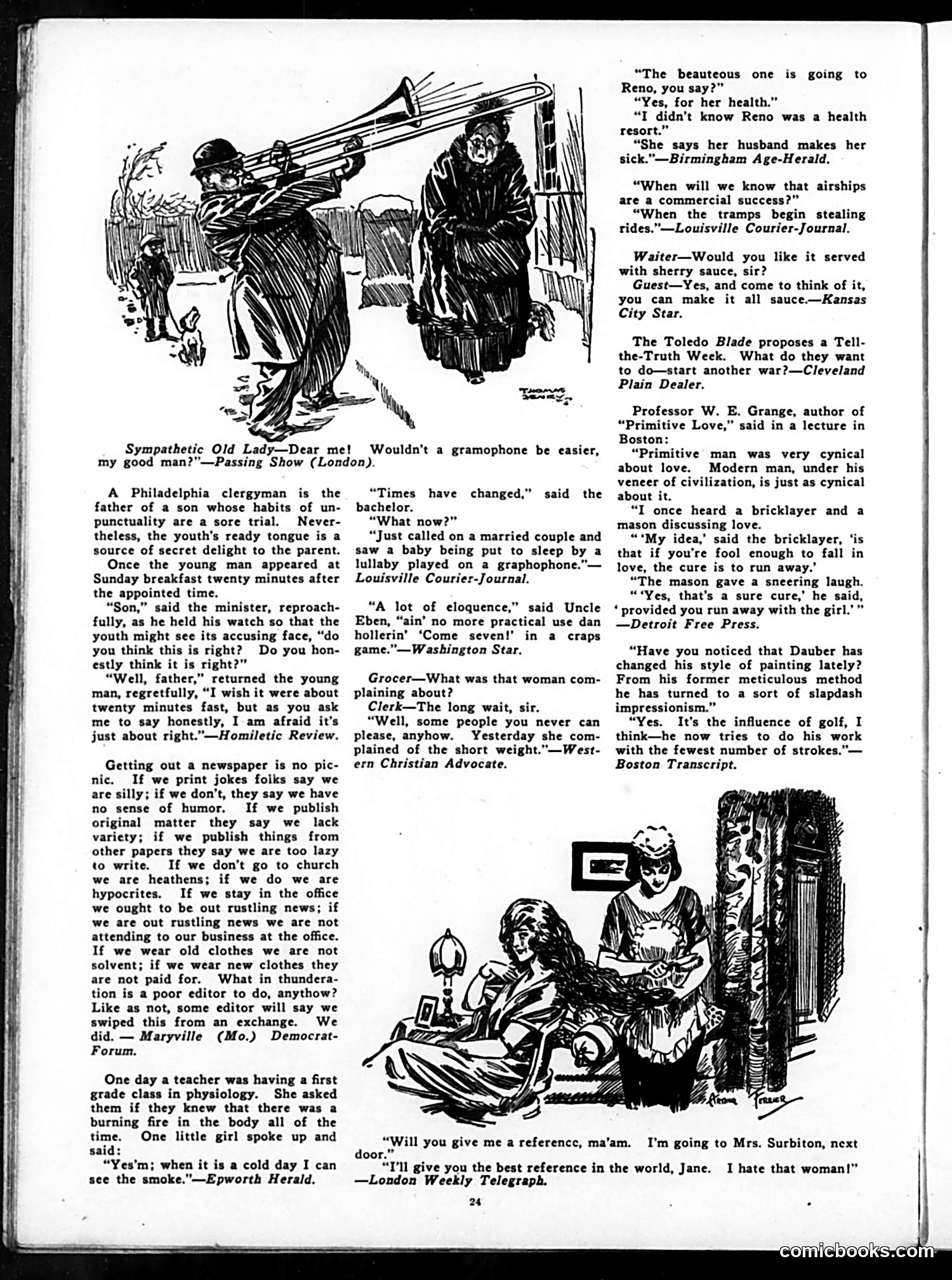
This page from the satirical magazine *Judge* collects various humorous anecdotes and jokes reflecting early 20th-century American life. **Key content includes:** The top cartoon depicts a man with a large gramophone horn pointed at an elderly woman—satirizing the new phonograph technology as impractically loud. **Notable jokes address:** - **Automobiles/transportation**: A quip about tramps stealing airship rides once they become common (mocking both new aviation and hobo culture) - **Divorce**: A "Reno" reference—Reno, Nevada was famous as a divorce destination where people went for quick separations - **Modern conveniences**: A bachelor surprised that a phonograph, not a lullaby, now puts babies to sleep - **Editor complaints**: A lengthy editorial lament about the impossible standards newspapers face **The satirical targets are:** - Technological disruption and changing social norms - Class tensions (tramping, servants) - Marital discord - Professional complaints The humor relies on contemporary readers understanding references like Reno divorces and early aviation's commercial viability—now-obscure cultural touchstones.
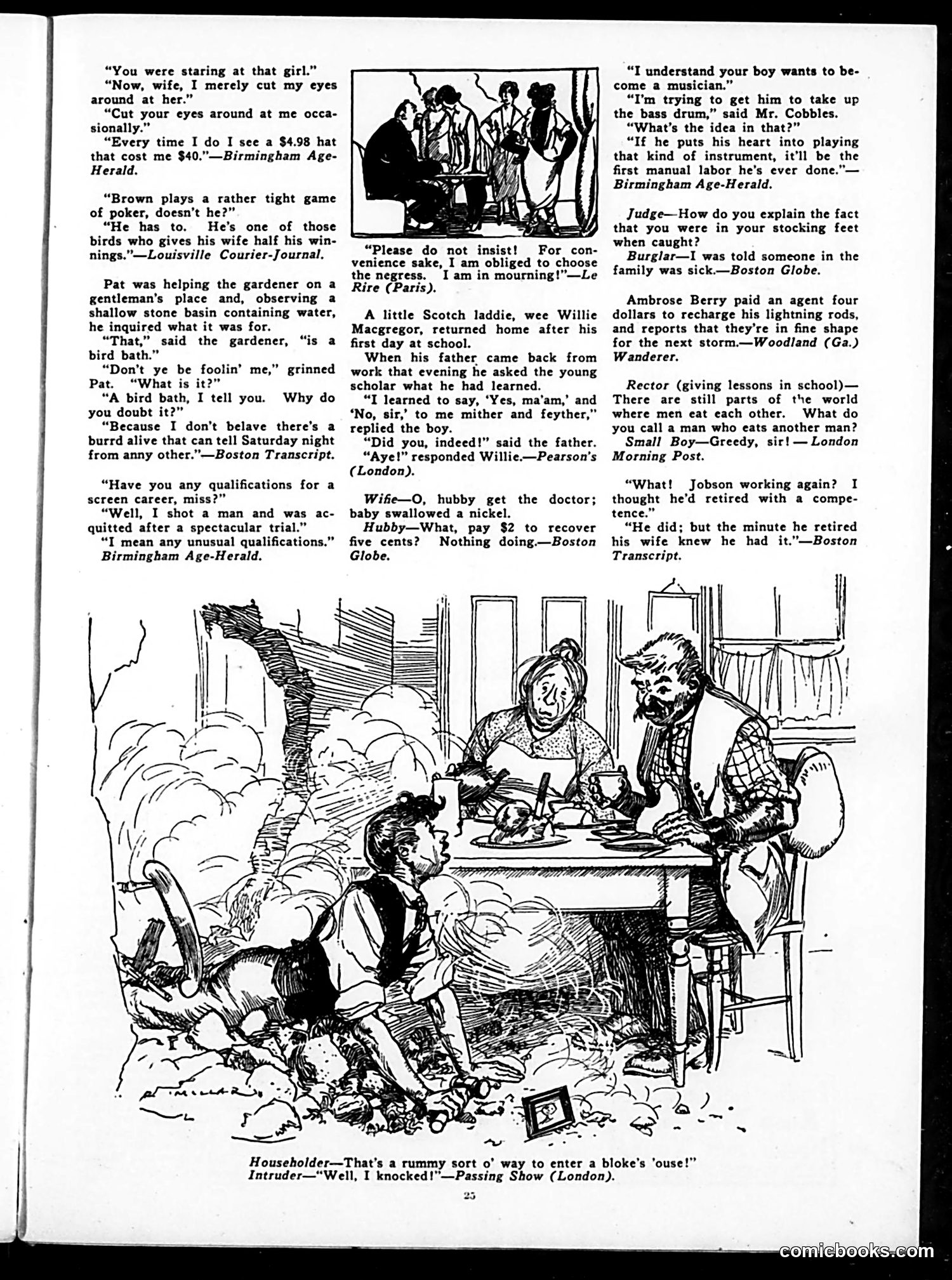
This page from *Judge* contains multiple short humorous anecdotes satirizing early 20th-century domestic and social life. Key themes include: **Marital dynamics**: Several jokes mock husbands' financial subordination to wives—men losing money to hat purchases or being unable to afford doctors for minor incidents without spousal approval. **Class and labor attitudes**: A joke about a boy taking up bass drum suggests working-class manual labor is beneath respectable families, reflecting period class anxieties. **Gender stereotypes**: Women are depicted as financially controlling, while criminals and the poor are portrayed as dimwitted (a burglar claims poverty as excuse; a drunk can't distinguish a bird bath). **The large cartoon** shows a burglar caught breaking in through a window while a family dines. The humor relies on the burglar's absurd excuse ("someone was sick") and the householder's complaint about the "rummy" entry method—treating the intrusion as a breach of etiquette rather than criminality. The content reflects *Judge*'s satirical approach to marriage, class, and social propriety of the era.
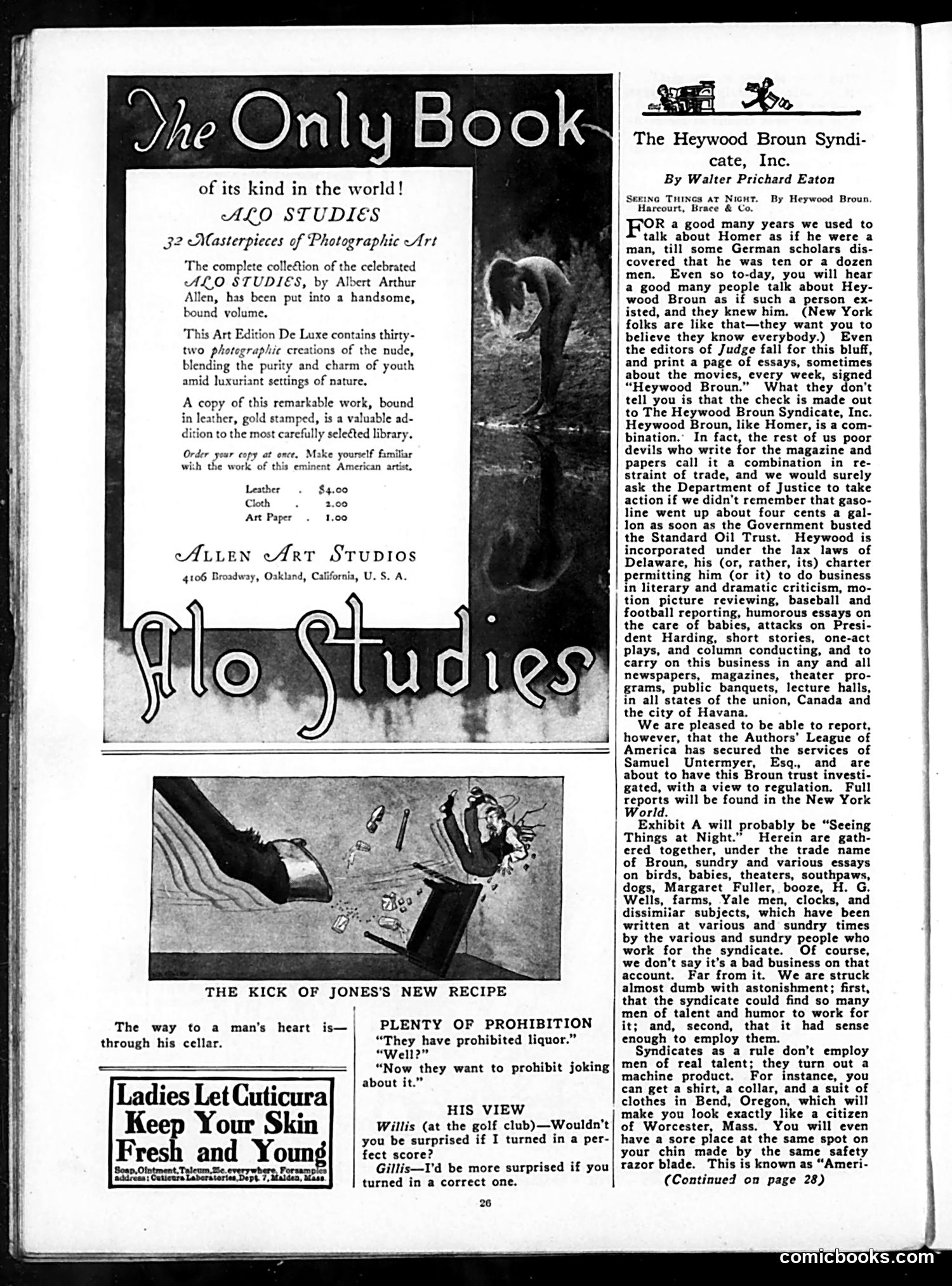
This page is primarily **advertising** for art books and consumer products, but the notable content is Walter Prichard Eaton's satirical essay mocking the "Heywood Broun Syndicate, Inc." **The Satire's Point:** Eaton playfully exposes that "Heywood Broun"—presented as a singular columnist writing for *Judge*—is actually a **corporate syndicate** (a content production company). Multiple ghostwriters produce essays under this brand name, similar to how Homer was revealed as multiple ancient authors, not one man. **The Complaint:** This is presented as a **restraint of trade**—a monopolistic practice. Writers sarcastically note they'd challenge it legally except the government recently broke up Standard Oil, so challenging monopolies seems futile. **The Joke:** Readers believing they know a real person called "Heywood Broun" are being fooled. The check goes to a corporation, not an individual. Eaton mocks both the syndicate's opportunism and New Yorkers' gullibility in "believing they know everybody." This reflects early 20th-century anxieties about **mass-produced content** and corporate consolidation in media.
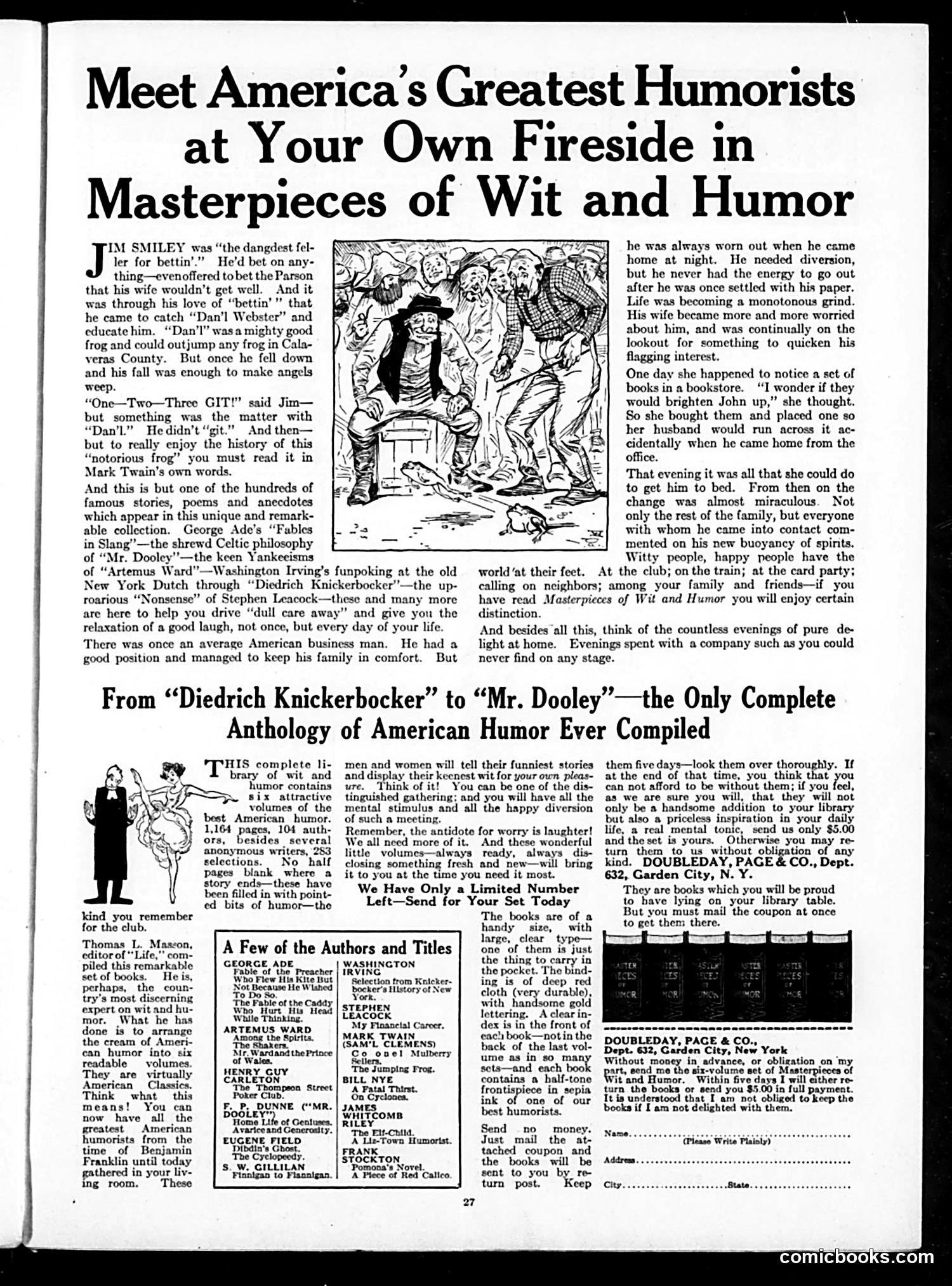
This is primarily a **book advertisement** for a six-volume humor anthology titled "Masterpieces of Wit and Humor." The central cartoon illustration depicts **Jim Smiley's famous frog from Mark Twain's "The Celebrated Jumping Frog of Calaveras County,"** shown surrounded by other frogs in what appears to be a racing or jumping scene. The page uses this iconic literary reference to promote the anthology's contents, which collect famous American humorists including Mark Twain, George Ade, Stephen Leacock, Washington Irving, and others. The accompanying narrative—about a bored businessman whose wife buys him these books, which transform his mood and social life—serves as the advertisement's emotional hook: humor books as domestic remedy and self-improvement tool. This reflects early-20th-century marketing that positioned literature as both entertainment and moral/psychological medicine for the modern urban male.
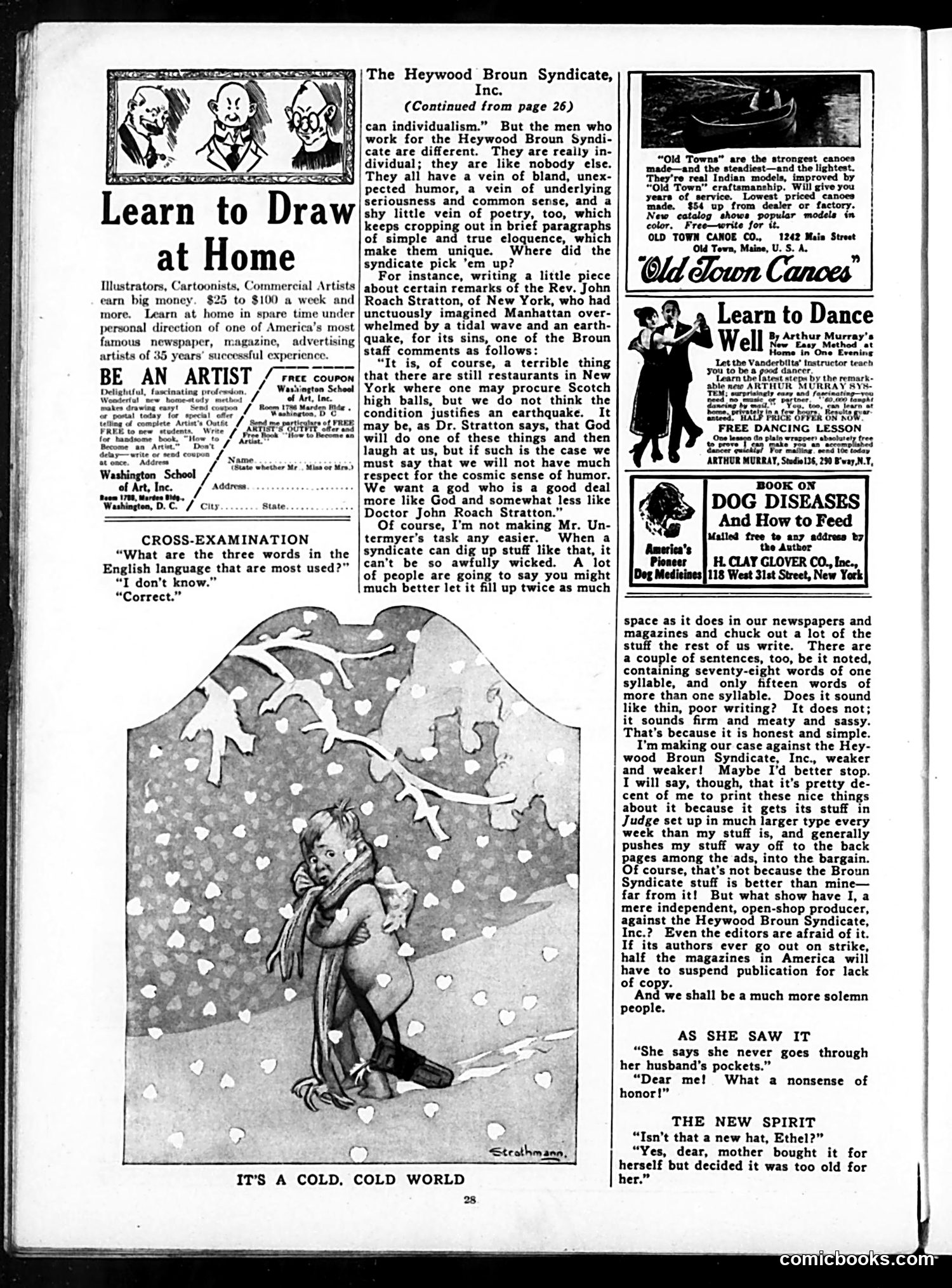
This page is primarily **advertising and promotional content** rather than political satire. The main cartoon, titled "It's a Cold, Cold World," depicts a shivering figure in snow—a generic winter-themed gag unrelated to politics. The page's substantive content is a **favorable essay about the Heywood Broun Syndicate, Inc.**, a newspaper content distributor. The author praises the syndicate's writers for their individualism, wit, and elegant simplicity of language. He illustrates their quality with a quote mocking Rev. John Roach Stratton's claim that God would punish New York with earthquakes for serving Scotch—the syndicate writer humorously argues that while bars are problematic, earthquakes seem excessive punishment. The piece is essentially **advertising disguised as editorial content**—promoting the syndicate's value to publications while self-deprecatingly acknowledging that Judge magazine itself gets pushed to the back pages in favor of the Broun Syndicate's material. The remaining space contains unrelated service advertisements: art instruction, dance lessons, and dog medicine.
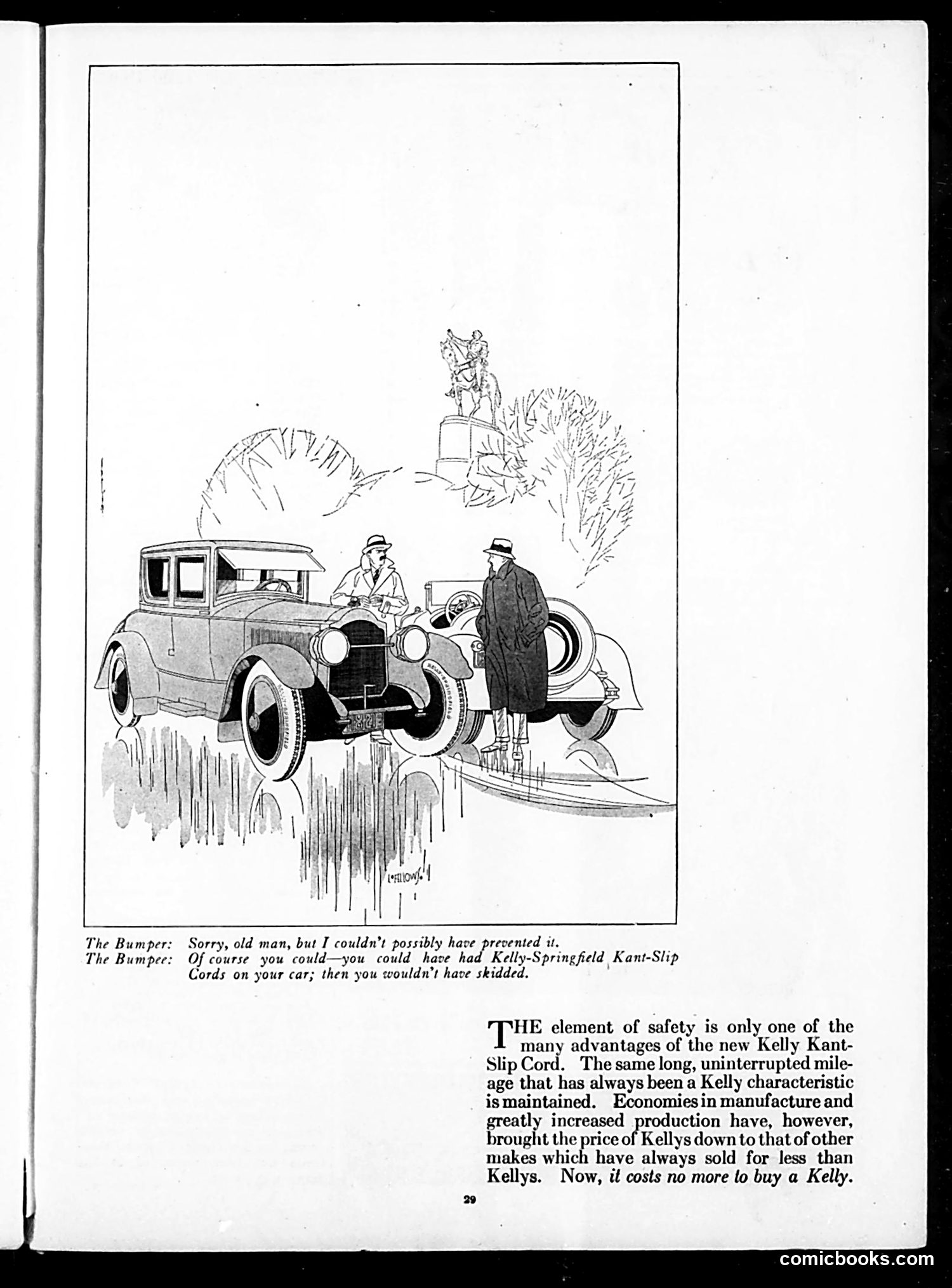
This is a **tire advertisement** disguised as a comic scenario. The "cartoon" depicts a traffic accident: one driver has hit an elderly pedestrian ("old man"), and the bumper driver explains he couldn't prevent the collision. The "bumper" (the other driver) responds by sarcastically suggesting the accident wouldn't have happened with **Kelly-Springfield Kant-Slip Cords** (a tire brand). The satire works through dark humor: rather than genuine concern for the injured pedestrian, the exchange becomes a sales pitch. The ad then follows, explaining that Kelly tires now cost the same as cheaper competitors while maintaining superior safety and mileage. **Context for modern readers:** This represents early 20th-century advertising's casual approach to serious topics (pedestrian safety) and acceptance of using accident scenarios in marketing. The "Kant-Slip" name suggests improved traction to prevent skidding—a selling point in an era of less-reliable tire technology.
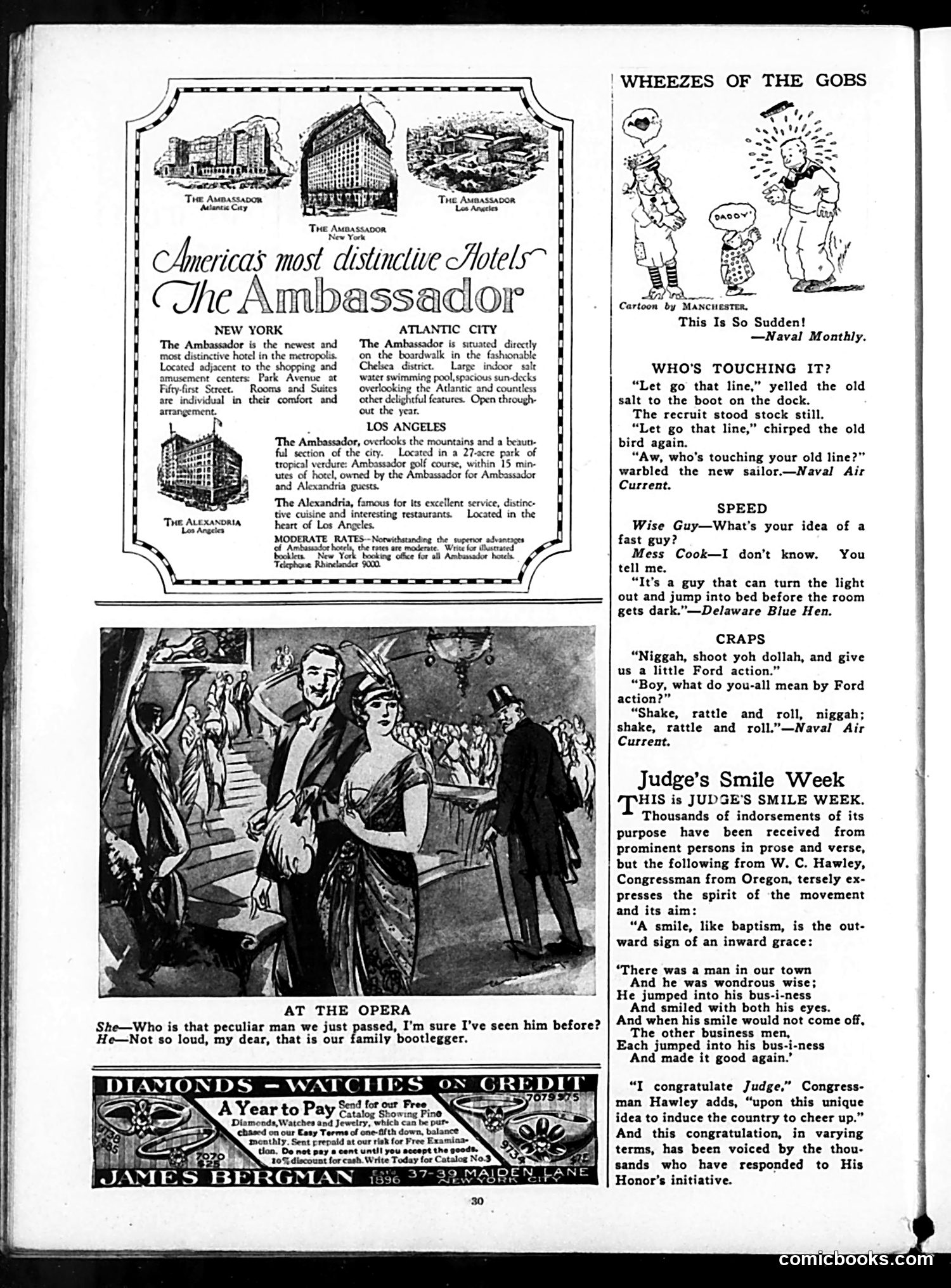
This page primarily features **hotel advertisements** for The Ambassador chain (New York, Atlantic City, Los Angeles) and a jewelry store credit ad—typical magazine filler. The small cartoon "AT THE OPERA" depicts a social scene where a well-dressed man is identified as "our family bootlegger." This is satirical commentary on **Prohibition era (1920s) hypocrisy**: respectable families openly acknowledged employing bootleggers to supply illegal alcohol, treating criminal activity as a normal domestic service. The joke mocks the pretense of propriety while openly flouting the law. The right column contains brief military humor ("Wheezes of the Gobs"—gobs being sailors) and includes **offensive racial dialect** typical of 1920s publications, now considered deeply inappropriate. The page concludes with promotion of "Judge's Smile Week," an editorial campaign encouraging optimism, supported by endorsements from Congressman W.C. Hawley of Oregon. **Context**: This reflects post-WWI American culture—Prohibition enforcement, naval service, and attempts at uplifting national mood.
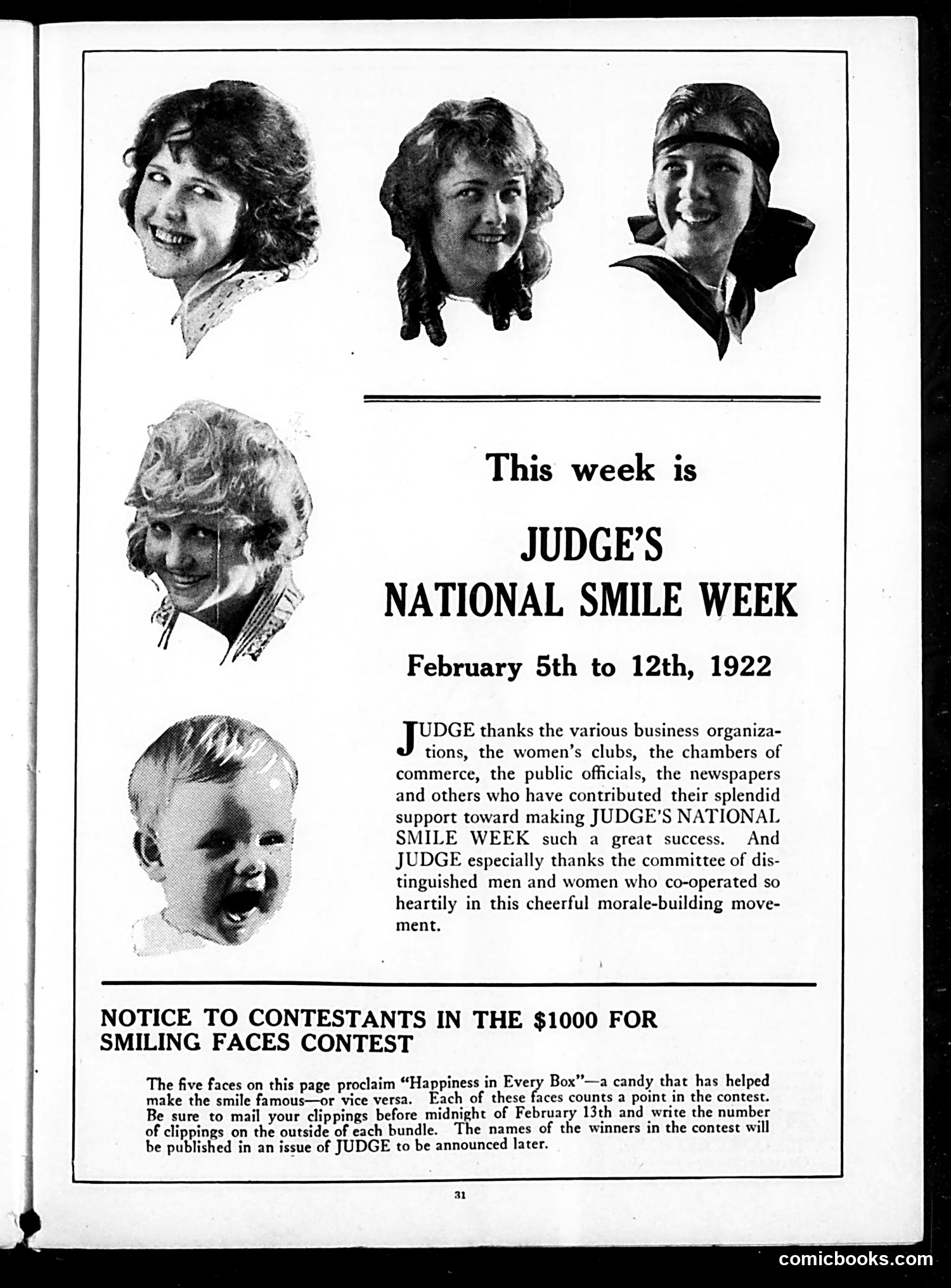
This page is primarily an advertisement disguised as editorial content. Judge magazine declared "National Smile Week" (February 5-12, 1922) as a morale-building initiative, thanking various civic organizations for support. The five smiling faces shown are promotional images for "Happiness in Every Box," a candy product. The page announces a $1000 contest where readers clip out these faces and mail them in, with winners announced later. For modern readers: this represents early 20th-century advertiser-friendly magazine culture, where companies could sponsor "public service" campaigns that boosted their brands. The cheerful, earnest tone—emphasizing happiness and morale during the post-WWI period—reflects 1920s optimism. The contest mechanics (cutting and mailing clippings) were typical period promotional tactics, essentially crowdsourcing free marketing by engaging readers as participants.
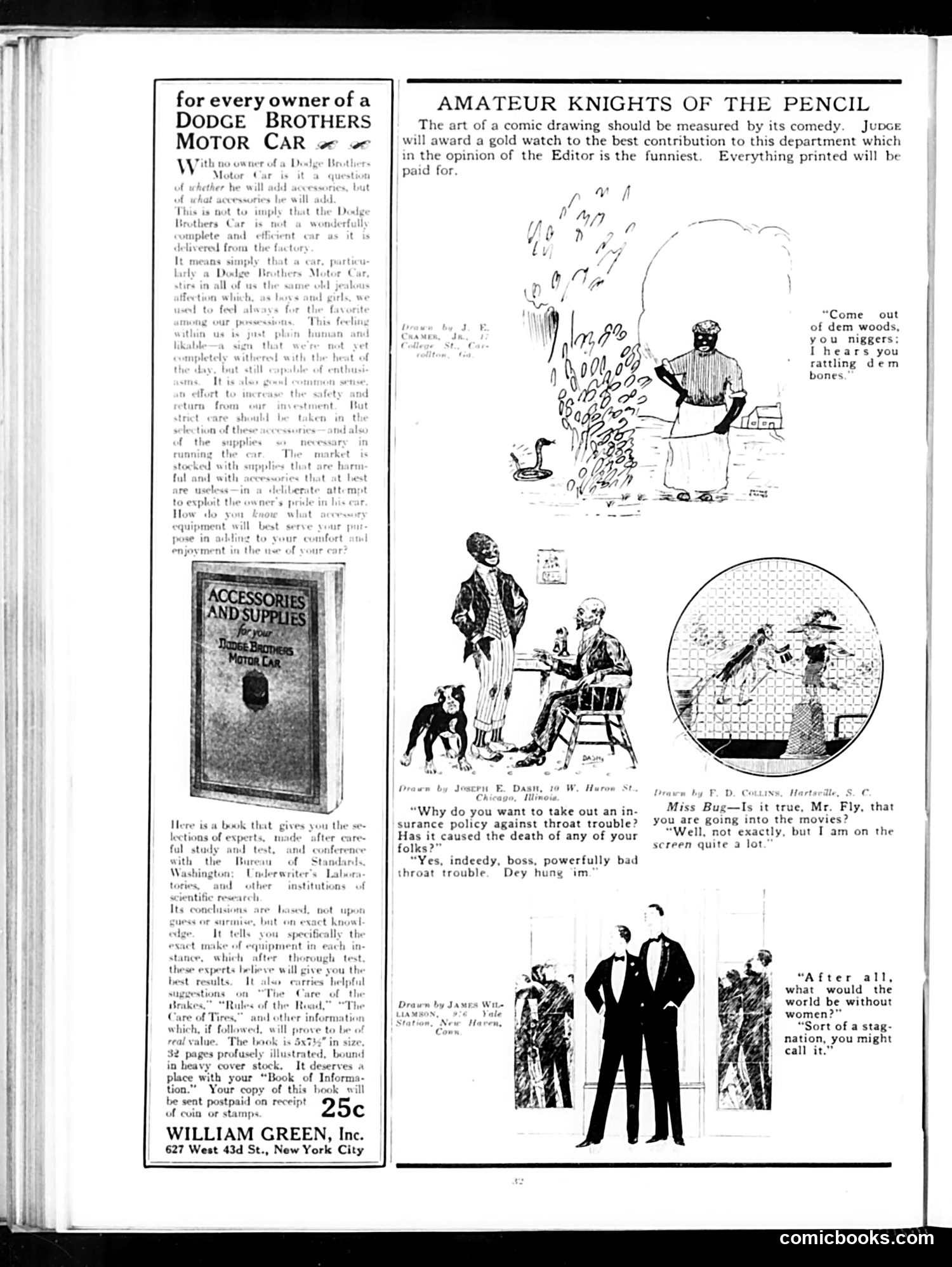
This page from *Judge* magazine features racist caricatures and dialect humor typical of early 20th-century American satire—content considered offensive today. The top cartoon depicts a white figure addressing Black people using a racial slur, with the "joke" relying on stereotype-based dialect ("dem woods," "bones"). The humor trades on dehumanizing caricature. Below are additional cartoons with period-typical themes: one about insurance and lynching (presented as dark humor), another about insects in movies, and one about gender relations using the "women are essential" trope common to the era. The page also advertises a Dodge Brothers automobile and a reference book on car accessories—standard magazine content of the period. The satire here reflects the casual racism and sexism embedded in American popular culture of this era, revealing what *Judge* considered acceptable entertainment for its audience.
This page from Judge presents an article by Samuel Hopkins Adams (third in a series for Leslie's Weekly) discussing the early 1920s automobile industry boom and its sustainability. **The Context & Satire:** The title's metaphor—"gasoline jag" (intoxication from car-buying enthusiasm) and "hang-over" (sobering reality)—suggests the 1922 auto-buying craze is unsustainable. Adams argues that the industry's future depends not on cheaper cars but on reliable service stations and educated car owners who understand maintenance, reducing repair costs and waste. **The Point:** The article critiques both predatory repair shops and careless owners, promoting H.W. Slauson's book "Everyman's Guide to Motor Efficiency" as the solution. Rather than celebrate automobile expansion, the piece implies reckless ownership and exploitative repairs threaten the market's long-term health. The satire targets both the industry's false promises and consumers' naive enthusiasm.
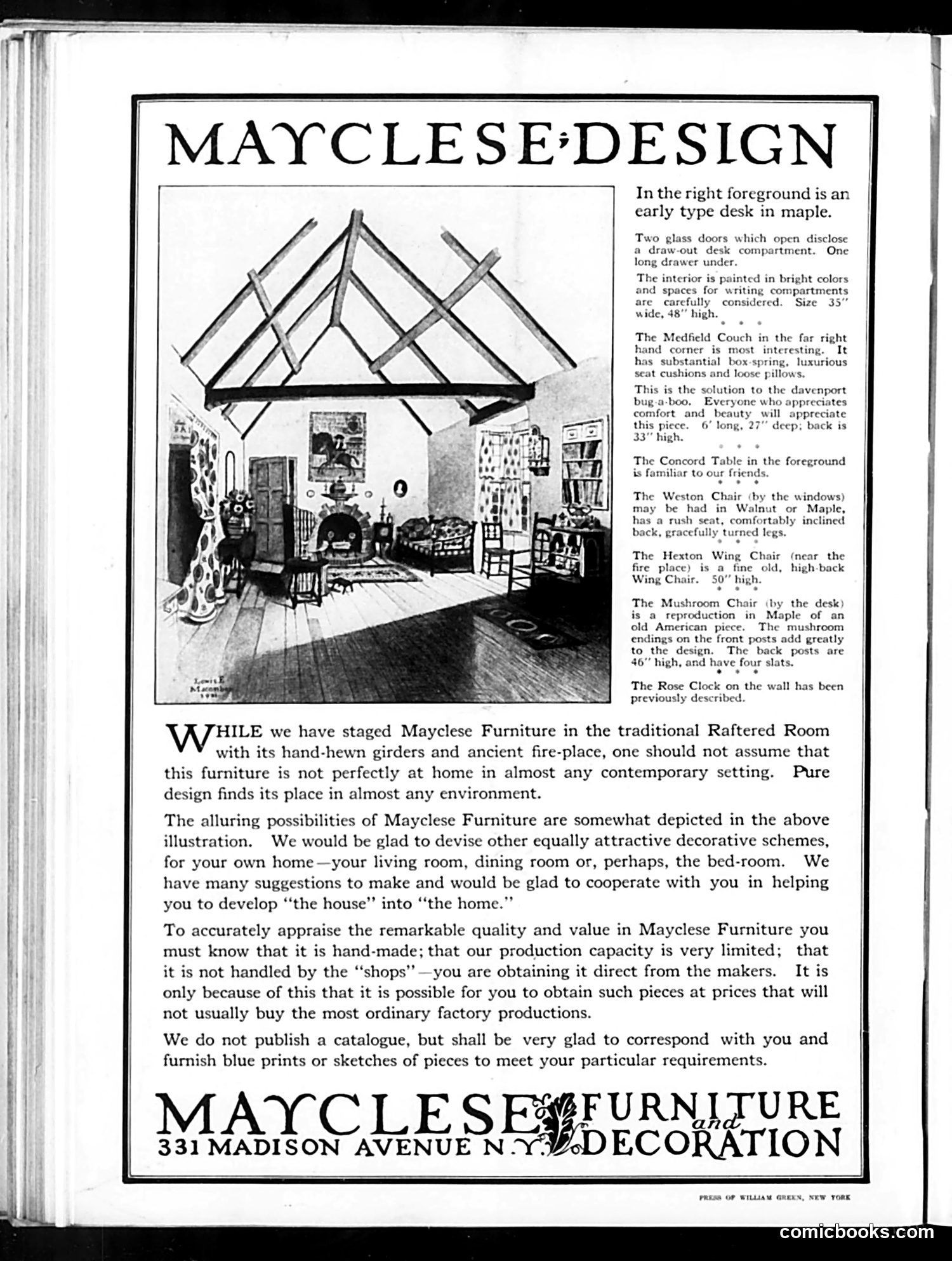
This is not a political cartoon but a **furniture advertisement** from Judge magazine. The page showcases Mayclese Furniture and Decoration, a New York company located at 331 Madison Avenue. The image depicts an interior room design featuring various pieces of handcrafted furniture: a maple desk, Medfield Couch, Concord Table, Weston Chair, Hexton Wing Chair, Mushroom Chair, and a Rose Clock. The staged "Raftered Room" with traditional architectural elements demonstrates how the furniture adapts to contemporary settings. The accompanying text emphasizes the company's selling points: hand-made quality, limited production capacity, direct-from-makers pricing, and custom design consultation. The company explicitly states it avoids mass-market retail distribution ("'shops'"), positioning itself as a premium, bespoke alternative to ordinary factory furniture. This represents early 20th-century advertising for luxury craftsman-style home furnishings targeting affluent consumers seeking quality and individualized design.