
Judge, 1922-02-11 · page 35 of 36
Judge — February 11, 1922 — page 35: what you’re looking at
What you’re looking at
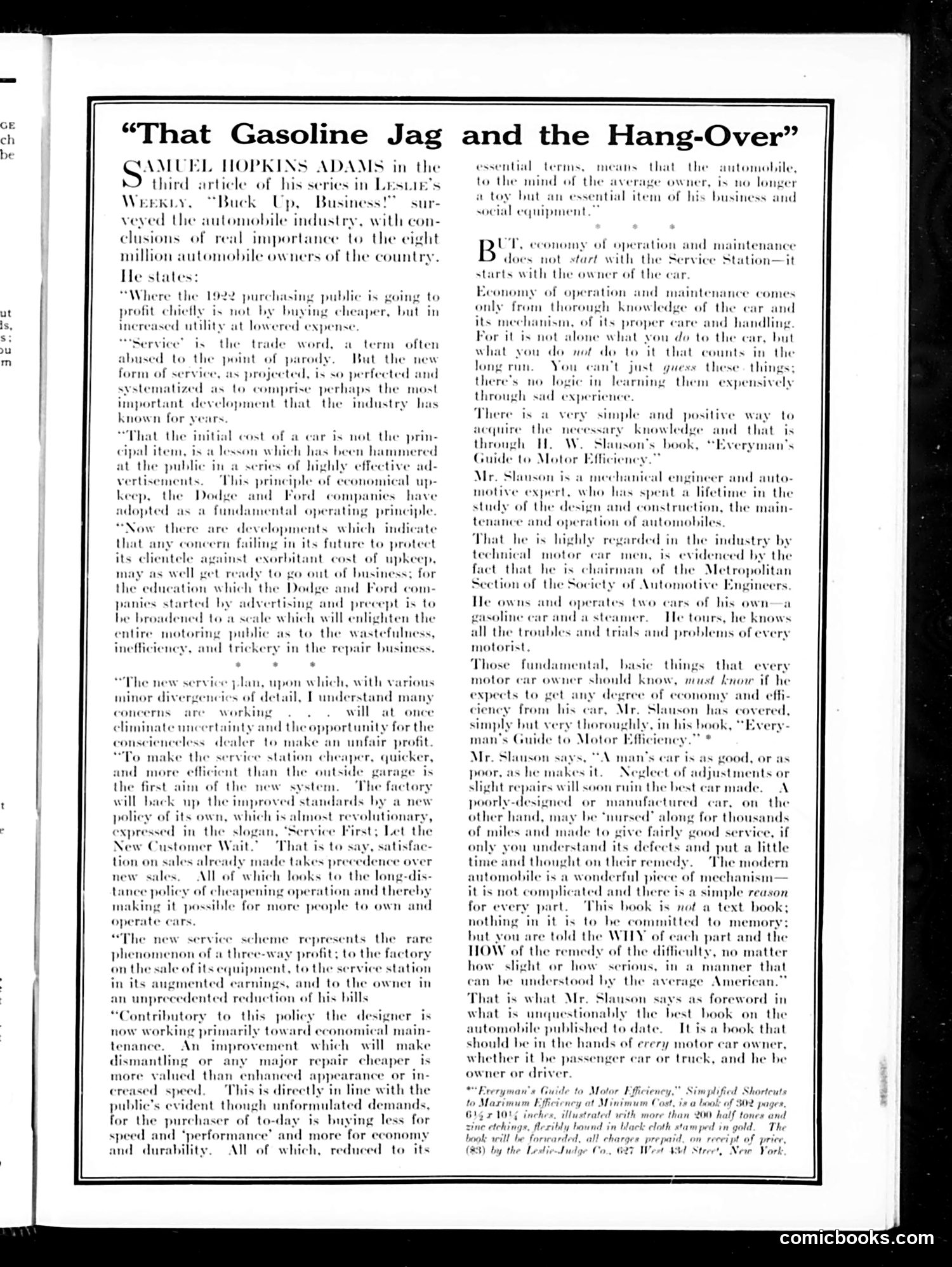
This page from Judge presents an article by Samuel Hopkins Adams (third in a series for Leslie's Weekly) discussing the early 1920s automobile industry boom and its sustainability. **The Context & Satire:** The title's metaphor—"gasoline jag" (intoxication from car-buying enthusiasm) and "hang-over" (sobering reality)—suggests the 1922 auto-buying craze is unsustainable. Adams argues that the industry's future depends not on cheaper cars but on reliable service stations and educated car owners who understand maintenance, reducing repair costs and waste. **The Point:** The article critiques both predatory repair shops and careless owners, promoting H.W. Slauson's book "Everyman's Guide to Motor Efficiency" as the solution. Rather than celebrate automobile expansion, the piece implies reckless ownership and exploitative repairs threaten the market's long-term health. The satire targets both the industry's false promises and consumers' naive enthusiasm.
📄 Transcribed text from this page (OCR, searchable)
Machine-transcribed from the original scan — historical spelling and the odd misread are preserved.
“That Gasoline Jag and the Hang-Over” SAMUEL HOPKINS ADAMS in the third article of his series in Lesuie’s Werekiy. “Buck Up, Business!" sur- veyed the automobile industry, with con- clusions of real importance to the eight million automobile owners of the country. He states: “Where the 1922 purchasing public is profit chiefly is not by buying cheaper, but in Increased utility at lowered expense ‘service’ is the trade word, a term often abused to the point of parody. But the new form of service, as projected, is so perfected and systematized as to comprise perhaps the most important development that the industry has known for years “That the initial tof a car is not the prin- cipal item, is a lesson which has been hammered at the public i of highly effective ad- vertisements. of economical up- keep, the Dodge and Ford companies have adopted as a fundamental operating principle “Now there are developments which indicate that any concern failing in its future to protect its clientele against exorbitant cost of upkee may as well get ready to vo out of business the education which the Dodge and For panies started by advertising and precept is to het ened to a seale which will enlighten the entire motoring public as to the wastefulness, inefficiency, and trickery in the repair business. nowhich, with various mine ‘| a T understand many concerns are working 5.0. will) at once climinate uncertainty and the opportunity for the useienceless dealer to make an unfair profit ro make t service station cheaper, quicker, and more efficient than the outside gara the first The facto) will back up the improved standards by a1 policy of its own, which is almost revolutionary, expressed in the slogan, ‘Service First; Let the New Customer Wait. ‘That is to say, satisfac- tion on sales already made takes precedence over new sales. All of which looks to the long tance policy of cheapening operation and thereby making it possible for more people to own and im of the new system. operate ears “The new service scheme represents the phenomenon of a three-way profit; to the factors on the sal its equipment, to the service station in its augmented earnings, and to the owner in an unprecedented reduction of his bills “Contributory to this poliey the desi now working primarily toward economic tenance. An improvement which wi dismantling or any major repair cheaper is more valued than enhanced appearance or in- creased spe This is directly in line with the publie’s evident though unformulated demands, for the purchaser of to-day is buying less for speed and ‘performance’ and more for economy and durability. All of which, reduced to its essential terms, means that) the automobile, to the mind of the average owner, is no lon a toy but an essential item of his business and social equipment.” Bur . economy of operation and maintenance does not start with the Service Station—it starts with the owner of the car Economy of operation and maintenance comes only from thorough knowledge of the ear and its mechanism, of its proper and handling For it is not me what vou do to the car, but what you do not do to it that counts ins the long run. You ean’t just’ guess these. thin there's no logic in learning them expensively through sad experience There is a very simple and positive way to acquire the necessary know sound that is through H.W. Slauson’s I “Everyman's Guide to Motor Efficiency.” Mr. ison is a mechanical engir and auto- motive expert, who lias spent a lifetime in the study of the nand construction, the main- and operation of automobiles it he is highly ded in the industry by technical mo romen, is evidenced by the fact that he is chairman of the Metropolitan ion of the Society of Automotive Engineers He owns and operates two cars of his own—a gasoline car and asteamer. Tle tours, he knows all the troubles and trials and problems of every motorist. Those fundamental, basie things that. every motor car owner should know, must know if he expects to 1 “© of economy and effi- ciency from his car, Mr. Slauson has covered, simply but very thoroughly, in his hook, “Every- man’s Guide to Motor Effie: Mr. Shiuson says, “A man’s car is as good, or as poor, as he makes it. Neglect of adjustments or slight repairs will soon ruin the by irmade. A poorly-designed or manufactured car, on the other hand, may be ‘nursed’ along for thousands of miles and made to give fairly good service, if only you understand its vets and put a little time and thought on their remedy. The modern automobile is a wonderful piece of mechanism— it is not complicated and there is a simple reason for every part. This book is not a text boo nit is to be committed to memory: but you are told the WHY of each part and the HOW of the remedy of the difficulty, no matter how slight or how serious, in a manner that can be understood by the average American.” That is what Mr. Slauson s: as foreword in what is unquestionably the best book on. the automobile published to date. [tis a book that should be in the hands of erery motor car owner, whether it be passenger car or track, and he be owner or driver TONE inches, Mustrated f with more than 200 half tones and ine etchings, fleribly to nd i ‘in Mack cloth stam pea The 1 charges prepaid H f price book will he forward (83) by the Lesdlie-dudge Co. GIT West 491 Stre comicbooks.com