
Judge, 1922-02-11 · page 28 of 36
Judge — February 11, 1922 — page 28: what you’re looking at
What you’re looking at
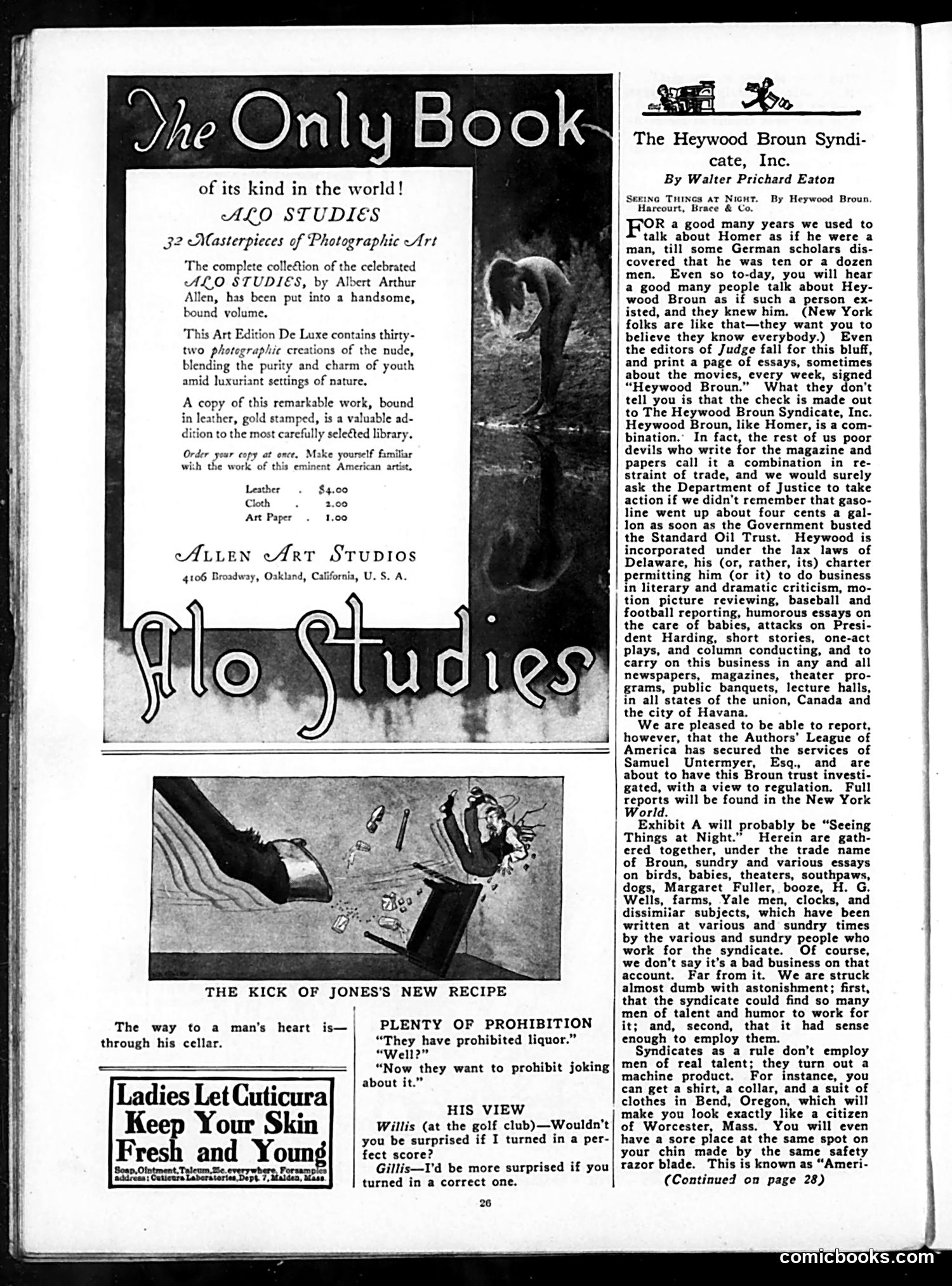
This page is primarily **advertising** for art books and consumer products, but the notable content is Walter Prichard Eaton's satirical essay mocking the "Heywood Broun Syndicate, Inc." **The Satire's Point:** Eaton playfully exposes that "Heywood Broun"—presented as a singular columnist writing for *Judge*—is actually a **corporate syndicate** (a content production company). Multiple ghostwriters produce essays under this brand name, similar to how Homer was revealed as multiple ancient authors, not one man. **The Complaint:** This is presented as a **restraint of trade**—a monopolistic practice. Writers sarcastically note they'd challenge it legally except the government recently broke up Standard Oil, so challenging monopolies seems futile. **The Joke:** Readers believing they know a real person called "Heywood Broun" are being fooled. The check goes to a corporation, not an individual. Eaton mocks both the syndicate's opportunism and New Yorkers' gullibility in "believing they know everybody." This reflects early 20th-century anxieties about **mass-produced content** and corporate consolidation in media.
📄 Transcribed text from this page (OCR, searchable)
Machine-transcribed from the original scan — historical spelling and the odd misread are preserved.
of its kind in the world! ALO STUDIES 32 Masterpieces of Photographic Art The complete colleétion of the celebrated ALO STUDIES, by Albert Arthur Allen, has been put into a handsome, bound volume. ‘This Art Edition De Luxe contains thirty- two photographic creations of the nude, blending the purity and charm of youth amid luxuriant settings of nature, A copy of this remarkable work, bound in leather, gold stamped, is a valuable ad- dition to the most carefully selected library. Order yeur copy at once, Make yourself familiar with the work of this eminent American artist, Leather . $4.00 Cloth . 2.00 Art Paper. 1.00 cALLEN Art STuDIOS 4106 Broadway, Oakland, California, U. S. A. THE KICK OF JONES'S NEW RECIPE The way to a man’s heart is— | through his cellar. Ladies Let Cuticura Keep Your Skin Fres umn Soap, Ointment, Taleum,25e. everywhere, Forsam: address: Cutieura Laboratories, Dept 7, Malden, Bass, PLENTY OF PROHIBITION “They have prohibited liquor.” “Well?” “Now they want to prohibit joking about it.” HIS VIEW Willis (at the golf club)—Wouldn’t you be surprised if I turned in a per- fect score? Gillis—I'd be more surprised if you turned in a correct one. Se ho, | The Heywood Broun Syndi- cate, Inc. By Walter Prichard Eaton xo THiNcs At NicHtt, By Heywood Broun. reourt, Brace & Co. FOR a good many years we used to talk about Homer as if he were a man, till some German scholars dis- covered that he was ten or a dozen men. Even so to-day, you will hear a good many people talk about Hey- wood Broun as if such a person ex- isted, and they knew him. (New York folks are like that—they want you to believe they know everybody.) Even the editors of Judge fall for this bluff, and print a page of essays, sometimes about the movies, every week, signed “Heywood Broun.” What they don’t tell you is that the check is made out to The Heywood Broun Syndicate, Inc. Heywood Broun, like Homer, is a com- bination.’ In fact, the rest of us poor devils who write for the magazine and papers call it a combination in re- straint of trade, and we would surely ask the Department of Justice to take action if we didn’t remember that gaso- line went up about four cents a gal- lon as soon as the Government busted the Standard Oil Trust. Heywood is incorporated under the lax laws of Delaware, his (or, rather, its) charter permitting him (or it) to do business in literary and dramatic criticism, mo- tion picture reviewing, baseball and football reporting, humorous essays on the care of babies, attacks on Presi- dent Harding, short stories, one-act plays, and column conducting, and to carry on this business in any and all newspapers, magazines, theater pro- grams, public banquets, lecture halls, | in all states of the union, Canada and the city of Havana. We are pleased to be able to report, however, that the Authors’ League of America has secured the services of Samuel Untermyer, Esq., and are about to have this Broun trust investi- gated, with a view to regulation. Full reports will be found in the New York World. Exhibit A will probably be “Seeing Things at Night.” Herein are gath- ered together, under the trade name of Broun, sundry and various essays on birds, babies, theaters, southpaws, dogs, Margaret Fuller, booze, H. G. Wells, farms, Yale men, clocks, and dissimiiar subjects, which have been written at various and sundry times by the various and sundry people who work for the syndicate. Of course, we don’t say it's a bad business on that account. Far from it. We are struck almost dumb with astonishment; first, that the syndicate could find so many men of talent and humor to work for it; and, second, that it had sense enough to employ them. Syndicates as a rule don’t employ men of real talent; they turn out a machine product. For instance, you can get a shirt, a collar, and a suit of clothes in Bend, Oregon, which will make you look exactly like a citizen of Worcester, Mass. You will even have a sore place at the same spot on your chin made by the same safety razor blade. This is known as “Ameri- (Continued on page 28)