
Judge, 1922-02-11 · page 12 of 36
Judge — February 11, 1922 — page 12: what you’re looking at
What you’re looking at
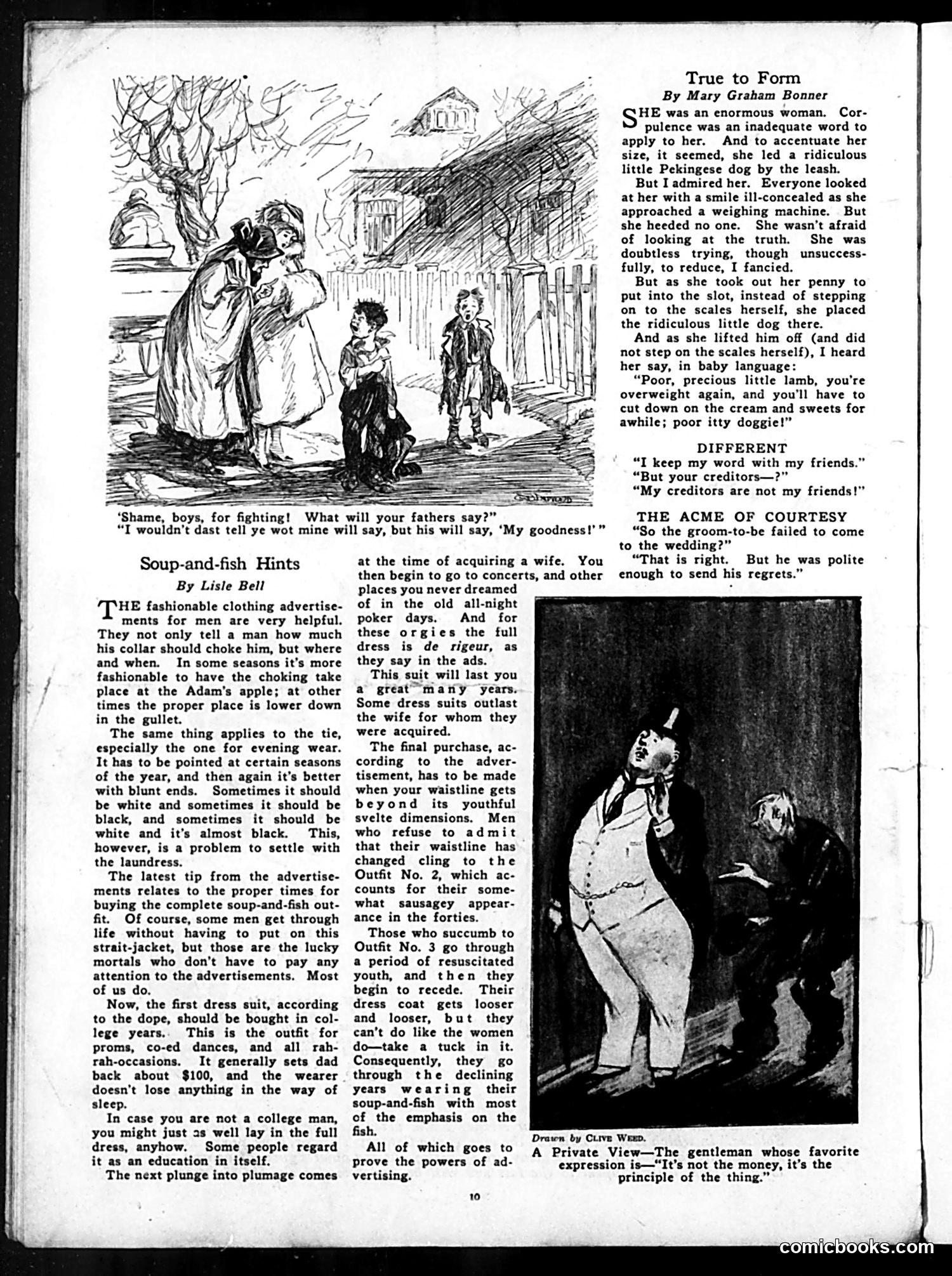
This page contains three satirical pieces targeting social pretension and hypocrisy: **"Soup-and-Fish Hints"** mocks men's fashion advertising's obsessive dictation of formal wear. The author sardonically notes that ads pressure men to buy expensive dress suits ("soup-and-fish") at life milestones—college, marriage, middle age—while constantly changing style requirements. The joke: men are enslaved to arbitrary fashion rules and advertising manipulation, yet some navigate life without these expensive "strait-jackets." **"True to Form"** satirizes an obese woman who weighed her tiny Pekingese dog instead of herself on a public scale, then scolded the dog for being overweight. The satire targets her obvious self-deception and hypocrisy—blaming her pet rather than confronting her own weight. **"The Acme of Courtesy"** appears to reference a groom failing to attend his wedding, then claiming politeness in sending regrets. The satire mocks hollow courtesy masking fundamental social failure. The cartoon illustration shows boys fighting while an adult scolds them about parental shame—juxtaposing their honest boyish behavior against adult hypocrisy discussed in the surrounding text.
📄 Transcribed text from this page (OCR, searchable)
Machine-transcribed from the original scan — historical spelling and the odd misread are preserved.
‘Shame, boys, for fighting! Soup-and-fish Hints By Lisle Bell ‘THE fashionable clothing advertise- ments for men are very helpful. They not only tell a man how much his collar should choke him, but where and when. In some seasons it’s more fashionable to have the choking take place at the Adam's apple; at other times the proper place is lower down in the gullet. The same thing applies to the tie, especially the one for evening wear. It has to be pointed at certain seasons of the year, and then again it’s better with blunt ends. Sometimes it should be white and sometimes it should be black, and sometimes it should be white and it’s almost black. This, however, is a problem to settle with the laundress. The latest tip from the advertise- ments relates to the proper times for buying the complete soup-and-fish out- fit. Of course, some men get through life without having to put on this strait-jacket, but those are the lucky mortals who don’t have to pay any attention to the advertisements. Most of us do. Now, the first dress suit, according to the dope, should be bought in col- lege ye This is the outfit for proms, co-ed dances, and all rah- rah-occasions. It generally sets dad back about $100, and the wearer doesn’t lose anything in the way of sleep. In case you are not a college man, you might just as well lay in the full dress, anyhow. Some people regard it as an education in itself. The next plunge into plumage comes What will your fathers say?” “I wouldn't dast tell ye wot mine will say, but his will say, ‘My goodness at the time of acquiring a wife. You then begin to go to concerts, and other places you never dreamed of in the old all-night poker days. And for these orgies the full dress is de rigeur, as they say in the ads. This suit will last you a great™many years. Some dress suits outlast the wife for whom they were acquired. The final purchase, ac- cording to the adver- tisement, has to be made when your waistline gets beyond its youthful svelte dimensions. Men who refuse to admit that their waistline has changed cling to the Outfit No. 2, which ac- counts for their some- what sausagey appear- ance in the forties. Those who succumb to Outfit No. 3 go through a period of resuscitated youth, and then they begin to recede. Their dress coat gets looser and looser, but they can’t do like the women do—take a tuck in it. Consequently, they go through the declining years wearing their soup-and-fish with most of the emphasis on the fish. All of which goes to prove the powers of ad- vertising. 10 True to Form By Mary Graham Bonner HE was an enormous woman. Cor- pulence was an inadequate word to apply to her. And to accentuate her size, it seemed, she led a ridiculous little Pekingese dog by the leash. But I admired her. Everyone looked at her with a smile ill-concealed as she approached a weighing machine. But she heeded no one. She wasn’t afraid of looking at the truth. She was doubtless trying, though unsuccess- fully, to reduce, I fancied. But as she took out her penny to put into the slot, instead of stepping on to the scales herself, she placed the ridiculous little dog there. And as she lifted him off (and did not step on the scales herself), I heard her say, in baby language: “Poor, precious little lamb, you're overweight again, and you'll have to cut down on the cream and sweets for awhile; poor itty doggie!” DIFFERENT “I keep my word with my friends.” “But your creditors—?” “My creditors are not my friends!” THE ACME OF COURTESY “So the groom-to-be failed to come to the wedding?” “That is right. But he was polite enough to send his regrets.” Drawn by Clive Ween. A Private View—The gentleman whose favorite expression is—“It’s not the money, it’s the principle of the thing.”