
Judge, 1922-02-11 · page 21 of 36
Judge — February 11, 1922 — page 21: what you’re looking at
What you’re looking at
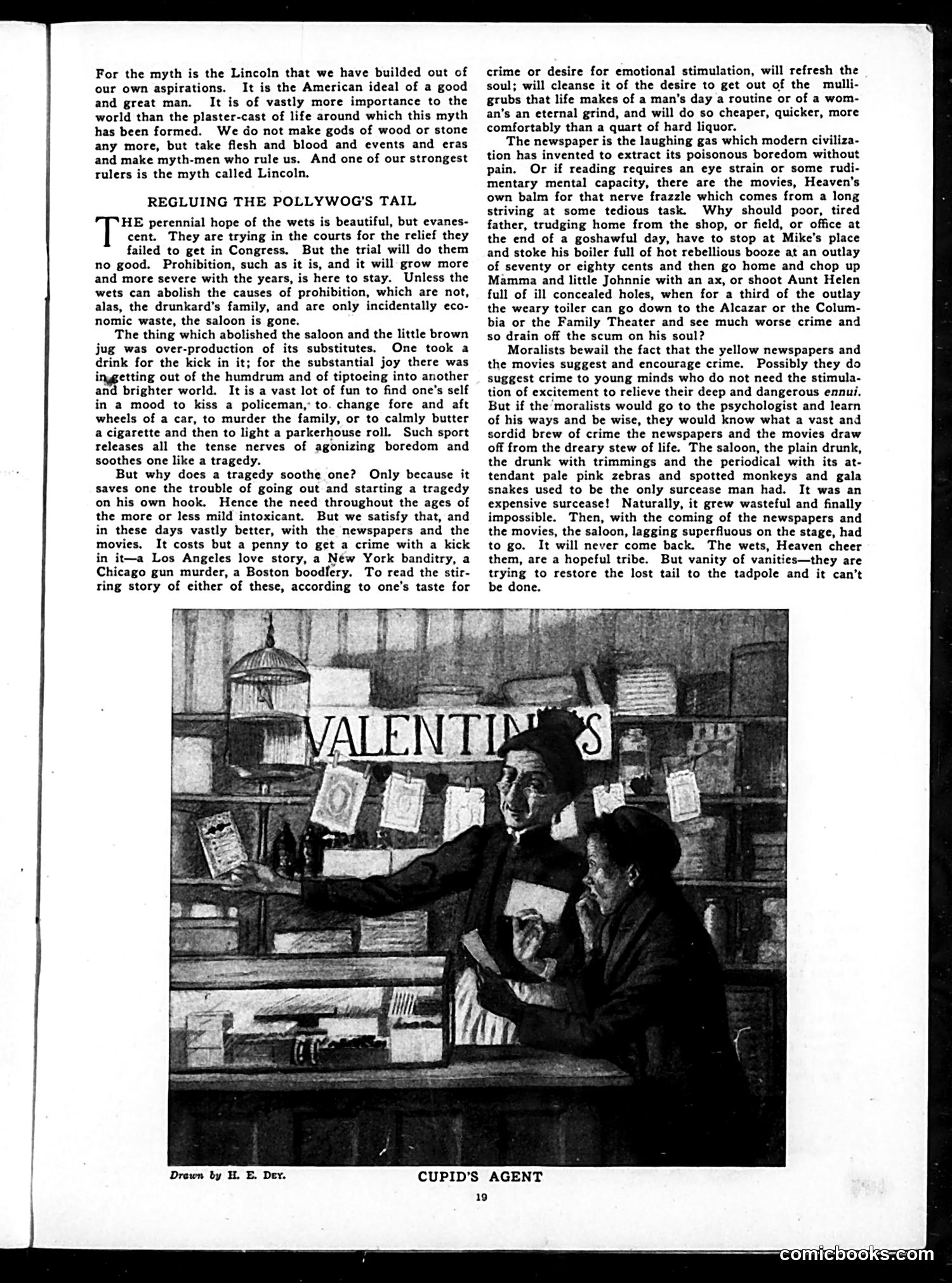
The cartoon depicts a Valentine's Day shop scene with two men examining cards displayed in a window. The drawing is credited to H. E. Dey. The accompanying text is a satirical essay titled "Regluing the Pollywog's Tail," attacking Prohibition advocates (the "wets" refers to anti-Prohibition forces, though the logic is complex). The author argues that Prohibition will endure because saloons were abolished by their own excess, not by temperance campaigns. The piece's main point: modern newspapers and movies have replaced alcohol as the public's escape from tedium and boredom. Rather than drinking to relieve "agonizing boredom," citizens now consume sensational crime stories and films. The author sardonically suggests these provide superior, cheaper thrills—allowing the tired worker to experience vicarious crime drama at a theater instead of committing actual violence while drunk. The satire critiques both moralists who blame media for crime and society's underlying desperation for stimulation.
📄 Transcribed text from this page (OCR, searchable)
Machine-transcribed from the original scan — historical spelling and the odd misread are preserved.
For the myth is the Lincoln that we have builded out of our own aspirations. It is the American ideal of a good and great man. It is of vastly more importance to the world than the plaster-cast of life around which this myth has been formed. We do not make gods of wood or stone any more, but take flesh and blood and events and eras and make myth-men who rule us. And one of our strongest rulers is the myth called Lincoln. REGLUING THE POLLYWOG'S TAIL HE perennial hope of the wets is beautiful, but evanes- cent. They are trying in the courts for the relief they failed to get in Congress. But the trial will do them no good. Prohibition, such as it is, and it will grow more and more severe with the years, is here to stay. Unless the wets can abolish the causes of prohibition, which are not, alas, the drunkard’s family, and are only incidentally eco- nomic waste, the saloon is gone. The thing which abolished the saloon and the little brown jug was over-production of its substitutes. One took a drink for the kick in it; for the substantial joy there was ingetting out of the humdrum and of tiptoeing into another and brighter world. It is a vast lot of fun to find one’s self in a mood to kiss a policeman, to. change fore and aft wheels of a car, to murder the family, or to calmly butter a cigarette and then to light a parkerhouse roll. Such sport releases all the tense nerves of agonizing boredom and soothes one like a tragedy. But why does a tragedy soothe one? Only because it saves one the trouble of going out and starting a tragedy on his own hook. Hence the need throughout the ages of the more or less mild intoxicant. But we satisfy that, and in these days vastly better, with the newspapers and the movies. It costs but a penny to get a crime with a kick in it—a Los Angeles love story, a Néw York banditry, a Chicago gun murder, a Boston boodfery. To read the stir- ting story of either of these, according to one’s taste for Drewn by H. E. Dey. 19 crime or desire for emotional stimulation, will refresh the soul; will cleanse it of the desire to get out of the mulli- grubs that life makes of a man’s day a routine or of a wom- an’s an eternal grind, and will do so cheaper, quicker, more comfortably than a quart of hard liquor. The newspaper is the laughing gas which modern civiliza- tion has invented to extract its poisonous boredom without pain. Or if reading requires an eye strain or some rudi- mentary mental capacity, there are the movies, Heaven's own balm for that nerve frazzle which comes from a long striving at some tedious task. Why should poor, tired father, trudging home from the shop, or field, or office at the end of a goshawful day, have to stop at Mike's place and stoke his boiler full of hot rebellious booze at an outlay of seventy or eighty cents and then go home and chop up Mamma and little Johnnie with an ax, or shoot Aunt Helen full of ill concealed holes, when for a third of the outlay the weary toiler can go down to the Alcazar or the Colum- bia or the Family Theater and see much worse crime and so drain off the scum on his soul? Moralists bewail the fact that the yellow newspapers and the movies suggest and encourage crime. Possibly they do suggest crime to young minds who do not need the stimula- tion of excitement to relieve their deep and dangerous ennui. But if the ‘moralists would go to the psychologist and learn of his ways and be wise, they would know what a vast and sordid brew of crime the newspapers and the movies draw off from the dreary stew of life. The saloon, the plain drunk, the drunk with trimmings and the periodical with its at- tendant pale pink zebras and spotted monkeys and gala snakes used to be the only surcease man had. It was an expensive surcease! Naturally, it grew wasteful and finally impossible. Then, with the coming of the newspapers and the movies, the saloon, lagging superfluous on the stage, had to go. It will never come back. The wets, Heaven cheer them, are a hopeful tribe. But vanity of vanities—they are trying to restore the lost tail to the tadpole and it can’t be done. CUPID'S AGENT