
Judge, 1922-02-11 · page 16 of 36
Judge — February 11, 1922 — page 16: what you’re looking at
What you’re looking at
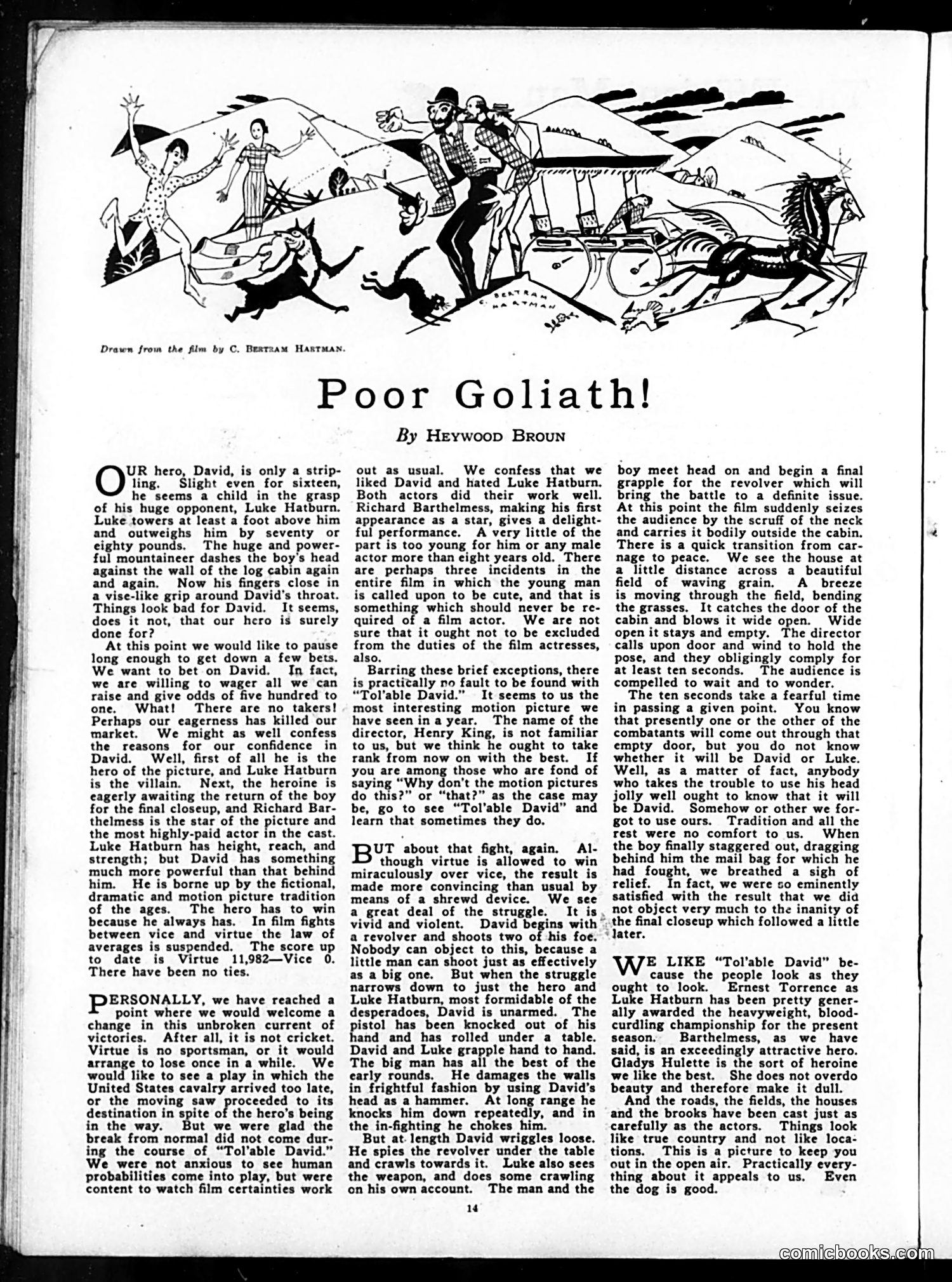
This is a 1921 film review by Heywood Broun critiquing "Tol'able David," a motion picture starring Richard Barthelmess. The illustration shows a scene from the film depicting the fight between the protagonist David (a slight sixteen-year-old) and the villain Luke Hatburn (a massive mountaineer). Broun's satire mocks Hollywood's predictable moral formulas: the hero *always* wins because he's the hero—Virtue's score stands at 11,982 to Vice's 0. He playfully bemoans this absence of realistic stakes, wishing cinema would occasionally let the cavalry arrive too late or allow the villain to triumph. Yet he admits he actively *wanted* David to win anyway, demonstrating how completely narrative convention overrides rationality. The review praises Barthelmess's performance and director Henry King while critiquing the few moments requiring the young star to perform cuteness—deemed inappropriate for male actors.
📄 Transcribed text from this page (OCR, searchable)
Machine-transcribed from the original scan — historical spelling and the odd misread are preserved.
Drawn from the film by C, Bertzam HARTMAN. Poor Goliath! UR hero, David, is only a strip- ling. Slight even for sixteen, he seems a child in the grasp of his huge opponent, Luke Hatburn. Luke towers at least a foot above him and outweighs him by seventy or eighty pounds. The huge and power- ful mountaineer dashes the boy's head against the wall of the log cabin again and again. Now his fingers close in a vise-like grip around David's throat. Things look bad for David. It seems, does it not, that our hero is surely done for? At this point we would like to pause long enough to get down a few bets. We want to bet on David. In fact, we are willing to wager all we can raise and give odds of five hundred to one. What! There are no takers! Perhaps our eagerness has killed our market. We might as well confess the reasons for our confidence in David. Well, first of all he is the hero of the picture, and Luke Hatburn is the villain. Next, the heroine is eagerly awaiting the return of the boy for the final closeup, and Richard Bar- thelmess is the star of the picture and the most highly-paid actor in the cast. Luke Hatburn has height, reach, and strength; but David has something much more powerful than that behind him. He is borne up by the fictional, dramatic and motion picture tradition of the ages. The hero has to win because he always has. In film fights between vice and virtue the law of averages is suspended. The score up to date is Virtue 11,982—Vice 0. There have been no ties. ERSONALLY, we have reached a point where we would welcome a change in this unbroken current of victories. After all, it is not cricket. Virtue is no sportsman, or it would arrange to lose once in a while. We would like to see a play in which the United States cavalry arrived too late, or the moving saw proceeded to its destination in spite of the hero’s being in the way. ut we were glad the break from normal did not come dur- ing the course of “Tol’able David.” We were not anxious to see human probabilities come into play, but were content to watch film certainties work By Heywoop Broun out as usual. We confess that we liked David and hated Luke Hatburn. Both actors did their work well. Richard Barthelmess, making his first appearance as a star, gives a delight- ful performance. A very little of the part is too young for him or any male actor more than eight years old. There are perhaps three incidents in the entire film in which the young man is called upon to be cute, and that is something which should never be re- quired of a film actor. We are not sure that it ought not to be excluded from the duties of the film actresses, also. Barring these brief exceptions, there is practitally no fault to be found with “Tol'able David.” It seems to us the most interesting motion picture we have seen in a year. The name of the director, Henry King, is not familiar to us, but we think he ought to take rank from now on with the best. If you are among those who are fond of saying “Why don’t the motion pictures do this?” or “that?” as the case may be, go to see “Tol’able David” and learn that sometimes they do, But about that fight, again. Al- though virtue is allowed to win miraculously over vice, the result is made more convincing than usual by means of a shrewd device. We see a great deal of the struggle. vivid and violent. David begins with a revolver and shoots two of his foe. Nobody can object to this, because a little man can shoot just as effectively as a big one. But when the struggle narrows down to just the hero and Luke Hatburn, most formidable of the desperadoes, David is unarmed. The pistol has been knocked out of his hand and has rolled under a table. David and Luke grapple hand to hand. The big man has all the best of the early rounds. He damages the walls in frightful fashion by using David’s head as ahammer. At long range he knocks him down repeatedly, and in the in-fighting he chokes him. But at. length David wriggles loose. He spies the revolver under the table and crawls towards it. Luke also sees the weapon, and does some crawling on his own account. The man and the 14 res the final closeup which followed a little ‘later. boy meet head on and begin a final grapple for the revolver which will bring the battle to a definite issue. At this point the film suddenly seizes the audience by the scruff of the neck and carries it bodily outside the cabin. There is a quick transition from car- nage to peace. We see the house at a little distance across a beautiful field of waving grain. A_ breeze is moving through the field, bending the grasses. It catches the door of the cabin and blows it wide open. Wide open it stays and empty. The director calls upon door and wind to hold the pose, and they obligingly comply for at least ten seconds. The audience is compelled to wait and to wonder. The ten seconds take a fearful time in passing a given point. You know that presently one or the other of the combatants will come out through that empty door, but you do not know whether it will be David or Luke. Well, as a matter of fact, anybody who takes the trouble to use his head jolly well ought to know that it will be David. Somehow or other we for- got to use ours. Tradition and all the rest were no comfort to us. When the boy finally staggered out, dragging behind him the mail bag for which he had fought, we breathed a sigh of relief. In fact, we were so eminently satisfied with the result that we dia not object very much to the inanity of E LIKE “Tol'able David” be- cause the people look as they ought to look. Ernest Torrence as Luke Hatburn has been pretty gener- ally awarded the heavyweight, blood- curdling championship for the present season. Barthelmess, as we have is an exceedingly attractive hero. Gladys Hulette is the sort of heroine we like the best. She does not overdo beauty and therefore make it dull. And the roads, the fields, the houses and the brooks have been cast just as carefully as the actors. Things look like true country and not like loca- tions. This is a picture to keep you out in the open air. Practically every- thing about it appeals to us. Even the dog is good. ?