
Judge, 1922-02-11 · page 13 of 36
Judge — February 11, 1922 — page 13: what you’re looking at
What you’re looking at
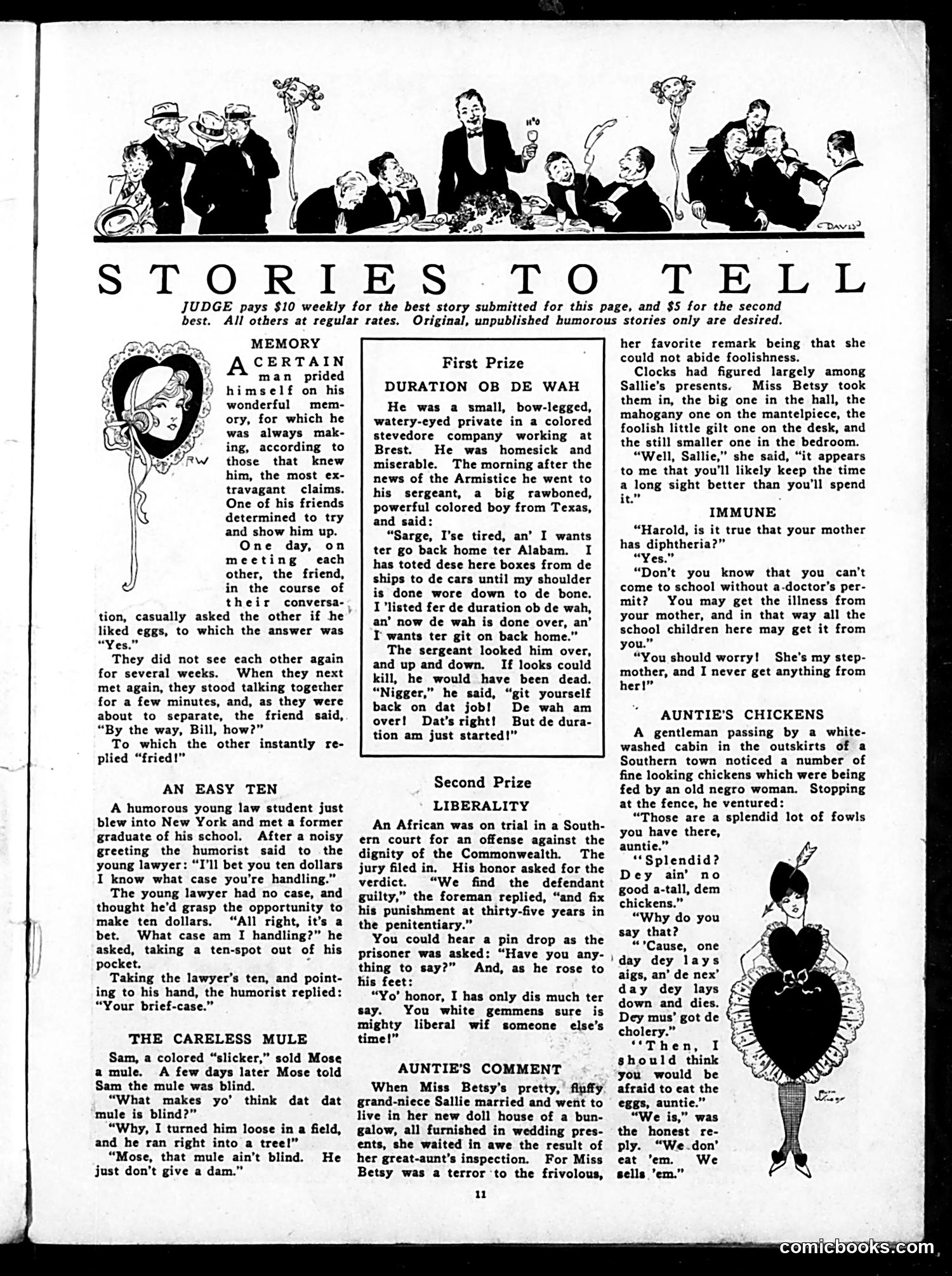
This page features a "Stories to Tell" contest where Judge magazine paid readers for humorous short stories. The content reflects early 20th-century American humor, relying heavily on racial stereotypes that were then considered acceptable entertainment. The stories include: - **"Memory"** and **"An Easy Ten"**: Wordplay jokes with no political content - **"Duration ob de Wah"**: A dialect-heavy story about a Black soldier after WWI's Armistice, using exaggerated "Negro" speech patterns. The sergeant's refusal to discharge him is presented as humorous - **"Liberality"**: Similar stereotyped dialect humor depicting a Black defendant in court - **"Auntie's Chickens"** and **"Auntie's Comment"**: Gentler domestic humor The cartoons above depict well-dressed white men at what appears to be a formal gathering, unrelated to the stories below. The racial caricatures and dialect humor reflect attitudes of that era but would be considered deeply offensive today.
📄 Transcribed text from this page (OCR, searchable)
Machine-transcribed from the original scan — historical spelling and the odd misread are preserved.
STOR MESS TO TELL JUDGE pays $10 weekly for the best story submitted for this page, and $5 for the second Original, unpublished humorous stories only are desired. best. LINED MEMORY a A CERTAIN < man prided } himself on his wonderful mem- ory, for which he was always mak- ing, according to those that knew him, the most ex- travagant claims. One of his friends determined to try and show him up. One day, on meeting each other, the friend, in the course of their conversa- tion, casually asked the other if he’ liked eggs, to which the answer was “Yes.” They did not see each other again for several weeks. When they next met again, they stood talking together for a few minutes, and, as they were about to separate, the friend said, “By the way, Bill, how?” To which the other instantly re- plied “fried!” AN EASY TEN A humorous young law student just blew into New York and met a former graduate of his school. After a noisy greeting the humorist said to the young lawyer: “I'll bet you ten dollars I know what case you're handling.” The young lawyer had no case, and thought he’d grasp the opportunity to make ten dollars. “All right, it’s a bet. What case am I handling?” he asked, taking a ten-spot out of his pocket. 4 Taking the lawyer’s ten, and point- ing to his hand, the humorist replied: “Your brief-case.” THE CARELESS MULE Sam, a colored “slicker,” sold Mose amule. A few days later Mose told Sam the mule was blind. “What makes yo’ think dat dat mule is blind?” “Why, I turned him loose in a field, and he ran right into a tree!” “Mose, that mule ain’t blind. just don’t give a dam.” He All others at regular rates. First Prize DURATION OB DE WAH He was a small, bow-legged, watery-eyed private in a colored stevedore company working at Brest. He was homesick and miserable. The morning after the news of the Armistice he went to his sergeant, a big rawboned, powerful colored boy from Texas, and said: “Sarge, I’se tired, an’ I wants ter go back home ter Alabam. I has toted dese here boxes from de ships to de cars until my shoulder is done wore down to de bone. I ‘listed fer de duration ob de wah, an’ now de wah is done over, an’ I wants ter git on back home.” The sergeant looked him over, and up and down. If looks could kill, he would have been dead. “Nigger,” he said, “git yourself back on dat job! De wah am over! D. right! But de dura- tion am just started!” Second Prize LIBERALITY An African was on trial in a South- ern court for an offense against the dignity of the Commonwealth. The jury filed in. His honor asked for the verdict. “We find the defendant guilty,” the foreman replied, “and fix his punishment at thirty-five years in the penitentiary.” You could hear a pin drop as the prisoner was asked: “Have you any- thing to say?” And, as he rose to his feet: “Yo’ honor, I has only dis much ter say. You white gemmens sure is mighty liberal wif someone else’s time!” AUNTIE’S COMMENT When Miss Betsy’s pretty, finffy grand-niece Sallie married and went to live in her new doll house of a bun- galow, all furnished in wedding pres- ents, she waited in awe the result of her great-aunt’s inspection. For Miss Betsy was a terror ‘to the frivolous, 1 her favorite remark being that she could not abide foolishness. Clocks had figured largely among Sallie’s presents. Miss Betsy took them in, the big one in the hall, the mahogany one on the mantelpiece, the foolish little gilt one on the desk, and the still smaller one in the bedroom. “Well, Sallie,” she said, “it appears to me that you'll likely keep the time a long sight better than you'll spend it” IMMUNE “Harold, is it true that your mother has diphtheria?” “Yes.” “Don’t you know that you can’t come to school without a-doctor’s per- mit? You may get the illness from your mother, and in that way all the school children here may get it from you.” “You should worry! She's my step- mother, and I never get anything from her!” AUNTIE’S CHICKENS A gentleman passing by a white- washed cabin in the outskirts of a Southern town noticed a number of fine looking chickens which were being fed by an old negro woman. Stopping at the fence, he ventured: “Those are a splendid lot of fowls you have there, auntie.” “Splendid? Dey ain’ no good a-tall, dem chickens.” “Why do you say that? “*Cause, one day dey lays aigs, an’ de nex’ day dey lays down and dies. Dey mus’ got de cholery.” “Then, I should think you would be afraid to eat the eggs, auntie.” “We is,” was the honest re- ply. “We-don’ eat ’em. We sells ’em.”