
Judge, 1922-02-11 · page 8 of 36
Judge — February 11, 1922 — page 8: what you’re looking at
What you’re looking at
This page collects humorous anecdotes, a common feature in early 20th-century Judge magazine. The cartoons and jokes target recognizable social types: **"The Fisherman"** mocks overeducated city folk (department store clerks) who learn fishing from books but lack practical sense—the clerk obsesses over rules while missing obvious opportunities. **"Equidistant"** satirizes rural Southern race relations and indifference, depicting a farmer unbothered by modern progress or time itself. **"What's the Use?"** uses dialect humor (common but now offensive) to joke about a confused Black passenger on a trolley—the humor relies on the character's supposed illogic. **"Pat's Ingenuity"** presents an Irish immigrant character solving a problem through dubious logic (melting a half-dollar to fill a hole in a dime), playing on ethnic stereotypes of Irish cleverness and resourcefulness. These jokes reflect period attitudes toward immigrants, rural people, and racial groups through caricature and dialect.
📄 Transcribed text from this page (OCR, searchable)
Machine-transcribed from the original scan — historical spelling and the odd misread are preserved.
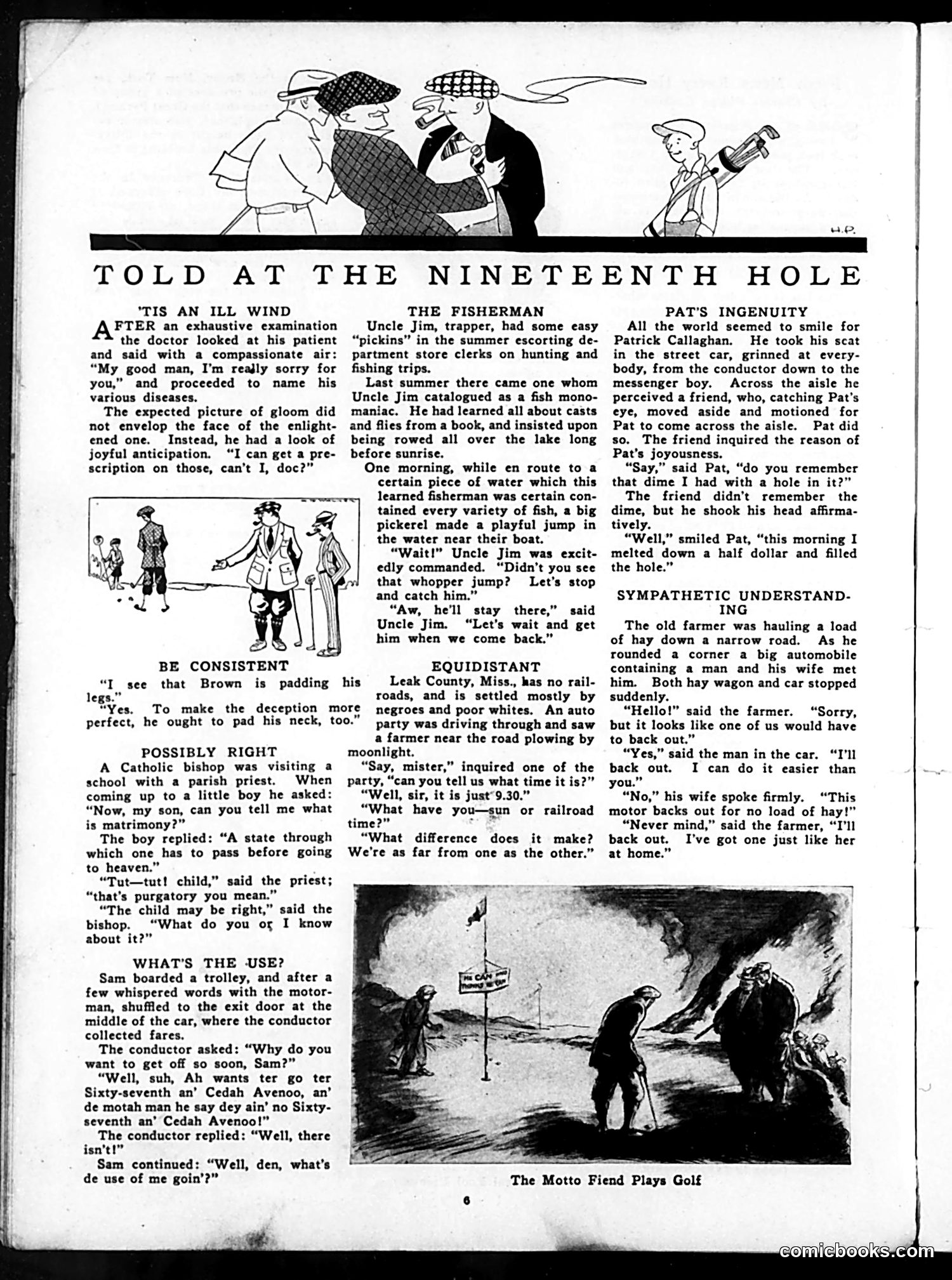
TOLD AT THE NINETEENTH HOLE ‘TIS AN ILL WIND FTER an exhaustive examination the doctor looked at his patient and said with a compassionate air: “My good man, I’m reajly sorry for you,” and proceeded to name his various diseases. The expected picture of gloom did not envelop the face of the enlight- ened one. Instead, he had a look of joyful anticipation. “I can get a pre- scription on those, can’t I, doc?” BE CONSISTENT “I see that Brown is padding his legs.” THE FISHERMAN Uncle Jim, trapper, had some easy “pickins” in the summer escorting de- partment store clerks on hunting and fishing trips. Last summer there came one whom Uncle Jim catalogued as a fish mono- maniac. He had learned all about casts and flies from a book, and insisted upon being rowed all over the lake long before sunrise. One morning, while en route to a certain piece of water which this learned fisherman was certain con- tained every variety of fish, a big pickerel made a playful jump in the water near their boat. “Wait!” Uncle Jim was excit- edly commanded. “Didn't you see that whopper jump? Let’s stop and catch him.” “Aw, he'll stay there,” said Uncle Jim. “Let's wait and get him when we come back.” EQUIDISTANT Leak County, Miss., has no rail- roads, and is settled mostly by “Yes. To make the deception more negroes and poor whites. An auto perfect, he ought to pad his neck, too.” party was driving through and saw POSSIBLY RIGHT A Catholic bishop was visiting a school with a parish priest. When coming up to a little boy he asked: “Now, my son, can you tell me what is matrimony?” The boy replied: “A state through which one has to pass before going to heaven.” “Tut—tut! child,” said the priest; “that's purgatory you mean.” “The child may be right,” said the bishop. “What do you or I know about it?” WHAT'S THE USE? Sam boarded a trolley, and after a few whispered words with the motor- man, shuffled to the exit door at the middle of the car, where the conductor collected fares. The conductor asked: “Why do you want to get off so soon, Sam?” “Well, suh, Ah wants ter go ter Sixty-seventh an’ Cedah Avenoo, an’ de motah man he say dey ain’ no Sixty- seventh an’ Cedah Avenoo!” The conductor replied: “Well, there isn’t!” Sam continued: “Well, den, what’s de use of me goin’?” a farmer near the road plowing by moonlight. “Say, mister,” inquired one of the party, “can you tell us what time it is?” “Well, sir, it is just’9.30.” “What have you—sun or railroad time?” oe “What difference does it make? We're as far from one as the other.” PAT'’S INGENUITY All the world seemed to smile for Patrick Callaghan. He took his scat in the street car, grinned at every- body, from the conductor down to the messenger boy. Across the aisle he perceived a friend, who, catching Pat’s eye, moved aside and motioned for Pat to come across the aisle. Pat did so. The friend inquired the reason of Pat's joyousness. “Say,” said Pat, “do you remember that dime I had with a hole in it?” The friend didn’t remember the dime, but he shook his head affirma- tively. “Well,” smiled Pat, “this morning I melted down a half dollar and filled the hole.” SYMPATHETIC UNDERSTAND- ING The old farmer was hauling a load of hay down a narrow road. As he rounded a corner a big automobile containing a man and his wife met him. Both hay wagon and car stopped suddenly. “Hello!” said the farmer. “Sorry, but it looks like one of us would have to back out.” “Yes,” said the man in the car. “I'll back out. I can do it easier than you.” “No,” his wife spoke firmly. “This motor backs out for no load of hay!” “Never mind,” said the farmer, “I'll back out. I've got one just like her at home.”