
Judge, 1922-02-11 · page 7 of 36
Judge — February 11, 1922 — page 7: what you’re looking at
What you’re looking at
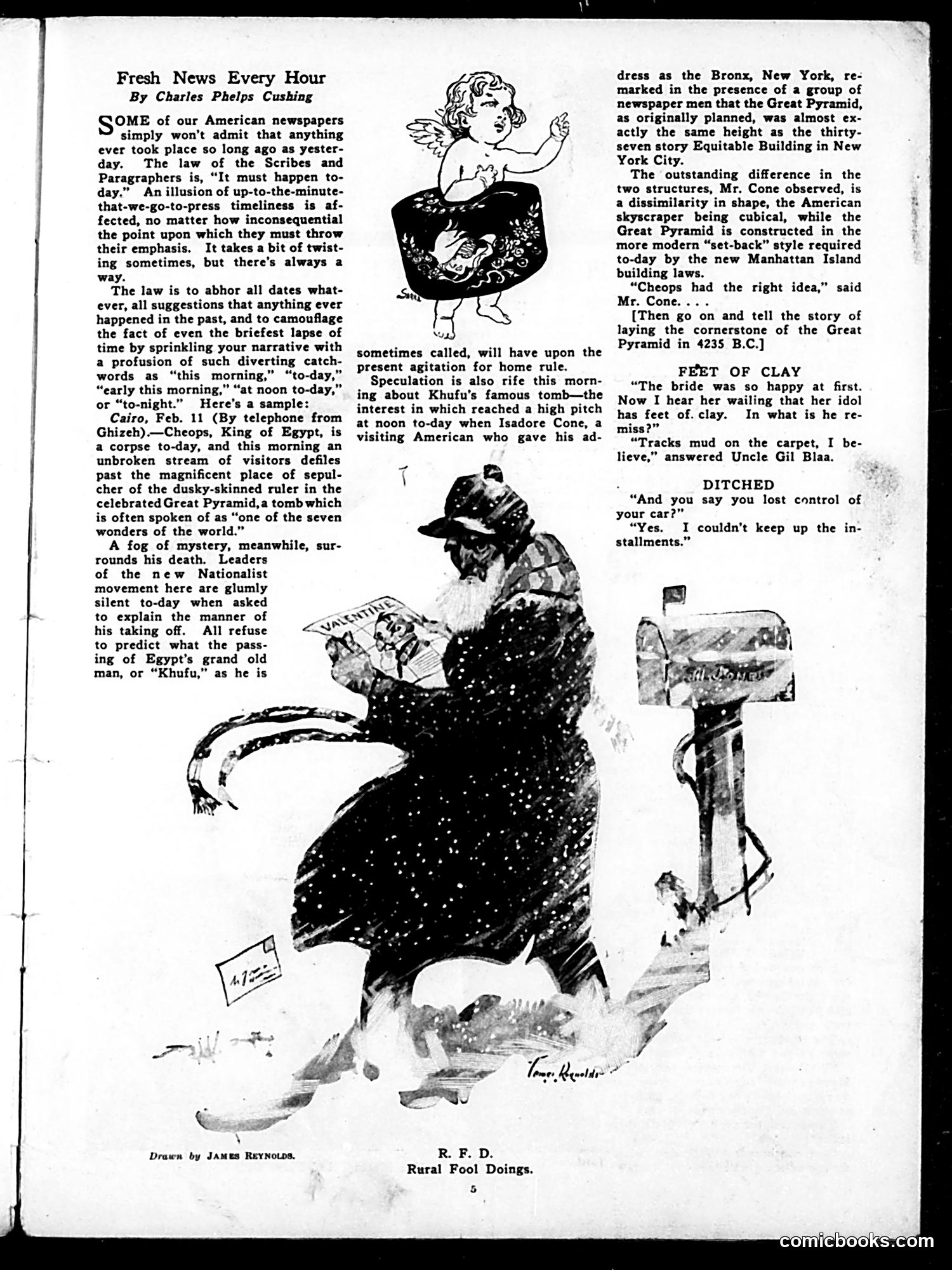
**Main Article ("Fresh News Every Hour"):** Cushing satirizes newspapers' obsession with presenting everything as happening "today," regardless of actual timeliness. The absurdist example—reporting Egyptian Pharaoh Cheops's death with modern datelines and comparing the Great Pyramid to Manhattan's Equitable Building—mocks this artificial urgency. The joke: newspapers twist facts to seem perpetually breaking news, even when covering ancient history. **"Rural Fool Doings" Cartoons:** The top cartoon shows a peasant discovering mud on his boots—illustrating the idiom "feet of clay" (hidden weakness in someone seemingly impressive). A bride's "idol" husband tracks dirt indoors, revealing his ordinariness. The bottom cartoon plays on "ditched" (abandoned). A driver claims he "lost control" of his car, but admits he couldn't afford the installment payments—a Depression-era joke about repossession masquerading as mechanical failure. Both mock rural/working-class misunderstandings of sophistication and financial precarity.
📄 Transcribed text from this page (OCR, searchable)
Machine-transcribed from the original scan — historical spelling and the odd misread are preserved.
Fresh News Every Hour By Charles Phelps Cushing SOME of our American newspapers simply won’t admit that anything ever took place so long ago as yester- day. The law of the Scribes and Paragraphers is, “It must happen to- day.” An illusion of up-to-the-minute- that-we-go-to-press timeliness is af- fected, no matter how inconsequential the point upon which they must throw their emphasis. It takes a bit of twist- ing sometimes, but there’s always a way. The law is to abhor all dates what- ever, all suggestions that anything ever happened in the past, and to camouflage the fact of even the briefest lapse of time by sprinkling your narrative with a profusion of such diverting catch- words as “this morning,” “to-day,” “early this morning,” or “to-night.” Here’s a sample: Cairo, Feb. 11 (By telephone from Ghizeh).—Cheops, King of Egypt, is a corpse to-day, and this morning an unbroken stream of visitors defiles past the magnificent place of sepul- cher of the dusky-skinned ruler in the celebrated Great Pyramid,a tomb which is often spoken of as “one of the seven wonders of the world.” A fog of mystery, meanwhile, sur- rounds his death. Leaders of the new Nationalist movement here are glumly silent to-day when asked to explain the manner of his taking off. All refuse to predict what the pass- ing of Egypt’s grand old man, or “Khufu,” as he is Drawn by James ReYNotps, Te 3098 sometimes called, will have upon the present agitation for home rule. Speculation is also rife this morn- ing about Khufu’s famous tomb—the interest in which reached a high pitch at noon to-day when Isadore Cone, a visiting American who gave his ad- = R. F. D. Rural Fool Doings. Fs Revol i dress as the Bronx, New York, re- marked in the presence of a group of newspaper men that the Great Pyramid, as originally planned, was almost ex- actly the same height as the thirty- seven story Equitable Building in New York City. The outstanding difference in the two structures, Mr. Cone observed, is a dissimilarity in shape, the American skyscraper being cubical, while the Great Pyramid is constructed in the more modern “set-back” style required to-day by the new Manhattan Island building laws. “Cheops had the right idea,” said Mr. Cone... . [Then go on and tell the story of laying the cornerstone of the Great Pyramid in 4235 B.C.] FEET OF CLAY “The bride was so happy at first. Now I hear her wailing that her idol has feet of. clay. In what is he re- miss?” “Tracks mud on the carpet, I be- lieve,” answered Uncle Gil Blaa. : DITCHED “And you say you lost control of your car?” “Yes. I couldn’t keep up the in- stallments.”